
- HOME
- LIFE·CULTURE
-
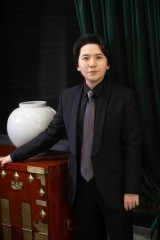
Popera tenor Lim Hyung-joo named youngest-ever special professor at Sookmyung Women's University
World-renowned popera tenor Lim Hyung-joo, 40, has been appointed as a special professor at Sookmyung Women's University, becoming the youngest person ever to hold the position at the school. According to his agency Digienkom on Friday, Lim was appointed as a special professor at Sookmyung Women's University's College of Hallyu International Studies and will personally teach the "Popera Choir Class," which begins Saturday. Of the full 12-week course, Lim will lead the "Popera Choir Class" for five weeks. The class drew dozens of enrollees as soon as registration opened. The Yongsan Cultural Foundation, where Lim serves as chairman, signed an MOU with Sookmyung Women's University in April. As part of the partnership to promote culture and arts among local residents, the foundation took on the role of "art director" for a citizen-participation arts education program, presenting the open lecture series "Beyond Art Class" together with the university's Future Education Center. Lim previously became the youngest-ever endowed chair professor at Rome City University of Arts, one of his alma maters, in 2015, and this marks his first professorship in his home country in years. "I will do my utmost to pass on the special experiences and artistic achievements I have built on the world stage to Sookmyung students, to expand opportunities for local residents to enjoy the arts, and to devote myself wholeheartedly to laying the groundwork for the sustainable development and academic foundation of K-culture," he said. Lim first gained attention in 1998 with his debut solo album and began his career in earnest as a popera tenor with his official debut stage in 2003. He sang the national anthem at the inauguration of President Roh Moo-hyun, the 16th president, becoming the youngest person ever to do so at a presidential inauguration. At the same time as his debut, he held a solo recital at Carnegie Hall in New York, becoming the youngest male vocalist in the world to do so, with the show selling out completely. Since 2023, he has served as a standing committee member of the presidential National Unification Advisory Council, and he was also elected a life fellow of the Royal Society of Arts in the United Kingdom.
Sept. 11, 2026
-
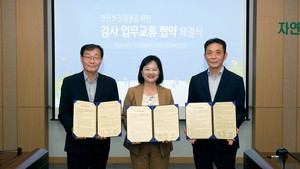
Wonju Innovation City agencies sign MOU on audit transparency, integrity
Korea Tourism Organization, Korea National Park Service, Korea Occupational Safety and Health Agency Tourism, environment and safety agencies also push for 'zero severe accidents' Move raises new town's profile ahead of second wave of institution relocations The Korea Tourism Organization, the Korea National Park Service and the Korea Occupational Safety and Health Agency signed a memorandum of understanding Thursday to build an advanced audit system. The three institutions — pioneering agencies in Wonju Innovation City representing the tourism, environment and safety sectors, respectively — also aim to enhance audit capabilities across their fields. Standing auditors Kim Byung-chan, Cho Chang-bae and Jeong Hye-sun signed on behalf of the Korea Tourism Organization, Korea National Park Service and Korea Occupational Safety and Health Agency, respectively. The transparency, integrity, safety and audit agreement among these long-established institutions in Wonju Innovation City is expected to serve as a model for public institutions relocating in a second wave. The move is also expected to elevate the new town's overall standing. Under the agreement, the internal audit bodies of the three institutions will establish a cooperative framework covering audit operations broadly and share audit techniques and internal control systems. They also plan to cooperate in various areas, including strengthening audit expertise and fulfilling their social responsibilities. The agreement is expected to serve as a springboard for establishing a more ethical and fair audit culture. This will be achieved through cross-audits, mutual support of specialized personnel, exchanges of safety audit techniques and joint training of audit staff, boosting the professionalism and transparency of audit work. The three institutions will combine their specialized audit expertise to achieve zero severe accidents and build an advanced audit model. This includes the Korea Tourism Organization's know-how in domestic and international tourism support and the Korea National Park Service's expertise in environmental conservation and visitor safety. It also draws on the Korea Occupational Safety and Health Agency's expertise in industrial safety and health. Kim Byung-chan, standing auditor of the Korea Tourism Organization, said, "Through this agreement, we expect to combine our nationwide organizational network and expertise to provide safe, high-quality services that make a real difference for the public and foreign tourists." He added, "We will work closely with expert institutions to build a safe and trustworthy tourism environment for everyone."
Sept. 11, 2026
-

'Chuncheon is youth': Five universities unite for 'Pieobom: Rae' festival
Chuncheon National University of Education, Songgok University and others cheer alongside Sandara Park, cheerleading squads Chuncheon carries the character for "spring" in its name — fitting, since the city has long been a hub of youth. Even before Namiseom island's television drama "Winter Sonata" put the region on the map, countless young people from across the country flocked to Chuncheon's Gongji Stream and Gangchon area. They created hundreds of millions of memories there. For generations of young Koreans, Chuncheon was the one place they could truly let loose. There, students from five universities pursuing their own youthful dreams showed off the city's reputation as a mecca for young people at their joint festival, "Pieobom: Rae" — a name blending the Korean words for "blooming" and "spring." The festival, which opened Thursday on the Hallym Polytechnic University campus, buzzed with energy from the morning as students cheered on inter-university sports matches and a League of Legends tournament. In the soccer, basketball and dodgeball finals, athletes representing their schools and their cheering squads shared in the excitement together. Experience booths set up around the venue also drew students and residents. University clubs offered tarot readings, an aromatherapy workshop, constellation keyring-making and beauty experiences, while international students shared their cultures through traditional costume and craft activities and language-exchange programs. The evening's main event opened with a joint parade of the five universities, led by Chuncheon National University of Education's pungmul (traditional percussion) club. As delegations from the five universities entered the venue carrying their school flags, students erupted in cheers. The mood built further with a cheerleading performance jointly prepared by students from Kangwon National University, Hallym University, Chuncheon National University of Education and Hallym Polytechnic University. The program then moved to an awards ceremony for the sports competitions and e-sports tournament, band and dance performances by nine student clubs, and audience-participation segments. Among the evening's K-pop guests, Sandara Park — dubbed "the goddess of the Philippines" — and rapper Nucksal took the stage for special performances, drawing cheers from the young crowd. Students from Kangwon National University, Songgok University, Chuncheon National University of Education, Hallym University and Hallym Polytechnic University organized this year's festival jointly. Beyond the student councils, the federation of student clubs and university student affairs offices also took part in planning and running the event, broadening student exchange and participation. Chuncheon Mayor Yuk Dong-han said, "I support your youth, your passion and your love for Chuncheon," adding, "The flowers blooming here tonight are all of you."
Sept. 10, 2026
-

Bukhansan rescue team saves hiker who lost consciousness on trail
The Korea National Park Service said Thursday that rescuers from its Bukhansan National Park office saved a hiker's life by quickly performing CPR and using an automated external defibrillator (AED) after the person lost consciousness on the Uisangbong ridge. According to the service, a report came in around 9:27 a.m. that day that a hiker had lost consciousness on the ridge, in the section between Gasadangammun and Yongchulbong. Four rescuers from the Bukhansan National Park rescue team rushed to the scene, arriving about 22 minutes later at around 9:50 a.m. They checked the hiker's condition, administered emergency first aid and CPR using the AED, and controlled the surrounding area while carrying out the rescue. As a result, the hiker regained consciousness around 10:02 a.m. Rescuers then worked with firefighters who arrived at the scene and airlifted the hiker to a hospital by helicopter at around 10:11 a.m. "Since initial response is critical in emergencies that occur in mountain areas, the rescue team's swift deployment and well-practiced first aid played a major role in saving a precious life," the Bukhansan National Park office said. "We will continue to strengthen our on-site response capabilities and do our best to ensure visitors can safely enjoy Bukhansan National Park."
Sept. 10, 2026
-

BTS rivals Beyonce, George Strait in US concert market
Ranks third among all artists with $214.2 million across 30 stadiums Trails country legend by just $400,000 despite playing only six shows Sells 1.6 times more tickets per show than rivals World-renowned pop star Beyonce and country legend George Strait now share the spotlight with BTS, often dubbed "the 20th century Beatles," as the group reshapes the US live concert market. According to Billboard's Boxscore tally of the highest-grossing concerts ever held at 30 NFL stadiums across the country, BTS holds the all-time revenue record at four different venues. The group's biggest showing came at Allegiant Stadium in Las Vegas, where four shows in May generated $49.5 million in revenue and drew 246,000 fans, making it the highest-grossing concert in the stadium's history. BTS's 2022 concert there, which brought in $35.9 million, ranked second, meaning the group holds both the No. 1 and No. 2 spots at that venue. BTS also topped the all-time rankings at Gillette Stadium in Foxborough ($28.7 million), M&T Bank Stadium in Baltimore ($27.6 million) and Raymond James Stadium in Tampa ($40.7 million). The group surpassed rock bands Metallica and U2 as well as pop icon Billy Joel at those venues. At MetLife Stadium near New York, the group earned $31.8 million, placing third behind Beyonce. In this tally, BTS accumulated $214.2 million in revenue over six shows, ranking third among all artists in total earnings. Beyonce took first place with $556.3 million from 16 shows, topping the charts at seven stadiums including MetLife Stadium ($70.3 million), SoFi Stadium ($55.7 million) and Mercedes-Benz Stadium ($55.4 million). George Strait came in second with $214.6 million, leading at seven venues including Nissan Stadium ($31.7 million) and AT&T Stadium ($28.4 million). BTS trailed George Strait by just $400,000, despite performing only six shows, less than half of Strait's 13. In terms of per-show turnout and revenue density, BTS has demonstrated some of the highest productivity in the US live market. BTS also scored a rare double debut atop the latest charts released by Pollstar, the US concert trade publication, with "BTS World Tour 'Arirang'" landing at No. 1 on both the LIVE75 and Global Concert Pulse rankings. On LIVE75, which measures average ticket sales per show over the past 30 days, BTS sold an average of 72,004 tickets per show across six performances. The shows took place at three US stadiums — MetLife, M&T Bank and Gillette. That figure is more than 1.6 times higher than the roughly 40,000 tickets sold per show by major Western acts. These included Noah Kahan (No. 2), Karol G (No. 3) and Chris Brown & Usher (No. 4). Country singer Riley Green (No. 7, 20,489) and pop band Jonas Brothers (No. 14, 13,945) also appeared on the chart, but the gap with BTS remained wide. On the Global Concert Pulse, which measures profitability, BTS topped the chart with an average of $12.7 million in revenue per show across 18 concerts over the past three months. That is $3.3 million more per show than second-place Karol G ($9.4 million), who is currently on her stadium tour "Tropitour." Also on the chart, HYBE labelmate ENHYPEN ranked 19th with $2.3 million per show on its "Blood Saga" world tour. British folk rock band Mumford & Sons followed at No. 23 with $1.8 million per show. BTS kicked off the tour in April at Goyang Sports Complex in South Korea. The group will continue with 14 shows across five South American cities, starting in Bogota, Colombia, on Oct. 2.
Sept. 10, 2026
-

'Hair loss medication gave me breasts': Lee Chang-sub reveals unexpected side effect
BTOB member Lee Chang-sub has drawn attention after saying he developed gynecomastia as a side effect of taking hair loss medication. The final installment of a trip to Shodoshima, Japan, featuring Lee, 2AM's Jung Jin-woon and Sistar's Soyou aired Wednesday on the KBS Joy variety show "Kkirikkiri." In the episode, Lee's phone alarm went off at 10 p.m., signaling it was time to take his hair loss medication. "I have to take it at the same time every day," he said as he prepared the pills. Watching this, Soyou asked why he was taking the medication when he already had a full head of hair. Lee replied, "It got this thick because I take it." When Soyou, who said she was also losing a lot of hair, wondered whether she should start taking hair loss medication herself, Lee explained, "You need to take hair loss medication while you still have hair," adding, "The medication does not make hair grow back — it prevents hair from falling out." However, Lee noted that the side effect for men is gynecomastia. "Breast tissue develops," he said. He went on to say, "I also developed breast tissue after taking it. With Jin-woon, even if he wears just one T-shirt, you can barely see his nipples poking out, but once you develop gynecomastia, your chest sticks out noticeably." He added, "Later on, you have to get surgery to remove the tissue, but once you get rid of it, it never comes back." In practice, gynecomastia has been reported as a side effect of some medications used to treat male pattern hair loss. Drugs such as finasteride and dutasteride, which work by inhibiting the conversion of testosterone into dihydrotestosterone (DHT), can rarely cause side effects including gynecomastia, breast pain and tenderness. In addition, sexual side effects such as reduced libido and erectile difficulties have also been reported due to changes in hormonal balance. The Ministry of Food and Drug Safety strengthened its side-effect warnings for hair loss medications after reviewing a 2026 safety assessment from the European Medicines Agency, and now requires that this information be provided to medical staff and patients.
Sept. 10, 2026
-
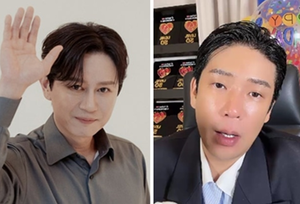
Kim Min-jong drops complaint against MC Mong over gambling allegations, calls it 'time to reflect on my life'
"It is already water under the bridge. Those 110 days were a time I will never forget for the rest of my life." Actor and singer Kim Min-jong said this as he withdrew his complaint against MC Mong, who had raised gambling allegations against him. In an official statement Thursday, Kim made clear, "As of today, I have withdrawn the complaint I filed against MC Mong." "Many people who heard the news expressed concern, asking why I would withdraw the complaint so easily," he said. "But no matter what, it is already water under the bridge. I made this decision after deep consideration, for myself, so that I can become a better version of myself going forward." Earlier, in May, MC Mong claimed during a live broadcast that an illegal gambling group involving celebrities existed and named Kim as one of its members. Kim strongly denied the claim, but MC Mong's allegations spread online and dealt considerable damage to Kim's career. In response, Kim filed a police complaint on Sept. 1, alleging defamation through the spread of false information. The complaint cited a violation of the Act on Promotion of Information and Communications Network Utilization and Information Protection. After the complaint was filed, MC Mong apologized, referring to Kim as his sunbae, a Korean term for a senior colleague. "I apologize once again for causing misunderstandings about Kim Min-jong," he said. "Mentioning my sunbae was my mistake. I will accept whatever comes out in the news from here on." The two apparently spoke privately about the gambling allegations, and Kim appears to have forgiven his junior colleague, prompting him to withdraw the complaint. "For me, those 110 days were a time I will never forget for the rest of my life," Kim said. "I lost a lot because of it, but I also think it was a time when I gained a lot." He added, "I bow my head deeply in gratitude to the many people who believed in and supported me throughout that process, and I also want to say I am sorry." "I will reflect more deeply going forward and work hard, very hard, to become a better Min-jong," he said. "I am truly sorry. And I am so grateful."
Sept. 10, 2026
-
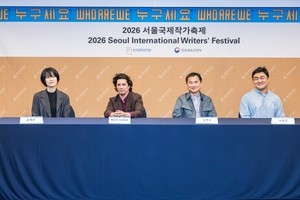
'Literature remains safe in the AI era'... humanity explored through stories
2026 Seoul International Writers' Festival 'Who Are You?' Adding complexity to seek solidarity with others Kim Ae-ran, Benjamin Labatut in opening dialogue "I think literature is completely safe from artificial intelligence. Large language models today cannot write great prose," said author Benjamin Labatut. The "2026 Seoul International Writers' Festival" will explore human existence and the world through literature's slow rhythm. The festival arrives as artificial intelligence rapidly expands into the realm of human creativity. Running Sept. 11-16 at the Ara Art Center in Jongno-gu, Seoul, the festival will bring together 24 authors from eight countries to meet with readers. This year's festival poses questions about the self, others and humanity under the theme "Who Are You?" Literature has long grappled with the question of who I am. But today, people tend to judge who they are through broader identities rather than understanding themselves with complexity. The theme was chosen to restore that complexity and seek solidarity with others. Kim Yeon-su, a program committee member for the festival, spoke at a press conference for the festival at the Korea Press Center in Jung-gu, Seoul, on Thursday. "Others can ultimately be understood only through stories. Stories are necessary to understand humanity," he said. He added, "Through these sections, readers are more likely to encounter another question rather than an answer to the theme, 'Who are you?' That is what literature does." Kim first served as a program committee member for the inaugural festival in 2006 and returned to the role 20 years later. He expressed particular emotion over the changed standing of Korean literature. "Even through AI, we cannot understand who I am, who others are, or how the world is structured. That is why literature is necessary," he said. "I am convinced that the tradition of explaining ourselves and others through stories has not collapsed to this day." The opening dialogue will feature author Kim Ae-ran and Chilean author Benjamin Labatut discussing the theme "I Am a Person." Kim, in works such as "Run, Dad," "Vapor Trail" and "I Said Goodbye," captures the fractures of everyday life while exploring society and humanity. Labatut, in "The MANIAC" and other works, digs into nonfiction until he reaches the point where science fails to explain, then shifts into fiction. The two writers ultimately meet at the point where understanding is possible only through stories. Kim Ae-ran said, "When I pay a visit or ask about a family's well-being, I feel humanity leaking through a tear in forgetfulness. Every animal has a will to self-preservation, but humans are almost uniquely capable of making choices against their own interest. I sometimes think about the beautiful inefficiency that tears through the body." Labatut said, "I think what constitutes a human being is the diversity of human experience and the mysteries of the world we cannot solve. This is exactly where art emerges. Literature continues to explore what has no knowable ending." AI is changing the basic relationship between reading and writing and even threatening the realm of creativity, but its limits remain clear. The authors observed that literature will not lose its unique power going forward. Kim Yeon-su said, "AI shows us results but offers only answers, without process. In art, the intermediate process matters enormously — the outcome emerges through the emotions felt along the way. There is a question of whether we should accept what AI produces as a work of art." He noted, "Gaining knowledge without any understanding of how you came to know it is no different from blind faith." Kim Ae-ran said, "When real-time translation first appeared on SNS, there was hope that it would make communication richer and faster. But in practice, it has contributed more to conflict, hatred and war." She added, "One of literature's virtues is that it does not offer illusions about communication. It is a medium that shows how difficult and arduous communication truly is, rather than pretending that a quick exchange of words amounts to understanding. Literature is a genre that has confessed, in long and varied ways, humanity's ignorance of the world and of itself." This year's festival brings together authors from a range of genres, including novels, poetry, picture books and graphic novels. A range of dialogues will follow. They include "I Am a Child" with Kim Hyo-eun and Beatrice Alemagna, and "I Am One Who Chooses" with An Bo-yun and Silvia Moreno-Garcia. Other sessions include "I Am One Who Faces" with Lee Seung-u and Damon Galgut, and "I Am One Who Uses the Body" with Kim Mella and Chen Xue. The lineup also features "I Am Different/The Same" with Hwang Jung-eun and Keiichiro Hirano.
Sept. 10, 2026
-
![Hong Yoon-hwa's yo-yo after losing 40 kg: 'So cold my hands shook' [Their Health Aesthetics]](https://wimg.heraldcorp.com/news/cms/2026/09/10/news-p.v1.20260910.75e3e5c8d46a418c89655158469e9a7c_T1.jpg?type=h&h=240)
Hong Yoon-hwa's yo-yo after losing 40 kg: 'So cold my hands shook' [Their Health Aesthetics]
There is a special routine behind the beauty of people who draw public attention. This series, Their Health Aesthetics, looks at the diets, exercise routines, procedures, and beauty and fashion habits of newsworthy figures as everyday lifestyle information. Comedian Hong Yoon-hwa has shared her experience of losing a dramatic 40 kilograms over nine months, describing a range of abnormal symptoms and a subsequent weight rebound. Her account has drawn attention to how a rapid, large-scale diet can burden the body. Hong recently appeared on SBS's variety show Dongsangimong 2 - Neoneun Nae Unmyeong ("You Are My Destiny"), where she showed off a gold bracelet her husband had given her to celebrate her past weight-loss success. Noting that the bracelet now fit more tightly than before, she cheerfully revealed that she had regained weight, saying, "I've been living a little too happily lately." But even during her successful 40-kilogram weight loss, her body had shown no shortage of warning signs. Hong once met with Oh Sang-woo, a family medicine specialist and obesity expert who is a professor at Dongguk University Ilsan Hospital, and told him, "After losing 40 kilograms over nine months, my body feels very tired. I'm not depressed, but I've become much calmer, and my body has changed so much that it feels unfamiliar." She said that although she had rarely felt cold before, after the weight loss she felt so cold that her hands would tremble. She also reported experiencing tinnitus, dizziness and insomnia, as well as bruises that took a long time to fade. At the time, Oh explained that this could be the body's way of adjusting to such a large drop in body fat. When Hong mentioned that she had regained 4 kilograms after eating more to nourish her body, he said, "That is exactly the start of a yo-yo effect." He also stressed the need to avoid repeating the cycle of losing a large amount of weight only to regain it. 40 kg in nine months: why pace matters more than the number More weight loss is not always better. Particularly when a person drastically cuts food intake over a short period to quickly bring down the number on the scale, the body can lose muscle and water along with fat, throwing its overall balance off. The Korean Society for the Study of Obesity's clinical guidelines recommend an initial goal of losing about 5 to 10 percent of pretreatment body weight within six months when starting obesity treatment. For someone weighing 100 kilograms, that means aiming to lose around 5 to 10 kilograms at first. The appropriate pace can vary depending on a person's degree of obesity, underlying conditions and treatment method. Still, Hong's 40-kilogram loss over nine months represents a considerably bigger change than the typical initial weight-loss target. When calorie intake is cut too sharply, the body adapts by lowering its energy expenditure to match the reduced supply. As body weight itself decreases, less energy is needed than before, and a decline in muscle mass can further lower basal energy expenditure. The problem emerges after the diet ends. Even when a person returns to a pre-diet eating pattern, the now-lighter body may need less energy than it once did. If food intake increases quickly under these conditions, the surplus energy gets stored as fat, making it easy for weight to climb again — one reason the so-called yo-yo effect occurs. Cold sensitivity, dizziness, fatigue: warning signs of extreme food restriction When a diet leads to deficiencies in specific nutrients, the problems go beyond weight alone. Insufficient intake of iron and various vitamins and minerals can cause fatigue or dizziness. If food intake drops sharply enough to cause low blood pressure or dehydration, a person may experience orthostatic dizziness — a blackout sensation upon standing up. Some people become more sensitive to cold after a large drop in weight and subcutaneous fat. When insufficient calorie intake is combined with nutritional imbalance, lethargy and fatigue can become even more pronounced. Easy bruising, or bruises that linger longer than usual, should not simply be dismissed as a byproduct of weight loss. Because such symptoms can stem from a range of causes, including nutritional deficiency, they should be checked by a doctor if they recur. Rapid weight loss can also raise the risk of gallstones, as changes in bile composition and gallbladder motility during fast weight loss can make stone formation more likely. Extreme food restriction that leads to deficiencies in protein and micronutrients can also trigger telogen effluvium, a form of hair loss in which large amounts of hair fall out at once. This typically appears months after the restriction began. Losing just 5% of body weight brings health benefits: maintenance matters more than speed The goal of obesity treatment is not to lose as much weight as possible in as short a time as possible. Losing even a relatively small percentage of one's current body weight can improve metabolic markers such as blood pressure, blood sugar and triglycerides. What matters more is building a lifestyle that can sustain the weight loss without regaining it. An approach of extreme food restriction followed by a return to old eating habits once a target weight is reached is difficult to sustain over the long term. It is advisable to ensure sufficient protein, vegetables and essential nutrients in one's diet while pairing it with physical activity suited to one's fitness level. Minimizing muscle loss is also important for managing weight after a diet ends. What determines whether a diet succeeds is not how quickly one reaches the lowest number on the scale. The key to healthy weight loss lies in shedding weight at a pace the body can handle and being able to sustain that state over the long term.
Sept. 10, 2026
-

Sleeping with lights on may reshape your heart, study finds
Those who habitually leave the TV or a night light on while sleeping should take note. New research has found that greater exposure to light at night may bring about changes in the structure and function of the heart. Researchers at Tulane University analyzed the link between nighttime light exposure and changes in heart structure, publishing their findings in the journal European Heart Journal, the UK's Sun reported Wednesday (local time). The team had 11,071 adults wear a wrist device fitted with a light sensor for a week to measure their nighttime light exposure. About three years later, the participants underwent cardiac MRI scans, and the researchers compared heart structure and function according to the level of light exposure. The results showed that people exposed to more than 3 lux of light at night exhibited adverse changes in heart structure and function. Those with the highest exposure had thicker walls in the left ventricle, which reduced its internal chamber space. Their heart muscles also became less flexible, showing early signs of cardiac dysfunction. The researchers described this as "cardiac remodeling," a phenomenon in which the heart's structure and function change in response to chronic stress or damage to the heart. "This is the first study to show that nighttime light exposure is associated with changes in heart structure," said Lu Qi, the Tulane University professor who led the research. "Changes in heart structure and function typically emerge as a response to chronic stress or damage to the heart," Lu said. "This is how our bodies adapt to stress, but it can ultimately weaken the heart and lead to heart failure." The researchers recommended sleeping in as dark an environment as possible at night. A sleep environment is generally recommended to stay below 1 lux of brightness, as anything brighter can disrupt deep sleep. The study found that nighttime light exposure above 3 lux was linked to changes in the heart. The researchers also stressed that reducing nighttime light exposure should be considered, at both the clinical and policy level, as one way to help prevent cardiovascular disease. "Light pollution at night has emerged as a new risk factor for cardiovascular disease," they said. "This suggests that clinicians and policymakers should consider reducing nighttime lighting exposure as one potential strategy for preventing heart disease."
Sept. 10, 2026
-
![[Herald Photo] Feeling sluggish in the afternoon? Try a non-alcoholic drink instead of coffee](https://wimg.heraldcorp.com/news/cms/2026/09/10/news-p.v1.20260910.4995e739e1014a6c9966bd6cfc64ceef_T1.jpg?type=h&h=240)
[Herald Photo] Feeling sluggish in the afternoon? Try a non-alcoholic drink instead of coffee
Cass held a two-day experiential event called "3PM All Zero Break" for its non-alcoholic beverage Cass All Zero on Wednesday and Thursday. The event took place in the first-floor lobby of ASEM Tower in Samsung-dong, Gangnam-gu, Seoul. Cass introduced Cass All Zero, a "four-free" product free of alcohol, sugar, calories and gluten. It offers a new option for the afternoon slump after lunch, an alternative to coffee or energy drinks.
Sept. 10, 2026
-
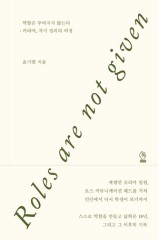
'At career's peak, a student again in her 40s': Yoon Ki-yeol's debut essay explores identity beyond titles
"Tell me the global MBA rankings." That was the short question typed into ChatGPT in January 2024, and it set everything in motion. At the time, the author was head of communications at a fintech unicorn, leading a team of about 40 people. Following the answer to that question, she soon received an acceptance letter from London Business School. She had to decide whether to give up her current position for an opportunity she had stumbled upon almost by chance. The decision did not take long. She left the company later that year and headed to London, returning to being a student in her 40s at the peak of her career. It marked the opening of a new "fourth act" in her life. She rose from an assistant in a corporate public relations team to an executive at one of the world's largest PR firms, eventually becoming head of communications at Toss. Dok Publishing announced Wednesday that it has released Yoon Ki-yeol's first essay collection, "The Role Is Not Given: A Journey of Career and Self-Definition." The book chronicles the questions the author raised and the answers she found while looking back on her career after 18 years of expanding her own role, having become a student again in her 40s in London. The author began her career as an assistant in a corporate public relations team, later working at a PR agency and serving as an executive (director) at Edelman Korea. She joined Viva Republica, the operator of Toss, in 2017 as its first PR manager. She went on to lead a team of about 40 people for seven years as head of communications, overseeing content, brand marketing and external affairs. At some point, she naturally began to consider a new life outside the organization. Choosing an opportunity she had come across almost by chance, she stepped outside a title for the first time. That period of recharging led her to reflect on her 18 years of work. The book is organized into three parts, tracing the start and growth of a career and what lies beyond it. "The Start and Growth of a Career" looks back at how chance beginnings and opportunities, both large and small, accumulate into experience. Over time, they become the material that shapes one's own standards and competitiveness. "The Leap in a Career" describes the process of defining and expanding one's role based on the essence of the work itself. It introduces ways to create one's own role rather than staying confined to a given one. "Beyond Career" recounts the author's experience in London of looking, for the first time, at herself apart from her work and title. Before writing the book, the author had expected that the chapters chronicling her career growth and achievements would be its highlight. But in the epilogue, she writes otherwise: "Ultimately, the place I most wanted to talk about turned out to be the final chapter, 'Beyond Career.'" Dok Publishing said the book is "recommended for all readers who want to define and forge their own role at different stages of life and build a narrative of their own."
Sept. 10, 2026
-
![Song Hyun-ok: "'Oh Se-hoon's wife' was once a shackle -- now it's just my circumstance" [Interview]](https://wimg.heraldcorp.com/news/cms/2026/09/10/news-p.v1.20260909.5945e124c44042b3a06f90dfe67dda5d_T1.jpg?type=h&h=240)
Song Hyun-ok: "'Oh Se-hoon's wife' was once a shackle -- now it's just my circumstance" [Interview]
A physical theater master who deconstructs classics and transcends the limits of language Play "The Chair Mender" opens Sept. 18 In an age when AI answers everything, the theater remains a space for thought "The Chair Mender," which endures a harsh, wretched reality through the fantasy of a chandelier; "The Lower Depths," which strips away the shackles of language to embody poetry written with the body; "A Five-Minute Proposal," which unearths the strata of the unconscious that Chekhov buried in silence ... . Director Song Hyun-ok, 65, who draws up the depths beneath the printed word onstage, goes by many titles: English literature scholar, theater critic, dramaturge, university professor, pioneer of "physical theater." Yet the most powerful title attached to her name remains "Oh Se-hoon's wife," or "the mayor's wife," Song Hyun-ok. Since entering the performing arts world as a theater critic in 1989, she has been a teacher nurturing younger talent. She has also been a creator who deconstructed the stage through language and context, and one who never hesitated to try something new. She now returns with her signature repertoire piece "The Chair Mender" (Sept. 18-20, Naru Art Center). The production, which she says "takes years to stage again because of its large cast and heavy physical movement," returns to audiences two years after its 2024 national tour. Song Hyun-ok, artistic director of theater company Mulgyeol, sat down for an interview ahead of the opening at the Seoul mayor's official residence in Yongsan-gu. Despite the sudden setback of a facial fracture suffered by her daughter and the play's lead actor, Oh Ju-won, she remained composed. "We already have plans A, B and C in place," she said. "Live theater always throws up variables, but I trust in the actor's strong will and sincerity." A chandelier pours over a wretched daily life... was that woman happy? For more than half a century, the woman who mended broken chairs carried her life in her hands. Every wrinkle between her knuckles holds a memory. At 14, on her first visit to a pharmacy, she encountered the pharmacist's son. Before the girl's eyes, a world as radiant as the glass jars of pills spreads open. "At that moment, a chandelier descends onto the stage. It's a fantasy world far removed from reality. Dreaming of fantasy in life is a trait unique to humans. Perhaps that fantasy was the driving force that let people without hope -- those living hard, marginalized lives -- endure." The production, adapted from Guy de Maupassant's short story "La Rempailleuse" ("The Chair Mender"), bears Song's signature touch. She has always searched for "the human being of today" within the classics. In "A Doll's House," she portrayed modern people living according to society's demands as dolls. In "Oedipus" and "Hamlet, Son of a Woman," she crossed a masculine worldview that chases truth with a feminine worldview that embraces the natural order. "Classics carry a power to overcome time, one that transcends era and nation," she stressed. "At the root of the power to overcome time -- a frightening and fearsome presence -- lies the human being. Universal human nature, the way our inner minds work, and the dynamics of relationships never change. When you dress a classic's foundation in contemporary clothing and reflect today's concerns through it, the resonance the classic teaches us is powerful." This production drops the audience vote on approval or disapproval that was part of its premiere and instead compresses that exchange into a debate among the actors onstage, preserving the fluidity of the stage aesthetic. The decisive change lies in the ending. The man who was the object of the woman's 55-year unrequited love is placed at the edge of the stage, overturning the narrator. It is the biggest departure from Maupassant's original. "The man appears and asks back, 'Is what you saw the only truth?' He grows angry, yet glances at his wife standing beside him and stares out the window. Outside the window stands a 17-year-old girl, standing in the snow. Truth changes depending on the frame. I wanted to break apart a single point of view." "The Chair Mender" is a work Song has long held close. Though she has staged countless productions, she never let herself feel emotionally attached to the characters, believing that "a director must remain free of emotion to attempt something neutral." But this year, as she prepares to restage "The Chair Mender," she says her heart has changed. "I've come to feel something for this woman. I think it's because I've gotten older. Onstage, the actors move slowly to embody the passage of time. It shows a woman's life aging -- from a girl, to a middle-aged woman, to an old woman. That scene brings me to tears. I suppose I feel for her because I, too, am growing older. (Laughs)" Physical theater, once branded 'heresy,' is now the mainstream "Is this dance or theater?" Genre-bending is now the mainstream, but the mood was different a decade or so ago. When a reinterpreted staging of Maxim Gorky's "The Lower Depths" opened in 2008, the theater world was thrown into an uproar. A modest "half-step" beyond convention would have sufficed, but Song's leap of "three or four steps" was branded "heresy" -- which is why she is called a "pioneer of physical theater." Her career did not begin with physical theater. A graduate of Korea University's English department who earned a doctorate researching Harold Pinter, she explored the "extremities of language" before turning to the body as a "meta-language" that transcends all language. Growing up in the studio of her late father, sculptor Song Young-soo -- a pioneering first-generation figure in Korean steel sculpture -- also shaped her sensibility. "I came to feel that language alone wasn't enough. Maybe because I spent my childhood among abstract sculpture, I never liked explaining things in exhaustive detail. Words can express things, but I believe the most truthful language is the body's language, which emerges spontaneously. Like poetry, I wanted to erase direct statement and bring metaphorical gestures onto the stage." Starting with "The Lower Depths" in 2008, she began presenting full-fledged physical theater, but domestic audiences responded with complaints that it was "obscure and difficult." The breakthrough, however, came from abroad -- when she staged the production in Russia in 2008 at the invitation of the Shchepkin and Shchukin theater schools and the Gorky Institute of World Literature in Moscow. Russian scholars and artists who watched "The Lower Depths" and "A Five-Minute Proposal" rose to their feet, applauding through tears. An elderly professor who said he had devoted 30 years solely to Chekhov approached her, grasped her hands and said, "This was the first time I ever considered the strata of the unconscious buried beneath Chekhov's text." Song wept then, washing away years of regret. "A local theater director's remark -- 'everything an actor does onstage is acting' -- washed away the disappointment and frustration I had felt in the Korean theater world. It was the moment I gained confidence in what I do." Theater written with the body reflects her artistic philosophy. "The value of language as a vessel for thought deserves respect, but the language of the body allows for intuitive communication among people," she said, adding that it evokes a wide range of emotions and ideas. "These days, we've entered an era when people no longer think for themselves. Ask AI anything, and an answer comes right away. For people today, the theater's duty is to give them time to think -- to create a space where they can reason and feel things for themselves." In her next work, too, Song poses questions. She is preparing a new creative piece, "Minority Opinion," inspired by the experience of an acquaintance who worked in the UN's human rights field. The play traces how individual memory becomes collective memory, how memory shapes history, and probes the gaps in how each group and nation strategically constructs its own memory. Once a shackle, 'Oh Se-hoon's wife' is now just her circumstance Though she has charted her own course with integrity, the frame of "Oh Se-hoon's wife" has always hung over her name. In her younger days, this label caught in her heart like a stumbling stone -- a shadow that threatened to swallow her independent existence as an artist. "In the past, even in articles about my own work, I used to plead with reporters to please remove the label 'Oh Se-hoon's wife.' No matter what production I staged, the shell of being a politician's wife would cover up its essence. Back then, it felt like a shackle I couldn't escape." Now, she remains composed and detached, no matter what label is attached to her. That shift likely stems from an inner upheaval she underwent after leaving the classroom she had kept for 40 years this past February. As she ran her hand over her desk before leaving her office for the last time, she felt as if she were rehearsing the end of her life. "As I stepped out of my office, it suddenly struck me that I would have no regrets even if I died right then, and my heart grew lighter," she recalled. "It's the same with 'Oh Se-hoon's wife' or 'the politician's wife.' It used to be a shackle, but now I simply accept it as one circumstance given to me. That my husband receives the public's love and support is something I'm endlessly grateful for. As a family member, my denying it wouldn't change anything, and I have no reason to be swayed by that circumstance. When the production team included the phrase 'Oh Se-hoon's wife' in introducing this show, I just laughed and thought, 'What does it matter either way.'" During her school days, eight characters were always written on the front page of her notebook: "extraordinariness within the ordinary." Having spent sleepless nights honing such an extraordinary artistic spirit, she now lets herself be carried by the natural flow of life. "Leading with intuition rather than planning has always been both my strength and my weakness. Now, I want to trust my intuition and drift along like water. Let's live without being too happy or too sad -- I think that's the kind of person I am, someone who lived and passed like flowing water."
Sept. 10, 2026
-
![Why did blockbuster director Lee Joon-ik turn to short-form drama? [Interview]](https://wimg.heraldcorp.com/news/cms/2026/09/10/news-p.v1.20260910.9ae7a5a2cfed4936adbd880014d03d6a_T1.jpg?type=h&h=240)
Why did blockbuster director Lee Joon-ik turn to short-form drama? [Interview]
Jung Jin-young, Lee Jung-eun lead 'Abeojiui Jipbap' 'Pushed into this' — a veteran director's response Hoping to be the synapse linking generations "Life is all about being pushed along, isn't it?" For filmmakers, simply being able to do the work they used to do has, at some point, become a distant dream. As investment dried up, even well-known directors began abandoning theatrical films altogether. More and more people, despite pouring decades into the craft, still find themselves struggling to make a single project happen. Amid all this, a veteran director with more than 30 years of experience spotted a new opportunity in the short-form market and urged his younger colleagues to take it on. "But why don't you do it, director? Is this a class society?" The half-joking response from his juniors hit him where it hurt. His own words came back to bite him, and being pushed along by them is how he ended up here. Lee Joon-ik is the filmmaker behind hits like The King and the Clown (2005), Dongju (2016) and The Book of Fish (2021), and has long been regarded as a master of the period drama. Yet he did not have any grand reason for turning to short-form drama. Abeojiui Jipbap ("Father's Home-Cooked Meal"), an original short drama for Lezhin Snack directed by Lee, will premiere later this month. The story, adapted from a webtoon of the same title by writer Gorita, was scripted by Shin Dong-sun. Shin worked alongside Lee on the production team of Hi! Dharma! in the early 2000s. Lee then translated it onto a vertical canvas — a format he was tackling for the first time himself. With a trustworthy cast led by Jung Jin-young, Lee Jung-eun and Byun Yo-han, the short drama has been meeting audiences first in theaters since Wednesday. It is screened as a 2-hour, 26-minute "vertical cinema." Lee Joon-ik, making a rare public appearance, was interviewed on Wednesday at Kidari Studio's headquarters in Seongdong-gu, Seoul. "There may be some resentment — the idea that I shot something for short-form and am now trying to cash in by bringing it to theaters. Some may also think an already-established director is encroaching on younger generations' territory." Lee was well aware of how people might view a veteran director's unusual foray into short dramas and a theatrical release. Still, he agreed to direct the project, believing it was his role to widen the base of short-form content — a trend he sees as unstoppable. He had a specific reason for bringing a thoroughly ordinary, understated story to a genre often criticized as nothing but sensational. The plot follows Ha-eung (played by Jung Jin-young), a father who has kept his distance from the kitchen his entire life, as he belatedly begins cooking for his family. "Everyone says the cliché is bad, but nothing is as precious as the cliché," Lee said with a laugh. "The relationship between spouses, or between parents and children, is the most cliché and yet most precious story there is — its essence hasn't changed in thousands of years. Whether it's film or short-form, everyone these days chases stimulation, but I wanted to tell a story with almost none of it. What could be more precious than what feels obvious?" The basic mechanics of storytelling — writing a story, having someone act it out, then filming and editing it — do not differ much between film and short-form. What did differ was the frame. Both the camera and the director's monitor switched from horizontal to vertical, forcing Lee to think about what to put into a narrower frame, and how. The conclusion he reached was that "if a horizontal frame is a landscape painting, a vertical frame is a portrait." In Abeojiui Jipbap, so-called panning shots — moving the camera horizontally to shift the frame — are almost nowhere to be found. Nearly every scene instead captures a single character's expression and actions. As a result, viewers come face to face with the emotions of Ha-eung, flustered as he tries to cook for the first time in his life; his wife Sun-ae (played by Lee Jung-eun), who has spent 40 years of marriage known simply as "the meal"; and their son Myung-bok (played by Byun Yo-han), who misses his mother's home cooking amid the grind of his job. Watching a face fill the frame, almost like viewing someone's portrait, produces a depth of emotion distinct from what film typically offers. This is exactly where the director focused his attention. "In a landscape painting, several figures appear together as a group, but on a vertical screen, there is only one person. If I had shot the same script horizontally, I probably would have focused more on the 'relationship,' but in a vertical frame, I felt I needed a way to connect directly with a single individual. Not just the older Ha-eung and Sun-ae, but the younger versions of them, the daughter-in-law, the younger sibling, the granddaughter — each of their lives comes to me individually, one on one." As the director put it, his move into short dramas may simply be the result of being pushed along. Lee described it not as a "challenge" but as a "response." In his view, short-form content is an unstoppable trend in an age when individualism has become universal. If the trend cannot be reversed, then actively responding to it is the only option — and the response he offers through Abeojiui Jipbap is precisely "breaking through the limits of short-form." "Today's media environment is polarized by generation. Older people still flip through TV channels to watch content, while younger generations watch Netflix alone. Each generation has grown accustomed to different platforms and different kinds of stimulation. There is no way to unify this at the hardware level, but I believe that if you create 'content' that spans generations, the story changes." A drama that anyone can relate to — one that becomes even richer when a family watches and shares it together. Breaking the assumption that short dramas are meant to be watched alone on a mobile device is exactly why Lee describes Abeojiui Jipbap as "a film good for sharing with family close to you." In an era of disconnection, what he hopes to achieve through this work is to forge connection through story. "Abeojiui Jipbap is a story that a grandfather, a daughter-in-law, a son, a grandson and a granddaughter can all share. Even across different devices, it can be content shared with just a single link. It's almost like a kind of synapse — the junction connecting one neuron to another — that lets generations share a common emotion. At a time when stimulation keeps splitting apart and repeating along generational lines, could content like this become a bridge connecting the gap between them?" No one knows whether vertical short-form content will make its way back to the big screen again, the way Abeojiui Jipbap is doing now in theaters. That depends entirely on audiences' choices. Still, Lee made clear that short-form is neither an alternative to film nor a lesser category beneath it. "Short-form is a medium that persistently and continuously delivers what film fails to capture," he explained. In the end, what matters is not the vessel but what is placed inside it. "If film feels like serving audiences a beautifully set table, a vertical screen lets audiences intently observe exactly what they want to see. If you look closely at Abeojiui Jipbap, it shows that what matters is eating warmly together as a family, whatever the meal, and that within that, a grandfather's home cooking, a son's home cooking and a granddaughter's home cooking each carry a different meaning. Works that portray three generations this richly are rare, and I think that was only possible because of the short-form format."
Sept. 10, 2026
-
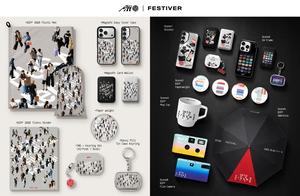
Busan film festival unveils collaboration merchandise with lifestyle brand Festiver
The Busan International Film Festival is set to unveil official collaboration merchandise with lifestyle IP brand Festiver ahead of its 31st edition next month. The Busan International Film Festival, or BIFF, said Thursday that it would preview the collaboration goods starting Friday through Festiver's official online store and Naver's brand store. Drawing on Festiver's brand slogan, "Doing, Digging" — helping people like what they like even more — the collection carries the message that "even after the movie ends, the love for it continues." It centers on mobile accessories and other everyday items. The lineup includes phone cases for iPhone and Galaxy devices, a MagSafe card wallet, and cases for AirPods and Buds earbuds, along with a ticket binder, a picnic mat, a film camera, an umbrella, an acrylic paperweight and a keyring. BIFF decided to preview merchandise online more than a month before its opening to extend the festival's reach beyond its 10-day, on-site run and into audiences' everyday lives. "Through this project, we have opened a channel for people to experience the mood of the festival online, starting more than a month before the opening," festival organizers said. The 31st Busan International Film Festival will run for 10 days, from Oct. 6 to Oct. 15, around the Busan Cinema Center. The opening ceremony on the evening of Oct. 6 at the Busan Cinema Center will be hosted solely by actor Kim Min-ha, while Im Si-wan will host the closing ceremony on the festival's final day. This year's opening film is Director Kim Jong-kwan's "Nat-gwa Bam-eun Seoro-ege" ("To Each Other, Day and Night").
Sept. 10, 2026
-
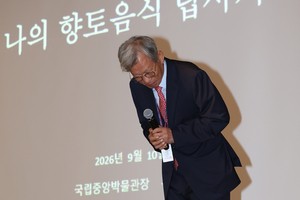
National museum director apologizes for mislabeling collaborator's calligraphy as patriot's work
National Museum of Korea Director Yoo Hong-jun publicly apologized after a calligraphy work he recently presented as the writing of an independence activist turned out to be the work of a pro-Japanese collaborator. According to Yonhap, Yoo bowed his head Thursday during a special lecture titled "Matdaemat," a lecture series held in the main auditorium of the National Museum of Korea in Yongsan-gu, Seoul, saying, "I apologize for what happened recently at the museum." Yoo said, "I feel deeply saddened that an error involving the calligraphy piece featured in the 'Urideurui Bapsang' ('Our Table') exhibition caused confusion for the public." The museum came under criticism for inadequate verification of its exhibits after the calligraphy piece titled "Ilban Sigugeun" (roughly, "even a bowl of rice is the nation's grace"), introduced in the "Urideurui Bapsang" exhibition that opened in July this year, was confirmed to be the work of a pro-Japanese collaborator. The scroll-form piece bears a saying attributed to the monk-general Yeonggyu (d. 1592), who is known as the first to raise a militia of monk soldiers during the Imjin War: "Even a bowl of rice is a debt owed to the nation." Based on the signature "Han-in Park Won-geun" — literally "Korean Park Won-geun" — the museum had presented the work as the writing of independence activist Park Won-geun (1912-1950), a native of Boeun, North Chungcheong Province, and a photo of his descendants performing a memorial rite upon learning of the discovery was even released. However, controversy erupted about a month into the exhibition when a tip revealed that "Park Won-geun" was in fact another name used by Park Jung-yang (1874-1959), a figure condemned as a pro-Japanese collaborator. Park Jung-yang held posts during Japanese colonial rule including councilor of the Central Advisory Council, governor of Hwanghae Province and governor of North Chungcheong Province, and served as an imperially appointed member of the House of Peers in the Imperial Diet of Japan. He reportedly took part in suppressing the March First Independence Movement in 1919. The Encyclopedia of Korean Culture, run by the Academy of Korean Studies, states that Park Jung-yang was regarded, according to the 1935 edition of "Joseon Gongnoja Myeonggam" (Directory of Meritorious Persons in Joseon), as one of the most meritorious figures over the 25 years of Japan's colonial rule of Korea. Yoo said, "Exhibitions presented at the National Museum of Korea fundamentally deal with material culture," explaining that he had introduced the calligraphy piece to highlight the meaning of a single bowl of rice in times of national hardship. He said, "Failing to correctly read the meaning of the artifact was a shortcoming and a mistake on the museum's part," adding, "We will make improvements so that this kind of mistake is not repeated." Yoo bowed his head again, saying, "As director, I feel a deep sense of responsibility." He added, "It is more important for a museum not to make a single mistake than to do a hundred things right," and said he hoped the meaning behind the phrase "Ilban Sigugeun" would be remembered.
Sept. 10, 2026
-
![Actor Ki Eun-se: 'I gained 2 kg from a trip, so I'm dieting' with homemade 'natural Mounjaro' [Their Health Aesthetics]](https://wimg.heraldcorp.com/news/cms/2026/09/10/news-p.v1.20260910.83ecc48cfd1d42059a6af0ac86cd0a49_T1.jpg?type=h&h=240)
Actor Ki Eun-se: 'I gained 2 kg from a trip, so I'm dieting' with homemade 'natural Mounjaro' [Their Health Aesthetics]
Behind the beauty of public figures lies a personalized regimen. [Their Health Aesthetics] looks at the diets, exercise routines, treatments, beauty and fashion of talked-about figures as everyday lifestyle information. Actor Ki Eun-se, 43, has revealed a homemade morning juice they drink to manage weight gained after a trip. The drink is made by blending banana, avocado, blueberries and almonds together. Ki called it a "natural Mounjaro," but the juice does not actually produce the same effects as the obesity treatment drug of the same name. In a video posted Sept. 3 on their YouTube channel "Ki Eun-se's House," Ki said, "I think I gained about 2 kilograms after coming back from a trip. I'm going to start dieting today." They then said, "I'm going to make a natural Mounjaro," and blended banana, avocado, blueberries, almonds, low-fat milk and allulose together. After drinking the finished juice, Ki recommended it as a simple breakfast, saying, "It's perfect to blend and drink on a busy morning commute." Blending fruit with nuts boosts fullness -- but too much makes a high-calorie drink Each ingredient Ki used contains nutrients that can be useful in a weight-management diet. Banana provides carbohydrates, dietary fiber and potassium, while blueberries are relatively low in calories and contain antioxidants such as anthocyanins. Avocado and almonds are rich in unsaturated fat and fiber. Almonds in particular contain protein as well as fat, which can help sustain fullness longer than eating fruit alone. Research has also examined how nuts affect satiety. A research team at the University of California, Los Angeles gave 95 overweight or obese adults either mixed nuts or pretzels as a snack and tracked their weight changes. Participants went through a 12-week weight-loss program followed by a 12-week weight-maintenance program. Both groups lost weight, with no significant difference in the amount lost. However, after 24 weeks, the group that ate nuts reported greater fullness than before the study began. Adding low-fat milk provides both protein and calcium. Using allulose instead of sugar helps maintain sweetness while lowering the calorie load. If using almond milk instead of dairy milk, it is best to check whether the product is unsweetened, since sugar content varies widely by brand. However, just because these are healthy ingredients does not mean they can be added without limit. Using several bananas can raise sugar content and overall calories. Because avocado and almonds are also nutrient-dense, adding too much can push the calorie count of a single drink higher than expected. A smoothie made by blending whole fruit, unlike juice that extracts only the liquid, has the advantage of retaining a substantial amount of dietary fiber. But because a blended drink can be consumed faster than food eaten by chewing, it is better for weight management to decide the portions of banana, avocado and nuts in advance. 'Natural Mounjaro' is just a figure of speech -- it works differently from obesity drugs The term "natural Mounjaro" that Ki used is closer to a playful nickname for a homemade health juice. It does not mean the drink actually works the same way as the obesity treatment drug Mounjaro. Tirzepatide, the main ingredient in Mounjaro, is a drug that acts on GIP and GLP-1 receptors. It helps reduce weight through several mechanisms, including curbing appetite and food intake and slowing the rate at which food leaves the stomach. By contrast, the fiber in fruit and the fat and protein in almonds and avocado can help control portion size by slowing digestion and sustaining fullness. This may sound similar in that both can result in "feeling less hungry," but it is an entirely different concept from the physiological action of a pharmaceutical drug. Ki Eun-se: 'Low-carb, high-fat is my 10-year body secret' -- but what about the long term? Ki has previously cited a low-carb, high-fat diet as the eating method they have long maintained. On the ENA program "X the League," aired Aug. 2, Ki said, "The secret to keeping my body the same for 10 years is exactly low-carb, high-fat." A low-carb, high-fat diet cuts carbohydrate intake while raising the proportion of fat. When carbohydrate intake drops sharply, stored glycogen in the body is used up along with the water stored alongside it, which can cause relatively fast initial weight loss. Fat and protein can also help reduce overall intake by sustaining fullness for longer. However, when it comes to long-term weight-loss effects alone, it is difficult to say a low-carbohydrate diet is necessarily superior to a low-fat diet. A Stanford University research team divided 609 overweight or obese adults into a healthy low-carbohydrate diet group and a healthy low-fat diet group. The team then compared their weight changes over one year. Average weight fell by 6.0 kilograms and 5.3 kilograms, respectively, but the difference between the two groups was not statistically significant. In weight management, choosing what kind of food to eat matters as much as simply cutting carbohydrates or fat. For fat, it is better to focus on unsaturated fat found in nuts, olive oil and fatty fish rather than the saturated fat common in butter and processed meat. There is also no need to cut out carbohydrates entirely. Reducing sugar and refined grains while eating an appropriate amount of whole grains, legumes and vegetables can help prevent shortfalls in fiber, vitamins and minerals. Ultimately, what determines the success of a diet is not the name of a particular eating method. It is the amount and quality of food a person can sustain over the long term.
Sept. 10, 2026
-
![Why this film is called 'The Assassin(s),' not 'The Assassin' [Review]](https://wimg.heraldcorp.com/news/cms/2026/09/10/news-p.v1.20260910.24165788a1794406a0eebaf7b4e9babb_T1.jpg?type=h&h=240)
Why this film is called 'The Assassin(s),' not 'The Assassin' [Review]
Six gunshots, two missing bullets A mystery drama built around the assassination of a first lady Faces of those who resisted an era of oppression An all-star cast led by Jung Woo-sung, Park Jung-min and Uhm Tae-woong Director Heo Jin-ho's new film "The Assassin(s)," which opens in theaters over the chuseok holiday, carries an unusual feature rarely seen in a movie title: parentheses. Its English title, too, carries the same parentheses without exception: "The Assassin(s)." Audiences confronting this unfamiliar title may naturally wonder why. Why did the film take the gamble of putting the plural suffix in parentheses, as if the possibility exists and does not exist at the same time? Many words carry weight in their plural form, but "assassin" in particular becomes explosive once pluralized. The moment the most heinous and grave of crimes turns out not to be the work of one person alone, the question grows far more complex and enormous than simply one or two. That is especially true when the target of the assassination is a first lady. By this point, the answer is already clear. Was the shocking incident that rocked the entire nation more than 50 years ago truly the act of a lone Korean-Japanese youth, or was there a larger force behind him, using him as a pawn? This question, which lingers throughout the film, is exactly what that single letter trapped in parentheses is trying to say. "The Assassin(s)" is the first film in Korean cinema history to tackle the mystery surrounding the assassination of a first lady in 1974. "The Assassin(s)" is a chase thriller that follows those pursuing the truth behind the shooting that took place during that year's Liberation Day ceremony. Using the still-unresolved questions of that day — questions that have lingered for half a century — as its spark, the film fills in the missing pieces with cinematic imagination. The film weaves together roughly four sets of interests: a man who pulled the trigger on the head of state; a government that did not hesitate to trample its own citizens in the name of patriotism; police officers who moved on the government's orders; and a press that relentlessly pursued facts and truth in the face of censorship. Among them, the film follows the choices and actions of Cheolgu (Yoo Hae-jin), a police inspector from Jungbu Police Station who was at the scene; Jaehwan (Park Hae-il), a veteran city desk editor at Dongsung Ilbo; and Youngil (Lee Min-ho), the newspaper's youngest reporter who dives into the story alongside Jaehwan — drawing closer to a truth that someone may have deliberately buried. The story of "The Assassin(s)" begins with six sharp gunshots that suddenly ring out inside the National Theater just as the ceremony gets underway. A man pulls a gun from inside his coat, rushes toward the podium and fires repeatedly, and the first lady, seated beside the podium, slumps in her chair. The scene descends into chaos, and the assailant is subdued on the spot. Cheolgu, the police officer in charge of security for the event, and Youngil, the reporter covering it, both witness the incident with their own eyes, unable to believe what they are seeing. Cheolgu had tried to stop the man from entering without a pass, but the head of the presidential security detail (Uhm Tae-woong) let him in anyway. Cheolgu is then stunned to learn that the man was none other than the gunman. That day, Jaehwan, the city desk editor who was as usual locked in a battle of nerves with the censors, learns of the shocking incident through a live television broadcast. Youngil tells him that the first lady has been shot, and that a high school student sitting in the audience was also shot and taken away. Under Jaehwan's direction, all of Dongsung Ilbo's reporters are mobilized to cover the shooting, and in the meantime, both the first lady and the student die. Within hours, the authorities announce that the gunman is Mun Se-gwang, a Korean-Japanese man affiliated with Chongryon, a pro-Pyongyang organization of ethnic Koreans in Japan. Jaehwan senses something is off in the briefing's suspiciously well-prepared delivery and the air of concealment surrounding it. Cheolgu, angered that all the blame for the security lapse is being pinned squarely on him and his colleagues, digs deeper into the case. He eventually discovers that although six gunshots rang out at the scene, only four bullets were ever found, and that the gunman had been accompanied by another man before the shooting. Cheolgu shares what he has uncovered with Jaehwan. The baffling circumstances and evidence ultimately point to a single conclusion: the shooting was not the work of a pro-North Korean sympathizer acting alone. So who was the man with Mun Se-gwang? Did Mun really plan and carry out the attack by himself? And who exactly is the force persistently obstructing those chasing the truth? One clue gives rise to another question, and each new question pulls the characters further toward the center of the case. "The Assassin(s)" adds the rhythm of a period drama to its mystery-chase framework, sustaining the tension all the way to the end. A string of suspicious circumstances — the head of presidential security letting the gunman into the venue, the authorities announcing his identity before he even speaks, forensic investigators being barred from the scene — pushes the audience into a labyrinth from which there seems to be no easy escape. As the story makes clear that nothing is quite as it appears, viewers find themselves walking, alongside the characters, deeper and deeper into the heart of the mystery. The portrayal of an era in which state violence was dressed up as patriotism forms the backbone of the film's narrative. From the turbulent color and atmosphere of the 1970s to the newsroom where censorship was routine, every frame conveys the oppression and tension of the period without a word of dialogue. It was a time when an offhand joke could get someone branded a communist and dragged off to Namsan. It was an era when tyranny was justified under the name of the Yushin system, and the country held its breath under the blade of emergency decrees. The film's mise-en-scene, evocative of press photography, signals that it is not simply romanticizing that era through nostalgia. It reads less like a summoning of memory and more like testimony to a time when unchecked power bore down on this land. While "The Assassin(s)" digs into an unresolved mystery at its core, it also renders, in detail, the faces of those who refused to bow during that ruthless era. Within it lies the unvarnished truth of a time that was colder and hotter than ever before, even as the nation raced up an unprecedented ladder of growth. Voices that were shaped and silenced by the state under slogans of patriotism and love for the people, and the struggle of those who nonetheless refused to yield, run through the entire film. Cheolgu, who had lived believing that working for the state was patriotism, begins for the first time to doubt the very thing he had been loyal to, after the state he tried to protect saddles him with the blame for the case. Jaehwan, Youngil and the other Dongsung Ilbo reporters keep running into the wall of censorship and outside pressure the further they dig, yet they never give up their resistance in pursuit of honest journalism. The film reminds us that the era when the basic rights of freedom and truth vanished feels like a distant past only because there were those who ceaselessly resisted to protect them. Even so, the film never lets go of the "assassins," plural, until the very end. Much of the credit for making that plural possible belongs to the director's casting choices. Lead-caliber actors — including Jung Woo-sung, Uhm Tae-woong, Park Jung-min and Yoo Yeon-seok, as well as Shim Eun-kyung, Oh Dal-su, Park Sung-hoon, Bae Seong-woo, Oh Jung-se and Shin Hyun-been — all signed on for brief appearances. Each actor's individual gravitas ensures that their presence lingers over the truth of the story, even in the briefest of appearances. Every time one of them appears on screen, the possibility that the character could be one of the accomplices refuses to leave the viewer's mind. In the end, the film puts nearly every face on screen under potential suspicion, keeping the audience from fully trusting anyone as it chases the case to its conclusion. That said, the risk that these familiar faces, appearing without warning, could disrupt immersion cannot be entirely ruled out. The performances of the leads — Park Hae-il, Yoo Hae-jin and Lee Min-ho chief among them — hardly need explaining. In particular, the desperation and resolve that Park Hae-il, returning to the screen after four years, brings to Jaehwan leave a lingering impression. The political and diplomatic interests of the era are woven tightly into the film's cinematic imagination, but that does not make the film feel purely heavy. The brisk pace typical of a chase thriller, along with the quick back-and-forth banter between the cast, lightens that weight just enough. Walking out of the theater, a question that refuses to fade lingers in the mind: could there still be an "s" out there that we have failed to notice? With its compelling subject matter, a cast audiences can trust, and the weight befitting a period drama, all combined in just the right measure, "The Assassin(s)" seems more than qualified to fill theaters this chuseok season on the strength of that one question alone. The film opens Sept. 23 and is rated 12 and up.
Sept. 10, 2026
-
![Actor Park So-dam opens up about papillary thyroid cancer: 'I look to nature more often now' [Their Health Aesthetics]](https://wimg.heraldcorp.com/news/cms/2026/09/10/news-p.v1.20260910.df5a24f61fad401490849cb6a0e606af_T1.jpg?type=h&h=240)
Actor Park So-dam opens up about papillary thyroid cancer: 'I look to nature more often now' [Their Health Aesthetics]
Behind the beauty of public figures lies a personal regimen. [Their Health Aesthetics] examines the diets, exercise routines, treatments, and beauty and fashion habits of newsmakers as everyday lifestyle information. Actor Park So-dam has shared how their daily life changed following surgery for papillary thyroid cancer. They said they came to appreciate nature and the ordinariness of everyday life in ways they had not noticed before. Park launched a personal YouTube channel called Sodam Sodam PARKSODAM on Tuesday, releasing a travel vlog from a trip to Matsuyama, Japan. Timed to their birthday, the first video showed them traveling alone this summer, taking a slow tour through unfamiliar lodgings, restaurants and streets in the city. Toward the end of the video, they explained why they started the channel. "I love nature so much," Park said. "I think I looked up at the sky a lot after I got sick." They added, "I think I learned very late how grateful I should be for all of this, what happiness really is. So these days I go out to see a lot of nature, and I want to share that with you." Park was diagnosed with papillary thyroid cancer during a routine health checkup in 2021 and underwent surgery. At the time, their agency, Artist Company, said the surgery had been completed on the advice of the medical team and that Park would focus on recovery. Since regaining their health, Park has continued acting and recently played the second daughter, Yeongju, in the film "Gyeongju Travelogue." Papillary thyroid cancer: the most common type, often symptomless early on The thyroid is a butterfly-shaped endocrine gland located at the front of the neck. It secretes thyroid hormones that regulate metabolism, body temperature and other physiological functions. A malignant tumor that develops in this gland is called thyroid cancer. According to the National Cancer Information Center, thyroid cancer is classified by tissue type into papillary, follicular, medullary and anaplastic carcinoma, among others. Papillary thyroid cancer, the type Park was diagnosed with, is the most common form of thyroid cancer in South Korea. Papillary thyroid cancer generally progresses relatively slowly. However, even within this type, treatment and follow-up methods can vary depending on the size and location of the tumor and whether it has spread to lymph nodes. They can also vary depending on the patient's age and overall health. Early-stage thyroid cancer often shows no clear symptoms. It is sometimes discovered incidentally during a health checkup or a neck ultrasound performed for another reason. When symptoms do appear, they can include a lump felt at the front of the neck, a change in voice, difficulty swallowing, or a feeling of pressure in the neck. However, these symptoms alone cannot confirm a thyroid cancer diagnosis. If a nodule is found in the thyroid, doctors examine its size and shape via ultrasound. If necessary, they determine whether it is malignant through a fine-needle aspiration biopsy, in which cells are collected with a thin needle. Surgery is not the end: recurrence must be monitored consistently Doctors determine treatment based on the cancer's type, size and stage, as well as whether it has spread to the lymph nodes or other organs. Surgery is the primary treatment. Depending on the patient's condition, doctors remove either part of the thyroid or the entire gland, sometimes combined with radioactive iodine therapy and thyroid hormone treatment. Patients who have had their entire thyroid removed can no longer produce enough thyroid hormone on their own and must take hormone replacement medication continuously. Patients who had only part of the gland removed may also be prescribed hormone medication, depending on test results, recurrence risk and the judgment of their medical team. The medication both compensates for the hormone deficiency and, in some cases, helps lower the risk of cancer recurrence. Regular follow-up monitoring after surgery is also important. According to the National Health Information Portal, operated by the Korea Disease Control and Prevention Agency (KDCA), patients may undergo blood tests and neck ultrasounds depending on their condition. A whole-body radioactive iodine scan can also be used to check whether the cancer has spread to the lymph nodes, lungs, bones or other areas. Thyroid cancer is often described as a cancer with a good prognosis, but the course of the disease is not the same for every patient. Subsequent treatment can vary greatly depending on whether the cancer recurs, where it recurs, and whether it spreads to distant organs. In particular, when the cancer spreads to other organs such as the lungs or bones, the treatment burden increases. The prognosis can also differ from cases where the recurrence is confined to the neck. Daily life after recovery matters too: stick to medication and checkup schedules After surgery, patients may experience neck pain or a foreign-body sensation, changes in voice, difficulty swallowing and fatigue. Changes in thyroid hormone levels can also occur depending on how much of the gland was removed. If symptoms persist for a long time or worsen, it is best to see a doctor to determine the cause rather than dismiss it as a normal part of recovery. Lifestyle management should also be tailored to each patient's treatment status. Rather than pushing through strenuous exercise or excessively restricting certain foods in hopes of speeding up recovery, patients should prioritize following their medication regimen. They should also keep to the checkup schedule set by their medical team. Patients undergoing radioactive iodine therapy may be subject to additional dietary restrictions or lifestyle guidelines depending on the timing of treatment. Park did not disclose the specifics of their treatment or current medical status in the video. Instead, they spoke about how their outlook on everyday life changed after going through a cancer diagnosis and surgery. In the video's description, they wrote, "These days, I sometimes look up at the wide sky, take a deep breath, and find myself thinking about all sorts of things." The sky, nature and ordinary days that Park once took for granted have come to carry a slightly different meaning after going through the illness.
Sept. 10, 2026
-
BTS, Jennie soar near top of Billboard's 2026 Summer Songs chart
The two groups known together as "2B" — BTS and Blackpink — showed their strength this summer. BTS and Jennie of Blackpink both landed near the top of Billboard's 2026 Summer Songs rankings. According to Billboard on Thursday, BTS and Jennie secured top spots in this year's summer-season recap chart, which tallies the biggest songs of the summer into a top 10. BTS's "SWIM" ranked second on the Billboard Global Excl. US summer recap, which reflects music consumption worldwide outside the United States. The song also placed sixth on the Billboard Global 200 summer recap, which includes the US, underscoring its staying power on a global scale. Billboard attributed the achievement in part to the momentum from BTS's halftime performance at the FIFA World Cup final at MetLife Stadium in East Rutherford, New Jersey, on July 19. During that performance, BTS headlined the first-ever World Cup final halftime show in history, sharing the stage with Shakira, Justin Bieber and Madonna. Jennie's singular global reach was also on display. Her collaboration with Tame Impala, "Dracula," ranked fifth on the Billboard Global 200 summer recap and sixth on the Billboard Global Excl. US summer recap. The result marked a successful cross-genre collaboration on the world stage. This is not the first time a K-pop act has landed on Billboard's annual Summer Songs ranking, which tallies chart performance each summer. In 2023, BTS's Jungkook made K-pop history by topping the global summer song chart with "Seven," his solo single featuring rapper Latto.
Sept. 10, 2026
MOST READ
- 1KAIST develops high-performance bio-based adhesive using E. coli instead of petroleum
- 2Pope Leo XIV declines French honors and banquet, accepts only private meeting with Macron
- 3Daimler Truck unveils next-generation transport solutions at IAA 2026
- 4What was Rachmaninoff's performance fee? A 1928 price list tells all
- 5Samsung Biologics union's show of force backfires at the bargaining table
- 6APR says hair-loss treatment research published in international journal
-
WORLD

US warns of punishment for anyone enabling Iran's Strait of Hormuz toll scheme
-
INDUSTRY

Toyota union puts productivity first; Hyundai Motor union demands bigger share of profits
-
FINANCE

National Growth Fund to invest $531M in FuriosaAI, which rebuffed Meta's $800M takeover bid
-
INDUSTRY
Korea Shipowners' Association holds amateur baduk tournament for Maritime Day