
- HOME
- FINANCE

Woori Card boosts credit sales, lifts nine-month net profit 26%
Q3 net profit rises 30.3% on-year to 39.2 billion won Nine-month operating profit up 15.1% to 174.8 billion won Credit sales assets surge 44.9%, driving balance sheet growth Delinquency rate edges up 0.14 percentage points quarter-on-quarter to 1.95% Woori Card's net profit for the first nine months of this year rose more than 26% from a year earlier, driven by customer base expansion and growth in credit sales assets. Earnings for the third quarter alone also climbed more than 30%. According to Woori Financial Group's third-quarter earnings report released Friday, Woori Card's nine-month net profit for the period reached 133.7 billion won ($101 million), up 26.4% from the same period a year ago. Nine-month operating profit also rose 15.1% year-on-year to 174.8 billion won. For the third quarter alone, net profit came to 39.2 billion won, up 30.3% from a year earlier. However, it fell 21.5% quarter-on-quarter. Operating profit stood at 54.6 billion won, down 17.3% from the previous quarter. Nine-month net operating revenue grew 5.6% year-on-year to 804.3 billion won. Interest income rose 3.0% to 579.8 billion won, while fee income fell 14.7% to 158 billion won. Selling and administrative expenses increased 9.0% to 246.9 billion won over the same period, while credit loss provisions edged down 0.2% to 382.6 billion won. Card assets expanded, led by credit sales. Total credit card assets at the end of the third quarter stood at 16.56 trillion won, up 29.3% from a year earlier. Within that, credit sales assets rose 44.9% to 11.68 trillion won, while card loan assets grew 3.1% to 4.27 trillion won. Third-quarter credit sales volume also increased 19.1% year-on-year to 21.11 trillion won. Asset quality indicators, however, deteriorated somewhat. The delinquency rate at the end of the third quarter stood at 1.95%, up 0.15 percentage points from a year earlier and 0.14 percentage points from the previous quarter. The non-performing loan ratio also rose 0.17 percentage points quarter-on-quarter to 1.60%. "We are continuing to improve our earnings on the back of customer base expansion and financial asset growth, and we are also strengthening the competitiveness of our payments business through the expansion of our own merchant network and increased use of our proprietary cards," a Woori Card official said. "Going forward, we will build a stable foundation for growth by reinforcing the competitiveness of our independent business operations and advancing our risk management."
Kim Seo Hyun Oct. 23, 2026
-

Hana Card's nine-month net profit rises 3.1% on personal credit, payment growth
Nine-month net profit 175.3 billion won, operating profit 234.2 billion won Hana Card posted a nine-month cumulative net profit of 175.3 billion won ($132 million), up 3.1 percent from the same period a year earlier, the company said Friday. Cumulative operating profit also rose 7.2 percent year-on-year to 234.2 billion won. Growth in fee income underpinned the nine-month results. Cumulative fee income climbed 9.1 percent year-on-year to 277.9 billion won, while interest income rose 2.7 percent to 349.1 billion won. Cumulative loan-loss provisions, however, increased 3.2 percent from a year earlier to 243.9 billion won. For the third quarter alone, provisions reached 73.4 billion won, up 28.0 percent year-on-year. "Despite a challenging business environment marked by tightened lending regulations and concerns over asset quality, cumulative net profit increased on the back of growth in personal credit card sales, debit card and corporate payment volumes, and the expansion of our global business," a Hana Card official said. "However, net profit fell quarter-on-quarter due to higher funding costs from rising interest rates and exchange rate fluctuations." Third-quarter net profit came in at 49.4 billion won, down 17.4 percent from a year earlier and 27.8 percent lower than the previous quarter. Operating profit fell 3.7 percent year-on-year to 66.3 billion won. The delinquency rate at the end of the third quarter stood at 1.84 percent, up 0.05 percentage points from a year earlier and 0.11 percentage points from the previous quarter. Hana Card said it is managing the delinquency rate by focusing on higher-quality customers, writing off and selling non-performing bonds, and improving collection efficiency. "We expect a difficult operating environment to persist in the fourth quarter, with funding costs continuing to rise and lending regulations tightening further," the official said. "We plan to pursue stable growth centered on our payment business while strengthening risk management — including delinquency rate control — to maintain sound, quality-focused operations."
Oct. 23, 2026
-
Woori Financial Group posts W1.05tr profit for second straight quarter
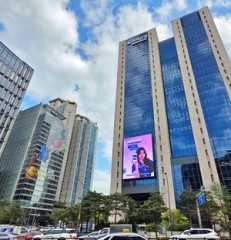
Cumulative net operating revenue hits all-time high in first three quarters Woori Bank's nine-month net profit rises 4.68% Board approves Q3 dividend of 220 won per share Only bank holding company to offer tax-exempt dividend Woori Financial Group said Friday its third-quarter net profit reached 1.05 trillion won ($792 million), the first time since the group's founding that it has exceeded 1 trillion won in net profit for two consecutive quarters. Cumulative net operating revenue for the first three quarters rose 6.2 percent year-on-year to 8.68 trillion won, an all-time high. Woori Financial said the growth was driven by expanded interest income from corporate-lending-focused loan growth and higher non-interest income from its non-banking units. Cumulative net profit for the period came to 2.66 trillion won, down 4.9 percent from a year earlier. Excluding one-time gains such as the bargain purchase gain from last year's insurance company acquisition, the figure rose 18.7 percent year-on-year, Woori Financial added. Woori Bank's won-denominated loans outstanding stood at 313 trillion won as of end-September, up 4.1 percent from the end of last year. The group's cumulative interest income for the first three quarters rose 4.5 percent year-on-year to 7.04 trillion won. Non-interest income also continued its upward trend, climbing 13.9 percent year-on-year to 1.64 trillion won. Rising long-term interest rates weighed on securities-related gains, but the consolidation of the insurance subsidiary and expanded synergies among affiliates contributed to overall revenue growth. The cost-to-income ratio for the third quarter improved 0.8 percentage points year-on-year to 42.3 percent. The credit cost ratio fell 0.10 percentage points year-on-year to 0.42 percent. Cumulative operating profit for the first three quarters rose 19.5 percent year-on-year to 3.54 trillion won. Return on equity for common shares improved from 9.0 percent in the first half to 9.9 percent through the third quarter, reflecting stronger capital efficiency. Woori Bank, the group's core subsidiary, posted third-quarter net profit of 1.03 trillion won, up 22 percent quarter-on-quarter and the highest quarterly earnings on record. Its cumulative net profit for the first three quarters reached 2.4 trillion won, up 4.68 percent from the same period last year. Woori Financial Group's board resolved Friday to pay a third-quarter dividend of 220 won per share. The group is the only bank holding company in South Korea to offer a tax-exempt dividend. In September last year, Woori Financial announced plans to channel 80 trillion won into productive and inclusive finance over five years through its "Future Co-Growth Project." In the year since the project's launch, the group deployed a total of 34.7 trillion won — 33.3 trillion won in productive finance and 1.4 trillion won in inclusive finance — reaching 38.5 percent of its five-year target.
Oct. 23, 2026
-
Tiger Research hosts seminar with Standard Chartered's Geoff Kendrick on digital asset outlook
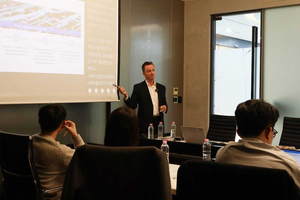
About 20 analysts from domestic brokerages attend Stablecoins and asset tokenization take center stage Tiger Research announced Friday that it hosted a seminar Thursday featuring Geoff Kendrick, global head of digital asset research at Standard Chartered Group, under the theme "Global Digital Asset Market in 2032: What Will Change?" The event drew about 20 analysts covering digital assets at domestic brokerages. Kendrick outlined the changes blockchain technology is expected to bring to traditional financial markets. He said stablecoins would serve as a turning point for the financial industry, predicting that decentralized finance, or DeFi, and the real-world asset tokenization market would enter a phase of full-scale growth as a result. Kendrick leads global research on digital assets at Standard Chartered Group, covering bitcoin, ether, stablecoins and asset tokenization. Drawing on his background in foreign exchange and macroeconomic analysis, he has provided institutional investors with outlooks on the digital asset market. Yoon Seung-sik, head of Tiger Research's research center, then presented on "Changes and Outlook for South Korea's Digital Asset Market." Yoon identified the shortening of settlement cycles through stablecoin adoption as a key shift ahead for financial markets, and raised the possibility that ultra-short-term financial products leveraging stablecoins could emerge. The question-and-answer session focused on how stablecoins and tokenized assets could be applied in real financial markets. Attendees asked in depth about shifts in the global stablecoin market, the role of financial institutions, settlement and payment infrastructure for tokenized assets, and the potential cost savings from tokenization. "As stablecoins and asset tokenization move into the mainstream financial system, the perspective of domestic brokerage research is broadening from individual asset analysis to the financial infrastructure as a whole," Yoon said. "It was a meaningful occasion to share the views of Standard Chartered Group, which leads global digital asset research, directly with domestic analysts." Tiger Research co-hosted an institutional forum with Canton Network, Noves and IBM on Sept. 29.
Oct. 23, 2026
-

Squaretech signs MOU with GOAT Network for AI-based stablecoin payments
Service to prioritize foreign tourists; on-chain identity and spending limits among planned safeguards Squaretech announced Friday that it has signed an MOU with GOAT Network, a Bitcoin-based AI agent commerce infrastructure provider, to develop a stablecoin payment service in South Korea. Under the agreement, the two companies will explore integrating AI agent technology into a stablecoin payment program being developed for foreign tourists. The service is being co-developed with Road System, a domestic mobile identity authentication company, and aims to let foreign tourists verify their identity using a mobile passport and pay at local merchants using dollar-based stablecoins. Squaretech will handle domestic project development, merchant acquisition and regulatory compliance, while GOAT Network will provide its AI agent payment technology and network. DAC Labs, the infrastructure developer behind GOAT Network, will support technical integration, security review and network operations. The two companies are also exploring expanding their cooperation to cover digital gift cards and voucher purchases. The companies also plan to deploy technology addressing security risks that could arise when AI agents execute payments on behalf of users. Each AI agent will be assigned an on-chain identity based on the ERC-8004 standard, with spending limits and user approval procedures set to allow transaction records to be verified. The initial service is expected to use dollar-based stablecoins. The companies also plan to build the technical foundation to expand support to a Korean won stablecoin once relevant laws and regulations are established domestically. "Through this collaboration, we will integrate global technology to fit the domestic payment environment and regulatory framework, and build a new payment ecosystem where AI and stablecoins can be used in everyday life," said Kim Kang-ho, CEO of Squaretech. Kevin Liu, co-founder and CEO of GOAT Network, said AI agents are evolving to purchase products and services on behalf of users. "Through this collaboration, we will explore how the technology can be applied to real-world commerce in South Korea," he added. Meanwhile, RN2 Technologies changed its name to Squaretech on Oct. 14 to reflect its expansion into new businesses. The company is also pursuing cooperation with Anchorage Digital of the United States on institutional digital asset infrastructure.
Oct. 23, 2026
-

Hana Financial, Dunamu launch stablecoin payment PoC linked to Kaia Wallet
Hana Card joins effort to expand payment ecosystem PoC to verify multi-stablecoin deductions using dollar and yen stablecoins Hana Financial Group announced Friday that it is jointly conducting a proof of concept with Dunamu to build a payment and settlement ecosystem based on Upbit, Dunamu's digital asset platform. The core of the pilot is to link Upbit with the Kaia Wallet digital asset wallet and verify the full process — from stablecoin payment to merchant settlement — using stablecoins held by customers. Hana Card, a key affiliate of Hana Financial Group, is also taking part in the verification. Hana Financial said it plans to boost the everyday utility of stablecoin payments, drawing on the model of Travellog, its product offering free currency exchange and waived overseas transaction fees. The most significant change is expected in settlement cycles for online and offline merchants. Unlike traditional credit card networks, which can take several days to settle, blockchain technology can compress that process to near real time, improving cash flow for small business owners. The PoC will also test "multi-stablecoin deduction," which allows a single transaction to draw from more than one stablecoin. When a customer uses a card linked to the Upbit wallet abroad, the system first charges dollar stablecoins USDT and USDC, then automatically switches to JPYC, a yen-denominated stablecoin, if the balance runs short. The two companies also plan to develop a benefits program for VIP customers, including high-net-worth individuals. Hana Card intends to roll out tailored premium services and exclusive partnership perks for Dunamu's VIP customers starting in January. "Through our collaboration with Dunamu, we have been able to realize a next-generation payment and settlement process that the general public can genuinely feel and use in practice," a Hana Financial official said. "By integrating the already widely adopted Upbit exchange wallet, we plan to set the standard for the domestic digital asset payment market and build a payment ecosystem where everyone is connected and actively engaged." Meanwhile, Hana Financial and Dunamu are also working to build a blockchain-based overseas remittance and payment infrastructure. For that project, the group has selected Lambda256, a subsidiary of Dunamu, as its technology partner and is working to integrate Kaia Chain with its existing foreign exchange and account systems.
Oct. 23, 2026
-

Hana Financial posts record W3.62tr net profit through Q3
Core profit rises 14.2% year-on-year to 9.63 trillion won Fee income growth approaches 30% Board approves 250 billion won share buyback and cancellation Quarterly cash dividend set at 1,165 won per share Hana Financial Group said Friday its cumulative consolidated net profit for the period through the third quarter reached 3.62 trillion won ($2.74 billion), up 5.6 percent from a year earlier — the highest figure on record. The group's cumulative core profit through the third quarter — the sum of interest income and non-interest income — rose 14.2 percent year-on-year to 9.63 trillion won, comprising 7.48 trillion won in interest income and 2.14 trillion won in fee income. Cumulative fee income through the third quarter grew 29.8 percent year-on-year. Fee income's share of core profit climbed 2.7 percentage points to 22.3 percent from 19.6 percent a year earlier, contributing to broader diversification of the group's revenue mix. The group's estimated common equity tier 1 ratio at the end of the third quarter rose 0.18 percentage points quarter-on-quarter to 13.45 percent, meeting the target of 13 percent or above set under its Corporate Value Enhancement Plan 2.0. Return on equity held steady at 10.62 percent, in line with the previous quarter. Return on assets came in at 0.71 percent, while the estimated BIS capital ratio stood at 15.45 percent. The group said it plans to strengthen execution of its corporate value enhancement plan while maintaining a balance between sound capital adequacy and expanded shareholder returns. The group's cumulative credit cost ratio through the third quarter was 0.30 percent. The cost-to-income ratio fell 0.38 percentage points year-on-year to 38.38 percent. Total assets as of the end of the third quarter stood at 924.45 trillion won, including 218.64 trillion won in trust assets. Hana Bank, the group's core subsidiary, posted cumulative consolidated net profit for the period of 3.32 trillion won through the third quarter, including 1.19 trillion won in the third quarter alone — up 5.8 percent from a year earlier. Cumulative fee income through the third quarter rose 11.5 percent year-on-year to 874 billion won. Hana Financial Group's board of directors approved a 250 billion won share buyback and cancellation to implement the corporate value enhancement plan and expand shareholder returns. The board also resolved to pay a quarterly cash dividend of 1,165 won per share, up 26.6 percent from a year earlier. Including 699 billion won in share buybacks already completed through the third quarter, the group's cumulative annual share buyback and cancellation total reached 949 billion won — a 25.8 percent increase from 754.1 billion won last year.
Oct. 23, 2026
-
Corporate deposits start to flee, putting banks on edge
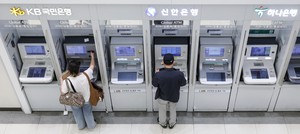
[Banks' liquidity battle] Corporate deposits had cushioned banks even as retail savings shrank Year-end maturities and capital spending plans raise the specter of a mass exodus Rising corporate deposit outflows are dragging down banks' LCR liquidity ratios Banks racing to launch high-rate deposit promotions and issue bank bonds Financial authorities ask banks to stagger bond issuance timing Corporate time deposits, which had served as a liquidity lifeline for South Korea's banks even through this year's stock-market money migration, are showing cracks in the fourth quarter. After swelling by nearly 60 trillion won ($45.3 billion) over the course of the year, corporate time deposits have begun to shrink as year-end maturities arrive — and with major new capital expenditure plans still on the horizon, analysts expect the outflows to accelerate. For banks that have grown heavily dependent on corporate deposits, the situation has become urgent. Uncertain about when large sums might be pulled, lenders are rolling out high-rate time deposit promotions at 4 percent annually and issuing bank bonds beyond their original plans. The concern is that intensifying competition for deposits among banks could raise funding costs for savings banks and other second-tier financial institutions as well. Higher deposit rates and heavier bank bond issuance push up borrowing costs, which can feed through to higher lending rates. Financial authorities have stepped in, asking banks to spread out their bond issuance schedules to manage the risk. Corporate deposits rescued banks during the money migration — rising 13 trillion won while retail savings fell 3 trillion won The combined balance of corporate time deposits at South Korea's five largest banks — KB Kookmin Bank, Shinhan, Hana, Woori Bank and NH NongHyup — stood at 560.6 trillion won as of Oct. 13, down 612.2 billion won from 561.21 trillion won at the end of last month, according to financial industry data released Friday. Corporate deposits had consistently grown throughout this year's money-migration cycle, providing a crucial buffer for banks. Even at the end of June, when the Kospi had climbed into the mid-8,000s, the combined time deposit balance held by individuals and other non-corporate depositors had fallen to 435.91 trillion won — a drop of 2.96 trillion won from 438.88 trillion won at the end of last year. Over the same period, corporate time deposits rose by 13.08 trillion won. That divergence was the basis for banks' confident assertions that there was "no problem with liquidity flows" even as retail money poured into equities. Analysts now say a genuine exodus has begun as corporate time deposits reach their maturity dates this month. At least one bank saw its corporate deposit balance fall by 8.4 trillion won in just over ten days between the end of last month and Oct. 13. The outflows are expected to pick up speed as year-end approaches. "When a retail time deposit matures, customers tend to roll it over, but companies sometimes choose not to reinvest if a sudden funding need arises — for capital expenditure, for example," an official at a major commercial bank said. "Year-end also brings scheduled payment obligations, so corporate deposits cannot simply be treated as stable funding." An industry official echoed the concern, noting that large deposit withdrawals often coincide with the execution of investment plans that require substantial cash outlays, such as factory expansions. Banks' liquidity ratios deteriorate — LCR falls at all four major banks As corporate deposit outflows begin in earnest, lenders are under mounting pressure. They must meet year-end regulatory liquidity requirements while also securing enough funding to satisfy government-backed productive-finance lending initiatives. The strain is already showing up in the liquidity coverage ratio, the key liquidity metric for banks. The combined average LCR of the four major banks — KB, Shinhan, Hana and Woori — rose from 106.08 percent at the end of the first quarter to 106.14 percent at the end of the second quarter, then fell to a preliminary 104.76 percent at the end of the third quarter. The LCR measures how much high-quality liquid assets a financial institution holds relative to its projected net cash outflows over a 30-day stress period. Regulators require a minimum of 100 percent. The ratio falls as net cash outflows increase. Under Basel III standards, corporate deposits carry cash outflow rates up to ten times higher than retail deposits, depending on the type of entity and the nature of the deposit. This means that even an identical time deposit generates a larger calculated cash outflow if held by a corporation rather than an individual, adding greater downward pressure on the LCR. Corporate deposits' share of total time deposits has in fact risen — from 53.2 percent at the end of last year to 55.3 percent as of Oct. 13 — meaning banks are more exposed to the higher-outflow category even as those deposits begin to leave. "Retail customers tend to leave their money in the bank once they deposit it, but corporates are unpredictable," a financial authority official said. "That is precisely why corporate deposits are assigned a higher outflow rate in LCR calculations — they are qualitatively lower-quality assets." The official added that banks' recent push to issue bank bonds aggressively is also aimed at acquiring government bonds and other high-quality liquid assets to shore up their liquidity ratios. Banks pay a premium to issue bonds as the money-migration bill comes due — and borrowers feel the ripple effect The recent wave of high-rate time deposit promotions offering 4 percent annually is a direct response to the corporate deposit risk. Inside the industry, there is talk that banks are now receiving the bill for the money migration. Bank bond issuance is also climbing. KB Kookmin Bank disclosed plans to issue an additional 6 trillion won in bank bonds during the fourth quarter, after exhausting its original annual issuance limit of 11 trillion won. None of the other three major banks — Shinhan, Hana and Woori Bank — have yet disclosed additional issuance plans for this year, but all have already issued more bank bonds in 2026 than in 2025. Data from the Korea Financial Investment Association's bond information center show that the four major banks' cumulative issuance through Oct. 15 reached 47.43 trillion won, surpassing last year's full-year total of 45.3 trillion won. Across the entire banking sector, issuance stood at 226.36 trillion won, also exceeding last year's total of 221.61 trillion won. "The volume of bank bonds maturing in the fourth quarter is higher than a year ago, and there is pressure to issue before rates rise further," an official at a major commercial bank said. Banks are expected to pay an increasingly steep price for bond issuance as the year draws to a close. With supply rising and competition for investors intensifying, lenders will need to offer higher yields to place their bonds. Year-end book-closing by major market participants could tighten supply-demand conditions further, adding upward pressure on rates. The costs are also being passed on to second-tier financial institutions. Savings banks, which fund a significant portion of their operations through deposits, must maintain deposit rates above those of commercial banks to attract customers — meaning every time a bank raises its time deposit rate, savings banks must follow. Credit card companies and capital firms face a similar dynamic: as bank bond supply grows, lower-rated specialty credit finance companies must offer even higher yields to place their own bonds. Borrowers are feeling the effects as well. Fixed-rate bank loans are benchmarked to bank bond yields, so fiercer bond issuance competition translates directly into higher lending rates. The new COFIX rate, which serves as the benchmark for variable-rate loans, also rises as funding costs from deposits and bank bonds increase. As of Thursday, the upper end of fixed-rate bank lending stood at 7.02 percent annually, with variable rates at 6.74 percent, and some in the industry are raising the possibility of rates reaching 8 percent before year-end. Second-tier lenders will have no choice but to pass their own higher funding costs through to borrowers as well. Not yet a Legoland-level crisis — but regulators urge banks to ease up on deposit competition Financial authorities are closely monitoring the year-end deposit competition among banks. Although the spread between bank bond yields and specialty credit finance company bond yields has narrowed somewhat following the government's recent reduction in Treasury bond issuance, regulators believe the structural risk posed by volatile corporate deposits makes it too early to be complacent. Earlier this month, authorities collected bank bond issuance plans from lenders and asked them to stagger the timing. "The situation does not call for drastic measures like the bond issuance moratorium imposed during the Legoland crisis, but we are continuously urging banks to manage their risks as we monitor market conditions," a financial authority official said.
Oct. 23, 2026
-
Bank of Korea chief says era of ultra-low interest rates unlikely to return
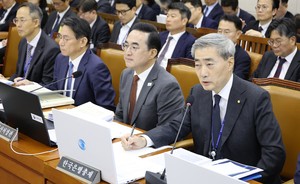
Remarks at National Assembly national audit Bank of Korea Governor Shin Hyun-song said Friday that a return to the era of ultra-low interest rates seen in the past is unlikely. Shin made the remarks Friday afternoon at a comprehensive national audit by the National Assembly's Finance and Economy Planning Committee, where Democratic Party of Korea lawmaker Kim Tae-nyeon asked whether he agreed with that assessment. "I agree," Shin said. He also agreed with the view that policymakers should not simply wait for interest rates to fall again, but instead build an economic policy framework premised on a prolonged period of high interest rates. "I agree," he said. The Bank of Korea raised its benchmark interest rate to 3 percent in consecutive moves in July and August before holding it steady in October. Markets expect the central bank to raise rates again in November. "Going forward, growth rates and interest rates will move together, so rather than being trapped by the old concept of secular stagnation, we will pursue policies that prepare for a future of high growth and high interest rates," Shin said.
Oct. 23, 2026
-
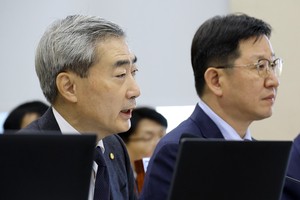
Shin Hyun-song says fiscal caution remarks not a denial of government's active role
Remarks at National Assembly comprehensive national audit Bank of Korea Governor Shin Hyun-song said his warnings about expansionary fiscal policy were "not a denial of the government's active role." Shin made the remark Friday afternoon at the National Assembly's Finance and Economy Planning Committee comprehensive national audit, responding "yes" when Democratic Party of Korea lawmaker Oh Ki-hyung asked whether he was denying the government's active role. At a monetary policy press briefing Thursday, Shin said there was a need to be mindful of whether fiscal spending was "without any problems," adding that "sustainability must always be kept in mind even if the fiscal multiplier is low." He added that "if temporary revenue sources give rise to ongoing expenditure, sustainability deserves particularly close attention," because "continuing expenditure can create items that become impossible to reverse." At Friday's comprehensive national audit, Shin clarified that his Thursday remarks were intended to convey that "if the revenue source is temporary, there needs to be a plan for long-term spending, and if obligations arise that require continued outlays, rigidity sets in and it becomes difficult to reverse course." On the government's role regarding vulnerable borrowers, Shin said South Korea is in a situation where "polarization is quite severe," and that "while income support is of course important, measures for vulnerable borrowers are also urgently needed." He added that "support measures for vulnerable borrowers are largely fiscal in nature, and in that sense fiscal policy and monetary policy must work in harmony."
Oct. 23, 2026
-

Auto insurance loss ratios improve through September on lower rainfall, reduced traffic
September monthly loss ratio hits 85.0%, down 9.2 percentage points from a year earlier; autumn travel season and rising repair costs raise concerns about year-end deterioration The cumulative auto insurance loss ratios of South Korea's major non-life insurers through September came in slightly lower than a year earlier, driven by a sharp drop in rainfall and reduced highway traffic. However, industry watchers warn that loss ratios could climb again toward year-end as the autumn travel season picks up and cost pressures mount. According to the non-life insurance industry on Friday, the average cumulative auto insurance loss ratio for the January–September period at the four largest non-life insurers — Samsung Fire, Hyundai Marine & Fire Insurance, DB Insurance and KB Insurance — stood at 84.7 percent, down 0.8 percentage points from 85.5 percent in the same period last year. Through August, the figure had been running 0.3 percentage points above the prior-year level, but the September results pulled it into a year-on-year decline. Among the four, KB Insurance posted the highest cumulative loss ratio at 85.0 percent, followed by DB Insurance and Hyundai Marine & Fire Insurance at 84.8 percent each, and Samsung Fire at 84.3 percent. Compared with a year earlier, Samsung Fire improved the most, falling 1.5 percentage points, followed by Hyundai Marine & Fire Insurance at 1.2 percentage points and KB Insurance at 0.4 percentage points. DB Insurance was the only one to worsen, edging up 0.1 percentage points. Mid-tier insurer Meritz Fire also improved, with its cumulative loss ratio falling 1.4 percentage points to 82.8 percent. The improvement was even more pronounced on a single-month basis. The four major insurers averaged a September loss ratio of 85.0 percent, down 9.2 percentage points from 94.2 percent in September last year, when all four saw their ratios soar into the 92–95 percent range. For this September, Hyundai Marine & Fire Insurance led at 86.1 percent, followed by Samsung Fire at 85.3 percent, KB Insurance at 85.2 percent and DB Insurance at 83.3 percent. The General Insurance Association of Korea attributed the improvement to seasonal factors, including lower rainfall and reduced traffic. September rainfall this year totaled 26.4 millimeters, roughly one-ninth of the 228.8 millimeters recorded in September last year. Highway traffic over the same period fell about 7.1 percent, from about 285.38 million vehicle trips to about 265.03 million, reducing the number of accident claims filed. Seasonal factors are now expected to work in the opposite direction, however. October marks the peak of autumn foliage season, when leisure travel surges, potentially driving up both the number of accidents and the cost of personal injury per incident. Rising repair shop labor rates and daily wage increases for temporary workers add further cost pressure. "We are concerned that the peak autumn foliage season in October will increase leisure travel demand, pushing up both accident counts and personal injury costs per accident," an official at the General Insurance Association of Korea said. "With cost-side pressures such as continued increases in repair rates and daily wages for temporary workers still widespread, loss ratios are expected to deteriorate going forward."
Oct. 23, 2026
-
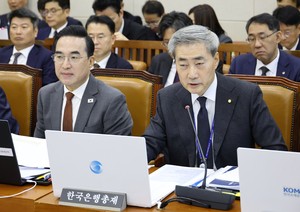
Shin Hyun-song says preemptive rate hikes gave Bank of Korea room to maneuver
Remarks made at National Assembly fiscal committee national audit Bank of Korea Governor Shin Hyun-song said the central bank's preemptive rate hikes in July and August gave it "room to maneuver in conducting monetary policy in line with domestic conditions." Speaking at a national audit session of the National Assembly's Finance and Economy Planning Committee on Friday afternoon, Shin said the Bank of Korea raised rates in two consecutive months — July and August — explaining at the time that the moves were preemptive. "After that, the US Federal Reserve also raised rates, and there were external shocks including a rise in long-term interest rates abroad," he said. "By raising rates twice in a row at that point, we gained room to conduct monetary policy well in line with domestic conditions," Shin added. "In that sense, acting early — nipping it in the bud — proved more helpful for monetary policy management this time around." Shin said inflation is expected to remain above the Bank of Korea's target level and will likely stay considerably elevated next year as well. He added that the bank's commitment to respond "until inflation converges to the target level" does not mean an immediate rate hike, but rather that the goal will be achieved gradually within the monetary policy timeline, taking various economic conditions into account.
Oct. 23, 2026
-
Jeonbuk Bank, Finda to jointly acquire Daewon Savings Bank with 40-60 stake split
Business expansion through fintech partnership Jeonbuk Bank and fintech firm Finda will jointly acquire Daewon Savings Bank, combining the bank's credit assessment and risk management expertise with Finda's data and AI technology to expand their cooperation into the savings bank sector. Jeonbuk Bank announced Friday that the joint acquisition with Finda received regulatory approval Wednesday. Under the deal, Finda will take a 60 percent stake as the largest shareholder, while Jeonbuk Bank will hold the remaining 40 percent. The acquisition extends a strategic partnership the two companies formed in 2023. They plan to build on their existing cooperation by expanding into savings bank operations to pursue new business opportunities. Daewon Savings Bank, founded in 1998, is based in Gyeongju, North Gyeongsang Province. Finda will drive business innovation using financial data and IT capabilities, while Jeonbuk Bank will support credit assessment, risk management and internal controls to ensure stable operations. By broadening their collaboration from product brokerage to running a financial institution, the two companies aim to build a foundation connecting data analysis to product design, screening and post-management. The partners plan to integrate data and AI technology into financial product development and business operations to expand personalized services and improve operational efficiency. Jeonbuk Bank will also apply AI experience gained through the partnership to its existing business in stages. The bank is also exploring ways to improve the convenience and accessibility of consulting and non-face-to-face services for everyday consumers, small business owners and foreign customers. "This joint acquisition will be an important opportunity to expand into new business areas and accumulate experience and capabilities in applying AI technology to actual financial operations," Jeonbuk Bank President Park Chun-won said. "We will continuously strengthen our role in regional and inclusive finance while actively leveraging fintech and AI technology to provide customers with more convenient and differentiated financial services."
Oct. 23, 2026
-

IBK launches Pokémon credit card with 30% subscription discount
Six popular Pokémon designs available; card sold online only Industrial Bank of Korea has launched an online-only credit card featuring Pokémon characters. The bank introduced the "I-Pokémon Credit Card" on Thursday, offering six designs based on popular characters — Pikachu, Eevee, Snorlax, Charizard, Team Rocket and Squirtle Fire Brigade. The card offers discounts across everyday spending categories. Subscribers to streaming services such as Netflix and YouTube Premium receive 30 percent off, while fashion retailers and convenience stores offer 10 percent off. A 5 percent discount applies to restaurants, cafes, CJ Olive Young, Daiso, transportation and online food delivery services. Available exclusively to individual customers, the card can be applied for through the i-ONE Bank personal app or the IBK Card app. Annual fees are 15,000 won ($11) for the domestic-only BC version and 18,000 won for the international version, which supports Visa and Mastercard. "Through this card, we aim to offer customers both the joy of collecting beloved Pokémon and practical discounts in their daily lives," a bank official said. "We will continue to introduce products that reflect current trends and enhance customer satisfaction in everyday life." Meanwhile, Industrial Bank of Korea is expanding digital financial services for corporate clients. On Tuesday, it became the first financial institution in South Korea to apply "corporate public MyData" to corporate deposit services, and plans to extend the system to corporate cards by year's end.
Oct. 23, 2026
-

BOK chief backs future growth fund, calls long-term investment 'desirable and necessary'
Remarks made at National Assembly audit Recent rise in long-term rates tied to competition for funding Bank of Korea Governor Shin Hyun-song said Friday that the government's proposed future response fund represents investment that is "desirable and necessary" for raising long-term growth. Speaking at a comprehensive audit of the National Assembly's Finance and Economy Planning Committee, Shin responded to a question from Democratic Party of Korea lawmaker Kim Young-hwan about the outlook for South Korea's potential growth rate, calling the current moment "an important inflection point." He said the long-term stagnation thesis that had persisted since the 2010s was being shaken, and that the trajectory of global potential growth was improving. Shin added that there had been broad consensus at the IMF annual meetings that the recent trend of rising investment and higher long-term interest rates was not a fiscal problem but was instead linked to improving returns on investment. When Kim asked how South Korea could take a leading role in this environment and what Shin thought of the future response fund, the governor said investment aimed at raising long-term growth was "desirable and necessary." He also said competition in financial markets to secure long-term funding had become quite active, and agreed that the recent rise in long-term interest rates stemmed from that competition. Last month the government approved next year's budget at a cabinet meeting, setting total expenditure at 820.9 trillion won ($620 billion) — a 93 trillion won, or 12.8 percent, increase from this year's original budget of 727.9 trillion won. The plan includes a newly created future response fund worth 162 trillion won, financed in part by additional tax revenue from the semiconductor sector, with 45 trillion won earmarked for future-oriented investment. Some critics have warned of the risks of expanding the budget on the back of what they see as a temporary semiconductor boom. Because spending, once increased, is difficult to cut, they argue that a future downturn in the semiconductor cycle could significantly worsen the fiscal burden. Former BOK Governor Lee Chang-yong has also raised concerns about expansionary fiscal policy on several recent occasions. Shin has generally been supportive of the government's expansionary fiscal stance, arguing that as long as the budget is directed toward raising potential growth, it need not be at odds with a restrictive monetary policy. However, on Thursday he warned at a post-rate-decision press conference about the risks of expansionary fiscal policy. While investment to raise potential growth is necessary, he said, the sustainability of budget execution deserves careful attention. On Friday, addressing concerns about the government's expansionary fiscal stance, Shin said the budget contained "a significant amount of transfer payments alongside investment items," and noted that transfer payments have a limited impact on GDP as measured by the fiscal multiplier. Transfer payments refer to funds or goods the government disburses unilaterally without receiving anything in return. Shin had earlier told the same committee's national audit that next year's budget was expected to affect GDP and prices by 0.5 percent and 0.06 percent, respectively. Even so, Shin said it was necessary to remain attentive to whether fiscal spending posed any problems, stressing that sustainability must always be kept in mind even when the fiscal multiplier is low. He added that if temporary revenue sources gave rise to ongoing expenditure, sustainability would require especially close attention, because continued spending could create items that become impossible to reverse. He said that when designing spending with sustainability in mind, policymakers should consider how easily outlays could be unwound if the circumstances were temporary — otherwise, concerns about sustainability could arise. Shin added, however, that the fiscal authorities would be keeping a close watch, and that ultimately it would be up to the National Assembly to scrutinize the budget rigorously.
Oct. 23, 2026
-
Kyobo Life settles claims in 2 hours on average, fastest among life insurers
Average rapid-payment period of 0.24 days in H1 About one-third of industry average of 0.71 days AI-powered automated review cuts processing time Kyobo Life said Friday it ranked first among domestic life insurers in claims processing speed during the first half of this year, with an average rapid-payment period of 0.24 days, driven by its AI-based review system. That is roughly three times faster than the industry average of 0.71 days. Based on an eight-hour business day, the figure translates to an average of about two hours from the time a customer files a claim to when payment is received. The rapid-payment period measures the average time taken for claims settled within three business days of receiving the required documents. Kyobo Life attributed the faster turnaround to a full digital transformation of its claims payment process. The company said it upgraded its AI automated review model and optical character recognition system for claim documents, and built a framework that triggers payment immediately once a review is complete. Kyobo Life introduced an AI automated review system for accident insurance claims in 2020 and has since expanded automatic recognition to a wider range of claim documents — including medical certificates and hospitalization, discharge, surgery and outpatient confirmation records — a first in the industry. The machine learning-based AI model assesses the difficulty of each claim and determines whether automated processing is applicable, improving both speed and accuracy. The company said the initiative reflects the customer-protection philosophy of Kyobo Life Chairman and Chief Executive Shin Chang-jae. Shin has repeatedly said that the essence of life insurance lies in delivering on promised coverage when customers face hardship from illness or accident, helping them overcome adversity. At the "The Race Kyobo Lo-Run" marathon event in April, he said life insurers and financial planners should serve as "pacemakers" who help customers push through difficult times and complete the race of life. Kyobo Life has also made its payment notifications more detailed. Since June, the company has been sending claims payment alerts that include a breakdown of payouts by coverage item, a summary by treatment type, and an explanation of any excluded items and the reasons for exclusion. Personalized guidance messages, previously sent only to customers receiving cancer or death benefits, have been extended to those receiving diagnosis benefits for brain and cardiovascular conditions, along with health management content to support treatment and recovery. Support at the claims filing stage continues as well. The "Lifetime Steady Service," launched in 2011 as an industry first, assigns a dedicated financial planner to regularly review a customer's coverage, identify unclaimed benefits and assist with filing. The service handles about 500,000 claims assistance cases a year, averaging 48.5 billion won ($36.6 million) per month. Cumulative users surpassed 2.01 million as of the end of last year. "Claims payment is the most important moment for fulfilling our promise to customers and the core service that demonstrates the true value of life insurance," a Kyobo Life official said. "We will continue to leverage AI and digital technology to improve the speed and accuracy of claims payment and strengthen the coverage services that customers can feel." Meanwhile, Kyobo Life also ranked first in the second half of last year with an average rapid-payment period of 0.22 days, according to disclosures by the Korea Life Insurance Association.
Oct. 23, 2026
-

AI startups backed by Hashed hit hundreds of millions in monthly sales, score exits
Hashed CEO Kim Seo-jun highlights AI-driven organizations at Nitro Track Day Firm to recruit founding teams on rolling basis, expand direct AI company launches Founding teams that participated in global digital asset venture capital firm Hashed's startup support program are delivering results, with some posting hundreds of millions of won in monthly sales and others completing successful exits. Hashed plans to recruit promising founding teams on a rolling basis, offering rapid small-ticket investments and connections to global investors. At the Nitro Track Day event held Thursday at Hashed Lounge in Gangnam-gu, Seoul, CEO Kim Seo-jun said he began rethinking the firm's investment approach after witnessing solo "vibe coding" founders generate significant revenue. "When Claude Opus 4.5 appeared late last year and I saw solo vibe-coding founders pulling in major sales, I realized we couldn't keep investing the way we had been," he said. "I wanted to build a community where we could work alongside people who are hard to find through traditional VC methods." Nitro is Hashed's AI-focused community for founders and developers. It is a revamped version of Hashed Vibe Labs, a startup support program launched earlier this year, and is designed to help founders share lessons learned during the development process and collaborate with experts. At a Game Day event held in April, Hashed unveiled products from four teams: KYRO, GPTO, Elyn and GGUI. Kim said GPTO has since secured investment from Hashed's main fund and grown into a company generating hundreds of millions of won in monthly sales, while Elyn achieved a successful exit after rapid growth in a short period. Hashed is also expanding its own AI ventures. At the event, Kim introduced two in-house projects: Vooy, an AI agent service, and Morpio, an AI animation production project. He said Vooy has integrated connections to roughly 110 external services across South Korea and Japan, while Morpio is developing technology to render text and comic-book scenes into video. Hashed also plans to build a platform connecting Nitro participants with global investors and major South Korean conglomerates. "A defining feature of the Hashed fund is that virtually all of Korea's major conglomerates are in as limited partners," Kim said. "We want to provide a platform that enables interaction with Samsung, Naver, Kakao, LG Group, SK Group, Hanwha, Nexon and Krafton."
Oct. 23, 2026
-

'I'm 27 weeks pregnant — can I travel to Europe?' Expectant mothers fill prenatal wellness talk
Hanwha General Insurance hosts 'Plus Clover Prenatal Wellness Talk' Audience resonates with gap in travel insurance for pregnant women Live Q&A covers pregnancy, childbirth, career and mental health 'Wellness Cruise Hannam' runs through Sunday at Hannam office "I'm 27 weeks pregnant and have an important business trip to Europe in two weeks. Skipping it isn't really an option for my career — what should I be careful about?" The question came from one of the expectant mothers in the audience at the "Plus Clover Prenatal Wellness Talk," held Thursday at Hanwha General Insurance's Hannam office in Yongsan-gu, Seoul. Obstetrician Ryu Ji-hyeon, one of the event's panelists, urged caution. "Weeks 12 through 25 are the most stable period," she said. "From week 28, the risk of preterm labor starts to rise." She added that if travel was unavoidable, she would recommend taking out travel insurance and bringing a cream to ease sudden abdominal tightening. Lee Seon-young, an MBC announcer who hosted the event, said she had looked into travel insurance when planning a prenatal trip to the United States during her own pregnancy, only to find that maternity-related coverage was almost entirely absent from policy riders. "Travel insurance specifically for pregnant women is absolutely necessary," she said. Influencer Ha Eun-mi, also on the panel, agreed. "We really do need prenatal travel insurance," she said. Standard overseas travel insurance typically excludes pregnancy- and childbirth-related losses. Prenatal travel has become an established part of Korean culture, yet expectant mothers have little insurance to fall back on. The event drew 15 pregnant women — all at least 15 weeks along — who had applied in advance, and the session became a forum where consumers themselves identified gaps in available products, covering concerns ranging from pregnancy and childbirth to career and mental health. The talk show was a spin-off of the YouTube series "Sanjeonchoriwon," a prenatal wellness content series, brought to life as a live event by Plus Clover, Hanwha General Insurance's wellness brand for women during pregnancy, childbirth and child-rearing. The event was built around the idea that preparation before birth matters as much as postpartum care, and offered a space for candid conversation about the realities of becoming a mother. The atmosphere was one of continuous solidarity. Lee shared her own experience of being taken off an early-morning news program as soon as she disclosed her pregnancy, under maternity protection regulations. More than half of the 15 attendees said they planned to return to work after giving birth, and audible sighs of recognition rippled through the audience. Questions kept coming — on managing gestational diabetes, on twin pregnancies — and the talk show was broadcast live online. Im Hyeon-jae, 30, who is 17 weeks pregnant, said the concept of a prenatal wellness program was new to her. "Everyone focuses on the baby during this period, but I could feel that Hanwha General Insurance was looking out for women's lives," she said. Ju Hui, 29, said she was moved to tears by the space and the talk. "I already have a fetal insurance policy with Hanwha General Insurance, so it meant even more to see a major insurer put together something like this," she said. The talk show was part of "Wellness Cruise Hannam," an urban wellness and culture festival Hanwha General Insurance is hosting at its Hannam office through Sunday. The company's first wellness culture project of its kind, the festival brings together more than 30 brands — including Plus Clover — across 12 themed spaces centered on exercise, food and rest. Highlights include exercise equipment reimagined as art installations at "Yachae Gym," a local food culture class, an ondol-style sauna, and a casino-concept space where visitors can play a game built around a wellness-type test developed by Hanwha General Insurance's femtech research lab. Admission is free with no ticket required, and the venue is open from 11 a.m. to 9 p.m. through Sunday. Hanwha General Insurance has set "leading partner for customer wellness" as its corporate mission. The insurer has been expanding its touchpoints with female customers by pairing women-focused insurance products with offline wellness spaces.
Oct. 23, 2026
-
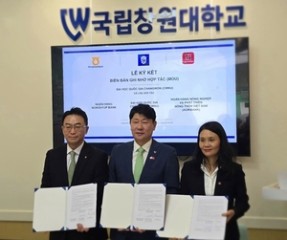
NH NongHyup Bank signs three-way MOU to support Vietnamese student recruitment at Changwon National University
Three-way MOU signed in Hanoi Partnership covers local recruitment, tuition and living-expense remittances NH NongHyup Bank, Agribank to expand cooperation on remittances, card marketing NH NongHyup Bank has teamed up with Vietnam's Agribank and Changwon National University to support the recruitment of Vietnamese students and provide them with financial services. The bank announced Friday that it signed an MOU with Agribank and Changwon National University in Hanoi on Thursday, formalizing the three-way partnership. Under the agreement, Agribank will use its local branch network and other in-country channels to support Changwon National University's student recruitment efforts in Vietnam, helping raise the university's profile and attract prospective students. NH NongHyup Bank and Agribank will also link financial services for students from the pre-departure stage through their enrollment in South Korea. The two banks plan to offer foreign exchange services — including tuition and living-expense remittances — as well as other financial products needed before and after students begin their studies. NH NongHyup Bank and Agribank signed a strategic cooperation MOU in April, under which they have been pursuing customer base expansion, card-based overseas remittance services, K-content-linked card marketing and cooperation on Agribank's privatization. In July, Agribank President Pham Toan Vuong and other executives and staff visited South Korea for a follow-up strategy meeting. "This agreement is meaningful in that it supports Changwon National University — one of our institutional customers — in recruiting Vietnamese students, while at the same time providing those students with convenient financial services and expanding our foreign customer base," said Ji Seong-uk, head of NH NongHyup Bank's Hanoi Financial Center. "We will work closely together to develop this into a cooperation model that benefits Vietnamese students, Changwon National University and Agribank alike." Meanwhile, NH NongHyup Bank has been stepping up efforts to grow its foreign customer base domestically. The bank operates a specialized advisory center for companies with foreign direct investment and has been expanding financial services targeting foreign customers and businesses.
Oct. 23, 2026
-

Finda Savings Bank names Park Yeon-hyun, ex-Toss Bank executive, as inaugural CEO
Park led launch of Korea's first co-lending product at Toss Bank Targets January operations; to oversee product development and launch preparations Finda has appointed Park Yeon-hyun, former head of corporate products at Toss Bank, as the inaugural CEO of Daewon Savings Bank, which Finda recently acquired. Park led the launch of "Hamkke Daechul" ("Together Loan"), Korea's first co-lending product, and will now spearhead the fintech firm's push to build a digital savings bank powered by its financial data. Finda announced Friday that it had named Park as the first CEO of what will be rebranded as Finda Savings Bank. Born in 1989, Park graduated from Korea University with degrees in business administration and statistics before working as a financial strategy consultant at Deloitte Consulting. He joined Toss Bank as a founding member in 2020, where he helped establish the bank and shape its business strategy while driving new ventures. At Toss Bank, he served as project owner of the co-lending squad, overseeing the entire process — from conception and product design to launch — of the co-lending product. He went on to serve as head of strategy development and later head of corporate products, advancing new financial businesses including co-lending and corporate banking. Finda valued Park's expertise in lending and his hands-on experience building a bank from the ground up. "Park was a founding member of Toss Bank and has a deep understanding of overall bank operations that Finda has not had firsthand experience with," a Finda official said. "Given that Finda Savings Bank will not have a large staff, swift decision-making will be critical. We expect him to fill that role." On Wednesday, Finda received approval from the Financial Services Commission to change the major shareholder of Daewon Savings Bank as part of the acquisition — the first time a domestic fintech company has taken over a savings bank. The total acquisition price is 12 billion won ($9.05 million), with Finda securing a 60 percent stake and Jeonbuk Bank, an affiliate of JB Financial Group, holding the remaining 40 percent. Finda plans to combine Park's experience in financial product development with its own data and AI technology to strengthen the savings bank's lending competitiveness. The company intends to analyze customer financial needs using data accumulated through its existing loan comparison and brokerage platform, then apply those insights to credit screening and product design. Park's co-lending background also raises the prospect of his introducing a new lending model rarely seen in the savings bank sector. Ahead of the planned January launch, he is expected to oversee all preparations — including relocating the head office, changing the corporate name, creating a logo, promoting the brand and opening pre-registrations for new products. "The competitiveness of a financial product depends on how accurately you understand the customer's situation and needs," Park said. "Drawing on the data and customer insights Finda has built up, I will design products that genuinely meet the needs of financial consumers and work to create a new banking model driven by data and technology."
Oct. 23, 2026
MOST READ
- 1Hyundai Mobis to develop robot semiconductors for Atlas humanoid
- 2Anpanman rolls out to all CJ Olive Young stores with limited-edition collabs from 30-plus brands
- 3Korean woman's mugshot goes viral in US after DUI arrest in Georgia
- 4Theater actor Kim Hyun-i asks public to stop sharing her photos after mix-up with late stunt performer of same name
- 5‘Blockchain won’t replace banks — integration is the key‘: Bankfrick
- 6Paper straws more harmful than plastic? Study finds 6 times higher cancer risk, double the acidification
-
WORLD

US warns of punishment for anyone enabling Iran's Strait of Hormuz toll scheme
-
INDUSTRY
Toyota union puts productivity first; Hyundai Motor union demands bigger share of profits
-
FINANCE

National Growth Fund to invest $531M in FuriosaAI, which rebuffed Meta's $800M takeover bid
-
INDUSTRY

Korea Shipowners' Association holds amateur baduk tournament for Maritime Day