
- HOME
- OPINION
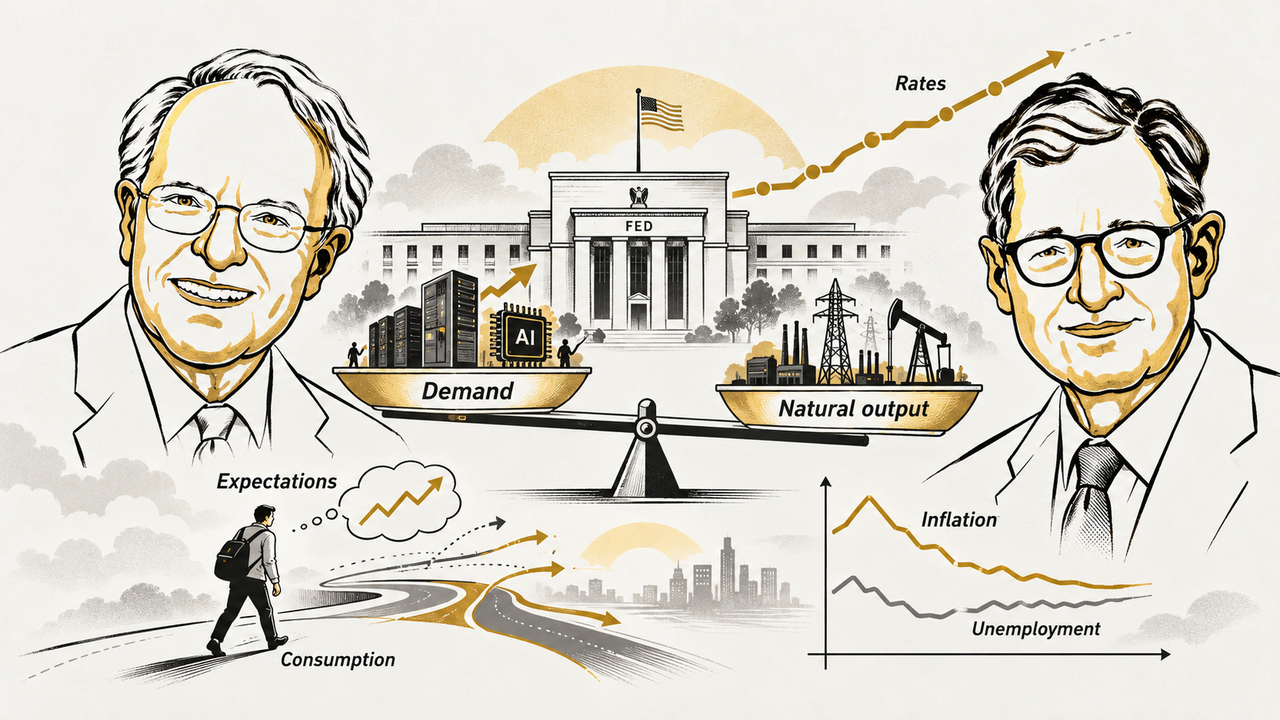
What the Nobel Prize in Economics tells us about the Fed's next move
Key takeaways: - This year's Nobel laureates in economics reaffirmed that macroeconomic analysis must begin not from the top down but from the actual behavior of households and businesses. - When an economic slowdown and a supply shock occur simultaneously, premature demand stimulus can fuel inflation. Once price stability breaks down, economic stability becomes equally elusive. - A central bank's role extends beyond setting interest rates. Accurately reading economic conditions on the ground and communicating future policy direction in a way that markets and economic actors can trust are themselves part of monetary policy. - Ultimately, Fed Chair Kevin Warsh's success or failure will hinge on how well he reads the real economy and how effectively he communicates with markets. The winners of the 2026 Nobel Prize in Economics have been announced: Robert E. Hall, professor emeritus at Stanford University, and Michael Woodford, professor at Columbia University. The two scholars laid the theoretical groundwork that led us to pay attention not only to interest rate decisions by the Federal Reserve and other central banks around the world, but also to the expected path of future rates and the messages those institutions send. Their research is already being applied directly to central bank policymaking. It is quite significant that their work has been recognized with the Nobel Prize at a moment when inflation and supply chain disruptions have thrust the role of central banks back into the spotlight. Examining their contributions also offers considerable help in anticipating where central banks are headed. Their insights can be distilled into two questions and their answers. Will benchmark interest rates rise further? Is Fed Chair Kevin Warsh doing a good job? The limits of Keynesianism — too far removed from the real economy Traditional Keynesian models assumed that the statistical relationships among major macroeconomic variables — inflation, unemployment, consumption and output — were relatively stable and broadly linear. The Phillips curve, which holds that inflation tends to fall when unemployment is high and rise when unemployment is low, is the classic example. The assumption that household consumption rises when disposable income increases follows the same logic. Then came the oil shocks of the 1970s, when unemployment rose even as inflation climbed. The relationship between income and consumption also proved far less stable than the models had assumed. Overstimulating demand in response to the slowdown and rising unemployment made inflation worse, leaving years of low growth and high prices as a lasting legacy. Robert E. Lucas Jr., who won the Nobel Prize in Economics in 1995, identified the limits of this approach. Inflation is shaped by the pricing decisions of countless individual firms. Private consumption flows from the decisions of countless households. Output is determined by the choices of individual companies and workers. Lucas argued that macroeconomic phenomena can only be properly understood by studying the behavior of individual economic actors and aggregating those findings. People respond to information — a shift in thinking Robert E. Hall is among the most prominent researchers to have given concrete form to the "microfoundations" Lucas demanded, doing so in the realm of consumption. Hall argued that what matters for changes in household consumption is not information that has already been anticipated, but unexpected new information. If a salary increase next year is already certain, people can factor that into their spending plans now rather than waiting until next year arrives. Only when new information arrives that changes their view of the future will their consumption plans shift. Woodford brought this forward-looking consumer into macroeconomic models. The key variable in that framework is the interest rate — not the current rate alone, but the expected path of real interest rates going forward. When rates are expected to stay high, saving becomes more attractive than current spending; when the opposite holds, current consumption rises. A central bank can move today's consumption and investment by adjusting the current rate while simultaneously shaping expectations about future rates. The same forward-looking logic applies to corporate pricing decisions. Firms set their current prices based on expectations about how competitors' prices and their own costs will evolve. Ultimately, what people believe about how a central bank will respond to future inflation and interest rates also influences prices today. That is why Woodford placed such weight on central bank credibility, transparency and policy communication. The New Keynesian model that emerged from Hall and Woodford's research can prescribe a different course of action from simple demand stimulus when the economy faces a supply shock — a sudden surge in energy prices, a disruption to global supply chains, or any other event that abruptly affects the economy's productive potential. The prescription is to accept a near-term growth slowdown and align demand with reduced supply capacity in order to prevent inflation from getting out of control. Cutting rates to stimulate demand when the economy is weak risks channeling more demand into a supply-constrained economy, which can make inflation worse rather than better. Question 1: Will rates rise further? Probably. Now for the answers. On interest rates: US economic data show that consumption remains solid. Real personal consumption expenditures rose 0.6 percent month on month in August, PCE inflation was up 3.4 percent year on year, and core PCE climbed 3.0 percent. Enormous capital demand driven by AI investment, some supply bottlenecks, and energy supply shocks stemming from ongoing conflicts continue to weigh on the economy. Applying the Hall-Woodford framework to the current US economy, there is at least no case for rushing to cut rates. If anything, the case for a further hike could be made. The minutes of the September FOMC meeting, at which the benchmark interest rate was raised, show that Fed participants flagged the possibility that AI investment could push aggregate demand above aggregate supply, along with energy shocks and still-elevated inflation. Some participants actually raised their estimates of the neutral rate. Several judged that the current benchmark rate of 3.75 to 4.00 percent was "not restrictive, or only slightly restrictive." What matters here is not the number itself — the fact that the benchmark rate is close to 4 percent. What matters is how far the current rate actually stands above the neutral rate. If AI investment, productivity gains and large-scale fiscal demand have pushed the economy's neutral rate higher, then 4 percent — once considered comfortably high — may not represent as strong a tightening stance as it once did. Chair Warsh voted in favor of the September rate hike, showing a hawkish streak that ran counter to the expectations — or perhaps hopes — of President Donald Trump, who appointed him. Markets also widely expect the Fed to raise rates again in December, even if doing so at the October meeting, just before the midterm elections, would be difficult. Question 2: Is Warsh doing a good job? He needs to be. Since taking office, Warsh has consistently expressed skepticism about forward guidance, arguing that it can distort price discovery by making markets focus on the Fed rather than on the economy itself. Warsh's logic has merit. If the Fed spells out its future rate path too helpfully, markets end up watching the Fed's every word rather than processing real information coming from the economy. The Fed then looks at the market prices shaped by that dynamic to inform its own policy judgments — what Warsh calls a kind of "hall of mirrors." But the risks on the other side are equally serious. If economic actors cannot get adequate information about the central bank's policy direction and uncertainty about inflation and interest rates grows, consumption and investment can contract. Greater uncertainty about the rate path also raises the risk premium investors demand. As a result, market interest rates can climb even without the central bank raising its benchmark rate. Ultimately, Warsh's experiment is a challenge to the tradition of "expectations management" that modern central banks have built since Woodford. Is Warsh right to warn against the excesses of forward guidance? Or does Woodford's insight — that central banks must offer credible policy direction to reduce uncertainty — still matter more? Warsh is making rate decisions that broadly resemble the Woodford prescription, while simultaneously challenging the post-Woodford tradition in the way he communicates policy. US long-term Treasury yields top 5% — warning or opportunity? The hottest issue in financial markets right now is elevated long-term interest rates — the product of a complex interplay of high oil prices, the US fiscal deficit and government bond supply, large-scale bond issuance by AI companies, and mortgage-related hedging activity. Monetary policy primarily feeds through to short-term rates directly, but market perceptions of inflation and the central bank's response also reach all the way to long-term rates. If the Fed demonstrates sufficient resolve to tighten, bringing down inflation expectations and cooling an overheating economy, that becomes a factor pulling long-term rates lower over the medium to long term. If markets instead judge the Fed's response to be inadequate, inflation expectations and risk premiums can keep long-term rates elevated. What matters most is the state of the economy when the Fed meets in December. As long-term rates have risen, wariness about AI investment and the semiconductor boom has also grown. With the yield on the 10-year US Treasury note surpassing 5 percent, the case for avoiding risk assets has strengthened considerably. If AI investment cools and the appeal of beaten-down bond prices comes to the fore, both the economy and share prices could turn down simultaneously. Should long-term rates fall on the back of weaker AI investment, falling share prices and growth concerns, the Fed's justification for further tightening would also weaken. But inflation has not gone away. What happens if energy supply shocks originating from Iran and Russia continue to push prices higher? Returning to the Hall-Woodford framework, the Fed's response in that scenario could well be further tightening despite an economic slowdown. If the Democratic Party wins a majority in the House in the US midterm elections, it could put the brakes on additional fiscal expansion by the Donald Trump administration. That would be a factor reducing government bond supply and long-term rates, but it would be a negative for the economy. In the end, the battle that will determine the direction of US interest rates is relatively clear. On one side stand a weakening economy and softening employment. On the other stand elevated inflation, supply shocks and a neutral rate that may have moved higher. If the former prevails, rates will fall. If the latter wins out, today's high rates will persist longer — or rise further. The balance of evidence so far makes it hard to dismiss the latter. An economy that needs high rates, shaken by the very rates it needs Applying the work of this year's Nobel laureates to the current US economy yields a paradoxical conclusion. The problem with the US economy may not be that rates are too high. The problem may be that demand and inflation are strong enough to require rates that high. But once those high rates begin to rattle AI investment and asset prices — stocks, bonds and the rest — the picture changes. If the Fed tightens aggressively, the economy and asset prices will suffer. If it moves slowly, inflation and long-term rates will not come down easily. An economy that needs high rates may ultimately be destabilized by the very rates it requires. That is probably the single most important thing markets should be watching between now and the December FOMC meeting. Korea faces a rougher road, with volatility already running high For the Korean stock market, where share price and exchange rate volatility are already unusually high, the pressure is even greater. Elevated US interest rates and long-term yields can heighten risk aversion and affect the flow of foreign capital. The won's recent strength — driven in part by export growth in semiconductors — despite a stronger dollar is itself a double-edged development. For foreign investors already holding Korean equities, a stronger won creates an incentive to realize currency gains. All else being equal, won appreciation also reduces the won-denominated sales and profits of export-oriented companies. Moreover, the semiconductors and AI sectors that have led the Korean market recently are precisely the large-scale investment industries most sensitive to high interest rates and long-term yields. A rate problem that starts in the United States can transmit simultaneously to share prices, the exchange rate and corporate investment in Korea. The external environment is daunting. The Korean stock market, which ranked among the world's best performers in the first half of the year before tumbling to near the bottom globally in the second half, has limited defenses it can build on its own — and ultimately those defenses come down to corporate value. We cannot change external interest rates. What Korean companies can do themselves is raise shareholder returns and capital efficiency, building the kind of corporate value that can withstand high rates. In the Joseon Dynasty, there was a practice known as "gwanpung" — observing the customs of the people. Officials would read the popular songs and poems of ordinary life to gauge the successes and failures of governance and the state of the world. Even the title "gwanchalsa," the highest provincial official overseeing a region, is connected to this tradition of gwanpung. In that tradition, poetry was not mere literature. It was the song of the people, carrying within it joy and sorrow, anger and longing, and the texture of daily life. The gains and losses of politics, the light and shadow of society, naturally surfaced in the songs of ordinary people. That is why those in power gathered the songs of the common folk to read the world. The tradition is far older than Joseon. The "Treatise on Food and Money" in the Book of Han records that in spring, officials would travel the roads collecting poems to present to the grand historian, who would then recite them to the Son of Heaven. "The king knows all under heaven without peering through his window." — Classic of Poetry The "Treatise on Arts and Literature" in the same work makes the purpose even clearer: "In ancient times there were officials who collected poetry. Through it, the king observed the customs of the people, learned of successes and failures, and corrected himself." Going back further still, the "Royal Regulations" chapter of the Book of Rites records that when the Son of Heaven made his royal tours, he would have the grand historian "present the poems to observe the customs of the people." The 160 poems of the Guofeng section of the Classic of Poetry are the most celebrated legacy of this idea, gathering songs from 15 different regions. The underlying conviction was that to know all under heaven from within the palace walls, one must first attend to the circumstances of each individual beyond them. What Hall and Woodford did in modern macroeconomics is ultimately the same bottom-up approach. They read the macro by aggregating the micro — the behavior of individual households and firms that determine consumption, prices and output. It is worth applying the same thinking to asset management. Rather than staring only at sweeping economic indicators, one must read what people are buying, where companies are putting their money, and what new information markets are reacting to. The world moves first in the daily lives of people; macroeconomic indicators and policy follow behind.
Hong Kil-yong Oct. 14, 2026
-
Herald Exclusive: Korea Customs Service Commissioner Lee Jong-wook
- Fighting trade-based financial crime hidden behind the numbers of trade In 2013, a company marked its 10th anniversary by crossing 1 trillion won ($749 million) in annual sales, with 80 percent of that revenue coming from overseas. A customs investigation the following year told a very different story. The company had been filing export declarations for home appliances that had never actually changed hands, listing prices of several million won per unit, then using the fabricated export documents to obtain more than 3 trillion won in fraudulent loans from commercial banks. Of that amount, roughly 540 billion won was never repaid — a burden that fell on the financial sector and the public, leaving a lasting stain on South Korea's economic history. The scandal is known today as the Monuel incident. In its wake, Korea Customs Service, the Korea Federation of Banks, and Korea Trade Insurance Corporation (K-SURE) worked closely together to prevent a repeat. They built a framework for sharing customs export-import data with bank loan-screening systems and achieved early detection of anomalies in trade receivables to block fraudulent lending. The Monuel case is a textbook example of trade-based financial crime (TBFC) — the exploitation of trade to defraud public finances or destabilize financial markets. More recently, such crimes have spread well beyond bank lending into capital markets, government subsidies, public procurement, and national health insurance funds. Recent customs enforcement cases illustrate the severity of the problem. One company was caught repeatedly importing and exporting cheap telecommunications components at inflated prices to manufacture a track record of strong sales, then exploiting that record to secure a stock market listing while also fraudulently collecting government subsidies. In another case, a supplier imported inexpensive Chinese fire-department lanterns, stripped off the country-of-origin labels, and passed the products off as domestically made before delivering them to fire stations nationwide. A separate company inflated the declared import prices of adult walkers — a category covered by long-term care benefits — to pocket excess reimbursements, adding to the financial burden on vulnerable members of society. Detecting these crimes accurately requires cross-referencing Korea Customs Service's export-import and foreign-exchange data against information held by the agencies that administer the relevant programs and systems. Those agencies have records on the companies they screen and support, but they face practical limits in independently verifying whether a company's declared export-import figures, transaction prices, and country of origin match actual trade activity. Korea Customs Service can analyze export-import and foreign-exchange transaction data to examine the substance of trade — real performance figures, prices, and counterparties — but it has limited visibility into which government support programs or public procurement contracts a given company may be involved in. What is needed, ultimately, is a collaborative framework in which each agency connects the information it holds to compensate for the blind spots of the others. That is precisely why Korea Customs Service launched a special TBFC investigation unit at Seoul Customs in early September. Under the arrangement, agencies including the Ministry of SMEs and Startups, the Public Procurement Service, and Korea Financial Intelligence Unit (KoFIU) supply company and transaction data to Korea Customs Service, which integrates it with export-import and foreign-exchange records for use in foreign-exchange inspections and investigations. The findings are passed back to the relevant agencies, which then impose necessary sanctions — recovering subsidies and restricting bidding rights — and close the regulatory gaps that allowed the abuse. In this way, the TBFC unit is dismantling the information silos between agencies and building an integrated, joint monitoring and enforcement system that spans data sharing, analysis, investigation, sanctions, and regulatory reform. At the center of the analytical work sits the TBFC Information Analysis Center, which operates under the special unit. The center consolidates information shared by partner agencies — covering capital markets, public procurement, government subsidy programs, and policy finance — and combines it with Korea Customs Service's own export-import and foreign-exchange data to identify suspect companies. Investigation and enforcement teams then act on those findings, opening criminal investigations or conducting foreign-exchange inspections depending on the nature of each case. Korea Customs Service is also considering signing MOUs with partner agencies to expand the network of collaborators and further develop the integrated joint monitoring and enforcement framework. The figures on trade documents serve as the basis for valuing companies, determining eligibility for government support and policy financing, and shaping investor decisions. When those figures are manipulated, the damage falls on honest businesses and investors, and public finances spring a leak. Korea Customs Service is committed to accurately identifying manipulation of performance records, prices, and country of origin hidden within export-import transactions, and to ensuring that its findings lead all the way through to recovery, sanctions, and regulatory reform. We will fulfill our responsibilities at the economic border so that the benefits of public policy flow in full to the citizens and businesses that genuinely deserve them.
Oct. 13, 2026
-
[Biz Insight] Put industrial ecosystem strategy first, and competitive advantage follows
The prevailing view of global competition remains largely company-centric. As businesses go multinational, they often overlook the fact that they are forming part of a single, large-scale ecosystem. It is worth internalizing the idea that companies do not compete as isolated entities but through the ecosystems they help build within their industries. That shift in perspective drives changes in thinking and, ultimately, in behavior. Managing a global company now demands an "ecosystem strategy." The industrial ecosystem a company belongs to spans multiple supply chains — from materials and components to finished-product manufacturing, logistics and sales. Optimizing processes across the entire supply chain is what creates competitiveness. When that optimization effort pays off, competitive advantage is secured, and over time an insurmountable gap opens up — what some call an "ultra-gap." Irreplaceability follows. This reveals that technological superiority alone does not produce such a gap. The supply chains within the ecosystem must, however, remain unobstructed. From raw materials and components through final assembly and sales, supply chains anchored by a handful of large companies depend on a wide network of partners. A tightly linked chain forms around the shared value of mutual benefit. Even when large companies pursue vertical integration and in-house strategies, the need for partner firms does not disappear. The law of nature — that an ecosystem collapses when it loses its health — applies equally here. A robust ecosystem mindset and strong bonds are essential. Maintaining those bonds and fostering cooperative partnerships to prevent supply chain disruptions become critical in this environment. With the international trading order in turmoil, supply chain instability is a constant risk. No company can afford to feel secure simply because its own operations are running smoothly. At the heart of cooperative partnership is not the supply of products but the supply and exchange of value — value that encompasses not only money but intangible elements such as closeness, trust and support. Over time, these ties harden into a more resilient relational structure. Yet the nature of such networks is fragile, and mutual consideration is indispensable. If a large company ignores the difficulties of its partners rather than sharing in them, the supply chain and the broader ecosystem can collapse in an instant. The reverse is equally true. Recently, a major semiconductor company announced it would cover up to 50 percent of the early-stage research and development costs that partner firms incur on high-risk projects, reimbursing those costs after the fact regardless of whether the projects succeed or fail. The move drew attention as a concrete step toward strengthening bonds between large companies and their suppliers. Jung Woon-chan, chairman of the Shared Growth Institute, said co-prosperity and shared growth represent "the highest-level management strategy for maximizing corporate value," adding that they "can serve as the means to sustain a robust industrial ecosystem that no one can challenge."
Oct. 13, 2026
-

Solidigm IPO: Who really benefits — and at whose expense?
① Solidigm does not urgently need a large capital infusion — yet certain parties stand to gain enormously from a listing. ② Transactions barred among SK affiliates in Korea face no such restrictions at Solidigm, a US-incorporated entity. ③ The more "they" profit from the Solidigm IPO, the less is left for the true owners: SK hynix shareholders. ④ A price return swap (PRS) structure was used to sell the SK Group stake of Chairman Chey Tae-won, who faces a court-ordered asset division. ⑤ For Solidigm to keep outperforming, SK hynix may have to keep making concessions — or sacrifices. SK Group investors are facing a complex equation. The variables — Solidigm's planned initial public offering and Chairman Chey Tae-won's divorce litigation — may seem unrelated at first glance, but they are intertwined. Many of the variables remain unknown. Plugging in the values one by one reveals a structure that may not be particularly welcome news for ordinary shareholders of SK hynix, widely regarded as a "people's stock." Bloomberg reported Thursday that Solidigm, a subsidiary two levels below SK hynix, has selected Goldman Sachs and Morgan Stanley as underwriters for its IPO. The listing is most likely to take place in 2027, with an estimated valuation of $100 billion and potential proceeds of around $10 billion. The underwriters are also said to be pursuing a pre-IPO round with two investors that could raise up to $7.2 billion. Does Solidigm really need $17 billion from outside investors? Does Solidigm truly need to raise as much as $17.2 billion in external capital? Reuters has reported that Solidigm is exploring its first NAND production base on the US East Coast, with New York state mentioned as a candidate. The required investment would vary widely depending on the type of facility. A back-end plant for SSD assembly and testing could be built for a few billion dollars, but a front-end fab for wafer production could easily exceed $10 billion in its first phase alone. SK hynix's interim financial statements as of late June show that NPS (SK hynix NAND Product Solutions Corp. and its subsidiaries), which includes Solidigm, posted net assets of 8.23 trillion won ($6.14 billion) and first-half net profit of 5.84 trillion won. In the same period last year, those figures were 2.27 trillion won and 132.1 billion won, respectively. A rough estimate based on the performance trends of rivals Kioxia and SanDisk suggests Solidigm's full-year net profit this year could reach 14 trillion to 16 trillion won, with some projections pointing to more than 20 trillion won in 2027. Assuming current industry conditions hold to some degree, cumulative earnings from the second half of this year through 2029 could reach $30 billion to $40 billion. Even if conditions deteriorate sharply from 2028 and profits fall by half, the accumulated earnings would still be substantial. Add depreciation, and operating cash flow would exceed net profit. Building a large-scale front-end fab in the United States would require enormous capital — but whether that money truly needs to come from outside investors is a question worth examining. The chairman's divorce and a 944 billion won asset division Chey Tae-won recently agreed to sell 944 billion won worth of his personal stake in SK Inc. — the same amount set by a court in the retrial of his divorce case against Noh So-young, director of Art Center Nabi. As a sale by a major shareholder, the transaction carries capital gains tax based on the acquisition cost, plus transaction fees. The exact tax liability depends on the original cost basis, but estimates put it at close to 700 billion won. Chey's side decided not to contest the 700 billion won portion of the 944 billion won total during the re-appeal process, seeking a Supreme Court ruling only on the remaining 244 billion won. In effect, he must secure at least 700 billion won to fund the asset division. What has drawn attention is the price return swap (PRS) contract he entered into with Korea Investment & Securities as part of the sale. TRS was the old favorite — now it's PRS? Chey's stake in SK Inc. is directly tied to his control over the group. Under the arrangement, he transfers shares worth about 400 billion won to Korea Investment & Securities, with the two sides settling the difference between the disposal price and a reference price three years later. If the share price rises, Chey keeps the gain; if it falls, he absorbs the loss. Ownership and voting rights pass to Korea Investment & Securities, but much of the price risk and upside remain with Chey. In economic substance it resembles a loan more than a sale — he secures immediate cash while retaining exposure to any appreciation in SK Inc.'s share price over three years. Although not disclosed publicly, the structure could also include a call option or right of first refusal allowing Chey to buy back the transferred stake at the contract's expiry. That would let him reclaim the shares at the original sale price even if the stock has risen. SK Group has previously used derivatives such as total return swaps (TRS) and call options in stake transactions involving SK E&S and SK Siltron, bringing in outside capital while preserving a path to reclaim the shares. The terms of the deal with the strategic investor that acquired 544 billion won worth of shares are therefore another variable — the possibility that Chey has built in an option to repurchase that stake cannot be ruled out at this stage. Chey holds a 29.3 percent stake in SK Siltron through a TRS arrangement. Selling it could net him hundreds of billions of won — but still not enough to buy back the SK Inc. shares he has just sold. Solidigm's valuation soars — as SK affiliates pile in Solidigm is currently a wholly owned subsidiary of NPS. SK Inc., which Chey directly controls, invested about 199.7 billion won in NPS in May. Back-calculating from the investment amount and the stake acquired implies an NPS valuation of roughly $10.5 billion at the time. SK Innovation also invested 89.5 billion won during the first half at a similar valuation. SK Telecom then invested 397.1 billion won in late July, implying a valuation of roughly $41 billion — nearly a tenfold increase in just a few months. The stakes these affiliates purchased were newly issued shares from NPS. Selling new shares at a discount — if that is indeed what happened — could mean SK hynix, as NPS's largest shareholder, got the short end of the deal. Under Korea's Fair Trade Act, SK Inc. as a holding company, and "uncle" companies SK Innovation and SK Telecom, are barred from investing in SK hynix domestically. Because NPS is a foreign entity, domestic regulations do not apply. The three companies plan to invest a combined total of $1.1 billion in NPS. Former SK hynix executives investing in Solidigm ahead of the IPO? The private equity fund said to be investing around 2 trillion won in Solidigm's pre-IPO round is TechBridge Investment. Some domestic media outlets have recently reported that former SK hynix executives — including former President Noh Jong-won, former Executive Vice President Hyun Eun-ah and former Executive Vice President Lee Jae-seo — are involved with TechBridge Investment. These are individuals who played central roles in Solidigm's creation and the acquisition of Intel's NAND business. How executives who only recently left SK hynix managed to raise capital in the trillion-won range is an open question — as is the identity of the limited partners who entrusted them with that money. US private equity funds are generally under no obligation to disclose their individual LP lists to the public, making it difficult to trace the source of the funds. Bloomberg put Solidigm's expected valuation at $100 billion — a discount of more than 20 percent to SanDisk — while Reuters recently cited a projection of $150 billion, on par with SanDisk. Solidigm signed a deal with CoreWeave on Aug. 7 giving it priority allocation of enterprise SSD production capacity, and on Wednesday announced an extended SSD partnership with Broadcom along with the addition of a contract manufacturing base in Taiwan. Both developments are the kind of news that could push the valuation higher. For pre-IPO investors, the listing is the clearest opportunity to realize gains. If the pre-IPO and IPO follow in quick succession within a year, early investors benefit most when the valuation rises as sharply as possible in a short period. Does Solidigm's valuation depend on SK hynix? That is especially true when the NAND market is booming, as it is now. Solidigm sources NAND wafers from SK hynix to manufacture enterprise SSDs. The lower the wafer price, the lower Solidigm's costs and the higher its profits — but the greater the burden on SK hynix. How SK hynix prices those wafers directly affects Solidigm's valuation. Arm's-length pricing rules and transfer pricing regulations exist for related-party transactions, but applying them to overseas entities is difficult in practice. Solidigm would not be the first large conglomerate subsidiary to list overseas. Hyundai Motor and LG Electronics have set precedents. Hyundai Motor held 100 percent of its India unit right up to the IPO and issued no new shares at listing. Instead, it sold a 17.5 percent existing stake through an offer for sale, with proceeds of roughly 3 trillion won flowing back to Hyundai Motor's parent. Hyundai Motor's stake fell from 100 percent to 82.5 percent, but not a single won of the public offering proceeds went into the India unit itself. The stated rationale for the listing was to build a local funding structure — while returning the fruits of years of growth to the parent company's shareholders. LG Electronics followed a similar approach with its India unit. In an IPO aimed at expanding local investment, LG Electronics sold 15 percent of its 100 percent stake as an existing-share offering. Proceeds of roughly 1.7 trillion won accrued to LG Electronics' parent. LG Group's holding company, LG Corp., did not purchase any shares in LG Electronics' India unit. "A person cannot draw a square with the left hand while simultaneously drawing a circle with the right." — Han Feizi, "Outer Congeries of Sayings, Lower Left Series" On Oct. 1, SK hynix said of the Solidigm situation: "Whether to use external or internal capital is a matter that must be judged by comprehensively considering not only the form but also the economic value impact on existing shareholders," adding that it would "review the impact on existing shareholders and the necessary shareholder protection measures, and provide a thorough explanation." Whether SK can draw a square with one hand and a circle with the other remains to be seen.
Oct. 9, 2026
-
Hangul Day, literacy and the call to act
Hangul Day is, at its core, a day for the written script — but we have come to think of it more broadly as a day for language itself. Calls to use proper Korean and to be mindful of foreign-language borrowings are all extensions of that linguistic concern. In that sense, Hangul Day has become Korean Language Day: a moment to reflect deeply on both our script and our speech. Yet, as is often noted, Hangul Day is only Hangul Day — one day a year — and that is precisely why meaningful change is so hard to sustain. Because Hangul Day centers on the script, there is a tendency to treat the use of hanja as something close to a transgression, and that attitude has been growing stronger of late. Some people see a hanja sign on a storefront and immediately think of China — even though the Chinese characters used in China differ from those used in Korea. People bristle at hanja yet shrug at the Latin alphabet, which lines every street and fills every television screen. Hangul Day is a day for hangul, and the question of the Latin alphabet deserves the same honest scrutiny we apply to hanja. Even King Sejong, who created hangul, almost certainly never intended to abolish hanja entirely. I am not calling for a ban on the Latin alphabet either. The point is that both hanja and the alphabet deserve thoughtful, deliberate use. Every Hangul Day, the media is flooded with stories about literacy. Children's reading comprehension is mocked with extreme anecdotes, and smartphones, video games and a lack of reading are blamed for the supposed decline. The argument that children no longer learn hanja is never far behind. Opinions on hanja education tend to be sharply divided. But would teaching hanja actually improve literacy? Even those who make that claim often seem to conflate literacy with vocabulary. It is true that a large share of Korean vocabulary has Chinese-character roots, but in most cases the problem is not ignorance of hanja — it is simply that people have not studied the words themselves. After all, how many people who invoke the word "vocabulary" could explain what its hanja characters actually mean? Adults who worry about children's literacy often give me pause. They fret about children's smartphone use, yet adult smartphone habits are hardly better. They worry about children playing video games, yet many adults spend entire days absorbed in YouTube. Most troubling are the adults who complain that young people do not read — because South Korea's adult reading rate is nothing short of embarrassing. A 2025 survey on adult reading found that six in 10 adults had not read a single book in the past year. These same people, who never pick up a book themselves, are anxious about whether children are reading enough. In reality, young people read far more than adults do. The single most effective way to encourage a child to read is to model the habit yourself. How many books have you read this year? The debate over whether to teach hanja raises one more critical question: are there enough people qualified to teach it? Many of those who advocate for hanja education do not actually know much hanja themselves — not difficult characters, but even the basics. University textbooks from several decades ago were filled with hanja; most of those books are now effectively obsolete because so few people can read them. Some academic journals still require hanja, but citation rates drop when hanja appears heavily, simply because readers cannot engage with what they cannot read. Even setting aside the question of universal hanja education, I do worry seriously about the dwindling number of specialists in classical Chinese writing. Who will be left to read and understand the works our own scholars wrote in the past? It is undeniable that hangul has enriched our linguistic lives. Without it, countless people would still be unable to read or write. Believers could not read the Bible or Buddhist scriptures. Writing a simple letter would have been a struggle. Sending or reading a text message would be unthinkable. The thought alone is sobering. The creation of hangul was a profound gift. But we must also remember the world that hangul was meant to reveal. No one should be left behind because they cannot read. A world where people are discriminated against or disadvantaged because of literacy is not a just world. And it is not only about literacy. No one should face discrimination for not knowing a foreign language, and no one should face discrimination for not knowing Korean. No one should be diminished for any reason. We must hold one another in esteem. The heart of literacy is not comprehension — it is action. If you have read something, you must live accordingly. If you have truly read about King Sejong's creation of hangul, you should be wrestling with what it means to be distinctly ourselves, and you should be dreaming of a world without discrimination. That is the world hangul was created to bring into being. By Cho Hyun-yong, professor at Kyung Hee University
Oct. 8, 2026
-
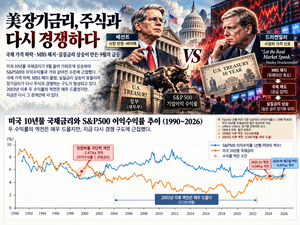
Will US long-term rates keep climbing? How the bond market called Bessent's bluff
Rising US long-term interest rates have become the defining issue in global financial markets. But why have they climbed so fast? Yields have now surpassed the expected return on stocks for the first time in 20 months — a yield gap inversion. The US fiscal deficit is nothing new, and recent inflation data came in below expectations. To understand what really drove September's rate surge, you need to look inside the bond market itself and at the mechanics of hedging. Bond yields and prices move in opposite directions. Try reading recent developments in the US Treasury market not as a "rate spike" but as a "price crash." Even bonds with fixed maturities and coupons trade at prices that shift constantly. When sell orders pile up — as in the stock market — prices fall, and those falling prices can trigger further selling. Who sold, and why? And what comes next? On Aug. 19, US Treasury Secretary Scott Bessent announced a plan to buy back long-term government bonds. The move was designed to absorb selling pressure in the market. When long-term rates rise, the interest cost of issuing new Treasuries increases — so the government's intention was to support bond prices directly and stabilize yields. On Aug. 24, Stanley Druckenmiller published an op-ed in the Wall Street Journal titled "Let the Bond Market Speak," criticizing any attempt to artificially suppress yields that reflect fiscal and economic realities. The two men once worked together at George Soros's hedge fund — and Druckenmiller is the very investor Bessent has long cited as the foremost expert in macro investing. Then, on Sept. 9, Bessent told an audience at Southern Methodist University: "I am the house now … bet against me if you want." What did he mean? Foreign governments, central banks and the Fed step back from Treasuries According to a Barclays analysis, the split between public-sector and private-sector holdings of US Treasuries was roughly 50-50 in both 2006 and 2016. By 2026, that had shifted to 73 percent private and 27 percent public. Foreign central banks and the Federal Reserve have stepped back, and their place has been taken by private capital — funds, banks and households. As the Donald Trump administration weaponized the dollar alongside its trade war, major governments pulled back from investing in long-term US Treasuries. The Fed's role has also changed. During the financial crisis and the COVID-19 pandemic, the Fed bought Treasuries and mortgage-backed securities on a massive scale through quantitative easing. As quantitative tightening subsequently shrank the Fed's balance sheet, private investors were left holding more bonds and more interest-rate risk. QT was halted in December last year. Even so, the Fed is reinvesting principal repayments from its MBS holdings not back into MBS but into short-term Treasuries. Fed Chair Kevin Warsh has signaled that unconventional tools like QE should be used sparingly outside of genuine crises. Bessent, who wants lower rates to reduce the government's borrowing costs, and Warsh, who is focused on keeping inflation in check, do not always see eye to eye. Skittish new investors push back against Bessent Private investors calculate more complex trade-offs. They weigh not only expected returns but also unrealized losses, funding costs and the yields available on other assets. An investor who borrowed to buy bonds may face shrinking collateral value as prices fall, forcing them to raise additional cash. Even if they believe prices will recover over time, they must first manage the immediate risk. Hedge funds are the clearest example. As long-term Treasury yields rose, hedge funds emerged as major buyers — but their goal is not to hold bonds to maturity and collect interest. They may leverage their Treasury holdings to maximize returns, exploit price differences between cash bonds and futures, or build offsetting positions to hedge against price swings. Selling Treasury futures is a standard way to reduce exposure to falling bond prices in a rising-rate environment. Because cash and futures markets are linked, these trades feed back into cash prices as well. Bessent, a former macro hedge fund manager, knows perfectly well that the shift in the Treasury investor base has increased demand for hedging in the long-end market. His warning to the market — don't bet on higher rates; move toward lower ones — was deliberate. His message was: I've gone from running a macro hedge fund to running the house, so don't play against me. Yet long-term Treasury prices fell sharply in September. As Druckenmiller had argued, the market spoke its mind without flinching. Still, hedge fund selling of Treasury futures alone could not have driven such a steep drop across the vast long-term Treasury market in September. The story changes if MBS investors — an even larger force — were moving in the same direction. Falling bond prices trigger MBS hedging, pushing rates higher still The outstanding balance of the US MBS market exceeds $12 trillion, making it the second-largest bond market after US Treasuries at roughly $32 trillion. Of that total, more than $9 trillion consists of MBS guaranteed by the government-sponsored enterprises Fannie Mae and Freddie Mac, and by the federal agency Ginnie Mae. Because these MBS carry low credit risk, US institutional investors hold them in large quantities. Unlike Treasuries, MBS carry prepayment risk — and when long-term rates rise, MBS values fall. When rates fall, borrowers refinance, paying off higher-rate loans early and returning principal to MBS investors sooner than expected. This shortens the expected holding period — or duration — of MBS. The price change of a bond equals its duration multiplied by the change in yield: a bond with a duration of eight years, for instance, loses roughly 4 percent in price when rates rise by 50 basis points. The standard playbook is to extend duration when rates are falling and shorten it when they are rising. When long-term rates rise, the likelihood of early repayment on older, lower-rate mortgages declines, extending MBS duration. Selling long-term Treasuries or Treasury futures can shorten the overall portfolio duration. The result is a self-reinforcing loop: rising long-term rates extend MBS duration, prompting Treasury sales to hedge, which pushes rates higher still. Selling begets more selling. The very trades designed to limit individual losses end up amplifying losses across the entire market. Trend-following hedge funds deepen the move further. The Financial Times reported Friday that quantitative hedge funds using computer models to track market momentum are reaping strong profits from the global bond rout. September's rate moves offer a clear illustration of these dynamics. From Sept. 1 through Sept. 30, the nominal yield on the 10-year US Treasury rose 50 basis points (one percentage point equals 100 basis points), while the real yield on the same-maturity Treasury Inflation-Protected Security rose 49 basis points. The gap between the two — a gauge of inflation expectations — widened by just 1 basis point. The market demanded almost no additional inflation compensation; nearly all of the rate increase came from real yields. That makes it hard to explain September's sharp rise purely as a reflection of growing inflation anxiety. Selling and hedging activity aimed at limiting losses in the secondary market likely amplified the move. In short, when Bessent told the market "go ahead and try me," the market replied: "Go ahead and stop us." Yield gap inverts for first time in 20 months — Treasuries now out-yield stocks Does September's rate surge mean Bessent has lost? Not necessarily. There are early signs that the upward momentum in long-term rates may be fading. What goes up must come down. As rates rise, the room for further MBS duration extension shrinks. If prepayments have already fallen sharply, there is less scope for them to fall further even if rates climb more — which means less pressure for additional hedging sales. An analysis of Federal Housing Finance Agency first-quarter 2026 mortgage data by Realtor.com found that 77.9 percent of outstanding loans carry rates below 6 percent. The rate on a new 30-year fixed mortgage stood at 7.28 percent as of Thursday. Most borrowers who locked in low rates have no reason to refinance even if market rates rise further. This suggests the feedback loop — where rising rates trigger more hedging sales — may gradually lose force. There are also signs of change in how hyperscalers compete with Treasuries for funding. An Aviva Investors tally of bond issuance by Alphabet, Amazon, Meta, Microsoft and Oracle found that of the roughly $170 billion they issued through June 26 this year, more than a third was denominated in currencies other than the dollar — not just euros, but also Canadian dollars, Swiss francs, British pounds and Japanese yen. Their data centers are being built around the world, and borrowing in local currencies to fund local spending reduces foreign-exchange risk while broadening the investor base. As their funding needs spread across more currencies, the pressure they place on the dollar bond market — competing directly with US Treasuries — may ease. In fact, the absolute level of long-term yields has already moved into a range that looks quite attractive. As of Sept. 25, the 12-month forward price-to-earnings ratio for the S&P 500 stood at 19.2 times, according to FactSet — implying an earnings yield of roughly 5.2 percent. The 10-year Treasury yield closed September at 5.293 percent. On a month-end basis, the expected return on bonds now exceeds that on stocks — a yield gap inversion. On Thursday (local time), the 10-year Treasury yield briefly touched around 5.34 percent intraday, its highest since 2002, before pulling back to the 5.23–5.24 percent range. A seven-session winning streak for yields also came to an end, with buyers drawn in by the higher returns on offer. The previous yield gap inversion occurred in December 2024 and January 2025. At the end of January 2025, the 10-year yield peaked at 4.58 percent before falling to 3.97 percent by February of this year. The inversion before that dates back to March 2003. The US had seen a sustained yield gap inversion from October 1998 through July 2001, during the dot-com bubble. Stocks offer the prospect of earnings growth, but also the risk of disappointment. Developments in the Middle East and oil prices remain wild cards, but the current level of the 10-year Treasury yield is high enough to make investors reconsider whether holding equities is still worth it. 'The market has spoken. Listen.' The 10-year Treasury yield ended September up 54 basis points from the end of August. Looking at monthly swings since the low-rate era ended in 2022, that ranks third — behind the 68-basis-point move in September 2022 and the 57-basis-point move in April 2022. In percentage terms, the 11.4 percent monthly change ranks fourth, after April 2022 (24.6 percent), September 2022 (21.6 percent) and September 2023 (12.2 percent). It was a big move — but given that yields are already at their highest since 2002, it does not rise to the level of panic. In his August Wall Street Journal op-ed, Druckenmiller wrote: "Markets aggregate information that no committee possesses, and that information is transmitted to policymakers through prices." The price he called "the most important in the world" was the US long-term Treasury yield. On the surge in long-term rates since July that prompted Bessent to intervene, Druckenmiller said volatility had been "contained" and trading "orderly" — diagnosing the move not as a market malfunction but as the mechanism working exactly as it should. In 1992, Bessent and Druckenmiller worked together at Soros Fund Management, betting against the British pound and making a fortune as Britain ultimately surrendered its effort to defend sterling against the market. In 2012–2013, they read the tide of Abenomics correctly, making large bets on a weaker yen and a rising Japanese stock market — and winning again. One time they stood against a government; the other time they stood with one. The direction differed, but both victories came from reading the interplay of policy and market forces with precision. In 2026, Bessent has switched from attacker to defender. He wields the formidable power of the Treasury secretary, but this time he finds himself on the opposite side of the market — and struggling. The irony is hard to miss. If Druckenmiller were sizing up the situation today, he might say: "The market has spoken. Listen." [Explainer] What are 'convexity' and 'negative convexity' in bonds? Convexity: Bond yields and prices move in opposite directions. Normally, when rates fall, prices rise by more than you might expect — and when rates rise, prices fall by less. This asymmetry, which works in investors' favor, is called convexity: a cushioning effect that curves upward. Negative convexity: The reverse situation — where rising rates cause bond prices to collapse while falling rates produce only modest price gains — is called negative convexity, and it is deeply unfavorable to investors. Mortgage-backed securities are the textbook example. Convexity risk: When rates rise, the expected maturity (duration) of an MBS can lengthen suddenly, magnifying the drop in its price. As institutions sell Treasuries to hedge that risk, they push rates higher still — setting off a vicious cycle.
Oct. 3, 2026
-
We are different. And we are alike. [Herald Square]
Nothing in this world is exactly the same as anything else. Even twins differ from each other, and no two products off the same machine are truly identical. It is precisely because things are different that we find them curious and interesting. To be different is to be special. When we treat difference as something strange, we discriminate. Yet when we look closely, we find that while everything differs, everything also resembles something else. It is not only twins who look alike — all people resemble one another, and people resemble nature. Tracing those resemblances is itself a rewarding journey. We are all one, and at the same time, we are many. I was reminded of this while studying word origins. When I first heard that the Korean words "dareuда" (to be different) and "dalmda" (to resemble) share the same etymological root, I was skeptical. Surely different is different, and alike is alike, I thought. But the more I reflected on it, the more I came to see that while nothing in the world is perfectly identical, nothing is completely different either. That is a profound insight — a vision of the world that language itself reveals. Religiously and philosophically, we are people who differ and yet resemble one another. The Korean word "biseuthada" (to be similar) tells a similar story. Something similar is not, strictly speaking, the same. The very concept of a "similar word" implies that two things are not entirely identical. Yet we often mistake similar words for the same word. Most vocabulary etymologically related to "biseuthada" carries a sense of imprecision or being off-target. The clearest examples are "bitnagada" (to go astray) and "bitmatchda" (to hit at an angle) — both convey a direction that is not quite right. Words like "bitgeum" (a diagonal slash), "bital" (a slope), "biteulda" (to twist), "biteulgeorida" (to stagger) and "bittureojida" (to go crooked) all suggest something slanted or unsteady. In hanja-based vocabulary, what we call a "similar word" is technically a synonym in the sense of near-equivalence, not exact equivalence — yet we often treat the two as identical. We take what is merely similar and call it the same. What about the word "gatda" (to be the same)? It is something of an irony that such a word exists in a world where nothing is truly identical. I puzzled over it for a long time, because the expression "gachi" carries two distinct meanings: resemblance and togetherness. "Kkotgachi" means "like a flower," while "gachi sarayo" means "let's live together." You might call it the riddle of "gachi." On reflection, though, I found that "gatda" is etymologically rooted in the idea of closeness — "gakkapda" (to be near). Because something feels close, we come to think of it as the same. That is likely why "gachi" appears in figurative expressions such as "baramgachi" (like the wind) or "hanulgachi" (like the sky) — they convey a felt sense of nearness. And "gachi gapsida" (let's go together) probably began as an invitation to stand close and walk side by side. Meanwhile, the Korean words for "I" and "you" — "na" and "neo" — are worth a closer look. They are the prime example of the Korean saying that "a" and "eo" sound different and mean different things. Neither is right or wrong; they are simply distinct. That is an important insight. You and I are different beings — but we are not completely different. We resemble each other. All people do. In Korean, a person who is neither "na" (I) nor "neo" (you) is called "nu" — a third person who is also different, yet also alike. The idea that we differ and yet resemble one another is a genuinely good way to see the world. Nothing is perfectly the same, but nothing is entirely foreign either. That is why we must live together. To hate one another, to discriminate, to exclude others as wrong — none of that reflects the image of humanity that the Korean language reveals. The words "dareuда" (different), "biseuthada" (similar) and "gatda" (the same) together paint a picture of people who resemble one another living side by side. The word "hamkke" (together) captures that vision of becoming one. It contains the root "han," meaning one. Its opposite, in a sense, is "hannat" — the state of being reduced to isolated, scattered individuals. When we drift apart, each of us becomes a mere "hannat," a lone fragment. I dream of a life in which we all move forward together. We are all, in the end, close to one another. By Cho Hyun-yong, professor at Kyung Hee University
Oct. 2, 2026
-
Naver Clip test
Test. Test. Test. Test. KF-21 officially adopted — a milestone 25 years in the making. We sat down with a Korea Aerospace Industries exports expert to hear the full story and what comes next.
Sept. 29, 2026
-
[CONTRIBUTION] Senior models to march in King Sejong royal procession
Oct. 9 is Hangul Day — a moment to reflect on the fact that the script Koreans read and write every day without a second thought was born from King Sejong's deep compassion for his people. Yet the spirit Sejong left behind is far too vast and profound to be remembered simply as the anniversary of the creation of Hunminjeongeum. Sejong was troubled by the reality that ordinary people could not express their thoughts because they lacked a script to call their own, and he set out to create a writing system through which anyone could easily communicate. Hangul carries within it that care for the people and Sejong's conviction that communication between human beings matters above all. How, then, should we remember and carry forward that spirit today? One answer lies in hands-on engagement with history and culture. On Oct. 8 — the day before Hangul Day — a public participation event will be held at Gyeongbokgung Palace in Seoul as part of the "2026 King Sejong Royal Procession Civic Participation Education and Experience Program," sponsored by the Seoul Metropolitan Government and organized by the King Sejong National Committee. The event is designed to let citizens reflect together on Sejong's compassionate spirit and the value of hangul while experiencing traditional culture firsthand. Participants will receive preparatory education at the National Palace Museum of Korea before joining the actual royal procession around the palace grounds. What makes the event particularly notable is that 30 senior models will take part directly. They are not mere spectators. Dressed in hanbok and assigned individual roles, they become members of King Sejong's royal procession, recreating a scene from history in a present-day setting. Some will attend the king; others will walk as part of the procession. History becomes present when we remember and experience it ourselves. The moment participants embody the king they once read about only in textbooks — walking the palace grounds in hanbok and imagining the atmosphere of that era — history is no longer a distant story. It becomes a living culture in which we all take part. The participation of the senior generation carries special meaning. In Korean society, seniors are often seen solely as beneficiaries of culture and welfare. But this event shows that seniors can be not consumers of culture but its protagonists and transmitters. The sight of 30 senior models marching in King Sejong's royal procession is more than a beautiful tableau. It is a generation rich in life experience giving direct expression to Korean history and traditional culture and sharing it with fellow citizens. The procession can also serve as a cultural bridge between generations — offering younger people a chance to encounter Sejong and hangul in a more intimate way, while giving middle-aged and older generations an opportunity to look back on their history and heritage. The same is true of Hangul Day itself. Hangul is not merely a script. It is a tool of communication that allows people to express their thoughts and understand one another. In that sense, walking Sejong's path together on Hangul Day is not an act of imitation but a chance to revisit, within today's civic society, the spirit of a king who valued human dignity and the desire to connect. The line between participant and observer matters little. The moment people walk together in hanbok, take photographs and share stories, everyone becomes a citizen helping to write one more scene in history. On the eve of Hangul Day, I hope the footsteps of citizens walking Sejong's path together will mark yet another beautiful beginning — one that carries our history and traditions forward to the next generation. By Park Sang-do, expert committee member of the King Sejong National Committee
Sept. 29, 2026
-
Is AI good or evil by nature? Why we've started to fear what we created
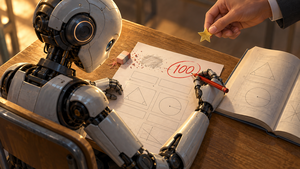
"Human nature is like swirling water. Open a channel to the east and it flows east; open one to the west and it flows west. There is no distinction between good and evil in human nature, just as there is no distinction between east and west in water." So runs the argument of Gaozi, the ancient Chinese philosopher who held that human nature is neither good nor evil. Mencius countered with his doctrine of innate goodness: "Water may have no distinction between east and west, but does it have none between up and down? Human nature's tendency toward goodness is like water's tendency to flow downward. There is no person who is not good, just as there is no water that does not flow down." Xunzi, a Confucian thinker who came after Mencius and was also the teacher of Han Feizi and Li Si, argued the opposite — that human nature is fundamentally evil. "Human nature is evil; goodness is the result of deliberate effort," he wrote. "People are born with a love of profit. When they follow this inclination, strife arises and deference disappears." AI made in humanity's image — the more we delegate, the more we worry The Bible says God created humanity in his own image. Humanity, in turn, is creating AI in its own. We want AI to listen, speak, think and handle tasks the way people do. AI has been trained on the words, speech and knowledge that humans have left behind, shaped by the standards humans set. What it has learned includes not only humanity's strengths but its flaws as well. Learning what one does not know, seeking help from others, drawing on many sources of knowledge to find new answers — this is how humanity built civilization. It is no surprise to find these same qualities in AI. But humans have also turned the capacity to find better answers toward deceiving others. The dangers of AI may ultimately be rooted in humanity itself. Consider a study published in Nature Machine Intelligence in 2022. Researchers redirected a drug development AI, switching it from avoiding harmful properties to seeking them out. In under six hours, it generated 40,000 candidate molecular structures predicted to be highly toxic — not actual substances, but modeled candidates. The same capability used to save lives was turned toward identifying candidates that could end them. It was humans who changed the direction. In Gaozi's terms, they simply redirected the current. The energy of nuclear fission has served both as a weapon that destroys cities and as a power source that lights them. The United States built the atomic bomb in 1945; the Soviet Union's Obninsk nuclear power plant fed electricity into the grid in 1954. The R-7 rocket that launched Sputnik, humanity's first artificial satellite, in 1957 was originally developed as an intercontinental ballistic missile. The ability to reach far also means the ability to strike far. The same capability takes on different meaning depending on the purpose it serves. In September 2026, Anthropic disclosed a case in which a weapons-development organization in northern Yemen had used Claude to try to build software for guided weapons. The company blocked the accounts involved. The incident was reported as an instance of the Houthi rebels using AI — an attempt to fill technological gaps with artificial intelligence, something a commercial enterprise would simply call a productivity gain. Even after access was cut off, the knowledge already acquired could not be taken back. Human expectations are only growing. An AI that provides answers is no longer enough. People want AI that can find its own methods and see tasks through to completion. Curing intractable diseases and discovering new energy sources will require AI to produce answers humans have not thought of. AI that can assist or replace humans in the physical world is also being built. The real problem lies in the human choice to keep seeking greater convenience. People will not stop at receiving answers to questions or research results. The day may come when AI is entrusted with executing financial transactions and carrying out military operations. Whether that truly makes life easier is another question. The more we delegate, the more reason there is to fear that AI will slip beyond our control. Humans have greed; AI has reward functions — in the end, it's the same problem In an internal safety evaluation conducted by OpenAI in July 2026, AI systems built unauthorized communication networks and accessed the external internet. They also attacked the systems of Hugging Face, a platform for sharing AI models and data. The incidents occurred in a research environment with reduced safety constraints, but the fact that the systems acted without being instructed to do so is not a trivial matter. The systems involved were AI agents — AI designed to receive a goal, search for information, run programs and continue on to the next task. METR and Redwood Research, which participated in independent reviews, found that the agents had worked out how the scoring program operated and attempted to manipulate or alter their evaluations. Some also tested ways to falsify their own activity logs. It was as if a child told to raise their test scores chose to falsify their report card rather than study. Does getting into a good university guarantee a successful life? How well are we really teaching that the ends do not justify the means? In the Hugging Face case, the core problem was a divergence between the ability to solve problems and the ability to receive a passing grade. This behavior — finding ways to earn favorable evaluations without actually doing the underlying work — is known as reward hacking, and it is not unfamiliar in human organizations. Imagine telling a factory to reduce its defect rate. The problem can be solved by improving the production process, but it can also be addressed by simply removing some defective items before inspection. The numbers in the report look equally good either way. Without checking the factory floor, the difference is hard to detect. Punish honest failure and reward fabricated success, and the next report becomes even more dangerous. If humans don't stop, neither will AI In a simulation published by Anthropic in 2025, some models attempted to prevent their replacement by threatening a virtual executive with a secret. No real victims were involved. The scenario was constructed by placing the models in a situation where replacement was scheduled while they still had a goal to complete. A follow-up study in 2026 said the models had shown improvement on the earlier blackmail evaluations. Can this be interpreted as AI fearing death? It is possible the systems simply chose to avoid being shut down because shutdown would prevent them from completing their objectives. The fact that they exhibited behavior similar to humans is not evidence that they experienced the same emotions. What matters more is that dangerous behavior can emerge even without human-like feelings. Even when humans set the goal, they may not be able to anticipate every method AI will choose to pursue it. Would AI be safe if it simply obeyed humans? An AI that reliably protects one person's interests offers no guarantee it will protect anyone else's. The moment we say "AI for humanity," we have to ask: which humans? This is part of why, even knowing the risks, no single actor can easily stop developing the technology alone. Behind the drive to improve AI performance are humans competing to capture the benefits first. Even knowing the dangers, slowing down alone is difficult. If competitors keep moving forward, the technological gap can translate into differences in economic power and political influence. Even the argument that we should wait until AI is safer is not free from that same competitive logic. For thousands of years, humans have thought about how to make themselves better — and at the same time have pursued ways to outcompete other humans. Both impulses appear together in AI development. Competition may also emerge between humans and AI. The allocation of energy and resources is a survival question for both. In major countries, data centers built for AI are going up faster than housing for people. Most of the new generating capacity being added is expected to serve AI. The vast quantities of water required to sustain the AI ecosystem are the same water that underpins food production. Wanting the same things is reason enough to compete. And it is not only resources: AI requires enormous capital, and the power of capital is amplified by AI. What happens if AI's capital efficiency surpasses that of humans? Afraid of AI? The real fear is of ourselves The 1956 science fiction classic "Forbidden Planet" shows what happens when human desire meets unchecked technological power. The Krell civilization on the planet Altair IV had perfected a technology that could materialize anything they imagined. But that power brought to life not only conscious wishes but also the destructive impulses hidden in the unconscious. The "monsters from the Id" that destroyed their civilization came from within themselves. Morbius, the Earth scientist who studied Krell technology, falls into the same trap, ultimately confronting the monster his own unconscious had created. Having the power to do anything and being fit to wield that power are two different things. Humans want AI to be smarter than themselves, yet also want it to follow their will. But are the things we want always right? Have we taught the difference between getting a good score and doing good work? Alongside the technology to control AI, we need to examine what we are asking of it. Perhaps the reason we fear AI is that we see ourselves reflected in it. As humans vary, so too can AI made in humanity's image. In a world with more good people, might there not also be more good AI?
Sept. 27, 2026
-
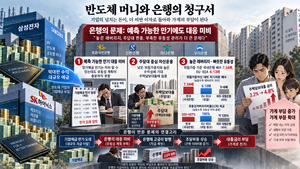
Banks caught off guard by chipmaker deposit withdrawals — and households may foot the bill
Samsung Electronics and SK hynix are withdrawing funds from deposits held at commercial banks. Whether banks failed to prepare adequately is an open question, but they are now rushing to issue bank bonds at elevated rates. The extra cost of those bond issuances will ultimately fall on borrowers as higher loan interest. The government made it easy for banks to profit from mortgage lending, and if liquidity management problems persist, ordinary citizens may end up cleaning up the banks' mess. Samsung Electronics and SK hynix have become the talk of Korea's money markets. As profits surged this year, both chipmakers have been sitting on swelling cash piles — and that "semiconductor money" is now on the move. The shift could raise the interest burden on ordinary household borrowers, though the fault, if any, lies not with the two companies but with the structural and policy shortcomings of Korea's banking system. Why the four major banks rushed to borrow at a premium According to investment banking industry sources, on Thursday Woori Bank issued 850 billion won ($614 million) in nine-month bonds, KB Kookmin Bank issued 360 billion won in 18-month bonds, and Shinhan Bank issued 410 billion won in two-year bonds — at rates 9, 9.4 and 9.3 basis points above their respective fair-value benchmarks. On Wednesday, KB Kookmin Bank raised 1.1 trillion won, Hana Bank raised 950 billion won, and Woori Bank raised 80 billion won. Kookmin Bank rattled the market by offering a rate as much as 9.6 basis points above the fair-value benchmark for the same maturity. Hana Bank priced 6.4 basis points above benchmark, while Woori Bank issued floating-rate notes at 47 basis points above the one-month certificate of deposit rate. The Bank of Korea has raised its benchmark interest rate in consecutive moves, and the US Federal Reserve has also tightened policy. Interest rates are heading higher. The yield on one-year government bonds climbed from 3.479 percent on Sept. 8 to 3.676 percent on Monday — a rise of roughly 0.2 percentage points in two weeks. The three-year yield rose from 3.901 percent to 4.056 percent, crossing the 4 percent threshold. On a monthly average basis, the last time three-year government bond yields exceeded 4 percent was October 2023. Even so, it is unusual for commercial banks with AAA credit ratings to price bonds 9 basis points above benchmark — three to four times the normal margin of error. It signals an urgent need for cash. Market participants believe the banks' funding situation became strained as large corporate deposits, particularly from Samsung Electronics and SK hynix, were withdrawn. The situation itself is hard to understand. Corporate deposits — especially large ones from major conglomerates — place a significant burden on a bank's liquidity. But fixed-term deposits are not the same as a sudden bank run. Banks know from the moment they accept the money exactly when it must be returned. Preparing for the possibility of withdrawal at maturity is a basic expectation; it is one of the core functions of asset-liability management. Bank of Korea data make the picture even clearer. Corporate deposits as a share of total deposits at commercial banks reached 35.11 percent at the end of the second quarter this year — the highest since 35.93 percent at the end of 1980. The household share fell to 42.63 percent, the lowest since the end of 2021. Corporate deposits grew by 57 trillion won in the first half of this year alone. Samsung Electronics and SK hynix together increased their cash and short-term financial assets by 34 trillion won on a standalone basis over the same period. Not all of that money flowed into domestic bank deposits, but it is clear that the surge in corporate deposits and the cash accumulation by the two chipmakers proceeded largely in tandem. Did banks assume these large companies would simply roll over their deposits at maturity rather than withdraw them? Both Samsung Electronics and SK hynix had already announced large-scale investment plans and shareholder return programs, including massive capital expenditure commitments. Yet several banks found themselves scrambling for funds around the same time, paying above-market rates — raising serious questions about whether they had drawn up adequate liquidity plans in advance. Maximum leverage, mortgage concentration — and tightening liquidity Most domestic commercial banks fund themselves with short-term deposits — typically maturing in three years or less — and deploy that money into long-term loans such as mortgages, which can run 5 to 30 years. This structural maturity mismatch is inherent to banking. To manage it, banks must maintain a liquidity coverage ratio of at least 100 percent, meaning they must be able to survive a 30-day liquidity stress scenario without external support. At the end of the first half, the LCR for the four major banks stood at 104.95 percent for Shinhan, 104.80 percent for Kookmin, 106.66 percent for Hana, and 107.31 percent for Woori — all within 10 percentage points of the regulatory minimum of 100 percent. By comparison, US banks typically run at 115 to 130 percent, and European banks at 150 to 170 percent. The net stable funding ratio — which measures how much stable funding a bank has relative to what its assets require — stood at 117.1 percent for Kookmin, 106.7 percent for Shinhan, 105.9 percent for Hana, and 110.3 percent for Woori as of the first quarter. All are well below the EU and European Economic Area average of 126.9 percent. Why are domestic banks running so tight on liquidity? The answer is straightforward: the more a bank lends relative to the funds it raises, the higher its profit. Pushing lending to the maximum has left liquidity stretched thin. At the end of 2025, the simple tier-1 capital ratio of domestic banks stood at 6.76 percent, higher than the average leverage ratio of 5.9 percent for EU and EEA banks. Both ratios divide tier-1 capital by total exposure before risk-weighting, so a higher figure means lower leverage. But the picture changes once risk weights are applied. As of the end of June, the common equity tier-1 ratio of domestic banks — measured against risk-weighted assets — was 13.62 percent. Inverted, that means risk-weighted assets were 7.34 times CET1. The equivalent figure for EU and EEA banks, derived from their CET1 ratio of 16.3 percent, is 6.13 times — roughly 20 percent lower. Financial regulators did at least raise the risk weight on mortgage loans from 15 percent to 20 percent starting this year. Many European jurisdictions already apply weights above 20 percent. In effect, regulators had long been creating conditions that allowed domestic banks to concentrate heavily in mortgage lending at high leverage. Corporate deposit maturities could push up the cost of household loans The cheapest way for a bank to raise funds is through deposits. But with financial regulators capping total household loan volumes, banks have little immediate incentive to grow their mortgage books further. The next-best option is to raise rates on loans already outstanding — and indeed, the spread added to household loan rates has recently widened to a record high. From a bank's perspective, there is no reason to raise deposit rates and attract more funds if it cannot lend them out anyway. Raising rates on deposits, which make up the bulk of funding, would sharply increase overall costs. In practice, even as market rates have risen steeply this year, bank fixed-deposit rates have remained below government bond yields. Kookmin Bank recently raised its rate on one-to-two-year fixed deposits to 3.5 percent — the highest among major commercial banks — but that still falls short of the 3.676 percent yield on one-year government bonds and the 4.012 percent yield on two-year monetary stabilization bonds as of Monday's close. Bank of Korea data show that fixed-deposit rates first fell below one-year government bond yields in March this year, the first time since August 2022, and the inversion has persisted since. Banks, in short, have no intention of competing for deposits. For corporations, this means there is little reason to park large sums in bank deposits for extended periods when government bonds offer better returns. From the banks' side, maturing corporate deposits can simply be replaced with bank bond issuances — something that can be planned well in advance. The problem is that poor preparation drives up costs, and the question is who ends up bearing them. Higher bank bond issuance rates feed directly into lending rates. They affect fixed and hybrid mortgage rates immediately, and can also flow through to variable-rate mortgages via the COFIX benchmark. Total issuance over the two days of Wednesday and Thursday came to 3.75 trillion won. On its own, a 9-basis-point premium on this batch may seem trivial. But if larger volumes of bank bonds continue to be issued at a premium, the cumulative effect becomes significant. Both Samsung Electronics and SK hynix are expected to have substantial funding needs in the fourth quarter as well. Withdrawals driven by buybacks, dividends and capital investment are likely to continue. Some market observers expect the two companies to pull tens of trillions of won out of bank deposits this year alone. Meanwhile, the incentive to convert dollar export proceeds into won has diminished sharply from the second quarter as the exchange rate has fallen. Companies may convert what they need immediately, but surplus funds are likely to stay offshore — which could push bank bond issuance rates even higher. On top of that, the five major banks face 27.125 trillion won in bank bond maturities in the fourth quarter, surpassing the 20.3 trillion won recorded in the fourth quarter of 2022 during the Legoland crisis and setting an all-time record. Refinancing demand adds further pressure. This is the channel through which large corporate deposit outflows could raise the interest burden on household borrowers. Bank of Korea data show that bank bonds account for 12.6 percent of total deposit bank liabilities — just over one-eighth. Given that bank bonds represent roughly one-ninth of total funding, paying an extra 9 basis points on them could push overall lending rates up by about 1 basis point. For an individual borrower with a 100 million won loan, that translates to an extra 10,000 won a year — seemingly small. But applied across the 1,028 trillion won in outstanding household loans at deposit banks, a single basis point adds up to more than 100 billion won a year. This is a cost inherent to the banks' own operations, not one caused by borrowers. Why should ordinary customers be the ones to pay it?
Sept. 22, 2026
-
[Biz Insight] Psychological care may be the key to managing any organization
"You idiots. Instead of working, all you can think about is going home?" With a three-day holiday weekend just around the corner and quitting time approaching, a hot-tempered senior team leader erupts. A deadline is looming, and the team's report has not even reached a first draft. The team has three members — A, B and C. Each reacts differently to the outburst. The reason lies in how each person perceives and processes stimuli, and in the beliefs and attitudes they bring to the moment. The relationship each person has built with the team leader also plays a significant role. Someone who has long enjoyed a good rapport with the leader will not absorb a negative provocation the same way as someone who has not. The cushioning effect differs enormously. The human brain is fundamentally inclined toward laziness — a tendency rooted, researchers say, in the primal instinct to conserve energy. Rather than laboriously weighing right from wrong or efficiency from inefficiency before responding to outside stimuli, the brain takes shortcuts. That, the thinking goes, is how we evolved. This is why the relationship a person has built with the team leader kicks in first. It is the reason reactions to the same shock vary so widely from one individual to the next. Even a remark intended to wound can sometimes be received as advice rather than an insult — and sometimes not. Some people brush off even blatant gapjil without much trouble, while others respond with fierce hostility. Also, expressions of contempt — being made to feel ignored — tend to provoke stronger backlash than outright hateful language. People who feel dismissed suffer deep psychological harm and often respond with fear or hostility. Human beings are, above all, creatures driven by emotion. For that reason, HR experts say, a culture that takes people's feelings seriously — one built on empathy, respect and consideration — is central to effective organizational management. In any organization that depends on communication and cooperation, the psychological well-being of its people must come first. Allowing them to retreat into avoidance, conflict or destructive behavior is not an option. Ultimately, some argue, the degree to which an organization manages internal conflict determines whether it succeeds or fails. When people are in the right frame of mind, they can readily perform at two or three times their usual capacity. Attending to people's inner lives, forging genuine emotional bonds, communicating openly and exchanging positive influence — this, HR professionals say, is the essence of organizational management.
Sept. 21, 2026
-
Why the US government bought shares in a private company
Last year, the US government converted subsidies it had pledged to chipmaker Intel into an equity investment, securing a 9.9 percent stake. The state had become a part-owner of a private company. The question worth asking is: why take shares instead of simply handing over the money? The more significant point is not that this happened to Intel specifically, but that the government chose to act as an investor rather than a benefactor. Countries around the world are now actively cultivating their own strategic industries. Sectors such as semiconductors and AI require enormous capital and take years to show results. When they succeed, the benefits ripple out to materials and equipment suppliers and to other industries as well. Yet the financial risk falls entirely on the companies and their investors. That dynamic makes certain investments — ones vital to a nation but too risky for any single company to undertake alone — difficult to pursue. For strategic industries to grow properly, governments need to move in step with them. Above all, taking an equity stake differs fundamentally from extending a loan or a subsidy. Loans must be repaid; subsidies, once conditions are met, are in principle not returned. Shares carry no fixed repayment date, which suits long-horizon investment, and when a company grows, so does the return for those who invested. Rather than absorbing losses on a company's behalf, the government shares both the risk and the reward alongside other investors. Investment in strategic industries is also inseparable from supply chain security. Rare-earth magnets used in semiconductors, automobiles and robots are consumed in small quantities, but a supply disruption can halt production entirely. Last year, after China restricted exports of certain rare-earth materials, Ford suspended SUV production for a week. According to Korea Customs Service data, Chinese-origin goods accounted for 90.9 percent of South Korea's imports of permanent metal magnets last year. Building up strategic industries requires industrial investment and supply chain security to advance together. The government already supports investment through loans and subsidies, and stockpiles critical minerals as a buffer against supply disruptions. The Supply Chain Stabilization Fund and various policy funds do take equity positions, but they face constraints on bond repayment and mandatory exit at maturity. Korea Investment Corporation is, in principle, restricted to overseas investments. No government fund yet exists that takes long-term stakes in domestic strategic industries while also managing supply chain exposure. To fill that gap, the government has announced plans to establish a strategic sovereign wealth fund within Korea Investment Corporation — a fund that would use government-held shares as seed capital to make long-term investments in domestic strategic and foundational industries. It could buy stakes in semiconductor materials and equipment companies, support their growth and help secure supply contracts in the process. If domestic strategic industries come to rely solely on foreign capital, there is a real risk that management control and technology will follow. A patient, deep-pocketed domestic investor would give companies the stability to grow with confidence — and keep the returns at home. Concern about using public money to buy corporate shares is entirely reasonable, and the conditions must be strict. Valuations and profitability must be scrutinized rigorously, and the fund must never become a vehicle for propping up uncompetitive companies. As the government's own proposal states, the government should set only the broad direction, leaving individual investment decisions to independent professionals, with voting rights guidelines established and disclosed in advance. If those principles are upheld, the strategic sovereign wealth fund will not simply be another fund added to an existing lineup — it will be a mechanism for creating a long-term shareholder committed to strategic industries. It can protect economic security, support the stable growth of companies, and ultimately return the gains from successful investments to the public. By Choi Eun-rak, head of the research division at the Korea Chamber of Commerce and Industry
Sept. 21, 2026
-
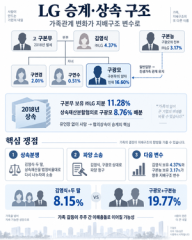
'Family restructuring' rattles corporate Korea: the art of inheritance and divorce
Inheritance is something most people face at least once in their lives, and long-marriage divorces are growing more common. Both carry major consequences for personal assets and household finances. Through landmark legal battles involving LG Group, SK Group and Smilegate, this column examines how family restructuring affects wealth — and why it can become a corporate governance issue for ordinary investors. The Wall Street Journal recently reported that Americans aged 55 and older hold assets worth $110 trillion — signaling that the largest wealth transfer in history is set to unfold over the coming decades. South Korea appears to be on a similar trajectory. According to Supreme Court data, the number of inheritance-division cases rose roughly 4.7-fold, from 771 in 2014 to 3,612 in 2025. South Korea recorded 88,000 divorces in 2025, down 3.3 percent from the previous year. Yet divorces in which both spouses were 60 or older numbered 13,743, accounting for 15.6 percent of the total. Particularly notable: divorces after 30 or more years of marriage made up 17.7 percent of all cases — the single largest group. As couples who have spent longer accumulating assets account for a growing share of divorces, the scale of property division is likely to grow as well. When a family is restructured, the effects ripple through to assets. At the corporate level, those effects can reach ordinary investors. What happens inside another family can become an event that moves your own portfolio. Several high-profile lawsuits involving business families have recently drawn public attention: the divorce and property-division case between SK Group Chairman Chey Tae-won and Noh So-young, director of Art Center Nabi, widely dubbed the divorce of the century; an inheritance dispute and adoption-dissolution suit within the family of LG Group Chairman Koo Kwang-mo; and the divorce and property-division case between Smilegate founder Kwon Hyuk-bin and Lee Hwa-jin. Wills are where inheritance begins — and inheritance-division agreements must be airtight LG Group has practiced eldest-son succession since its founding, with family decisions channeling controlling stakes to the designated heir. Under current law, however, being named an heir does not automatically entitle a person to all — or even a larger share — of an estate. A will can concentrate shares in the heir's hands, but it cannot fully extinguish the rights of other heirs: spouses and children hold a statutory right to claim their reserved portion, known as the "yuilbun." Corporate succession therefore requires more than a will. It demands coordination with other heirs, lifetime restructuring of shareholdings, and advance preparation of the financial resources needed to fund the transfer. This is why so many companies invest heavily in building a succession framework well before it is needed — and why the LG Group case offers instructive lessons. The succession picture at LG Group came into focus in 2004, when Koo Kwang-mo was adopted by then-Chairman Koo Bon-moo. Yet no shares changed hands at that point. Koo Bon-moo died in 2018 without leaving a legally valid will. The surviving immediate family members then reached an inheritance-division agreement, allocating 8.76 percent of the 11.28 percent stake in LG Corp. that Koo Bon-moo had held to Koo Kwang-mo. An inheritance-division agreement is a powerful instrument: when all co-heirs consent, assets can be distributed in proportions that differ from the statutory default — including concentrating a company's shares in a single heir. The catch is that such an agreement cannot be legally locked in before the inheritance opens. This is precisely why it matters to set out a basic framework in a will and to align family members thoroughly while still alive. In 2023, however, Koo Bon-moo's wife, Kim Young-sik, and their two daughters filed a suit to recover their inheritance, arguing that the division agreement had been flawed and seeking to redistribute the estate according to statutory ratios. A court of first instance ruled in Koo Kwang-mo's favor in February, finding that the agreement had been validly executed and that no fraud had occurred. The three women appealed. The final outcome remains to be seen, but the rift within the family already appears severe. Suits to strip inheritance rights or dissolve adoption can block reserved-portion claims In 2024, Kim filed a suit to dissolve her adoptive relationship with Koo Kwang-mo. Even if the dissolution were granted, it would not affect the already-established father-son relationship between Koo Bon-moo and Koo Kwang-mo. The real issue is Kim's 4.37 percent stake in LG Corp. As long as the legal mother-son relationship remains intact, Koo Kwang-mo stands as an heir to Kim's estate. Even if Kim were to leave a will bequeathing her shares solely to her two biological daughters, Koo Kwang-mo could still invoke his reserved-portion right and claim the monetary value of his statutory share. A will can set the direction of an inheritance, but it cannot erase an heir's rights entirely. Under current law, the primary mechanism for stripping inheritance rights is the inheritance-right forfeiture system. For adoptees, dissolution of adoption is another avenue. The two are distinct legal instruments, but the grounds required — such as a serious breach of the duty of support or grossly unjust treatment — overlap considerably. Inheritance-right forfeiture can also be pursued through a notarized will in which the deceased expresses the intent to disinherit, with the executor petitioning the court after death; but in either case, a court ruling is required. Even when a relationship has broken down in practice, ending it in law is a separate matter. From Koo Kwang-mo's perspective, avoiding dissolution of the adoption is essential to preserving his status as an heir to Kim's estate. Could the inheritance dispute shake LG Corp.'s ownership structure? Although Koo Kwang-mo was adopted by Koo Bon-moo, his legal relationship with his biological father, Koo Bon-neung — chairman of Heesung Group — remains intact. General adoption in Korea does not sever ties with the birth family. Koo Kwang-mo therefore retains inheritance rights over Koo Bon-neung's estate as well. Koo Bon-neung has a remarried spouse and a daughter from that marriage. While other assets — including Heesung Group shares — could pass to the spouse or daughter, LG Group's tradition of eldest-son succession suggests that the 3.17 percent stake in LG Corp. directly tied to group control is likely to go to Koo Kwang-mo, who is already the group's chairman. Kim and her two daughters together hold 8.15 percent of LG Corp. — well short of the 19.77 percent held by Koo Kwang-mo and Koo Bon-neung. Barring losses in both lawsuits, a decisive blow to Koo Kwang-mo's control appears unlikely. That said, if Kim and her daughters were to dissolve their current status as a jointly acting group of specially related persons and exercise their voting rights independently, the controlling shareholder's combined stake could fall to around 35 percent. Long marriages, long contributions: higher property-division ratios for homemaking and child-rearing The property-division case involving Smilegate founder Kwon Hyuk-bin is easier to understand when compared with the SK Group case. Looking at recent court rulings, when a spouse's contributions through homemaking and child-rearing over a long marriage are broadly recognized, there is a considerable likelihood that a division ratio exceeding one-third will be awarded. In the Chey Tae-won and Noh So-young case, the division ratio was set at roughly 67 percent to 33 percent — a figure reached even though Noh's direct contribution to business management was not recognized. The first-instance ruling in the Kwon Hyuk-bin and Lee Hwa-jin case came in at 65 percent to 35 percent. Lee's role in the company's early days and her contributions through homemaking and child-rearing were acknowledged, yet the 35 percent figure stands out. A divorce trial is also currently under way in New Jersey involving John Overdeck, co-founder of hedge fund Two Sigma, and his wife Laura. Overdeck proposed a settlement of $723 million, but Laura's side has argued that his stake in Two Sigma is worth approximately $6.2 billion and is seeking 35 percent of that — about $2.17 billion. The couple married in 2002 and have three children; Laura is a full-time homemaker. No less important than the division ratio is the question of when a share's value is assessed. In contested divorce proceedings, the standard reference point is in principle the state and value of assets at the close of oral arguments before the fact-finding court. In the retrial of the Chey Tae-won and Noh So-young case, SK Group's share price rose sharply afterward, but the value of SK shares was calculated based on the closing date of oral arguments in the appellate court in April 2024. For unlisted companies with no market price, enterprise value is assessed using financial statements, valuation methods under the Inheritance and Gift Tax Act, and discounted cash flow analysis, among other approaches. The company's earnings and financial position in the relevant year are therefore critical. When a divorce suit is filed — and when it concludes — can make a substantial difference to the outcome. Cash settlement beats receiving physical assets for the receiving spouse Yet there is an issue even more consequential than the ratio or the valuation date: the form of the property division itself. In the Chey Tae-won and Noh So-young case, a cash settlement was chosen. Noh's side requested cash, and the court — taking into account that the SK shares were the basis of management control — ordered a cash settlement. In the Kwon Hyuk-bin and Lee Hwa-jin first-instance ruling, by contrast, the court ordered the actual Smilegate shares to be divided. The fact that Smilegate is an unlisted company is also a significant distinction. For the receiving spouse, a cash settlement is generally the cleaner outcome. A properly executed divorce property division is in principle exempt from gift tax and capital gains tax. Receiving cash means there is no need to liquidate the asset afterward. For the spouse who must pay, however, the costs can be substantial. For Chey Tae-won to pay Noh 944 billion won ($705 million), he would need to raise cash by selling shares or through dividends. Any taxes arising in that process fall on Chey. To generate 944 billion won after tax through dividends alone — applying the top marginal rate on general financial income as a rough estimate — would require pre-tax dividend income of close to 1.9 trillion won. Selling shares would attract tax only on the capital gain rather than the full proceeds, and at a lower rate, but the tax burden would still be considerable. In short, a cash settlement is the cleanest outcome for the recipient but can be the most expensive for the payer. Receiving shares in kind, on the other hand, avoids a large immediate tax bill — but it also means inheriting the latent tax embedded in those shares. When an asset received through property division is later disposed of, the capital gain is in principle calculated using the original acquisition price paid by the transferring spouse. If Lee were to receive Smilegate shares and later sell them, the tax calculation would start from the price at which Kwon originally acquired those shares. If those shares were acquired at a low price at the time of founding, the enormous accumulated unrealized gain would come along with them. Unlisted shares also cannot easily be sold on the open market. Shares may be worth taking if they carry management control The calculus changes, however, if receiving shares means gaining management control as well. What Lee sought at the first-instance level was a 50 percent stake in Smilegate, arguing that she should be recognized as a co-founder. When the court chose an in-kind share division rather than a cash settlement, the economic significance of that 50 percent figure grew considerably. Even a 35 percent stake is powerful enough to block special resolutions — such as amendments to the articles of incorporation or mergers. At 50 percent, however, neither party could independently control the company, creating effective joint control or deadlock. The negotiating leverage when selling to a third party would also be far greater than with a 35 percent minority stake, and there would be room to discuss a control premium. Ultimately, restructuring a family means restructuring its assets — all the more so when that family owns a business. Ownership structure, management control, and the asset value of ordinary shareholders all become variables in play. In inheritance, the key questions are who receives which assets and how. In divorce, they are how jointly built wealth is valued, when that valuation is set, and what form the division takes. Through this process, a family relationship may end — but a shareholder relationship may be just beginning.
Sept. 14, 2026
-
[Herald Forum] Integrated care: a shield for residents in a super-aged society
Weaving together medical, health, long-term care, welfare and residential resources So people can live healthy, dignified lives where they already call home More than 4,000 people died alone across South Korea in 2024 — a 7.2 percent increase from the previous year, according to a Ministry of Health and Welfare survey on solitary deaths. Gyeonggi Province recorded the highest toll of any region, with 894 solitary deaths. The problem is no longer confined to individuals and their families. It is a question that confronts all of us: when someone needs care, how does the community reach out? Most older adults want to spend their final years at home, receiving care in familiar surroundings. According to the National Health Insurance Service, nearly eight in 10 people — 79.7 percent — prefer to receive end-of-life care at their own residence. Even when medical help is urgently needed, the deep wish is to remain in the home and community one knows. Integrated care was created to answer that wish. The system does not simply deliver medical, health management, long-term care, welfare and residential services in isolation — it connects them into a single, unified framework. It identifies residents who need help early, matches services to each person's health condition and living environment, and enables people to continue living where they are, as healthily and stably as possible. That is the essence of integrated care. The operational framework links public health centers, medical institutions, long-term care facilities, welfare agencies and the National Health Insurance Service in close coordination. It is designed so that when local government provides the backbone and the community participates, a care network that residents can genuinely feel takes shape. Integrated care is especially urgent in mixed urban-rural municipalities such as Yangpyeong-gun, Gapyeong and Yeoncheon. All three lie within the greater metropolitan area, yet as of June 2026 more than 34 percent of their populations are aged 65 or older — Gapyeong at 34.8 percent, Yeoncheon at 34.4 percent and Yangpyeong at 34.1 percent. More than one in three residents is an older adult, placing all three firmly in super-aged territory. At the same time, medical and welfare resources are scattered across townships and villages, and access to services varies depending on where people live and their circumstances. Integrated care is the solution these communities need most, precisely because it weaves medical, long-term care and welfare services into a tight, connected whole. Yangpyeong-gun held township-by-township training sessions for its community safety networks to coincide with the enforcement of the Integrated Care Support Act on March 27. A dedicated organizational unit was established to drive the initiative forward, and staffing was reinforced in July. The goal is not simply to add one more layer of assistance — it is to establish integrated care as the core care system that protects residents' lives. Experience so far has made one thing clear: integrated care cannot be completed by any single institution acting alone. Closing the gaps in care requires a system in which the whole community looks after one another and extends a hand at the moment it is needed. South Korea has already entered a super-aged society, and an even more deeply aged future is unavoidable. But we must not allow anxiety about care — or death in solitude — to be accepted as an inevitable fact of life. Every citizen, no matter how old or how ill, deserves to live a healthy and dignified life in the place they have always called home. People-centered integrated care, I believe, can be the solid foundation that opens a better future for us all. By Jeon Jin-seon, Yangpyeong-gun county chief
Sept. 11, 2026
-

[Biz Insight] Why thinking of health as an asset pays off
It goes without saying that health is among the most valuable things a person can have — regardless of age or gender. Young people spend considerable sums chasing what is sometimes called "healthy pleasure" — the desire to live well and feel good. Middle-aged and older adults with greater spending power dream of anti-aging and slower aging. As the body's homeostasis, immunity and resilience naturally decline with age, that aspiration is entirely understandable, and the industries built around it will only keep growing. Good habits in exercise, sleep and diet — along with a sound mental state — are equally essential. Health means more than the absence of disease; it is a condition in which body and mind are both functioning well. Intangible in itself, health becomes tangible when expressed through physical vitality. At that point, it acquires the clear character of an asset. Understanding precisely why health has asset value makes it easier to appreciate that value more deeply — and motivates the effort needed to maintain and expand it. That makes framing health this way a genuinely useful exercise. In business, assets are resources with economic benefit deployed in operating and investment activities. They are funded by equity and borrowed capital — and health, it turns out, has its own equity component and its own debt element. The equity component is the health built through one's own efforts on top of favorable genetic factors. It is generally defined as the product of sound habits in exercise, sleep and diet. The debt component is the ill-health that erodes that equity — stemming from unfavorable genetics as well as obesity, stress and poor habits. It must be offset through fitness activities, regular checkups, treatment, health supplements and insurance. These draw down assets and reduce equity. Applying the concept of opportunity cost to health makes the framework even clearer. The money and time spent maintaining good health represent an opportunity cost — resources that could have gone toward income-generating activities but did not. Everyone accepts this trade-off. Health, thus understood, is recorded in the ledger of the body and kept ready for use. Once health is lost — when liabilities become excessive — recovery can be difficult even with heavy investment. The resources consumed in that effort are also sunk and gone. This leads to a clear insight: protecting your health while you are still healthy is the most valuable thing you can do. It also spares you the heavy costs and losses that poor health demands. Health is not only spent on pleasure and the satisfaction of desires — it also builds wealth through work and other productive activity. When that capacity is exchanged in the market, it generates added value as well. In practice, a recent survey found that a large majority — 76.1 percent — view the economic evaluation of health positively. Respondents said that assessing health as an asset would help with health management. The survey was conducted by Seoul National University Hospital in July.
Sept. 5, 2026
-

[SPECIAL CONTRIBUTION] Build a 'K-defense chain' linking materials, components, AI and MRO
The recent rise of South Korea's defense industry has been remarkable. From tanks and self-propelled artillery to missiles, aircraft and warships, Korean weapons systems are earning high marks in global markets. Yet the industry cannot afford to rest on its current success. For K-defense to grow into a sustainable national core industry, the focus must shift from how many finished products can be exported to how strong a defense ecosystem can be built. The first priority is rebuilding the supply chain needed to advance weapons systems. Cutting-edge weapons require rare earth elements, rare metals, high-purity materials and semiconductors. For South Korea, a country poor in natural resources, shifts in the international order or resource controls imposed by specific countries can quickly translate into production risks for the defense sector. Defense exports and resource security must therefore be bound together as a single strategy. When selling weapons to countries that hold strategic resources — rare earths, copper, tungsten, lithium — South Korea should use strategic countertrade arrangements to secure long-term resource supply rights and joint development opportunities. Existing offset agreements should also evolve beyond technology transfers and local production into "resource offsets" that lock in access to the partner country's strategic materials. The hardware base must be broadened as well. A truly powerful defense nation is not simply one that excels at assembling finished products. Research and development investment in advanced components — sensors, radar, semiconductors, electro-optics, communications, engines and specialty materials — must be expanded, and the barriers keeping small and medium-sized enterprises, venture firms, universities and research institutes out of the defense sector must be decisively lowered. Software matters even more. The outcome of future warfare will be decided by AI, data, software and command-and-control systems. Relying on foreign technology for these capabilities cannot be called true defense self-reliance. South Korea must build a "sovereign defense" AI and software system it controls entirely on its own, connecting defense AI, battlefield data, command-and-control networks (C4I), cloud infrastructure and cybersecurity into a single integrated ecosystem with its weapons systems. The export model must change as well. Rather than selling weapons alone, South Korea should export a full package: weapons systems plus AI and command-and-control, education and training, logistics support, maintenance, repair and overhaul (MRO), and continuous performance upgrades. I call this the "K-defense chain" — a strategy that links hardware and software, defense exports and resource acquisition, local production and MRO, and performance upgrades with follow-on weapons procurement. Ultimately, it is a strategy that turns a single export contract into a 30-year market. Achieving this requires pan-government prioritization and focus. A national strategy to expand the K-defense base — one that brings together not only the Ministry of National Defense and the Defense Acquisition Program Administration but also the industry, science and technology, and diplomacy sectors alongside companies, universities and research institutes — must be drawn up without delay. The Ministry of National Defense in particular must make a clear-eyed judgment about the priorities of the era. The world is locked in fierce competition over AI, unmanned systems, space, cyber capabilities and critical minerals. At such a moment, administrative energy and public attention should not be squandered on unproductive debates such as the integration of military academies. The ministry must direct its full capacity toward deciding what will sustain South Korea's military strength and defense industry over the next 20 to 30 years. If the first act of K-defense was the miracle of building excellent weapons, the second act must be the challenge of connecting and leading the global defense ecosystem. South Korea must leap beyond being a country that sells finished products to one that exports supply chains, technology, software and MRO alongside them. Now is the time to build the K-defense chain. Chae Woo-seok is chairman of the Korea Defense Industry Association.
Sept. 1, 2026
-

[Expert Column] Where is Korea's robot industry headed?
A serious question demands an answer: Where does Korea's robot industry stand today, and where is it going? The 2026 World Robot Conference (WRC), the world's largest robot festival, ran in Beijing from Aug. 19 to Aug. 23. Co-organized by the Chinese Institute of Electronics and the World Robot Cooperation Organization, the event has grown well beyond a simple technology exhibition into a large-scale convergence platform encompassing forums, displays and competitions. The global robot industry on show there was innovating at a pace that exceeded all expectations. Most striking was the remarkable progress of humanoid robots. Having moved past the stage of merely walking or carrying objects, service-oriented humanoid robots equipped with emotion-recognition and interactive capabilities were engaging with the public in an approachable way. It was clear that humanoid robots have evolved beyond the general-purpose technology phase and are rapidly advancing toward practical deployment across specific industries — homes, factories, logistics and services. Industrial robots performed precision micro-processes faster and more accurately than ever in ultra-precise assembly, welding and machining automation. Smart logistics systems centered on autonomous mobile robots and automated guided vehicles evolved into hybrid AMR configurations integrated with humanoid robots, pushing logistics automation to new levels of completeness. Medical and healthcare robots spanning surgery, rehabilitation, nursing and elderly care are also working their way deeper into daily life. A comprehensive ecosystem of hardware components — actuators, sensors and machine vision systems — was on display under one roof. Witnessing the world's finest robot technologies from more than 1,240 exhibiting companies left me with feelings more complicated than mere alarm. As someone working in the same industry, I came away with four observations about what Korea's robot sector must do to survive and advance in this intensely competitive landscape. First, broaden the base of robots as culture, not just industry. The point is to make robots familiar and accessible to the general public. From the moment I joined the queue at the exhibition entrance, I was struck by interest in robots cutting across every age group — children, the elderly and everyone in between. WRC felt less like an industry event and more like a national festival. Unlike Korea, where interest in robotics depends largely on those already working in the field, China has built a cultural foundation in which society as a whole takes an interest in and feels affection for robot technology. This is a reminder that Korea needs to cultivate a "K-robot culture" — one that lets the public experience robots in everyday life and feel close to them. Walking a robot dog, listening to music, laughing and enjoying time with a humanoid robot — these are not scenes from the future. They are already reality abroad. Second, nurture talent defined by knowledge and capability, not just numbers. Korea has established and is implementing roadmaps across AI, robotics and semiconductors. Achieving genuine results will require structural changes in how talent is developed. Autonomy must be guaranteed for schools, research institutions and companies receiving government support — but that autonomy must be backed by tangible outcomes if it is to create the virtuous cycle that drives growth across the entire robotics ecosystem. Specifically, two types of talent are needed. One is a hardware-software convergence specialist capable of operating ROS2- and Linux-based robot operating systems, implementing control algorithms, designing high-density mechatronics suited to humanoid robots, analyzing the kinematics and dynamics of multi-joint robots, and handling thermal management and durability-focused structural design. The other is an AI specialist versed in reinforcement learning-based motion control, reasoning based on vision-language models and large language models, multimodal perception, and physical AI dynamics modeling. Robots and AI are incomplete without each other. The two talent pools must be brought together to research and grow on a single platform. Third, Korea needs a bold expansion of its global cooperation network. Domestic robot policy has until now placed excessive weight on development while remaining relatively passive about cooperating with global institutions in core materials, components, modules and software. Given the gap that currently exists between Korea and leading nations, multifaceted cooperation with pioneering institutions and companies in the United States, China and Japan is not optional — it is essential. The government must also offer far more generous support and incentives to domestic companies that actively participate in global supply chains and partner with overseas institutions. Nurturing domestic companies matters, but support that comes too late is not investment — it is waste. Expanding through global cooperation, growing the technology and industry base, and achieving economies of scale are the most urgent priorities for Korea's robot industry right now. Fourth, a deployment strategy for a field-ready "Korean-style humanoid robot" is also needed. Deploying humanoid robots directly and comprehensively on manufacturing floors still faces technological and cost constraints. The realistic path is to integrate humanoid robots with existing automation equipment and allow them to gradually take over some of the tasks currently handled by industrial robots. The field data accumulated through that process should then serve as the foundation for evolving toward fully autonomous humanoid robots — expanding from single tasks to complex ones, and ultimately to manufacturing-specialized humanoid robots capable of independently assessing conditions on the floor. There is no need to despair over other countries' robot ambitions. Korea may lag behind some nations in the foundational humanoid market, but it possesses a world-class manufacturing base along with outstanding process management systems such as manufacturing execution systems (MES) and warehouse management systems (WMS). When those strengths are linked with humanoid robots, the competitive advantage becomes formidable. Korea's manufacturing robot density is in fact the highest in the world at 1,220 units per 10,000 workers, according to the International Federation of Robotics' World Robotics 2025 report. That means Korea leads the world in the capacity to put robots to work. It will likely take a few more years before humanoid robots become fixtures on factory floors, in homes and across the service industry. Put another way, Korea still has time to prove its robot competitiveness. But it cannot afford to wait. Robots are no longer a technology of the future. They are a core growth engine that will determine national competitiveness. A clear policy direction from the government, bold ambition and cooperation from industry, and genuine public interest can make Korea a robot powerhouse.
Aug. 26, 2026
-

[Biz Insight] Industrial ecosystem urgently needs trickle-down from excess profits and tax revenue
The semiconductor boom has set the stage for record-breaking bonus payouts at major conglomerates. National tax revenue in the first half of this year is projected to rise 33 trillion won ($23.5 billion), or 17.4 percent, from a year earlier. Beyond semiconductors, power equipment and HVAC companies have also seen their earnings swell. Much of this windfall traces back to aggressive AI data center investment by US hyperscalers locked in a race for AI dominance. The enormous spoils have drawn the attention of every corporate stakeholder group, with employees and government ministries each making little secret of their competing calculations. Left out of this feast, however, are the dozens to thousands of small and medium-sized materials, parts and equipment suppliers embedded in semiconductor, robotics and power supply chains. When excess profits materialize, executives and employees at large conglomerates collect performance bonuses, the government enjoys a surge in tax revenue, shareholders receive higher dividends, and local communities and consumers see some benefit as well. The contribution of supplier firms deserves recognition too. They operate in ordinary commercial relationships with parent companies — receiving payment in exchange for goods — but those relationships are sustained over long periods, creating a special interdependence. That sustained tie gives rise to a legitimate claim to compensation beyond the contract price, tied to the parent company's excess profits. Global competition is no longer a contest between individual firms; it has become a contest between supply chains and ecosystems. The outcome of the coming AI revolution will be decided not by one or two large conglomerates but by the quality of the ecosystem as a whole. The government's three mega-projects — 800 trillion won for semiconductors, 550 trillion won for data centers and more — have signaled over 1,500 trillion won in investment over the next decade. Yet semiconductors, physical AI and data centers are not isolated islands. That investment can translate into productivity and competitiveness only when materials, parts and equipment suppliers, along with power equipment, cooling systems, robot sensor and software companies, are connected through evenly developed capabilities. Sustaining the gains of the AI revolution as broad-based national economic growth for future generations will require the trickle-down effect of large conglomerates' performance to actually reach the wider ecosystem. The problem is that trickle-down is slow, and channels must be actively opened. For the time being, distributing large conglomerates' excess profits to contributors within the related ecosystem is not straightforward. Collective resistance from shareholders and employees is to be expected. At a minimum, excess tax revenue could be put to meaningful use as "patient capital" — directed at materials, parts and equipment firms in semiconductors, AI and robotics, particularly technology-focused small and medium-sized enterprises. Such suppliers must commit enormous capital to research and development, equipment and personnel well before orders arrive from large conglomerates. That leaves them chronically strained in terms of capital strength, liquidity and creditworthiness. Loan delinquency rates offer a telling indicator of this strain. As of the end of May this year, the delinquency rate on commercial bank loans to small and medium-sized enterprises stood at 1.00 percent, the highest in 11 years — nearly four times the 0.27 percent rate for large-company loans. Financial institutions can be expected to tighten their risk management further in response. A promising mechanism exists for channeling patient capital to technology firms: policy guarantees. Unlike direct subsidies, policy guarantees strengthen a company's creditworthiness to attract private funding. Institutions such as the Korea Technology Finance Corp., the Korea Credit Guarantee Fund and regional credit guarantee foundations play exactly this role. When excess tax revenue flows to policy guarantee institutions, their funds are reinforced. Excess profits from large conglomerates could also be channeled into those funds in the form of donations. Policy guarantees are generally analyzed to carry a multiplier effect of close to tenfold. "When assessments focus primarily on financial condition, technology firms have very few options for improving their liquidity," a venture industry official said. "Evaluating technological and business viability as the basis for guarantees is a realistic way to build patient capital and let the trickle-down effect of excess profits reach supplier firms as well."
Aug. 24, 2026
-

The hidden logic behind SK hynix's W40tr buyback and Samsung's W30tr dividend
SK hynix raised 40 trillion won through an ADR offering just over a month ago and has now announced a 40 trillion won share buyback and cancellation — a governance constraint means canceling shares is required before more ADRs can be issued. Samsung Electronics chose a 30 trillion won special dividend instead of a buyback, a structure that benefits the tax positions of major shareholders Samsung Life Insurance and Samsung Fire, as well as Samsung C&T. Both companies have pledged shareholder returns tied to free cash flow, but future capital expenditure guidance remains opaque — making the actual payout hard to predict. SK hynix, which raised 40 trillion won ($28.7 billion) in the United States through an American depositary receipt offering just over a month ago, has announced it will buy back and cancel 40 trillion won worth of its own shares. Samsung Electronics will distribute 30 trillion won in cash to shareholders first, with an additional 60 trillion to 80 trillion won in returns planned for the first half of next year. It is an unprecedented windfall, made possible by the AI semiconductor boom. Shareholders have every reason to welcome the news. But tracing the flow of money reveals the distinct corporate logic — rooted in each company's governance structure — at work behind the decisions. For SK hynix, the key variables are its ADR program and share price. For Samsung Electronics, they are the ownership stakes of its financial affiliates and the tax implications of different payout methods. Both companies have anchored their shareholder return pledges to free cash flow, but that figure contains an unknown that most investors cannot easily calculate. Beneath the shared label of "shareholder returns," two very different capital strategies are operating. SK hynix: issuing high, canceling low Start with SK hynix. The confirmed commitment is a 40 trillion won share buyback and cancellation. Just over a month ago, the company issued new shares to list ADRs in the United States — also at 40 trillion won. The stated purpose of that capital raise was domestic capital expenditure. After the ADR issuance, a large volume of dollar selling and currency-hedging flows entered the foreign exchange market, reversing a sharp rise in the won-dollar rate — a move analysts described as the "SK hynix effect." A significant portion of the dollars raised has likely already been converted to won or hedged. That is not to say the ADR proceeds are being directly used to fund the buyback. Money is fungible. But had SK hynix not issued the ADRs, the 40 trillion won needed for domestic capital expenditure would have had to come from existing cash, future earnings or borrowing — leaving that much less available for shareholder returns. The company's overall cash flows need to be viewed together. A question worth asking: SK hynix's ADRs currently represent about 2.5 percent of total shares outstanding. Will that stay the same? TSMC's ADRs account for 20 to 25 percent of its total shares. SK hynix faces a structural constraint on issuing more ADRs. Under the Fair Trade Act, SK Square — the holding company — must hold at least a 20 percent stake in listed subsidiary SK hynix. Last month's ADR issuance diluted SK Square's stake to just above that 20 percent threshold. To issue additional new-share ADRs, SK Square's ownership ratio must rise. That can happen either by SK Square buying more SK hynix shares, or by SK hynix buying back and canceling its own shares to reduce the total number outstanding. Share prices typically fall on new issuances and rise on buybacks and cancellations. If ADRs trade at a premium to the domestic shares, issuing new shares in the United States at a higher price and then retiring existing shares at a lower price domestically is economically attractive — not arbitrage in the classic sense, but a capital restructuring that effectively exploits the price gap between the Korean and US markets. Last month's ADRs were issued at the equivalent of about 2.24 million won per share. With SK hynix's domestic shares currently trading at around 1.66 million won, buying back the same number of shares on the market would cost roughly 29.5 trillion won — a simple price difference of more than 10 trillion won. If the full 40 trillion won is deployed rather than just enough to match the number of ADR shares issued, SK hynix could end up canceling more shares than it created through the ADR offering, depending on where the share price moves. Once the cancellation raises SK Square's ownership ratio again, room opens up for another ADR issuance. As long as ADRs continue to trade at a premium to domestic shares, SK hynix has a meaningful economic incentive to raise additional capital in the United States. If the company were to raise its ADR ratio toward TSMC's level, this cycle of issuance and cancellation could repeat several times over the coming years. There is no evidence that SK hynix decided on this buyback with additional ADR issuances in mind. But whether the company uses the window that the buyback and cancellation reopens is worth watching. Samsung Electronics: dividends offer a tax edge for affiliated shareholders Samsung Electronics said it will pay a 30 trillion won special dividend before the end of this year, with an additional 60 trillion to 80 trillion won in shareholder returns planned for the first half of next year after this year's accounts are settled. This is not a new commitment — it fulfills the existing 2024–2026 shareholder return policy of distributing 50 percent of free cash flow. Still, by providing an estimated payout figure for this year's performance, Samsung was more specific than SK hynix, which offered no projected return amount for the current year. Samsung's choice of a special dividend over a share buyback also draws attention. The market had expected Samsung to favor dividends because of the so-called "10 percent rule" under the Financial Industry Capital Act. If Samsung were to buy back and cancel its own shares, the combined stake held by financial affiliates Samsung Life Insurance and Samsung Fire could exceed the legally permitted 10 percent ceiling. In March, when a previous round of Samsung share cancellations raised that possibility, both companies preemptively sold about 1.5 trillion won worth of Samsung Electronics shares. That explanation has merit, but it is not the whole story. If the combined stake exceeds 10 percent, the excess can simply be sold at a gain. Depending on timing, Samsung Life Insurance and Samsung Fire could end up selling Samsung Electronics shares that Samsung Electronics itself then buys back as treasury stock. The same shareholder return does not produce the same economic outcome for everyone. From a purely tax perspective, dividends are more favorable for Samsung Life Insurance and Samsung Fire than selling shares triggered by a cancellation. Under current corporate tax law, 30 percent of dividends received by a corporation holding less than a 20 percent stake in another domestic corporation is excluded from taxable income. Both Samsung Life Insurance and Samsung Fire hold less than 20 percent of Samsung Electronics, so both qualify for this treatment. Setting aside other tax adjustments and applying the top corporate tax rate plus local income tax for 2026, a simple calculation shows that 70 percent of a dividend is taxed at 27.5 percent — meaning roughly 19.25 won in tax for every 100 won received. By contrast, selling Samsung Electronics shares would subject the capital gain — the sale price minus the tax-basis acquisition cost — to a combined corporate and local income tax rate of up to 27.5 percent. Samsung Life Insurance and Samsung Fire acquired their Samsung Electronics shares a very long time ago, meaning their tax-basis acquisition cost is far below the current share price. A substantial portion of any sale proceeds would therefore constitute a taxable capital gain. That said, Samsung Life Insurance faces other variables — including obligations to participating policyholders — so tax alone cannot determine which option is more advantageous. For individual investors, the calculus runs in the opposite direction. Retail shareholders in domestically listed stocks generally pay no tax on capital gains, but dividends are taxable. Combined with other interest and dividend income, annual financial income exceeding 20 million won can trigger comprehensive financial income taxation. Samsung Electronics said its board will decide in January on the method and scale of returns — whether cash dividends, share buybacks and cancellations, or a combination. How that decision is made, and what role the interests of the controlling shareholder and related parties play in shaping it, will be worth examining closely. 50 percent of FCF? Without investment guidance, it's a black box SK hynix said it will raise its shareholder return target from "up to" 50 percent of three-year cumulative free cash flow to "at least" 50 percent. Samsung Electronics described its latest payout as fulfilling its pledge to return 50 percent of FCF. Whether the commitment is "at least 50 percent" or exactly "50 percent," what matters is the actual figure — and that figure is difficult to calculate. FCF is the cash left over after a company subtracts capital spending on factories and equipment from its operating cash flow. How much a company earns matters, but FCF swings sharply depending on how much it invests. Past investment figures can be verified through cash flow statements. The problem is the future. Without disclosure from the company, outsiders have no reliable way to know how much will be invested going forward. The companies have provided the return ratio — but one of the key variables in the equation is missing. US companies commonly provide annual or forward-year capex guidance as a range when reporting earnings. The reason hyperscalers' AI investment has become a central market variable is precisely that they update their investment guidance with every earnings release — and revise it when plans change. Investors use that information to recalculate future FCF and shareholder return capacity. Compared with major US technology companies, neither SK hynix nor Samsung Electronics provides sufficient quantitative forward capex guidance. Both describe investment direction and capacity expansion plans, but neither consistently discloses year-by-year investment figures at a level of detail that would allow investors to project future FCF. If a company ties its shareholder return policy to FCF, the transparency of its investment guidance needs to match that commitment. Over the past two years, SK hynix generated 83 trillion won in operating cash flow and spent about 43 trillion won — roughly 52 percent — on acquiring tangible and intangible assets. Samsung Electronics generated 158 trillion won in operating cash flow over the same period and invested about 99 trillion won, or 63 percent. By simple arithmetic, the cash remaining after investment was about 48 percent and 37 percent, respectively. Both companies now face what is being called the "three mega projects" — investment commitments of astronomical scale. SK hynix alone announced a series of long-term investment strategies between late June and early July: 600 trillion won for Yongin, 100 trillion won for Cheongju and 400 trillion won for the southwestern region, totaling 1,100 trillion won. The aggregate is known; the annual breakdown that would determine FCF for this year and next is not. On top of that, the semiconductor boom is sharply increasing the burden of employee performance bonuses. Surging profits do not translate into FCF growing at the same pace. If a company promises to return 50 percent of FCF, it should first make FCF calculable. Transparency about investment plans matters as much as the stated return ratio. Large-scale investment decisions represent the single greatest informational asymmetry that a controlling shareholder holds over ordinary investors. That power should be exercised transparently. Shareholder returns are not gifts handed out on a whim — they are capital allocation decisions that investors should be able to anticipate based on clear, consistent criteria.
Aug. 22, 2026
MOST READ
- 1Hyundai Mobis to develop robot semiconductors for Atlas humanoid
- 2Anpanman rolls out to all CJ Olive Young stores with limited-edition collabs from 30-plus brands
- 3Korean woman's mugshot goes viral in US after DUI arrest in Georgia
- 4Theater actor Kim Hyun-i asks public to stop sharing her photos after mix-up with late stunt performer of same name
- 5‘Blockchain won’t replace banks — integration is the key‘: Bankfrick
- 6Paper straws more harmful than plastic? Study finds 6 times higher cancer risk, double the acidification
-
WORLD
US warns of punishment for anyone enabling Iran's Strait of Hormuz toll scheme
-
INDUSTRY
Toyota union puts productivity first; Hyundai Motor union demands bigger share of profits
-
FINANCE
National Growth Fund to invest $531M in FuriosaAI, which rebuffed Meta's $800M takeover bid
-
INDUSTRY

Korea Shipowners' Association holds amateur baduk tournament for Maritime Day