
- HOME
- STOCK
When retail investors sell and foreigners buy, Kospi rises — 86.5% of the time
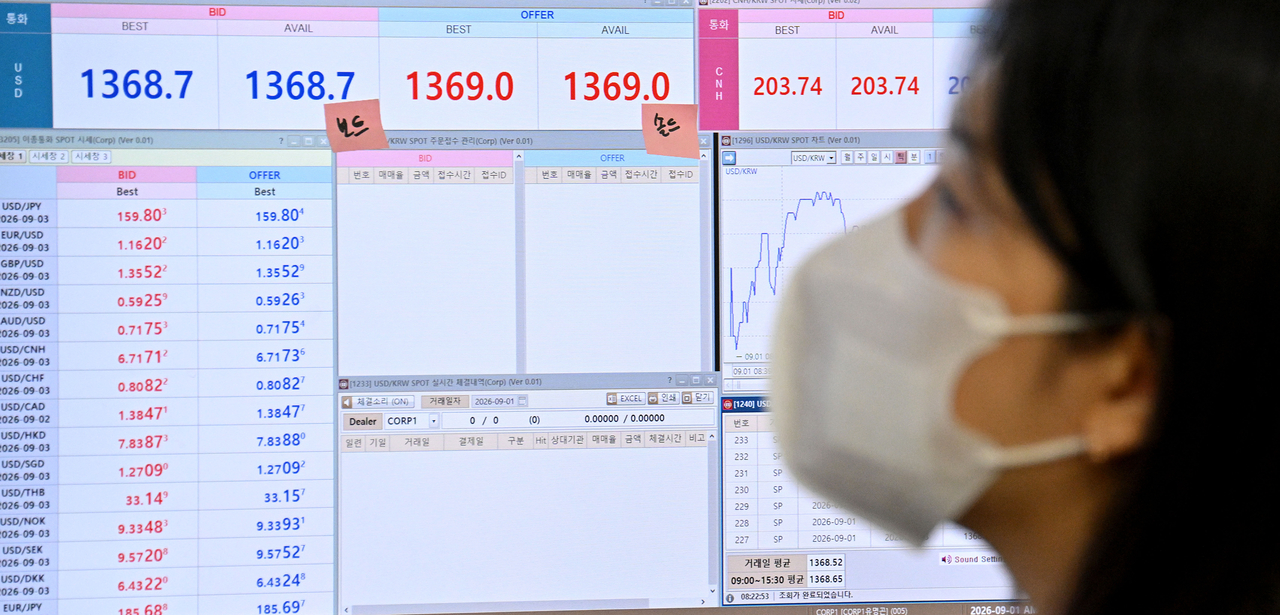
"When I buy, it falls. When I sell, it rises." It is a kind of Murphy's Law that has long circulated among retail stock investors. The self-deprecating saying goes: the moment you finally summon the courage to buy, share prices sink as if on cue — and the moment you can no longer hold on and sell, the market rebounds as if nothing happened. The flip side holds that when foreign investors buy, the market goes up, and when they sell, it goes down. That joke, passed around among retail investors, has now been confirmed to be largely true. Over the past six months, the Kospi rose on roughly 87 percent of the trading days when foreign investors made net purchases of domestic shares. Conversely, on days when retail investors were net sellers, the Kospi advanced on a striking 91 percent of occasions. The trend has grown more pronounced of late. The tendency for the Kospi to move in the opposite direction from retail investor trading has also become increasingly conspicuous. Kospi up 86% on foreign buying days; alignment hits 92% in October An analysis of daily investor trading data and Kospi figures from Korea Exchange shows that foreign investors were net buyers on the domestic Kospi market on 37 trading days over the six months from April 21 to Oct. 21. Of those, the Kospi rose on 32 trading days — a rate of 86.5 percent. In other words, nearly nine times out of 10 when foreigners were buying, the benchmark index finished higher. Over the same period, the Kospi rose on 70 of 122 total trading days, a rate of 57.4 percent. The advance rate on days of foreign net purchases was 29.1 percentage points higher than the overall rate — suggesting the index gains on those days cannot be explained simply by a broader upward trend in the market. More recently, the tendency for the Kospi to fall on days when foreign investors are net sellers has grown steadily more pronounced. In May alone, the Kospi fell on only five of the 16 trading days when foreigners were net sellers — a rate of just 31.3 percent. That means the index actually rose more than twice as often as it fell even when foreigners were selling. By June, however, that rate had climbed to 47.1 percent, and by July it had risen to 75.0 percent. It dipped back to 50.0 percent in August before rising again to 69.2 percent in September. This month the figure reached 88.9 percent — on eight of the nine trading days between Oct. 1 and Oct. 21 when foreigners were net sellers, the Kospi fell. The shift becomes even starker when both foreign net buying and net selling days are considered together. Defining an "alignment" as a day when the Kospi rises on a foreign net-purchase day or falls on a foreign net-selling day, the alignment rate in May was just seven out of 18 trading days — 38.9 percent, below even half. At the time, it was common for the Kospi to rise even when foreigners were selling. By July, however, the alignment rate had climbed to 72.7 percent, then moved through 65.0 percent in August and 75.0 percent in September before soaring to 92.3 percent in October. In October in particular, the Kospi rose on all four trading days when foreigners were net buyers and fell on eight of the nine days when they were net sellers. In 12 of 13 trading days, the direction of foreign trading and the direction of the Kospi matched. The sole exception was Oct. 2, when foreigners were net sellers yet the Kospi rose 0.46 percent from the previous session. Setting that one day aside, foreign trading direction has in effect been a near-perfect guide to the Kospi's daily movement this month. Kospi up 91% when retail investors sell; 100% decline rate on net-purchase days in Sept. and Oct. The picture for retail investors was the mirror image. Whereas the Kospi tended to rise when foreign investors were buying, it tended to rise when retail investors were selling. Over the past six months, retail investors were net sellers on 53 trading days. Of those, the Kospi rose on 48 — a rate of 90.6 percent. The market adage that share prices go up when retail investors sell held true more than nine times out of 10. That is 33.2 percentage points above the overall Kospi advance rate of 57.4 percent over the same period, and even higher than the 86.5 percent advance rate on days of foreign net purchases. Another notable feature is that the pattern held consistently throughout the entire six-month period. Breaking it down by month, the Kospi rose on every single day retail investors were net sellers in May and June — a 100 percent alignment rate across five and six trading days, respectively. The rate dipped to 75.0 percent in July before returning to 100 percent in August and reaching 90.9 percent in September. So far this month, the Kospi has risen on five of the six trading days when retail investors were net sellers. The flip side — that the Kospi falls when retail investors buy — has grown more pronounced of late. Over the full six months, retail investors were net buyers on 69 trading days, and the Kospi fell on 46 of them, a rate of 66.7 percent. Two out of every three times retail investors were buying, the index finished lower. Looking at just the past two months, the pattern is even more extreme. In September, the Kospi fell without exception on all nine trading days when retail investors were net buyers. The same has been true this month: the index has fallen on all seven trading days when retail investors were net buyers. Combined, retail investors were net buyers on 16 trading days in September and October — and the Kospi fell on every single one of those 16 days. It amounts to an extreme phenomenon in which the index has declined every time retail investors have been buying over the past two months. As a result, the rate at which retail investor trading and the Kospi move in opposite directions has risen sharply of late. In May, retail investor trading ran counter to the Kospi's direction on 10 of 18 trading days — a rate of just 55.6 percent. By July the rate had climbed to 81.8 percent, and by August to 85.0 percent. In September, retail trading and the Kospi moved in opposite directions on 19 of 20 trading days — a rate of 95.0 percent. This month the figure stands at 92.3 percent, with 12 of 13 trading days showing the same divergence. Across the full six-month period, retail investor trading and the Kospi moved in opposite directions on 94 of 122 trading days — a rate of 77.0 percent. Supply and demand over fundamentals? Foreign flows emerge as key market driver The increasingly sharp divergence between the trading direction of foreign and retail investors — and its correlation with Kospi moves — aligns with a growing view in the brokerage community that supply-and-demand dynamics are playing a larger role in driving the market. Analysts say that as the domestic market has swung sharply in both directions of late, the trading behavior of foreign investors has emerged as a key short-term variable for gauging market direction. Share prices fundamentally reflect a company's earnings power and growth potential, but in the short term they are driven by the tug-of-war between buying and selling pressure. Even strong corporate earnings cannot prevent a share price from falling if a wave of sell orders hits the market at once — and conversely, prices can rise even without any change in underlying value if buying interest surges. Market observers say conditions have recently entered a phase in which supply-and-demand forces are exerting an unusually strong influence. As the index has increasingly moved in different directions depending on whether foreigners are buying or selling, analysts argue that tracking foreign capital inflows and outflows deserves as much attention as corporate earnings or valuations. Hwang Su-wook, a researcher at Meritz Securities, said investor sentiment and supply-and-demand dynamics are currently having a greater impact on share prices than corporate fundamentals. He said that with retail and institutional investor flows failing to establish a clear market direction, the movement of foreign capital warrants close attention. "I believe share prices are being driven more by investor sentiment and supply-and-demand than by fundamentals," Hwang said. "It would not be too late to assess the market's direction after observing whether foreign buying flows in on a sustained basis." That said, the high alignment rate between foreign trading and Kospi moves does not by itself prove that foreign buying and selling determines index direction. This analysis examined how often the two moved in the same direction on the same day over the past six months; it does not establish causation or demonstrate predictive power for future index moves. ※ The analysis covers 122 total trading days from April 21 to Oct. 21, 2026, based on daily data from Korea Exchange. Trading days on which the index was unchanged (0.00 percent) were included in the total trading day count but excluded from both the advance and decline tallies.
Hong Tae-hwa Oct. 23, 2026
-
Woori Investment Securities posts W3.4b Q3 net profit as IB fees drive 27.3% cumulative gain
Cumulative net profit reaches 28.2 billion won, operating profit 31.2 billion won through Q3 IB fees surge 163.5%, lifting non-interest income 94.2% year-on-year Costs from bad PF assets and IT investment continue to weigh Woori Investment Securities posted a net profit of 3.4 billion won ($2.57 million) in the third quarter of this year. Although the quarterly figure fell from the previous quarter, cumulative net profit through the first three quarters rose 27.3 percent year-on-year, driven by growth in investment banking fees. According to the company's earnings release Friday, third-quarter net profit came in at 3.4 billion won, with operating profit reaching 1.8 billion won. Woori Investment Securities said rising interest rates and a deteriorating bond-trading environment weighed on trading revenue during the quarter. A slowdown in new IB deal activity also reduced non-interest income from the previous quarter, pulling down both operating profit and net profit. Cumulative net profit for the first three quarters stood at 28.2 billion won, up 27.3 percent from the same period a year earlier. Operating profit climbed 72.2 percent to 31.2 billion won, while net operating revenue — combining interest and non-interest income — rose 46.0 percent to 203.5 billion won. Growth in IB fee income drove the earnings improvement. Cumulative non-interest income through the third quarter reached 101.4 billion won, up 94.2 percent year-on-year. IB-related fees in particular surged 163.5 percent to 67.2 billion won, boosted by a pickup in large-deal mandates following a 1 trillion won rights offering in May. Interest income also grew 17.2 percent to 102.1 billion won. Cost pressures persisted. Stricter assessments of real estate project financing assets originated before the firm's launch as a securities company, combined with the deterioration of some projects, pushed cumulative credit loss provisions to 39.3 billion won — a 105.3 percent increase from the same period last year. The company said it has cut its non-performing PF assets by more than 50 percent since its launch as it works to improve asset quality. Investment in building out the firm's securities business also continued. Spending on a proprietary IT system and the recruitment of specialist staff pushed cumulative selling and administrative expenses up 31.7 percent year-on-year to 133.1 billion won. The company said upfront investment costs and expenses related to managing legacy non-performing PF assets remain a burden. Woori Investment Securities recorded a net profit of 24.7 billion won and operating profit of 29.4 billion won in the first half of this year. Fee income from IB and related businesses reached 49.1 billion won during that period, a 206 percent increase year-on-year, and was the primary driver of the earnings improvement. The company expects earnings to improve in the fourth quarter as large IB transactions close. Over the longer term, it plans to pursue full-scale growth from 2028, when the cost burden from early-stage investment and legacy non-performing PF assets is expected to ease. "Even as we bear the costs of proactive investment to build our securities business and secure competitiveness, as well as expenses from managing non-performing PF assets inherited from before our launch, we remain focused on revenue growth centered on IB," a company official said. "From 2028, when our early investments begin to bear fruit, we will move onto a full growth trajectory and work toward our goal of becoming a comprehensive financial investment firm by 2030."
Oct. 23, 2026
-

Blackstone pulls in $63b in Q3 amid market volatility
12-month inflows top $270 billion Infrastructure, energy assets drive performance Global private equity fund manager Blackstone posted solid third-quarter earnings despite ongoing market volatility. Blackstone said Friday that its total capital inflows for the third quarter reached $63 billion. Cumulative inflows over the past 12 months surpassed $270 billion, the highest level in four years, with infrastructure and energy-related assets identified as the primary drivers of investment performance. By segment, assets under management in the Private Wealth division rose 15 percent year-on-year to a record high of $330 billion. Third-quarter sales totaled approximately $9 billion. Blackstone also launched a new product for investors outside the United States, the Blackstone Private Markets Fund (BXPM). In the Credit and Insurance segment (BXCI), insurance AUM grew 14 percent year-on-year to surpass $300 billion. The investment-grade private credit platform also expanded, with AUM climbing 24 percent year-on-year to approximately $150 billion. Demand in the real estate segment is rising, led by data centers and logistics assets. Leasing activity at Blackstone's global data center platform is expected to reach three times its previous level this year, and its US logistics assets posted record leasing results in the third quarter. In the AI and infrastructure segment, Blackstone is directing large-scale capital toward supply-demand imbalances in the market. The firm said it aims to generate long-term investment value under disciplined principles as capital demand grows alongside the expansion of the AI industry. Blackstone Chairman and CEO Stephen Schwarzman said the firm's flagship investment strategies outperformed public market indexes and that positive momentum continued across key fundraising channels. "AI and energy infrastructure are the defining investment themes driving global economic growth today," he said, adding that Blackstone is leveraging its investment platform to provide investors with differentiated access to compelling opportunities. Meanwhile, Blackstone has been strengthening its foothold in South Korea's real estate market. Blackstone Real Estate Partners, which launched a dedicated Korea real estate investment team three years ago and has consistently acquired core domestic assets, purchased two advanced logistics centers in Gimpo and Namyangju — key last-mile locations in the greater Seoul area — last year through Cube Industrial Asset Management. Including its investment in Sanha Logistics Park II in September, the firm has completed five deals in South Korea over the past 14 months, among them three logistics centers.
Oct. 23, 2026
-
Kospi stages dramatic late comeback to close above 5,550 after 4% intraday plunge
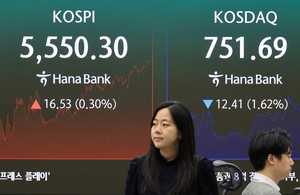
Index tumbles 4.12% at open before reversing course SK hynix surges 4.42%, leading index rebound Solidigm IPO cancellation lifts investor sentiment Foreigners net sell 981 billion won; institutions net buy 869 billion won The Kospi staged a dramatic intraday reversal Friday, clawing back from a loss of more than 4 percent after a sharp selloff in US semiconductor stocks and rising oil prices driven by escalating tensions in the Middle East sent the index tumbling at the open. Investor sentiment recovered — led by large-cap chipmakers — after SK hynix announced it was halting its review of a US initial public offering for its subsidiary Solidigm. The Kospi turned positive with just 20 minutes left in the session and closed above the 5,550 level. According to Korea Exchange, the Kospi finished Friday up 16.53 points, or 0.30 percent, at 5,550.30. The index opened down 130.60 points, or 2.36 percent, at 5,403.17 and slid as far as 5,305.98 — a drop of 4.12 percent — in early trading before steadily paring losses and turning positive in the final stretch. Institutions led the advance. On the main Kospi market, institutions net bought 869 billion won and individuals net bought 45 billion won ($34 million). Foreigners flipped to net selling for the first time in three sessions, offloading 981 billion won. Overnight on Wall Street, the three major indexes closed mixed. The Dow Jones Industrial Average edged up 0.02 percent, while the S&P 500 fell 1.21 percent and the NASDAQ Composite tumbled 2.60 percent. AI and semiconductor stocks were hit across the board after Meta swung to a free cash flow deficit and Tesla cut its capital expenditure outlook. Micron fell 6.26 percent, Nvidia dropped 4.40 percent, Intel lost 8.04 percent, SK hynix's American depositary receipts fell 8.07 percent and SanDisk shed 8.51 percent. The Philadelphia Semiconductor Index tumbled 6.72 percent. Rising global oil prices tied to the escalating situation in the Middle East added to the pressure on equities. The domestic market opened lower, led by large-cap chipmakers, but sentiment partially recovered after SK hynix said it was scrapping its review of a US listing for its subsidiary Solidigm, helping lift the index off its lows. In a pre-market disclosure, SK hynix said Solidigm had been reviewing various financing options to expand production capacity and strengthen competitiveness, but decided to halt its review of a pre-IPO process and initial public offering after weighing overall capital market conditions. The market had long worried that a Solidigm listing would amount to a de facto dual listing that would dilute SK hynix shareholder value, and the announcement removed that uncertainty. SK hynix, which had fallen more than 4 percent in early trading, reversed course to close up 4.42 percent at 1,277,000 won. Samsung Electronics, which had traded as low as 203,500 won, down 5.13 percent, shortly after the open, fully recovered its losses to finish up 0.47 percent at 215,500 won. Many other large-cap stocks also turned positive or trimmed their losses. SK Square, the parent company of SK hynix, rose 3.20 percent, and Samsung Biologics surged 7.71 percent. On the downside, LG Energy Solution fell 1.79 percent, Samsung Electro-Mechanics dropped 2.01 percent, Hyundai Motor lost 1.99 percent and KB Financial Group declined 3.29 percent. The Kosdaq extended its losing streak. The index fell 12.41 points, or 1.62 percent, to close at 751.69, marking a second consecutive session of losses. It opened down 15.78 points, or 2.07 percent, at 748.32 and at one point sank as low as 732.87, a drop of 4.09 percent, before recovering some ground in the afternoon. On the Kosdaq, foreigners were net sellers of 44 billion won and institutions net sold 25 billion won, while individuals were net buyers of 63.5 billion won. Among top-cap stocks, HLB gained 0.73 percent, while Alteogen fell 2.81 percent, Ecopro dropped 5.83 percent, Ecopro BM lost 5.50 percent, Jusung Engineering declined 3.64 percent and Rainbow Robotics fell 3.42 percent. The won weakened slightly against the dollar. As of 3:30 p.m. in the Seoul foreign exchange market, the won-dollar rate stood at 1,324.6 won, up 0.4 won from the previous session's close.
Oct. 23, 2026
-
Korea Exchange halts wind-down trading amid court challenges to penny-stock delistings
Korea Exchange suspends wind-down trading for affected firms Newintech, Hyungji Global file injunction bids Exchange to wait for court ruling before proceeding Earlier market-cap delisting cases also put on hold Korea Exchange has suspended wind-down trading procedures for companies facing delisting due to share prices below 1,000 won — so-called penny stocks. The move comes after two Kosdaq-listed companies filed injunctions at court seeking to halt their delisting decisions. Korea Exchange said it will proceed with the delisting decisions themselves but hold off on wind-down trading until the court rules. Korea Exchange said Friday that Newintech and Hyungji Global had filed injunctions with Seoul Southern District Court that day, seeking to suspend the effect of their delisting decisions stemming from below-threshold share prices. "In response to these injunction filings, we are suspending wind-down trading procedures for the companies concerned until there is a change in circumstances, such as a court ruling, in order to protect investors," the exchange said. "Korea Exchange will faithfully present its case in the injunction proceedings." In connection with the litigation, the exchange also laid out its broader approach to market measures for all companies facing delisting due to below-threshold share prices. It will proceed with issuing delisting decisions but suspend wind-down trading for those companies until a court ruling or other change in circumstances. The move is a precaution against potential investor harm that could arise if wind-down trading were completed before a court suspended the effect of a delisting decision. Korea Exchange had suspended share trading Thursday for five Kosdaq-listed companies — TKG Aikang, Hyungji Global, Newintech, i-Scream Edu and Barunson Entertainment & Arts. The five companies had been placed on the watchlist on Aug. 13 and then traded below 1,000 won for 45 consecutive trading days. They are the first cases to go through delisting procedures for below-threshold share prices since the delisting requirements were tightened on July 1. Under the tightened rules, a company is placed on the watchlist if its share price stays below 1,000 won for 30 consecutive trading days. If the price fails to recover above 1,000 won for 45 consecutive trading days within the following 90 trading days, the company becomes subject to delisting. Korea Exchange had pre-disclosed eight companies at risk of delisting on Oct. 7. Of those, three — Inno Instrument, E8 and Jeongmoon Information — have already had their trading suspended following decisions to consolidate their shares. Market watchers are closely following whether the injunction filings will produce a similar outcome to earlier cases involving delistings for insufficient market capitalization. The 51st Civil Division of Seoul Southern District Court accepted injunction applications from Jooyontech and KM Pharmaceutical, which faced delisting for falling below the market cap threshold. The court found that the companies had not been guaranteed adequate opportunity to present their case or to file objections, and Korea Exchange subsequently suspended all market-cap-based delisting procedures pending a ruling on the merits. Legal experts expect the central issue in future court proceedings over penny-stock delistings to be whether the requirement to sustain a share price above 1,000 won for 45 consecutive trading days is appropriate. The number of penny stocks subject to delisting is expected to grow. As of Thursday, there were 113 penny stocks — excluding preferred shares and SPACs — listed across the two main markets: 26 on the Kospi and 87 on Kosdaq. The outcome of the current injunction cases is widely seen as the first real test of the penny-stock delisting regime's future direction.
Oct. 23, 2026
-
Hana Securities' nine-month operating profit nearly doubles, but Q3 results disappoint
Q3 operating profit falls 67.8% Rising rates weigh on asset management returns Lower market trading volume also hits fee income Hana Securities said Friday its cumulative operating profit for the first three quarters of this year reached 366.4 billion won ($277 million) on a consolidated basis, with net profit for the period at 283.4 billion won. Compared with the same period a year earlier, operating profit surged 98.9 percent and net profit for the period rose 67.1 percent. However, looking at the third quarter alone, consolidated operating profit fell 67.8 percent year-on-year to 21.1 billion won. Net profit for the period dropped 83.9 percent to 10.1 billion won in the quarter, while sales rose 93.7 percent to 4.7 trillion won. "There were headwinds from a decline in asset management returns due to rising interest rates and a drop in market trading volume, but we maintained an active management stance across all divisions and focused on securing new growth drivers," the company said. The wealth management division saw fee income decline as trading volume fell. The sales and trading division was also affected by rising interest rates, which weighed on bond management returns, though institutional sales and delta-one businesses showed growth. "We are maintaining a conservative management stance in response to rising interest rates while concentrating on securing new growth drivers," a Hana Securities official said. The company plans to focus on expanding its customer base by promoting Hana Securities V, a new MTS built on AI and data technology that enhances investment information services. Hana Securities V is designed to let AI analyze complex market and investment data and deliver insights to customers quickly and easily. To mark the launch of the new MTS, the company is also offering a one-year fixed-term promissory note with a special pre-tax annual yield of 5.7 percent.
Oct. 23, 2026
-
Woori Financial Q2 operating profit rises 43.6% on-year to W1.42tr
Woori Financial disclosed Friday that its second-quarter consolidated operating profit rose 43.62 percent year-on-year to 1.42 trillion won ($1.07 billion). Revenue for the same period climbed 66.24 percent to 13.3 trillion won. Net profit for the period fell 16.38 percent to 1.08 trillion won, according to preliminary figures.
Oct. 23, 2026
-
Hana Financial Group posts W1.63tr operating profit in Q3, up 10.4% on-year
Hana Financial Group disclosed Friday that its third-quarter consolidated operating profit rose 10.35 percent from a year earlier to 1.63 trillion won ($1.23 billion). Revenue for the same period climbed 83.6 percent to 20 trillion won. Net profit for the period came to 1.26 trillion won, a preliminary figure reflecting an 11.02 percent increase from a year earlier.
Oct. 23, 2026
-
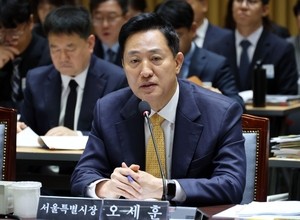
'Oh Se-hoon theme stocks' surge after acquittal in appellate ruling
Chinyang Industry, Chinyang Poly hit upper limit First-instance fine overturned to not guilty on appeal Stocks linked to Seoul Mayor Oh Se-hoon soared Friday after he was acquitted on appeal on charges that he had a third party cover the cost of polling services provided by political broker Myung Tae-kyun. According to Korea Exchange, shares of Kospi-listed Chinyang Industry hit the daily upper limit Friday, while other Chinyang group stocks also surged — Chinyang Poly (+29.81 percent), Chinyang Chemical (+29.81 percent), Chinyang Holdings (+23.01 percent) and Chinyang Pharmaceutical (+19.37 percent). The stocks have long been classified as theme stocks tied to Oh because Yang Jun-young, chief executive of Chinyang Holdings, is a fellow Korea University alumnus of the mayor. The acquittal, which allows Oh to remain in office, ignited investor sentiment. Oh had been fined 10 million won ($7,550) at trial after being convicted of receiving polling services from Myung and arranging for a third party to pay for them. The appellate court overturned that verdict Friday, finding him not guilty.
Oct. 23, 2026
-
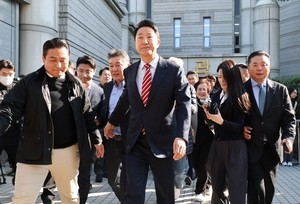
'Oh Se-hoon theme stocks' surge to daily limit after acquittal
Stocks loosely associated with Seoul Mayor Oh Se-hoon surged to the daily price limit immediately after he was acquitted on appeal Friday. According to Korea Exchange, shares of Jinyang Chemical, Jinyang Industry and Jinyang Poly hit the daily ceiling after the verdict was announced, each jumping 29.81 percent from the previous session. The three stocks are regularly cited in the market as "Oh Se-hoon theme stocks." Jinyang Chemical had already hit the daily limit after Oh won the Seoul mayoral race in June, with Jinyang Industry and Jinyang Poly also rising in tandem at the time. In practice, however, the companies have no significant ties to Oh. They were grouped together as "Oh Se-hoon theme stocks" simply because their founders attended the same university as the mayor. The shares also fell sharply on July 22, when the first-instance verdict was handed down. The Jinyang companies have stated that they have no direct connection to Oh. Regardless of such clarifications, the stocks continue to swing sharply as theme plays, and investors are advised to exercise caution. Oh was acquitted at the appeals court Friday, reversing his first-instance conviction. The Seoul High Court's Criminal Division 7, presided over by Judge Gu Hoe-geun, found Oh not guilty on charges of violating the Political Funds Act. His aide Kang Cheol-won, a former senior political affairs secretary of the Seoul Metropolitan Government, and businessman Kim Han-jeong, a longtime supporter who was indicted alongside Oh, were also acquitted. The appeals court ruled that it had not been sufficiently proven that Oh received polling results 10 times from Myung Tae-gyun ahead of the April 7, 2021 Seoul mayoral by-election and arranged for Kim — described as a longtime supporter — to cover the 33 million won ($24,900) cost on his behalf.
Oct. 23, 2026
-
SK hynix eyes share price rebound on Solidigm IPO withdrawal, Q3 earnings
Solidigm pre-IPO and IPO review scrapped Dual-listing discount and dilution concerns expected to ease Q3 earnings and shareholder returns on Wednesday seen as key to recovery SK hynix announced Friday that it is scrapping plans to list its US-based subsidiary Solidigm on American stock exchanges — a move that had been pursued as a fundraising vehicle — raising hopes that the overhang from dual-listing concerns weighing on its share price may finally ease. With the Solidigm listing withdrawn, attention is now turning to the company's third-quarter earnings release on Wednesday and any additional shareholder return measures as potential catalysts for a share price recovery. SK hynix disclosed before the market open that it was halting its review of a pre-IPO fundraising round and an initial public offering for Solidigm. After the announcement, SK hynix shares showed relative resilience compared with Samsung Electronics on the Kospi. The stock opened down about 2 percent at 1.2 million won ($906) before trimming losses during the session to briefly turn flat in morning trading, even as Samsung Electronics fell between 1 and 4 percent in early trade. Concerns over dual-listing discounts, equity dilution and profit-sharing from a Solidigm listing had long weighed on SK hynix shares. The issue drew sustained criticism from politicians and financial regulators, with the negative aspects of the plan dominating public discourse. Financial Supervisory Service Governor Lee Chan-jin added to the controversy at a recent national audit, saying both the Financial Services Commission and the Financial Supervisory Service had concluded that Solidigm's listing would constitute a dual listing and that it fell under dual-listing guidelines. Since Bloomberg reported on Oct. 7 (local time) that Solidigm was pursuing a US listing, SK hynix shares had fallen 30.35 percent on an opening-price basis through Friday. The decline was steeper than Samsung Electronics' 23.28 percent drop over the same period, amid concerns over US inflation-driven interest rate hikes, the funding burden for AI data center investment and the competitive threat from Chinese memory chip makers. The industry expects the withdrawal of Solidigm's US listing to somewhat ease concerns about dual-listing discounts and equity dilution, though a sharp near-term rebound in the share price is not widely anticipated. Yang Hyeon-gyeong, a researcher at iM Securities, said the Solidigm listing withdrawal "is a factor that can ease concerns related to SK hynix's dual listing," but cautioned that "the reduced opportunity to raise external capital and the potential for a heavier investment funding burden going forward must also be considered." Domestic investor sentiment is also expected to remain focused on limiting losses in a falling market rather than rotating back into large-cap semiconductor stocks. Yang said that while easing dual-listing concerns could limit the downside for SK hynix, "selling pressure on semiconductors from the US could amplify volatility in large-cap names such as Samsung Electronics and SK hynix." She added that "if market unease persists, buying interest could shift toward stocks with stable earnings and cash flows, or defensive plays." The tools available to fill the void left by the end of the buyback program are additional shareholder return measures and the third-quarter earnings release. SK hynix recently completed early its 40 trillion won buyback program, which had originally been scheduled to run through Nov. 19. For the first three trading days of next week, the market will have to rely solely on expectations for third-quarter results and shareholder returns to lift sentiment, without the price support that buyback demand had provided. What the industry is most eager to see is how SK hynix deploys what is estimated to be around 30 trillion won in additional shareholder return resources. When SK hynix announced its 40 trillion won share acquisition and cancellation plan in August, it said further measures would combine share buybacks and cancellations with dividend payments. The industry is now anticipating a concrete plan that could include additional buybacks or an expanded dividend program encompassing existing fixed dividends and special dividends. Third-quarter earnings, forecast to reach record highs, are the other key to a rebound. Following Samsung Electronics, which is expected to post operating profit exceeding 100 trillion won for the third quarter, SK hynix is also projected to set an all-time earnings record. According to FnGuide, SK hynix's consolidated third-quarter earnings are expected to surge 301.76 percent in sales and 576.11 percent in operating profit compared with the same period last year. The consensus estimate puts sales at 98.23 trillion won and operating profit at 76.96 trillion won. Analysts expect a combination of upward earnings revisions and shareholder returns to add momentum to a share price recovery. Kim Rok-ho, a researcher at Hana Securities, said SK hynix is set to announce additional shareholder return measures alongside its third-quarter results, and that "share buybacks and cancellations are likely to play a more important role than dividends." He added that next year's earnings forecasts, which have been revised down, are expected to be revised upward again after the third-quarter results are released.
Oct. 23, 2026
-
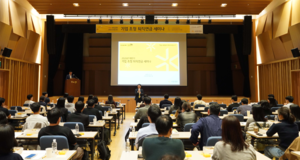
KB Securities holds seminar for 100 corporate pension managers
Event covers 2027 economic outlook, mandatory pension rules and fund-type regime KB Securities held a retirement pension seminar for about 100 corporate pension managers at its headquarters in Yeouido, Seoul, on Thursday, the company said Friday. The seminar was designed to help corporate managers keep pace with changes in the pension system and financial markets, offering practical information on reserve management and administration. Topics ranged from the economic outlook and labor issues to defined-benefit reserve management, defined-contribution product operations and pension-related taxation. The opening session featured KB Financial's management research institute, which examined domestic and international economic trends and key variables under the theme "2027 Economic Outlook." A follow-up session, "Retirement Pension System Issue Check," looked at how companies should respond to major regulatory shifts, including discussions on mandatory retirement pension enrollment and the introduction of a fund-type pension regime. The second half focused on pension management and taxation. KB Asset Management presented market trends and reserve management strategies under the theme "Retirement Pension Market Changes and DB Reserve Management," while KB Securities outlined pension tax-saving measures and product management considerations in a session titled "Pension Tax Efficiency and DC Product Management." "The retirement pension market is at a critical turning point amid institutional changes and an increasingly complex regulatory environment," KB Securities CEO Lee Hong-gu said. "Through this event, we aim to become a reliable retirement pension partner that offers differentiated asset management capabilities, professional consulting and digital-based customer service." KB Securities has also been conducting corporate social responsibility activities abroad to improve educational environments. The company said it completed its "Overseas Rainbow Classroom" project Monday, installing an outdoor library and a counseling room and renovating an aging science classroom at Lac Vien Middle School in Hai Phong, Vietnam. On Oct. 13, a company delegation visited the University of Economics and Business under Vietnam National University, Hanoi, to present scholarships.
Oct. 23, 2026
-

Shinhan Securities launches Naver Pay quick-order challenge with up to 800,000 won in prizes
4,000 customers who trade 500,000 won or more in cumulative volume to receive 5,000 Naver Pay points Shinhan Securities announced Friday that it is running the "Npay Securities Quick-Order 8 Weeks Challenge" for customers using the Naver Pay (Npay) securities quick-order service through Dec. 4. The event is open to Korean individual customers aged 19 and older who register during the promotion period. It is divided into two components: a cumulative domestic stock trading event and a weekly trading event. Under the cumulative trading event, 4,000 customers who trade 500,000 won ($377) or more in domestic stocks through the Naver Pay securities quick-order service on Shinhan Securities' web trading system (WTS) will be selected by lottery to receive 5,000 Naver Pay points. The weekly trading event runs for eight weeks, with prizes awarded each week by lottery across three transaction tiers — 500,000 won or more, 50 million won or more, and 500 million won or more — in the form of mobile Shinsegae gift certificates. Existing customers can receive certificates worth up to 500,000 won, while customers who open a new Shinhan Securities account through the quick-order service during the event period are eligible for up to 800,000 won in certificates. To participate, customers select a stock within the Naver Pay app's securities service and tap the "Quick Order" button, which connects them to Shinhan Securities' mobile WTS. After completing identity verification via a digital certificate, they can trade both domestic and overseas shares. Details on how to register and the full range of benefits are available on the Naver Pay securities event banner and the Shinhan Securities mobile WTS event tab. "We hope this event gives Naver Pay securities customers a chance to experience our investment services alongside a range of benefits," a Shinhan Securities official said. "We will continue to improve convenience and expand rewards for customers using our partner services." Shinhan Securities also held the 100th-episode special of "Shinhan Premier My Seminar," an online investment information program for wealth management customers, on Thursday. The seminar, in which research center analysts and wealth management specialists share outlooks on domestic and overseas markets and investment strategies, has drawn a cumulative 108,000 participants. The special edition covered the outlook for domestic and global stock markets in 2027 and the potential impact of the US midterm elections on the global economy.
Oct. 23, 2026
-
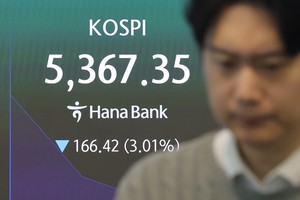
Kospi tumbles over 3% as AI investment skepticism deepens
Korean stocks open lower following Wall Street selloff SK hynix scraps Solidigm US listing plan Kosdaq also falls, dropping over 2% at open Growing skepticism over AI investment sent South Korean stocks sharply lower Friday, with both the Kospi and Kosdaq falling more than 2% at the open. By 9:20 a.m., the Kospi had dropped 189.41 points, or 3.06%, to 5,364.36, after opening down 130.60 points, or 2.36%, at 5,403.17. Samsung Electronics and SK hynix — the top two stocks by market capitalization — were each down around 3%. Samsung Electronics fell 3.96% to 206,000 won ($155), while SK hynix slid 2.62% to 1,191,000 won. The declines tracked an overnight selloff on Wall Street that was concentrated in technology stocks. SK hynix disclosed before the regular session opened that it had halted its review of a US listing for Solidigm, a subsidiary that had weighed on the company's share price. The announcement was not enough to reverse the decline, though SK hynix's losses were smaller than those of Samsung Electronics. Shareholders had long worried that a Solidigm listing would trigger a holding-company discount that would erode SK hynix's value. Solidigm was established after SK hynix acquired Intel's NAND flash and solid-state drive business in 2021. SK hynix holds a 100% stake in Solidigm through its US intermediate holding company, AI Company. Other major decliners included Samsung Electronics preferred shares (-3.29%), SK Square (-2.40%), LG Energy Solution (-2.82%) and Samsung Electro-Mechanics (-6.72%). On the Kospi, retail and foreign investors were net sellers of 12.1 billion won and 181.9 billion won, respectively, while institutions were net buyers of 188.7 billion won. Wall Street also fell overnight as earnings reports from major technology companies, including Meta, intensified concerns about the enormous cost of AI investment and whether returns would justify the spending, sharply dampening investor sentiment. The S&P 500 closed down 93.74 points, or 1.21%, at 7,663.43, while the tech-heavy NASDAQ Composite tumbled 694.00 points, or 2.60%, to 26,008.86 — its steepest single-day drop since June. The Dow Jones Industrial Average bucked the trend, edging up 11.89 points, or 0.02%, to close at 52,867.98. Meta had reported third-quarter earnings that beat market expectations on Tuesday (local time), but said it planned to issue a new class of non-voting shares to fund its expanding AI investment. Meta's stock tumbled about 7% that day. The Philadelphia Semiconductor Index also fell 6.7%, dragged down by Nvidia (-4.4%) and Micron (-6.3%), among others. SpaceX, which had announced its first quarterly profit on Oct. 20, dropped 9.1%, and Tesla fell 3.1% on disappointing earnings. The selloff spread beyond the biggest technology names — Alphabet (-3.2%) and Amazon (-4.6%) — to data center-related companies as well. The Kosdaq opened down 15.78 points, or 2.07%, at 748.32, and had since extended losses to 738.58, down 25.52 points, or 3.34%, from the previous session. Most large-cap Kosdaq stocks were also in the red, including Alteogen (-1.52%), Ecopro (-5.57%), Ecopro BM (-6.01%), Jusung Engineering (-7.07%) and Rainbow Robotics (-4.79%). Retail and institutional investors were net sellers of 15.2 billion won and 12.9 billion won, respectively, while foreign investors were net buyers of 31.8 billion won. "Meta's credit default swap premium surged to a record high while credit risks at neo-cloud companies persisted, concentrating selling pressure on AI-related stocks including semiconductors," said Seo Sang-young, a managing director at Mirae Asset Securities. "Hedge fund short-selling leverage approaching a five-year high also amplified the decline in technology stocks by adding to supply-demand pressure," he added.
Oct. 23, 2026
-
Bukwang Pharmaceutical posts 120.7% rise in Q3 operating profit
Bukwang Pharmaceutical said Friday its third-quarter consolidated operating profit rose 120.7 percent year-on-year to 2.16 billion won ($1.63 million). Revenue for the same period climbed 21.2 percent to 57.97 billion won. Net profit for the period fell 43.3 percent to 847 million won, according to preliminary figures.
Oct. 23, 2026
-
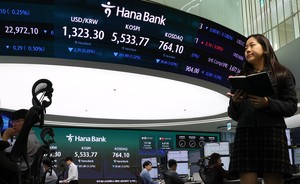
Kospi faces another 'Black Friday' as US chip stocks tumble; SK hynix halts Solidigm IPO plan
NASDAQ falls 2.60%, Philadelphia Semiconductor Index drops 6.72% Nvidia down 4.4%, SK hynix ADR off 8% AI profitability fears compound oil price surge Market watches fallout from Solidigm IPO cancellation Renewed concerns over AI profitability hammered semiconductor stocks on Wall Street overnight, and analysts expect the domestic market to remain under pressure Friday. The Kospi closed Thursday down 201.89 points, or 3.52 percent, at 5,533.77. At the close of the regular session at 3:30 p.m., foreign investors and retail investors were net buyers of 59 billion won ($44.5 million) and 381 billion won, respectively, while institutions were net sellers of 463 billion won. Including after-market trading, foreign and retail net purchases stood at 37.1 billion won and 363.3 billion won, respectively, while institutions remained net sellers at 446.5 billion won. Several factors converged to weigh on the market: profit-taking following Wednesday's sharp rebound, the conclusion of share buyback programs by Samsung Electronics and SK hynix, lingering doubts about AI infrastructure investment, and growing fears over a Middle East escalation. It was also the first trading session after Samsung Electronics completed its employee stock-compensation buyback and SK hynix wrapped up its 40 trillion won share buyback and cancellation program — the former earlier this month and the latter on Wednesday — adding a supply-demand overhang to the market. Samsung Electronics tumbled 4.03 percent and SK hynix fell 5.49 percent. Overnight on Wall Street, conditions were equally grim. The three major indexes closed mixed amid broad weakness in AI and semiconductor stocks. The Dow Jones Industrial Average edged up 0.02 percent, while the S&P 500 fell 1.21 percent and the NASDAQ Composite dropped 2.60 percent — the NASDAQ's steepest single-day decline since June. Seo Sang-young, a managing director at Mirae Asset Securities, said Meta's free cash flow deficit and Tesla's downward revision to its capital expenditure outlook — both reported Thursday — reignited concerns about returns on AI investment. "Meta's five-year credit default swap premium reached an all-time high of 114.79 basis points, reflecting the financial strain now being priced into credit markets as well," he said. The Philadelphia Semiconductor Index tumbled 6.72 percent. Micron fell 6.26 percent, Nvidia dropped 4.40 percent and Intel lost 8.04 percent. Memory-related names also took heavy losses, with SK hynix's American depositary receipts falling 8.07 percent and SanDisk declining 8.51 percent. A surge in crude oil prices driven by heightened Middle East tensions added further downward pressure on equities. Brent crude futures on the London ICE exchange settled up 4.00 percent at $113.17 per barrel, the highest level since May. West Texas Intermediate for December delivery rose 2.39 percent on the New York Mercantile Exchange. Indicators tracking Korean market sentiment fell across the board. The MSCI Korea ETF dropped 4.98 percent and the MSCI Emerging Markets ETF fell 2.91 percent. The Russell 2000 index and the Dow Jones Transportation Average bucked the trend, rising 0.11 percent and 1.87 percent, respectively. KOSPI 200 overnight futures fell 2.64 percent. However, some market participants expressed cautious optimism that SK hynix's announcement halting its review of a NASDAQ listing for its subsidiary Solidigm could provide a positive catalyst for SK hynix shares and the broader Kospi. SK hynix disclosed at around 7:30 a.m. Friday that "Solidigm has been reviewing various financing options to expand production capacity and strengthen competitiveness, but has decided to halt its review of a pre-IPO and initial public offering after comprehensively considering capital market conditions and other factors." Market participants had long worried that a Solidigm IPO would amount to a de facto dual listing and, if realized, could dilute shareholder value in SK hynix. Some analysts also noted that concerns over big tech's continued AI spending and related credit risks had already been partially priced in through Thursday's sharp domestic market selloff, suggesting the downside Friday may be more limited than feared. Han Ji-young, a researcher at Kiwoom Securities, said the domestic market was likely to open lower on the back of the US AI stock correction triggered by Meta's credit concerns and higher oil prices. "The negative fallout from Meta has already been partially priced in by the domestic market the previous day, and the case for oversold conditions remains valid," she added.
Oct. 23, 2026
-
Meta's plan to issue new shares to fund AI spending sends Nasdaq tumbling 2.6%
Philadelphia Semiconductor Index drops 6.7% Meta announces new share class to raise AI investment funds US stocks tumbled Thursday (local time), led by technology shares, as skepticism over AI investment spending resurfaced. Meta's announcement that it plans to issue a new class of shares to fund its AI ambitions deepened concerns about the mounting cost of large-scale AI buildouts. The Dow Jones Industrial Average edged up 11.89 points, or 0.02 percent, to close at 52,867.98 on the New York Stock Exchange. The S&P 500 fell 93.74 points, or 1.21 percent, to 7,663.43, while the tech-heavy Nasdaq Composite tumbled 694.00 points, or 2.60 percent, to 26,008.86 — its steepest single-day decline since June. The broad selloff reflected renewed anxiety over the cost of AI investment at major technology companies and the burden of financing it. Doubts about whether those outlays will ultimately generate commensurate returns also weighed on investor sentiment. Meta's financing plan was the primary catalyst for the renewed AI skepticism. The company reported third-quarter earnings that beat market expectations, but said it intends to issue a new class of non-voting shares to raise the capital needed to expand its AI investment. Meta also raised the lower end of its full-year capital expenditure guidance, to a range of $135 billion to $145 billion from a prior range of $130 billion to $145 billion. Its future spending commitments grew to $825 billion from roughly $700 billion in July. Meta's free cash flow for the third quarter came in at negative $2.12 billion — the first time the company has posted a free cash flow deficit since its listing, fueling concern that AI spending is outpacing its ability to generate cash internally. "The worry around AI is no longer about the technology itself," said Michael Antonelli, market strategist at Baird Private Wealth Management. "The question is how everyone can raise the money at the same time." Meta's share price tumbled about 7 percent on the day. Nvidia fell 4.4 percent and Micron dropped 6.3 percent, dragging the Philadelphia Semiconductor Index down 6.7 percent. SpaceX, which announced its first quarterly profit on Tuesday, fell 9.1 percent. Tesla slid 3.1 percent after reporting earnings that missed market expectations. Selling pressure extended to Alphabet, down 3.2 percent, Amazon, down 4.6 percent, and other large technology companies and data center-related stocks. Defensive and financial stocks, which face comparatively less pressure from AI spending, bucked the trend and rose as capital rotated out of technology shares into other sectors. Investors also sought safety in US Treasurys. The yield on the 10-year Treasury note fell 19.3 basis points to 4.952 percent — its largest single-day drop since the US regional banking crisis in March 2023. A surge in crude oil prices driven by escalating geopolitical tensions in the Middle East added further pressure on equities. Brent crude topped $113 per barrel after Iran-aligned Houthi rebels in Yemen intensified attacks on Saudi Arabia, reaching its highest level in about five months since May.
Oct. 23, 2026
-

ETFs with 100%+ returns face delisting risk as correlation rule stalls for 6th year
Four active exchange-traded funds have fallen short of the correlation coefficient threshold required to maintain their listings. With five products already delisted this year for the same reason, concerns are growing over further removals. Although financial authorities said early this year they would pursue regulatory reform, efforts to ease the correlation coefficient requirement — under discussion since 2020 — have made no progress in six years. The asset management industry says the current rules are constraining the operational autonomy of active ETFs. According to Korea Exchange on Thursday, four active ETFs disclosed Wednesday that they had failed to meet the correlation coefficient standard. The products are NH Amundi Asset Management's HANARO Global Physical AI Active and HANARO US S&P500 Active, Timefolio Asset Management's TIME Global Top Pick Active, and Asset Plus Asset Management's Asset Plus China Top Company Focus 10 Active. Their correlation coefficients as of Tuesday were 0.69, 0.64, 0.64 and 0.69, respectively. The combined net asset value of the four products as of Wednesday stood at 132.8 billion won ($100 million). The concern is that even funds with strong returns can face delisting if their correlation coefficient falls too low. HANARO Global Physical AI Active has posted a return of 127.19 percent since inception as of Wednesday, outpacing its benchmark index by 91.86 percentage points. Yet the fund has been below the correlation coefficient threshold since July 31, and if it fails to recover by Oct. 30, trading will be suspended Nov. 3 and the fund will be delisted Nov. 4. The correlation coefficient measures how closely an ETF's returns move in line with its benchmark index. Domestic active ETFs are free to adjust their holdings and weightings, but they must maintain a correlation coefficient of at least 0.7 — meaning the fund's returns must broadly move in the same direction as the benchmark, rising when it rises and falling when it falls. Once a fund has been listed for more than a year, its correlation coefficient is assessed based on the preceding 12 months of returns. A reading below 0.7 for three consecutive months or more triggers delisting eligibility. This year marks the first time ETFs have been delisted for failing the correlation coefficient requirement. In July, four products managed by Korea Investment Trust Management — ACE TDF2030 Active Qualified, ACE TDF2050 Active Qualified, ACE Long-Term Asset Allocation Active and ACE Apple Value Chain Active — were delisted. In August, Timefolio Asset Management's TIME US Dividend Dow Jones Active was removed for the same reason. Kim Jae-chil, a senior research fellow at the Korea Capital Market Institute, said maintaining a correlation coefficient with a benchmark index is difficult for actively managed equity ETFs, and that the requirement places significant constraints on strategy formulation and individual stock weighting. "In most countries, active ETFs do not track the direction of a specific index," he said. "In principle, it would be desirable to abolish the obligation for domestic active ETFs to maintain a correlation coefficient with a benchmark index." Discussions on easing the correlation coefficient requirement have been ongoing since 2020, when Korea Exchange said it would consider lowering the threshold, delaying the disclosure timing of portfolio composition files, or exploring non-disclosure options depending on market conditions. The Financial Services Commission also announced in January that it would pursue amendments to the Capital Markets Act to introduce fully active ETFs with no index-tracking requirement, and that it would support the National Assembly in introducing relevant legislation in the first half of the year. The FSC's failure to follow through on its reform announcement drew criticism at the National Assembly. At the Financial Services Committee's national audit on Oct. 8, Democratic Party of Korea lawmaker Han Min-su said the FSC had not held a single related meeting since its announcement at the start of the year and urged the commission to move forward with deregulation. Han also said Korea Exchange had expressed the view that the correlation coefficient threshold should be lowered from the current 0.7 to 0.5. FSC Chairman Lee Eok-won said he agreed on the need to introduce fully active ETFs but cited the need for legislative amendments and investor protection considerations. Industry officials say that active ETF regulatory reform took a back seat in the first half of the year as the introduction of single-stock leveraged ETFs emerged as the dominant policy issue. They add that a string of correlation-coefficient-related delistings in the second half has placed growing pressure on fund managers running their investment strategies. One industry official said he understood why financial authorities had tightened investor protections in the wake of incidents such as the Hong Kong ELS crisis and the Lime Fund scandal. "Cases where the benchmark index rises but the ETF underperforms also need to be taken into account," the official said. "That said, it is disappointing that regulatory reform has not advanced even after the FSC announced its intention to introduce fully active ETFs earlier this year."
Oct. 22, 2026
-
Kospi could hit 9,300 next year despite recent plunge to 5,500, Hanwha Investment says
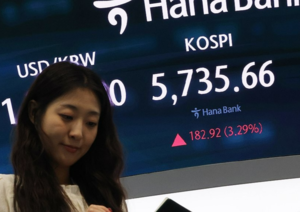
Even as the Kospi has been pushed down to the 5,500 level, a brokerage is forecasting the index could climb as high as 9,300 next year. Domestic companies are maintaining strong profitability, but their share prices have yet to fully reflect it, the analysis found. Hanwha Investment & Securities set a Kospi target of 8,500 for next year in its "2027 Stock Outlook" report released Thursday, with an expected trading range of 6,000 to 9,300. Ha Jang-kwon, a researcher at Hanwha Investment, said the recent market decline represents a situation where share prices have fallen sharply ahead of actual corporate earnings. He recommended buying on dips below the 6,000 level, arguing that macroeconomic concerns have already been substantially priced in. The Kospi plunged on Oct. 13 and Oct. 15, briefly touching the 5,500 level. Concerns over a prolonged high-rate environment in the United States and uncertainty surrounding the semiconductor industry weighed on investor sentiment. Meanwhile, earnings forecasts for major domestic companies have not deteriorated significantly. Hanwha Investment said this divergence between fundamentals and prices would serve as the basis for a future market rebound. Record-high earnings, plunging share prices — forward PER falls to 4x The key indicators Hanwha Investment highlighted are return on equity and price-to-book ratio. Return on equity, or ROE, measures how much profit a company generates from its shareholders' equity. Price-to-book ratio, or PBR, shows how many times a company's share price trades relative to its net assets. According to the report, the Kospi's forward 12-month ROE stood at 25.5 percent as of Friday — close to an all-time high. Yet the PBR over the same period remained at just 1.08 times. Applying the historical relationship between ROE and PBR observed in the domestic market from 2005 to 2023, the current level of profitability would justify a PBR of around 2 times — but share prices are trading at roughly half that level, the report said. The forward 12-month price-to-earnings ratio has also fallen to around 4 times, the lowest since 2010. Ha said the ROE currently priced into shares is only about 11 percent — a significant gap from the trailing 12-month ROE of about 16 percent and the forward 12-month estimate of about 26 percent. The report also noted that domestic companies' profitability compares favorably with peers in other major markets. On an MSCI basis, Korean companies' forward 12-month ROE has surpassed that of Taiwan for the first time in about 12 years. Profitability has risen sharply, yet the valuation of the domestic market remains relatively low. Hanwha Investment said a rerating of share prices would become possible once market confidence in the sustainability of corporate earnings growth is restored. The market's forward 12-month ROE estimate for the Kospi at end of next year has risen from 18.2 percent in March to 22.7 percent recently, signaling that expectations for future corporate profitability are being revised upward. Historical data was also cited in support of a potential rebound. An analysis of periods since 2005 when the ROE priced into the market was lower than companies' actual trailing 12-month ROE found that the Kospi's average return one year later was 28 percent. The index rose in 84 percent of such instances. Hanwha Investment said the key variable for a share price rerating will be how consistently companies can sustain their high profitability going forward. Consolidation in the first half of next year, then a renewed rally — high-rate headwinds seen as limited Hanwha Investment expects the Kospi to recover to around 7,600 in the fourth quarter of this year. The brokerage set a first-quarter target of 7,700 for next year and a second-quarter target of 7,550. The rally is expected to slow temporarily in the first half, before resuming in the second half driven by growth in companies' net assets and improving profitability. The third-quarter target for next year is 7,900, with the fourth-quarter target at 8,500. Even if the high-rate environment persists, its drag on further market gains is expected to be limited. Hanwha Investment forecast that the Federal Reserve will raise its benchmark interest rate to 4.25 percent in December and hold it there through the end of next year. The yield on the 10-year US Treasury note is expected to move in a range of 4.80 to 5.60 percent next year. Ha said that based on the historical relationship between long-term US Treasury yields and market valuations, rising interest rates do not always lead to falling share prices. An analysis of the relationship between the 10-year US Treasury yield and the forward 12-month price-to-earnings ratio of the S&P 500 since 1985 found that rates and valuations tended to move in the same direction as long as yields remained below 6 percent. Above 6 percent, however, rising rates acted as a drag on equity valuations, the report said. The report also flagged changes in the labor market driven by the spread of AI. Hanwha Investment said that as AI adoption expands, workforce reductions will increase — particularly in high-wage sectors — which would limit wage-driven inflationary pressure. If labor cost burdens and inflationary pressure ease while corporate profitability holds up, financial markets may be less likely to worry about further tightening even in a high-rate environment, the brokerage said. On that basis, Hanwha Investment characterized share price corrections driven by macroeconomic uncertainty as opportunities to increase exposure to risk assets. Semiconductors and IT in focus through year-end — banks and steel to broaden the rally from the second quarter of next year The sectors expected to lead the market higher will vary by timing, the brokerage said. Hanwha Investment identified semiconductors and IT hardware as the top investment picks from the fourth quarter of this year through the first quarter of next year. Improving earnings at chipmakers and memory chip price negotiations are expected to serve as catalysts for share price gains. In particular, earnings releases from major memory chip companies at the end of this month, long-term supply contracts at year-end, and HBM price negotiations for next year are all expected to influence a broader rerating of the sector. From the second quarter of next year, the rally is expected to broaden to other sectors. As upward pressure on interest rates eases and the won strengthens, investor attention could shift toward banks, steel, transportation and utilities, the report said. Hanwha Investment forecast the won-dollar exchange rate to fall from 1,350 won per dollar in the first quarter of next year to 1,270 won in the fourth quarter. A stronger won would benefit sectors where import costs for raw materials and energy fall as a result. The brokerage highlighted the possibility that the semiconductor-led rally could broaden to value stocks and cyclical sectors. For the Kosdaq market, Hanwha Investment identified the second half of next year as the period to watch for a potential rebound. The gradual unwinding of the liquidity squeeze caused by prior rate hikes — rather than rate cuts themselves — could serve as the trigger for a Kosdaq recovery, the report said. On shareholder return policies in the domestic market, the brokerage said a closer link to corporate earnings is needed. According to the report, South Korean companies' total shareholder return ratio last year was 31.1 percent, well below Japan's 65.0 percent and Taiwan's 56.8 percent. Hanwha Investment said that while shareholder return policies such as dividends and buybacks can have a positive effect on share prices, sustained gains require underlying market confidence in corporate earnings. Ha said what matters most is how high a level of profitability companies can maintain even during periods when ROE falls from its peak. The Kospi target of 8,500 for next year was derived from the expectation that companies' improved profitability will be reflected in share prices. Hanwha Investment said the index could rise to the upper end of its forecast range — 9,300 — if earnings growth is sustained and market valuations normalize.
Oct. 22, 2026
-

Foreign investors sell SK hynix, buy Samsung Electronics — what's behind the divergence?
Foreign investors have been moving in opposite directions on South Korea's two dominant chipmakers, Samsung Electronics and SK hynix. Buying has flowed into Samsung Electronics in recent sessions, while selling pressure on SK hynix has persisted. On Wednesday, however, foreigners turned net buyers of both stocks. Securities analysts said investor sentiment is recovering on the back of strong earnings from US AI companies, but whether the foreign buying will continue remains uncertain. According to Korea Exchange data released Thursday, foreign investors net bought Samsung Electronics for four consecutive trading days from Friday through Wednesday. Their cumulative net purchases reached 1.31 trillion won ($991 million). Over the same period, they net sold SK hynix shares worth 414 billion won. Foreign investors had sold SK hynix for 18 consecutive trading days from Sept. 21 through Tuesday, accumulating net sales of 16.17 trillion won. On Wednesday, however, they turned net buyers of both Samsung Electronics and SK hynix simultaneously, signaling a possible shift in foreign flows into large-cap semiconductor stocks — the first time that had happened since Sept. 9. SK hynix also suffered a steeper share price decline over the period. From Sept. 21 through Wednesday, Samsung Electronics fell 14.37 percent while SK hynix dropped 30.32 percent. During the same stretch, foreign investors net sold 15.97 trillion won worth of SK hynix shares and 3.94 trillion won worth of Samsung Electronics shares. The concentrated foreign selling in SK hynix is widely seen as a key driver of its sharper price decline. Among the factors cited for the divergence in foreign flows is the controversy surrounding the planned NASDAQ listing of Solidigm, an SK hynix subsidiary. "Since last year, expectations for the domestic stock market have rested on the structural earnings growth of Korean companies driven by expanded AI capital investment, and on governance improvements following amendments to the Commercial Act," said Heo Jae-hwan, a researcher at Eugene Investment & Securities. "However, governance improvements and shareholder returns have fallen short of expectations." The concern is that a Solidigm NASDAQ listing could deepen the so-called Korea discount. Recent strong earnings from US AI-related companies have helped lift sentiment toward semiconductor stocks. SpaceX announced Wednesday (local time) that it turned a profit for the first time in the third quarter. On a conference call, CEO Elon Musk said demand from hyperscalers to lease AI computing capacity is outpacing supply and that the shortage is expected to persist for an extended period, fueling expectations for further AI infrastructure investment and rising semiconductor demand. Super Micro Computer also issued a preliminary sales forecast of $18.5 billion to $19.5 billion for the first quarter of fiscal year 2027, well above the market consensus of $15.2 billion. Its gross margin guidance of 12.0 to 12.5 percent also exceeded the market estimate of 10.15 percent, raising hopes for a profitability recovery. "A direct catalyst that would ease the funding concerns weighing on AI-sector sentiment has yet to materialize," said Hwang Su-uk, a researcher at Meritz Securities. "That said, a succession of earnings surprises is increasing the likelihood that market attention will shift back from flows and sentiment to earnings and fundamentals." Analysts said uncertainty surrounding AI remains elevated, making it unclear whether the rally in semiconductor stocks can be sustained. They particularly advised watching whether foreign buying continues. "For the first time since Sept. 9, we have seen foreigners simultaneously net buy both Samsung Electronics and SK hynix, suggesting that risk perception toward the semiconductor sector as a whole may have eased somewhat," said Lee Jae-won, a researcher at Yuanta Securities Korea. "Given that net buying and net selling have alternated recently, however, additional confirmation is needed before concluding that foreigners have decisively shifted to sustained buying," he added. "Foreign investors are buying in the spot market, but conviction about the market's direction is still lacking," said Lee Jun-young, a researcher at Eugene Investment & Securities. "Rather than chasing the rally, a response that accounts for volatility is warranted." On Wednesday, foreign investors net bought 655.8 billion won on the Kospi market while simultaneously net selling 816.5 billion won in KOSPI 200 futures. "In a thin liquidity environment, tug-of-war dynamics are frequently emerging between expectations for expanding real AI demand and a sustained investment cycle on one side, and concerns over profitability and funding risks on the other," said Han Ji-young, a researcher at Kiwoom Securities. "Volatility will be unavoidable through next week as the market works through earnings from US hyperscalers and domestic chipmakers."
Oct. 22, 2026
MOST READ
- 1Hyundai Mobis to develop robot semiconductors for Atlas humanoid
- 2Anpanman rolls out to all CJ Olive Young stores with limited-edition collabs from 30-plus brands
- 3Korean woman's mugshot goes viral in US after DUI arrest in Georgia
- 4Theater actor Kim Hyun-i asks public to stop sharing her photos after mix-up with late stunt performer of same name
- 5‘Blockchain won’t replace banks — integration is the key‘: Bankfrick
- 6Paper straws more harmful than plastic? Study finds 6 times higher cancer risk, double the acidification
-
WORLD

US warns of punishment for anyone enabling Iran's Strait of Hormuz toll scheme
-
INDUSTRY
Toyota union puts productivity first; Hyundai Motor union demands bigger share of profits
-
FINANCE
National Growth Fund to invest $531M in FuriosaAI, which rebuffed Meta's $800M takeover bid
-
INDUSTRY

Korea Shipowners' Association holds amateur baduk tournament for Maritime Day