
- HOME
- POLITICS
Detailed plan for unified military academy pushed past this month
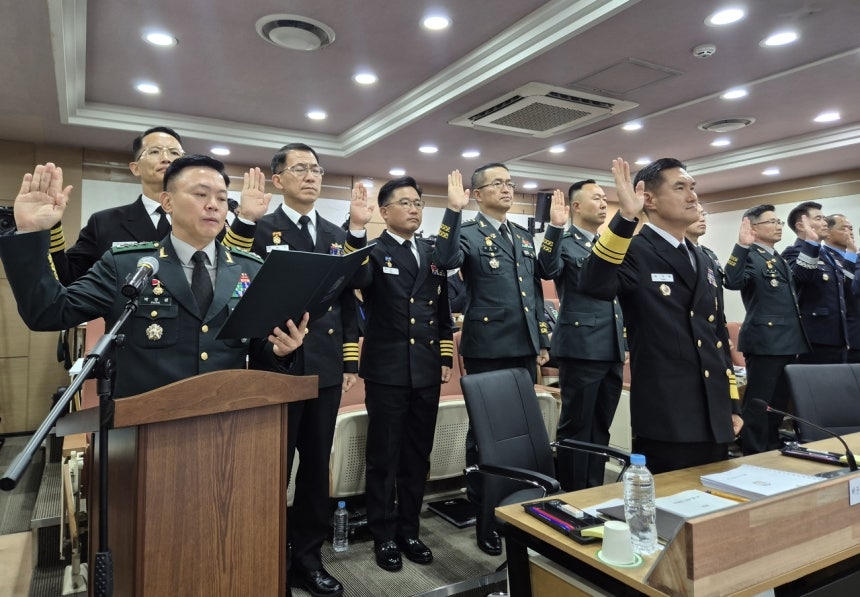
Defense Ministry cites new minister's inauguration, other variables; year-end announcement expected South Korea's Defense Ministry said Friday that its detailed plan for establishing a unified national military academy, originally set for release this month, has been delayed due to variables including a change in defense minister. A Defense Ministry official told reporters Friday that announcing the plan this month had become physically impossible given multiple complicating factors. "There are many variables, including the inauguration of the new minister and the landmine explosion in the Demilitarized Zone," the official said. "Various opinions also emerged during the national audit, and we will incorporate and refine those before making the announcement." The official added that the ministry planned to present the public with the best possible plan for establishing the academy "in the near future, given the gravity of the matter — training elite officers for the future." No specific announcement date has been set, but the urgency of the issue points to a release before the end of the year. The Defense Ministry unveiled a basic plan in July to establish a four-year unified national military academy — merging the Army, Navy and Air Force academies — at Jaun-dae in Daejeon, a hub of military education and training facilities. The ministry had said it would pursue releasing a detailed plan around October after gathering public input through hearings and other consultations. Specifics such as when the first class of cadets would be admitted and how they would be selected were expected to be included in that detailed plan. Newly inaugurated Defense Minister Kang Sin-cheol has said publicly that he is open to revising the existing basic plan if further input reveals areas for improvement. At his confirmation hearing last month, Kang expressed commitment to reforming the military academies but said of the ministry's integration blueprint: "Personally, I see areas that need to be supplemented. In my view, it is not complete."
Yoon Ho Oct. 23, 2026
-
Shincheonji row splits Democratic Party leadership at Supreme Council meeting
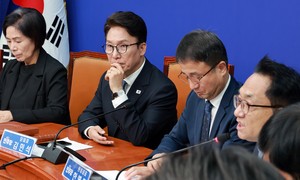
Lee Sung-yoon calls for disclosure of Shincheonji probe results Park Sun-won fires back, vowing to announce findings at press briefing Kim Min-seok intervenes; no press conference held after closed-door talks Party leadership to revisit question of disclosure A sharp clash erupted at a Democratic Party of Korea Supreme Council meeting Friday over whether to release the findings of an internal probe into allegations that Shincheonji church members had systematically joined the party. Supreme Council member Lee Sung-yoon, aligned with the pro-Jung Chung-rae faction, demanded the results be made public, prompting Park Sun-won — a pro-Lee Jae Myung faction member who heads the party membership review task force — to shoot back on the spot: "Fine, let's release everything." At the meeting held at the National Assembly, Lee called on the party to disclose the probe results in full. "The time has come to reveal to the public and party members, exactly as they are, the findings of the investigation into Shincheonji's alleged interference — interference that has divided our party and wounded our members," he said. Lee added that a joint police-prosecution investigative team of dozens of prosecutors and investigators had spent eight months on the case without confirming allegations of organized Shincheonji infiltration or election interference in any party other than the People Power Party. "We must also disclose the basis for the so-called anti-Lee Jae Myung, divisionist, secret Shincheonji alliance — and bring this matter to a close," he said. "If the allegations of Shincheonji interference are true, those responsible must be held accountable. If there is no basis for them, our party must impose equally stern accountability on those who made the claims." Park, seated directly beside Lee, visibly bristled, muttering "Sure, sure — release it all." The tension continued toward the end of the open session, when Park declared he would make a public announcement at the National Assembly press briefing room and take personal responsibility as TF head. Party leader Kim Min-seok stepped in, telling him to take the matter outside. After a closed-door leadership session, the party resolved to hold off on an immediate press conference. The confrontation extends the pro-Lee Jae Myung versus pro-Jung Chung-rae factional tensions that flared during the party leadership election in August. Kim had clashed with the camp of then-leader Jung Chung-rae during the primary election by raising allegations of a secret three-way alliance among anti-Lee Jae Myung forces, divisionists and Shincheonji. The factional conflict reignited after Kim said the party had secured evidence of mass Shincheonji membership sign-ups and testimony about organized interference in the primary election. The Democratic Party leadership had initially agreed to defer any decision on when to release the Shincheonji probe results. Lee's renewed push for disclosure Friday, compounded by Park's impromptu announcement of intent, thrust the question back onto the agenda. Chief Democratic Party Spokesperson Park Sung-joon told reporters after the meeting that various views on releasing the Shincheonji membership list had been circulating within the party. "My understanding is that Park Sun-won, who had pushed back against Lee Sung-yoon's pressure to disclose, expressed the view that since the investigation has already been completed, it may be appropriate to release the findings," he said. Park Sung-joon added that the Supreme Council would need to weigh all of this from a political standpoint. "The outcome, the public reaction, and internal party dynamics all have to be factored in — and I believe the Supreme Council will reach a conclusion after considering all of those elements," he said.
Oct. 23, 2026
-
Koreas edge toward loudspeaker standoff as North warns of broadcast restart
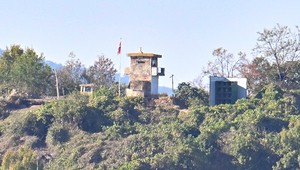
Foreign Ministry sends Security Council letter demanding North Korea apologize over mine blast; Kim Yo-jong says loudspeakers will be on standby 'within days' The two Koreas are edging toward a resumption of loudspeaker psychological warfare after North Korea signaled it would restart cross-border broadcasts and South Korea's military left open the possibility of a matching response. Analysts note, however, that Seoul faces considerable pressure not to follow suit, given persistent questions about the effectiveness of such broadcasts and growing concerns about their impact on border communities. Kim Yong-hyun, a professor at Dongguk University, said Friday that the likelihood of loudspeaker operations resuming "is currently rising." "The North is signaling firm resolve and showing through this mine incident and related developments that it will not back down," Kim said. "There is also an element of reinforcing internal cohesion." He added that "finding an exit strategy is not easy at this point," and that "without new movement in North America–North Korea dialogue, it will be difficult to find a breakthrough in inter-Korean relations." Kim Yo-jong, director of the Korean Workers' Party General Affairs Department, cited South Korea's warning shots fired at North Korean soldiers who crossed the MDL on Thursday as a pretext to announce that "our new countermeasures along the entire border will enter a mission-ready posture," adding that "loudspeakers directed at South Korea will also be placed on standby within days." On this, the Defense Ministry said at its regular briefing the same day that "nothing has been decided," but added, "If North Korea does something, I think we naturally need to have a proportionate response," leaving open the possibility of a reciprocal move. Resuming South Korea's own loudspeaker broadcasts toward the North would not come without significant costs, however. The effectiveness of such broadcasts has consistently been questioned, and residents in border areas have long complained of health problems — including sleep deprivation — caused by the noise. The tourism and livestock industries in those areas have also suffered heavily. That is why the Ministry of Unification said Thursday that "just over a year ago, we experienced unbearable suffering on both sides as loudspeakers blared at each other," urging that "the mistakes of the past must not be repeated." Meanwhile, the Ministry of Foreign Affairs sent a two-page letter to the president of the UN Security Council on Thursday (local time), under the name of South Korea's UN Ambassador Cha Ji-hoon. The letter conveyed the findings of a probe concluding that the Sept. 21 landmine explosion in the demilitarized zone was caused by mines planted by North Korean troops, and stated that the incident constituted a violation of the Armistice Agreement. The government used the letter to demand a North Korean apology and responsible action, and to call on Pyongyang to engage in dialogue to ease tensions and restore trust.
Oct. 23, 2026
-
Democratic Party pushes to include W13.28b for Itaewon special probe in next year's budget
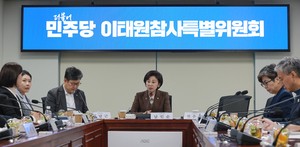
The Democratic Party of Korea is pushing to include 13.28 billion won ($10 million) in next year's government budget to fund the activities of the special investigation commission tasked with uncovering the truth behind the Oct. 29 Itaewon crowd crush and preventing a recurrence. The Democratic Party's special committee on the Itaewon crowd crush announced the plan Friday after holding a meeting at the National Assembly with officials from the special investigation commission and the Ministry of Interior and Safety, ahead of the fourth anniversary of the disaster. The proposed amount is similar in scale to this year's budget of 13.3 billion won. Rep. Nam In-soon, the National Assembly vice speaker who chairs the special committee, said the commission's operating period had been extended but that it continued to face difficulties securing investigators and seconded civil servants, and that the extended period was not adequately reflected in the proposed budget. "We must secure sufficient funding so the commission can focus entirely on its investigation, and we must actively work to provide organizational and personnel support, including professional investigators and seconded civil servants," she said. Nam added that the extended operating period should be devoted entirely to uncovering the truth. "We must make it absolutely clear why the state's disaster prevention and response systems failed to function, and who bears what responsibility in that process," she said. The meeting also covered the status of ongoing investigations related to the disaster and measures to support victims. "There is still a long road ahead before we can complete the work of establishing the truth and holding those responsible accountable," Nam said. "The special committee will continue to monitor the commission's investigative activities and will fulfill its responsibilities to the end — from securing budget and personnel support to guaranteeing victims' rights and reforming the system to prevent a recurrence."
Oct. 23, 2026
-

Ruling, opposition parties clash over Lee's 'impeachment grounds' remark
National audit nears end amid intensifying political exchanges Han Byung-do tells PPP to reflect on Yoon-era failings first Jeong Jeom-sik says Lee focused on 'political jailbreak' across 5 trials As the National Assembly's national audit of the Lee Jae Myung government's second year nears its end, political clashes are intensifying over President Lee's remarks about so-called "impeachment grounds" and the controversy surrounding Serious Crimes Investigation Agency chief Kim Ji-yong's attendance at Cabinet meetings. Democratic Party floor leader Han Byung-do, speaking at a supreme council meeting Friday, criticized the People Power Party for raising objections to investigative agency heads attending Cabinet meetings and invoking the principles of independence, neutrality and fairness. "That is simply a comedy," Han said, urging the PPP to first reflect on its own failings in undermining the independence and neutrality of investigative agencies. "Does attending a Cabinet meeting compromise investigative independence, while staying away preserves it? What kind of bizarre logic is that?" Han said. He added, "Have they already forgotten how, under the Yoon Suk Yeol administration, prosecutors and police were reduced to servants of power?" Supreme council member Park Seon-won also said Cabinet meetings are held to discuss the organization, budget, personnel and operations of investigative agencies, and that directing or discussing any specific investigation there is simply not possible. "Discussing the operations of investigative agencies and intervening in individual cases are entirely different matters, and the legal basis for this is clear — including Article 12, Paragraph 4 of the Government Organization Act," Park said. Park said it was a distortion and a leap in logic to characterize the legally permitted attendance of investigative agency heads at Cabinet meetings as unlawful interference in investigations. "If not attending Cabinet meetings is what guarantees investigative independence, then how politically neutral were the prosecutors under the Yoon administration, who did not attend Cabinet meetings?" he said. The PPP pushed back by citing President Lee's post on X, formerly Twitter, in which he wrote that "relinquishing command and oversight of the Serious Crimes Investigation Agency would constitute grounds for impeachment." PPP members countered, "Does that mean every other president in history should have been impeached?" PPP floor leader Jeong Jeom-sik, speaking at a national audit strategy meeting Friday, said forcing the Serious Crimes Investigation Agency chief to attend Cabinet meetings amounted to an open and routine attempt to pressure a state institution through the Cabinet. "This kind of conduct is itself what constitutes grounds for impeachment," Jeong said. Jeong said the president can receive reports on state affairs through the relevant minister. "Even though lawful means of command and oversight exist, the purpose of forcibly seating the head of an investigative agency is to lay the groundwork for directly or indirectly influencing the president's own trials," he said. Jeong added that President Lee had, for more than 500 days since taking office, "consistently devoted himself to a 'political jailbreak' aimed at eliminating his five ongoing trials." He warned that "the tower of wrongdoing built to cover up his own crimes will ultimately collapse on him." PPP Rep. Jang Dong-hyeok wrote on Facebook on Thursday that "the authority to command and oversee administrative agencies and the political neutrality of investigative agencies are entirely separate issues — and the attendance of investigative agency heads at Cabinet meetings is an even more distinct matter." Independent lawmaker Han Dong-hoon also wrote on Facebook that "if a president directs investigations — whether through the Serious Crimes Investigation Agency, the prosecution service or the police — to block probes into his own crimes or attack political rivals, that constitutes grounds for impeachment." The ruling and opposition parties also traded barbs over the Constitutional Court's partial acceptance of an injunction request filed by People Power Party lawmaker Lee Jin-suk regarding a recusal vote, as well as the failure to secure the National Assembly's steering committee adoption of witnesses including Cheong Wa Dae First Deputy Chief of Staff Kim Hyun-ji. The Democratic Party filed a complaint Thursday with the Seoul Metropolitan Police Agency against Jang Dong-hyeok on charges of defamation under the Act on Promotion of Information and Communications Network Utilization and Information Protection, alleging that Jang had spread false information to maliciously slander President Lee.
Oct. 23, 2026
-
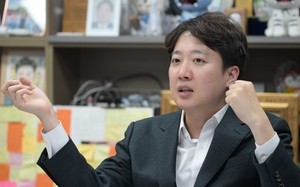
Lee Jun-seok says he will keep distance from 'legal clique' feuds in politics
'Right-flank competition will intensify' 'My perspective changed after becoming Dongtan's lawmaker' Reform Party lawmaker Lee Jun-seok said Friday he intends to keep as much distance as possible from what he called the "legal clique" — a term for politicians who exploit the law for personal gain, often applied to those with legal backgrounds — and their feuds in the National Assembly. Lee made the remarks during an appearance on YTN Radio's "Jang Seong-cheol's News Myeongdang," saying his perspective on politics had shifted since becoming the lawmaker for Dongtan. "Dongtan's per capita GDP could reach $110,000 next year depending on how you calculate it," he said. "People in a city centered on science and engineering, on the front lines of the technology competition with China, and with the highest birth rate in the country have very little interest in what legal technicians are up to." He added that "the most unproductive space is one where politics becomes a kind of sport," and said he wished the legal clique would disappear from the political arena. "After 15 years in politics, I can see that people are utterly fed up with the obsession over sending someone to prison or desperately trying to stay out of prison yourself," Lee said. "For young people, the real issues are housing policy and childbirth support — yet less than 5 percent of what the National Assembly deals with touches on those things." Looking ahead to the next general election, Lee predicted fierce competition among conservative contenders for the so-called right flank. "Conservative parties follow a pattern," he said. "Those who position themselves on the right eventually get pushed out by those even further right — and the far right gets pushed out by the extreme far right." "Ultimately, the extreme far right gets voted out," he added. "Those on the right may not feel it coming, but they will end up drinking saltwater." Asked about recent suggestions that People Power Party lawmakers Lee Jin-suk and Kim Tae-gyu are threatening party leader Jang Dong-hyeok's position, Lee said the party leader "has no choice but to keep competing with the right." "One has a long career as a broadcast journalist, and the other is a former judge — both have their own appeal," he said. "The competition on the right can only grow more intense." On independent lawmaker Han Dong-hoon, Lee said he reminded him of former PPP leader Hong Joon-pyo. "People tend to grow to resemble the person they originally disliked," Lee said. "Hong Joon-pyo has always been good at playing the sniper role. I wonder if Han is heading in a similar direction." Still, Lee said he agreed with Han's pledge to show leadership once the national audit wraps up. "Of course he should," he added.
Oct. 23, 2026
-
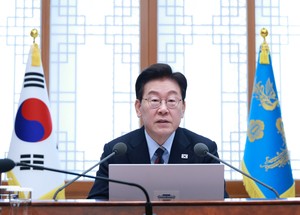
Lee declares 'war' on violent crime, orders shift to prevention
President chairs pan-government meeting on building an 'ultra-safe society' 'Action plan is the starting point for public safety' President Lee Jae Myung on Friday called for a sweeping shift to a prevention-first public safety system, saying the government must approach violent crime — including relationship-based offenses and random-motive attacks — "with the resolve to declare war." Opening a pan-government meeting on building an "ultra-safe society" at Cheong Wa Dae, Lee said public anxiety had grown sharply as violent crimes continued to mount — from offenses committed within intimate relationships such as families and romantic partners to random-motive attacks targeting unspecified victims. "These crimes are a serious problem that endangers not only individual victims but the safety of society as a whole," he said. "In particular, relationship-based crimes keep repeating a pattern in which victims are exposed to ongoing threats or fail to receive adequate protection even after reporting the danger." Lee said the situation could no longer be left unaddressed. "Protecting the lives and safety of the people is the most fundamental duty of the state," he said, "and we must approach violent crime with the resolve to declare war on it." He also called for a fundamental overhaul of the public safety paradigm. "We must go beyond reactive responses and make a sweeping shift to a prevention-first system — including building mechanisms that can detect warning signs early," Lee said. He added that authorities should conduct thorough analyses of crimes that have already occurred to determine whether they could have been prevented, and use those findings to establish recurrence-prevention measures that reliably protect the public from similar threats. "I convened this meeting under a grave sense of crisis so that all relevant ministries could come together and discuss extraordinary measures," he said. Lee said the pan-government action plan for an ultra-safe society discussed Friday was "the starting point for building a society where every citizen can feel safety and security in their daily lives." He urged participants to produce effective measures through the day's discussions that the public would be able to feel as real change, saying there could be "not even the smallest gap" in the work of protecting people's lives and safety. Earlier, at Lee's direction, Cheong Wa Dae Policy Chief Ha Jun-kyung chaired a presidential office meeting on Oct. 15, and Prime Minister Han Seong-sook presided over an interministerial meeting on Monday. Those sessions covered sector-by-sector measures including crime prevention, strengthened on-scene response, isolation and punishment of offenders, and protection and support for victims. Friday's meeting was convened to report on and review pan-government measures — built on the discussions held so far — for responding to random-motive and relationship-based crimes as well as violent offenses targeting socially vulnerable groups.
Oct. 23, 2026
-
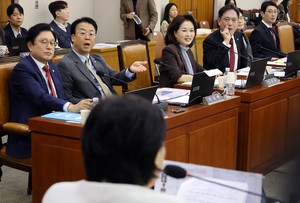
Parties on edge ahead of Oh Se-hoon appeal ruling; Democratic Party leader says Seoul mayoral election 'increasingly likely'
Democratic Party calls for strict ruling; PPP accuses rival of pressuring judiciary Democratic Party's Seo Young-gyo draws fire over statement on appeal PPP: 'Political funding transparency and election fairness must be upheld' Ruling and opposition parties are watching closely ahead of the appeals court ruling in Seoul Mayor Oh Se-hoon's Public Official Election Act violation case — a verdict that could determine whether Oh keeps his post and reshape the race for the next presidential and party leadership contests. The Democratic Party of Korea called for a strict ruling based on law and evidence, while the People Power Party pushed back, accusing the Democratic Party of pressuring the judiciary. Democratic Party leader Kim Min-seok, appearing on the program "Minti 07" on Friday, said he was bracing for the first-instance guilty verdict to be upheld. "Before getting into the legal arguments, I am mentally preparing on the assumption that the original ruling will stand," Kim said. "I see no circumstances that would change the first-instance guilty verdict, so I lean toward thinking it will go the same way." Kim said that mental preparation amounted to accepting that a Seoul mayoral by-election was increasingly likely. "Preparing ourselves mentally means the probability of holding a Seoul mayoral election is rising," he said. "From our side, it is better to think and plan that way, and we are reviewing various matters with Seoul Metropolitan Party Chairman Kim Young-bae at the center." On the question of candidate eligibility for a potential Seoul mayoral race, Kim said the party was weighing how to run a primary election. "There are candidates from various factions, and there could also be candidates from outside the party, so we are thinking about how to most efficiently pool everyone's strengths," he said. Seo Young-gyo, the Democratic Party chairwoman of the Legislation and Judiciary Committee, issued a statement during a national audit of the Prosecution Service on Thursday, saying the 2004 election law that toughened grounds for invalidating an election victory had been called the "Oh Se-hoon Act." "The time has come for him to step down from public office under that very law," she said. People Power Party Secretary-General Jung Seok-jun said Seo's statement crossed a clear line. "Is it not a blatant violation of judicial independence and interference in a trial for the chairwoman of the Legislation and Judiciary Committee — who must remain neutral as the body overseeing the courts — to pressure a specific trial's outcome and even its sentence?" he said. Jung said Seo had openly demanded a prison sentence from the bench ahead of Oh's appeal ruling. "This is the typical arrogance of someone who wants to bend even the political neutrality of investigative agencies and the independence of the judiciary to the will of those in power," he said. PPP lawmaker Kim Tae-gyu, who chairs the party's legal advisory committee, held a press conference and said the Seoul High Court falls under the Legislation and Judiciary Committee's oversight and that a comprehensive audit was still scheduled for Monday. "This is a clear case of interference in — and intimidation of — a court that is subject to the committee's oversight," he said. PPP floor spokesperson Choi Su-jin also weighed in, saying she hoped the appeals court would deliver a fair judgment based solely on clear evidence and strict law, free from the speculation and conflicting testimony that had shaped the first-instance ruling. "They are forcibly linking Mayor Oh to a financial transaction between third parties he knew nothing about and insisting it constitutes 'proxy payment,'" she said. "This is nothing more than a far-fetched argument that ignores the basic principles of criminal trials." The Democratic Party maintained that, since the first-instance court had handed down a ruling that would strip Oh of his post, the appeals court should be equally strict. Lee Jeong-hyeon, chief spokesperson of the Democratic Party's Seoul chapter, said in a statement on Thursday that the party was urging the court "to uphold the transparency of political funding and the fairness of elections with a strict ruling based on law and evidence." Lee said the first-instance court had sentenced Oh to lose his mayoral post on the basis of clear evidence. "The illegal transfer of money was established as fact in court," she said. Lee called on the appeals court to rule with equal rigor. "Neither his status as the sitting Seoul mayor nor his political influence as a leading presidential contender can serve as a shield against legal accountability," she said.
Oct. 23, 2026
-
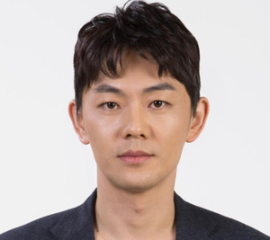
Who tops the senior official wealth list? Meet the ex-Google executive overseeing youth policy with assets 320 times the average young Korean's
Kim Tae-won, the 46-year-old senior secretary for youth affairs at Cheong Wa Dae, topped the latest government disclosure of senior officials' assets, reporting a total net worth of 16.1 billion won ($12.2 million) — roughly 320 times the average wealth of a South Korean young adult. The Government Ethics Committee published the figures Friday in the official gazette as part of its periodic asset disclosure for senior public officials. Born in 1980, Kim graduated from Korea University with a degree in sociology before building a career at Google Korea, where he rose to senior director of global business. He is also a former executive at Innored, an independent digital advertising agency he joined in 2024. Earlier, during the Park Geun-hye administration in 2013, he served as a youth mentor on the Presidential Advisory Committee on Youth Affairs. Kim was appointed as the inaugural senior secretary when President Lee Jae Myung established the Office of the Senior Secretary for Youth Affairs under the Presidential Chief of Staff on July 16. At the time, Cheong Wa Dae spokesperson Kang Yu-jung said the office was created "with the aim of actively resolving the problems facing young people and presenting a vision for their future," adding that Kim was expected to "develop innovative future strategies and creative youth policies from the perspective of young people." Shares accounted for the largest share of Kim's declared assets, totaling 11.9 billion won. Under his own name, Kim holds 11.6 billion won in equities — including 2,338 shares of LG Uplus, 650 shares of Samsung Electronics, 583 shares of Bank of America and 322 shares of Microsoft — while shares held by his spouse and other family members amount to about 300 million won. He also declared an apartment in Yongsan-gu, Seoul, valued at 2.38 billion won, and bank deposits of 1.53 billion won. Kim's wealth is expected to draw scrutiny over how closely he can relate to the housing insecurity and employment struggles that define the lives of many young Koreans. His declared net worth is 320 times the average wealth of someone in his target demographic. A 2024 government survey on youth living conditions, conducted by the Office for Government Policy Coordination, found that South Koreans between the ages of 19 and 34 earned an average annual income of 26.25 million won and held average assets of 50.12 million won. In the same disclosure, Oh Seok-geun, Busan's vice mayor for future innovation, ranked second with 8 billion won, while Shim Uk-gi, head of the Daejeon Regional Tax Office, came in third at 5.71 billion won.
Oct. 23, 2026
-
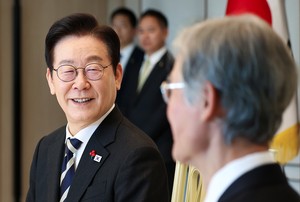
Lee's approval rating rebounds to 40%; public opposes Chief Justice impeachment
Lee posts 40% positive, 50% negative; slide halts Democratic Party leads PPP by 9 percentage points 34% back Chief Justice impeachment, 39% opposed Centrists favor Democratic Party but split evenly on impeachment President Lee Jae-myung's approval rating climbed back above 40 percent for the first time in seven weeks, signaling that a prolonged slide may be stabilizing. The Democratic Party of Korea also extended its lead over the People Power Party to 9 percentage points. Public opposition outweighed support, however, for the ruling bloc's push to impeach Chief Justice Jo Hee-dae of the Supreme Court. While Democratic Party supporters backed the impeachment, centrist voters were evenly split — a dynamic that could complicate the ruling camp's efforts to move forward. A Gallup Korea survey of 1,001 adults aged 18 and older nationwide, conducted Monday through Wednesday, found that 40 percent gave President Lee a positive job performance rating, while 50 percent gave a negative assessment. Ten percent withheld judgment. The last time Lee's approval rating reached 40 percent was seven weeks ago. A decline that had persisted through the Chuseok holiday period came to a halt in October, pulling the figure back from a post-inauguration low of 37 percent. His negative rating, however, remained at 50 percent — 10 percentage points above the positive figure. Negative assessments were particularly pronounced among centrists and independents. Among centrist respondents, 40 percent rated Lee's performance positively and 47 percent negatively. Among those with no party affiliation, only 21 percent gave a positive rating while 54 percent gave a negative one. Men also showed a wide gap, with 36 percent positive and 57 percent negative. Real estate policy was the most frequently cited reason for a negative assessment, at 18 percent, followed by the economy and livelihoods at 16 percent and national defense, security and North Korea policy at 10 percent. Real estate policy has topped the list of reasons for negative ratings every week since the fourth week of July. Among those with a positive view, diplomacy ranked first at 21 percent, followed by the economy and livelihoods at 14 percent and communication at 7 percent. In party support, the Democratic Party stood at 37 percent against 28 percent for the PPP — a 9-point gap. This marks the fifth time since the current administration took office that the gap between the two major parties has fallen within 10 percentage points. The margin has remained in single digits for three consecutive weeks since the second week of October. The Rebuilding Korea Party polled at 3 percent and the Reform Party at 2 percent, while 27 percent of respondents identified with no party. On the question of impeaching Chief Justice Jo, however, opposition ran higher than support. Thirty-four percent said they supported the impeachment, while 39 percent were opposed. Twenty-eight percent withheld an opinion. Among centrist voters, support and opposition were tied at 34 percent each. Among independents and respondents in their 20s, roughly half declined to take a position. Notably, despite the Democratic Party leading the PPP by 17 percentage points among centrists in party support, it failed to secure clear centrist backing for the impeachment of Chief Justice Jo. Support for the impeachment push among the party's core base has not spread to the political center. The Democratic Party and the Rebuilding Korea Party have been in ongoing discussions over the impeachment of Chief Justice Jo. The Rebuilding Korea Party has pressed the Democratic Party to act, releasing a draft impeachment motion and proposing the formation of a joint task force. Within the Democratic Party, disagreements persist over both the necessity of impeachment and the timing of any move. Meanwhile, pessimism also dominated the economic outlook. Only 27 percent of respondents said they expected the domestic economy to improve over the next year — the lowest reading since the current administration took office — while 40 percent expected conditions to worsen. Even as the slide in Lee's approval rating has steadied, public confidence in the economy remains weak. The survey was conducted via telephone interviews using randomly selected virtual numbers provided by the three major mobile carriers. The response rate was 10.6 percent, with a margin of error of plus or minus 3.1 percentage points at a 95 percent confidence level. Further details are available on the website of the National Election Survey Deliberation Commission.
Oct. 23, 2026
-
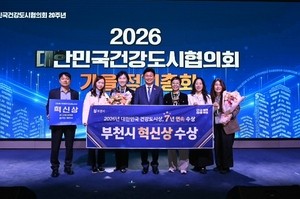
Bucheon elected chair city of Korea Healthy Cities Partnership
City to host 2027 general assembly Bucheon has been elected the next chair city of the Korea Healthy Cities Partnership (KHCP), a network of more than 100 local governments across the country. The city was confirmed as the 11th chair city at the KHCP's 2026 autumn general assembly, held Thursday at Lotte Hotel & Resort in Gimhae, South Gyeongsang Province. Bucheon will lead the partnership for two years beginning in 2027 and will also host the organization's autumn general assembly that year. About 300 people attended the assembly, including heads of member local governments, academic committee members and other officials, who shared achievements in public health policy and discussed future areas of cooperation. Bucheon Mayor Jo Yong-ik presented the city's policy accomplishments since it joined the partnership in 2007. Jo unveiled the city's vision for its healthy-city initiative, which he called "Bucheon's Healthy L.I.F.E." The vision expands the concept of a healthy city beyond medicine and public health to encompass the full range of municipal affairs — including employment, education, residential environment, culture and care services — with the aim of improving both physical and mental health while closing gaps in the welfare safety net. At the assembly, the city received the Innovation Award at the 2026 Korea Healthy Cities Awards for its "Whole-Village Bucheon" project, a community care initiative launched in 2023. The project is a proactive welfare model that combines AI technology with community networks to address the challenges of a super-aged society. It delivers tailored services through neighborhood shops called "On Stores" that help identify households in crisis, a resident volunteer group called "Village Geniuses," AI-assisted welfare guidance and cognitive health screenings, and integrated care programs run in partnership with universities and pharmaceutical organizations. Bucheon has built a track record in sustainable public health policy, winning the Korea Healthy Cities Award for seven consecutive years and the Alliance for Healthy Cities award four consecutive times. "A healthy city is one that weaves the value of health into every aspect of residents' daily lives," Mayor Jo said. "As the 11th chair city, we will share the policy expertise and best practices we have accumulated with local governments across the country, strengthen solidarity among member cities, and take the lead in building a sustainable healthy-city environment."
Oct. 23, 2026
-
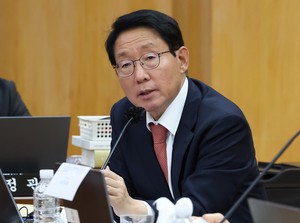
PPP lawmaker introduces two bills to ease jeonse market strain, cut first-home buying costs
New deduction rates proposed for purchase-type and short-term rental housing Acquisition-price threshold for tax relief raised to 1.5 billion won People Power Party lawmaker Kim Sang-hoon announced Friday that he had introduced two bills — one to prevent a contraction in rental housing supply in the jeonse and monthly rent market, and another to ease the acquisition tax burden on first-time homebuyers. According to the Korea Real Estate Board, Seoul apartment prices rose for 88 consecutive weeks through the second week of October, setting an all-time record for the longest uninterrupted streak. Seoul apartment jeonse prices climbed 0.80 percent in September, while monthly rent prices rose 0.93 percent. In its August tax reform package, the government proposed raising the comprehensive real estate tax's fair market value ratio from the current 60 percent to 70 percent by 2027, while also phasing out tax benefits for purchase-type rental apartments in designated adjustment areas. The plan calls for the gradual reduction and eventual elimination of preferential treatment for such properties — including exemptions from the capital gains tax surcharge, enhanced long-term holding deductions, and exclusions from the corporate tax surcharge. Under current rules, the 70 percent long-term holding special deduction rate applies only to privately built rental housing registered by the end of 2027 and rented out for at least 10 years before being sold. The benefit does not extend to privately purchased rental housing or to short-term private rental housing — a six-year category reintroduced by a legislative amendment at the end of 2024. Kim's amendment addresses those gaps by establishing differentiated deduction rates based on rental housing type and rental period. The rate for privately built rental housing, which has the greatest effect on new supply, would rise from 70 percent to 80 percent. A new 70 percent rate would be created for privately purchased rental housing, and a 50 percent rate for short-term private rental housing with a six-year term. The registration deadline would also be extended from 2027 to 2031. The bill also raises the acquisition-price threshold for the tax reduction from 1.2 billion won ($906,000) to 1.5 billion won, and extends the reduction period through 2031. The reduction ceiling would increase from 3 million won to 4 million won for small, low-priced, multi-unit and population-decline-area priority housing, and from 2 million won to 2.5 million won for other general housing. The combined reduction ceiling for joint acquisitions by two or more people would be raised accordingly. "Home prices have been rising for the longest stretch on record, and jeonse and monthly rents are surging too, yet the government remains fixated on tightening real estate taxes," Kim said. "I will protect the supply of rental housing for tenants searching for jeonse and monthly rent units, and reduce the acquisition burden on first-time buyers who genuinely need a home."
Oct. 23, 2026
-
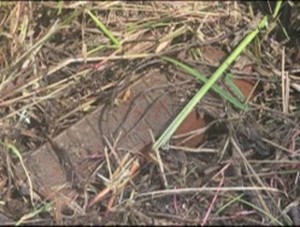
Exclusive: North Korea answered UNC 'pink phone' on day of DMZ mine blast — lawmaker
Cheon Ha-ram: North's response is 'sufficient circumstantial evidence' it planted mines across MDL UNC used routine communication check to notify North of armistice violation North Korea unusually accepted a call from the United Nations Command on the day a landmine exploded in the western demilitarized zone on Sept. 21, it has been confirmed. Analysts say Pyongyang — which normally refuses UNC contact outside designated communication-check windows — picking up the phone that day is circumstantial evidence that it planted mines across the military demarcation line. According to the office of Reform Party floor leader Cheon Ha-ram, the so-called "pink phone" — a direct hotline between the UNC and the Korean People's Army — was activated at a critical moment on the day of the blast, when South Korean forces were urgently seeking UNC approval to enter the DMZ. The military and the Ministry of Unification have both lost their separate communication channels with the North, and the pink phone is understood to be answered by the North only during two scheduled daily communication checks. On the day of the explosion, however, the UNC placed an urgent call to the North outside those scheduled hours to coordinate helicopter access to the DMZ for casualty evacuation — and the North answered immediately. That response is widely interpreted as a strong indication that Pyongyang was already aware of the incident. "The fact that North Korea, which normally does not answer calls outside the scheduled check times, picked up the phone on this occasion appears to be sufficient circumstantial evidence that it was on edge over the explosion of mines it had planted across the MDL," Cheon said. Cheon went on to say that Pyongyang has since been monitoring the joint field investigation by the UNC and South Korean forces, and that finding it difficult to deny responsibility, it has adopted a brazen, blame-shifting posture. "There are also clear signs of an intent to drag this into a political dispute through inflammatory statements and warnings," he added. The UNC also used a scheduled communication check after the blast to formally notify North Korea that the incident constituted a violation of the armistice agreement. The North is said to have listened in silence as a UNC official read out a statement over the pink phone, then quietly hung up. Just before delivering that notification, the UNC had stated in a public release in late September that investigators had found one North Korean antipersonnel mine on the South Korean side of the MDL during the field investigation, and that it had determined this to be a violation of the armistice agreement. Meanwhile, UNC Deputy Commander Lt. Gen. Scott Winter of the Australian Army, in a podcast interview with the Royal United Services Institute released Thursday, said the mine explosion "demonstrates that whatever activity we conduct in the DMZ requires careful and thorough planning and commitment," adding that "it is important that we communicate with the Korean People's Army through the communication lines we have kept open."
Oct. 23, 2026
-
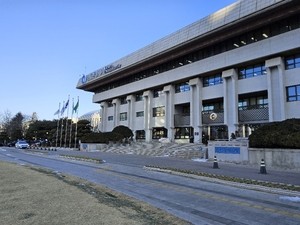
Incheon pioneers first integrated satellite-drone marine debris removal system
Incheon Metropolitan City has become the first local government in South Korea to deploy a smart marine environment management system that uses satellites and drones to detect, collect and transport ocean debris in a single integrated operation. The city said Friday that on Tuesday it used heavy-lift drones to transport about 4.4 metric tons of marine debris collected by residents on the islands of Mungapdo and Soyado in Ongjin-gun, loading the waste onto a dedicated transport vessel, the Ongjin Cheongjong, for removal to the mainland. The achievement is a product of the city's "Smart Marine Village" project. It marks the country's first demonstrated case of linking every stage of the process — wide-area satellite detection, precision drone surveys, resident collection, drone transport and vessel removal — under a single integrated control system. Rocky shores and cliffs on Incheon's outlying islands had long been inaccessible to workers and vessels due to difficult terrain. As a result, debris was routinely left to accumulate, and the risk of accidents during manual removal operations had been a persistent concern. The city had built a monitoring system since 2022 to analyze debris accumulation sites, but struggled to move beyond monitoring to actual removal. In this latest demonstration, however, detection data was directly linked to on-site collection work. The city deployed heavy-lift drones capable of carrying up to 100 kilograms per trip to fly debris from previously inaccessible coastlines directly to collection points and retrieval vessels, establishing a system in which detection leads to actual disposal. The city has steadily expanded the project's scope since a pilot operation last October at Parae-geum Beach on Deokjeokdo, which recovered 0.3 metric tons. Following a haul of 4.6 metric tons in September, the city removed an additional 4.4 metric tons by Tuesday. Park Gwang-geun, director of Incheon's Marine and Aviation Bureau, said the system that safely carries debris found by satellites and drones out to sea via drones and a dedicated vessel had taken firm hold in the field. "We will go further by building drone stations aboard vessels to keep even the most remote island coastlines clean, creating a smart marine city," Park said. The city plans to conduct additional demonstrations in underserved collection areas of Ongjin-gun through November, with a target of removing a total of 30 metric tons of debris by year's end. Alongside this, the city intends to finalize an "Incheon-model smart marine management standard" based on the data gathered and roll it out to coastal municipalities across the country.
Oct. 23, 2026
-
![[Breaking] President Lee's approval rating recovers to 40s: Gallup Korea](https://wimg.heraldcorp.com/news/cms/2026/10/23/news-p.v1.20261023.8237cf1835df4162ab94659e431df498_T1.jpg?type=h&h=240)
[Breaking] President Lee's approval rating recovers to 40s: Gallup Korea
Oct. 23, 2026
-
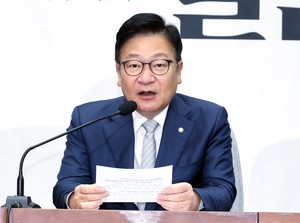
PPP keeps up criticism of President Lee's 'impeachment grounds' remark
'Would past presidents have been impeached?' floor leader asks Party calls move a bid to influence Lee's ongoing trials The People Power Party on Friday continued its sharp criticism of President Lee Jae Myung's remark that refusing to oversee and direct the Serious Crimes Investigation Agency constitutes grounds for impeachment, firing back that "it is this kind of conduct that would actually constitute grounds for impeachment." PPP Floor Leader Jeong Jeom-sik, speaking at a national audit strategy meeting at the National Assembly that morning, pushed back against the president's position. "If President Lee's argument holds, should every past president have been impeached for not seating the head of an investigative agency at Cabinet meetings?" he asked. Jeong said Lee's claim "falls apart at the very first question," adding that past presidents had kept the prosecutor general out of Cabinet meetings precisely to protect the independence and neutrality of investigations. Jeong argued that Lee's push to seat the Serious Crimes Investigation Agency chief at Cabinet meetings was aimed at influencing the president's own ongoing trials. "Under the law establishing the agency, the relevant minister can direct the agency chief on specific cases," he said. "The president can convey matters related to state affairs through the competent minister." "Even though such lawful and commonsense channels for oversight already exist, there is another reason behind the attempt to force the agency chief and the public prosecution chief into Cabinet meetings," Jeong said. "It is a calculated move to exert direct or indirect influence on the president's own trials." Jeong recalled that at a Cabinet meeting in June, Lee had told acting Prosecutor General Gu Ja-hyeon that "if you've done something wrong, you apologize and withdraw it" — which Jeong characterized as pressure on prosecutors to apologize to Lee and drop charges against him. "For more than 500 days since taking office, President Lee has consistently devoted himself to a political jailbreak aimed at making five ongoing trials disappear," he said. Jeong added that in September, Lee had called on the National Assembly at a press briefing to push for a special prosecutor probe — which Jeong described as a setup to drop charges under the guise of investigating fabricated indictments — and that the Democratic Party had responded by announcing plans to pursue such a probe after the national audit period. Jeong characterized the effort as an attempt to "overturn his trials," saying Lee intended "to reverse the five trials against him through a pliant special prosecutor of his own appointment." "President Lee is now even attempting to neutralize the Supreme Court chief justice's authority to recommend Supreme Court justices, so that he can handpick the judges for his own trials," Jeong said. "Forcing the Serious Crimes Investigation Agency chief into Cabinet meetings is part of the same pattern." On the question of seating the agency chief at Cabinet meetings, Jeong said the move amounted to "an open, standing threat to pressure state institutions through the Cabinet." "This kind of conduct is precisely what constitutes grounds for impeachment," he said. "Since taking office, the president has consistently piled one wrongdoing on top of another to cover up his crimes," Jeong said. "The tower of wrongdoing he has built will ultimately collapse on the president himself." Jeong also weighed in on the failure to secure the appearance of witnesses — including presidential office chief of staff Kim Hyun-ji and former chief of staff Kang Hoon-sik — at the National Assembly's Steering Committee, calling it "in effect a confession to the various allegations." "The Democratic Party says the opposition's demand for witnesses to appear is a political attack," Jeong said. "If so, the four — Kim Hyun-ji, Kang Hoon-sik, Kim Yong-beom and Jeong Jin-sang — should come before the Assembly and refute the opposition's claims. The fact that they won't do that is nothing more than a confession that they fear the truth coming out," he added.
Oct. 23, 2026
-
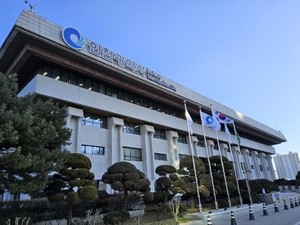
Incheon secures additional federal funds to clear river and estuary waste, expanding project to W2.2b
Incheon Metropolitan City has secured additional government funding to intercept marine debris flowing in from the Han River watershed and other waterways. The city announced Friday that it had obtained an additional 146.3 million won ($110,000) in national subsidies for its 2026 river and estuary waste cleanup project. The increase brings the total national funding allocated to the project this year to 2.2 billion won, up from 2.06 billion won. The river and estuary waste cleanup project collects and disposes of trash before it reaches the sea, intercepting debris that travels through inland waterways and rivers to prevent contamination of the marine ecosystem. An average of about 5,400 metric tons of waste flows into Incheon's coastal waters each year. The city plans to direct the newly secured funds immediately to Ganghwa-gun, which will receive 46.3 million won, and Ongjin-gun, which will receive 100 million won — both areas where waste collection operations have been strained by heavy inflows — for emergency on-site collection, transport and disposal work. The city also said it will conduct detailed inspections of waste stockpile conditions across its districts and counties and strengthen on-site management to ensure the expanded budget is fully spent before the end of the year.
Oct. 23, 2026
-

N. Korea estimated to have laid 960,000 mines in DMZ since 2024
North Korea is estimated to have laid close to one million landmines in the Demilitarized Zone over the past two years, according to multiple lawmakers' offices. Offices of lawmakers on the National Assembly's intelligence and defense committees said the military reported to the Assembly that North Korea has planted an estimated 960,000 mines in and around the DMZ since 2024, Yonhap reported. Experts in the field estimate the total number of mines currently buried in the DMZ — including those laid by South Korean forces — at roughly two million. Unification Minister Jeong Dong-young also cited the two-million figure when he raised the DMZ mine issue during a national audit on Oct. 7. If the military's reported estimate of 960,000 mines laid by North Korea since 2024 is accurate, roughly half of all mines now in the DMZ were planted within the past two years. North Korea appears to be deploying mines on a massive scale as part of a "border fortification" campaign along the Military Demarcation Line. Pyongyang began the effort in earnest in April 2024 after redefining inter-Korean relations as those between "two hostile states." Beyond the large-scale mine-laying, North Korea has also been reported to be erecting barriers, clearing vegetation, building tactical roads and barbed-wire fencing, and severing the road links along the Gyeongui and Donghae lines. As North Korea pressed ahead with the work along the armistice line, a North Korean mine exploded south of the MDL on Sept. 21, seriously injuring South Korean soldiers. North Korean troops have repeatedly crossed the MDL in the course of the fortification work, heightening military tensions in the area. South Korean forces have responded with warning broadcasts and warning shots directed at North Korean troops crossing the line. Pyongyang has pushed back, calling such measures a threat to its soldiers' safety and warning it would resume loudspeaker broadcasts toward the South. Foreign Ministry to send letter to UN Security Council president The Ministry of Foreign Affairs said it plans to send a letter to the president of the UN Security Council over North Korea's DMZ mine explosion and its recent escalatory actions, Yonhap reported Thursday. Foreign Ministry spokesperson Park Du-sun said the letter would explain that the explosion was caused by a mine planted by North Korean troops and constitutes a clear violation of the Armistice Agreement, demand a North Korean apology and responsible action, and call for dialogue to prevent further escalation and restore trust. Park also said the letter would draw attention to North Korea's recent attempts to label South Korean forces' legitimate operations near the MDL as provocations and shift responsibility for regional tensions onto Seoul. The letter will be addressed to the Greek ambassador to the UN, who currently holds the Security Council presidency. After the president receives it, the letter is expected to be circulated among Security Council member states within a few days and subsequently posted on the council's website. That process would place the DMZ mine explosion on the official Security Council record and allow South Korea to disseminate its position more broadly. The government had taken no notable diplomatic steps since South Korea's UN ambassador called for a "public apology and responsible measures" at a UN General Assembly First Committee session on Oct. 8 (local time). The latest move is seen as a response to North Korea's announcement that it would resume loudspeaker broadcasts toward the South and its leader's inspection visits to "border fortification" sites, both of which have further raised tensions.
Oct. 23, 2026
-

Han Dong-hoon urges Lee Jae Myung to play Call of Duty: Modern Warfare 4, citing North Korea threat
'Feel firsthand the devastation of inadequate defense' 'May an ash-covered Seoul remain fictional' Independent lawmaker Han Dong-hoon on Friday urged President Lee Jae Myung to play the video game Call of Duty: Modern Warfare 4, saying he recommends the president "play this game and feel firsthand what kind of devastation unfolds when defense preparedness falls short." Writing on Facebook that day, Han commented on the game's depiction of a surprise North Korean invasion of the South, saying, "I hope the image of a Seoul reduced to ashes in the game remains in the realm of fiction." He criticized those who have raised concerns about the game, saying, "North Korea's invasion on June 25, 1950, was real history, and North Korea's military threat remains an undeniable reality today," and noting that "some worry the game stokes hostility toward North Korea." Han then said that "rather than frowning at the game for depicting a North Korean invasion, we need to focus on the question it poses" — namely, "if that day comes again, are we 'prepared'?" He went on to say that "this question is directed at the Lee Jae Myung administration's security policy," adding that "North Korea has even enshrined in law the possibility of preemptive use of nuclear weapons," yet "the president has described North Korea's nuclear arsenal as a 'weapon of last resort.'" Han also said the government "is aggressively pushing for an early transfer of wartime operational control before sufficient verification has been completed," and questioned whether South Korea's defense readiness is adequate "at a time when even joint Korea-US military exercises have been scaled back." He added that "peace cannot be preserved through vague hope that relies on the goodwill of the other side," stressing that "it can only be protected when we assume the worst and prepare thoroughly."
Oct. 23, 2026
-
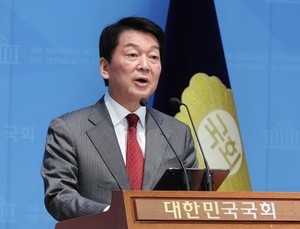
Solidigm IPO withdrawal 'a victory for ordinary retail investors,' says Ahn Cheol-soo
People Power Party lawmaker Ahn Cheol-soo said Friday that SK hynix's decision to halt the US stock market listing of its subsidiary Solidigm was "a result created by the voices of ordinary retail investors," after SK hynix disclosed it was suspending the listing process. Ahn made the remarks on his Facebook page Friday, adding that he hoped the development would serve as an opportunity for SK hynix "to recognize that we are now in an era where shareholders and the company must grow together." However, Ahn also directed sharp criticism at the government. "The problem is the Lee Jae Myung administration. What on earth did it do?" he said. "It called for a 'value-up' while staying silent for months with no clear position on dual listings," he added. "It did nothing while shareholder concerns boiled over and share prices were cut in half." "People find it hard to even look at their stock portfolios," Ahn said. "Do they really have to monitor the stock market every single day and post manifestos themselves?" SK hynix disclosed Friday that Solidigm, its overseas subsidiary, had "been reviewing various financing options to expand production capacity and strengthen competitiveness, but decided to halt its review of pre-IPO investment and an initial public offering after comprehensively considering capital market conditions and other factors." The announcement came 78 days after news of the planned listing first emerged on Aug. 5. SK hynix said it "determined that, given recent capital market conditions and share price trends, there was a need to reconsider whether a current IPO would be the most advantageous choice for SK hynix and its existing shareholders." Solidigm was launched after SK hynix acquired Intel's NAND flash and solid-state drive business in 2021. The subsidiary accounts for approximately 12.9 percent of SK hynix's total enterprise value.
Oct. 23, 2026
MOST READ
- 1Anpanman rolls out to all CJ Olive Young stores with limited-edition collabs from 30-plus brands
- 2Korean woman's mugshot goes viral in US after DUI arrest in Georgia
- 3Theater actor Kim Hyun-i asks public to stop sharing her photos after mix-up with late stunt performer of same name
- 4Paper straws more harmful than plastic? Study finds 6 times higher cancer risk, double the acidification
- 5Man on 8-year run used brother, hometown friend to deal cannabis from Thailand
- 6Galux CEO warns AI drug development still far from ‘mission accomplished’
-
WORLD
US warns of punishment for anyone enabling Iran's Strait of Hormuz toll scheme
-
INDUSTRY
Toyota union puts productivity first; Hyundai Motor union demands bigger share of profits
-
FINANCE

National Growth Fund to invest $531M in FuriosaAI, which rebuffed Meta's $800M takeover bid
-
INDUSTRY
Korea Shipowners' Association holds amateur baduk tournament for Maritime Day