Korea's music industry association cites standard contracts and cultural industry law
Critics say the system must withstand individual disputes
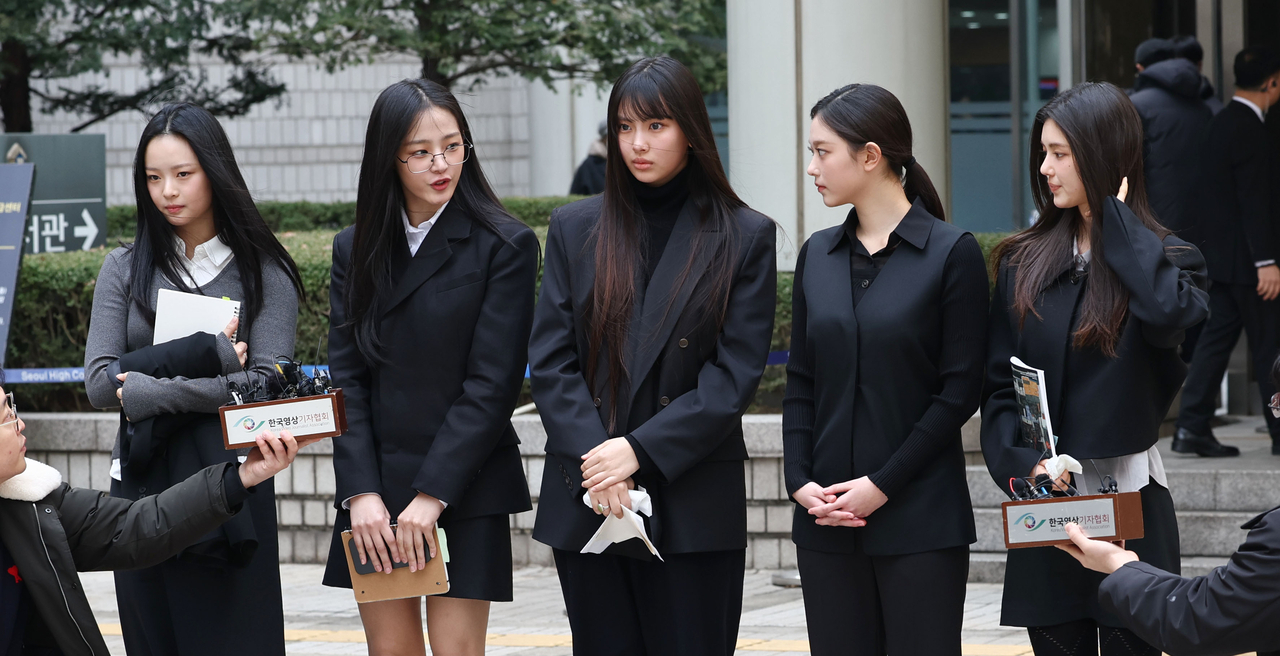
South Korea's leading association of popular music producers has directly rebuffed a New York Times report on NewJeans' exclusive contracts, saying the characterization of the K-pop industry as one of "label control" ignores the sector's legal framework and institutional structure.
The Korea Music Content Industry Association said Monday the report "failed to adequately consider the legality and legitimacy of contracts concluded under the laws and institutional regulations of the Republic of Korea, and offered a one-sided and biased assessment that did not sufficiently account for the characteristics and value of the unique incubating system that has contributed to K-pop's growth as a global industry."
The association, whose members include major labels and distributors such as Hybe, SM Entertainment, JYP Entertainment and YG Entertainment, changed its name from the Korea Music Content Association last April.
The association said the fairness of an exclusive contract cannot be judged by individual clauses alone. It argued that supplementary agreements, relevant laws, the circumstances of signing, and actual performance must all be considered together.
According to the association, major companies sign national-standard supplementary agreements with underage trainees guaranteeing rights to personal dignity, sleep, education and rest, and are required by law to designate a youth protection officer. The association noted that some companies maintain their own in-house medical staff, saying the level of artist management is highly systematized. "This dedicated management and upfront investment system is a uniquely Korean industrial ecosystem that must not be dismissed as 'oppressive control,'" it said.
The New York Times reported Thursday (local time) that it had obtained the exclusive contracts signed in April 2022 between the five members of NewJeans — who were minors at the time — and Ador. The report said the contracts omitted protections for minors' sleep and study rights found in the government's standard contract template, and that the penalty calculation method and post-contract provisions on the use of members' likenesses and voices were excessively unfavorable to the members.
Hybe and Ador responded the following day with point-by-point rebuttals. They said protections for minors are covered in a separate national-standard youth supplementary agreement and in human rights clauses within the contract itself, and that the penalty formula differs from the standard contract only in wording, not in economic effect. They also said the contract was finalized after three months of questions and answers and a review by the artists' lawyers, following the sharing of a draft in January 2022. However, the two sides remain at odds over who led the contracting process — Hybe points to Min Hee-jin, who was then Ador's CEO, while Min's side cites Hybe's legal team and final approval by the CEO.
The contracts drew intense public attention as the latest chapter in a dispute between Hybe and Min that has stretched more than two and a half years. After Hybe launched an audit in April 2024 over allegations that Min had attempted to seize management control, NewJeans declared the termination of their exclusive contracts with Ador that November, citing the label's breach. Courts repeatedly upheld the contracts' validity — accepting Ador's injunction against independent activities by the members in March 2025, and with the Seoul High Court dismissing the members' appeal in June of that year. On Oct. 30 of the same year, a first-instance court ruled that "the exclusive contracts concluded between Ador and NewJeans on April 21, 2022, are valid." Haerin, Hyein and Hanni subsequently returned to Ador, while Ador terminated its contract with Danielle last December and has continued to pursue penalty and damages claims.
The association also expressed deep concern that a contract subject to ongoing litigation had been disclosed to foreign media in apparent breach of confidentiality obligations. It said the industry must be alert to unverified claims or one-sided perspectives being accepted as objective fact, and to individual disputes spilling over into negative assessments of the K-pop industry as a whole.
"The K-pop incubating system is a talent development framework with unique characteristics and competitiveness that cannot be judged solely through a Western lens," the association said. "It is within this very ecosystem that the celebrated boy groups and girl groups that captivate audiences around the world today were born."
shee@heraldcorp.com