
- HOME
- STOCK
-
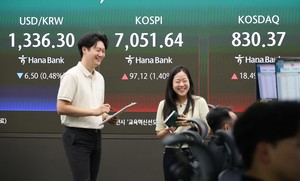
Korea Exchange to launch after-market trading Monday, extending session to 8 p.m.
Runs 4-8 p.m., replacing existing after-hours single-price trading Most Kospi, Kosdaq shares eligible for trading; ETFs, ETNs excluded Market orders restricted; same ±30% price limit and volatility interruption as regular session Korea Exchange will launch an after-market session Monday, allowing investors to trade shares in real time even after the regular trading session ends. The four-hour window, running from 4 p.m. to 8 p.m., will cover most Kospi and Kosdaq issues, replacing the existing after-hours single-price trading system. Korea Exchange said Wednesday that it had approved amendments to the operating rules for the Kospi and Kosdaq markets. The after-market session will run for four hours, from 4 p.m. to 8 p.m., with orders executed in real time. This differs from the previous after-hours single-price trading system, which ran from 4 p.m. to 6 p.m. As a result, Korea Exchange will discontinue that system. Most Kospi and Kosdaq shares and depositary receipts will be eligible for after-market trading. Exceptions include stocks under investment warning and those undergoing liquidation trading procedures that require closer market oversight. However, Korea Exchange will exclude ETFs and ETNs from after-market trading due to concerns over market volatility. Only limit orders, best-priority limit orders and best-price limit orders will be allowed. Market orders, whose prices can fluctuate depending on market conditions, will be restricted to protect investors. The after-market session will apply the same daily price limit as the regular session — plus or minus 30 percent of the previous day's closing price. It will also trigger the same volatility interruption mechanism used during regular trading hours to curb sudden price swings caused by short-term shifts in supply and demand. Settlement of shares traded during the after-market session will occur two business days after the trade, or T+2, the same as in regular trading. Even after the after-market session begins, disclosure filing hours will remain unchanged, from 7:30 a.m. to 6 p.m. Korea Exchange said most listed companies file disclosures during business hours, and extending the disclosure window could risk delaying the release of negative news. However, if media reports or other sources reveal embezzlement, breach of trust or other delisting-related issues after the disclosure deadline has passed, the exchange will act. It will suspend trading of the relevant stock as necessary. "The launch of this after-market session will be a first step toward elevating South Korea's stock market to a global standard by improving investor accessibility and market competitiveness," Korea Exchange said. "The extended trading hours will allow investors to make quicker investment decisions by immediately reflecting information that emerges after the regular session ends into prices." Securities firms are also rolling out promotional events tied to the after-market launch. Korea Investment & Securities said Sept. 1 that it would mark the launch of Korea Exchange's after-market trading with a promotional event. The brokerage will give the first 3,000 users of its Bankis app a daily 2,000 won ($1.50) investment credit usable during the after-market session, running through Sept. 30. The credit can be claimed once per day during the promotional period, and any unused credit will be automatically forfeited the following day.
Sept. 9, 2026
-
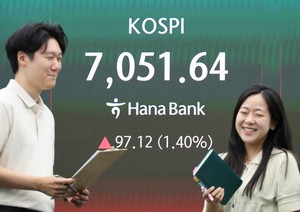
Kospi reclaims 7,000 mark after 33 sessions as SK hynix tops W1.8m
The Kospi reclaimed the 7,000 mark for the first time in 33 trading sessions. The benchmark index closed at 7,051.64, up 97.12 points, or 1.40 percent, from the previous session, while the Kosdaq index rose 18.49 points, or 2.28 percent, to close at 830.37, according to the Korea Exchange. Among the top two stocks by market capitalization, Samsung Electronics ended the session unchanged at 269,500 won ($201). SK hynix closed at 1,856,000 won, up 63,000 won, or 3.51 percent, from the previous session. The gains reflect improved investor sentiment toward local chip stocks, following a 1.30 percent rise in the Philadelphia Semiconductor Index on the New York stock market.
Sept. 9, 2026
-
Samsung Securities becomes 8th short-term financing licensee as FSC approves
Short-term financing business now open to 8 comprehensive financial investment firms Firms can raise funds up to 200% of equity capital Investor deposits down 40 trillion won from June peak Brokerages also compete on promissory note rates Samsung Securities is entering the promissory note market after receiving short-term financing business approval from financial regulators. With cash sitting on the sidelines in the stock market shrinking rapidly, the number of promissory note issuers has grown to eight, intensifying competition among brokerages to attract customer funds. The Financial Services Commission said it held its 15th regular meeting Wednesday, presided over by FSC Chairman Lee Eok-won, and deliberated and approved a short-term financing business license for Samsung Securities under Article 360 of the Financial Investment Services and Capital Markets Act. Samsung Securities plans to begin issuing promissory notes based on the new license. Promissory notes are financial products with maturities of up to one year that brokerages issue based on their own creditworthiness. Because they allow firms to raise funds of up to 200 percent of their equity capital, brokerages use them as a funding tool to expand into investment banking and other businesses. The latest approval brings the total number of comprehensive financial investment firms allowed to run a short-term financing business to eight. Mirae Asset Securities, Korea Investment & Securities, NH Investment and KB Securities were the original four, joined last year by Kiwoom Securities, Shinhan Investment and Hana Securities. Samsung Securities is the latest to join the group. Samsung Securities' entry comes as cash sitting on the sidelines in the stock market continues to shrink. According to the Korea Financial Investment Association, investor deposits stood at 96.99 trillion won ($72.3 billion) as of Tuesday. That was down about 40 trillion won from 136.83 trillion won on June 23. The figure fell as low as 93.55 trillion won on Friday, the lowest level in about eight months, since early this year. As stock market volatility rises and banks raise deposit and savings rates, brokerages are also competing to hold onto customer funds. Promissory note rates have also climbed back above 4 percent. Korea Investment & Securities recently raised the rate on its one-year won-denominated promissory notes to 4.00 percent from 3.85 percent, while Kiwoom Securities and Hana Securities are also offering 4.00 percent on one-year notes. Promissory note rates, which had fallen into the 3 percent range since 2024 amid interest rate cuts, are climbing again. The FSC expects Samsung Securities' new license to boost the supply of venture capital. "We expect it to respond to companies' diverse funding needs, including the supply of venture capital," an FSC official said, referring to Samsung Securities.
Sept. 9, 2026
-
Cosmecca Korea decides on W136b investment in new facility
Cosmecca Korea disclosed Wednesday that it decided to invest 136 billion won ($101 million) in a new facility. The investment amounts to 40.45 percent of the company's equity capital, with the investment period running through Dec. 31, 2030. The company said the move is "aimed at expanding production capacity to meet growing demand for cosmetics."
Sept. 9, 2026
-
Korea Exchange to suspend derivatives night trading ahead of Chuseok
Night trading halted from 6 p.m. Sept. 23 to 6 a.m. Sept. 24 Move aims to manage investor risk from price swings over long holiday Korea Exchange will suspend derivatives night trading for a day ahead of the extended Chuseok holiday. The move is meant to prevent night-session positions from being exposed to risk over an extended period amid possible sharp price swings during the holiday. The exchange said Wednesday that it would suspend derivatives night trading set to run from 6 p.m. Sept. 23 to 6 a.m. Sept. 24. Night trading in derivatives is settled together with the regular session that immediately follows. As a result, if night trading proceeds as scheduled on Sept. 23, those trades will be settled together with the regular session on Sept. 28, after the Chuseok holiday ends. The exchange explained that running night trading right before an extended holiday could leave market participants' night-session positions exposed to risk for a prolonged period. It said client risk from unfilled orders, offsetting trades or a lack of liquidity was one factor. The heavier burden of managing risk from sharp price swings during the holiday also weighed on the decision. The suspension covers all products traded during derivatives night sessions. These include futures on the KOSPI 200, Mini KOSPI 200 and Kosdaq 150, as well as options on the KOSPI 200, Mini KOSPI 200, Kosdaq 150, KOSPI 200 Weekly and Kosdaq 150 Weekly. Futures on the US dollar, three-year government bonds and 10-year government bonds will also be suspended. Major Asian exchanges, including the Hong Kong Exchanges and Clearing and the Taiwan Futures Exchange, also suspend night trading the day before long holidays. Korea Exchange has followed the same practice for major holidays since introducing derivatives night trading in June last year. The suspension comes as Korea Exchange prepares to expand stock market trading hours. Starting Monday, the exchange will operate an after-hours market on the KOSPI and Kosdaq that allows real-time trading from 4 p.m. to 8 p.m. It will scrap the existing single-price after-hours session, which ran from 4 p.m. to 6 p.m. It will also introduce continuous after-hours trading that executes orders immediately once buy and sell prices match. This marks the biggest overhaul of Korea Exchange's trading-hour system in a decade. The regular market's closing time was last changed in August 2016, when it was pushed back from 3 p.m. to 3:30 p.m. "Going forward, we plan to actively support market participants' risk management by continuing to suspend night trading the day before long holidays," an exchange official said.
Sept. 9, 2026
-
Korea Financial Investment Association to launch 4 training programs, including 'Global Investment Insight' in New York
Program in New York to cover global investment trends New training program also launched for private equity firm compliance officers The Korea Financial Investment Association's Financial Investment Education Institute said Wednesday that it would launch four training programs covering overseas investment, asset management and compliance monitoring, among other areas, to strengthen the practical skills of financial investment industry workers. The first, called "Global Investment Insight (NY)," will run in New York from Nov. 1 to Nov. 8. Participants will visit NASDAQ, Jane Street, SIG and Direxion to learn about the macroeconomic structure of the US market, the AI ecosystem, the quant and derivatives markets, and ETF product design. Applications will be accepted until Sept. 23. A separate course on overseas real estate investment practices will also be offered. The program will use case studies to teach the structures, procedures, regulations, tax rules and investment strategies involved in overseas real estate investment. The course will run from Nov. 17 to Nov. 19, with applications accepted until Oct. 7. The "Asset Management Company New Employee (Weekday)" course will cover foundational knowledge needed for asset management work, including fund basics and practices, marketing, and tax accounting. It is designed for new hires at asset management companies and related financial institutions. The course will run from Nov. 9 to Nov. 12, with applications due by Oct. 2. A training program to develop compliance officers for private equity firms has also been arranged. It will focus on practical knowledge needed in the field, including internal control regulations under the Capital Markets Act and internal controls related to asset management operations. The eight-day course will run from Nov. 9 to Nov. 25, and applications will be accepted until Sept. 30. Details on each course and how to apply can be found on the Financial Investment Education Institute's website. The Financial Investment Education Institute is a public educational body established under Article 291 of the Financial Investment Services and Capital Markets Act to improve the qualifications of financial investment industry workers and disseminate professional knowledge related to the financial investment business. The institute develops and runs more than 200 group and e-learning programs to cultivate key talent by job function, raise ethical standards among financial investment professionals, and protect investors.
Sept. 9, 2026
-

Daishin Securities offers up to 60,000 won to new Creon customers
Open an account by Sept. 20 for 30,000 won Trade 1 million won in Korean stocks for 30,000 won more Daishin Securities said Wednesday it will run an investment support event through Sept. 20 for customers who open their first non-face-to-face account on Creon, its online securities trading service. The event is designed to support new customers' investment in Korean stocks. Customers who open a Creon non-face-to-face account during the event period and apply for investment support money within 15 days will immediately receive 30,000 won ($22). The support money is applied first when purchasing Korean stocks and can be used for 15 days, including the day it is issued. Customers who trade at least 1 million won worth of Korean stocks within 15 days of receiving the support money will get an additional 30,000 won. The trading amount is calculated by combining the value of both buy and sell transactions. "We designed this benefit so that customers can go beyond simply opening an account and actually experience stock trading," said Cho Tae-won, head of Daishin Securities' customer solutions department. "We hope customers will use Creon to lower the burden of investing while broadening their investment experience." Daishin Securities is also holding a live investment competition with a purse of 350 million won to attract customers and boost its brand profile. The competition, open to individual customers, runs through Oct. 23 and is recruiting a range of investors based on asset size, investment style and risk appetite. The first 5,000 customers to complete their competition registration will also receive a 2,000-won CU mobile gift voucher. Daishin Securities posted a net profit for the period of 403.3 billion won in the first half of this year, up 165.2 percent from the same period a year earlier. Operating profit rose 164.9 percent over the same period to 462.4 billion won, driven by brokerage fee income and gains from securities valuations.
Sept. 9, 2026
-
FSS warns overseas real estate funds can wipe out principal even with steady rental income
Financial Supervisory Service meets with 8 real estate fund managers to review investor protection measures Even with rent coming in, junior investors can lose entire principal if property values fall Deputy Governor Seo Jae-wan: 'High-risk structures like mezzanine and junior tranches need careful review from the design stage' The Financial Supervisory Service is strengthening investor protection for high-risk funds, including overseas real estate funds. Many overseas real estate funds are structured so that domestic investors can lose their entire investment if property prices fall, even when the building is generating normal rental income. The regulator plans to have asset managers scrutinize such risks more closely from the product design stage and disclose them more clearly to investors. The Financial Supervisory Service held a meeting Wednesday, chaired by Deputy Governor Seo Jae-wan, with executives from eight major real estate asset management firms and the head of the asset management division at the Korea Financial Investment Association. The meeting reviewed investor protection measures taken so far and the industry's preparedness. Speaking at the meeting, Seo said that overseas real estate funds and REITs carry a greater risk of loss than most ordinary investors realize. In typical overseas real estate investments, a local financial institution first provides a senior loan, while Korean investors' money goes in afterward as junior equity that absorbs losses first. The problem is that even if rental income is coming in consistently, a drop in the property's appraised value below a certain threshold can trigger an "event of default" under the local loan agreement. This requires early repayment of the loan. In such cases, the senior lender may recall the loan early or sell the mortgaged property, and fund investors holding junior positions can lose part or all of their investment. "In some recent products, a total loss of principal has in fact occurred because of deterioration in the underlying asset combined with a junior equity investment structure," Seo said. He added that asset managers should not simply create and sell funds but must manage risk as "product manufacturers." He said products with high potential for consumer harm — such as mezzanine and junior tranche investments — require careful review of loss potential from the design and manufacturing stage. This is especially true amid ongoing global geopolitical risk and interest rate uncertainty. Because these are publicly offered funds aimed at retail investors, he said, an "investor-first principle" of identifying risks from the investor's perspective must be established from the product-building stage onward. The Financial Supervisory Service has strengthened its regime in three main ways. The first is stronger self-inspection by asset managers, which has already been in effect since April 1. A review of major asset managers following last year's total-loss incidents found that due diligence reports from local firms often merely listed general information about the investment region or market. They did not analyze specific risk factors such as structural defects or compliance with local regulations. In response, the Financial Supervisory Service requires asset managers to conduct their own internal review of due diligence performed by overseas firms, with the internal control department recording its assessment. The chief executive and compliance officer must also sign off to clarify accountability. To help investors gauge worst-case scenarios, funds must now attach profit-and-loss performance graphs and stress-test scenario analyses to securities registration statements. The second measure is clearer disclosure of key risks, set to take effect Sept. 30. This follows recommendations from a financial consumer protection forum in November 2025 that investment risks be written in more specific, investor-friendly language. The measure applies to overseas real estate and overseas REIT funds, equity-linked funds and derivative-linked funds, leveraged and inverse funds, covered-call funds, target-conversion funds, physical gold funds and overseas fund-of-funds products. Going forward, these products must state four key investment risks on the first page of their simplified prospectus — one principal-loss risk and three special risks. For any past case in which a similar in-house product suffered a loss exceeding 20 percent, asset managers must disclose the fund name, investment region and asset, and the date and scale of the loss. For rental-type real estate funds, managers must explicitly state that a decline in property value — regardless of rental income — can result in investors losing part or all of their principal through the senior lender's exercise of its security interest. The third measure is stronger screening. The Financial Supervisory Service set up a special screening team within its Asset Management Supervision Department this past January and introduced a concentrated review system that assigns multiple reviewers to high-risk funds. When screening overseas real estate funds, the regulator examines whether the self-inspection report on local due diligence was thoroughly prepared and whether risks investors need to know are disclosed according to the standard format for key risks. It will particularly focus on whether a fund's structure allows the senior lender to dispose of the property at will, against the wishes of fund investors. Asset management executives who attended the meeting agreed that, amid heightened market uncertainty, it is necessary to identify a fund's major risks from the investor's perspective and explain them in an accessible way. They said they would treat past cases of large-scale losses as cautionary lessons and work to launch reliable products that give consumers confidence to invest. The Financial Supervisory Service said it will continue to strengthen its monitoring of market trends and communication with the industry to protect investors and support the sound development of the capital markets.
Sept. 9, 2026
-
Daewoo Engineering wins W413.4b Sanggye 2-district housing redevelopment project
Daewoo Engineering disclosed on Wednesday that it signed a contract for the Sanggye 2-district housing redevelopment project worth 413.43 billion won ($308 million). The contract amount is equivalent to 5.13 percent of the company's 2025 sales, with a contract period of 42 months from the date of the ground-breaking report.
Sept. 9, 2026
-
Innotena signs W1b trust deal for share buyback
Innotena said Wednesday it signed a trust contract with Korea Investment & Securities to buy back 1 billion won ($745,000) worth of its own shares to boost shareholder value. The contract runs through March 8, 2027.
Sept. 9, 2026
-

KB Securities honors winners of youth mock investment contest, top return hits 151%
13,615 young investors take part; purse totals 38 million won Top three winners receive prize money and a KB Securities internship opportunity KB Securities held an awards ceremony for "Motu's Marble," a mock investment contest for young people run jointly with the National Pension Service and North Jeolla Province. More than 13,000 young investors took part, and the top winner posted a return of 151.03 percent. KB Securities said Wednesday it held the awards ceremony for "Motu's Marble" at the seventh GENIE Forum, which took place Thursday near the National Pension Service in the North Jeolla Province innovation city. "Motu's Marble" is a mock investment contest designed to give young people a chance to experience the market and build sound investment habits before making real investments. The contest, which carried a purse of 38 million won ($28,300), opened for applications on July 20 and ran for three weeks, from Aug. 3 to Aug. 21. A total of 13,615 young investors took part. The first-place winner posted a return of 151.03 percent and received 20 million won in prize money. The second- and third-place winners posted returns of 81.71 percent and 80.34 percent, respectively, earning 10 million won and 5 million won. Along with the prize money, the top three winners will also get the chance to take part in a KB Securities internship. The company said the internship is meant to build on the mock investment experience by giving winners a deeper understanding of the financial investment business and hands-on work experience. The contest was one of the key initiatives under an MOU on building a financial ecosystem and boosting the regional economy, signed by KB Financial Group, the National Pension Service and North Jeolla Province. "I hope this mock investment contest served as an opportunity for young people to experience the capital market firsthand and develop sound investment habits," said Lee Hong-koo, president of KB Securities. "We will continue to put customers' investment experience first and keep upgrading our services and content going forward." KB Securities has also been expanding its AI-based consumer protection system. In July, the company introduced a service that uses AI to check in real time the enrollment process for customers subscribing to public offering funds via tablet. It expanded the service to wrap accounts starting Aug. 31. Under the system, AI checks whether product explanations and required disclosures were fully covered before a customer leaves a branch. If any gaps are found, staff provide additional explanations and re-record the consultation on the spot.
Sept. 9, 2026
-
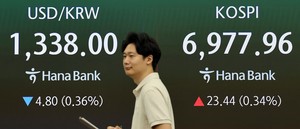
Kospi tries to hold above 7,000 as chip stocks rally
Kospi opens higher, reclaims 7,000 line Retail investors buy as foreigners, institutions sell Samsung Electronics, SK hynix climb together, lead gains The Kospi rose in early trading, attempting to hold above the 7,000 mark, as strength in US semiconductor stocks offset geopolitical tensions in the Middle East. Large-cap chipmakers Samsung Electronics and SK hynix led the index's gains. According to the Korea Exchange, the Kospi opened at 6,972.87 on Wednesday, up 18.35 points, or 0.26 percent, from the previous session. It has been fluctuating around the 7,000 level as it tries to settle above that threshold — a milestone market watchers have dubbed "chilcheonpi," or Kospi 7,000. On the Kospi, retail investors were net buyers of 89.8 billion won ($66.9 million) worth of shares. Foreign investors and institutions — which had posted net buying for four consecutive sessions — turned net sellers, offloading 97.8 billion won and 48 billion won worth of shares, respectively. This marked the first time in five trading days that retail investors have led the buying activity. Other corporate investors were net buyers of 55 billion won worth of shares. Overnight on Wall Street, all three major US indexes fell amid fallout from military clashes in the Middle East, but semiconductor-related stocks bucked the trend. The Dow Jones Industrial Average dropped 1.18 percent from the previous session, while the S&P 500 and the tech-heavy NASDAQ Composite fell 0.58 percent and 0.32 percent, respectively. By contrast, Intel jumped 9.05 percent, AMD 5.90 percent, Broadcom 2.98 percent and Seagate 6.49 percent, driving the Philadelphia Semiconductor Index up 1.30 percent. SK hynix's American depositary receipts also surged 4.83 percent. That strength carried over to the domestic market, where South Korea's two chip heavyweights also advanced — Samsung Electronics gained 0.19 percent and SK hynix 1.51 percent. SK Square, Samsung Electro-Mechanics and LG Energy Solution also rose, up 0.09 percent, 2.48 percent and 0.43 percent, respectively. Samsung C&T, KB Financial Group and Samsung Life fell, down 0.26 percent, 0.23 percent and 1.14 percent, respectively. The Kosdaq extended its gains as well, opening at 815.06, up 3.18 points, or 0.39 percent, from the previous session, and widening its advance from there. Foreign investors were net buyers of 96.5 billion won worth of shares, while retail investors and institutions were net sellers of 86.6 billion won and 9.5 billion won, respectively. Among the index's top market-cap stocks, Ecopro rose 1.85 percent, Ecopro BM 2.96 percent and Jusung Engineering 5.09 percent, while Alteogen and Silicon2 declined 1.08 percent and 1.51 percent, respectively.
Sept. 9, 2026
-

Samsung Securities launches event for retirement pension account holders buying individual investor bonds
Winners to receive 10,000 won point coupon Samsung Securities said Wednesday that it will hold a "retirement pension individual investor bond event" for customers holding retirement pension accounts such as individual retirement pension (IRP) and defined contribution (DC) plans, offering a 10,000 won point coupon. The event will run through Dec. 31. Government bonds for individual investors are products issued by the government, with principal and interest guaranteed by the state. If held to maturity, they earn compound annual interest at a rate combining the coupon rate and an additional spread, with principal and interest paid together on the maturity date. Investing through a retirement pension account defers taxation on investment gains until withdrawal, and pension income tax applies when the funds are received as a pension. Retirement pension accounts are limited to investing up to 70 percent of total holdings in riskier assets, with the remainder required to go into stable assets such as deposits. Samsung Securities expects that adding individual investor bonds to the list of eligible retirement pension investments will widen the range of stable-asset options available to subscribers seeking long-term management. Under the event, customers holding retirement pension IRP or DC accounts can subscribe to individual investor bonds through those accounts during the event period. Those who receive an allotment will be entered into a drawing for 500 winners, each receiving a 10,000 won point coupon. Details on the event are available through Samsung Securities' mobile app "mPOP" or Samsung Financial Group's integrated app "monimo." The subscription periods for individual investor bonds are Sept. 9-15, Oct. 8-15, Nov. 11-17 and Dec. 9-15, each lasting five business days. Sales began Wednesday of government bonds that individuals can purchase through retirement pension accounts, sparking fierce competition among banks and brokerages to attract customers. The financial firms through which individuals can buy government bonds via retirement pension accounts are three banks — Shinhan, Hana and NH Nonghyup — and five securities firms. The securities firms are Mirae Asset, Samsung, Korea Investment & Securities, KB and NH Investment & Securities. The products on offer are identical, as they are government bonds issued by the state. The 10-year and 20-year bonds carry coupon rates of 4.415 percent and 4.570 percent annually, respectively, with an additional spread applied to each. A Samsung Securities official said, "We expect individual investor bonds to expand customers' options for managing retirement pension funds and contribute to their post-retirement asset management."
Sept. 9, 2026
-

Kospi eyes fresh run at 7,000 as oil nears $100, US chip stocks rally
Middle East tensions push oil near $100 a barrel Wall Street's three main indexes fall as US chip index gains 1.3% 'Psychological resistance' at Kospi 7,000 seen prompting cautious trading Attention is turning to whether the Kospi, which fell just short of the psychological 7,000 mark, will make another attempt to reclaim that level on Wednesday. Analysts expect a cautious, wait-and-see market to continue, as renewed geopolitical instability in the Middle East drives up oil prices and concerns simmer over upcoming US inflation data, even as semiconductor shares show strength. The Kospi opened higher on Tuesday and extended its gains through most of the session. It reversed course late in regular trading, however, closing at 6,954.52, down 40.87 points, or 0.58 percent, from the previous session. The index opened at 7,045.79, up 50.40 points, or 0.72 percent, and climbed as high as 7,171.52 during the session, before ultimately giving up the 7,000 level by the close. On the main bourse, foreign and institutional investors extended their buying streak to a fourth straight session through Tuesday. Individual investors, however, sold more than 3 trillion won ($2.23 billion) worth of shares on net. Foreign investors posted net purchases of 648.2 billion won and institutions 642.7 billion won, while individual investors logged net selling of 3.03 trillion won. Other corporations were net buyers, purchasing 1.76 trillion won worth of shares. Samsung Electronics, which had led the Kospi's gains in the first half of the session, ended down 0.19 percent, while SK hynix pared its advance to close up 0.56 percent. Saudi Arabia said Tuesday that several energy facilities in the south of the country were hit by missile and drone strikes from Yemen's Iran-aligned Houthi rebels. Fires forced some operations to shut down. Caution over upcoming US inflation data — including the producer price index and consumer price index due later this week — also weighed on sentiment. A tariff dispute between the United States and Canada appears to have further dampened investor confidence. As a result, all three major Wall Street indexes fell. The Dow Jones Industrial Average dropped 1.18 percent from the previous session, while the S&P 500 and the tech-heavy Nasdaq composite fell 0.58 percent and 0.32 percent, respectively. The declines came as fighting intensified overnight in the Red Sea shipping lanes, an area under the influence of the Iran-aligned Houthi rebels, following earlier clashes near the Strait of Hormuz. This fueled concerns over supply disruptions. International oil prices climbed toward the $100-a-barrel mark. Brent crude futures for November delivery closed at $97.92 a barrel, up 0.95 percent from the previous session, while West Texas Intermediate crude futures for October delivery settled at $93.03 a barrel, up 1.69 percent. The yield on the 10-year US Treasury note rose to 4.805 percent, climbing back above the 4.8 percent mark. Semiconductor-related shares, however, mostly showed strength. The Philadelphia Semiconductor Index rose 1.30 percent. By stock, Intel surged 9.05 percent, AMD gained 5.90 percent, Broadcom rose 2.98 percent and Seagate jumped 6.49 percent. SK hynix's American depositary receipts also climbed 4.83 percent. Seo Sang-young, a managing director at Mirae Asset Securities, said, "The confirmation that AI demand continues to expand — as shown at Citigroup's technology, media and telecom conference and Goldman Sachs' conference — boosted related stocks." The MSCI Korea ETF, seen as a gauge of investor sentiment toward the local stock market, edged up 0.55 percent. Geopolitical concerns are likely to continue weighing on trading in the local market on Wednesday. Overseas investment banks have repeatedly raised their oil price forecasts, reflecting concerns that Middle East supply disruptions could persist. This suggests these external factors will continue to influence the market for now. Han Ji-young, a researcher at Kiwoom Securities, predicted, "Despite the strength in the Philadelphia Semiconductor Index, the local market will likely face resistance near the 7,000-point level and show cautious, wait-and-see trading amid renewed US-Iran tensions and growing caution over the August CPI." He continued, "Amid Middle East instability, heavy net selling by individual investors caused the Kospi's 7,000-point level to act as a resistance zone. Since August, the Kospi has repeatedly failed to break through the 7,000-point mark during intraday trading, which appears to have led the market to view that level as a psychological resistance line."
Sept. 9, 2026
-
[Obituary] Wife of Choi Woon-yull, Korean Institute of Certified Public Accountants chairman
Hwang In-kyung (former dean of Seoul National University's College of Human Ecology) has died. She is survived by her husband, Choi Woon-yull, chairman of the Korean Institute of Certified Public Accountants; sons Choi Dae-il (managing director at Credit Agricole Securities) and Choi Jun-il (professor at KAIST); daughters-in-law Bang Ji-hyun and Park Jong-kyung; and grandchildren Choi Tae-jun, Tae-hee and Ri-won. The mourning altar is set up in Room 31, Seoul St. Mary's Hospital Funeral Hall, from Tuesday, with the burial set for 6:30 a.m. Friday at Eden Paradise Memorial Park. 02-2258-5940.
Sept. 9, 2026
-
Mideast tensions rattle markets: Wall Street sinks, oil nears $100
Armed conflict in Strait of Hormuz spurs risk aversion Chip stocks surge, with Intel jumping 9% US Treasury yields climb back above 4.8% Wall Street's three major indexes all declined Tuesday (local time) as rising oil prices amid escalating Middle East tensions stoked inflation concerns. The Dow Jones Industrial Average fell 628.18 points, or 1.18 percent, to close at 52,786.07. The S&P 500 dropped 45.08 points, or 0.58 percent, to 7,673.52, while the tech-heavy Nasdaq composite slipped 85.58 points, or 0.32 percent, to 26,421.41. Risk-averse sentiment grew after oil prices spiked over the weekend and during the US Labor Day holiday period, as tensions in the Middle East resurfaced. Concerns over supply disruptions spread as fighting intensified not only in the Strait of Hormuz but also along Red Sea shipping routes under the influence of the Iran-aligned Houthi rebels. Yemen's Iran-aligned Houthi rebels said they carried out large-scale retaliatory strikes on Tuesday, targeting facilities and an air base belonging to Saudi Arabia's state oil company, Aramco. In the Strait of Hormuz, renewed armed conflict between the US and Iran continued to threaten vessel traffic. Around the market close, reports emerged that a small Iranian oil tanker had been hit by a US missile strike near Iran's Kharg Island. Kharg Island is a key hub for Iranian crude exports in the Gulf. Iran's Islamic Revolutionary Guard Corps Navy has already vowed immediate retaliation for the US strike. In response, international oil prices climbed to levels near $100 a barrel. Brent crude futures for November delivery closed at $97.92 a barrel, up $0.92, or 0.95 percent, from the previous session. West Texas Intermediate crude futures for October delivery settled at $93.03 a barrel, up $1.55, or 1.69 percent. "Rising oil prices are muddying the inflation picture," said Kyle Rodda, senior financial market analyst at Capital.com, adding, "Military activity is keeping risk premiums elevated in energy markets, as it raises the prospect of a deeper and more prolonged disruption to the global oil supply." Caution ahead of next week's Federal Open Market Committee (FOMC) meeting also weighed on the market, with investors wary of the August consumer price index due out Friday. Semiconductor stocks stood out with notable gains that day, partially offsetting the downward pressure from higher oil prices. Intel and AMD surged 9.1 percent and 5.9 percent, respectively, while Broadcom rose 3 percent. US Treasury yields also rose amid the oil price surge and inflation worries. The yield on the 10-year Treasury note climbed to 4.805 percent, moving back above 4.8 percent. Gold prices fell. December gold futures on the Comex dropped 1.0 percent to close at $4,430.10 an ounce. Copper prices, meanwhile, hit an all-time high amid speculation that President Donald Trump could expand US tariffs on copper to include refined copper. Three-month copper on the London Metal Exchange rose 1.5 percent to $14,728 a ton. On Tuesday, the Kospi reclaimed the 7,000 mark shortly after the open, buoyed by strength in semiconductor shares, but retreated below that level during trading to close lower. The index posted its first decline in four trading sessions.
Sept. 9, 2026
-
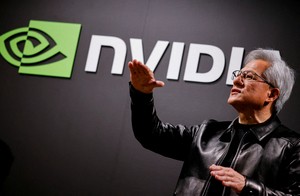
Stuck holding SK hynix at W2.98m? Nvidia walked the same road
As semiconductor stocks including Samsung Electronics and SK hynix rebound from steep declines, investors are once again setting their sights on previous highs. For those who bought near the peak, the key question is not simply whether prices will recover — but whether they can reclaim their all-time highs. Analysts say it is premature to call a full recovery, but argue that if chip earnings continue to grow as expected, the rally may not yet be over. Nvidia's own journey through correction and comeback is being cited as the leading reference case. KB Securities, in a research report titled "A Case Study on the Possibility of Recovering Previous Highs," noted that the current earnings trajectory of memory chips closely mirrors the phase Nvidia went through in 2024 and 2025. The central insight is that growth rate and absolute profit do not necessarily move in the same direction. The market's consensus view on memory chips can be summarized in three points: earnings growth will slow, but profit margins will remain high, and absolute profit will continue to expand modestly as sales increase. South Korea's semiconductor sector is expected to sustain operating profit margins of around 70 percent going forward. Put simply: if a company's profit grew from 100 to 200 last year, the growth rate was 100 percent. If profit then rises from 200 to 240 the following year, the growth rate drops sharply to 20 percent — yet the company is actually earning more than before. A slowing growth rate, in other words, does not automatically mean earnings have peaked. Nvidia followed exactly this pattern. After profits surged from 2023, its growth rate slowed sharply in the second half of 2024, and its operating profit margin stopped climbing meaningfully beyond the 60 percent range. Yet as sales kept rising, absolute profit continued to grow. The share price, however, did not rise smoothly. Nvidia endured three major corrections beginning just before its earnings growth rate started to decelerate in earnest: a roughly 20 percent drop in the spring of 2024, a roughly 30 percent drop in the summer of that year, and a nearly 40 percent decline in early 2025 when the DeepSeek shock and tariff fallout hit simultaneously. Each time, the stock recovered and went on to surpass its previous high, resuming its advance at even higher levels. That pattern offers a useful lens for reading the recent moves in Samsung Electronics and SK hynix. When fears grow that the semiconductor cycle has peaked, investors tend to sell before earnings actually decline — because a slowdown in growth rate alone is enough to compress valuations. But if earnings keep rising even after the share price has corrected sufficiently, the calculus changes. A lower price combined with continued profit growth creates fresh room for the stock to climb again. The sequence, in other words, need not end at "slowing growth → falling share price." It can instead run through "fears of slowing growth → valuation compression → confirmation of rising earnings → share price re-rating." "Nvidia's share price is a useful reference for how investors behaved in a similar environment of slowing growth, sustained high margins and rising absolute profit," said Lee Eun-taek, a director at KB Securities. "If high margins and growing absolute profit persist even as the growth rate slows, the share price could finish its rally at a level higher than where it stands today." The broader market backdrop is also, for now, favorable for semiconductors. The Kospi fell 38.6 percent from its peak during this correction, compressing valuations sharply. The price-to-earnings ratio — the share price divided by expected earnings over the next 12 months — dropped from around 8 times in June to roughly 5 times. That means buying the Kospi today implies recouping the investment through earnings alone in just over five years. Share prices fell first, while earnings forecasts were not cut by nearly as much. Whether Samsung Electronics and SK hynix will trace Nvidia's historical path, however, remains uncertain. Absolute profit growth in the memory segment is expected to be lower than Nvidia's, and the overhang from the earlier price surge is heavier. "Memory chips face some disadvantages compared with Nvidia," Lee said. "Nvidia's profit is growing more than 20 percent every quarter even as its margin plateaus, whereas memory is expected to grow at around 10 percent going forward." He added that "some near-term uncertainties still need to be resolved" and that "memory faces a relatively larger overshoot burden on the supply-demand side as well." One particular obstacle is the wall of retail selling pressure built up along the index's path higher. Shares purchased by individual investors since late June are concentrated in the Kospi range of 7,500 to 8,500. In the 8,250–8,500 band alone, retail investors made net purchases of 18 trillion won ($13.4 billion). With that inventory still sitting at a loss, selling pressure from investors looking to break even could intensify as the index climbs. "Resistance could be fierce once the index pushes above 7,000, and a tug-of-war between buyers and sellers may persist for some time," said Kim Jun-young, a researcher at iM Securities. "The second-half path looks likely to involve a period of consolidation around 7,000 before repeated attempts to clear 8,400." He added that "clearly demonstrating the durability of the memory cycle will be essential before the index can challenge its previous high."
Sept. 8, 2026
-

Samsung Electronics, SK hynix face W1.45tr in sell pressure from KRX rebalancing after surge
Samsung Electronics and SK hynix surged after foreign and institutional investors combined to net purchase more than 4 trillion won ($2.98 billion) in the two stocks in a single session, but the rally faces a potential headwind on Thursday. An estimated 1.45 trillion won in sell pressure is expected to emerge from the periodic rebalancing of the KRX Semiconductor Index. According to Korea Exchange, SK hynix closed Monday up 136,000 won, or 8.26 percent, at 1.78 million won. Samsung Electronics also finished the session 14,500 won, or 5.68 percent, higher at 270,000 won. Over the past month — from Aug. 7 to Monday — SK hynix and Samsung Electronics gained 19.26 percent and 17.14 percent, respectively. The day's sharp gains were driven by heavy buying from foreign and institutional investors. Foreign investors net purchased 1.35 trillion won worth of SK hynix and 871.1 billion won worth of Samsung Electronics on Monday. Institutions added 1.22 trillion won in Samsung Electronics and 643.8 billion won in SK hynix. Combined net purchases of the two stocks by foreign and institutional investors reached 4.09 trillion won for the day. Foreign capital was particularly concentrated in semiconductor stocks. "Foreign investors, who net purchased around 2.6 trillion won on the Kospi on Monday, bought 2.3 trillion won worth of semiconductor stocks alone, absorbing a significant portion of retail investors' loss-recovery and position-unwinding supply," said Han Ji-young, a researcher at Kiwoom Securities. The opposing supply-demand pressure will come from ETF rebalancing scheduled for Thursday. Korea Exchange announced the results of periodic changes to 29 indexes, including KRX sector indexes, on Thursday and Friday of last week. The revised indexes take effect Friday, with the corresponding trades expected to be executed near Thursday's closing price. The sell pressure on Samsung Electronics and SK hynix stems from the KRX Semiconductor Index's individual stock weight cap. The index limits each constituent to a maximum weighting of 20 percent, and any stock exceeding that threshold has its weighting reduced during the periodic rebalancing. According to Mirae Asset Securities, SK hynix held a 36.75 percent weighting in the KRX Semiconductor Index as of Friday, while Samsung Electronics stood at 22.78 percent — both above the 20 percent cap. As a result, estimated sell pressure of 1.24 trillion won for SK hynix and 206.8 billion won for Samsung Electronics is expected, for a combined total of approximately 1.45 trillion won. Conversely, semiconductor stocks whose weightings are set to increase are expected to see inflows. Hanmi Semiconductor is projected to attract 306.4 billion won in buy demand, while Jusung Engineering is expected to see 179.5 billion won. Both stocks showed strength ahead of the rebalancing — Hanmi Semiconductor and Jusung Engineering rose 4.57 percent and 4.99 percent, respectively, on Monday. Market analysts estimate that more capital will move from weighting adjustments among existing constituents than from additions or removals in this round of periodic changes. The combined net asset value of 33 domestic ETFs directly tracking the 29 indexes subject to rebalancing stood at 11.7 trillion won as of Friday. Of the estimated 2.2 trillion won in rebalancing trades, about 400 billion won is attributed to constituent additions and removals, while 1.8 trillion won is tied to weighting adjustments. Comparing the estimated trade volumes against typical daily turnover reveals significant differences by stock. Mirae Asset Securities estimates the rebalancing trade volume at 0.19 times the 20-session average daily turnover for SK hynix and 0.04 times for Samsung Electronics. By contrast, Hanmi Semiconductor — which faces expected buy demand — stands at 2.74 times, and Jusung Engineering at 0.90 times. While the absolute estimated sell figures are larger for Samsung Electronics and SK hynix, Hanmi Semiconductor carries the highest rebalancing volume relative to its average daily turnover. Ahead of Thursday's rebalancing, key variables include whether the recent return of foreign buying interest in semiconductor stocks will persist and how supply-demand dynamics shift in the final stretch of trading. "Given the sharp short-term gains, there is room for temporary profit-taking and a price pullback centered on semiconductor stocks and the broader Kospi," Han said. "What matters, however, is whether foreign net buying continues even during any pullback." Yoon Jae-hong, a researcher at Mirae Asset Securities, also said that "trades for the index change are expected to be executed near Thursday's closing price," adding that "stocks with large estimated trade volumes relative to their average daily turnover may see heightened volatility just before the market close."
Sept. 8, 2026
-
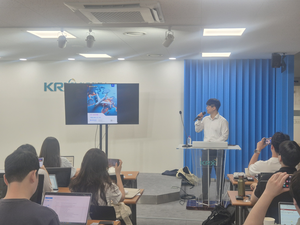
Shinhan Investment says Korean market P/E near bottom, worst volatility unlikely to return
'Earnings estimates intact while share prices fell' — Korea ETF forward P/E at 5.17x Single-stock leveraged ETF turnover plunges to one-tenth of peak 15 trillion won level Simultaneous selling by institutions, foreigners and retail a concern; SCHD, XLE flagged Shinhan Investment said Tuesday that the price-to-earnings ratio of the Korean stock market has fallen to near-bottom levels following a sharp recent decline. With corporate earnings forecasts — led by the semiconductor sector — remaining intact while share prices have dropped sharply, valuation pressure has eased, the brokerage said. It also projected that the extreme volatility seen in June and July, amplified by single-stock leveraged ETFs, is unlikely to recur for now, as trading in those products has fallen to about one-tenth of its peak. "In terms of P/E, the Korean market has come down to the bottom," Park Woo-yeol, a researcher at Shinhan Investment, said at a press briefing held at Korea Exchange in Yeouido, Seoul, on Tuesday. "Earnings estimates haven't been revised down at all — it's just the share prices that have fallen." He added that from a fundamentals perspective, "the P/E is at a floor and earnings momentum is still solid." In a comparison of country-specific ETFs listed in the United States, Shinhan Investment found that the iShares MSCI South Korea ETF (EWY) carried a forward P/E of 5.17 times and a price-to-book ratio of 1.64 times. The fund posted a three-month return of minus 12.5 percent, though its one-year return reached 155.1 percent. The P/E deviation was assessed as being at a "floor" level, with earnings forecasts continuing to improve even as share prices underwent a steep correction. The semiconductor sector showed a similar divergence between share prices and earnings expectations. "From June through August, semiconductor analysts around the world — not just in Korea — kept raising their earnings estimates," Park said. "Valuations are still cheap and companies are generating strong profits, yet share prices have fallen sharply." Shinhan Investment assessed that ongoing earnings improvement across major markets including the United States and Korea, as well as in the semiconductor sector, makes equities more attractive than other asset classes. The market impact of single-stock leveraged ETFs, which amplified volatility in June and July, has also diminished significantly. According to Shinhan Investment, the combined average daily trading value of those ETFs at that time exceeded 10 trillion won ($7.45 billion), but has since plunged to about one-tenth of that peak. The Kospi Volatility Index (VKOSPI) hit successive all-time highs in June and July, shortly after those ETFs were listed. "In June and July, single-stock leveraged ETFs were trading at a combined daily average of around 15 trillion won, but data from the past week shows that figure is now at one-tenth of that level," Park said. "I think we won't see that kind of volatile market for now." When single-stock leveraged ETF trading surges, market makers increase their hedging activity in the underlying assets, which in turn amplifies share price swings. When prices fall, additional selling by market makers deepens the decline. Park described it as "a structure where selling begets more selling," adding that "investors are not trading leveraged ETFs as heavily now, so much of that pressure has dissipated." However, the disconnect between corporate earnings forecasts and market flows remains a concern. Even as the earnings revision ratio improves, institutions, foreign investors and retail investors have all turned to net selling. Park called it "a part where the fundamentals and the supply-demand picture don't add up." Shinhan Investment proposed a portfolio that trims the bond allocation from the conventional 60 percent equities and 40 percent bonds mix to a new split of 60 percent equities, 30 percent bonds, 8 percent alternative assets and 2 percent digital assets. Among equity ETFs, it named the Schwab US Dividend Equity ETF (SCHD) as a preferred product for exposure to high-dividend US stocks. For hedging geopolitical risk, it recommended the Energy Select Sector SPDR Fund (XLE), which invests in US energy stocks. The Health Care Select Sector ETF (XLV) and the SPDR S&P Biotech ETF (XBI) also made the preferred list. "The top three sectors in US dividend stocks are energy, healthcare and consumer staples — and all three are currently functioning as leading sectors," Park said. "With wars continuing, I view dividend stock ETFs that pool companies with strong cash flows as my top pick right now." Shinhan Investment noted that US dividend stocks, unlike their domestic counterparts, carry a higher weighting in healthcare and energy, giving them both defensive qualities and upside momentum.
Sept. 8, 2026
-
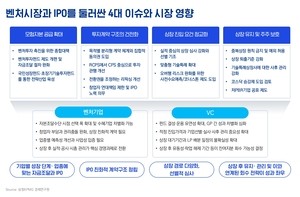
VC investment rebound fuels IPO activity, but sustainable earnings remain key
Samjong KPMG releases report on IPO trends through VC investment lens Venture investment hits 8.8 trillion won in H1 amid deep tech surge 83% of Kosdaq listing rejections tied to earnings concerns The venture capital market is staging a sharp recovery, led by future growth industries such as AI, semiconductors and biotech, opening up significantly more opportunities for technologically capable, high-growth companies to pursue initial public offerings. However, demonstrating sustainable earnings and strong commercialization capabilities — not just technological prowess — has emerged as the central challenge for a successful listing. According to a report released Tuesday by Samjong KPMG titled "IPO Market Trends Through the Lens of VC Investment," domestic new venture investment reached 13.62 trillion won ($10.1 billion) last year, up 14.0 percent from the previous year. In the first half of 2026, investment climbed a further 56.2 percent year-on-year to 8.87 trillion won, sustaining the recovery momentum. Investment, however, is not flowing evenly across companies — it is concentrating in firms that have clearly demonstrated growth potential and profitability. The average investment per portfolio company has risen consistently: 2.54 billion won in 2024, 3.01 billion won in 2025 and 3.86 billion won in the first half of 2026. By company age, investment in early-stage firms with three or fewer years of operation surged 57.7 percent year-on-year, driven by expanded early-stage commitments from the Korea Fund of Funds and large funding rounds secured by deep tech startups in AI, semiconductors and robotics. By sector, ICT services and biotech and healthcare continued to lead the market, while investor attention broadened into deep tech areas including robotics, fuel cells, aerospace and AI semiconductors. Biotech and healthcare investment in the first half of this year jumped 92.7 percent year-on-year to 1.5 trillion won, and the electrical equipment and machinery sector rose 54.0 percent to 1.5 trillion won. ICT manufacturing surged 146.9 percent to 1.1 trillion won, emerging as a primary investment destination. Particularly notable at the subsector level were large pre-IPO rounds raised by AI chipmakers: Rebellions secured 640 billion won and Furiosa AI raised 400 billion won. IPOs are also playing a growing role as an exit route for venture capital. The share of VC exits via IPO rose from 24.3 percent in 2022 to 37.9 percent in the first half of this year, while exits through asset sales fell from 56.5 percent to 47.7 percent over the same period. On Kosdaq, the proportion of technology company listings using the technology evaluation and growth potential special listing tracks expanded from 25.7 percent in 2018 to 56.3 percent in the first half of 2026, reflecting their growing use as a pathway for tech firms to go public. Yet the prevailing IPO review climate has tightened scrutiny not only of technological originality but also of business viability, profitability and the sustainability of earnings. In practice, 83 percent of companies that withdrew or were denied preliminary listing approval from last year through the first half of this year were affected by earnings-related issues, including sales stability and profitability. As a result, demonstrating concrete commercialization potential — including target market size, secured sales channels, and production and financing capacity — has become a prerequisite. The report advises companies preparing for an IPO to build an earnings base and business model that can be sustained after listing. To that end, it recommends that companies proactively review customer concentration, accounts receivable collectability, inventory buildup and the reasonableness of projected sales, while also putting in order their internal control systems, related-party transactions, conversion terms for redeemable convertible preferred shares and convertible bonds, and the volume of shares eligible for trading after listing. Kang In-hye, deputy managing partner and head of Samjong KPMG's IPO Support Center, said companies should treat an IPO "not as a short-term event, but as an ongoing process of managing earnings and share price after listing." She added that companies preparing to go public "must proactively address the basis for projected earnings, internal controls, plans for using proceeds, and overhang risk." Kang also said venture capital firms "should view a listing not as an immediate exit point, but develop a phased exit strategy that accounts for lock-up periods and market absorption capacity," adding that "a long-term investment and exit strategy spanning from the investment stage through the post-IPO period will become increasingly important." Meanwhile, Samjong KPMG, which operates on a March fiscal year, posted operating revenue of 905.6 billion won for the current fiscal year running from April 2025 through March 2026, up about 3.4 percent from the previous year, crossing the 900 billion won threshold for the first time.
Sept. 8, 2026
MOST READ
- 1Hyundai Motor unveils all-new Tucson with bigger body, smarter tech after 6-year wait
- 2Flat sneakers are back: Why Nike is reviving a 55-year-old running shoe
- 3Pope Leo XIV declines French honors and banquet, accepts only private meeting with Macron
- 428 illegal sports streaming sites found operating freely despite repeated blocks
- 5What was Rachmaninoff's performance fee? A 1928 price list tells all
- 6Samsung Biologics union's show of force backfires at the bargaining table
-
WORLD

US warns of punishment for anyone enabling Iran's Strait of Hormuz toll scheme
-
INDUSTRY
Toyota union puts productivity first; Hyundai Motor union demands bigger share of profits
-
FINANCE
National Growth Fund to invest $531M in FuriosaAI, which rebuffed Meta's $800M takeover bid
-
INDUSTRY
Korea Shipowners' Association holds amateur baduk tournament for Maritime Day