
- HOME
- STOCK
-
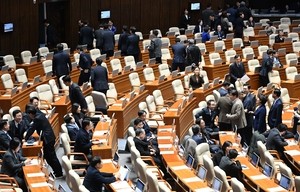
Revised Commercial Act takes effect, sets up shareholder clash next year
The second-phase revision of the Commercial Act, which expands the separate election of audit committee members and mandates cumulative voting for large listed companies with assets of at least 2 trillion won ($1.49 billion), took effect Thursday. Industry watchers say the changes offer shareholders limited benefit while adding to corporate confusion. The changes are expected to collide head-on at next year's regular shareholder meetings. Listed companies are focusing on reducing the number of director seats to be filled beforehand. Institutional investors and minority shareholders, meanwhile, plan to nominate as many director candidates as possible in response to the new rules. That is expected to trigger a clash as early as the shareholder proposal stage. A quick look: What are separate audit committee elections and cumulative voting? Separate election of audit committee members allows the director who will serve on the audit committee to be voted on as a separate agenda item from other directors. The voting rights of the largest shareholder and related parties are capped at 3 percent, meaning that even if the largest shareholder holds a 40 percent stake, only up to 3 percent of that stake can be exercised in the vote for audit committee members. This raises the chance that minority shareholders and institutional investors, by pooling their votes, could elect a candidate who runs counter to the largest shareholder's wishes. Cumulative voting applies when two or more directors are elected at once. It gives each shareholder voting rights equal to the number of shares held multiplied by the number of directors to be elected, allowing shareholders to concentrate all those votes on a single candidate. Assuming all voting rights are exercised, a shareholder holding more than 25 percent of shares could secure one seat when three directors are being elected. The fewer directors being elected, the higher the threshold becomes for minority shareholders to enter the board through cumulative voting. According to the financial investment industry, companies' top priority is to reduce the number of director seats to be filled in advance. The smaller the board, the narrower the opening for shareholder-backed candidates to win a seat through cumulative voting. Shareholders counter that companies and controlling shareholders are trying to neutralize a system designed to protect minority shareholders by adjusting the number and terms of directors. Ultimately, how many director candidates are put forward in shareholder proposals is expected to become the first flashpoint at next year's shareholder meetings. On this front, listed companies are split largely into those whose articles of incorporation cap the number of directors and those that do not. Companies without such a cap have no legal basis to limit the number of candidates and face immediate practical difficulties. The shift is already visible in the numbers. Leaders Index, a corporate analytics institute, analyzed 332 listed companies among the top 500 firms for which 2025 and 2026 data were comparable. It found that the number of registered executives stood at 2,328 as of the end of August, down 46, or 1.9 percent, from 2,374 a year earlier. The number of independent directors rose only slightly, from 1,256 to 1,258, but their share of total registered executives climbed 1.1 percentage points, from 52.9 percent to 54.0 percent. An even bigger source of confusion on the ground is the interpretive gap created by the simultaneous implementation of the two systems. Cumulative voting applies when two or more directors are elected together. With the number of separately elected audit committee members rising to two, a new question has emerged over whether cumulative voting must apply when both are elected together. This has left some companies wondering whether increasing the number of separately elected audit committee members would actually shrink the scope for cumulative voting. Others are considering whether structuring the process to let the company choose between the two systems would make compliance easier. At the same time, an opposite uncertainty persists. Since two or more audit committee members are now subject to separate election, cumulative voting could still apply in that case as well. Conflicts between requirements also remain unresolved. A company could find itself unable to simultaneously satisfy the limit on the number of directors along with the required numbers of independent directors, audit committee members and financial experts. In such cases, there is no clear answer on whether directors already elected would have to be invalidated and re-elected. That is why legal disputes are expected to continue for a considerable period after elections are held. The Ministry of Justice's authoritative interpretations also have clear limits. If the ministry issues a hasty interpretation on an issue where legal clarity has not been established and courts later rule differently, confusion would only deepen. Because the bill was drafted as lawmaker-sponsored legislation rather than a government bill, it did not undergo sufficient advance review of how the two systems would interact. That lack of review is cited as another factor complicating interpretation. Listed companies also repeatedly point to the unusual nature of the systems themselves. Separate election of audit committee members is a system with few, if any, precedents overseas. South Korea is the only country that combines it with a 3 percent cap on shareholder voting rights. Cumulative voting, meanwhile, is left to corporate discretion elsewhere. The United States applies it only on an opt-in basis when specified in a company's articles of incorporation, and Japan allows companies to opt out through their articles. The United Kingdom, France and Germany have not adopted it at all. In effect, no country mandates both systems at once. It remains uncertain how much benefit shareholders will actually gain from the revision. Eom Su-jin, a researcher at Hanwha Investment, said, "The second-phase revision of the Commercial Act can raise the odds of electing the audit committee members and directors that shareholders want, or increase their numbers, but it is not, in itself, a system that fundamentally blocks specific company actions or lets shareholders receive immediate compensation." Kim Choon, director general at the Korea Listed Companies Association, said, "Companies will respond with the primary goal of narrowing in advance the number of directors to be elected. Companies that have not capped the number of directors in their articles of incorporation could immediately face practical difficulties from demands to elect a large number of directors." He added, "We can only wait and see how the issues that were flagged even before the system took effect will play out in reality," and said, "We expect legal disputes to continue for now even after directors are elected."
Sept. 10, 2026
-
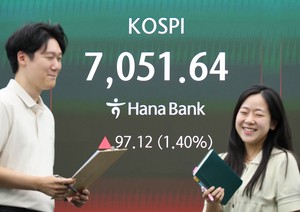
Retail investors dump W16.8tr in 5 days, buy inverse ETFs as Kospi tops 7,000
Retail investors dumped more than 16 trillion won ($12 billion) worth of shares over five trading days as the Kospi reclaimed the 7,000-point mark, cashing in on gains in a wave of profit-taking, data showed. They also snapped up inverse exchange-traded funds that bet on a market decline. Analysts say a thick overhang of retail buying above the 7,000 level, along with the growing likelihood of foreign investors' profit-taking above 7,500, could weigh on further gains. The Korea Exchange said Thursday that retail investors net sold 16.84 trillion won worth of shares on the Kospi from Sept. 3 to Wednesday. On Monday alone, they sold a net 6.84 trillion won, marking the largest single-day net sale so far this year. During the same period, the Kospi climbed 7.45 percent, from 6,562 points to 7,051 points, prompting the wave of profit-taking, analysts said. Foreign and institutional investors bought a net 3.36 trillion won and 6.82 trillion won, respectively, supporting the index's rise. Other corporate entities also posted net purchases of 6.75 trillion won. Retail selling was concentrated in the two semiconductor heavyweights. Individual investors net sold 6.37 trillion won worth of Samsung Electronics shares and 7.92 trillion won worth of SK hynix shares. The combined net selling of the two stocks totaled 14.29 trillion won, accounting for about 85 percent of all retail net selling on the Kospi. While selling off shares en masse on the Kospi, retail investors are also betting on a market pullback. According to Koscom, they net purchased 196.9 billion won worth of KODEX 200 Futures Inverse 2X and 156.7 billion won worth of KODEX Inverse. They also bought 77.7 billion won worth of SOL SK hynix Futures Inverse 2X. The moves suggest investors are placing more weight on the possibility of a correction than on further gains for the Kospi. Retail investors appear to have grown more wary as the Kospi repeatedly failed to close above the 7,000 mark even after breaching it during intraday trading. On Tuesday, the index approached 7,200 during the session before a wave of profit-taking pared its gains. Rising global oil prices and other external uncertainties also dampened investor sentiment. Kang Jin-hyuk, a researcher at Shinhan Investment, said, "The Kospi has finally reclaimed the 7,000-point level, but it is running into resistance and the tug-of-war around the 60-day moving average continues, with the index also giving back some of its intraday gains." Market watchers believe the index's future trajectory will hinge on how much of retail investors' massive profit-taking foreign and institutional investors can absorb. Since a large volume of retail buying is stacked above the 7,000 level, selling pressure could intensify the higher the index climbs. According to iM Securities, retail buying was concentrated in the 7,000-8,500 point range between October last year and July this year. Cumulative net purchases by index range were tallied at 37.8 trillion won for the 7,000-7,500 range, 60.4 trillion won for the 7,500-8,000 range, and 56.6 trillion won for the 8,000-8,500 range. Park Yu-an, a researcher at KB Securities, said, "Investors who traded in the 6,500-7,000 point range later experienced further declines. As the index climbs back to that same price range, there is a growing chance that sales aimed at reducing losses on those earlier purchases could emerge." Kang said, "It will take time to win back the confidence of retail investors who exited amid the intense deleveraging process. Rather, the capacity for inflows from foreign investors, who respond more sensitively to fundamentals, is more meaningful for the Kospi's short-term resilience." Market watchers also cite foreign investors' possible profit-taking as a variable. Park said, "Above 7,500 points, losses for retail investors who bought early in the correction will narrow, while foreign investors who bought at lower index levels will still have room to lock in gains."
Sept. 10, 2026
-

After chips, experts see defense, nuclear power as Korea's next stock leaders
2026 Korea Herald HIT Forum held Morgan Stanley, JPMorgan among panelists Defense, nuclear power in spotlight; chip upside remains Governance reform, investor communication remain challenges Global financial experts have named defense and nuclear power as the next drivers of South Korea's stock market rally, which has so far been led by the semiconductor "super cycle." They said the spread of Korea's industrial leadership could lead to a structural rerating of the Kospi. However, they pointed to challenges that remain to be addressed, including overconcentration in a handful of stocks, closed corporate governance structures and a lack of communication with investors. The discussion took place during a panel session titled "Can Korea Become a Key Investment Destination for Global Capital?" at the "2026 Korea Herald HIT Forum," held Tuesday at the Korea Chamber of Commerce and Industry in Jung-gu, Seoul. Suk Jun, Morgan Stanley's head of Korea strategy, said defense companies in Europe and the United States are grappling with capacity shortages. He said Korea is filling that gap by advancing its defense technology through the localized production of the K2 tank and K9 self-propelled howitzer. "For about 25 years since the Gulf War, the average global defense budget hovered around 2 percent of gross domestic product, but it has continued to rise since Russia's invasion of Ukraine in 2022, and we believe this ratio could climb to 3.5 percent," Suk said. "As Korea's defense industry enters a new era, its technological range keeps expanding, and given the demand to replace aging conventional weapons and platforms, there is significant room to expand overseas." "When considering the three themes of a multipolar world, AI and the energy transition, Korea is the most suitable investment destination, particularly among emerging markets," he added. Park Jung-woo, chief economist at Nomura Securities, said a "rediscovery of manufacturing" is underway. Concerns are growing over overreliance on a single supply chain -- China -- in the wake of the COVID-19 pandemic. Manufacturing was once regarded as an industry for low-wage countries with a low return on equity. It is now being reevaluated as an asset nations must hold to secure a voice amid geopolitical conflict, he said. In this context, panelists said defense and nuclear power go beyond simple industrial growth, directly reflecting Korea's strategic position amid a rapidly shifting global order. Frank Benzimra, head of Asia equity strategy at Societe Generale, said, "In the US stock market, there is still no strong global player in several industrial engineering fields, including batteries, shipbuilding and nuclear power." He added, "A handful of Korean conglomerates are filling that vacuum." The panelists said this spread of industrial leadership is driving a structural rerating across the Kospi as a whole. According to Park, Korea is expected to post growth of more than 3 percent this year for the first time since 2017. That excludes 2021, when growth reflected a base effect from the pandemic. "Countries that exceed the global growth rate of 3 percent are typically markets worth watching -- ones that command a 'growth premium,'" he said. "The won, which had weakened to as much as around 1,500 won against the dollar, is strengthening again, and the interest rate gap between Korea and the US is also narrowing -- a signal that points to an improving growth outlook ahead." Alexander Treves, managing director at JPMorgan Asset Management, stressed that investment opportunities in Korea should not be limited to memory chips. "If every investor is talking about the exact same stock, that is a sign you should be looking elsewhere," he said. He drew a line, however: "It is true that the memory chip market is generating large profits right now, but that does not mean an entire portfolio should be built around memory chips." "There are many other companies that could be candidates for a value-up rerating, and how quickly investors can seize new opportunities amid a shifting geopolitical landscape will be key," he added. The panel also flagged risks that warrant caution alongside the optimistic outlook. Treves pointed to corporate governance issues. "A structure in which a controlling shareholder with a low stake can exert outsized influence over a company's overall decision-making can lead to abnormal outcomes," he said. "Narrowing the gap between ownership and voting rights will be important from an investor's perspective." Park also pointed to limits in corporate communication. "When I look at how Korean companies communicate with investors at earnings conferences and elsewhere, I feel they fall considerably short compared with overseas companies," he said. "Investor communication and access to corporate information remain conservative overall." Park also said the semiconductor boom is likely to continue for now. "When a chip shortage is 'supply-constrained,' unlike a typical cycle, it tends to last about three years," he said. "This cycle, which began in the second half of 2025, could continue for roughly three more years." "As chipmaking grows more technologically demanding, the average annual growth rate of semiconductor supply keeps slowing, making it increasingly difficult to expand supply," he added.
Sept. 10, 2026
-
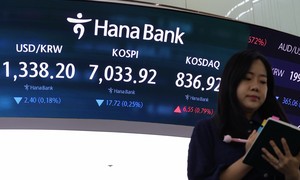
Kospi wavers before eking out finish above 7,000 amid record oil surge, rate jitters
Index falls 0.25% on Middle East tensions; Samsung Electronics, SK hynix both slip Oil tops $100 a barrel; 10-year US Treasury yield hits 4.85% The Kospi edged down Thursday amid a surge in global oil prices triggered by Middle East tensions and interest rate jitters. However, the index held above the 7,000 mark at the close. According to the Korea Exchange, the Kospi closed at 7,033.92, down 0.25% from the previous session. The index opened at 7,038.85, down 0.18% from the previous close, and fell as low as 6,898.45 during trading before narrowing its losses in the afternoon. Samsung Electronics and SK hynix, the Kospi's two largest companies by market capitalization, both closed slightly lower. Samsung Electronics shares fell 0.19% to close at 269,000 won ($201). The stock opened weak, down 0.19%, and briefly recovered to 270,000 won during trading before ultimately falling back. SK hynix shares also fell 0.16% to close at 1.85 million won. The stock opened up 1.24% and rose as high as 1.89 million won, a 1.83% gain, in early trading, but gave up all those gains by the close. Among other large-cap stocks, SK Square fell 0.26%, Samsung Electro-Mechanics 0.28%, LG Energy Solution 1.62% and Samsung Biologics 2.00%. A spike in oil prices stemming from a military clash between the US and Iran, compounded by concerns over a possible US interest rate hike, weakened investor sentiment. Brent crude for November delivery rose $3.29, or 3.36%, from the previous session to settle at $101.21 per barrel, closing above the $100 mark for the first time since July 23. The oil price surge fueled expectations that the US Federal Reserve would raise its benchmark interest rate to curb inflationary pressure. US government bond yields also rose. The yield on the 10-year US Treasury note topped 4.85% during trading, marking its highest level since November 2023. By investor type, retail and institutional investors made net purchases of 380.2 billion won and 433.4 billion won, respectively, in Kospi-listed shares, while foreign investors offloaded a net 2.48 trillion won. Retail investors, who had been net sellers for five consecutive trading sessions, turned to net buying. Institutional investors extended their net buying streak to six consecutive sessions, helping cushion the index's decline. The Kosdaq rose 0.79% to close at 836.92. Alteogen shares fell 0.89% to close at 277,000 won, while Ecopro (0.12%), Ecopro BM (3.31%), Jusung Engineering (7.02%) and Rainbow Robotics (0.79%) all ended higher. Retail and foreign investors were net sellers of 269.8 billion won and 1.07 trillion won, respectively, while institutional investors made net purchases of 1.35 trillion won. The Kosdaq, which recovered above the 800 mark at the close on Friday, has stayed above that level for five consecutive trading sessions, showing an upward trend. Investor deposits at brokerages topped 100 trillion won again. According to the Korea Financial Investment Association, investor deposits — cash parked in brokerage accounts awaiting investment — stood at 102.85 trillion won as of Wednesday. The figure grew by 5.86 trillion won in just one day, returning above the 100 trillion won mark for the first time in five trading sessions. It last topped that level on Sept. 2, when it stood at 102.27 trillion won. Deposits tend to rise during market upswings and fall during downturns, and the latest increase appears to reflect the Kospi's return above the 7,000 mark. Lee Kyung-min, a researcher at Daishin Securities, said, "The domestic market opened lower due to external risks but found a bottom near the 6,900 level before rebounding to reclaim the 7,000 mark." He added, "Short-term volatility in supply and demand widened as the regular rebalancing of KRX sector indexes coincided with the simultaneous expiration of futures and options, while TSMC's solid sales results served as a positive factor for investor sentiment toward semiconductors."
Sept. 10, 2026
-

KODEX real estate REIT ETF to raise dividends through year-end on building sale gains
Largest among REIT ETFs eligible for separate taxation Adjusted payout applies to purchases made by Friday Dividend income excluded from comprehensive financial income taxation Samsung Asset Management said Thursday it will adjust dividend payouts for its KODEX Korea Real Estate REIT Infrastructure ETF through the end of the year, reflecting a special dividend from Koramco THE ONE Reit, one of the ETF's holdings. The adjustment will be carried out four times, from this month through December. Combined with the existing monthly payout, the special dividend is expected to lift the monthly distribution rate to about 1.4 percent — up sharply from the recent rate of 0.6 to 0.7 percent. The actual dividend amount and distribution rate may vary depending on market conditions and the ETF's price on the record date. The funding for the adjusted dividend comes from Koramco THE ONE Reit's sale of the Hana Securities building, an asset held by the REIT that KODEX Korea Real Estate REIT Infrastructure invests in. Koramco THE ONE Reit completed the sale in June and announced a special dividend of 8,900 won per share, funded by the sale gains — equivalent to a market dividend yield of 81.4 percent. KODEX Korea Real Estate REIT Infrastructure holds the largest net assets among domestic REIT ETFs eligible for separate taxation benefits. Its net assets stand at 488.8 billion won ($365 million), cementing its position as a leading separately taxed REIT ETF in Korea. A REIT is an indirect investment vehicle that pools money from multiple investors to invest in real estate and real estate-related securities, then distributes the returns to investors as dividends. A REIT ETF diversifies investments across multiple REITs, allowing investors to receive real estate rental income and other returns in the form of dividends. KODEX Korea Real Estate REIT Infrastructure also qualifies for separate taxation benefits in a regular brokerage account. Under the current Restriction of Special Taxation Act, investors who meet the requirements and apply for separate taxation are subject to a 9 percent tax rate on dividend income generated over three years from the date of investment, up to a combined investment limit of 50 million won. Including local income tax, the effective rate is 9.9 percent. That dividend income is not added to the comprehensive income tax base used for financial income taxation, making the product an attractive option in terms of after-tax cash flow for investors with substantial financial income, compared with general REIT ETFs or high-dividend products. KODEX Korea Real Estate REIT Infrastructure pays dividends monthly. To receive the adjusted payout, investors must purchase shares by Friday, the day before the ex-dividend date. "We expect that, thanks to Koramco THE ONE Reit's special dividend, investors in KODEX Korea Real Estate REIT Infrastructure will receive higher monthly payouts than before through the end of the year," a Samsung Asset Management official said. "This case shows another attraction of REIT investment and the importance of separate taxation, as it demonstrates that not only regular REIT dividends but also special gains from asset sales can flow through to ETF investors as dividends."
Sept. 10, 2026
-
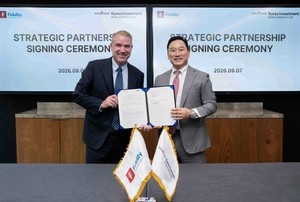
Korea Investment & Securities partners with Fidelity, PIMCO, Carlyle
Strategic tie-ups with Fidelity, PIMCO and Carlyle Expands partnerships across global asset management Combines each firm's expertise with KIS products Korea Investment & Securities announced Thursday that it has forged a series of strategic partnerships with top-tier global asset managers Fidelity, PIMCO and Carlyle. The brokerage aims to expand its partnerships across the full spectrum of global investment areas — including research, bonds and alternative investments — to grow into a world-class securities firm. Korea Investment & Securities signed a memorandum of understanding with Fidelity International, a global asset manager overseeing $775 billion in assets, in London on Monday (local time). Under the agreement, the two companies will provide Korean investors with exclusive access to Fidelity's broad research capabilities spanning global macro, equities, bonds and multi-asset strategies. They will also explore joint product development and co-investment opportunities. As their first joint product, the two firms plan to launch a Korea-China-US technology fund. They will also expand the domestic supply of Fidelity's key investment products and pursue broader retail cooperation, including global investment education programs for Korea Investment & Securities' private bankers and staff. Korea Investment & Securities then signed separate memorandums of understanding with PIMCO and Carlyle in New York on Wednesday (local time). PIMCO is a global fixed-income specialist managing $2.33 trillion in assets. Korea Investment & Securities agreed with PIMCO on short-term fund management cooperation. For retail customers, the brokerage plans to strengthen exclusive research services on its mobile trading system, drawing on PIMCO's global market outlook and analysis of major events. It will also regularly introduce PIMCO's various fund products to the domestic market and expand sales cooperation, improving Korean investors' access to global bond investments. In addition, the two firms will cooperate on developing customized products that incorporate PIMCO's asset management solutions. They also plan to expand their cooperation to include personalized wealth management solutions such as separately managed accounts and wrap accounts. Korea Investment & Securities is also expanding its alternative investment cooperation with Carlyle, a private equity fund manager with which it has maintained close ties since 2023. The two firms signed an agreement on entrusted fund management, under which they will invest short-term funds based on market conditions and investment performance. Through these partnerships, Korea Investment & Securities aims to go beyond simply importing the expertise of global financial firms. Instead, it aims to strengthen a global business model that connects such expertise to actual customer touchpoints in products, research and asset management. The brokerage plans to provide domestic investors with timely access to global investment products and information. Such products and information had previously been available only in limited fashion to overseas financial markets and some professional clients. It aims to steadily grow customers' wealth on that basis, and to use its enhanced global standing to secure additional high-quality investment opportunities. In particular, the company is turning the network it has built through its "KIS Night" IR events into substantive business cooperation. It has held these events since 2024 in global financial hubs such as New York and Hong Kong. Korea Investment & Securities is unusual among domestic brokerages in hosting dedicated IR events overseas. It uses them to deepen exchanges with the financial industry and explore new collaboration and investment opportunities. Kim Sung-hwan, president of Korea Investment & Securities, said, "Our role at Korea Investment & Securities is not simply to bring in the products and deep insights of top-tier global asset managers, but to carefully curate and deliver them in line with the perspective and needs of Korean investors. We will connect the partnerships we have built through global IR events like 'KIS Night' into products and services that customers can truly feel the benefit of, so that investors in Korea can also enjoy financial services of a global standard."
Sept. 10, 2026
-
GS Engineering & Construction wins W637.4b Suyeong 1-zone redevelopment order
GS Engineering & Construction announced Thursday that it signed a contract worth 637.4 billion won ($476 million) for the Suyeong 1-zone redevelopment project. The contract amount is equivalent to 5.12 percent of the company's 2025 sales, and the contract period is 46 months from the actual ground-breaking date.
Sept. 10, 2026
-
![Kospi slips back below 7,000 a day after clearing it as institutions, foreigners sell in tandem [Investment 360]](https://wimg.heraldcorp.com/news/cms/2026/09/10/rcv.YNA.20260910.PYH2026091003690001300_T1.jpg?type=h&h=240)
Kospi slips back below 7,000 a day after clearing it as institutions, foreigners sell in tandem [Investment 360]
Index sinks as low as 6,800s during trading as institutions, foreigners sell in tandem Samsung Electronics, SK hynix both weaken; Kosdaq falls more than 1 percent Futures-options expiration, US CPI concerns in focus: 'time to check whether 7,000 line holds' The Kospi, which closed above the 7,000 mark Wednesday for the first time in 33 trading sessions, slipped back into the 6,900 range just a day later. Concerns over rising global oil prices and long-term US Treasury yields persisted. Combined selling by institutions and foreign investors on the day of the simultaneous expiration of futures and options contracts dragged down the index. As of 10:50 a.m. Thursday, the Kospi stood at 6,939.14, down 112.50 points, or 1.60 percent, from the previous session, according to the Korea Exchange. The index opened at 7,038.85, down 12.79 points, or 0.18 percent, before extending its losses. It fell as low as 6,898.45 during the session, briefly slipping below the 6,900 line, before recovering some of the decline. On the main bourse, institutions and foreign investors were net sellers of 781.8 billion won ($584 million) and 496 billion won worth of shares, respectively. Individual investors were net buyers of 768.7 billion won. Samsung Electronics shares traded at 265,000 won, down 4,500 won, or 1.67 percent, from the previous session, while SK hynix fell 26,000 won, or 1.40 percent, to 1.83 million won. SK Square (-2.55 percent), Samsung Electro-Mechanics (-3.35 percent), LG Energy Solution (-2.29 percent), Hyundai Motor (-1.42 percent) and Samsung Biologics (-2.07 percent) also declined. KB Financial Group was the only major gainer among top-cap shares, up 0.23 percent. Overnight, Wall Street also fell for a third consecutive session, weighed down by rising oil prices and long-term interest rates. The Dow Jones Industrial Average fell 0.77 percent, the S&P 500 lost 0.48 percent and the NASDAQ Composite dropped 0.64 percent Wednesday (local time). Oil prices rose on uncertainty stemming from the Middle East, while long-term interest rates climbed after the US Treasury Department's bond buyback fell short of market expectations. This weighed on investor sentiment. The yield on the 10-year US Treasury note rose to around 4.8 percent. AI-related shares, however, fared relatively well. Micron gained 2.75 percent and SK hynix's American depositary receipts jumped 7.05 percent after Meta unveiled its agentic AI model, Muse. The Philadelphia Semiconductor Index also rose 0.37 percent. On top of external factors, the local market is also digesting supply-and-demand volatility stemming from Thursday's simultaneous expiration of futures and options contracts. It also faces caution ahead of the release of US consumer price data for August. The Kosdaq also weakened. As of the same time, the index stood at 818.30, down 12.07 points, or 1.45 percent, from the previous session. It opened at 825.06, down 5.31 points, or 0.64 percent. On the Kosdaq, individual investors were net buyers of 244.6 billion won worth of shares. Foreign investors and institutions were net sellers of 189.7 billion won and 54.3 billion won, respectively. Among major Kosdaq-listed shares by market capitalization, Alteogen (-3.40 percent), Ecopro (-4.03 percent), Ecopro BM (-4.00 percent) and Rainbow Robotics (-1.35 percent) declined. Wonik IPS (-1.67 percent), EO Technics (-1.28 percent) and Simtek (-1.06 percent) also declined. Jusung Engineering (1.94 percent) and Robotis (2.10 percent) were the only gainers. Market watchers say that with the Kospi closing above 7,000 Wednesday, the key question now is whether the 7,000 line will hold as a support level. Han Ji-young, a research analyst at Kiwoom Securities, said, "While the task before was whether the market could break through the 7,000 resistance line, we have now moved a step forward to checking whether that level can actually convert into a support line." Han added, "Even if the market faces macro-driven volatility this week or next week, there is no need to interpret it as damaging the overall market trend."
Sept. 10, 2026
-
![Korea shifts focus from 'discount' to 'premium' era [2026 Korea Herald HIT Forum]](https://wimg.heraldcorp.com/news/cms/2026/09/10/news-p.v1.20260910.4b3bc913bbf849cc85fb60ffa8ff6e3d_T1.jpg?type=h&h=240)
Korea shifts focus from 'discount' to 'premium' era [2026 Korea Herald HIT Forum]
2026 Korea Herald HIT Forum held Global experts gather under theme of 'Korea premium' Beyond semiconductors, defense and nuclear power seen as next growth drivers Governance reform, shareholder returns, infrastructure innovation named as key tasks Prime Minister Han Seong-sook: 'An irreplaceable Korea, beyond Korea premium' Seoul Mayor Oh Se-hoon: 'A virtuous cycle where success leads to innovation and investment' Capital market experts from Korea and abroad gathered to present a blueprint for overcoming the "Korea discount" and ushering in an era of "Korea premium." They offered in-depth proposals and advice — from bolder shareholder returns and corporate governance reform to identifying new growth industries beyond semiconductors and modernizing infrastructure to meet global standards. The 2026 HIT Forum, hosted by The Korea Herald at the Korea Chamber of Commerce and Industry's international conference hall in Jung-gu, Seoul, on Tuesday, drew senior government officials, financial industry executives and global investors. Prime Minister Han Seong-sook, in a video congratulatory address, said, "We will spare no effort at the government level to help our capital market win the trust of the public and the world, take a step forward, and go beyond Korea premium to build an 'irreplaceable Korea.'" Seoul Mayor Oh Se-hoon added his support, saying, "A virtuous cycle in which excellent companies are properly valued for their worth, and that success feeds back into further innovation and investment — that is exactly the Korea premium we need to build." Jeong Eun-bo, chairman of the Korea Exchange, said South Korea's capital market stands at a critical turning point. The market is marking the 70th anniversary of the opening of its stock exchange. "We will prepare, without a hitch, a 24-hour trading system and a shortened T+1 settlement cycle to maximize accessibility for overseas investors," Jeong said. "We will also promote value-up disclosures to encourage voluntary improvement among low price-to-book ratio, or PBR, companies, and introduce artificial intelligence to counter increasingly sophisticated unfair trading and establish a fair trading order." Choi Jin-young, CEO of Herald Media Group, said in his opening speech, "Sustained corporate value reassessment requires transparent governance, consistent shareholder returns, predictable rules and a fair market." Shareholder returns lacking, governance needs reform Lee In-hyung, vice president of the Korea Capital Market Institute, pointed to concrete data to describe the reality of the Korean stock market. "From 2012 to 2021, the average PBR of listed Korean companies stood at 1.2, only half the level of advanced markets," Lee said. "This is not some vague psychological factor — it is a measurable structural problem stemming from insufficient shareholder returns and an ownership structure centered on controlling shareholders." He then offered a positive assessment of the recent wave of reform. "The value-up program, once limited to voluntary recommendations, is evolving into a multidimensional system spanning corporate law and the tax code — including mandatory disclosure, the introduction of directors' fiduciary duty to shareholders, incentives for share buybacks and cancellations, and separate taxation of dividends," he said. Lee particularly singled out the national pension as the most powerful force to help root these reforms in the market. "The national pension's holdings of domestic shares are projected to surge from 14.3 percent in 2023 to 19 percent in 2026," he said. "With recent pension reforms pushing back the fund's depletion point by more than a decade, the national pension will remain an anchor shareholder in Korea's capital market until at least 2050." A sober perspective from the foreign investor's side followed. Alexander Treves, managing director at JP Morgan Asset Management, who has watched the Korean market for 30 years, said, "Since the 1997 Asian financial crisis, Korea's economy and K-soft power have grown remarkably, but shareholder returns and governance are still weak." Citing Japan's success with shareholder returns under "Abenomics," he advised, "To appear attractive to foreign investors, Korea needs modernized rules aligned with global standards." James Kim, chairman of the American Chamber of Commerce in Korea (AMCHAM), also called for regulatory innovation. "In a recent survey, Korea ranked third in the Asia-Pacific region as a preferred location for regional headquarters, earning high marks for its infrastructure and technological capabilities, yet fewer than 100 multinational companies actually run their businesses with Korea as their regional hub," Kim said. "For Korea to establish itself as a true premium nation and an attractive financial hub, it must modernize outdated regulations and demonstrate solid, numbers-backed momentum that foreign investors can trust." From 'semiconductor rally' to broader 'Korea rally' with defense, nuclear power In the closing panel discussion, key financial experts from Korea and abroad took the stage for an in-depth discussion on whether Korea can become a key destination for global capital. Choi Young-jin, chief marketing officer and vice president at Hanwha Asset Management, moderated the session. Panelists included Treves; Frank Benzimra, head of Asia equity strategy at Societe Generale; Park Jung-woo, chief economist at Nomura Securities; and Suk Jun, head of Korea strategy at Morgan Stanley. Panelists said Korea's recent stock market rally has been overly concentrated in the semiconductor sector. They agreed that the market as a whole needs to improve its fundamentals rather than rely on a handful of leading industries. They named defense, nuclear power, shipbuilding and K-culture as the "next leading sectors" to drive Korea's stock market forward. "We need to break away from a situation where most index gains come from just a few sectors," Treves said. "Korea should actively nurture globally attractive industries it already possesses — defense, shipbuilding, K-culture, gaming — and expand this into a genuine 'Korea rally.'" Benzimra pointed to shifting global macro trends, saying, "Korea's industrial structure is increasingly aligning with the global shift toward capital investment, reindustrialization and economic security. Particularly in batteries, shipbuilding, industrial engineering and nuclear power generation, Korea offers unique strengths that are difficult for other countries to replicate." Suk also highlighted the structural advantages Korea has gained amid the global geopolitical realignment. "As the world shifts recently toward a multipolar system, geopolitical risk continues to rise," he said. "Structural demand is emerging in the defense sector, traditionally led by the United States and Europe, and Korea is filling that gap remarkably well." Park predicted the semiconductor tailwind would continue. "As technological complexity increases, it is becoming harder for chipmakers to rapidly expand supply," he said. "The semiconductor supercycle and the broader business cycle will serve as a boon for the domestic stock market for now."
Sept. 10, 2026
-
C&M advances Kosdaq listing bid, eyes AI, robotics and defense markets
Files preliminary listing review with Korea Exchange; Korea Investment & Securities to serve as lead underwriter Rooted in LG Electronics' motor division, company brings 45 years of core motor technology C&M, an electric drive solutions company, has filed for a preliminary review of its Kosdaq listing, formally kicking off the initial public offering process. The company built its core motor technology over more than 45 years, since its start as LG Electronics' motor division, and gained stable earnings from its automotive electrification business. Building on this foundation, C&M plans to expand into high-value-added advanced sectors such as AI data centers, robotics, and defense and unmanned systems after listing. C&M submitted a preliminary review request for a Kosdaq listing to the Korea Exchange, formally starting the listing process, the company said Thursday. Korea Investment & Securities is serving as the lead underwriter, and C&M aims to complete the listing within this year. C&M traces its roots to LG Electronics' motor division, established in 1980, and holds proprietary core motor technology and know-how built up over more than 45 years. Since being spun off as an independent company in 2006, it has completed a fully integrated electric drive technology structure. The company develops and mass-produces everything in-house, from precision cores and wound stators — key motor components — to finished motors and integrated electric drive modules. Building on this technological pedigree and proven mass-production quality, the company has fully transformed its business structure, shifting from a home appliance-centered operation to one focused on automotive electrification components. This shift has secured a strong cash cow for the company. In practice, C&M posted consolidated sales of 238.5 billion won ($178 million), operating profit of 21.3 billion won and net profit for the period of 19.8 billion won in 2025. The results demonstrate both growth and profitability. The automotive electrification business accounted for 64.1 percent of sales, driving the company's earnings. C&M operates a total of five global production facilities, including three domestic factories in Gimhae, where it is headquartered, as well as in Asan and Busan. It also runs two overseas subsidiaries in Nanjing and Yantai, China. Based on this infrastructure, the company supplies key components to major multinational automakers and home appliance makers as well as Tier 1 customers. With the Kosdaq listing, C&M plans to take a "big step" into future advanced industries, building on its solid cash cow business. The company's long-honed motor technology and integrated mass-production system are highly compatible with new business areas. This strength, it says, will let it capture high-value-added future markets with minimal trial and error. "We are an electric drive solutions company that has proven excellent mass-production performance in the home appliance and automotive electrification markets, building on the technological legacy and know-how of LG Electronics' motor division that has continued since 1980," said C&M CEO Kim Hyung-ga. "Through this Kosdaq listing, we will expand our proven core motor technology into advanced industries such as AI data centers, robotics and defense unmanned systems, and take a major leap forward to become a world-class electric drive solutions company." Also preparing for a Kosdaq listing is voice AI company Neosapience. Neosapience said Monday that it is "evolving beyond voice generation into a conversational AI business that listens and communicates through voice." Founded in 2017, Neosapience operates Typecast, a generative AI platform that converts text into voice imbued with human emotion and intonation. Through this IPO, Neosapience plans to offer 2 million shares. The desired offering price range is 13,800 to 15,800 won, with total expected proceeds of 27.6 billion to 31.6 billion won. Based on the upper end of the price range, the company's expected market capitalization is about 192.7 billion won. Subscriptions for general investors will run from Thursday through Friday.
Sept. 10, 2026
-
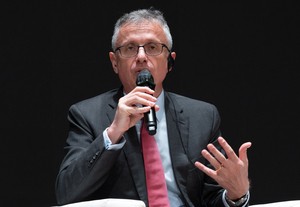
MSCI developed-market status could drive capital out of Korea, forum warns
2026 Korea Herald HIT Forum held JPMorgan's Trevis leads panel discussion 'Better to be a big fish in a small pond than a small fish in a big pond' Institutional investors put money into Korea as part of emerging-market strategy Developed-market status would pit Korea against US, Europe for capital Korea's push for MSCI (Morgan Stanley Capital International) developed-market status could end up costing the country more than it gains, industry experts warned, even if the reclassification eventually goes through. The 2026 Korea Herald HIT Forum was held at the Korea Chamber of Commerce and Industry's international conference hall in Jung-gu, Seoul, on Tuesday. There, global asset management figures cautioned that losing emerging-market status could actually weaken Korea's presence in global investment portfolios. "From an investability standpoint, Korea's move from 'emerging' to 'developed' status may not necessarily be a good thing," Alexander Trevis, managing director at JPMorgan Asset Management, said during a panel discussion titled "Can Korea Become a Key Destination for Global Capital?" Korea has long pushed for inclusion in the MSCI developed-market index as part of efforts to align its market infrastructure with global standards and improve access for foreign investors. The country had hoped to be added to MSCI's watchlist for developed-market status in late June, a required first step, but the bid ultimately failed. A country must remain on the watchlist for at least a year before it can be formally reclassified. The government is now expected to intensify policy reforms with the aim of securing a spot on the watchlist by June 2027. It aims to achieve formal inclusion in the developed-market index by 2028. MSCI classifies countries' stock markets as developed, emerging or frontier based on factors including economic development, market size and liquidity, and investor accessibility. Trevis noted that many institutional investors currently put money into Korea as part of a broader "global emerging markets" strategy. "If Korea is reclassified as a developed market, its stock market would have to compete for investor attention and capital with the much larger US and European markets," Trevis said. "Wouldn't it be better to remain one of the biggest fish in a small pond, rather than become a small fish in a huge pond?" Trevis also said the binary framing of "emerging" versus "developed" markets was itself "not healthy." Trevis, a Briton who has lived in Asia for 30 years, drew on personal experience to make his point. "When I go back to the UK, the subway barely works, and you can get your phone snatched if you pull it out carelessly on the street," he said. "Yet the UK is called a 'developed' country, while in Korea, you can leave your bag or phone at a cafe table and step away, and no one will touch it -- the country's social infrastructure and safety are already at a 'developed' level." Frank Benzimra, head of Asia equity strategy at Societe Generale, said his firm had simulated what would happen if MSCI moved Korea from emerging- to developed-market status. "All else being equal, the result showed a certain level of capital outflow, which runs counter to the conventional expectation inside and outside the market," he said. Benzimra pointed to low liquidity and high volatility as obstacles to Korea's transition to developed-market status. "Despite the large number of companies listed in Korea, it remains questionable how many of them actually have sufficient liquidity," he said. "Since the Kospi's sharp rally, volatility has actually increased, so Korea needs to show more stability in its exchange rate and stock market," Benzimra added. "The debt management and liquidity capabilities of listed companies also need to be examined together." However, Benzimra said the Kospi's rally this year, which pushed the index past the 9,000 mark, was "the most surprising performance I have seen since I started working in finance." He added that this points to significant room for further market improvement. "I have never seen a case where earnings and returns improve this dramatically at the same time," Benzimra said. "The way pricing works in the Korean market has fundamentally changed, and from a financial and equity investment standpoint, the re-rating premium is an extremely important factor." Citing Japan, where clear re-rating signals have been evident over the past two years as the market undergoes reassessment, Benzimra pointed to similar prospects for Korea. "There is a strong chance a similar re-rating could take place in the Korean market as well, and I expect that trend to actually materialize going forward," he said.
Sept. 10, 2026
-

SK hynix ADR nears $200, hits record high two months after listing
Surges 7% to close at $198.63 Up 33% from IPO price of $149 Reflects expectations of prolonged memory chip shortage SK hynix's American depositary receipts surged 7 percent, hitting their highest level since the company's shares began trading on the NASDAQ on July 10. SK hynix's ADR closed at $198.63 on Wednesday (local time), up 7.05 percent from the previous session. The stock touched an intraday high of $199.87. The closing price marked a 33 percent gain from the IPO price of $149. SK hynix's ADR shares have risen for three consecutive trading days since Friday, a trend attributed to expectations that the memory chip supply shortage will persist for now. The Philadelphia Semiconductor Index also gained 0.37 percent, extending its winning streak to five consecutive trading days. Micron Technology rose 2.75 percent as well. UBS analyst Timothy Arcuri forecast that shortages of both DRAM and NAND flash chips would continue through 2027. Dan Kim, chief strategy officer at research firm TechInsights, rated the current overheating in the memory chip market as an "8 out of 10." He added that the market would likely stay at that level at least until the end of 2027. Some market observers noted that memory chip inventories have fallen to less than 10 days' worth of supply. Bank of America upgraded its rating on SK hynix's ADR to "buy" and set a target price of $250. Eric Diton, president of Wealth Alliance, compared today's semiconductor industry to "picks and shovels during the gold rush." He said investors would struggle to find a better option than semiconductors in the current market. However, SK hynix's common shares were trading weak on the domestic market Thursday. As of 9:35 a.m., the shares were changing hands at 1.85 million won ($1,380), down 0.3 percent from the previous session's close. The decline was attributed to a weak start for the Kospi on "quadruple witching day" — when futures and options contracts expire simultaneously. It was also compounded by a downturn on Wall Street driven by rising international oil prices and US government bond yields. Selling pressure on SK hynix tied to the regular rebalancing of the KRX Semiconductor Index was also cited as a reason for the price pullback Thursday. That selling pressure stems from the index's cap on individual stock weightings — the KRX Semiconductor Index limits any single stock's weighting to 20 percent, requiring rebalancing to trim the weighting of stocks that exceed the cap. According to Mirae Asset Securities, SK hynix's weighting in the KRX Semiconductor Index stood at 36.75 percent as of Friday, exceeding the 20 percent cap. This was estimated to trigger about 1.24 trillion won in selling pressure on SK hynix shares. Yoon Jae-hong, a researcher at Mirae Asset Securities, said trading to reflect the index rebalancing would take place near Thursday's closing price, adding, "Stocks with a large estimated trading amount relative to their average trading value could see increased volatility just before the market closes."
Sept. 10, 2026
-
Woori Investment & Securities raises deposit rates, 1-year time deposit up to 4.05%
Note-issuing time deposit rates up 0.10-0.15 percentage point CMA rates also rise up to 0.20 percentage point, boosting short-term, standby fund returns Woori Investment & Securities is raising interest rates across its deposit products for individual customers, including its note-issuing time deposit and comprehensive asset management account, or CMA, offerings. Its one-year time deposit now offers up to 4.05 percent annual interest for customers who sign up online. According to Woori Investment & Securities on Thursday, the company raised interest rates on its note-issuing time deposit product for individual customers by 0.10 to 0.15 percentage point. The increase depends on maturity. As a result, the rate on its one-year (365-day) lump-sum time deposit rose to 3.95 percent annually before tax for individual customers. Customers who sign up online receive an additional 0.10 percentage point in preferential interest, bringing the rate up to 4.05 percent. The company also raised interest rates by 0.10 to 0.20 percentage point across all tiers of its CMA Note and Woori WON CMA Note products. Both products allow customers to make deposits and withdrawals at any time. The CMA Note is a tiered-rate product where interest rates vary depending on the deposit period, with the posted contractual rate applied for each tier. With the online sign-up benefit applied, individual customers can earn between 3.00 and 3.80 percent annual interest before tax. The Woori WON CMA Note offers rates that vary depending on the account balance and is available only through online channels. For individual customers, deposits up to 10 million won ($7,460) before tax earn 3.00 percent annual interest, while the portion exceeding 10 million won earns 2.80 percent. Through the rate hikes, Woori Investment & Securities aims to strengthen the competitiveness of its deposit products. The move lets customers choose products suited to their intended use of funds — short-term spare cash, living expenses or money awaiting investment — and preferred holding period. "We raised interest rates on our deposit products, including time deposits and CMAs, so that customers can feel tangible benefits during this period of rising market interest rates," a company official said. "We will continue to offer competitive financial products tailored to customers' fund management goals and time frames." Woori Investment & Securities has been accelerating its business expansion after bolstering its capital base through a 1 trillion won rights offering in May. Its net profit for the period in the first half of this year came to 24.7 billion won, up 47.1 percent from the same period last year. Operating profit rose 93.3 percent to 29.4 billion won. Fee income, which includes investment banking, jumped 206 percent to 49.1 billion won. This pushed the share of non-interest income in net operating revenue up to 58 percent this year from 43 percent in the first half of last year.
Sept. 10, 2026
-
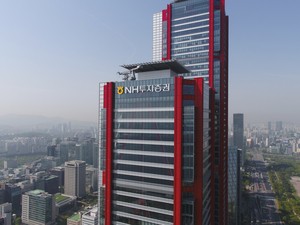
NH Investment gathers Busan's ultra-wealthy families for family office seminar
Private seminar targets families with at least 30 billion won in assets Session covers market outlook, wealth succession strategies for Busan business leaders NH Investment & Securities said it held the Exclusive Family Office Seminar for its family office clients at the Park Hyatt Busan hotel on Wednesday. The private seminar invited family office clients and CEOs of major companies in the Busan region. It aimed to closely examine growing volatility in the domestic stock market and trends in global equities, and to discuss strategic responses. NH Investment & Securities' family office division is a top-tier premium service for ultra-high-net-worth families with at least 30 billion won in assets. It leads the market with tailored, comprehensive solutions covering a family's lifestyle needs, including multilayered tax-saving strategies for inheritance, gifts and business succession. These solutions also extend to domestic and overseas real estate, and consulting on immigration and studying abroad. The seminar featured a range of programs, including a presentation on the outlook for the domestic stock market and key investment picks by NH Investment & Securities research fellow Lee Hyuk-jin, a session on top overseas stock picks by research fellow Ko Min-sung, and a wine-tasting session titled "Wines Chosen by World Leaders" led by sommelier Lee Ji-sun. Lee Jae-yeol, head of NH Investment & Securities' wealth management division, said, "At a time of growing uncertainty in domestic and global financial markets, it is meaningful to share sophisticated response strategies with Busan's business leaders and family office clients." He added, "We will fulfill our responsibility as a reliable partner that supports stable asset succession and the creation of future value, backed by industry-leading expertise." NH Investment & Securities has also been rolling out a range of new products. Starting Wednesday, the company began accepting the first subscriptions for its government bonds for individual retirement investment, which can be purchased through defined contribution and individual retirement pension accounts. Subscriptions will be open for five business days, from Sept. 9 to Sept. 15, with orders accepted between 9 a.m. and 4 p.m. on business days. The minimum subscription amount is 100,000 won, with additional purchases available in increments of 100,000 won. The bonds are issued through monthly subscriptions and can be purchased at branches, by phone, or through the company's mobile trading app, N2 or Namu.
Sept. 10, 2026
-
Brokerages post record W5.2tr profit in Q2, W9.5tr in H1
Second straight record quarter after W4.3tr in Q1 Trading volume surges to W4,438tr as brokerage fees jump 34% Wealth management fees up 57%, IB fees up 28%, trading gains up 46% South Korean brokerages posted a net profit of more than 5 trillion won ($3.73 billion) in the second quarter of this year. The result set a new quarterly record amid a stock market rally. Stock trading volume surged nearly 60 percent from the previous quarter, driving brokerage commissions sharply higher, while revenue from wealth management and investment banking also grew. The Financial Supervisory Service released the "2026 Second-Quarter Securities and Futures Firms' Business Performance (Preliminary)" report on Thursday. It showed the 61 domestic securities firms recorded a combined net profit for the period of 5.19 trillion won in the second quarter. That is up 864.6 billion won, or 20 percent, from the previous record of 4.33 trillion won set in the first quarter. It also marks an increase of 2.34 trillion won, or 82.1 percent, from the same period last year, when the figure stood at 2.85 trillion won. Brokerage earnings have now broken records for two consecutive quarters this year. The first-quarter net profit of 4.33 trillion won had itself marked an all-time quarterly high, only to be surpassed again just three months later. As a result, cumulative net profit for the first half of the year reached 9.52 trillion won, edging close to the 10 trillion won mark. The rally in the domestic stock market drove the improved earnings. Brokerages' commission income totaled 8.87 trillion won in the second quarter, up 2.17 trillion won, or 32.5 percent, from 6.69 trillion won in the previous quarter. Of that, brokerage commissions rose 1.47 trillion won, or 34 percent, to 5.77 trillion won. The jump reflects a sharp increase in stock trading. Trading volume on the Kospi, including alternative trading systems, rose to 4,438 trillion won in the second quarter from 2,775 trillion won in the first quarter. That marked an increase of 1,663 trillion won, or 59.9 percent. Revenue also grew in business lines beyond stock brokerage. Wealth management fees rose 381 billion won, or 56.7 percent, to 1.05 trillion won from 672.1 billion won in the previous quarter, driven by an increase in discretionary investment fees. Investment banking fees climbed 259.3 billion won, or 27.5 percent, to 1.2 trillion won from 941.5 billion won, helped by higher fees tied to debt guarantees. The stock market rally also boosted proprietary trading. Brokerages' proprietary trading gains rose 1.88 trillion won, or 45.8 percent, to 5.98 trillion won in the second quarter from 4.1 trillion won in the previous quarter. The Kospi climbed 67.8 percent, from 5,052 points at the end of March to 8,476 points at the end of June, lifting stock and fund-related gains by 37.38 trillion won. By contrast, derivatives-related losses tied to hedging operations widened by 36.19 trillion won, while bond-related gains rose by 684.3 billion won. Brokerages also grew in size. Total assets held by securities firms reached 1,256.1 trillion won as of the end of June, up 157.7 trillion won, or 14.4 percent, from 1,098.4 trillion won at the end of March. The increase was driven by gains of 57.8 trillion won in cash and deposits and 50.4 trillion won in accounts receivable. Total liabilities rose 149.4 trillion won, or 15.1 percent, to 1,140.9 trillion won from 991.5 trillion won over the same period. Total equity capital increased by 8.2 trillion won, or 7.7 percent, to 115.1 trillion won. Financial soundness indicators also improved. The average net capital ratio for brokerages stood at 1,140.5 percent, up 140.1 percentage points from the end of March, with every firm exceeding the regulatory threshold of 100 percent. The average leverage ratio rose 5.1 percentage points to 723.4 percent, with all firms remaining within the regulatory ceiling of 1,100 percent. The three domestic futures firms posted a combined net profit for the period of 36.84 billion won in the second quarter, up 4.19 billion won, or 12.8 percent, from 32.65 billion won in the previous quarter. That was also up 63.5 percent from the same period last year. "Amid a favorable stock market environment, both large and small and midsize firms saw improved earnings, driven by brokerage commissions as well as proprietary trading gains," a Financial Supervisory Service official said. "In particular, large comprehensive financial investment firms are seeing overall profit expand as revenue also rises in other business areas such as wealth management and investment banking." The official added that the regulator "plans to encourage brokerages to take preemptive steps such as disposing of distressed assets, and to strengthen monitoring of profitability and soundness, in preparation for prolonged geopolitical risks and growing volatility in domestic and overseas financial markets."
Sept. 10, 2026
-

Oil tops $100, bond yields surge as Wall Street falls for third day
Dow down 0.77%, Nasdaq down 0.64% Brent crude at $101, US 10-year yield at 4.85% Wall Street's three major indexes fell for a third consecutive session as crude oil prices topped $100 a barrel and US Treasury yields surged. The Dow Jones Industrial Average closed at 52,380.66 on Wednesday (local time), down 405.41 points, or 0.77 percent, from the previous session. The S&P 500 fell 37.16 points, or 0.48 percent, to 7,636.36, while the tech-heavy Nasdaq Composite dropped 168.07 points, or 0.64 percent, to 26,253.34. Investor sentiment was weighed down by concerns that rising tensions between the United States and Iran could prolong disruptions to oil supplies. US Central Command (CENTCOM) said Wednesday it destroyed five Iranian oil tankers in response to an attack on a US military vessel by Iran's Islamic Revolutionary Guard Corps. Brent crude for November delivery settled at $101.21 a barrel on the London ICE Futures exchange that day, up $3.29, or 3.36 percent, from the previous session -- its highest closing price since May 22. West Texas Intermediate crude for October delivery also rose, gaining $3.02, or 3.25 percent, to close at $96.05 a barrel. US President Donald Trump suggested that global oil prices could remain elevated at least until the US midterm elections in November, citing the war with Iran. "The oil prices will crash right after the midterms. We are going to make that happen, and I believe gas prices will fall below $2 a gallon," Trump said, adding, "It looks like it will take a little more time than the midterms." As the spike in oil prices adds to inflationary pressure, some expect the US Federal Reserve to raise its benchmark interest rate. Markets are closely watching this week's US producer price index and consumer price index data. Should the data show strong inflationary pressure, the likelihood of a Fed rate hike in September could increase. A slowdown in price growth would strengthen the case for the Fed to hold rates steady. A rise in US Treasury yields also weighed on the stock market. The US Treasury Department announced that day it would buy back up to $6 billion in long-term government bonds on Thursday, but yields rose instead after the amount fell short of the $8 billion to $10 billion some market participants had expected. The yield on the 10-year US Treasury note topped 4.85 percent during trading, its highest level since November 2023. The Philadelphia Semiconductor Index rose 0.37 percent. American depositary receipts of Micron and SK hynix gained 2.75 percent and 7.05 percent, respectively. Seo Sang-young, a managing director at Mirae Asset Securities, said, "The Citi and Goldman Sachs conferences showed that AI is expanding from training to inference use, and the Astra issue that has recently driven the rally continued, pushing shares higher." Gold prices rose. December gold futures on the New York Mercantile Exchange settled at $4,458.80 an ounce, up 0.5 percent from the previous session.
Sept. 10, 2026
-
![Oil ETFs surge 26% in a month as Mideast conflict drives crude toward $120 a barrel [Investment 360]](https://wimg.heraldcorp.com/news/cms/2026/09/09/news-p.v1.20260317.16a5dd8be861454a91e0eb377fd56482_T1.jpg?type=h&h=240)
Oil ETFs surge 26% in a month as Mideast conflict drives crude toward $120 a barrel [Investment 360]
Domestic crude oil exchange-traded funds have surged more than 25 percent in the past month as supply worries persist across the Middle East. The rally accelerated recently after clashes between the United States and Iran combined with an attack on a Saudi Arabian energy facility. That combination pushed global oil prices back toward $100 a barrel. Goldman Sachs raised its December price outlook and said Brent crude could climb as high as $120 a barrel if supply disruptions worsen. High oil prices are expected to add to US inflationary pressure and weigh on monetary policy. Markets are now focused on the August consumer price index due Friday and the Federal Open Market Committee meeting scheduled for Sept. 15-16. According to the Korea Exchange, TIGER Crude Oil Futures Enhanced (H) rose 25.88 percent and KODEX WTI Crude Oil Futures (H) rose 25.70 percent from Aug. 7 to Tuesday. RISE US S&P Oil Producers (Synthetic H) climbed 16.55 percent, while KIWOOM US Oil & Energy Enterprise and KODEX US S&P500 Energy (Synthetic) advanced 6.00 percent and 5.61 percent, respectively. By contrast, KODEX WTI Crude Oil Futures Inverse (H) and TIGER Crude Oil Futures Inverse fell 20.70 percent and 21.14 percent, respectively. As geopolitical tensions stemming from the Middle East persisted, products betting on rising oil prices and those betting on a decline posted starkly divergent returns. As armed conflict in the Middle East escalated recently, oil and energy products gained not only in South Korea but also in global markets. According to Mirae Asset Securities, the Invesco DB Energy Fund (DBE), which invests broadly across the energy sector, rose 7.3 percent from Aug. 31 to Sunday. ProShares K-1 Free Crude Oil Strategy ETF (OILK) gained 5.7 percent in the same period. The iShares Global Energy ETF (IXC), which invests in global energy companies, also advanced 2.3 percent. "The renewed fighting between the United States and Iran, a tightened blockade of the Strait of Hormuz, and armed conflict around the Bab-el-Mandeb Strait have all combined to heighten supply risks in the oil market," said Yoon Jae-hong, a researcher at Mirae Asset Securities. Supply worries stemming from the Middle East pushed global oil prices close to $100 a barrel. Brent crude for November delivery settled at $97.92 a barrel, up $0.92, or 0.95 percent, from the previous session — its highest level since July 24. During trading, the price topped $99. West Texas Intermediate for October delivery rose $1.55, or 1.69 percent, to $93.03 a barrel. Iran-aligned Houthi rebels in Yemen attacked Saudi Arabian energy facilities and air bases, raising concerns that supply disruptions could spread beyond the Strait of Hormuz to the Red Sea. That fear drove prices higher. Some analysts expect oil prices to climb further. Goldman Sachs raised its December forecasts for Brent and WTI by $5 each, to $85 and $80 a barrel, respectively. The bank also said Brent could rise as high as $120 a barrel if oil supply disruptions in the Gulf region persist at a significant scale. Dan Struyven, co-head of global commodities strategy at Goldman Sachs, warned in a Monday interview with Bloomberg TV that Brent could climb to $120 a barrel. He said this could happen "if attacks on vessels expand and intensify." He added that a recent string of incidents was also raising concerns about disruptions to maritime shipping. While rising oil prices lifted crude ETFs, they also weighed on stock markets broadly. The Dow Jones Industrial Average fell 1.18 percent, the S&P 500 dropped 0.58 percent, and the NASDAQ slipped 0.32 percent on Tuesday (local time). The yield on the 10-year US government bond climbed back above 4.8 percent, reaching 4.805 percent. "As the conflict between the United States and Iran persisted, and reports emerged of an attack on Saudi Arabian oil facilities, international oil prices kept climbing," said Lee Kyung-min, a researcher at Daishin Securities. "Appetite for risk assets weakened as a result." While high oil prices weigh on the broader stock market, the energy sector benefits from rising crude prices. Park Woo-yeol, a researcher at Shinhan Investment, named the Energy Select Sector SPDR Fund (XLE), which invests in US energy companies, as a product to address geopolitical risk. XLE rose 2.2 percent last week and is up 45.3 percent since the start of the year. Park said that as oil prices rise, energy companies' sales and profits are likely to increase as well. As inflation concerns grow again amid higher oil prices, attention has also turned to the Federal Reserve's rate decision. BlockBeats reported, citing CME's FedWatch tool, that the probability of the Fed raising its benchmark interest rate by 0.25 percentage point in September stood at 60.4 percent. "Uncertainty in the Middle East pushed international oil prices to the brink of $100 a barrel, raising government bond yields and adding to valuation pressure on the stock market," said Min Kyung-won, a researcher at Woori Bank. Woori Bank said bets on a Fed rate hike had grown since the situation in the Middle East deteriorated. The US August consumer price index, due Friday, will be the key indicator shaping the Federal Open Market Committee's rate decision at its Sept. 15-16 meeting. Markets expect that if the CPI comes in above forecasts amid mounting inflation concerns driven by high oil prices, expectations for a Fed rate hike will gain further momentum.
Sept. 9, 2026
-

Copper hits record high, up 47% in a year amid AI-driven demand surge
Copper prices have topped $14,700 a ton for the first time ever, setting new records day after day. Long-term demand from AI data centers and power grid investment is converging with mine supply disruptions in Chile and the prospect of new US tariffs. Three-month copper futures on the London Metal Exchange surged to an intraday high of $14,779 a ton Tuesday (local time), setting a fresh all-time high, according to Bloomberg. The metal had already climbed to an intraday high of $14,533 that day, surpassing the previous record set in January and marking the second straight day of fresh highs. Copper prices have risen about 18 percent so far this year, and 47 percent over the past 12 months. Copper is often called "Dr. Copper" for its role as a leading indicator of the global economy — prices tend to rise when production and construction pick up, and fall when a slowdown looms. Market analysts say the recent rally cannot be explained by economic trends alone. Long-term demand is climbing as AI data centers and power grid construction expand. Supply disruptions at major mines and the possibility of a US tariff on refined copper are adding short-term upward pressure on prices. The immediate trigger behind the latest price gains is the prospect of an expanded US tariff on refined copper imports. The US Department of Commerce has proposed imposing a 15 percent tariff on refined copper imports starting next year, rising to 30 percent in 2028. A probe report on whether to impose the tariff was due by June 30 but has been delayed for more than two months. The delay in a final decision has added to the uncertainty pushing copper prices higher. Regional stockpile imbalances are also fueling the rally, as the US has been preemptively stockpiling copper ahead of a possible tariff, drawing inventories toward American warehouses. Copper stocks held by the Commodity Exchange, or COMEX, in the US now account for nearly 70 percent of global inventories. "As copper has concentrated in the US ahead of the possible tariff, COMEX inventories have risen to an all-time high of 696,000 tons, while LME inventories have fallen by about 40 percent since late May," said Kim Seok-hwan, an analyst at Mirae Asset Securities. "Unless there is a clear stance on the tariff, copper prices are likely to have room for further gains for the rest of the year," said Ok Ji-hee, an analyst at Samsung Futures. Production setbacks in Chile, the world's largest copper producer, are also stoking concerns over supply shortages, as mine collapses and declining ore grades weigh on output. Chile's copper exports fell to $4.63 billion in August from $5.37 billion in July, the lowest level in more than a year. Chile accounts for about a quarter of the world's mined copper output. Morgan Stanley has also lowered its copper supply outlook. The global investment bank had expected mine output to rise this year but now projects it will be flat or slightly lower than last year. That would mark the first year-on-year decline in global copper mine production since 2017. Market watchers point to the prospect of US tariffs and mine supply disruptions as the drivers behind the recent price surge. They expect AI data center and power infrastructure investment to lift copper demand over the medium to long term. Copper is a core raw material used across the power industry, from generation to transmission to end consumption. Demand for the metal is surging as AI data centers proliferate and investment in renewable energy and power grids expands. S&P Global, the US financial information firm, forecasts global copper demand will rise from 28 million tons last year to 42 million tons by 2040. Without a matching expansion in supply, the firm projects a shortfall of about 10 million tons by 2040. "Beyond AI data centers, rising global electricity consumption is also driving copper demand," said Kang Song-chul, an analyst at Eugene Investment & Securities. "Investors can consider holding ETFs backed by physical copper and buying in installments during price pullbacks."
Sept. 9, 2026
-
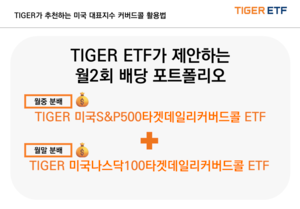
Biweekly payouts: covered-call ETF strategy offers steady income beyond monthly dividends
Mirae Asset Global Investments has presented an ETF investment strategy that allows investors to receive dividend payouts every two weeks by combining the S&P 500 and NASDAQ 100 indexes. Lee Jung-hwan, head of Mirae Asset's Strategic ETF Management Division, spoke at a webinar hosted on the company's YouTube channel "TIGER ETF" at 10 a.m. Wednesday. "The biggest enemy of long-term investing is not a market downturn itself, but the anxiety that keeps investors from enduring it," he said. "The most realistic way to keep investing during volatile markets is not to try to predict the market, but to pursue steady cash flow regardless of how the market moves." Lee also noted that the recent rush of capital into monthly-dividend ETFs reflects growing investor demand for stable cash flow. In practice, covered-call ETFs have been attracting large sums of money. According to Koscom, the TIGER Dividend Covered Call Active ETF took in 1.2 trillion won ($895 million) over the past three months. The TIGER US NASDAQ 100 Target Daily Covered Call and TIGER US Dividend Dow Jones ETFs drew 924.5 billion won and 665.8 billion won, respectively. With the domestic stock market lacking clear direction, covered-call ETFs have emerged as an investment alternative. They allow investors to partly participate in share price gains while also generating cash flow. The covered-call ETF market is also expanding. According to the Korea Exchange, the combined net asset value of covered-call ETFs listed in Korea stood at 15.11 trillion won at the start of the year. It grew to 27.57 trillion won as of Aug. 26. That marks an increase of more than 12 trillion won in less than eight months. A covered call involves holding shares while simultaneously selling call options on those shares as the underlying asset. It seeks gains from share price increases while using the premiums earned from selling call options as a source of distributions. In a rising market, however, returns can be limited. Because call options are sold, investors may not fully benefit from gains in the underlying asset if the market rises sharply. Mirae Asset Global Investments introduced a biweekly-distribution investment strategy using ETFs tracking major US indexes at the webinar that day. "By combining the TIGER US S&P500 Target Daily Covered Call and TIGER US NASDAQ 100 Target Daily Covered Call ETFs, investors can build a portfolio that invests in major US indexes while receiving distributions every two weeks," Lee said. The TIGER US S&P500 Target Daily Covered Call ETF changed its distribution record date this month, moving it from the last day of each month to the 15th. Investors who purchase the ETF up to two business days before the record date can receive the monthly distribution. As a result, investing in it alongside the TIGER US NASDAQ 100 Target Daily Covered Call ETF, which distributes at the end of each month, allows investors to receive payouts every two weeks. Lee emphasized that both ETFs are designed to participate in gains in their underlying indexes. Typical covered-call products sell 100 percent of their options, limiting upside when the market rises. Target daily covered-call products, by contrast, lower the daily options-selling ratio to about 10 percent, aiming to capture more than 90 percent of the underlying index's gains. According to Mirae Asset Global Investments, the TIGER US S&P500 Target Daily Covered Call ETF has tracked about 94 percent of its underlying index's performance since its listing. The TIGER US NASDAQ 100 Target Daily Covered Call ETF has tracked about 91 percent. "Investors can expect biweekly cash flow by diversifying across the S&P 500 and NASDAQ 100, and reinvesting the distributions can also serve as a long-term strategy to increase holdings during market downturns," Lee said.
Sept. 9, 2026
-

Kospi finally reclaims 7,000 after monthlong wait; retail investors dump 16.8tr won
Kospi closes at 7,051 Retail investors net sell 16.8tr won over five sessions Kosdaq also gains 2.28% Kospi reclaimed the 7,000 level based on its closing price Wednesday, marking the first time in 33 trading sessions. Institutional investors led the index's rise, while retail investors extended a heavy net-selling streak to a fifth consecutive session. According to the Korea Exchange, Kospi closed at 7,051.64, up 97.12 points, or 1.40 percent, from the previous session. This was the first time the index closed above the 7,000 mark since July 23, when it ended at 7,096.89. The index opened at 6,972.87, up 18.35 points, or 0.26 percent, from the prior close, and extended its gains through the session, rising as high as 7,112.48 during trading. Institutional investors led the rally. On the KOSPI, institutions posted net purchases of 941.7 billion won ($702 million), while other corporate investors also bought a net 1.78 trillion won. Retail and foreign investors posted net sales of 2.29 trillion won and 427.1 billion won, respectively. Retail investors extended their selling streak to a fifth consecutive session, with total net sales reaching 16.84 trillion won over the period. The day's gains were driven by the continued "Astra effect" from OpenAI's new AI model, which has boosted related stocks on Wall Street. Renewed confirmation of expanding AI demand at Citigroup's Technology, Media and Telecom conference and the Goldman Sachs conference also lifted investor sentiment toward semiconductor stocks. "Despite unstable external conditions, the continued Astra effect from OpenAI's GPT-6, along with the renewed emphasis on AI growth potential and demand momentum highlighted at Citigroup's TMT conference and the Goldman Sachs conference, acted as upward pressure on related sectors," said Lee Kyung-min, a researcher at Daishin Securities. Among the top market-cap stocks, SK hynix closed up 3.51 percent at 1.86 million won. Samsung Electronics ended the session flat at 269,500 won. Samsung Electro-Mechanics (2.48 percent), Hyundai Motor (0.78 percent) and Samsung Biologics (0.83 percent) also rose. KB Financial Group (-0.98 percent), Samsung C&T (-1.57 percent) and Samsung Life (-1.46 percent) fell. The Kosdaq index closed at 830.37, up 18.49 points, or 2.28 percent, from the previous session. The index opened at 815.06, up 3.18 points, or 0.39 percent, from the prior close, then expanded its gains to more than 2 percent. On the Kosdaq, foreign investors posted net purchases of 226.9 billion won. Retail and institutional investors posted net sales of 214.6 billion won and 19.7 billion won, respectively. Among the top market-cap stocks, Alteogen (0.90 percent), Ecopro (7.03 percent) and Ecopro BM (9.64 percent) rose. HLB (-0.47 percent), PharmaResearch (-0.81 percent) and Peptron (-0.48 percent) fell.
Sept. 9, 2026
MOST READ
- 1Hyundai Motor unveils all-new Tucson with bigger body, smarter tech after 6-year wait
- 2Flat sneakers are back: Why Nike is reviving a 55-year-old running shoe
- 3Pope Leo XIV declines French honors and banquet, accepts only private meeting with Macron
- 428 illegal sports streaming sites found operating freely despite repeated blocks
- 5What was Rachmaninoff's performance fee? A 1928 price list tells all
- 6Samsung Biologics union's show of force backfires at the bargaining table
-
WORLD
US warns of punishment for anyone enabling Iran's Strait of Hormuz toll scheme
-
INDUSTRY
Toyota union puts productivity first; Hyundai Motor union demands bigger share of profits
-
FINANCE
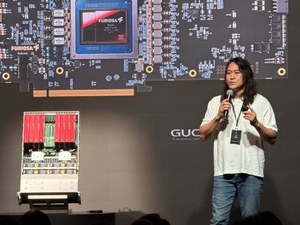
National Growth Fund to invest $531M in FuriosaAI, which rebuffed Meta's $800M takeover bid
-
INDUSTRY
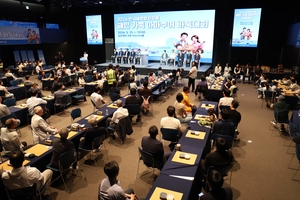
Korea Shipowners' Association holds amateur baduk tournament for Maritime Day