Middle East tensions push oil near $100 a barrel
Wall Street's three main indexes fall as US chip index gains 1.3%
'Psychological resistance' at Kospi 7,000 seen prompting cautious trading
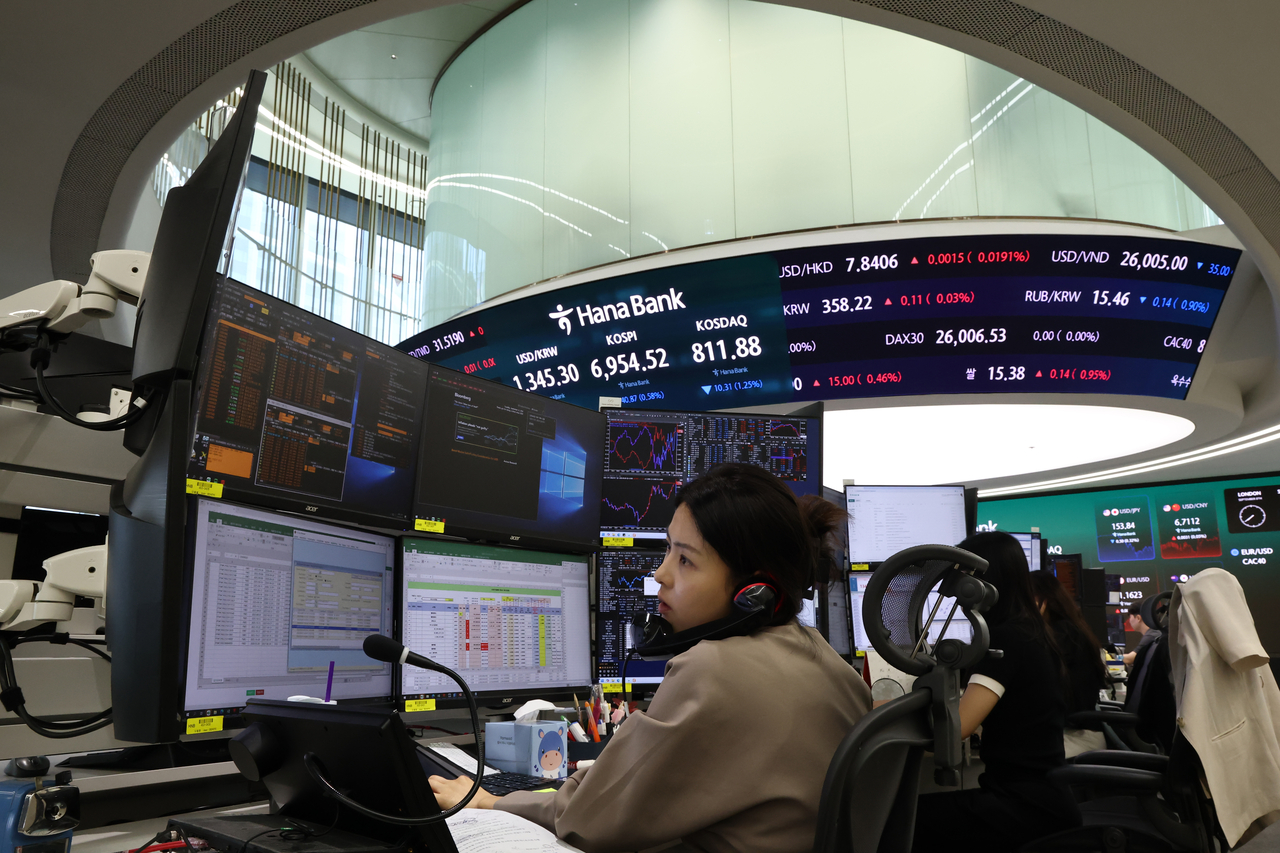
Attention is turning to whether the Kospi, which fell just short of the psychological 7,000 mark, will make another attempt to reclaim that level on Wednesday. Analysts expect a cautious, wait-and-see market to continue, as renewed geopolitical instability in the Middle East drives up oil prices and concerns simmer over upcoming US inflation data, even as semiconductor shares show strength.
The Kospi opened higher on Tuesday and extended its gains through most of the session. It reversed course late in regular trading, however, closing at 6,954.52, down 40.87 points, or 0.58 percent, from the previous session.
The index opened at 7,045.79, up 50.40 points, or 0.72 percent, and climbed as high as 7,171.52 during the session, before ultimately giving up the 7,000 level by the close.
On the main bourse, foreign and institutional investors extended their buying streak to a fourth straight session through Tuesday. Individual investors, however, sold more than 3 trillion won ($2.23 billion) worth of shares on net. Foreign investors posted net purchases of 648.2 billion won and institutions 642.7 billion won, while individual investors logged net selling of 3.03 trillion won. Other corporations were net buyers, purchasing 1.76 trillion won worth of shares.
Samsung Electronics, which had led the Kospi's gains in the first half of the session, ended down 0.19 percent, while SK hynix pared its advance to close up 0.56 percent.
Saudi Arabia said Tuesday that several energy facilities in the south of the country were hit by missile and drone strikes from Yemen's Iran-aligned Houthi rebels. Fires forced some operations to shut down. Caution over upcoming US inflation data — including the producer price index and consumer price index due later this week — also weighed on sentiment. A tariff dispute between the United States and Canada appears to have further dampened investor confidence.
As a result, all three major Wall Street indexes fell. The Dow Jones Industrial Average dropped 1.18 percent from the previous session, while the S&P 500 and the tech-heavy Nasdaq composite fell 0.58 percent and 0.32 percent, respectively.
The declines came as fighting intensified overnight in the Red Sea shipping lanes, an area under the influence of the Iran-aligned Houthi rebels, following earlier clashes near the Strait of Hormuz. This fueled concerns over supply disruptions.
International oil prices climbed toward the $100-a-barrel mark. Brent crude futures for November delivery closed at $97.92 a barrel, up 0.95 percent from the previous session, while West Texas Intermediate crude futures for October delivery settled at $93.03 a barrel, up 1.69 percent.
The yield on the 10-year US Treasury note rose to 4.805 percent, climbing back above the 4.8 percent mark.
Semiconductor-related shares, however, mostly showed strength. The Philadelphia Semiconductor Index rose 1.30 percent.
By stock, Intel surged 9.05 percent, AMD gained 5.90 percent, Broadcom rose 2.98 percent and Seagate jumped 6.49 percent. SK hynix's American depositary receipts also climbed 4.83 percent.
Seo Sang-young, a managing director at Mirae Asset Securities, said, "The confirmation that AI demand continues to expand — as shown at Citigroup's technology, media and telecom conference and Goldman Sachs' conference — boosted related stocks."
The MSCI Korea ETF, seen as a gauge of investor sentiment toward the local stock market, edged up 0.55 percent.
Geopolitical concerns are likely to continue weighing on trading in the local market on Wednesday. Overseas investment banks have repeatedly raised their oil price forecasts, reflecting concerns that Middle East supply disruptions could persist. This suggests these external factors will continue to influence the market for now.
Han Ji-young, a researcher at Kiwoom Securities, predicted, "Despite the strength in the Philadelphia Semiconductor Index, the local market will likely face resistance near the 7,000-point level and show cautious, wait-and-see trading amid renewed US-Iran tensions and growing caution over the August CPI."
He continued, "Amid Middle East instability, heavy net selling by individual investors caused the Kospi's 7,000-point level to act as a resistance zone. Since August, the Kospi has repeatedly failed to break through the 7,000-point mark during intraday trading, which appears to have led the market to view that level as a psychological resistance line."

yuni@heraldcorp.com