![An image related to Samsung Electronics and SK hynix. [Generated with ChatGPT]](https://wimg.heraldcorp.com/news/cms/2026/09/08/news-p.v1.20260908.fbde632388cc4f14ac099d4b71146e92_P1.png)
Samsung Electronics and SK hynix surged after foreign and institutional investors combined to net purchase more than 4 trillion won ($2.98 billion) in the two stocks in a single session, but the rally faces a potential headwind on Thursday. An estimated 1.45 trillion won in sell pressure is expected to emerge from the periodic rebalancing of the KRX Semiconductor Index.
According to Korea Exchange, SK hynix closed Monday up 136,000 won, or 8.26 percent, at 1.78 million won. Samsung Electronics also finished the session 14,500 won, or 5.68 percent, higher at 270,000 won. Over the past month — from Aug. 7 to Monday — SK hynix and Samsung Electronics gained 19.26 percent and 17.14 percent, respectively.
The day's sharp gains were driven by heavy buying from foreign and institutional investors. Foreign investors net purchased 1.35 trillion won worth of SK hynix and 871.1 billion won worth of Samsung Electronics on Monday. Institutions added 1.22 trillion won in Samsung Electronics and 643.8 billion won in SK hynix. Combined net purchases of the two stocks by foreign and institutional investors reached 4.09 trillion won for the day.
Foreign capital was particularly concentrated in semiconductor stocks. "Foreign investors, who net purchased around 2.6 trillion won on the Kospi on Monday, bought 2.3 trillion won worth of semiconductor stocks alone, absorbing a significant portion of retail investors' loss-recovery and position-unwinding supply," said Han Ji-young, a researcher at Kiwoom Securities.
The opposing supply-demand pressure will come from ETF rebalancing scheduled for Thursday. Korea Exchange announced the results of periodic changes to 29 indexes, including KRX sector indexes, on Thursday and Friday of last week. The revised indexes take effect Friday, with the corresponding trades expected to be executed near Thursday's closing price.
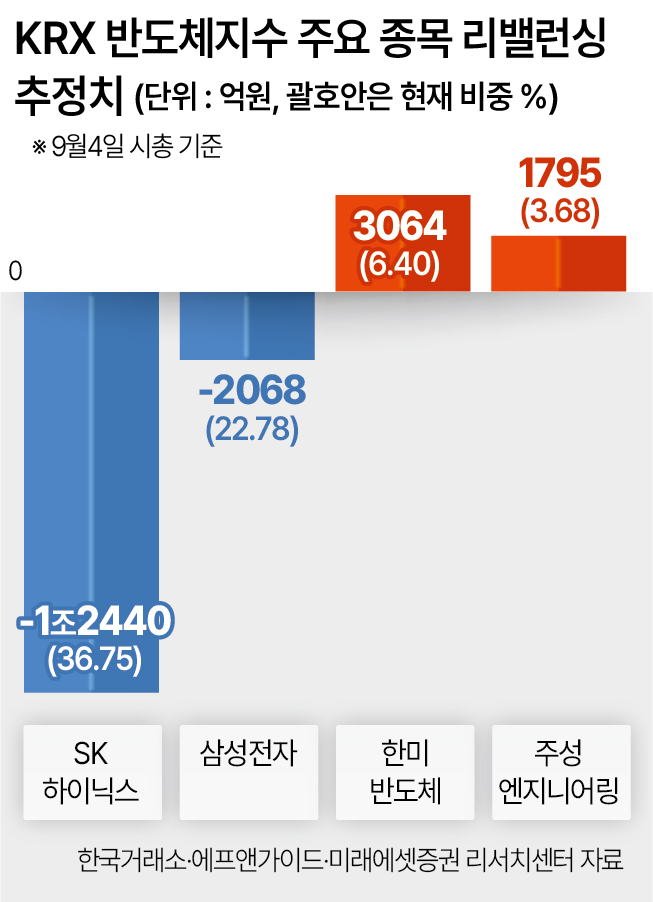
The sell pressure on Samsung Electronics and SK hynix stems from the KRX Semiconductor Index's individual stock weight cap. The index limits each constituent to a maximum weighting of 20 percent, and any stock exceeding that threshold has its weighting reduced during the periodic rebalancing.
According to Mirae Asset Securities, SK hynix held a 36.75 percent weighting in the KRX Semiconductor Index as of Friday, while Samsung Electronics stood at 22.78 percent — both above the 20 percent cap. As a result, estimated sell pressure of 1.24 trillion won for SK hynix and 206.8 billion won for Samsung Electronics is expected, for a combined total of approximately 1.45 trillion won.
Conversely, semiconductor stocks whose weightings are set to increase are expected to see inflows. Hanmi Semiconductor is projected to attract 306.4 billion won in buy demand, while Jusung Engineering is expected to see 179.5 billion won. Both stocks showed strength ahead of the rebalancing — Hanmi Semiconductor and Jusung Engineering rose 4.57 percent and 4.99 percent, respectively, on Monday.
Market analysts estimate that more capital will move from weighting adjustments among existing constituents than from additions or removals in this round of periodic changes. The combined net asset value of 33 domestic ETFs directly tracking the 29 indexes subject to rebalancing stood at 11.7 trillion won as of Friday. Of the estimated 2.2 trillion won in rebalancing trades, about 400 billion won is attributed to constituent additions and removals, while 1.8 trillion won is tied to weighting adjustments.
Comparing the estimated trade volumes against typical daily turnover reveals significant differences by stock. Mirae Asset Securities estimates the rebalancing trade volume at 0.19 times the 20-session average daily turnover for SK hynix and 0.04 times for Samsung Electronics. By contrast, Hanmi Semiconductor — which faces expected buy demand — stands at 2.74 times, and Jusung Engineering at 0.90 times. While the absolute estimated sell figures are larger for Samsung Electronics and SK hynix, Hanmi Semiconductor carries the highest rebalancing volume relative to its average daily turnover.
Ahead of Thursday's rebalancing, key variables include whether the recent return of foreign buying interest in semiconductor stocks will persist and how supply-demand dynamics shift in the final stretch of trading. "Given the sharp short-term gains, there is room for temporary profit-taking and a price pullback centered on semiconductor stocks and the broader Kospi," Han said. "What matters, however, is whether foreign net buying continues even during any pullback."
Yoon Jae-hong, a researcher at Mirae Asset Securities, also said that "trades for the index change are expected to be executed near Thursday's closing price," adding that "stocks with large estimated trade volumes relative to their average daily turnover may see heightened volatility just before the market close."

hajun825@heraldcorp.com