
- HOME
- STOCK
-
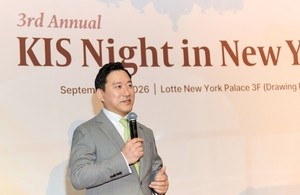
Korea Investment & Securities woos New York with third consecutive 'KIS Night'
Held independently for third consecutive year — a first among Korean financial firms About 150 senior executives from JPMorgan, Carlyle attend MOUs signed separately with Fidelity, Pimco and Carlyle Korea Investment & Securities announced Sunday that it held "KIS Night in New York 2026," an IR event for senior executives of global financial institutions, in New York on Thursday (local time). KIS Night is the firm's proprietary IR event designed to expand its cooperation with global financial partners and strengthen its local network. Since its debut in New York in 2024, the event has expanded to Hong Kong as well, with the New York edition now held as an annual fixture. Korea Investment & Securities is the only Korean financial firm to independently host such a large-scale global IR event in New York on a consecutive basis. Through sustained engagement, the company has built solid partnerships with leading global investment institutions and generated tangible business collaboration. This year's event drew about 150 CEOs and senior executives from global financial firms and major investment institutions, including Pimco, JPMorgan, Carlyle, Neuberger Berman and Man Group. President Kim Sung-hwan took the stage as a speaker, highlighting the growth potential of the Korean financial market and Korea Investment & Securities. He also held in-depth discussions with attending firms on business expansion and strategic cooperation opportunities. In his welcoming remarks, Kim said the company "is growing rapidly on the strength of a powerful network with global partners and is cementing a solid presence not only in Korea but across Asian markets." He added that the firm would "continue to join hands with partners possessing diverse financial capabilities to offer differentiated business opportunities to investors at home and abroad." George Walker, chairman and CEO of Neuberger Berman, said Korea Investment & Securities' "aggressive global investment moves in recent years have been very impressive," adding that he looks forward to "expanding cooperation from alternative investments to the supply of quality retail products, so that both companies can achieve global growth together." Greg Bond, CIO and head of the Americas at Man Group, and Jeff Nedelman, co-president of Carlyle, also said retail product supply and long-term cooperation to date had laid the groundwork for successful results and mutual growth. They expressed their intention to support Korea Investment & Securities in its bid to emerge as a leading Asian financial institution through new product launches and an expansion of areas of cooperation. Korea Investment & Securities has been steadily expanding its financial footprint through strategic alliances with global firms. It signed an MOU with Fidelity on Monday and separate MOUs with Pimco and Carlyle on Wednesday, aimed at strengthening cooperation on expanding the supply of global financial products, co-investment and the provision of global research. Through these partnerships, Korea Investment & Securities said it aims to go beyond simply adopting the expertise of global financial firms and instead reinforce a global business model that connects that expertise directly to customers through products, research and wealth management. The company noted that such global partnerships are considered a core pillar of its wealth management competitiveness. Korea Investment & Securities has also established cooperative ties with other prominent global institutions, including JPMorgan, Stifel Financial and China's Guotai Junan Securities. Building on those relationships, the firm has been accelerating efforts to enhance its retail services, including offering exclusive access to global research content through its mobile trading system. Underpinning the firm's ability to forge partnerships on equal footing with global major players is its strong financial foundation. In the first half of this year, the company posted operating profit of 2.17 trillion won ($1.62 billion) on a consolidated basis, up 89.1 percent from the same period last year, while net profit for the period rose 68.9 percent to 1.73 trillion won. The firm surpassed in just half a year the 2 trillion won annual operating profit threshold it became the first in the domestic securities industry to achieve last year.
Sept. 13, 2026
-

Musinsa kicks off Kospi listing process, seen as shot in the arm for sluggish IPO market
Online fashion platform Musinsa has formally launched the process of listing on the Kospi. With the initial public offering market subdued this year due to a lack of major listings, attention is turning to whether Musinsa — whose valuation is being discussed in the trillions of won — can inject fresh momentum into the market. Korea Exchange said Monday it had received Musinsa's preliminary review application for a Kospi listing. Founded in June 2012, Musinsa operates an online clothing sales and mail-order business. As of the application date, Chairman Jo Man-ho and 26 other shareholders collectively hold a 54.2 percent stake. Korea Investment & Securities and Citigroup Global Markets Securities are serving as lead underwriters, with KB Securities as a co-underwriter and JPMorgan as an overseas co-underwriter. The total shares scheduled for listing stand at 227.83 million, with 26.6 million shares set for public offering. Industry watchers expect the company to complete its public offering before year-end and list in early next year. The market values Musinsa at between 7 trillion and 10 trillion won ($7.47 billion). "The market has been citing a range of 8 trillion to 10 trillion won, but recent over-the-counter transactions in existing shares have been at around the 4.2 trillion won level, while the underwriter selection process saw figures of 7 trillion to 9 trillion won discussed," said Jo Gyeong-jin, a researcher at IBK Securities. Musinsa's top-line growth has continued. Sales on a consolidated basis for the first half of this year reached 821.7 billion won, up 22.6 percent from the same period last year — a record for any half-year period. Operating profit, however, fell 11.2 percent to 52.3 billion won. The profit decline is attributed to rising raw-material and labor costs, higher logistics and commission expenses tied to increased transaction volumes, and upfront investment in overseas expansion into China, Japan and other markets. Analysts said the success of Musinsa's IPO will hinge on its ability to improve profitability going forward. "Top-line growth remains solid, but cost pressures are rising at the same time as the company expands overseas and into brick-and-mortar retail," said Oh Rin-a, a researcher at LS Securities. "In the IPO process ahead, a key evaluation criterion will be how stably the company can defend its profitability while sustaining sales growth in the 20 percent range." Musinsa's listing push comes as the IPO market has contracted sharply. From January through August this year, there were 28 IPOs excluding blank-check companies, down 48 percent from 54 in the same period last year. On the Kospi in particular, Kbank — which listed in March — was effectively the only entrant, and no other company could be called a marquee listing. Post-listing share performance has also been weak. According to Eugene Investment & Securities, the six stocks newly listed on the Kosdaq last month posted an average return of 9 percent from their offering price to their opening price — the lowest of any month this year. Based on closing prices at the end of August, the average decline from offering prices was 23.6 percent, with five of the six stocks — all except Ingenia Therapeutics — trading below their offering prices. The average institutional book-building competition ratio of 372-to-1 and the average retail subscription competition ratio of 275-to-1 last month were also the lowest for any August since Eugene Investment & Securities began tracking the data in 2017. From this month onward, however, the IPO market is expected to gradually recover. Eugene Investment & Securities projected nine to 11 IPOs this month, above the historical average of six for September based on data going back to 1999. Estimated proceeds from public offerings are seen in the range of 400 billion to 500 billion won, with estimated market capitalization of 2.1 trillion to 2.7 trillion won. Market participants are hoping that a September rebound, followed by a successful debut from a large offering like Musinsa, would restore investor sentiment across the broader IPO market. Beyond Musinsa, Sono International — another company cited as a trillion-won-class listing candidate for the second half — filed its preliminary review application with Korea Exchange in June. Sono International, with Mirae Asset and Daishin Securities as lead underwriters, is targeting a valuation of 3 trillion won.
Sept. 12, 2026
-

Kospi leans on $18.7b buyback binge as investors brace for October funding crunch
Samsung Electronics and SK hynix have bought back about half of their announced share buyback volumes just three weeks after starting the program, with the two companies together spending 25 trillion won ($18.7 billion). Amid heavy selling by individual and foreign investors, the two chipmakers have been in effect the only buyers propping up the Kospi, fueling concerns over a supply-demand vacuum once their buying ends. According to the Financial Supervisory Service's electronic disclosure system and the Korea Exchange, Samsung Electronics had completed 52.17 percent of its announced buyback volume and SK hynix 43.00 percent as of the market open Friday. Samsung Electronics purchased 27.8 million shares out of the 53,285,968 shares it disclosed on Aug. 21, while SK hynix bought 10.35 million shares out of the 24.07 million shares it disclosed Aug. 19. The cumulative purchase amounts stood at 7.26 trillion won for Samsung Electronics and 17.73 trillion won for SK hynix. Together, the two companies' buybacks have absorbed roughly 25 trillion won worth of shares from the market. Dividing the purchase amount by the number of shares bought puts the average purchase price at about 261,000 won per share for Samsung Electronics and about 1.71 million won per share for SK hynix. The two companies' massive buybacks stem from an effort to expand shareholder returns and employee compensation, backed by cash that has piled up amid the memory chip boom. SK hynix's board approved a 40 trillion won share buyback on Aug. 19, covering about 3.3 percent of its total outstanding shares. All the repurchased shares will be retired once the buyback is complete, marking the largest share cancellation ever carried out by a listed Korean company. Two days later, on Aug. 21, Samsung Electronics unveiled a shareholder return plan worth 90 trillion to 110 trillion won for this year and simultaneously approved a 15 trillion won buyback for employee compensation. Samsung Electronics had earlier agreed with its labor union to pay special performance bonuses in the chip division using treasury shares. In trading data, such purchases are recorded as net buying by "other corporations" — the classification given to listed companies that buy their own shares on the open market. From Aug. 20, when SK hynix began its buyback, through Thursday, "other corporations" posted net purchases of more than 1 trillion won on the Kospi on every trading day except Sept. 3. Cumulative net purchases over that period reached 23.38 trillion won — a figure remarkably close to the 24.98 trillion won the two chipmakers actually spent on their buybacks over the same stretch. While the total buying by "other corporations" cannot be equated entirely with the two companies' buybacks, the similarity underscores how dominant an influence Samsung Electronics and SK hynix have had on that category of investors recently. Over the same period, individual investors net sold 17.5 trillion won worth of shares and foreign investors net sold 7.95 trillion won. The two groups together dumped more than 25 trillion won in shares, but "other corporations" absorbed most of the selling and kept the index from falling further. The Kospi closed at 7,051.64 on Sept. 9, reclaiming the 7,000 mark on a closing basis for the first time in 33 trading days since July 23. The buyback-driven buying was the single biggest driver behind the Kospi's ability to hold its gains despite heavy selling by individuals. The concern is what happens once the two companies finish their buybacks. The remaining volumes to be purchased stand at about 25.49 million shares for Samsung Electronics and 13.72 million shares for SK hynix. Simply converting those figures at the average purchase prices so far puts the remaining amount at around 30 trillion won. Given that the companies absorbed about half their target volumes in just three weeks, the buybacks are likely to wrap up earlier than the disclosed deadline of November. The moment the buying ends, the force that has effectively single-handedly supported the Kospi recently will vanish from the market. The buying by "other corporations" is less a reflection of fresh investment capital flowing into the market than a temporary, time-limited purchase executed by companies within a fixed scope and schedule. Once the buybacks end without a new source of demand emerging, the Kospi is bound to face a gap in buying power. That is why there is concern the momentum needed to reclaim the index's previous peak could weaken — the Kospi first closed above the 9,000 mark in history in June and rose as high as the 9,300 range during trading. "A notable shift in supply and demand is emerging in the recent Kospi rebound," said Kang Jin-hyuk, a researcher at Shinhan Investment. "Amid a lack of active buying under macro pressure, buybacks and other purchases by 'other corporations' have emerged as a fourth source of demand." "For the rebound to continue, we need to watch for the possibility that foreign and individual investors — the market's key sources of demand — return, which requires checking conditions such as the macro environment and corporate earnings," Kang added. "It will take time to turn around the sentiment of individual investors who exited the market amid intense deleveraging."
Sept. 11, 2026
-
Samsung Electronics eyes 40% HBM market share in Q4 as semiconductor comeback gains steam
Samsung Electronics is expected to stage a simultaneous recovery in both its high-bandwidth memory and foundry businesses, analysts say, as sales of sixth-generation HBM4 chips ramp up and yields at its leading-edge foundry processes improve. The company's "turnkey" capability — offering memory, foundry and advanced packaging under one roof — is drawing renewed attention from customers. KB Securities said Friday that Samsung Electronics' global HBM market share, which stood at 33 percent in the second quarter, is on track to approach 40 percent in the fourth quarter. Samsung's HBM share jumped 12 percentage points from 21 percent in the first quarter to 33 percent in the second, rapidly narrowing the gap with market leader SK hynix. Analysts say further share gains are possible as HBM4 shipments pick up in earnest in the second half of the year. Samsung has projected that its HBM4 revenue will more than triple in the third quarter from the previous quarter, and that HBM4 will account for more than 60 percent of total HBM revenue in the second half. The company's next-generation product roadmap is also taking shape. Following the start of HBM4 mass production, Samsung has begun supplying HBM4E samples to key customers, with plans to extend its lineup to HBM5 and zHBM, a next-generation three-dimensional architecture. Competing in next-generation HBM, however, requires more than producing high-quality DRAM. The growing importance of the base die — the component at the bottom of an HBM stack that handles data input/output and control — means advanced foundry and packaging capabilities are increasingly essential. That is precisely why Samsung's ownership of both memory and foundry operations is a competitive advantage. The company can handle everything from HBM DRAM and base die production to advanced packaging within a single supply chain, making it easier to tailor products to individual customer specifications. Not just HBM: foundry yields improving too Samsung's foundry business, long cited as a weak point in its semiconductor operations, is also entering a recovery phase. KB Securities said Samsung's 4-nanometer foundry process yield has stabilized above 80 percent, while yields on its 2-nanometer gate-all-around process are improving rapidly. Yield — the proportion of functional chips produced from a single wafer — is a key metric that determines the productivity and profitability of a foundry operation. Higher yields mean more sellable chips from the same wafer, lowering unit costs. Demonstrating stable mass-production capability is also critical to winning large customers. In the second half, Samsung is expanding production of AI inference LPUs on its 4-nanometer process. The company is also accelerating efforts to secure mobile and AI/high-performance computing customers for its 2-nanometer node, with the goal of raising utilization rates across its leading-edge processes. Analysts expect that if 4-nanometer utilization continues to rise and yields remain stable, the foundry business could lay the groundwork for a return to profitability as early as the second half of this year. Improvements to the 2-nanometer process carry implications beyond the foundry business alone. If finer logic processes are applied to HBM base dies going forward, Samsung's foundry technology could translate directly into performance and power-efficiency advantages in its HBM products. Memory + foundry + packaging: Samsung's play for the turnkey market As the AI semiconductor market expands, HBM is shifting rapidly from commodity products toward customer-specific designs. The market for "custom HBM" — chips engineered to match the capacity, speed and power characteristics of specific GPUs or AI accelerators — is growing fast. In this environment, customers must design not just memory but also logic semiconductors and packaging together. For Samsung, it opens a market where the company can leverage its integrated structure as a comprehensive semiconductor maker, rather than competing on memory chips alone. KB Securities said that as the share of customized products grows after HBM4, HBM makers' pricing power could also increase. The key question for Samsung's semiconductor business going forward is not simply how much it can grow HBM and foundry individually, but how effectively it can integrate the two. If Samsung recovers market share with HBM4 and stabilizes its 2-nanometer leading-edge process, its turnkey strategy — bundling memory, foundry and packaging — stands to gain considerably more traction.
Sept. 11, 2026
-
Kospi slips back below 7,000 amid rising rates, oil prices — key issues to watch next week
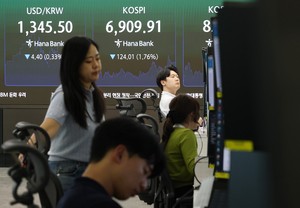
Semiconductor rally on Astra launch briefly lifted Kospi above 7,000 this week; index fell back Friday on rate and oil pressure FOMC on Wednesday, BOJ on Thursday–Friday; NH Investment sees Kospi range of 6,400–7,400 next week The Kospi, which had recovered the 7,000-point level this week, fell back to the 6,900 range as interest rates and international oil prices rose. Next week, with the US Federal Open Market Committee (FOMC) meeting on the calendar, market attention is focused on the US 10-year Treasury yield — which has approached 5 percent — and the Federal Reserve's rate decision. The Bank of Japan's rate decision is also seen as a potential driver of market volatility. According to Korea Exchange, the Kospi closed Friday down 124.01 points, or 1.76 percent, at 6,909.91. Over the week from Monday through Friday (Sept. 7–11), the Kospi gained 3.33 percent while Kosdaq rose 0.88 percent. The Kospi reclaimed the 7,000-point level on Wednesday after semiconductor shares surged following OpenAI's unveiling of GPT-6 Astra, its next-generation AI model. However, escalating Middle East tensions pushed international oil prices above $100 a barrel and drove the US 10-year Treasury yield close to 5 percent, pulling the index back to the 6,900 range on Friday. Kang Jin-hyeok, a researcher at Shinhan Investment, said AI-related positive news offset the burden of rising oil prices and interest rates, sparking a rebound led by large-cap semiconductor stocks. He added, however, that investors who had been unable to sell during the recent sharp selloff were taking advantage of the index's recovery to offload shares, capping further gains near the 7,000-point level. The most important event next week is the September FOMC meeting, scheduled for Wednesday (local time). Market views are split between expectations for a rate hold and a 25-basis-point hike. According to NH Investment, the CME FedWatch tool leans toward a rate increase, while Bloomberg's consensus forecast points to a hold. The dot plot to be released alongside the rate decision, as well as remarks by Federal Reserve Chair Kevin Warsh, are also seen as factors that will shape the direction of the US 30-year Treasury yield. Lee Sang-jun, a researcher at NH Investment, said that unlike the June FOMC, where the benchmark interest rate was held unanimously, three members dissented in favor of a rate hike in July, and geopolitical risks in the Middle East have yet to ease — meaning rate volatility is likely to persist even after the FOMC meeting. NH Investment projected a Kospi range of 6,400 to 7,400 points for next week, citing a potential decline in oil prices and the Astra effect as upside factors, and an escalation of the US-Iran war and further rises in market interest rates as downside risks. Whether the US 10-year Treasury yield breaks through 5 percent is another variable. Although the won-dollar exchange rate has recently fallen to around 1,340 won, foreign investors have been slow to return to the domestic market. According to Yuanta Securities Korea, foreigners net sold 17.2 trillion won ($12.9 billion) worth of Kospi shares from July through Thursday. While won strength has historically tended to draw foreign buying, rising US long-term interest rates and international oil prices are currently blocking foreign capital inflows. Lee Jae-won, a researcher at Yuanta Securities Korea, said that while foreign net purchases have generally accompanied won-strength periods in the past, there is currently no buying force to replace foreigners following their large-scale net selling. He added that for the index to rise, an interest rate environment conducive to foreign investors' return must materialize. The BOJ monetary policy meeting, running Thursday through Friday, is another variable. Markets are pricing in a BOJ rate hike. If Japan raises rates, a stronger yen and higher Japanese government bond yields could push up sovereign yields in major economies and heighten concerns about the unwinding of yen carry trades. Lee Gyeong-min, a researcher at Daishin Securities, noted that the Kospi's 12-month forward earnings per share rose from 1,240 points at the end of August to 1,265 points. He forecast that as semiconductor shares continue to gain on AI expectations, buying interest will spread to sectors where share prices are low relative to earnings — including IT hardware, IT home appliances, retail, insurance, shipbuilding and automobiles. Daol Investment & Securities forecast that the Kospi will remain range-bound ahead of the FOMC after recovering the 7,000-point level this week before slipping back to the 6,900 range. Jo Byeong-hyeon, a researcher at Daol Investment & Securities, said a large near-term rally in the Kospi would be difficult to expect. He added that if high interest rate pressure pulls the index down to the mid-6,000 range, semiconductor and hardware stocks would be worth watching, and that when the index rebounds, banks and insurers would serve as alternatives given the environment of high interest rates and a strong won.
Sept. 11, 2026
-

Samsung group ETF surges 11% as other conglomerate funds tumble up to 30%
As the Kospi recovered the 7,000 mark following a sharp correction, exchange-traded funds tracking Samsung Group affiliates posted returns that far outpaced ETFs tied to other conglomerates during the downturn. Samsung Group ETFs had already outperformed their peers when the Kospi first broke through 7,000 in May, and the performance gap only widened through the subsequent correction. According to the Korea Exchange on Friday, the KODEX Samsung Group ETF rose 11.17 percent from May 6 -- when the Kospi first topped 7,000 -- through Thursday. Over the same stretch, the TIGER Hyundai Motor Group Plus ETF fell 18.15 percent, while the WON Doosan Group Focus ETF dropped 22.79 percent. The ACE POSCO Group Focus and PLUS Hanwha Group ETFs slid 31.40 percent and 32.25 percent, respectively. The performance gap between the KODEX Samsung Group ETF and the PLUS Hanwha Group ETF reached 43.42 percentage points. Group-affiliate ETFs bundle a conglomerate's major listed subsidiaries at set weightings, allowing investors to compare returns as if they had invested directly across each group's stock performance. Other Samsung-linked ETFs also posted gains. Over the same period, the TIGER Samsung Group ETF climbed 13.47 percent and the KODEX Samsung Group Value ETF rose 8.54 percent. The ACE Samsung Group Sector Weighted and ACE Samsung Group Equal Weighted ETFs advanced 5.24 percent and 4.59 percent, respectively. That stands in stark contrast to the declines across major Hyundai Motor, Doosan, POSCO and Hanwha group ETFs. Samsung Group ETFs have outperformed rival conglomerate ETFs since the start of the year. From the last trading day of last year through Thursday, the TIGER Samsung Group ETF gained 98.19 percent and the KODEX Samsung Group ETF rose 88.41 percent. Over the same period, the TIGER LG Group Plus ETF rose 46.06 percent, the TIGER Hyundai Motor Group Plus ETF gained 20.73 percent, and the PLUS Hanwha Group ETF advanced 15.31 percent. The ACE POSCO Group Focus ETF rose 3.11 percent, while the BNK Kakao Group Focus ETF fell 21.66 percent. Strength in semiconductor and IT affiliates has helped drive Samsung Group ETFs' outperformance. As of that day, Samsung Electronics accounted for 26.18 percent of the KODEX Samsung Group ETF's holdings and Samsung Electro-Mechanics for 20.32 percent, together making up 46.50 percent of the fund -- nearly half of its total composition. Profit forecasts for Samsung affiliates have also been revised upward in succession. Shin Hyun-yong, a researcher at Yuanta Securities Korea, said Samsung Life's 12-month forward net profit estimate rose 24.5 percent, from 4.31 trillion won ($3.22 billion) on Aug. 9 to 5.36 trillion won on Sept. 9. Samsung Electro-Mechanics' estimate rose 6.7 percent, from 2.46 trillion won to 2.63 trillion won, while Samsung SDI's climbed 4.6 percent, from 1.18 trillion won to 1.24 trillion won. Samsung Electronics' forecast also increased 3.6 percent over the same period, from 40.98 trillion won to 42.45 trillion won. Market watchers expect the rally, which has so far been led by semiconductors, to broaden into other sectors. "Semiconductors drove the rebound since the July low," said Na Jung-hwan, a researcher at NH Investment. "While maintaining exposure to semiconductors, now is the time to think about which sector will lead the next leg up." He added, "Investors need to keep their semiconductor holdings while also adding domestic AI platforms, services and secondary batteries." Over the past month, other conglomerate ETFs have also rebounded. From Aug. 10 through Thursday, the WON Doosan Group Focus ETF rose 12.47 percent, outpacing the TIGER Samsung Group ETF's 10.22 percent gain. The ACE POSCO Group Focus ETF also climbed 8.10 percent. The TIGER LG Group Plus and PLUS Hanwha Group ETFs rose 4.91 percent and 3.38 percent, respectively. Shin Seung-jin, a researcher at Samsung Securities, pointed to consumer goods, energy storage systems and nuclear power as sectors likely to take on a bigger leadership role. "Since August, as semiconductors have risen, the rally has spread to sectors with strong individual momentum, such as consumer goods -- food, beverages and cosmetics -- energy storage systems, and nuclear power, including construction and utilities," Shin said. "For the rest of the second half, we expect the Korean market's leading sectors to broaden as AI semiconductors continue a gradual climb."
Sept. 11, 2026
-
Overseas-listed leveraged ETFs on Samsung, SK hynix grow even as Korea tightens rules
Overseas-listed leveraged products tracking Samsung Electronics and SK hynix are emerging as a fresh source of volatility for Korea's stock market, even as financial regulators tighten entry barriers for domestic single-stock leveraged products to cool overheated demand. The overseas market for such products has expanded, with several SK hynix single-stock leveraged offerings listed one after another in the United States. Analysts say growing leveraged demand abroad flows through global financial institutions' hedging trades, ultimately amplifying supply-demand imbalances and volatility in Korea's spot and futures markets. The combined net asset value of nine overseas-listed single-stock leveraged exchange-traded funds tracking Samsung Electronics and SK hynix stood at $6.45 billion as of Sept. 8. Converted at an exchange rate of 1,351 won per dollar, that amounts to about 8.71 trillion won ($6.51 billion). That figure exceeds the scale of domestically listed products. According to the Korea Exchange, the combined net asset value of 14 domestically listed single-stock leveraged products tracking Samsung Electronics and SK hynix stood at 7.19 trillion won as of Sept. 9. The asset scale of overseas-listed products is about 1.5 trillion won larger than their domestic counterparts. Among individual products, Hong Kong-listed ETFs dominate in scale. The CSOP SK hynix Daily (2x) Leveraged Product had $4.9 billion in net assets, the largest among overseas products, while the CSOP Samsung Electronics Daily (2x) Leveraged Product held $1.02 billion. The two products were the world's first single-stock leveraged ETFs tracking Samsung Electronics and SK hynix. In May, the CSOP SK Hynix 2X Daily Leveraged Product also became the world's largest single-stock leveraged ETF. After Korea listed its first single-stock leveraged products in May, several US asset managers began rolling out similar offerings starting in July. Among them, GraniteShares 2x Long SK Hynix Daily ETF had the largest net assets among US-listed products, at $232.37 million. It was followed by ProShares Ultra SK Hynix ($94.3 million), Leverage Shares 2X Long SK Hynix Daily ($92.01 million), T-Rex 2X Long SK Hynix Daily Target ETF ($46.16 million), Direxion Daily SK Hynix Bull 2X Shares ($42.51 million), Kogi SK Hynix 2X Daily ($27.64 million), and Tradr 2X Long SK Hynix Daily ETF ($580,000). In Korea, the launch of single-stock leveraged ETFs has produced a so-called "wag the dog" effect, in which derivatives trading influences the spot market. As shares of Samsung Electronics and SK hynix rose sharply, retail money poured into leveraged products, intensifying the imbalance in supply and demand. Financial regulators have moved to cool the overheated demand by raising the minimum deposit required for single-stock leveraged products from 10 million won ($7,300) to 30 million won, and by requiring new investors to complete mock trading before participating. The problem is that leveraged investment growing overseas can also affect supply and demand in Korea's stock market. Overseas asset managers use derivatives such as total return swaps with global financial institutions to run products that track twice the daily returns of Samsung Electronics or SK hynix. The counterparty financial institutions then buy and sell Korean spot shares, futures and options to hedge their risk. In this structure, leveraged demand generated overseas flows through such hedging trades into Korea's own stock market supply and demand. This effect can intensify particularly during periods of sharp share price swings, when rebalancing to meet leveraged products' daily target multiples — and the accompanying hedging trades — can expand. The larger the scale of overseas-listed products grows, the more such trading amplifies price movements and volatility in the domestic market. The Bank of Korea also flagged the ripple effects of expanding overseas leveraged investment. In its monetary and credit policy report released Thursday, the central bank said, "In global financial markets, the expansion of leveraged investment in domestic shares has led to unexpected ripple effects, including an increase in hedge-related spot and futures trading in Korea." "When a company running a single-stock leveraged product enters into a swap with a global investment bank such as Morgan Stanley or Goldman Sachs, the bank matches the leverage ratio by buying Korean shares," said an official at a securities firm. "Given how significant an impact foreign investor flows have on Korean shares, overseas products likely have a greater effect on the domestic stock market than domestic products do." "Volatility in semiconductor shares has eased recently, and the market appears to have calmed, but demand through overseas leveraged products remains just as strong," said a division head at an asset management firm. "It is questionable how much raising entry barriers only for domestic products can actually lower overall market volatility." On Wall Street, meanwhile, so-called ultra-short-term leveraged ETFs that adjust their leverage ratio every hour are preparing to launch. According to Reuters and other foreign media, US asset manager Defiance recently filed with the US Securities and Exchange Commission to launch 16 leveraged ETFs that track twice the hourly return of their underlying assets. Among them is a product based on DRAM, a memory chip ETF. DRAM holds Samsung Electronics and SK hynix at weightings of 19 percent and 16 percent, respectively, making the two companies its largest and second-largest holdings. While existing 2x leveraged products match their target multiple on a daily basis, this new product treats each hour as if it were a trading day, tracking twice the hourly return.
Sept. 11, 2026
-
National Pension Service, LG AI Research team up on AI-based exchange rate analysis service
Pension fund seeks to boost investment efficiency with AI The National Pension Service is teaming up with LG Group to develop AI-powered services specialized for financial operations. The National Pension Service said Friday that it signed a memorandum of understanding with LG AI Research in Magok, Seoul, to cooperate on AI technology in fund management. The agreement will combine the National Pension Service's fund management experience with LG AI Research's AI technology. The two organizations plan to jointly develop AI models and services specialized for financial operations, apply them to actual work and raise investment efficiency. The two organizations plan to cooperate on developing and testing an AI-based exchange rate analysis service specialized for fund management, jointly researching investment-related AI technology and applying it to fund operations, and strengthening the National Pension Service's AI utilization capabilities through joint working-level councils and training programs. As their first joint project, the two organizations will pursue the AI-based exchange rate analysis service. It will apply LG AI Research's AI technology to unstructured market information, including various macroeconomic indicators, news and research materials, to analyze exchange rate movements. The project will also test the service's practical usefulness in actual operations. Starting with the exchange rate analysis service, the National Pension Service plans to gradually identify other areas where AI can improve work efficiency. LG AI Research has previously unveiled Exaone-BI, a financial AI agent that provides change-prediction scores and expert-level commentary for about 8,000 listed stocks in South Korea and the United States. The institute has been advancing its AI technology in the financial sector through partnerships with Koscom and the London Stock Exchange Group. "This is a meaningful opportunity for Exaone's financial capabilities to be tested in the operations of the country's largest pension fund, and we will work together to build a model case that leads AI adoption in the public sector," said Lee Hwa-young, managing director at LG AI Research. "Through this agreement, we will apply AI technology to actual operations and systematically verify its potential uses," said Seo Won-ju, chief investment officer of the National Pension Service. "Starting with exchange rate analysis, we will continuously identify areas for AI application, streamline investment operations to build an environment focused on fund management, and further enhance the expertise and efficiency of our fund management," Seo added. The National Pension Fund is financed through pension premium income and investment returns. The Fund Management Headquarters invests the fund in stocks, bonds and alternative assets to professionally manage the public's retirement resources. As of the end of June, the fund's overall investment return was tentatively tallied at 27.22 percent. Returns for 2024 and the first half of 2025 stood at 9.71 percent and 4.08 percent, respectively.
Sept. 11, 2026
-
Kospi retreats below 7,000 as oil prices, interest rates surge
Kospi closes at 6,909 Foreigners, institutions net-sell 3.5 trillion won Samsung Electronics down 3%, SK hynix down 2% Kosdaq also falls 1.95% The Kospi surrendered the 7,000 level on Friday for the first time in three trading sessions, as surging crude oil prices and interest rates rattled investor sentiment. Foreign and institutional investors combined for more than 3.5 trillion won ($2.62 billion) in net selling, dragging the index lower. According to Korea Exchange, the Kospi closed at 6,909.91, down 124.01 points, or 1.76 percent, from the previous session. The index opened sharply lower, falling 231.42 points, or 3.29 percent, to 6,802.50, before trimming losses as retail investors and other corporations stepped in with buying. The index was unable to reclaim the 7,000 mark by the close. On the main Kospi market, individual investors net-bought 1.87 trillion won, while other corporations posted net purchases of 1.65 trillion won. Foreign investors and institutions net-sold 2.3 trillion won and 1.22 trillion won, respectively. Foreign investors also net-sold 680 billion won in the KOSPI 200 futures market. Investor sentiment froze as international oil prices and market interest rates surged simultaneously. Brent crude futures topped $105.74 per barrel, while West Texas Intermediate rose to $100.92, with both benchmarks crossing the $100 mark. The yield on the 10-year US Treasury note exceeded 4.9 percent. The yield on three-year South Korean government bonds also broke through 4.0 percent during trading, reaching its highest level in roughly three years. "With the US August consumer price index set to be released tonight — a key variable that will determine the direction of financial markets going forward — caution is running high amid the sharp rise in international oil prices and producer prices," said Lee Kyung-min, an analyst at Daishin Securities. Most large-cap stocks also weakened. Samsung Electronics fell 3.53 percent to close at 259,500 won, while SK hynix dropped 2.21 percent to 1.81 million won. SK Square (-4.05 percent), LG Energy Solution (-1.37 percent) and Hyundai Motor (-1.67 percent) also declined. KB Financial Group rose 2.60 percent. Doosan Enerbility gained 1.00 percent and Hanwha Aerospace advanced 1.31 percent. The Kosdaq also fell nearly 2 percent, closing at 820.64, down 16.28 points, or 1.95 percent, from the previous session. The index opened down 20.01 points, or 2.39 percent, at 816.91 and extended its losses through the session. On the Kosdaq market, individual investors net-bought 511.7 billion won, while foreign investors and institutions net-sold 313.6 billion won and 215.9 billion won, respectively. Among top Kosdaq-listed stocks by market capitalization, Alteogen fell 3.25 percent, Ecopro dropped 2.88 percent and Ecopro BM declined 7.08 percent. PSK Holdings rose 1.29 percent and Ollix gained 9.52 percent.
Sept. 11, 2026
-

'Can you afford this on a salary?' Wall Street calls foldable iPhone price 'reasonable'
Apple's share price surged more than 3 percent after the company unveiled its foldable iPhone, with analysts at home and abroad praising the pricing strategy as reasonable. Some forecasts put first-year sales from the device at up to 37 trillion won ($27.6 billion). According to Investing.com, Apple closed at $326.57 on Thursday, up 3.56 percent from the previous day — a notable gain given that the NASDAQ Composite fell 0.7 percent the same day. Analysts attributed the rally to positive reception of the foldable iPhone Duo, unveiled Wednesday (local time), along with expectations of strong replacement demand and a higher average selling price. Apple introduced the iPhone Duo at Apple Park in Cupertino, California, on Wednesday (local time). The iPhone Duo is priced at $1,999 for the 256-gigabyte model. In South Korea, it will retail for 3.29 million won. Apple also unveiled the iPhone 18 Pro series, the AirPods 5 wireless earbuds, the Apple Watch Series 12 and the Apple Watch Ultra 4. The iPhone 18 Pro starts at $1,199, while the Pro Max starts at $1,299. Analysts globally praised Apple's pricing as a sound strategic choice. JPMorgan said the pricing represented "a balanced decision that absorbs memory chip costs while maintaining positive sales volume." Hwang Ji-hyun, an analyst at NH Investment, said Apple had "minimized demand pressure by limiting price increases on lower-storage models of the iPhone 18 Pro and Pro Max, even as key specs such as the camera and processor were upgraded," adding that "the positive takeaway is the balanced pricing strategy of concentrating price increases on higher-storage models instead." The iPhone Duo's price came in slightly below market expectations. Wall Street had forecast the foldable iPhone would be priced between $2,000 and $2,500, and there had been concern that rising memory chip costs could push the retail price above those estimates. Goldman Sachs said the iPhone Duo could open the mass market for foldable smartphones, citing its record-thin design and competitive pricing. The bank maintained its shipment forecast for the iPhone Duo this year at 14 million to 35 million units. Bloomberg Intelligence raised its first-year sales forecast for the iPhone Duo to about 14 million units, projecting potential sales of $28 billion. Markets are also watching the impact of the foldable iPhone launch on component suppliers. The foldable phone is expected to have a limited effect on the overall earnings of Apple and Samsung Electronics, while component makers stand to benefit more significantly. Lee Jong-wook, an analyst at Samsung Securities, said that "given the revenue share of foldable smartphones, the near-term impact on the overall profits of Apple or Samsung Electronics will be limited," but added that Fine M-Tec and BH Co. could benefit as Samsung Display — the sole producer of the display — commands higher prices. Goldman Sachs also said "upgrades to the hinge, heat dissipation and camera components in the new product are expected to benefit Chinese supply chains, including Foxconn."
Sept. 11, 2026
-
Ecopro HN signs W19.8b supply contract for greenhouse gas reduction equipment
Ecopro HN disclosed Friday it has signed a supply contract with Hoffman Construction Co. of America for greenhouse gas reduction equipment. The contract is valued at 19.77 billion won ($14.8 million), equivalent to 14 percent of the company's 2025 sales. The contract runs through May 16, 2028.
Sept. 11, 2026
-

Catis poised for H2 rebound on AI data center orders, strong backlog
Consecutive wins including Naver's 'Gak Sejong' AIDC Order backlog reaches 43.9 billion won at end of H1 Re-order rate of 80% backed by high-end client references Catis, a spatial-recognition security platform company, is drawing growing market attention on the strength of its AI data center (AIDC) scale-up exposure and a robust order backlog. Independent research firm Valuefinder said Friday that Catis has passed its earnings trough from the first half of this year and is expected to enter a normalization phase in the second half, with a valuation re-rating anticipated on the back of its next-generation PQC technology and AIDC momentum. Valuefinder analyst Jeon Woo-bin highlighted Catis's spatial-recognition security platform as a differentiated competitive advantage, noting that no other listed company in South Korea shares the same business structure. He also cited a strong lock-in effect as a key strength — 16 of the company's top 20 customers by sales in 2023 placed repeat orders in 2024. Catis primarily supplies an industrial infrastructure security platform that integrates access control and alarm monitoring for critical national facilities. Its client base includes nuclear power plants, international airports, data centers and financial institutions — facilities that demand the highest levels of security stability and system continuity. Analysts say this high-end client base makes it easier to expand new orders and drives the company's high re-order rate. The trend has accelerated particularly in the AIDC segment, as the expansion of AI infrastructure has heightened the importance of physical security at ultra-high-density data centers. According to the report, Catis secured roughly 9 billion won in new data center orders in May and June alone, including 3.2 billion won ($2.39 million) for physical security at Naver's "Gak Sejong" facility and 5.8 billion won for a data center in Gimpo. The long-term partnership with Naver was cited as a prime example of Catis's unrivaled market position. Starting with Naver's Bundang headquarters "Green Factory" in 2008, Catis has been the sole security systems provider for every Naver site for 18 consecutive years — covering the "Gak Chuncheon Data Center" (2014), the new "1784" headquarters (2019) and the "Gak Sejong Data Center" (2023). Order visibility for the coming years has also improved significantly, as Naver has moved to concretize plans for a gigawatt-scale AI factory centered on "Gak Sejong" in partnership with Nvidia and Brookfield. Valuefinder assessed that Catis, as Naver's proven security partner, stands a strong chance of winning contracts for subsequent scale-up phases as the data center expansion continues. The visibility of an earnings rebound is equally strong. As of the end of the first half of this year, Catis held an order backlog of 34 contracts totaling 43.9 billion won — equivalent to 1.6 times last year's full-year sales of 27.9 billion won. Given that roughly 70 percent of annual revenue is concentrated in the second half due to the nature of public-sector procurement, a full earnings recovery is expected to materialize from the second half onward. The company's next-generation growth driver, PQC security, is also attracting attention. Catis has obtained GS certification for "AxiQuant," a next-generation integrated platform that applies post-quantum cryptography to biometric data and access control management, and is pursuing registration with the public procurement system in 2027. Catis is also moving into the domestic AI security screening market through a partnership with Israeli AI security screening firm SeeTrue Screening. The two companies signed a partnership agreement last month covering domestic sales and technical support for SeeTrue's AI-based automated threat detection solution. Through the arrangement, Catis plans to supply the technology to airports, customs offices and logistics facilities in South Korea, expanding the detection scope beyond firearms and explosives to include narcotics and undeclared foreign currency. "We are actively responding to the expansion of the AI data center market, drawing on the technology and track record we have built in markets that demand the highest levels of security, including critical national facilities and data centers," a Catis official said. "We will strengthen the competitiveness of our existing physical security business while adapting to the evolving security environment through our next-generation PQC-based security platform." Catis hit the daily upper limit on Kosdaq on Friday, closing up 29.91 percent at 2,315 won.
Sept. 11, 2026
-
Korea Investment Real Estate Trust signs MOU for Osan Station urban redevelopment project
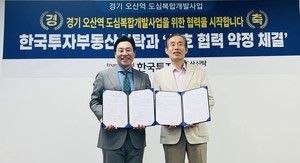
Deal supports systematic project management, stable financing Roughly 3,100 housing units planned in Osan-dong area Korea Investment Real Estate Trust said Friday that it signed a memorandum of understanding with the Osan Station Urban Redevelopment Project Committee on Wednesday to support the successful execution of the Osan Station urban redevelopment project underway in Osan, Gyeonggi Province. Under the agreement, the two sides will cooperate on comprehensive administrative support for advancing the project, feasibility studies and development planning, project management and financing review, and other matters needed to efficiently carry out the trust-based urban redevelopment project. The Osan Station urban redevelopment project is a large-scale mixed-use development planned for an area around 608-1 Osan-dong in Osan, involving roughly 3,100 housing units and a range of lifestyle facilities. The project aims to expand housing supply in the city center and improve aging residential conditions. Korea Investment Real Estate Trust provides trust services spanning the real estate sector, including land trusts, trust-based urban redevelopment projects and real estate investment trusts. In a trust-based urban redevelopment project, a cooperative or its members entrust land and other assets to Korea Investment Real Estate Trust, which then raises the funds needed to carry out the redevelopment before returning the completed project to the members. "The Osan Station urban redevelopment project is a meaningful undertaking that will improve housing conditions in the aging old town center and elevate the value of this transit-oriented location," said Park Min-gyu, head of division at Korea Investment Real Estate Trust. "Drawing on our expertise and experience in trust-based development, we will support systematic project management and a stable financing structure, and we will do our best to communicate closely with the committee to ensure the project's success."
Sept. 11, 2026
-
GnCenergy signs W46.9b generator supply deal
GnCenergy said Friday it signed a contract with LG Uplus to supply generators for Building 4 of the Paju center. The contract is worth 46.86 billion won ($35 million), equivalent to 17.84 percent of GnCenergy's 2025 sales. The contract runs through Sept. 30, 2028.
Sept. 11, 2026
-

Kospi sinks 2% as oil, bond yields surge; Samsung, SK hynix buybacks near limit
Chip giants drop over 3% as US markets slump Concern grows over supply-demand gap after buybacks end Oil tops $100, US bond yield hits 4.95% All three major New York indexes fell Thursday amid concerns over high oil prices and interest rates, and the Kospi followed suit Friday, dropping more than 2% in early trading and slipping below the 7,000 mark. Samsung Electronics and SK hynix, the two largest companies by market capitalization, both fell more than 3% in early trading. With individual, foreign and institutional investors all net sellers over the past month, the two companies' share buybacks had been the main force propping up the Kospi, but analysts say even that support may be reaching its limit. The Kospi stood at 6,867.77 as of 10 a.m. that day, down 2.36% from the previous close, according to the Korea Exchange. The index opened even lower, down 3.29% at 6,802.50, before trimming some of its losses. The Kospi opened lower after all three major US stock indexes fell overnight. The Dow Jones Industrial Average dropped 0.60%, while the S&P 500 and the NASDAQ Composite fell 0.58% and 0.65%, respectively. West Texas Intermediate crude futures jumped 6% to top $100 a barrel, following a similar rise in Brent crude, while the yield on the 10-year US Treasury note climbed past 4.95% — both weighing heavily on stock markets. Selling was concentrated in rate-sensitive technology shares. Nvidia and Micron Technology fell 2.26% and 4.90%, respectively, while Intel dropped nearly 6%. SK hynix's American depositary receipts fell 5.20%. Reflecting this pressure, shares of Samsung Electronics and SK hynix, the two leading chipmakers, were down 3.35% and 3.40%, respectively, as of 10 a.m. that day. Other large-cap stocks also declined, including Samsung Electronics preferred shares (down 5.07%), SK Square (down 4.67%), Samsung Electro-Mechanics (down 0.29%), LG Energy Solution (down 2.19%) and Hyundai Motor (down 2.31%). Buybacks by Samsung Electronics and SK hynix had helped cushion the Kospi's decline to some degree. Both companies announced buyback plans last month as part of efforts to expand shareholder returns and employee compensation, buoyed by rising cash reserves amid the memory chip boom. Such purchases are classified as net buying by "other corporations" in supply-demand statistics. That category posted net buying of 295.9 billion won ($221 million) that day. Individual investors were net buyers of 1.28 trillion won, while foreign and institutional investors were net sellers of 825 billion won and 754.4 billion won, respectively. Over the past month, "other corporations" were the only net buyers in the Kospi market. Individual investors net-sold 12.96 trillion won, foreign investors net-sold 10.36 trillion won and institutional investors net-sold 583.1 billion won, while "other corporations" net-bought 23.91 trillion won, effectively sustaining the market. The concern centers on around October, when the two companies' buyback programs are expected to end. Without a new buyer stepping in, the Kospi could face a vacuum in demand once the buybacks stop. The Kosdaq also declined. As of 10 a.m., the index stood at 822.37, down 1.74% from the previous close. It opened at 816.91, down 2.39%, before paring some losses. Large-cap Kosdaq stocks also fell, including Alteogen (down 3.07%), Ecopro (down 3.34%) and Ecopro BM (down 5.39%). "Amid growing macro uncertainty — including the US 10-year yield breaking above 4.9%, WTI crude re-entering the $100 range, weakness in US stocks, and caution ahead of the August US CPI reading — the Kospi is expected to open lower today, following a more than 3% drop in Kospi night futures," said Han Ji-young, a researcher at Kiwoom Securities. However, Han added, "It is worth noting that Oracle, which reported earnings after the US market closed, rose more than 6% in after-hours trading. Oracle's strong results are likely to help narrow the Kospi's losses during today's session in South Korea."
Sept. 11, 2026
-
KSD's integrated bond account tops $1.3b in cumulative trading after 2 years
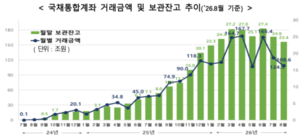
Custody balance reaches W27.4tr at end of first half KSD to build integrated bond investment information platform this year The Korea Securities Depository's integrated government bond account, linked to international central securities depositories, has recorded 1,740 trillion won ($1.3 trillion) in cumulative trading since its launch. The KSD said Friday that it held an industry meeting to mark the second anniversary of the account system's launch, sharing key operational achievements and future development plans for the integrated bond account. The integrated government bond account supports foreign investors' custody and settlement of Korean government bonds and monetary stabilization bonds through custody accounts that international central securities depositories open with the KSD. It was introduced in June 2024. Before the system was introduced, foreign investors seeking to trade Korean government bonds had to appoint a domestic custodian bank and open foreign currency and won-denominated accounts under their own names. Currency exchange and bond settlement payments could only be carried out through those accounts, a process that required navigating complex procedures such as the real-name financial transaction system and customer identification requirements. As of the end of the first half of this year, the custody balance in the integrated government bond account stood at 27.4 trillion won, while cumulative trading volume, both domestic and international, since the system's launch reached 1,740 trillion won. The KSD held an industry meeting Aug. 28 to mark the system's second anniversary, sharing its operational performance and regulatory improvement plans. About 60 working-level officials from 27 institutions attended, including the Ministry of Economy and Finance, the Bank of Korea, domestic investment dealers and custodian institutions. The KSD also outlined its future plans. It intends to build an integrated information platform for the government bond account within the year and to support the government's move to allow offshore securities lending transactions between foreign investors. "We will continue to do our best to improve foreign investors' access to Korea's government bond market and expand the use of the integrated bond account," a KSD official said.
Sept. 11, 2026
-
Experts call for consent decree system to speed up data breach relief
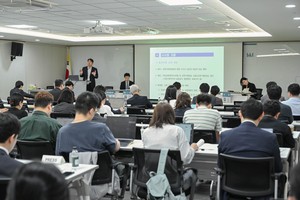
Bae, Kim & Lee, Personal Information Protection Law Association hold joint seminar 'Exploring a cooperative enforcement model under the Personal Information Protection Act' As large-scale personal data breaches continue to occur, critics say that punitive fines alone are not enough to genuinely help victims recover from the damage. This has fueled calls for South Korea to adopt a consent decree system that would allow for faster relief and more predictable law enforcement. Law firm Bae, Kim & Lee said Friday that it held a seminar with the Personal Information Protection Law Association, or PIPLA, to flesh out this discussion. The two organizations co-hosted the seminar on Thursday. It was titled "Exploring a Cooperative Enforcement Model Under the Personal Information Protection Act: Introducing a Consent Decree System for Effective Damage Relief and Reduced Regulatory Uncertainty." About 100 people from companies, government agencies and academia attended the seminar, held at the main conference room of the National Information Society Agency's Seoul office in Jung-gu. Their turnout underscored the high level of interest in introducing a consent decree system under the Personal Information Protection Act. At the opening ceremony, PIPLA Chairman Kim Do-seung delivered opening remarks. Cho Kyung-sik, an advisor at Bae, Kim & Lee and a former vice minister of the Ministry of Science and ICT, gave the welcoming address. Shin Young-soo, an advisor at PIPLA, also serves as dean of the Kyungpook National University School of Law and a commissioner at the Korea Fair Trade Commission. In the keynote speech, he spoke on "Beyond Sanctions to Recovery: The Possibilities and Challenges of a Paradigm Shift in Enforcing the Personal Information Protection Act." Drawing on his own experience operating the consent decree system in the fair trade sector, Shin said the current Personal Information Protection Act should be restructured into a cycle. He described this cycle as "detecting risk, halting the violation, restoring damage and improving the system." In the first presentation, Kim Geon-sik, an adjunct professor at Hallym International Graduate University, spoke on "Reviewing the Consent Decree System in the Fair Trade Sector and Its Implications." Kim said the system, introduced in 2011, has helped resolve cases quickly and restore consumer damages, but it also revealed structural limitations, including low utilization and poor implementation management. In response, Kim Jin-hoon, an attorney at Bae, Kim & Lee, led a discussion drawing on his practical experience in the fair trade field. He identified areas that would need to be addressed when introducing the system under the Personal Information Protection Act. In the second presentation, Kang Tae-uk, an attorney at Bae, Kim & Lee, spoke on "Key Issues and Challenges in Introducing a Consent Decree System Under the Personal Information Protection Act." Kang compared and analyzed the US Federal Trade Commission's consent orders and similar systems in the EU, Australia, Canada and Singapore. He also reviewed the current state of the consent decree system in South Korea's legal framework, along with the key contents of proposed amendments to the Personal Information Protection Act. Kang particularly emphasized that the consent decree system functions as a "cooperative enforcement framework" that strengthens the effectiveness of personal information protection. He cited expected benefits such as easing regulatory uncertainty in emerging technology and industry sectors and ensuring genuine compliance through enforcement fines. Hwang Eui-kwan, a research fellow at the Korea Consumer Agency, then continued the discussion on considerations for introducing the system. The subsequent panel discussion was moderated by PIPLA Chairman Kim Do-seung. Panelists included Lee Seung-min, a professor at Sungkyunkwan University School of Law, and Kim Jin-hwan, a commissioner at the Personal Information Protection Commission. Also on the panel were Kwon Se-hwa, a director at the Korea Internet Corporations Association, and Kang Dae-hyun, head of the Investigation Planning Division at the Personal Information Protection Commission. Im Chae-tae, head of the Personal Information Policy Bureau at the Korea Internet & Security Agency, also joined the discussion. They held an in-depth discussion on issues including the scope of application and exclusions for the consent decree system, implementation management and its relationship with criminal penalties. They also discussed victim participation procedures and the system's application to public institutions. "To strengthen the effectiveness of enforcing the Personal Information Protection Act, we need an enforcement framework that covers not just sanctions but also damage recovery and prevention of recurrence," said Park Ji-yeon, head of the TMT Group at Bae, Kim & Lee. "We will continue to actively participate in related legislative and policy discussions, and proactively support companies in responding to regulatory changes." Bae, Kim & Lee's TMT Group advises domestic and international companies on compliance and regulatory response across the information and communications technology sector, including AI, personal information, platform regulation and data governance. Founded in 1980 as South Korea's first law firm, Bae, Kim & Lee comprises about 900 professionals, including roughly 600 attorneys, along with foreign lawyers and certified public accountants. The firm operates specialized teams across areas such as corporate law, mergers and acquisitions, securities and finance, and fair trade, providing one-stop services. It launched its public interest committee in 2001 and has received honors including the first Korean Bar Association Pro Bono Award in the organization category and the 2014 National Human Rights Commission of Korea Human Rights Award.
Sept. 11, 2026
-

KB Asset Management proposes 'defense, income, growth' strategies ahead of Fed meeting
Rate uncertainty grows -- short-term bonds, US indexes to manage volatility From high dividends to AI and TDFs -- seven strategy funds proposed by investment goal KB Asset Management has proposed an investment strategy to manage volatility in interest rates and stock markets ahead of the US Federal Reserve's Federal Open Market Committee meeting in September. Rather than trying to predict short-term market direction, the firm said investors should assign different roles to different assets based on their goals. These include managing volatility, securing income and pursuing long-term growth. KB Asset Management said Friday that uncertainty in global financial markets has been rising. The rise is driven by US employment and inflation data, the direction of monetary policy, and variables such as international oil prices and geopolitical risks. With the direction of interest rates and stock markets difficult to predict, the firm said, investors increasingly need portfolios tailored to their goals and risk appetite. This is preferable to betting on the direction of a single asset. In response, KB Asset Management picked seven strategy funds built around three core approaches -- managing volatility, securing income and pursuing growth. Investors can choose among them depending on their objectives and risk tolerance. For investors seeking to manage volatility, the firm recommended the KB Naeil Dream Ultra-Short Bond Fund, KB US S&P 500 Index 40 and KB US Nasdaq 100 Index 40. The KB Naeil Dream Ultra-Short Bond Fund invests mainly in short-maturity domestic bonds and short-term financial products, lowering sensitivity to rate swings while allowing redemptions the next business day. The KB US S&P 500 Index 40 and the KB US Nasdaq 100 Index 40 are bond-mixed products. Each allocates 40 percent to a benchmark US stock index and 60 percent to short-term domestic bonds. This lets investors tap growth opportunities in the US stock market while keeping volatility lower than a 100 percent equity investment. For income through dividends, the firm highlighted the KB RISE US High Dividend ETF Moa Dream and the KB New High Dividend fund. Both aim to defend against downside risk and pursue stable returns even amid volatility, by generating income through dividends and investing in quality stocks. The KB RISE US High Dividend ETF Moa Dream diversifies across US high-dividend ETFs to pursue both dividend income and medium- to long-term capital gains. The KB New High Dividend fund centers on high-dividend stocks while also including companies that have cut dividends and growth-value stocks, seeking both dividend income and share-price appreciation. Finally, for investors seeking long-term growth, the firm proposed two asset-allocation products: the KB All Asset AI Solution EMP and the KB Dynamic Qualified Target Date Fund (TDF) 2040. The KB All Asset AI Solution EMP uses KB's AI deep-learning algorithm, called Anderson, to adjust asset weightings -- including stock, bond and raw-material ETFs -- amid market changes. The KB Dynamic Qualified TDF 2040 adjusts its allocation to risk assets according to a life-cycle glide path, making it suitable for investors building assets over the long term. "In a period when it is difficult to predict the direction of interest rates and stock markets, it is more important to clarify the role each asset plays within a portfolio than to guess which asset will rise," said Jang Soon-mo, head of KB Asset Management's product strategy division. In practice, US Treasury yields have recently risen sharply, stoking volatility concerns. The yield on the 10-year US Treasury note, a key global interest-rate gauge, rose 12 basis points to 4.964 percent on Thursday (local time), the highest level since October 2023. One basis point equals 0.01 percentage point. Back then, the yield's break above 5 percent was its first in 16 years, since July 2007, just before the global financial crisis. The 10-year yield had stood around 3.3 percent in April of that year before surging past the 5 percent mark within five months.
Sept. 11, 2026
-

Fund managers' Q2 profit hits W2.7tr amid bull market, but more post losses
Assets under management climb to W2,777tr, up 17.9% Fee income expands on higher share prices, ETF growth Loss ratio at private equity fund managers rises to 47.9% Asset management companies' net profit rose 83.4 percent quarter-on-quarter in the second quarter of this year. Growth in assets under management, driven by rising domestic share prices and an expanding exchange-traded fund market, boosted fee income and securities investment gains. However, the ratio of loss-making firms also rose, driven mainly by private equity fund managers. The Financial Supervisory Service released preliminary second-quarter business results Friday. Asset management companies posted a combined net profit for the period of 2.69 trillion won ($2.01 billion) in the second quarter, up 214.3 percent from a year earlier. Operating profit came to 2.42 trillion won, up 78.9 percent quarter-on-quarter. Fund-related fees, including management and performance fees, drove the earnings growth. Fee income totaled 2.61 trillion won in the second quarter, up 37.7 percent from the previous quarter. Of that, fund-related fees accounted for 2.03 trillion won and discretionary investment advisory fees came to 574.6 billion won. Securities investment gains from proprietary asset management and other activities came to 829.7 billion won, up 159.6 percent from the previous quarter. Assets under management also grew sharply. As of the end of June, asset management companies' assets under management stood at 2,777.5 trillion won, up 17.9 percent from the end of March. Fund net assets came to 1,730.9 trillion won, and discretionary investment assets totaled 1,046.6 trillion won. Public offering fund net assets, in particular, swelled to 897.4 trillion won on the back of the Kospi's rise and the expanding ETF market, up 27.2 percent from the previous quarter. ETF net assets grew 42.1 percent, from 360.7 trillion won at the end of March to 512.4 trillion won at the end of June. Private equity fund net assets rose 6.2 percent quarter-on-quarter to 833.5 trillion won. Under the Financial Investment Services and Capital Markets Act, public offering funds pool money from 50 or more unspecified investors, while private equity funds invest money raised from 49 or fewer investors in shares, bonds and other assets. While the industry's overall net profit increased, the proportion of loss-making firms also rose, driven mainly by private equity fund managers. Of the 513 companies in the industry, 293, or 57.1 percent, posted a profit. The ratio of loss-making firms rose to 42.9 percent from 37.6 percent in the previous quarter. Among the 77 public fund managers, the loss ratio fell 1.3 percentage points from the previous quarter to 14.3 percent. In contrast, the loss ratio among the 436 private equity fund managers climbed 6.4 percentage points to 47.9 percent. The Financial Supervisory Service said asset management companies posted strong quarterly earnings in the second quarter on the back of rising domestic share prices. However, it noted risk factors also emerged, including a concentration of investment funds in specific sectors and stocks, and excessive short-term trading and leveraged investment linked to ETFs. It added that uncertainty in financial markets remains due to rising interest rates at home and abroad and increased volatility in share prices and exchange rates. "We will closely monitor asset management companies with weak soundness and continue efforts to ease market volatility, including curbing leveraged and debt-funded investment, while continuing supervision and regulatory improvements so that the asset management industry can achieve sound growth by restoring investor trust and encouraging long-term investment," the Financial Supervisory Service said. Financial authorities implemented supplementary measures in July, including raising the minimum deposit for single-stock leveraged products to 30 million won. Additional measures, such as expanding minimum trading units, are planned going forward.
Sept. 11, 2026
-
'No business beats inflation': Wall Street falls for 4th day as oil tops $100
Dow sheds 0.60%, S&P 500 0.58%, NASDAQ 0.65% WTI surges 6.7% to $102 a barrel, rising for 8th straight session US 10-year Treasury yield tops 4.95% during trading, nearing 5% August PPI up 5.4%, reigniting energy-driven inflation fears Wall Street's three major indexes fell for a fourth consecutive session as global oil prices extended their rally past $100 a barrel and US Treasury yields surged. Concerns over supply disruptions from a prolonged war between the United States and Iran, combined with rising producer prices, reignited inflation fears. This revived expectations that the Federal Reserve could raise its benchmark interest rate. Selling pressure intensified, particularly in technology stocks sensitive to high interest rates. On Thursday (local time), the Dow Jones Industrial Average closed down 316.56 points, or 0.60 percent, from the previous day to 52,064.10. The S&P 500 fell 44.66 points, or 0.58 percent, to 7,591.70, and the tech-heavy NASDAQ Composite dropped 171.62 points, or 0.65 percent, to 26,081.72. Selling was concentrated in interest-rate-sensitive technology shares. Nvidia fell 2.26 percent and Micron Technology tumbled 4.90 percent, while Intel lost nearly 6 percent. The prolonged war between the US and Iran and fears over oil supply disruptions have kept investor sentiment under pressure amid the surge in crude prices. West Texas Intermediate crude futures for October delivery settled at $102.48 a barrel, up $6.43, or 6.69 percent, from the previous session. Brent crude for November delivery rose $6.42, or 6.34 percent, to $107.63 a barrel. Both benchmarks marked their highest levels since May 19. WTI extended its winning streak to eight straight sessions, its longest in three years. The surge in oil prices deepened inflation concerns, and a jump in US Treasury yields added further pressure on the stock market. The yield on the 10-year US Treasury note topped 4.95 percent during trading that day, its highest level since October 2023. Some in the market expect the 10-year yield to test the 5 percent threshold. The 30-year yield rose 7.5 basis points to close at 5.360 percent, its highest closing level since June 29, 2004. The two-year yield, which is sensitive to monetary policy, jumped 12.2 basis points to 4.548 percent — its largest increase since March and its highest level in more than two years. The US producer price index for August, released that morning, further stoked inflation worries. The US Department of Labor's Bureau of Labor Statistics reported that the PPI rose 0.4 percent from the previous month and 5.4 percent from a year earlier. The rise in energy prices was particularly pronounced, with diesel prices jumping 24.1 percent from the previous month. The data added further weight to expectations that the FOMC will raise its benchmark interest rate at next week's meeting. Concerns are also growing that the war between the US and Iran will not end soon. The Wall Street Journal reported that senior aides to President Donald Trump are internally considering the possibility that the conflict with Iran could continue until 2029. That would be the end of his presidential term.
Sept. 11, 2026
MOST READ
- 1Hyundai Motor unveils all-new Tucson with bigger body, smarter tech after 6-year wait
- 2Flat sneakers are back: Why Nike is reviving a 55-year-old running shoe
- 3Pope Leo XIV declines French honors and banquet, accepts only private meeting with Macron
- 428 illegal sports streaming sites found operating freely despite repeated blocks
- 5What was Rachmaninoff's performance fee? A 1928 price list tells all
- 6Samsung Biologics union's show of force backfires at the bargaining table
-
WORLD

US warns of punishment for anyone enabling Iran's Strait of Hormuz toll scheme
-
INDUSTRY
Toyota union puts productivity first; Hyundai Motor union demands bigger share of profits
-
FINANCE
National Growth Fund to invest $531M in FuriosaAI, which rebuffed Meta's $800M takeover bid
-
INDUSTRY
Korea Shipowners' Association holds amateur baduk tournament for Maritime Day