
- HOME
- STOCK
-

Kospi slides below 6,700 as KRX after-market trading launches Monday
Kospi falls more than 3% as foreigners sell; KRX after-market opens today with real-time trading from 4 to 8 p.m.; ETFs and ETNs excluded, price limit set at ±30% The Kospi tumbled more than 3 percent during trading Monday, retreating to the 6,600 range, as investor sentiment soured following the release of US August consumer price index data that fueled expectations of a benchmark interest rate hike at the September FOMC meeting. Concerns over calls to slow the pace of AI development added further pressure on the market. The index opened down 217.30 points, or 3.14 percent, at 6,692.61. Foreign investors and institutions posted net selling of 1.62 trillion won ($1.21 billion) and 451.5 billion won, respectively, dragging the index lower, while retail investors were the sole net buyers at 1.77 trillion won. The US August headline CPI rose 0.4 percent month-on-month and 3.4 percent year-on-year, in line with market expectations. However, core CPI — which strips out volatile food and energy prices — climbed 0.3 percent from the previous month, exceeding the consensus forecast of 0.2 percent. The stronger-than-expected core reading has reinforced expectations that the Federal Reserve will raise its benchmark interest rate at the September FOMC meeting. As of Friday, 16 of 20 global investment banks surveyed anticipated a September rate hike as the Fed's next policy move. The domestic market appears to have been pricing in that possibility throughout this week. Comments from major Big Tech CEOs over the weekend calling for a slowdown in AI development also weighed on investor sentiment. Anthropic CEO Dario Amodei warned on his blog Saturday (local time) about the potential for AI misuse and urged developers to slow the pace of model development to allow time for safety measures. SpaceX CEO Elon Musk echoed the sentiment, saying "he's right." Large-cap stocks fell broadly. Samsung Electronics dropped more than 3 percent, while SK hynix slid more than 5 percent. SK Square fell more than 6 percent, and Hyundai Motor was also down more than 3 percent. The Kosdaq was down 10.54 points, or 1.28 percent, at 810.10 at the same time. Starting Monday, Korea Exchange (KRX) launched an after-market session allowing real-time stock trading from 4 p.m. to 8 p.m. The number of tradable stocks will expand sharply, from roughly 600 to more than 2,000, with the aim of broadening investor trading opportunities and competing with global exchanges for liquidity. Previously, investors could trade after regular hours only through a single-price auction system operating in 10-minute intervals from 4 p.m. to 6 p.m. That system has now been abolished and replaced with a continuous order-matching session running from 4 p.m. to 8 p.m., in which trades are executed in real time on a first-come, first-served basis whenever matching buy and sell orders are entered. Eligible securities include Kospi- and Kosdaq-listed stocks and depositary receipts, excluding those listed on the Konex market. Stocks not traded during the regular session that day, as well as those under administrative designation, with extremely low liquidity, or flagged as investment caution or investment risk issues, are excluded. The number of tradable stocks will increase significantly. The current Nextrade (NXT) after-market handles only about 600 stocks, as NXT's daily average trading volume is capped at 15 percent of the total market under the Financial Investment Services and Capital Markets Act. Once the KRX after-market opens, investors will have access to more than 2,000 stocks. As of Friday, there were 943 Kospi-listed and 1,823 Kosdaq-listed stocks, for a combined total of 2,766. ETFs and exchange-traded notes (ETNs) have been excluded from the after-market, reflecting industry concerns that including them could amplify market volatility. KRX plans to assess market stability and liquidity before deciding whether to bring ETFs and ETNs into the after-market at a later stage. Order types are also restricted. Only limit orders with fixed prices — including standard limit orders, best-limit orders and most-favorable limit orders — are permitted. Market orders, midpoint orders and stop-limit orders, whose execution prices vary with market conditions, are prohibited to protect investors. The daily price limit is set at ±30 percent of the previous day's closing price — the same as the regular session. This is a significant widening compared with the old after-hours single-price auction, which applied a ±10 percent limit based on the day's closing price. To prevent sharp price swings, the same volatility interruption (VI) mechanism used in the regular session will apply. A dynamic VI is triggered when the expected execution price deviates by 3 percent or 6 percent or more from the immediately preceding price, pausing order acceptance for two minutes before resuming with a single-price auction. A static VI activates when the expected price deviates by 10 percent or more from the previous single-price execution; trading similarly resumes after a two-minute order-collection period. Short selling is permitted. The uptick rule — which prohibits short-sell orders at or below the immediately preceding price — and its exceptions apply in the same manner as in the regular session. The Nextrade after-market operates from 3:30 p.m. to 8 p.m. If an investor does not specify a trading venue, the brokerage will route the order to the most advantageous market based on execution probability and total transaction value under its smart order routing (SOR) policy. Settlement for after-market trades follows the same T+2 schedule as the regular session, meaning trades settle two business days after the transaction date. Investors should keep two key points in mind. Any unexecuted orders from the KRX regular session are automatically canceled at market close; investors must re-enter orders to trade in the after-market. NXT, by contrast, carries over unexecuted orders from the pre-market through the regular session and into the after-market. Investors should also be mindful of volatility stemming from thinner liquidity. After-market trading volumes are lower than during the regular session, which can lead to larger price swings or difficulty executing orders at desired prices. Investors are advised to check prices and the order book before placing trades.
Sept. 14, 2026
-
VC signs W1b share buyback trust with Yuanta Securities Korea
VC disclosed Monday that it signed a 1 billion won ($743,000) share buyback trust agreement with Yuanta Securities Korea to boost shareholder value and stabilize its share price. The contract runs through Sept. 13, 2027.
Sept. 14, 2026
-

Meritz Securities volunteer group wins top Seoul welfare award
Top prize in welfare donor category Volunteer group in operation since 2007 Meritz Securities announced Monday that it won the Seoul Metropolitan Government Welfare Award top prize at the 2026 Seoul Social Welfare Conference. The company's Chamsarang Volunteer Corps was selected as the top recipient in the welfare donor category in recognition of its sustained community service. The group was praised for providing holiday meals and daily necessities to vulnerable residents — including low-income elderly people and single-mother households — and for its ongoing emotional care activities. The Seoul Metropolitan Government Welfare Award is presented to individuals and organizations that have contributed to welfare improvement through fostering a culture of sharing and revitalizing local communities. Meritz Securities has operated the Chamsarang Volunteer Corps since August 2007 to channel employees' voluntary participation into community development. The corps carries out monthly themed volunteer activities — caring for infants of single mothers, running a secondhand goods shop, providing special holiday meals, and hosting birthday celebrations for elderly people living alone. On average, more than 30 employees and their family members take part each month. Last year, the group raised 820 million won ($609,000) in donations. The corps has partnered with Mapo Eastern Home-Visit Senior Welfare Center, a senior welfare facility, on community outreach since 2010. Each Lunar New Year and chuseok, it runs a special holiday meal program for low-income homebound elderly residents. From 2012 through 2026, the program has been held 30 times in total, delivering meals and wellness checks to a cumulative 3,900 elderly recipients. An official at Mapo Eastern Home-Visit Senior Welfare Center said Meritz Securities had supported the facility's ability to deliver stable services through long-term sponsorship and had worked to expand private welfare resources. "Because of its significant contributions to improving community welfare and supporting vulnerable groups, we recommended the company for commendation," the official said.
Sept. 14, 2026
-
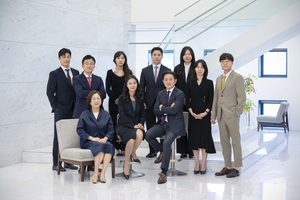
Sejong law firm launches task force to advise on electronic shareholder meetings
210 listed companies with assets of 2 trillion won or more Required to hold both in-person and electronic AGMs from 2027 Firm to host 'A to Z' seminar on electronic AGM preparation Law firm Sejong announced Monday that it is ramping up integrated advisory services for listed companies through its Electronic Shareholders' Meeting Task Force, ahead of the full rollout of the electronic shareholders' meeting regime next year. Under amendments to the Commercial Act passed last year, listed companies with total assets of 2 trillion won ($1.49 billion) or more will be required to hold both in-person and electronic shareholders' meetings starting in January 2027. Companies preparing for electronic meetings must address a wide range of legal and operational challenges in advance, including selecting and contracting with a management institution, establishing internal operating standards, issuing meeting notices, verifying shareholder identity and handling proxy attendance, setting rules for questions and statements from electronically attending shareholders, preparing for communication failures, and ensuring personal data protection. Sejong had already established its Corporate Governance Strategy Center and Corporate Governance Research Institute to advise and handle disputes for numerous listed companies on matters including shareholders' meetings, board operations and management control. From the moment the revised Commercial Act introducing electronic shareholders' meetings was promulgated, the firm activated its Electronic Shareholders' Meeting Task Force and has since published working papers to clarify key operational issues. Drawing on that accumulated expertise, the task force plans to provide timely legal services covering the entire process — from pre-meeting preparation and proceedings on the day of the meeting to post-meeting dispute resolution. Because the area involves corporate law issues intertwined with information and communications technology, personal data regulation and investor relations practice all at once, the firm intends to offer support through a single point of contact, from advance consultation through day-of operations to post-meeting dispute handling. The task force will assess each company's articles of incorporation, shareholder composition, existing electronic voting arrangements and potential dispute risks. It will then provide step-by-step support covering: board resolutions and meeting notices required to hold an electronic shareholders' meeting; review of entrustment contracts with management institutions; preparation of internal operating standards and proceedings scenarios; establishment of rules for questions, statements and voting rights exercise; communication failure and emergency response manuals; pre-meeting mock rehearsals; day-of operations and minutes preparation; and post-meeting dispute response. The task force is led by Managing Attorney Lee Dong-geon (29th class of the Judicial Research and Training Institute), a veteran in corporate governance and shareholder disputes with top-tier expertise and extensive experience in the field. He is joined by attorneys Lee Suk-mi (34th class), Oh Sae-ron (40th class), Choi Myeong (4th bar exam), Baek Seung-woo (8th bar exam) and Ahn Jeong-ho (38th class). Also participating is Ahn Hyo-seop, head of the Corporate Governance Research Institute, a practitioner who has handled investor relations and shareholder response work at leading Korean companies including Samsung and Hyundai Group. To mark the task force's launch, Sejong will host a hybrid online and offline seminar on Sept. 29 under the theme "A to Z for Successful Electronic Shareholders' Meeting Preparation." The seminar is designed to follow the actual workflow of practitioners preparing for electronic shareholders' meetings. Conducted in partnership with IR Kudos, an electronic shareholders' meeting management institution, the seminar will walk participants through what companies must decide and document at each stage: selecting a management institution and concluding an entrustment contract; establishing internal operating standards and issuing meeting notices and announcements; day-of operations; and post-meeting recordkeeping and disclosure. It will also take a close look at what screens are actually displayed in the management institution's system at each point in the process. Situations requiring company judgment — including attendance and identity verification, proxy electronic attendance, receipt and screening of questions and statements, voting rights exercise and tallying, vote allocation in cumulative voting, and communication failure response — will be demonstrated in detail using live operational screens. "An electronic shareholders' meeting goes beyond simply streaming a conventional shareholders' meeting online — it is a regime that must substantively protect the rights of electronically attending shareholders while also ensuring the legality of proceedings and resolutions and fairness toward shareholders attending in person," said Lee Dong-geon, managing attorney and head of the Corporate Governance Strategy Center. "Sejong will draw on its accumulated experience in shareholders' meetings and management control disputes, its proactive research, and its collaboration with management institutions and specialist practitioners to provide comprehensive solutions tailored to each company's circumstances." Meanwhile, Sejong posted record annual sales last year, with revenue rising 18 percent year on year to 436.3 billion won — the highest in the firm's history. The firm has nearly doubled in size in the five years since Managing Attorney Oh Jong-han took office in 2021. Annual sales were 267.1 billion won in 2021, 298.5 billion won in 2022, 319.5 billion won in 2023 and 369.8 billion won in 2024. Sejong has been strengthening its corporate governance advisory and response capabilities, having launched its Corporate Governance Strategy Center in July last year and its Corporate Governance Research Institute in February.
Sept. 14, 2026
-
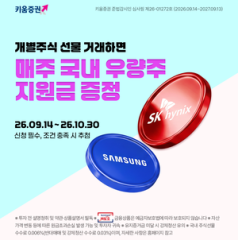
Kiwoom Securities runs stock futures event with Samsung Electronics, SK hynix share prizes
New customers can receive up to 20,000 won in Naver Pay benefits Kiwoom Securities is running a promotional event for domestic individual stock futures traders, offering share support grants for Samsung Electronics and SK hynix along with discounts of up to 90 percent on domestic futures and options commissions, as the brokerage looks to attract more derivatives investors. Kiwoom Securities announced Monday that it will hold weekly prize draws for domestic blue-chip share support grants targeting individual stock futures traders through Oct. 30, spanning seven weeks in total. Customers can receive one entry ticket simply by signing up for the event, meaning even those who have not traded individual stock futures can participate in the draws. The more a customer trades, the more draw entries they receive. For every 10 million won ($7,430) in domestic individual stock futures traded during the event period, one additional entry ticket is issued, and all tickets are automatically entered into the weekly draw. Winners receive share support grants for Samsung Electronics and SK hynix. For prizes exceeding 50,000 won, customers are responsible for a 22 percent tax and public levy. Separate benefits are available for new customers. Those trading individual stock futures for the first time will receive a 10,000 won Naver Pay gift certificate upon completing one contract, with an additional 10,000 won provided upon completing 10 contracts, for a maximum benefit of 20,000 won. Individual stock futures allow investors to respond to both rising and falling share prices. When a market decline is anticipated, traders can take a short position to hedge against the risk of falling prices on shares they already hold. Customers can also use their existing shares as substitute margin, reducing the need for separate cash collateral while enabling leveraged investment. However, if market volatility increases or prices move in the opposite direction from expectations, losses exceeding the principal can occur. Kiwoom Securities is also cutting trading costs for domestic futures and options. The brokerage will offer up to a 90 percent commission discount on domestic futures and options for new and dormant customers through Nov. 30. The discount applies for two months after registration, reducing the online commission rate for KOSPI 200 futures from 0.003 percent to 0.00025104 percent. The discount period can be extended based on trading volume. Customers who trade 60 billion won or more in futures or 1 billion won or more in options during the discount period can extend the discount by up to four months for non-face-to-face accounts, or up to two months for other account types.
Sept. 14, 2026
-
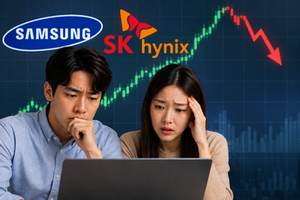
Samsung Electronics, SK hynix tumble as Astra rally fades ahead of FOMC
Kospi drops over 3%; semiconductor-related shares fall across the board Memory, storage stocks weaken on Wall Street as rate-hike fears mount Samsung Electronics and SK hynix, which surged last week on optimism over AI semiconductor demand, fell sharply in early trading Monday as profit-taking pressure mounted. Weakness in US memory and storage stocks, combined with growing caution ahead of this week's Federal Open Market Committee meeting, weighed on domestic chip shares. According to Korea Exchange, Samsung Electronics was trading down 7,250 won, or 2.79 percent, at 252,250 won ($187) as of 9:31 a.m. SK hynix tumbled 88,000 won, or 4.86 percent, to 1.724 million won. The Kospi fell 211.04 points, or 3.05 percent, to 6,698.87 at the same time. The so-called "S7" stocks — shares linked to Samsung Electronics and SK hynix through equity stakes or business ties — also fell across the board. SK Square dropped 6.34 percent, while Samsung Electro-Mechanics fell 4.43 percent, Samsung Life 4.23 percent, Samsung C&T 3.41 percent and Samsung Electronics preferred shares 3.26 percent. On Friday (local time), the Philadelphia Semiconductor Index rose 1.81 percent on the New York stock market, but memory and storage stocks bucked the broader rebound. Micron fell 0.22 percent, while SanDisk dropped 3.50 percent, Western Digital 2.98 percent and Seagate 3.73 percent. Despite the wider market's recovery, memory and storage names failed to participate in the rally. The recent sharp gains have also left investors more inclined to take profits. Samsung Electronics and SK hynix led the Kospi back above the 7,000-point threshold last week, driven by expectations of stronger demand for AI memory chips following the launch of OpenAI's next-generation AI model, Astra. The Kospi climbed to 7,051.64 on Wednesday, reclaiming the 7,000 level on a closing basis, but then fell for two consecutive sessions Thursday and Friday under pressure from rising interest rates and higher global oil prices. The September FOMC meeting scheduled for this week adds to the uncertainty. The US core consumer price index for August rose 0.3 percent from the previous month, exceeding the market consensus of 0.2 percent and reinforcing expectations of a rate hike. The yield on the 10-year US government bond approached 5 percent immediately after the CPI release. "The Kospi is expected to see volatility from the start of the week, influenced by last Friday's US August CPI result, the possibility of a rate hike at the September FOMC, the direction of the yen following the Bank of Japan meeting, changes in oil prices and shifts in foreign investor flows," said Han Ji-young, a researcher at Kiwoom Securities.
Sept. 14, 2026
-
Samsung Heavy Industries wins order for 4 LNG carriers worth W1.41 trillion
Samsung Heavy Industries disclosed Monday it has signed a contract with a shipowner in Oceania to build four liquefied natural gas carriers. The contract is valued at 1.41 trillion won ($1.05 billion), equivalent to 13.2 percent of the company's 2025 sales. The contract runs through Sept. 28, 2029.
Sept. 14, 2026
-
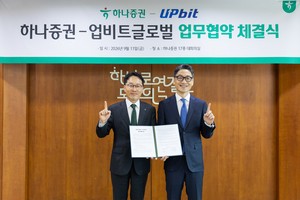
Hana Securities signs MOU with Upbit Global on digital asset finance
Digital asset management model development Product, service design and joint investment Hana Securities signed a memorandum of understanding with Upbit Global on Friday at its headquarters in Yeouido, Seoul, to cooperate on digital asset and financial businesses, the company announced Monday. Upbit Global is a Singapore-based holding company that oversees Upbit's overseas digital asset operations. Through the agreement, the two companies plan to combine their respective capabilities in finance, asset management, digital asset technology and global networks to identify new business opportunities. Key areas of cooperation include developing digital asset management business models, designing and launching digital asset-related products and services, building digital asset-related infrastructure and systems, and making joint investments in digital asset businesses. Hana Securities operates a Singapore-based asset management firm, Hana Asset Management Asia, while Upbit Global runs its overseas digital asset business out of Singapore. The two companies plan to leverage their respective local business foundations and networks to explore a range of cooperation opportunities centered on Singapore in a phased approach. Beyond the key cooperation areas, the two sides will continue to identify opportunities within the scope of their overseas networks and existing licenses. Kang Sung-mook, chief executive of Hana Securities, said the company is accelerating its digital asset business to build an early foundation for issuing and trading traditional financial products — such as shares, bonds and funds — in tokenized form. "We will continue to build related infrastructure, including an issuance platform, in step with the pace of STO systemization, and actively prepare for the full-scale launch of the STO market next year," he said. Kim Guk-hyun, chief executive of Upbit Global, said the agreement would serve as an opportunity to explore new areas of cooperation grounded in expertise in both traditional finance and digital assets. "We will draw on Upbit Global's technology and overseas business experience to identify practical avenues for collaboration and contribute to building a trustworthy digital asset financial ecosystem," he said. Hana Securities has also been pursuing a range of initiatives to improve customer convenience. Earlier this month, it officially launched Hana Securities V, a new MTS that enhances investment information services using AI and data technology.
Sept. 14, 2026
-
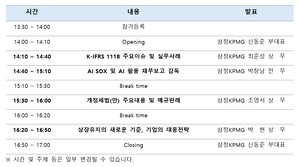
Samjong KPMG to hold financial strategy seminar for North and South Gyeongsang firms in October
Events set for Daegu and Busan on Oct. 1-2 Seminar to address fast-changing accounting, tax and digital landscape Samjong KPMG announced Monday it will hold the "2026 North and South Gyeongsang Regional Financial Strategy Seminar," offering companies practical guidance on navigating rapid changes in accounting, tax and the digital environment. The seminar is scheduled for Oct. 1 at the Daegu Trade Center and Oct. 2 at the Busan Chamber of Commerce and Industry. It was organized to help companies facing a fast-shifting business environment — including the introduction of K-IFRS 1118, revisions to tax law, the spread of generative AI and AI agents, and tightened listing maintenance requirements. Experts from Samjong KPMG across various fields will serve as speakers, presenting analysis of key issues and practice-oriented strategies. The opening presentation will be delivered by Samjong KPMG Managing Director Choi Jun-seong, who will address major issues arising from the adoption of K-IFRS 1118 and outline how companies can restructure their financial reporting frameworks, with a focus on changes to financial statement presentation and disclosure requirements under the new standard. Samjong KPMG Executive Director Park Chang-nam will then present on building an AI SOX and AI-assisted financial reporting oversight framework. His session will examine the risks that emerge when AI is applied to finance and accounting operations, and propose approaches to establishing internal controls and supervisory systems to ensure information reliability. Samjong KPMG Managing Director Jo Young-seo will share key highlights of the proposed 2026 tax law amendments and the latest rulings and case law trends, covering critical tax issues companies should consider in their management and investment decisions. Closing the program, Samjong KPMG Managing Director Park Hyeon will present on new listing maintenance standards and corporate response strategies, introducing a short- and long-term guide for companies navigating the tightened delisting criteria. "With accounting and tax changes and the spread of AI advancing simultaneously, companies must go beyond reacting to individual regulatory changes after the fact and conduct a comprehensive review of their financial reporting, tax, internal controls and systems as a whole," a Samjong KPMG official said. "We hope this seminar helps regional companies identify the key drivers of change in accounting, tax and digital areas and develop practical response strategies suited to their own business environments." Meanwhile, Samjong KPMG, which closes its books in March, posted operating revenue of 905.6 billion won ($673 million) for the fiscal year running April 2025 through March 2026, up about 3.4 percent from the previous year, crossing the 900 billion won threshold for the first time.
Sept. 14, 2026
-
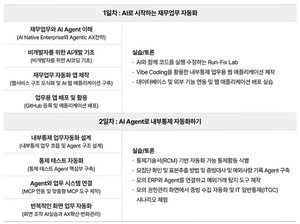
Samil PwC opens enrollment for 4th AI Finance Academy
Two-day program runs Oct. 6-7 Non-developer practitioners to learn hands-on AI automation from AX experts Samil PwC Academy announced Monday that it is accepting applications for the fourth cohort of its Samil AI Finance Academy, a program designed to strengthen AI utilization and work-automation skills among finance and accounting professionals. The two-day course, running Oct. 6-7, goes beyond basic AI usage to focus on helping practitioners build their own AI-powered automation tools. The curriculum is structured around step-by-step hands-on exercises so that finance and accounting staff with no development background can create automation tools with the help of AI. The first day covers AI agent concepts and AI coding fundamentals for non-developers, with the goal of automating finance tasks. A key feature is the introduction of "vibe coding," a method in which participants complete code through a conversational exchange with AI, enabling even those unfamiliar with programming to build and deploy their own finance automation web applications. The second day focuses on hands-on practice using AI agents to automate internal control tasks. Participants will design agent workflows tailored to their own processes and work through practical exercises step by step — running control tests, integrating with business systems, and handling repetitive screen-based tasks. Instruction will be led by specialists from AX Node, Samil PwC's dedicated AI transformation unit. Speakers include Vice Chairman Lee Seung-hwan, partners Lee Chang-hun, Jeong Su-jeong and Shin Min-seop, and Director Lee Gwon-il. "In finance and internal control, where accuracy and verification are paramount, it is important for the practitioners who know the work best to build AI agents themselves," said Kang Mi-ra, head of Samil PwC Academy. "This course is focused on equipping non-developers with practical AI transformation capabilities they can apply directly to their work." The program is fee-based, and all enrolled participants will receive access to a paid version of Claude for use during the exercises. Applications are open through Sept. 28 on the Samil PwC Academy official website. Meanwhile, Samil PwC — which closes its books in June — posted sales of 1.11 trillion won ($824 million) for the fiscal year ended June 2025, up about 8.4 percent from the prior year. Operating profit for the same period jumped 55.6 percent year on year to about 25.4 billion won.
Sept. 14, 2026
-

Hanwha Investment launches gold spot trading event with cash rewards
New account holders to receive 5,000 won in cash 20 don of pure gold to be given away through lottery Hanwha Investment announced Monday it will run a gold spot trading event through Nov. 30 to mark the launch of its mobile trading system (MTS) gold spot trading service. The event is open to individual customers trading gold spot products and offers three types of benefits depending on trading conditions and criteria. First, all customers who open a new gold spot account during the event period will receive a 5,000 won investment support payment. Minors, corporations and foreign nationals are excluded. Customers will also receive tiered cash rewards based on their cumulative net purchase amounts in gold spot trading, ranging from a minimum of 3,000 won to a maximum of 150,000 won ($112). A pure gold lottery has also been set up for gold spot trading customers. One lottery ticket is automatically issued for every 100 grams of gold spot traded, and a total of 20 don of pure gold will be awarded to 15 winners — five will receive 2 don each and 10 will receive 1 don each. Gold spot exchange trading on the Korea Exchange is not subject to comprehensive financial income taxation and is exempt from capital gains tax and dividend income tax. It also allows real-time trading in small units of 1 gram. The KRX gold market is a physical gold market established and operated by Korea Exchange with Financial Services Commission approval under the government's plan to bring gold trading into the formal economy. Investors trade directly through a brokerage's trading system after opening a securities account, much like trading shares. "We have prepared benefits for investors trading gold spot to mark the opening of our MTS gold spot service," said Im Ju-hyeok, executive director of Hanwha Investment's asset management division. "We will continue to do our best to support portfolio management using a diverse range of assets."
Sept. 14, 2026
-

Daishin Securities runs after-market trading event with weekly prizes
Weekly prizes include Musinsa, CU and Baemin gift vouchers; cumulative trades of 50 million won or more unlock a 500,000-won prize Daishin Securities announced Monday it will run a prize event for customers who trade domestic shares on the after-market. Customers who make at least one after-market trade from Monday through Oct. 8 will be entered into a draw. A total of 800 winners — 200 per week — will each receive prizes worth 50,000 won ($37). The prizes vary by week. From Monday through Friday, winners receive 50,000 won in Musinsa store credit; from Sept. 21 through Sept. 23, the prize is a 50,000-won CU convenience store gift card. From Sept. 28 through Oct. 2, winners receive a 50,000-won Baemin gift card, and from Oct. 6 through Oct. 8, the prize returns to 50,000 won in Musinsa store credit. Customers may enter multiple weeks. There is also a bonus prize tied to trading volume. Among customers whose cumulative after-market trades during the event period reach 50 million won or more, five will be selected by draw to receive 500,000 won in Musinsa store credit. Customers who have not made any after-market trades in the past six months but complete at least one trade during the event period will be eligible for a separate draw, with 5,000 winners each receiving a 3,000-won CU convenience store gift card. Advance registration is required to participate. "We designed the event so that customers can naturally experience after-market trading through fresh weekly incentives," said Cho Tae-won, head of the customer solutions division at Daishin Securities. "We hope customers will take advantage of the new trading hours to explore a wider range of investment opportunities." Korea Exchange launched the after-market on Monday, allowing investors to trade shares in real time from 4 p.m. to 8 p.m. The previous after-hours single-price auction session, which ran from 4 p.m. to 6 p.m. in 10-minute intervals, has been abolished.
Sept. 14, 2026
-
Obituary: Lee Dong-min, brother of Mirae Asset Global Investments director
Lee Dong-min, 48, died Sunday afternoon at Yeouido St. Mary's Funeral Home, Room 3. He is survived by his parents, Lee Seon-rae and Choi Yeong-hui, and his brother Lee Dong-hun, director of public relations at Mirae Asset Global Investments. The funeral procession departs Thursday at 7 a.m., with interment at Seoul Memorial Park. Tel. 02-3779-1526.
Sept. 14, 2026
-
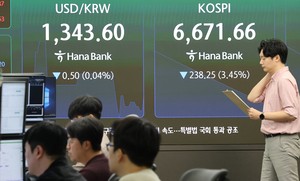
Kospi tumbles over 3% at open as Samsung Electronics and SK hynix lead decline
Samsung Electronics falls over 3%, SK hynix drops more than 4% Middle East crisis keeps pressure on Korean stocks The Kospi fell more than 3% at the open Monday, extending early-session weakness after news broke that a ministerial meeting among Iran, Iraq and Gulf states — aimed at addressing tensions over the Strait of Hormuz — had been postponed, adding to downward pressure on the market. According to Korea Exchange, the Kospi stood at 6,677.23 as of 9:02 a.m., down 232.68 points, or 3.37%, from the previous session. The index opened at 6,692.61, a drop of 217.30 points, or 3.14%. It has now fallen for three consecutive trading sessions since Thursday. The two semiconductor heavyweights also declined. As of 9:09 a.m., Samsung Electronics was trading at 251,000 won ($188), down 3.2% from the previous close, while SK hynix fell 4.6% to 1.727 million won. The Kosdaq was also lower at the same time, down 16.80 points, or 2.05%, at 803.84. The declines reflect the ongoing Middle East crisis, which has kept international oil prices and interest rates elevated. On Friday (local time), Brent crude futures for November delivery settled at $104.61 per barrel, down $3.02, or 2.81%, while West Texas Intermediate futures for October delivery closed at $100.05 per barrel, a drop of $2.43, or 2.37%. However, the foreign ministers' meeting among Iran, Iraq and Gulf states — which had underpinned the oil price decline and the rebound in US equity markets — was ultimately postponed. Iran had initially announced the meeting in a statement on Friday, saying the parties planned to "discuss and exchange views on the results of Iran-Oman negotiations regarding the designation of safe shipping lanes for commercial vessels passing through the Strait of Hormuz, along with other regional issues." Over the weekend, Bahrain announced it would not attend, citing Iran's attacks on Gulf infrastructure. Bloomberg and other international media reported that Saudi Arabia's participation was also uncertain due to Houthi attacks on the kingdom. Omani Foreign Minister Badr Albusaidi announced on X, formerly Twitter, late Sunday that "in order to reach a consensus, the regional meeting scheduled to be held in Salalah on Tuesday has been postponed." On the last trading day of the previous week, all three major US indexes rose together, rebounding after five sessions of losses. The Dow Jones Industrial Average gained 0.98%, the S&P 500 rose 0.86%, and the tech-heavy Nasdaq Composite climbed 0.96%. Sentiment indicators for the Korean market also rose across the board, but because those gains had been partly premised on stabilizing oil prices and interest rates, their positive effect on domestic stocks Monday is expected to be limited. The MSCI Korea ETF rose 3.25% and the MSCI Emerging Markets ETF gained 1.25%. The Philadelphia Semiconductor Index advanced 1.81%, and KOSPI 200 overnight futures rose 0.97%.
Sept. 14, 2026
-
Personnel: Shinhan Investment Securities
New department head Coverage Division 1: Heo Seong-hun
Sept. 14, 2026
-
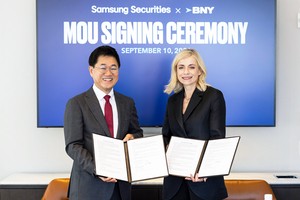
Samsung Securities partners with 240-year-old BNY to strengthen global financial infrastructure
Collaboration spans share brokerage, clearing, securities financing and collateral management Partnership to extend into AI and digital assets to boost global network competitiveness Samsung Securities has joined forces with BNY, a global financial group with more than 240 years of history, to strengthen its global financial infrastructure and expand into new business areas. Samsung Securities signed a comprehensive MOU with BNY at the company's headquarters in New York on Thursday morning (US Eastern time), establishing a framework for cooperation in global asset management and financial solutions. Under the agreement, the two companies will deepen collaboration across core traditional securities businesses — including share brokerage and clearing — as well as financial infrastructure areas such as securities collateral management and securities financing. They will also broaden the scope of their partnership into new business areas including AI and digital assets, with the aim of expanding their global networks and delivering new financial solutions to customers. Founded in 1784, BNY holds a leading position in financial infrastructure services including asset custody, clearing and collateral management in global financial markets. As of the end of June, its assets under custody and administration stood at $62.6 trillion, while assets under management reached $2.2 trillion. The firm is recognized as the No. 1 provider in both global custody and clearing and collateral management. BNY counts 94 percent of Fortune 100 companies, 96 percent of the world's top 100 investment managers and 96 percent of the world's top 100 banks by S&P rankings among its customers. "This MOU will serve as an opportunity to combine Samsung Securities' leadership in the Korean market with BNY's global capabilities," BNY Chief Client Officer Cathinka Wahlstrom said. "By bringing together the strengths of both companies across a wide range of areas, we look forward to collaborating to deliver innovative solutions that meet our clients' evolving needs." Samsung Securities President Park Jong-moon said the partnership with BNY — a firm that has helped set the standards of global financial markets — extends the company's reach from traditional financial infrastructure innovation into the realm of digital finance. "We will continue to offer domestic investors differentiated financial solutions that meet global standards," he said. Meanwhile, Park also met with major global partners including Morgan Stanley during his US trip to discuss expanding overseas investment information channels and introducing advanced financial services for domestic institutional and retail investors. Samsung Securities plans to continue strengthening its global platform competitiveness through strategic alliances with leading financial institutions worldwide.
Sept. 14, 2026
-
Kospi eyes rebound as Wall Street recovers, but 7,000 level hinges on foreign buying
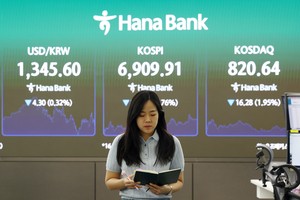
All three major US indexes rise KOSPI 200 night futures up 0.97% Foreigners net sold 2.1 trillion won last week Kiwoom Securities sees Kospi in 6,600–7,200 range this week The Kospi, which clawed back above 7,000 last week only to slip back into the 6,900 range, is expected to attempt a rebound Monday. US stocks ended a five-session losing streak and crude oil prices — which had surged past $100 a barrel — pulled back, easing pressure on the domestic market. Whether foreign investors resume net buying ahead of the Federal Reserve's FOMC meeting Wednesday (local time) is seen as the key factor in whether the Kospi can hold above 7,000. On Friday (local time), the Dow Jones Industrial Average rose 0.98 percent, the S&P 500 gained 0.86 percent and NASDAQ advanced 0.96 percent. The Philadelphia Semiconductor Index climbed 1.81 percent. The MSCI Korea ETF rose 3.25 percent, while KOSPI 200 night futures gained 0.97 percent. Falling oil prices lifted investor sentiment. News that Iran and Gulf states agreed to meet in Oman on Monday to discuss passage through the Strait of Hormuz sent Brent crude November futures down 2.81 percent to $104.61 a barrel, while West Texas Intermediate October futures fell 2.37 percent to $100.05 a barrel. "US stocks rose on expectations that Strait of Hormuz transit would resume, which weighed on oil prices, as well as optimism over expanded data center investment," said Han Ji-young, a researcher at Kiwoom Securities. The domestic market had recovered above 7,000 last week on strength in semiconductor stocks including Samsung Electronics and SK hynix, but gave back those gains in the latter half of the week as interest rates and oil prices climbed. According to Korea Exchange, the Kospi closed at 6,909.91 on Friday, up 3.33 percent for the week. The index had risen as high as 7,051.64 on Wednesday, reclaiming 7,000 on a closing basis, before falling for two consecutive sessions Thursday and Friday. Foreign investors net sold 2.13 trillion won ($1.59 billion) on the Kospi market last week, while retail investors offloaded 9.91 trillion won. Institutions, by contrast, net bought 3.59 trillion won, and other corporations net purchased 8.49 trillion won. The most important event this week is the September FOMC meeting Wednesday (local time). The US August consumer price index rose 3.4 percent year-on-year, in line with market expectations, but core CPI climbed 0.3 percent month-on-month, exceeding the forecast of 0.2 percent. According to CME FedWatch, the probability of a 0.25 percentage point rate hike at the September meeting stood at 86.3 percent as of Saturday. The yield on the 10-year US government bond briefly touched the 4.99 percent range immediately after the CPI release before retreating to the low-to-mid 4.9 percent range. Market attention is shifting to whether additional tightening will follow any rate increase. The researcher said the key question is "whether a September rate hike would be a one-off, pre-emptive move to head off a re-acceleration of inflation, or the start of a new tightening cycle." At the FOMC, the dot plot released alongside the rate decision and remarks by Federal Reserve Chair Kevin Warsh will also be closely watched. Lee Sang-jun, a researcher at NH Investment Securities, said the direction of the US 30-year yield in response to the dot plot and Chair Warsh's comments will matter more than the rate decision itself. He added that interest rate volatility could persist even after the FOMC, given that geopolitical risk in the Middle East has not subsided. Analysts say foreign buying must return for the Kospi to consolidate above 7,000. Han said "whether foreigners resume net buying as the market digests the September FOMC will be the condition for the Kospi to settle above 7,000." Kiwoom Securities set its projected Kospi range for this week at 6,600 to 7,200 points. The Bank of Japan's monetary policy meeting is also scheduled for Thursday and Friday. Markets expect the BOJ to raise its benchmark interest rate. The researcher said that if the BOJ signals a strong willingness to tighten further, a rise in the yen and Japanese government bond yields could reignite concerns about the unwinding of yen carry trades. Semiconductor stocks are also expected to see heightened volatility early in the week. While the Philadelphia Semiconductor Index rose 1.81 percent on Friday, memory and storage names fell — Micron lost 0.22 percent, SanDisk dropped 3.50 percent, Western Digital declined 2.98 percent and Seagate fell 3.73 percent. Reports over the weekend suggested some major AI companies may be slowing the pace of model development, though Kiwoom Securities said it was too early to interpret this as a sign of weakening AI investment. Han acknowledged that "a short-term expansion of volatility is unavoidable," but said investors should "prioritize a strategy of using this as an opportunity to increase equity exposure rather than raising cash holdings."
Sept. 14, 2026
-
'Family restructuring' rattles corporate Korea: the art of inheritance and divorce
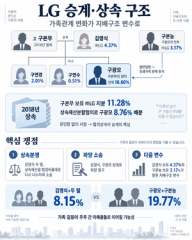
Inheritance is something most people face at least once in their lives, and long-marriage divorces are growing more common. Both carry major consequences for personal assets and household finances. Through landmark legal battles involving LG Group, SK Group and Smilegate, this column examines how family restructuring affects wealth — and why it can become a corporate governance issue for ordinary investors. The Wall Street Journal recently reported that Americans aged 55 and older hold assets worth $110 trillion — signaling that the largest wealth transfer in history is set to unfold over the coming decades. South Korea appears to be on a similar trajectory. According to Supreme Court data, the number of inheritance-division cases rose roughly 4.7-fold, from 771 in 2014 to 3,612 in 2025. South Korea recorded 88,000 divorces in 2025, down 3.3 percent from the previous year. Yet divorces in which both spouses were 60 or older numbered 13,743, accounting for 15.6 percent of the total. Particularly notable: divorces after 30 or more years of marriage made up 17.7 percent of all cases — the single largest group. As couples who have spent longer accumulating assets account for a growing share of divorces, the scale of property division is likely to grow as well. When a family is restructured, the effects ripple through to assets. At the corporate level, those effects can reach ordinary investors. What happens inside another family can become an event that moves your own portfolio. Several high-profile lawsuits involving business families have recently drawn public attention: the divorce and property-division case between SK Group Chairman Chey Tae-won and Noh So-young, director of Art Center Nabi, widely dubbed the divorce of the century; an inheritance dispute and adoption-dissolution suit within the family of LG Group Chairman Koo Kwang-mo; and the divorce and property-division case between Smilegate founder Kwon Hyuk-bin and Lee Hwa-jin. Wills are where inheritance begins — and inheritance-division agreements must be airtight LG Group has practiced eldest-son succession since its founding, with family decisions channeling controlling stakes to the designated heir. Under current law, however, being named an heir does not automatically entitle a person to all — or even a larger share — of an estate. A will can concentrate shares in the heir's hands, but it cannot fully extinguish the rights of other heirs: spouses and children hold a statutory right to claim their reserved portion, known as the "yuilbun." Corporate succession therefore requires more than a will. It demands coordination with other heirs, lifetime restructuring of shareholdings, and advance preparation of the financial resources needed to fund the transfer. This is why so many companies invest heavily in building a succession framework well before it is needed — and why the LG Group case offers instructive lessons. The succession picture at LG Group came into focus in 2004, when Koo Kwang-mo was adopted by then-Chairman Koo Bon-moo. Yet no shares changed hands at that point. Koo Bon-moo died in 2018 without leaving a legally valid will. The surviving immediate family members then reached an inheritance-division agreement, allocating 8.76 percent of the 11.28 percent stake in LG Corp. that Koo Bon-moo had held to Koo Kwang-mo. An inheritance-division agreement is a powerful instrument: when all co-heirs consent, assets can be distributed in proportions that differ from the statutory default — including concentrating a company's shares in a single heir. The catch is that such an agreement cannot be legally locked in before the inheritance opens. This is precisely why it matters to set out a basic framework in a will and to align family members thoroughly while still alive. In 2023, however, Koo Bon-moo's wife, Kim Young-sik, and their two daughters filed a suit to recover their inheritance, arguing that the division agreement had been flawed and seeking to redistribute the estate according to statutory ratios. A court of first instance ruled in Koo Kwang-mo's favor in February, finding that the agreement had been validly executed and that no fraud had occurred. The three women appealed. The final outcome remains to be seen, but the rift within the family already appears severe. Suits to strip inheritance rights or dissolve adoption can block reserved-portion claims In 2024, Kim filed a suit to dissolve her adoptive relationship with Koo Kwang-mo. Even if the dissolution were granted, it would not affect the already-established father-son relationship between Koo Bon-moo and Koo Kwang-mo. The real issue is Kim's 4.37 percent stake in LG Corp. As long as the legal mother-son relationship remains intact, Koo Kwang-mo stands as an heir to Kim's estate. Even if Kim were to leave a will bequeathing her shares solely to her two biological daughters, Koo Kwang-mo could still invoke his reserved-portion right and claim the monetary value of his statutory share. A will can set the direction of an inheritance, but it cannot erase an heir's rights entirely. Under current law, the primary mechanism for stripping inheritance rights is the inheritance-right forfeiture system. For adoptees, dissolution of adoption is another avenue. The two are distinct legal instruments, but the grounds required — such as a serious breach of the duty of support or grossly unjust treatment — overlap considerably. Inheritance-right forfeiture can also be pursued through a notarized will in which the deceased expresses the intent to disinherit, with the executor petitioning the court after death; but in either case, a court ruling is required. Even when a relationship has broken down in practice, ending it in law is a separate matter. From Koo Kwang-mo's perspective, avoiding dissolution of the adoption is essential to preserving his status as an heir to Kim's estate. Could the inheritance dispute shake LG Corp.'s ownership structure? Although Koo Kwang-mo was adopted by Koo Bon-moo, his legal relationship with his biological father, Koo Bon-neung — chairman of Heesung Group — remains intact. General adoption in Korea does not sever ties with the birth family. Koo Kwang-mo therefore retains inheritance rights over Koo Bon-neung's estate as well. Koo Bon-neung has a remarried spouse and a daughter from that marriage. While other assets — including Heesung Group shares — could pass to the spouse or daughter, LG Group's tradition of eldest-son succession suggests that the 3.17 percent stake in LG Corp. directly tied to group control is likely to go to Koo Kwang-mo, who is already the group's chairman. Kim and her two daughters together hold 8.15 percent of LG Corp. — well short of the 19.77 percent held by Koo Kwang-mo and Koo Bon-neung. Barring losses in both lawsuits, a decisive blow to Koo Kwang-mo's control appears unlikely. That said, if Kim and her daughters were to dissolve their current status as a jointly acting group of specially related persons and exercise their voting rights independently, the controlling shareholder's combined stake could fall to around 35 percent. Long marriages, long contributions: higher property-division ratios for homemaking and child-rearing The property-division case involving Smilegate founder Kwon Hyuk-bin is easier to understand when compared with the SK Group case. Looking at recent court rulings, when a spouse's contributions through homemaking and child-rearing over a long marriage are broadly recognized, there is a considerable likelihood that a division ratio exceeding one-third will be awarded. In the Chey Tae-won and Noh So-young case, the division ratio was set at roughly 67 percent to 33 percent — a figure reached even though Noh's direct contribution to business management was not recognized. The first-instance ruling in the Kwon Hyuk-bin and Lee Hwa-jin case came in at 65 percent to 35 percent. Lee's role in the company's early days and her contributions through homemaking and child-rearing were acknowledged, yet the 35 percent figure stands out. A divorce trial is also currently under way in New Jersey involving John Overdeck, co-founder of hedge fund Two Sigma, and his wife Laura. Overdeck proposed a settlement of $723 million, but Laura's side has argued that his stake in Two Sigma is worth approximately $6.2 billion and is seeking 35 percent of that — about $2.17 billion. The couple married in 2002 and have three children; Laura is a full-time homemaker. No less important than the division ratio is the question of when a share's value is assessed. In contested divorce proceedings, the standard reference point is in principle the state and value of assets at the close of oral arguments before the fact-finding court. In the retrial of the Chey Tae-won and Noh So-young case, SK Group's share price rose sharply afterward, but the value of SK shares was calculated based on the closing date of oral arguments in the appellate court in April 2024. For unlisted companies with no market price, enterprise value is assessed using financial statements, valuation methods under the Inheritance and Gift Tax Act, and discounted cash flow analysis, among other approaches. The company's earnings and financial position in the relevant year are therefore critical. When a divorce suit is filed — and when it concludes — can make a substantial difference to the outcome. Cash settlement beats receiving physical assets for the receiving spouse Yet there is an issue even more consequential than the ratio or the valuation date: the form of the property division itself. In the Chey Tae-won and Noh So-young case, a cash settlement was chosen. Noh's side requested cash, and the court — taking into account that the SK shares were the basis of management control — ordered a cash settlement. In the Kwon Hyuk-bin and Lee Hwa-jin first-instance ruling, by contrast, the court ordered the actual Smilegate shares to be divided. The fact that Smilegate is an unlisted company is also a significant distinction. For the receiving spouse, a cash settlement is generally the cleaner outcome. A properly executed divorce property division is in principle exempt from gift tax and capital gains tax. Receiving cash means there is no need to liquidate the asset afterward. For the spouse who must pay, however, the costs can be substantial. For Chey Tae-won to pay Noh 944 billion won ($705 million), he would need to raise cash by selling shares or through dividends. Any taxes arising in that process fall on Chey. To generate 944 billion won after tax through dividends alone — applying the top marginal rate on general financial income as a rough estimate — would require pre-tax dividend income of close to 1.9 trillion won. Selling shares would attract tax only on the capital gain rather than the full proceeds, and at a lower rate, but the tax burden would still be considerable. In short, a cash settlement is the cleanest outcome for the recipient but can be the most expensive for the payer. Receiving shares in kind, on the other hand, avoids a large immediate tax bill — but it also means inheriting the latent tax embedded in those shares. When an asset received through property division is later disposed of, the capital gain is in principle calculated using the original acquisition price paid by the transferring spouse. If Lee were to receive Smilegate shares and later sell them, the tax calculation would start from the price at which Kwon originally acquired those shares. If those shares were acquired at a low price at the time of founding, the enormous accumulated unrealized gain would come along with them. Unlisted shares also cannot easily be sold on the open market. Shares may be worth taking if they carry management control The calculus changes, however, if receiving shares means gaining management control as well. What Lee sought at the first-instance level was a 50 percent stake in Smilegate, arguing that she should be recognized as a co-founder. When the court chose an in-kind share division rather than a cash settlement, the economic significance of that 50 percent figure grew considerably. Even a 35 percent stake is powerful enough to block special resolutions — such as amendments to the articles of incorporation or mergers. At 50 percent, however, neither party could independently control the company, creating effective joint control or deadlock. The negotiating leverage when selling to a third party would also be far greater than with a 35 percent minority stake, and there would be room to discuss a control premium. Ultimately, restructuring a family means restructuring its assets — all the more so when that family owns a business. Ownership structure, management control, and the asset value of ordinary shareholders all become variables in play. In inheritance, the key questions are who receives which assets and how. In divorce, they are how jointly built wealth is valued, when that valuation is set, and what form the division takes. Through this process, a family relationship may end — but a shareholder relationship may be just beginning.
Sept. 14, 2026
-
Gold could top $5,000 by year-end under these scenarios
Samsung Futures sets base year-end gold price forecast at $4,550 Fed hold in September could push gold above $4,700 US-Iran truce and Strait of Hormuz normalization may test $5,000 Gold prices could climb above $4,700 or even test the $5,000 mark by year-end if the Federal Reserve holds interest rates despite inflation pressure or if a US-Iran truce normalizes traffic through the Strait of Hormuz, according to a new forecast. Samsung Futures said in a report titled "Recent Gold Price Trends and Outlook" that it expects gold to trade in a range of $4,100 to $4,750 through year-end, with a closing price of around $4,550. The brokerage left open the possibility of a significant departure from that base case depending on Fed policy decisions and the trajectory of global oil prices. Samsung Futures said gold could surpass $4,700 if the Fed opts to hold rates in September despite ongoing inflation pressure. Markets are currently pricing in a 72.5 percent probability of a 0.25 percentage point rate hike at the September FOMC meeting, with a 27.6 percent chance of a hold, the report noted. August nonfarm payrolls came in at 162,000, well above market expectations, and the producer price index rose 5.4 percent year-on-year, making it difficult to dismiss inflationary pressures. Samsung Futures said the political burden of midterm elections in November makes it hard to predict the rate path with certainty. If the Fed were to hold rates in that environment, markets would likely read the move as a signal beyond simple monetary easing — raising concerns that the central bank is prioritizing other objectives over taming inflation and undermining confidence in its commitment to price stability. In that scenario, an unusual dynamic could emerge in which US government bond yields rise alongside gold prices. Investors worried that inflation will not be brought under control may sell long-term bonds, pushing yields higher, while simultaneously buying gold to hedge against prolonged inflation and a weakening dollar. Samsung Futures identified "bond market instability stemming from a loss of confidence in dollar assets and the Fed" as one of two key forces that will drive gold prices for the rest of the year. Such instability could boost demand for gold as an alternative to dollars and Treasuries, the brokerage said. The scenario in which gold tests $5,000 hinges on a US-Iran truce and the effective reopening of the Strait of Hormuz. Geopolitical tensions and conflict are typically seen as factors that lift gold prices as a safe-haven asset. This year's Middle East conflict, however, has produced the opposite dynamic. What matters more for gold than the war itself is how the conflict moves oil prices, inflation and interest rates. When oil prices surge, energy-driven inflation pressure intensifies and expectations grow that the Fed will keep rates higher for longer or raise them further — reducing the investment appeal of gold, which pays no interest. In practice, as reduced traffic through the Strait of Hormuz was compounded by concerns over crude export disruptions via the Red Sea, Brent crude and West Texas Intermediate both topped $100 a barrel — and gold and silver prices actually fell. Samsung Futures said "the pattern of Middle Eastern conflict dragging gold lower has been repeating itself." If the current Middle East stalemate persists, oil is unlikely to fall below $90 a barrel, and gold could face renewed pressure each time oil rises, through the channel of inflation and tightening fears, Samsung Futures said. Conversely, a US-Iran ceasefire and a genuine reopening of the Strait of Hormuz could bring oil back to the $70s. While easing geopolitical tensions would normally weaken safe-haven demand for gold, Samsung Futures argued that in the current environment — where oil prices, inflation and the interest rate path are the dominant drivers of gold — the disinflationary effect of lower oil and the retreat of rate-hike fears would carry more weight. Lower oil prices would ease inflation pressure and reduce the need for further Fed tightening. As expectations for additional rate hikes fade, the opportunity cost of holding non-yielding gold also declines. Samsung Futures said the "lower oil → easing inflation → retreat of tightening fears" channel would have a greater impact on gold than the "war easing → reduced safe-haven demand" channel. Central bank buying is also providing a floor for gold prices. According to the World Gold Council, global central banks bought a net 288.9 tonnes of gold in the second quarter of this year, up 62 percent from a year earlier and the largest second-quarter total on record. Central banks were buying gold at record volumes even as the metal posted its biggest quarterly decline since 2013. China's purchases have been particularly notable. The People's Bank of China added 640,000 troy ounces, or about 20 tonnes, to its gold reserves in July and followed that with another 650,000 troy ounces in August, extending its buying streak to 22 consecutive months. Monthly purchases have been growing — from 160,000 troy ounces in March to 480,000 in June and higher still in recent months. Although Russia has been selling gold and foreign currency to cover fiscal shortfalls, demand from China and other emerging economies has more than offset those sales. "If the Fed ignores inflation pressure and chooses to hold in September, it could be interpreted as a signal that it has in effect deprioritized its inflation-control mandate," said Ok Ji-hoe, a researcher at Samsung Futures. "In that case, US Treasury yields could spike on concerns about damaged Fed credibility, and gold prices would likely rise above $4,700." She added that "if a US-Iran truce leads to a genuine normalization of the Strait of Hormuz, oil prices could return to the $70s and gold could test $5,000 or above."
Sept. 13, 2026
-

Over 70% of investors lose money following finfluencer tips on SNS: report
Hana Financial Research Institute releases report on finfluencer regulation Finfluencers proliferate amid stock market boom Financial Supervisory Service flags 5,511 suspected illegal videos Report calls for legal definition of finfluencers as prerequisite for oversight "Buy XX Power stock now. It's guaranteed to shoot up next week!" "Check the link in the video comments if you want exclusive information." As the Kospi more than doubled in just one year, the influence of "finfluencers" — individuals who produce financial and investment content through YouTube and other SNS platforms — has grown steadily. Illegal finfluencers have multiplied rapidly, sharing investment tips through unlicensed advisory channels and impersonating celebrities, prompting the government to urge investors to exercise caution. Experts say regulators must close the blind spots in the quasi-investment advisory framework that leave finfluencers largely unregulated, while also introducing indirect oversight through licensed financial institutions. According to financial industry sources, the Hana Financial Research Institute, a research arm of Hana Bank, published a report titled "Finfluencers: Balancing Freedom and Responsibility" on Friday. "In international usage, a finfluencer refers to an individual who shares investment content — including financial education and stock recommendations — through SNS, with the vast majority operating independently without any organizational affiliation," said researcher Noh Hye-ryeon. "As retail investing has gone mainstream, demand for information channels among young, small-scale investors has surged, giving rise to a culture of learning about finance through SNS, where freedom of expression and accessibility are guaranteed." Finfluencer influence grows since COVID-19, and so do follower losses The rise of digital platforms such as YouTube has lowered the barriers to content creation, fueling a rapid increase in one-person media channels that publish financial content without professional qualifications. According to the Financial Supervisory Service, the number of registered quasi-investment advisory firms rose from 132 in 2018 to 1,724 in 2024. The influx of investors in their 20s and 30s is widely cited as a key driver of finfluencers' growing reach. During the COVID-19 pandemic, a wave of new investors — many of them young people with little investment knowledge or experience — entered the market during the rebound that followed the sharp stock market decline. "Drawing on the openness and accessibility of SNS, a new culture has taken hold, particularly among the MZ generation, of consuming financial information through finfluencers rather than traditional professional media," Noh said. "In an intensely competitive environment, market forces have pushed finfluencers to make financial content more entertaining in order to survive." The problem is that as finfluencers' influence has grown, so have the financial losses and harm suffered by their followers. A 2024 survey by Capital One found that 74 percent of people who made investments based on SNS advice suffered losses, including financial damage and drops in credit scores. "While freedom of expression has no inherent limits, a lax accountability structure that allows information to spread indiscriminately without professional verification is expanding follower losses and harm — separate from outright fraud," Noh said. International bodies have begun regulating unregistered or unqualified finfluencers. The International Organization of Securities Commissions identified six key risks posed by finfluencers last year: unregistered or unqualified advice, fraud and market manipulation, unsuitable product recommendations, misleading content, undisclosed conflicts of interest, and the misuse of celebrity endorsements. The United States, the United Kingdom, France and other countries are building regulatory frameworks to bring finfluencers under oversight. FSS refers 33 channels for investigation; impersonation of prominent finfluencers also detected In South Korea, however, a formal regulatory definition of finfluencers has yet to be established. The Financial Services Commission introduced a conceptual definition for the first time in March, but Noh said a normative definition remains absent. Evidence of illegal activity by finfluencers has also been mounting. According to data submitted to the office of People Power Party lawmaker Park Sung-hoon of the National Assembly's Political Affairs Committee by the Financial Supervisory Service, the FSS reviewed 369 stock and economics finfluencer channels between April 13 and Aug. 21 this year and found signs of illegal activity in 151 of them, spanning 5,511 videos. The FSS referred a total of 33 channels for criminal investigation and requested that authorities block 47 videos. Among the most common violations was the creation of fake channels impersonating well-known finfluencers. Some operators presented schemes as investment projects involving financial institutions, built websites impersonating those institutions, collected investment funds and then disappeared. Authorities also uncovered cases in which operators purchased channels with large subscriber bases, converted them into stock-related channels and lured subscribers into unlicensed investment advisory groups. Experts call for legal definition of finfluencers and indirect regulation through financial firms Noh identified the legal codification of finfluencers as the top priority for financial regulators. Under current quasi-investment advisory rules, finfluencers who receive fixed compensation can be subject to legal oversight, but most finfluencer activities — including education, advertising, sponsorships and platform revenue — fall outside the regulatory scope. Because there is no concept of "registration" for finfluencers to begin with, oversight is entirely reactive, with no mechanism for preemptive action. "There is still no normative definition of finfluencers, which makes it unclear who should be subject to strict monitoring, and limits the ability to comprehensively manage the wide range of risks they pose," Noh said. The need for indirect regulation through financial institutions has also been raised. In the United States in 2024, a brokerage firm was fined $850,000 after regulators held it responsible for posts made by finfluencers it had paid. "Some countries hold financial institutions accountable for content produced in partnership with finfluencers, and domestic financial firms need to prepare for the introduction of similar regulations," Noh said.
Sept. 13, 2026
MOST READ
- 1Hyundai Motor unveils all-new Tucson with bigger body, smarter tech after 6-year wait
- 2Flat sneakers are back: Why Nike is reviving a 55-year-old running shoe
- 3Pope Leo XIV declines French honors and banquet, accepts only private meeting with Macron
- 428 illegal sports streaming sites found operating freely despite repeated blocks
- 5What was Rachmaninoff's performance fee? A 1928 price list tells all
- 6Samsung Biologics union's show of force backfires at the bargaining table
-
WORLD
US warns of punishment for anyone enabling Iran's Strait of Hormuz toll scheme
-
INDUSTRY
Toyota union puts productivity first; Hyundai Motor union demands bigger share of profits
-
FINANCE
National Growth Fund to invest $531M in FuriosaAI, which rebuffed Meta's $800M takeover bid
-
INDUSTRY
Korea Shipowners' Association holds amateur baduk tournament for Maritime Day