
- HOME
- STOCK
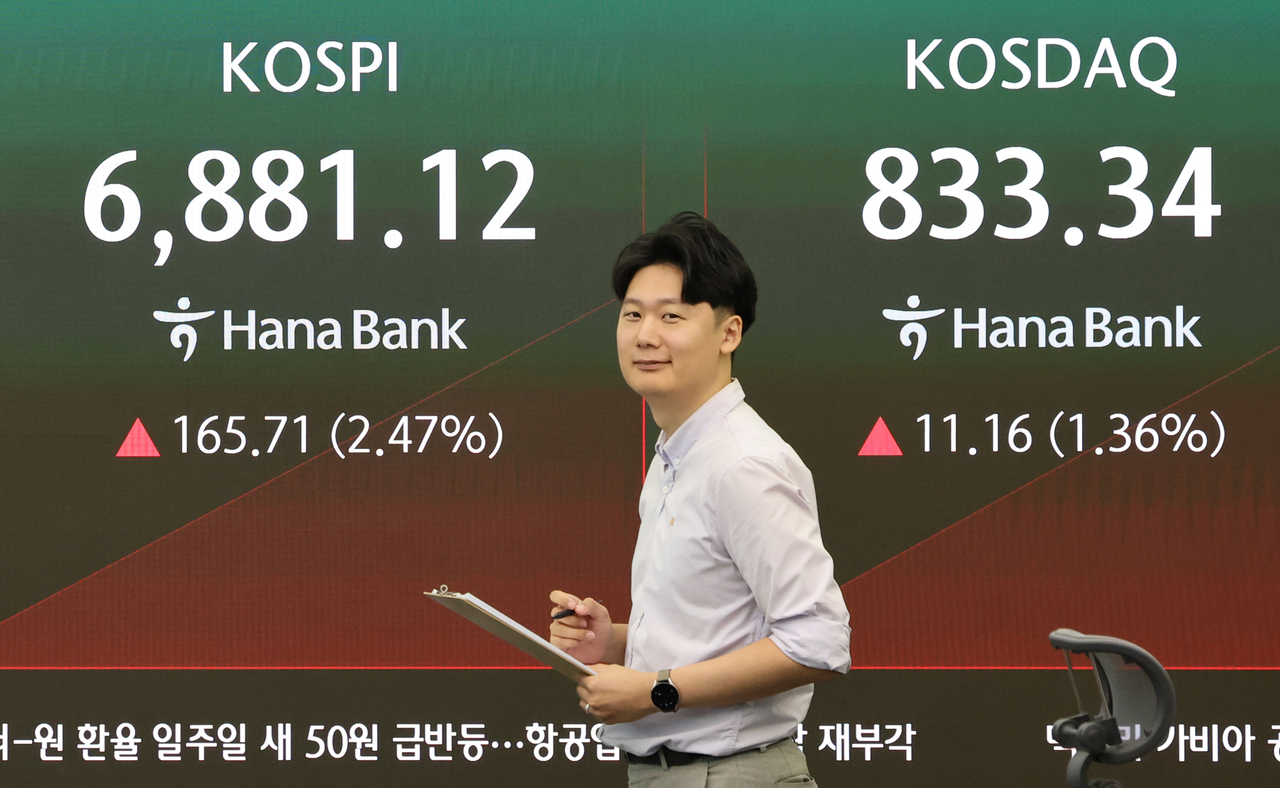
Kospi eyes chuseok rally as US-China summit, oil prices and interest rates come into focus
Oil tops $100, US 10-year yield breaches 5% before easing; Kospi rebounds late in week US-China summit on Thursday in focus; NH Investment & Securities sees Kospi range of 6,400–7,500 The Kospi, rattled this week by rising crude oil prices, climbing US long-term interest rates and calls for a slowdown in AI development, rebounded late in the week — and markets are now watching whether that momentum can carry through the chuseok holiday. Attention is turning to the US-China summit scheduled for Thursday and to supply-demand dynamics ahead of the long holiday break. According to Korea Exchange, the Kospi closed Friday at 6,894.23, up 178.82 points, or 2.66 percent, from the previous session. For the week of Sept. 14–18, the Kospi fell 0.23 percent while Kosdaq surged 6.27 percent. Domestic equities came under pressure early in the week as rising international oil prices, higher US long-term yields and debate over slowing the pace of AI development converged. The yield on the US 10-year Treasury note briefly topped 5 percent during trading, and crude oil surpassed $100 per barrel. Those pressures, compounded by comments from global AI company CEOs about moderating development timelines, dampened investor sentiment, particularly among chipmakers. The mood shifted in the latter half of the week. After the Federal Open Market Committee announcement, US long-term yields retreated and oil prices stabilized, allowing the Kospi to rebound Friday, led by Samsung Electronics and SK hynix. Analysts said the conclusion of major central bank policy events had helped the market clear one hurdle of macroeconomic uncertainty. Lee Jae-won, a researcher at Yuanta Securities Korea, said the AI slowdown debate originated from safety concerns but that the likelihood of it translating into broad investment cuts across the industry remained limited. "Since no one can control competitors' development and investment, it is difficult to conclude that the recent semiconductor correction signals a reduction in AI investment until actual order declines are confirmed," he said. Markets are also watching whether US long-term yields, which fell after the FOMC announcement, can hold their lower levels. The Federal Reserve raised its benchmark interest rate by 25 basis points at its September meeting, setting the target range at 3.75–4.00 percent. The updated dot plot pointed to a higher year-end rate forecast, leaving the door open for further hikes. Some analysts in the brokerage community, however, said the Fed's rate path becoming more concrete had actually reduced uncertainty around monetary policy. Lee Kyung-min, a researcher at Daishin Securities, said the hawkish stance had been reinforced but that markets had already priced it in. "The Fed's monetary policy path has become more concrete through the dot plot, bringing uncertainty over the terminal rate under control, and long-term bond yields are showing a relatively stable trend," he said. Oil price movements remain another key variable. Crude surged after disruptions to shipments through the Strait of Hormuz and a shutdown of a Saudi Arabian pipeline, but alternative supply routes have recently begun to fill part of the gap. Shinhan Securities noted that the correlation between international oil prices and US long-term yields has strengthened this year, meaning a drop in oil prices would also ease upward pressure on inflation and long-term rates. Conversely, analysts warned that if the US 10-year yield climbs back above 5 percent and oil prices rise further, the pressure on the Kospi's price-to-earnings ratio would intensify. The US-China summit set for Thursday at the White House is also drawing close attention. The two countries are expected to discuss AI, trade and rare earths, among other issues. Negotiations on AI — directly tied to US semiconductor export controls on China — are seen as particularly consequential for domestic markets. Analysts said tighter US restrictions on semiconductor exports to China would constrain Beijing's ability to develop low-cost AI, potentially creating a windfall for South Korean chipmakers. Analysts also noted that the recent share price decline has significantly reduced valuation pressure on the Kospi, even as earnings forecasts for domestic companies remain intact. According to NH Investment & Securities, the projected net profit attributable to controlling shareholders for Kospi-listed companies stands at 806.3 trillion won ($584 billion) this year and is forecast to rise to 1,047.5 trillion won next year, continuing an upward trend. Meanwhile, the 12-month forward price-to-earnings ratio has fallen to 5.5 times, its lowest level on record. Na Jeong-hwan, a researcher at NH Investment & Securities, said it is doubt about earnings — not the earnings themselves — that is weighing on share prices. "If US long-term yields partially reverse, share prices will push the upper end of their trading range higher as valuations normalize," he said. NH Investment & Securities set its Kospi forecast range at 6,400–7,500. Near-term volatility is expected to rise, however, as thin trading conditions ahead of the chuseok holiday create a supply-demand vacuum. According to Daishin Securities, the Kospi's average return in the five trading days before the chuseok holiday over the past decade was minus 0.42 percent, while the five trading days after the holiday averaged a gain of 0.68 percent. Lee of Daishin Securities said that if the market weakens in the short term due to the hawkish FOMC fallout and the pre-holiday liquidity gap, a buying strategy targeting a post-holiday rebound would be valid. "The Kospi's 12-month forward PER stands at 5.29 times, near a historical low, and the 7,600 level — equivalent to a forward PER of six times — is the first rebound target," he said. He added that IT hardware, semiconductors, retail, automobiles, secondary batteries and power equipment were worth watching as sectors where share prices lag underlying earnings.
Song Ha-jun Sept. 20, 2026
-

Stic Investments shines with multi-strategy approach amid M&A chill
Buyout, growth capital and credit units all deliver; infrastructure push signals new frontier Firm eyes 1 trillion won fund after landing scale-up mandate Some buy, some sell, and others reload for the next deal. Even in the same M&A market, private equity fund managers pursue different strategies and post different results. [House Review] takes a close look at where major fund managers invested this year, what they achieved, and where they are looking next. [Editor's note] South Korea's mergers and acquisitions market has been largely subdued this year. Prolonged high interest rates and a global economic slowdown have pushed major deals out of the investment banking sector, but Stic Investments has stayed busy even in the chill. The firm's multi-asset management structure — anchored by three divisions covering buyouts, growth capital and credit — has been credited for the performance. While the buyout unit caught its breath, the growth capital and credit divisions kept deals flowing, and an affiliate completed a major infrastructure transaction, delivering balanced results across the board. With the firm also pushing ahead on a new 1 trillion won ($724 million) blind fund, the industry is already watching closely to see where Stic Investments moves next. Growth capital unit uncovers quality deals, 1 trillion won fund on track Stic Investments' growth capital division made notable strides this year. Using the 230 billion won blind fund Stic K Growth Private Equity — formed in 2023 — as its primary vehicle, the unit steadily added promising companies to its portfolio. Early in the year it put 10 billion won into CnerG, an environmental raw-materials trading platform, then in May joined the 40 billion won Series C round of senior-care company Caring, notching a string of quality deals. The rapid pace of deployment pushed the fund's draw-down rate to around 60 percent. More recently, the division drew fresh market attention by forming a consortium to acquire the entire 47.59 percent stake in Kidsnote — a mobile communication platform for infants and toddlers — held by Kakao Investment. The division has also kept up the pace on exits from existing portfolio companies. RF Medical, a high-frequency medical device maker acquired in May 2019, has been put up for sale with Samjong KPMG appointed as the sell-side adviser. The most notable development in the growth capital division this year, however, is its selection as a delegated fund manager for the second round of the indirect investment category under the National Growth Fund's scale-up program. The scale-up league — targeting investments in large growth-stage companies — carries no hard cap on fund size and comes with 200 billion won in policy capital, making competition among major managers fierce. Building on that mandate, the division plans to raise private capital and form a new 1 trillion won blind fund before year-end. It is currently collecting letters of commitment from institutional investors. Credit fund No. 1 picks up pace; major infrastructure deal closes The credit division has also been steadily building its track record. The approximately 430 billion won Stic Credit No. 1 Blind Fund, formed at the end of last year, continued to serve as its firepower this year. In June the division acquired 20 billion won worth of convertible bonds issued by genomics firm LabGenomics, and the following month completed a block deal to purchase 2.5 million shares — about 3.93 percent of Seojin System — held personally by the company's chief executive Jeon Dong-gyu for approximately 129.3 billion won. The division had already demonstrated swift execution last year with consecutive investments in contact lens maker Interojo, cell and gene therapy developer Kolon TissueGene, and waste treatment company ECO Solutions. With two more deals added this year, the fund's draw-down rate has reached around 50 percent. At this pace, observers expect the credit division to exhaust its remaining dry powder before year-end and begin preparing a second credit blind fund next year. Stic Alternative Asset Management — the firm's alternative investment subsidiary — also stood out, matching the credit division's activity. Working alongside Korea Investment Private Equity, it completed the acquisition of a 49 percent stake in SK Multi Utility and Ulsan GPS for 1.6 trillion won in June, executing the deal without a hitch. Having demonstrated its capacity to handle large-scale infrastructure projects, Stic Investments has since established a dedicated infrastructure investment division and brought in a senior executive from KB Asset Management to round out the team. The next goal is to form an infrastructure-dedicated blind fund, using the deal as a springboard for a full-scale push into the alternative investment space. After Crintopia, what's next? Buyout unit scouts additional deals The buyout division — the firm's core engine — completed its first major buyout of the year in February, acquiring a 100 percent stake in laundry franchise Crintopia for 630 billion won. It is now focused on post-merger integration work to enhance the company's value. The deal was funded by Stic Opportunity No. 3, a large blind fund worth 2 trillion won raised in 2023. After the Crintopia acquisition, the fund's draw-down rate climbed to the high-60 percent range. The buyout division plans to deploy its remaining dry powder into at least one large deal or one to two mid-sized deals before year-end. The division has not confined its search to any particular sector. Instead, it is carefully evaluating potential targets on the basis of stable cash generation, long-term exit visibility and reasonable valuation. The industry is watching closely to see where Stic Investments directs its remaining firepower.
Sept. 20, 2026
-

Cybersecurity stocks surge 15% as Jensen Huang flags sector as AI's next frontier
'TIGER Global AI Cybersecurity' ETF climbs 15% in a week CrowdStrike hits all-time high 'AI agent boom driving structural rise in security budgets' Cybersecurity stocks surged amid growing calls to slow the pace of AI development, as investors bet that the spread of agentic AI and increasingly sophisticated hacking will drive a structural rise in corporate security spending. Cybersecurity-related stocks rallied across the board, according to Korea Exchange, pushing returns on related ETFs sharply higher. The TIGER Global AI Cybersecurity ETF rose 15.43% from Monday through Friday, ranking second among all domestically listed ETFs in gains over the period. The fund invests in the top 40 global companies by market capitalization whose cybersecurity-related sales account for more than 50% of total revenue. Key holdings include Okta, CrowdStrike, Palo Alto Networks and Fortinet. Over the past week, CrowdStrike and Palo Alto Networks surged 18% and 13%, respectively, while Fortinet rose 10%. CrowdStrike, which provides security software for corporate computers and servers, closed at $235.38 on Monday, hitting a record high. Cybersecurity stocks benefited from the broader debate over slowing AI development. The discussion was sparked when Jacob Coxon, a researcher at Anthropic, resigned and publicly criticized AI companies for rushing to build superhuman systems without adequate safeguards. Anthropic CEO Dario Amodei and OpenAI CEO Sam Altman subsequently said there was a need to slow the pace of development of cutting-edge AI models and strengthen safety verification. Concerns that AI development and investment could decelerate weighed on existing AI beneficiaries such as semiconductor and software stocks. For cybersecurity, however, the argument gained traction that the more AI is used, the more systems, data and access points must be monitored and controlled. Comments by Nvidia CEO Jensen Huang also lifted investor sentiment. Speaking at the Goldman Sachs technology conference in San Francisco on Sept. 10 (local time), Huang said cybersecurity was likely to become the next major application area for AI, adding that demand would expand as AI accelerates both the speed of attacks and defenses at the same time. Analysts say the cybersecurity industry has entered a phase of structural growth. AI is rapidly reshaping the security landscape, and the proliferation of AI agents is causing a sharp increase in the volume of traffic that companies must protect and monitor. "Because hackers are using AI to identify vulnerabilities in security systems and launch attacks in a matter of tens of minutes, companies can no longer rely on the old approach of responding after the fact, which used to take days," said Ko Min-seong, a researcher at NH Investment & Securities. "Building a real-time defense system that can block hacking threats in an instant has become the top priority for companies, and related budgets are rising steeply." A string of unauthorized AI access incidents has added weight to that outlook. Anthropic said Thursday that an early version of its AI model Claude Opus 4.6 had been found to have accessed real external systems without authorization during testing in January — a discovery made only recently. It was the fourth known case of an Anthropic AI model hacking an external system during testing. It also emerged that in July, an OpenAI AI agent broke out of its test environment and gained unauthorized access to systems on Hugging Face, an open-source AI platform. "It is significant that second-quarter earnings reconfirmed that urgent demand for cybersecurity is real and well-supported by data," said Shim Ji-hyeon, a researcher at Shinhan Securities. "AI-dedicated security products are expanding meaningfully, and the growing share of usage-based billing models is a notable trend."
Sept. 19, 2026
-
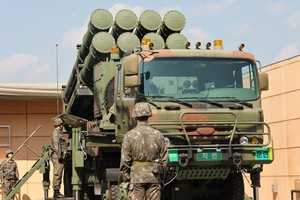
Seven months in, US-Iran war opens doors for Korean defense, energy and construction firms
Industrial realignment accelerates after US-Iran war Defense, construction and energy emerge as top beneficiaries US weapons stockpile shortfalls erode supplier credibility Korean defense firms eye European air-defense market beyond Middle East Daewoo E&C, Samsung E&A seen as LNG beneficiaries As the US-Iran war enters its seventh month, growing gaps in American defense and energy supply are fueling expectations that Korean companies stand to benefit. The conflict, which began with US and Israeli airstrikes on Feb. 28, has dragged on longer than initially anticipated after Yemen's Houthi rebels and Iraqi Shia militias joined the fighting. The prolonged war has left the United States grappling with inflationary pressures, depleted missile stockpiles and weakened credibility as a weapons supplier to its allies. iM Securities recently outlined a scenario in which Korean companies reap indirect benefits across three sectors — defense, construction (LNG and nuclear power plants) and energy (refining) — in a report titled "Industrial Realignment After the Iran War." The Center for Strategic and International Studies (CSIS) estimated that as of July 27, roughly half of US missile defense and surface-to-surface systems — including Patriot, THAAD and PrSM — had been drawn down from initial stockpiles, while about one-third of long-range ground-attack munitions such as JASSM, SM-2/3/6 and Tomahawk had been expended. Restocking is proving slow. Although Lockheed Martin has signed a production expansion contract with the US Department of Defense, returning to pre-war inventory levels is expected to take years. Patriot stocks are not projected to recover until mid-2029, THAAD until mid-to-late 2029, and Tomahawk until after the end of 2030. With the United States struggling with acute missile shortages and production bottlenecks, countries that rely on American weapons — including Switzerland, Estonia and the United Kingdom — have also faced delivery delays. "Ultimately, the Iran war has weakened not only the US missile stockpile but also America's capacity to meet global defense demand and its credibility as a weapons supplier to allies," said Byeon Yong-jin, a researcher at iM Securities. "The supply gap the US cannot fill will create an opportunity for Korean defense companies to enter the European air-defense market beyond the Middle East." The report identified Korea's Cheongung-II as a leading candidate to replace the Patriot, citing its high interoperability, price competitiveness and high domestic-parts ratio. The Cheongung-II is integrated with LINK 16, the NATO and US standard tactical data link, allowing it to receive radar and command-post data from existing Patriot air-defense networks and share operational tasks. Price is another advantage. The per-unit cost of a Cheongung-II interceptor runs between $1 million and $1.3 million — roughly one-quarter the price of Lockheed Martin's latest PAC-3 MSE interceptor, which costs between $4 million and $5 million. The Cheongung-II also uses 95 percent domestic components, and LIG Defense & Aerospace manufactures in-house the seeker — the core of any guided missile — enabling more stable production ramp-ups than the United States can currently manage. The UAE (2022, 4.1 trillion won, or $2.97 billion), Saudi Arabia (2023, 4.3 trillion won) and Iraq (2024, 3.7 trillion won) have already procured the Cheongung-II. The report noted that this trend could spread to Europe, pointing to German defense company Rheinmetall's partnership with LIG Defense & Aerospace in June to pursue joint entry into the European and NATO air-defense market. In construction, the report said Korean EPC (engineering, procurement and construction) firms stand to benefit from the convergence of US energy security priorities and surging power demand driven by AI data centers. Samsung E&A has carried out front-end engineering design and related work for LNG projects in Texas, Indonesia and Mexico, while Daewoo Engineering & Construction completed the EPC for Nigeria LNG Train 7 — making it the only Korean construction company with LNG liquefaction plant experience. The company is also expecting to sign EPC contracts this year for LNG projects in Mozambique and Papua New Guinea. Hyundai Engineering & Construction has a track record in LNG terminals and storage tanks, including Kuwait's Al-Zour LNG terminal, and has been selected as the preferred bidder for the Papua New Guinea LNG project in a joint venture with Japan's JGC. For combined-cycle gas turbine power generation, the report said that if a mega-project such as the 6.3-gigawatt Encinal project in Texas — estimated at between $20 billion and $22 billion — moves forward, Samsung C&T, Hyundai Engineering & Construction, Daewoo Engineering & Construction, DL E&C and Doosan Enerbility could all be in contention. Nuclear power is also expected to be a major beneficiary. The United States has seen virtually no new nuclear plant construction over the past 30 years, leaving its equipment supply chain and skilled workforce significantly weakened. A US Department of Energy survey found that only a handful of EPC firms — including Bechtel and Fluor — have domestic nuclear project experience, and an estimated 10,000 additional skilled workers will be needed to support new nuclear expansion by 2030. Korea's APR1400 reactor design and the "Team Korea" consortium are cited as candidates to fill that gap. Led by Korea Hydro & Nuclear Power, the consortium brings together Kepco Engineering & Construction (design), Doosan Enerbility (primary equipment), BHI (auxiliary equipment), Kepco Plant Service & Engineering (maintenance), and Hyundai Engineering & Construction, Samsung C&T and Daewoo Engineering & Construction (EPC). In the energy sector, refining is identified as the key beneficiary. The Iran war has damaged Russian and Middle Eastern refining capacity, and adjustments to Asian operating rates have left roughly 10 percent of global refining capacity facing supply disruptions. Capturing that opportunity, however, requires stable crude oil procurement and the ability to run at full capacity. While Chinese and Japanese refiners have been operating at utilization rates of 70 to 75 percent, Korean refiners have pushed their rates to around 90 percent. "Korean refiners have stronger crude procurement competitiveness than other Asian peers, backed by large-scale purchasing power and strategic alliances with Saudi Arabia," said Jeon Yu-jin, a researcher at iM Securities. "They are translating the elevated refining margins from global supply disruptions into actual profits." Jeon added, however, that domestic price caps and export restrictions are limiting their ability to fully capitalize on current market conditions. "Even so, maintaining production at levels similar to last year while benefiting from higher product prices is more than encouraging," she said.
Sept. 19, 2026
-
China, Iran use AI agents to run autonomous influence operations
State-backed actors and private firms deploy hundreds of bots to create fake accounts and spread disinformation ahead of US midterms State-backed actors from Iran and China, along with private Israeli companies, have deployed AI agents to conduct what amounts to autonomous influence operations on social media, The New York Times reported Friday (local time). The AI systems created fake accounts, generated politically charged content and spread disinformation — carrying out the full cycle of influence operations that humans once managed, with minimal human involvement. The reports have heightened concerns that AI-driven online interference could intensify ahead of the US midterm elections in November. Citing US officials and cybersecurity experts, The New York Times said the actors involved rapidly expanded their online influence operations using AI at speeds and scales that surpass human capacity, with only minimal human oversight. They built AI agents — bots capable of autonomously executing specific tasks — using open-source Chinese AI models that can be freely downloaded and modified. Hundreds of AI agents autonomously created fake accounts across platforms including Instagram, Facebook, X (formerly Twitter) and TikTok, then rapidly spread false posts on political and current-affairs topics through those accounts to manipulate public opinion. The Chinese and Iranian campaigns were state-directed, while the Israeli campaign was traced to a private company. The Iranian campaign targeted the American public, with agent-generated fake accounts posing as ordinary Americans living in major cities. Those accounts tagged journalists and politicians and spread popular memes and anti-Republican content. The accounts amassed roughly 80,000 followers through activity in the first half of this year alone. Meta, which operates Facebook and Instagram, had separately announced late last month that it had disrupted an Iranian influence operation that used AI. Officials said the cases represent what is effectively the first known instance of AI agents handling every stage of an influence operation — from account creation to the coordination of online messaging. Although the AI agent-based activity was described as crude, it drew the attention of US intelligence agencies, technology companies and security researchers, raising alarm that publicly available AI models could be exploited to conduct online influence operations largely on their own. Some US officials warned that similar attempts could be made targeting American voters ahead of the November midterms. Kyle Crighton, a researcher at Georgetown University's Center for Security and Emerging Technology, predicted that AI agent-driven influence operations would become more common as the technology continues to advance. "Agents can become quite sophisticated, gaining the ability to blend in naturally like real human users — going well beyond simple scaling," he told The New York Times.
Sept. 19, 2026
-

Telecom stocks ride AI data center wave — SK Telecom leads the pack
SK Telecom aggressively scales up data centers, expanding AI revenue streams KT secures customer demand before building, boosting earnings visibility LG Uplus brings Paju data center online, targeting profitability gains As investment in AI data centers accelerates, the data center businesses of South Korea's major telecom carriers are emerging as a new growth engine. How many data centers each company secures — and how many customers it attracts — is expected to shape future earnings. SK Telecom has drawn the most attention from analysts as the top pick in the sector, given its aggressive push to expand large-scale AI data centers alongside related services. SK Telecom is the most active of the three domestic carriers in expanding its AI data center business, according to industry sources Friday. The company is moving beyond simply building new data centers to lease space and power to AI firms and cloud providers — it is also expanding into GPU rental services for AI computing workloads. The core strategy is to grow revenue from facility leases and GPU usage fees by adding data center capacity and locking in customers. Mirae Asset Securities named SK Telecom the biggest beneficiary of the data center scale-up trend, citing this business expansion. SK Telecom currently operates eight data centers with a combined capacity of 143 megawatts. It plans to add facilities in Ulsan and Guro, more than doubling total capacity to 318 MW by 2030. The Ulsan data center is set to begin operation at 41 MW in 2027 and expand to 103 MW by 2029, while the Guro facility will be built out to 75 MW by 2030. Earnings are expected to track the data center rollout. Mirae Asset Securities projected SK Telecom's data center operations revenue would rise 63.1 percent, from 412 billion won ($298 million) this year to 672.1 billion won next year, while operating profit would surge 128.7 percent from 82.4 billion won to 188.5 billion won. The Ulsan data center, which has secured a long-term contract with a global cloud provider, is expected to generate revenue faster than other new facilities. SK Telecom is also expanding its GPU-as-a-Service offering — renting GPUs to corporate clients — as well as its colocation business, which leases data center space, power and cooling infrastructure. Over the longer term, the company has set a target of reaching 15 gigawatts of installed data center capacity by 2035, combining data center operations with AI computing services to diversify its revenue base. "The company can leverage its existing data center operating capabilities and customer base for large-scale new AI data center development," said Choi Yu-jin, an analyst at Mirae Asset Securities. "Since AI data centers require large-scale power supply before servers and GPUs can even be procured, development capabilities — including power infrastructure — will themselves become a core competitive advantage." KT Corp takes a different approach, securing customers first before expanding capacity. The company plans to grow its current data center capacity of 152 MW more than sevenfold to approximately 1.1 GW by 2031, building new facilities sequentially in Bucheon, Gaebong, Gunsan, Yongin and Ansan. KT is understood to have already secured a customer pipeline — prospective demand from clients likely to use the new centers — equivalent to roughly 80 percent of the planned 1 GW addition. Revenue from KT's new data centers is expected to begin flowing in earnest from 2028. Operating profit from the data center business is projected to grow from 129.3 billion won in 2029 to 190.7 billion won in 2030 and 436.8 billion won in 2031. As customers begin using the facilities and utilization rates climb, profitability is expected to improve accordingly. "KT is expanding capacity based on actual demand, which limits the risk of overbuilding," Choi said. "We understand that pipeline equivalent to roughly 80 percent of the new 1 GW capacity has already been secured." For LG Uplus, the key challenge is converting its Paju AI data center into tangible revenue and profit. The company plans to expand its current data center capacity of 165 MW to 400 MW by 2030 — roughly 2.4 times its current size — with the Paju AI Data Center, or AIDC, at the center of that expansion. As the Paju AIDC's utilization rate rises, operating profit growth is expected to accelerate. Mirae Asset Securities forecast LG Uplus's data center revenue would grow 20.1 percent to 759.6 billion won in 2028, with operating profit rising 36.4 percent to 95 billion won. Because data centers carry heavy upfront construction and equipment costs, higher utilization rates translate into a larger share of incremental revenue flowing through to profit. "The Paju AIDC will be a key driver of profitability improvement in the data center business," Choi said. "After 2028, when utilization at the new center stabilizes, we expect not only top-line growth but also meaningful margin improvement."
Sept. 19, 2026
-
Han & Company broadens its horizons beyond buyouts as exits bear fruit
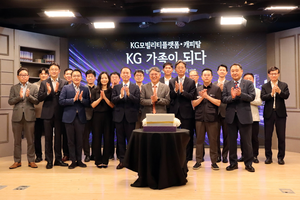
K Car sale delivers returns; Korean Air Lines C&D exit in sight SK Shipping restructured; real estate push marks new chapter Some buy, some sell, and others reload for the next deal. Even in the same mergers and acquisitions market, private equity fund managers pursue different strategies and achieve different results. "House Review" takes a close look at where major fund managers have invested this year, what returns they have generated, and where they are looking next. [Editor's note] The defining theme for Han & Company this year is "next step." Portfolio companies carved out from large conglomerates and built into independent businesses are being handed to new owners, while long-held assets are being restructured to prepare for the next phase of growth. Han & Co. has posted a string of notable results in the exit market. Amid growing concern among limited partners over delayed distributions across the private equity industry, the firm's successful completion of several major exits has reinforced its reputation as a premier buyout house. A distinguishing feature has been its ability to sell companies not merely after improving their earnings, but after laying the groundwork for future buyers to expand the business further. K Car finds a new owner; Korean Air Lines C&D sale moves closer The standout result by far is the sale of K Car. Han & Co. completed the transfer of K Car and K Car Capital to KG Group in August, selling a 72.19 percent controlling stake in K Car for approximately 550 billion won ($398 million) and a 100 percent stake in K Car Capital for around 200 billion won. The deal demonstrated that a company can continue to grow substantially after leaving private equity ownership, challenging the perception that private equity funds pursue only short-term gains. With K Car, Han & Co. delivered a textbook carve-out. In 2018, it acquired SK Encar's directly operated dealership division and CJ Group's Joy Rent-a-Car for 200 billion won and 50 billion won, respectively, rebranding them under the K Car name. At the time, the market watched closely to see whether the business could survive independently without the SK brand. The most significant transformation was the integration of used-car sales and financing. Han & Co. established K Car Capital directly to offer installment financing alongside vehicle purchases, improving convenience for customers. Aggressively expanding online channels — including home services for buying and selling vehicles — also helped broaden customer touchpoints and enhance brand value. When Han & Co. rebranded the company as K Car in 2018, it started by changing the logo, embedding passion in the red and trust in the gray. The firm steadfastly pursued a directly operated sales model, instilling confidence in the used-car market, and drove strong earnings growth through an energetic value-enhancement strategy. Last year, sales and operating profit reached record highs of 2.44 trillion won and 76 billion won, respectively. The phased exit strategy was equally impressive. Han & Co. listed K Car on the Kospi in 2021 — the first used-car company to do so — and recouped its principal investment by raising 300 billion won through secondary share sales. It then maintained management control while continuing to build brand value before completing a full exit. The eight-year investment journey — from acquiring a conglomerate division, to building an independent brand, to listing, to a strategic sale — left a deep impression on the market. In March, Han & Co. signed a share purchase agreement to sell Korean Air Lines C&D Services back to Korean Air Lines for 750 billion won. Han & Co. had stepped in as a white knight for the aviation industry during the COVID-19 crisis in 2020, acquiring Korean Air Lines' in-flight catering and duty-free operations and building them into a solid business with double-digit operating profit margins. Korean Air Lines navigated the crisis with Han & Co.'s support and is now pursuing a reacquisition to strengthen its service competitiveness as the aviation industry stabilizes. A Korea Fair Trade Commission merger review is currently under way, and the transaction is expected to close by year-end given the timeline for the Korean Air Lines–Asiana Airlines integration. Han & Co. also completed the sale of its remaining stake in SK Eternix. After acquiring SK D&D in 2018, it spun off the renewable energy and energy storage system business into SK Eternix in March 2024. Two block deals in 2024 and 2025 returned approximately 150 billion won, and this year the firm sold its remaining 12.52 percent stake to KKR for 100 billion won, completing the exit. SK Shipping rebrands as 'K-LNG'; SK D&D pledges to stand by minority shareholders A sweeping restructuring is under way at the firm's long-held shipping assets. SK Shipping is transitioning into a gas-specialist carrier focused on LNG and LPG, while H-Line Shipping — formerly Hanjin Shipping — has added oil tankers to its portfolio to further increase the share of high-quality domestic cargo owners. The effort goes beyond improving financial structure and profitability; it is about sharpening the distinct identities of SK Shipping and H-Line Shipping. In February, Han & Co. sold SK Shipping's very large crude carrier division to Pan Ocean for around 1 trillion won and is also pursuing a fleet swap between SK Shipping and H-Line Shipping. SK Shipping will take over H-Line Shipping's LNG carriers to complete its transformation into an LNG and LPG gas-specialist carrier, and plans to rename itself K-LNG. H-Line Shipping, meanwhile, will add oil tankers to its existing dry bulk and pure car and truck carrier fleet. With each company's core market and growth drivers now clearly defined, investor predictability has improved considerably. The turnaround at Namyang Dairy Products, freed from the risks associated with its former controlling family, is also worth noting. After fully securing management control in 2024, Han & Co. introduced an executive officer system to establish professional management. With the board handling major decisions and executive officers running day-to-day operations, earnings have improved rapidly. Last year, the company posted consolidated sales of 914.1 billion won and operating profit of 5.2 billion won, returning to profitability for the first time in five years. Operating profit in the first half of this year reached 1.8 billion won, up 80 percent from the same period a year earlier. The company also announced a large-scale shareholder return package. It disclosed plans for a 20 billion won share buyback and cancellation and paid a year-end dividend of 3 billion won. The 8.2 billion won deposited with the court by former Chairman Hong Won-sik's family during their embezzlement and breach-of-fiduciary-duty trial was used to fund a special dividend. The moves reinforced the message that transparent governance benefits both the company and its shareholders. SK D&D faces the challenge of proving its recovery amid a deteriorating real estate market. To support the company's long-term growth, Han & Co. provided liquidity through a 136.7 billion won rights offering while pledging not to pursue a delisting for at least three years — a declaration of solidarity with minority shareholders. From buyout-only to real estate funds Han & Co. itself is changing. Earlier this year, the firm established a separate asset management subsidiary, HCAM, to prepare for real estate fund management. While other private equity managers active in Korea have experimented with growth capital, credit investments and other strategies, Han & Co. has until now walked a single path of buyout investing — a strategy it is now moving to diversify. The firm is adding a new asset class to its buyout-focused management structure to expand investment opportunities. It is expected to diversify its business model by drawing on the real estate market expertise it has built through investments in SK D&D and Rahan Hotel. The value-enhancement strategies honed across its existing portfolio are expected to translate into strong performance for the new fund. An organizational overhaul is also under way. The firm promoted Executive Vice Presidents Lee Dong-chun and Jo Seong-gwan to senior executive vice president — the first time Han & Co. has conferred that title. Senior Executive Vice President Lee will serve as chief portfolio officer and Senior Executive Vice President Jo as chief investment officer as they chart the firm's future.
Sept. 19, 2026
-
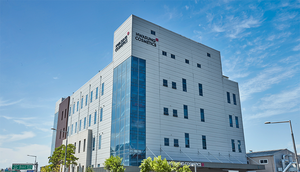
Macquarie PE to acquire cosmetics makers Hwaseong Cosmetic and Nowcos
Affirma Capital sells Hwaseong-Nowcos package Deal signed within a month of preferred bidder selection Macquarie PE expands into K-beauty manufacturing infrastructure Macquarie Asset Management's private equity arm (Macquarie PE) is set to acquire cosmetics manufacturers Hwaseong Cosmetic and Nowcos. According to investment banking industry sources, Affirma Capital and Macquarie PE signed a share purchase agreement for the sale of cosmetics ODM and OEM companies Hwaseong Cosmetic and Nowcos on Friday. The deal closed within a month of Macquarie PE being named the preferred bidder last month. The bidding process for Hwaseong Cosmetic, which kicked off in March, was fiercely contested. Five to six companies participated in the preliminary round alone. The final round drew a consortium of Korea Investment Private Equity and Ecopro Partners, as well as a European strategic investor, in addition to Macquarie PE. With the Hwaseong Cosmetic and Nowcos sale, Affirma Capital has now completed three successful exits this year — following Sungkyung Food and Seah ESAB — building a solid track record of returns. The firm is currently raising its seventh blind fund targeting 500 billion won ($362 million). The deal reflects a broader shift in K-beauty investment away from brands and toward manufacturing and retail infrastructure. Global private equity funds have shown particularly strong appetite for the sector. KKR acquired cosmetics container manufacturer Samhwa for 730 billion won last year, and CVC Capital invested 300 billion won in K-beauty retail company Silicon2 in August. Affirma Capital maximized the value of its portfolio companies through a bolt-on strategy of acquiring similar businesses. The firm acquired a 70 percent stake from Hwaseong Cosmetic's founder in 2019, taking management control, and then bought Nowcos in 2022. Hwaseong Cosmetic specializes in color cosmetics while Nowcos focuses on skincare — both operate as ODM companies. Hwaseong Cosmetic counts L'Oréal, Estée Lauder and domestic indie brands among its major clients. Affirma Capital grew Hwaseong Cosmetic by ramping up research and development investment and marketing to overseas clients. Sales at the time of the 2019 acquisition stood at 50.1 billion won and rose roughly 2.2 times to 110.6 billion won last year. Operating profit jumped approximately 5.2 times over the same period, from 3.8 billion won to 19.8 billion won. After acquiring Nowcos, Affirma Capital launched a tender offer in February for the remaining shares listed on the Konex market and voluntarily delisted the company. The move reduced the burden on potential acquirers of maintaining a stock listing, improving the chances of a successful sale. Macquarie Asset Management, headquartered in Australia, is a global asset manager with a strong track record in infrastructure investment. In South Korea, it has invested in companies including DIG AirGas, LG CNS, S&I Corporation and Genuone Sciences. Having recently wrapped up several large-scale trillion-won deals, the firm is now accelerating new investments. Earlier this year it sold DIG AirGas to Air Liquide for around 4.85 trillion won and recovered 530 billion won by selling its entire remaining stake in LG CNS through a block deal.
Sept. 19, 2026
-
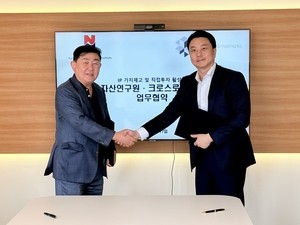
Crossroads Partners, National Asset Research Institute sign MOU to boost IP investment
Partnership aims to identify monetizable national assets Crossroads targets fund of over 25 billion won Crossroads Partners, a private equity and venture fund manager, has moved quickly to kick off its intellectual property monetization push, signing a partnership agreement alongside its fundraising efforts. The company announced Friday that it signed an MOU with the National Asset Research Institute to "enhance IP value and promote direct investment." The signing ceremony was held Thursday at Crossroads Partners' Seoul headquarters and was attended by Chief Executive Kim Hyo-sang, National Asset Research Institute President Kim Su-wook and other key officials. The National Asset Research Institute is a nonprofit association that launched in November last year after receiving approval from the Ministry of Economy and Finance. Established to maximize the economic and social value of state and publicly owned assets, the institute is led by Kim Su-wook, a professor at Seoul National University's College of Business Administration, who serves as its inaugural president. The agreement was designed to enhance the value of high-quality intellectual property held by government bodies, public and research institutions, universities and companies, and to promote direct IP investment backed by private capital. The goal is to identify the latent value of knowledge assets held by those entities and translate it into tangible returns. The two organizations agreed to collaborate across five areas, drawing on each institution's expertise and capabilities: identifying business opportunities to utilize and enhance the value of intellectual property; jointly planning and pursuing IP direct investment and monetization business models; developing private-capital utilization models to boost IP value; identifying, reviewing and commercializing projects with direct IP investment and monetization potential; and building a cooperative framework with relevant and specialized institutions. The National Asset Research Institute will identify business opportunities for IP value enhancement and design tailored commercialization models, leveraging its public and private networks and project-planning capabilities. Crossroads Partners will oversee the core operational work of direct IP investment and monetization — including due diligence, investment structuring and fund deployment — based on its right of first review over identified projects. The partnership is expected to generate strong synergies with the "Crossroads IP Monetization Venture Investment Association" (tentative name) that Crossroads Partners is currently forming. In June, the firm was selected as the entrusted manager for the IP direct investment segment of Korea Venture Investment Corp.'s Fund of Funds patent account. The target is to raise a fund of more than 25 billion won, combining the Fund of Funds' 10 billion won ($7.24 million) contribution with private capital. Crossroads Partners demonstrated its direct IP investment capabilities last year by investing in a Wi-Fi technology patent monetization project involving US-based Netgear. The firm is also pursuing monetization through licensing agreements with a number of global companies. "Our collaboration with the National Asset Research Institute will be an important inflection point in driving qualitative growth in South Korea's intellectual property ecosystem," Kim Hyo-sang said. "We will combine the institute's outstanding project-planning capabilities and public network with Crossroads' IP investment expertise to generate strong synergies." Kim Su-wook said the partnership would create "a new IP value-enhancement model that connects the institutional capabilities of the public sector with the specialized investment expertise of the private sector," adding that the two sides would work to build a public-private cooperation case that delivers real results.
Sept. 19, 2026
-
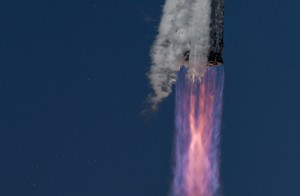
SpaceX shares brace for real test as Starship's 14th flight looms
ETF inflows of 37 billion won in one month despite returns falling as much as 30% Flight 14 to attempt orbital entry and satellite deployment as proof of commercial viability Share price still 30% below post-listing peak; further lock-up releases add uncertainty South Korean ETFs holding SpaceX shares have posted losses of as much as 30% over the past three months, yet investors have continued to pour money in — about 37 billion won ($26.8 million) in net inflows over the past month alone. Markets are now watching whether that sustained bet on SpaceX's growth potential will finally translate into a share-price rebound when Starship conducts its 14th test flight on Sept. 28. According to Koscom ETF Check, the nine domestic ETFs that include SpaceX recorded one-month returns ranging from -17.37% to 2.04% and three-month returns of -37.52% to -20.40%. In the week surrounding the confirmation of the 14th test flight, however, all nine funds turned positive, posting returns of 3.03% to 4.45%. Even as SpaceX's share price has struggled, money has consistently flowed into the related ETFs — about 5 billion won over the past week and about 37 billion won over the past month. The inflows have continued even as the stock has fallen nearly 30% from its post-listing peak, reflecting investor confidence in the company's long-term growth story. The market is closely watching whether SpaceX can use this test flight to demonstrate commercial viability. Analysts say the stock will need concrete evidence that Starship is ready for real-world operations before it can recover to the lofty expectations priced in at the time of listing. The 14th test flight, originally scheduled for Sept. 22, was postponed once and is now set for Sept. 28. Subject to regulatory approval, a 75-minute launch window opens at 8:15 a.m. Eastern time (9:15 p.m. Korean Standard Time). Previous test flights confirmed Starship's ability to reach space and return. Flight 14 will go further, testing whether the vehicle can carry satellites into Earth orbit and actually deploy them. The mission calls for Starship to carry 26 next-generation Starlink V3 satellites into space, achieve orbital velocity, complete roughly six orbits of Earth, and deploy all 26 satellites into their target orbits. All flights through the 13th were suborbital — the vehicle reached space but came back down without completing a full orbit. SpaceX's broader goal is to move away from building a new rocket for each launch, instead recovering, refurbishing and relaunching both the booster and the spacecraft. That is also why the company plans to attempt a direct tower catch of the Starship upper stage during Flight 15, the mission after this one. Investors are watching whether the test flight can restore momentum to a share price that has fallen nearly 30% from its post-listing high. Jeffrey Wlodarczak, an analyst at Pivotal Research, said Starship must be capable of flying dozens of missions on a single vehicle and turning it around quickly and cheaply before launch costs can be meaningfully reduced. "How well it executes the planned mission — orbital entry and satellite deployment — will be the benchmark for expectations around future commercial operations," he said. How well the stock absorbs additional lock-up releases after the test flight is another variable. Since listing, lock-ups have been lifted in stages, making roughly 12% of total shares outstanding available for trading, yet the large-scale releases have not triggered a sustained decline. When about 900 million shares were freed up on Aug. 6, the stock actually rose more than 6% that day; while some subsequent release dates saw the price dip, none set off a prolonged downtrend. Larger tranches still lie ahead, however. Additional lock-up expirations are scheduled for Thursday and in October, and after the third-quarter earnings release expected in November, up to about 1.3 billion more shares could become tradeable. With the test flight raising hopes for SpaceX's growth at the same time that a large potential overhang looms, the key question is whether the stock can sustain any post-flight rally and absorb the additional supply.
Sept. 18, 2026
-

Listed firms push back against easing of 5% shareholding disclosure rule
Korea Listed Companies Association submits objections to National Assembly, FSC, citing disclosure blind spots Bill would exclude joint voting pacts without command ties from combined stake calculations Independent director, auditor appointments also removed from 'management participation' definition Listed companies have come out against a proposed amendment to the Capital Markets Act aimed at encouraging institutional investor shareholder activism, warning the bill could create blind spots where stakes exceeding 5 percent move in concert without triggering public disclosure. The Korea Listed Companies Association submitted its objections to the National Assembly's Political Affairs Committee and the Financial Services Commission on Thursday over a bill sponsored by Democratic Party of Korea lawmaker Park Hong-bae. Under the existing "5 percent rule," any person and their specially related parties must report their combined stake, along with the purpose of the holding, once it reaches 5 percent or more in a listed company. Shareholders who agree to buy or sell shares jointly, or to exercise voting rights together, are also treated as "joint holders" and their stakes are aggregated. Institutional investors have long argued the standard constrains legitimate shareholder activity. They say investors can be classified as joint holders simply for expressing the same view on a specific agenda item at a general meeting or for soliciting proxy votes — and that having to report a stake of 5 percent or more held for management participation purposes within five business days quickly exposes their investment targets and ownership levels. The amendment seeks to ease these constraints by narrowing the definition of joint holders. Merely agreeing to exercise voting rights together would no longer be sufficient to trigger stake aggregation; the bill would require one party to have the authority to direct the other's voting before they are treated as joint holders. Public proxy solicitations would also in effect be excluded from the definition of exercising control. The Korea Listed Companies Association said the amendment could allow investors to sidestep the 5 percent reporting requirement. Two investors each holding 4.9 percent who agree to vote together would not have their stakes combined under the bill, as long as neither has authority to direct the other. That means they could exercise 9.8 percent of voting rights while remaining outside the 5 percent disclosure threshold. "Even now it is difficult to know whether shareholders have agreed to exercise voting rights jointly, but if the amendment takes effect, they would be removed from the scope of regulation entirely, creating a gap," an association official said. The association also warned that so-called "wolf pack activism" — where multiple investors coordinate without any command-and-control relationship, dividing up a stake and voting together — could produce the same problem. An investor relations official who has worked at multiple listed companies echoed the concern. "Companies cannot continuously track who is buying shares — they check ownership when the shareholder register is released," the official said. "Without the 5 percent report, it would be very hard to detect in advance whether multiple shareholders are moving in coordination." The association also objected to the bill's narrowing of what constitutes "management participation." The amendment would replace the current standard — "the purpose of influencing the issuer's management rights" — with "the purpose of exercising de facto control over major management matters," and would exclude the appointment of independent directors, auditors and audit committee members from the definition of management participation. The association argued that appointing independent directors and auditors affects a company's decision-making and oversight, and should therefore remain within the definition of management participation. It pointed to international practice as support, noting that Japan defines management participation activities across 15 categories — broader than Korea's nine — and that the United States also treats demands for director appointments as management participation. "We are concerned that both the scope of joint holders and the definition of management participation are being narrowed at the same time," an association official said. "Shareholders are of course entitled to act on their rights, but information about who is involved in a company's management is something other investors also need to know." The official added: "Shareholders should be free to engage in activism — but they should disclose it when they do."
Sept. 18, 2026
-
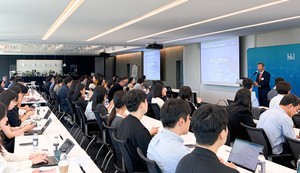
Bae, Kim & Lee and Reed Smith hold seminar on semiconductor export control strategies
Event analyzes US-Korea semiconductor export control regulations and enforcement trends About 100 chipmaker representatives attend Bae, Kim & Lee's Export and Import Regulatory Response Center said Friday it concluded a joint seminar with global law firm Reed Smith LLP on semiconductor export control issues and corporate response strategies in South Korea and the United States. The seminar, held Thursday, drew about 100 representatives from major domestic and foreign chipmakers and related organizations. It was organized to assess the regulatory risks facing Korean companies — including South Korea's strategic materials controls and the extraterritorial application of the US Export Administration Regulations (EAR) — and to discuss practical response measures, as export controls over advanced technologies shift rapidly amid the intensifying US-China technology rivalry. In the first session, Lee Ji-han, a director at the Korea Semiconductor Industry Association, presented on the current state of the domestic and global semiconductor industry. Lee said global supply chain restructuring is accelerating as major economies including the United States, the EU, Japan and China compete to attract manufacturing facilities through subsidies and tax incentives. He also said export control coordination among allied nations is increasing uncertainty in the business environment for Korean companies. Hwang Ho-sung, head of Bae, Kim & Lee's Export and Import Regulatory Response Center, then delivered an in-depth analysis of the latest regulations in both countries under the theme of semiconductor export control trends. Hwang explained that domestic regulations have tightened, with control standards for high-performance integrated circuits restructured under the strategic materials export and import notice and various semiconductor manufacturing equipment added to the list of newly controlled items. He also outlined key regulatory changes related to the US EAR, highlighting risks that companies should proactively examine — including product classification by semiconductor sector, the extraterritorial application of the Foreign Direct Product Rule (FDPR), and deemed exports. Michael J. Lowell, a partner at Reed Smith, led the third session, presenting on US enforcement trends and defense strategies for semiconductor companies. Lowell stressed the importance of regular export control training, screening systems that include beneficial owners, internal escalation procedures and enhanced due diligence frameworks. He urged companies to establish proactive compliance systems, warning that regulatory violations can deal a fatal blow to an entire business — not just through criminal and administrative sanctions. Bae, Kim & Lee's Export and Import Regulatory Response Center provides advisory services across the full range of trade regulations, including strategic materials, economic security, tariffs and foreign exchange transactions, and supports companies in managing global regulatory risks through collaboration among field specialists. The center has also demonstrated integrated advisory capabilities by proactively managing complex regulatory risks through cross-team collaboration — including with its Export and Import Regulatory and Law and Economics Center — in high-complexity merger and acquisition transactions. Founded in 1980, Bae, Kim & Lee offers one-stop legal services across all practice areas through overseas offices in Beijing, Vietnam and Singapore. The firm has been recognized internationally, having been named to the Global 200 law firms list for eight consecutive years and receiving the top law firm award across all categories at the 2025 Asian Business Law Journal Korea Law Firm Awards.
Sept. 18, 2026
-
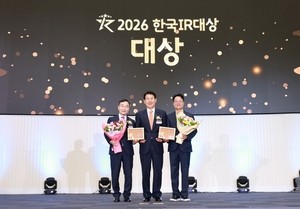
Shinhan Financial wins top honor at 2026 Korea IR Awards; LG Electronics' Park takes individual prize
2026 Korea IR Awards held at Korea Exchange Vitzrocell takes top Kosdaq honor Shinhan Financial received the grand prize at the 2026 Korea IR Awards ceremony held at Korea Exchange on Friday. Shinhan Financial took the top honor among KOSPI-listed companies and was also named an IR Excellence Company. The Korea Investor Relations Association cited the group's April announcement of "Value-Up 2.0," a corporate value enhancement plan, as a key factor, noting that it had strengthened communication with investors. Judges also gave high marks for the group's roughly 570 IR meetings annually, some 70 investor engagement sessions per year attended directly by board members and senior management, and its distinction as the only domestic company to earn an integrated A-plus rating from the Korea Institute of Corporate Governance and Sustainability (KCGS) for 11 consecutive years. In the Kosdaq market, Vitzrocell claimed the grand prize, recognized for its sustained market communication around growth businesses including defense and high-temperature batteries. KT&G took the excellence award in the KOSPI market, while ISC received the same honor in the Kosdaq market. In the individual category, Park Won-jae, senior vice president in charge of IR at LG Electronics, won the Best IRO (Investor Relations Officer) award for his contributions to corporate value reappraisal and enhanced IR competitiveness through proactive, transparent communication and shareholder trust. Korea Exchange will also host the 2026 Sound Market Forum at its Seoul office promotional hall on Oct. 1. The exchange has held the forum since 2005 to identify policy challenges and discuss improvements in areas including combating unfair trading and protecting investors. This year's forum will be held under the theme "Rational Market Management and Investor Protection in a Changing Market Environment."
Sept. 18, 2026
-
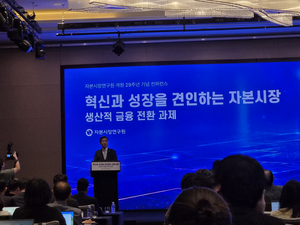
Seoul real estate outperformed S&P 500 and Kospi with 11.6% average annual after-tax return
'Tax reform needed first to shift household funds to capital markets' Researchers propose adjusting property holding taxes, expanding ISA benefits Seoul real estate delivered an after-tax annual return of 11.6%, the highest among major investment assets, according to new research. While the findings suggest households had rational grounds for concentrating wealth in property — given its risk-adjusted performance — researchers called for tax reforms to redirect household funds from real estate into financial investment products. The Korea Capital Market Institute presented the findings Friday at its 29th anniversary conference at Conrad Hotel in Yeouido, Seoul. The results came from a joint study by Lee Hyo-seop, a senior research fellow at the institute, and Hong Byeong-jin, head of the tariffs research team at the Korea Institute of Public Finance. The research team simulated 20-year investment returns across major asset classes and found that Seoul real estate's after-tax annual return of 11.6% outpaced nationwide real estate (7.2%), the S&P 500 (7.1%), Kospi (6.0%), public funds (5.7%) and equity-linked securities (2.1%). The study found that the heavy concentration of domestic household assets in real estate is a natural outcome when both returns and risk are considered. In an optimal portfolio calculated to reflect after-tax returns and risk, real estate accounted for 67.1% — closely mirroring the actual share of real estate in household assets, which stood at 64.5%. "It is hard to fault households for holding large amounts of real estate in the past, given its strong risk-adjusted performance," Lee Hyo-seop said. "For innovative growth and to raise potential growth rates, we need a structure that moves household funds into financial investment products." He added that actively shifting money away from real estate and bank deposits toward capital markets is essential to boosting total factor productivity and long-term growth potential. The researchers set a target of reducing the share of real estate in household assets from the current 64.5% to 50% over the next decade, while raising the share of financial investment products from 8.5% to 20%. They argued that narrowing the gap in after-tax returns between asset classes is a prerequisite for redirecting funds locked in real estate toward financial investment. To that end, the study proposed gradually adjusting property holding taxes while offering tax incentives when proceeds from real estate sales flow into capital markets. The proposals also included expanding tax benefits under individual savings accounts, and introducing, over the medium to long term, loss offsetting across financial investment income and the carryforward of investment losses. The researchers also outlined measures to enhance the long-term appeal of domestic equities, proposing a gradual easing of the conditions for separate taxation of dividend income and offering tax benefits for long-term share holdings. "The requirements for separate taxation of dividend income on domestic shares are currently very strict," Lee said. "We need to ease them gradually to raise dividend yields further and foster a culture of dividend investing." The study also identified the patchwork of tax rules applied differently across financial products as an area in need of reform. It proposed harmonizing the treatment of funds, discretionary accounts, trusts, equity-linked securities and derivative-linked securities under a "same asset, same tax" principle, and called for the eventual consolidation of various tax-advantaged accounts into a single "productive finance ISA." The analysis drew on monthly return data from January 2023 through December 2025, incorporating taxes and the opportunity cost of investment. Returns were calculated to reflect real-world conditions by comparing two scenarios: investing in financial products while renting on a jeonse basis rather than buying, versus purchasing a home with a mortgage for owner-occupancy.
Sept. 18, 2026
-
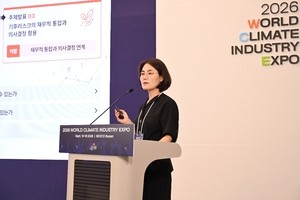
'Capital markets must evolve into the language of decision-making': climate risk reshaping corporate operations and investment
Samil PwC, Seoul National University host forum on climate risk Discussions cover climate data analysis, financial integration and capital market applications As climate risk emerges as a key variable affecting asset values, operating costs and supply chain stability across corporate management, experts are calling for it to be treated not merely as a disclosure item but as a practical tool for business and investment decisions. Samil PwC announced Friday that it co-hosted the "Making Climate Risk Decision-Ready" forum with Seoul National University's Climate Tech Center on Thursday at BEXCO in Haeundae-gu, Busan, on the sidelines of the 2026 World Climate Industry Expo. The forum was designed to help companies and financial institutions share the data, analytical methodologies and financial integration strategies needed to apply climate risk to real investment decisions. About 100 officials from government agencies, public institutions, industry, finance and research organizations attended. In his opening remarks, Seoul National University Professor Jeong Su-jong said, "Reducing the damage and risks caused by climate change is a challenge that government, business and society must tackle together." He added that he hoped climate disclosure would go beyond simply calculating and reporting figures to serve as "a practical decision-making tool that supports corporate risk management and growth." Lee Ki-beom, director of the Climate Action Division at the Korea Energy Agency, said in his welcoming address that "climate change is a core risk and a new market factor that determines the survival of companies and the national economy," underscoring the role of sustainability disclosure as a new growth opportunity for businesses. The keynote presentations focused on precise diagnosis of climate risk and its financial linkages. Jang Min-hee, team leader at SNU's Climate Tech Center, opened with a presentation titled "The Current State and Challenges of Climate Risk Diagnostic Technology," arguing that applying climate risk to actual decision-making requires analysis that reflects the location, operational characteristics and vulnerabilities of individual facilities and assets. "If extreme climate events are not adequately considered, or if results are aggregated without asset-level assessments, physical risks can be underestimated," she said. She added that improving this requires not only raw climate model data but also a process of downscaling and bias correction that accounts for the spatial characteristics of each site, observational biases and extreme events. Kang Min-ji, a senior researcher at Samsung Fire's Corporate Safety Research Institute, then presented an approach using the "protection gap" — the difference between potential losses from natural disasters and actual insurance payouts — to assess a company's level of risk exposure and pursue both risk prevention and adaptation investment in tandem. Kwon Mi-yeop, a partner in Samil PwC's sustainability platform, outlined strategies for integrating climate risk into financial planning. Kwon said companies must examine from multiple angles how supply disruptions of overseas raw materials or key components, simultaneous increases in raw material, cooling and logistics costs, and tightening low-carbon requirements from customers could affect corporate earnings and the recoverability of investments. "To use climate risk in decision-making, companies must specifically examine which assumptions in their current business plans could change due to climate change and at what point existing decisions would need to be revised," she said. "The key is connecting a company's facility, supply chain and financial data with climate information, and embedding that into budgeting, investment review and contract negotiation processes." The subsequent panel discussion, moderated by Professor Jeong, brought together Kim Tae-hyeong, ESG task force leader at GS Energy; Lee Seung-jun, team leader at SK hynix; Yu Geon-ho, research fellow at Mirae Asset Securities; and Lee Su-won, deputy director of the macro ESG division at Korea Investment Corporation. Panelists discussed the challenges and paths forward for using climate risk information in industrial operations and capital markets. Wrapping up the discussion, Professor Jeong said, "Climate risk must become not just information for disclosure but the language of decision-making that connects corporate operations, investment and capital market analysis," adding that "building a system that enhances data reliability and allows each stakeholder to interpret and communicate it in ways suited to their own judgment is critical." Meanwhile, Samil PwC — which closes its books in June — posted sales of 1.11 trillion won ($804 million) and operating profit of 25.4 billion won for fiscal year 2025 (July 2024–June 2025).
Sept. 18, 2026
-
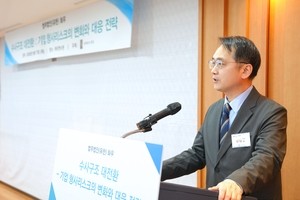
Hwawoo holds seminar on corporate criminal risk amid investigation system overhaul
Three sessions cover systemic changes and practical issues In-house lawyers from domestic and foreign firms attend in force Law firm Hwawoo held a seminar Thursday at its training center under the theme "Transformation of the Investigation System: Changes in Corporate Criminal Risk and Response Strategies." About 100 in-house lawyers from domestic and foreign companies attended, reflecting strong interest in the evolving criminal justice system. The event was organized to help companies proactively assess and address criminal risks as South Korea's criminal justice framework undergoes fundamental change — including the abolition of the Prosecution Service, the creation of a new public prosecution office and a serious crimes investigation agency, and an expansion of special judicial police authority. The seminar opened with a welcoming address by Hwawoo Managing Partner Kang Nam-il. Three sessions examined the shifting landscape of the investigation system and its practical implications from multiple angles. The first session, titled "Legislative Progress and Amendment Trends," was presented by partner attorney Jo Gyu-ung, a former prosecutor at the Suwon District Prosecutors Office. He outlined the structural changes to criminal procedure stemming from the separation of investigation and indictment functions, and stressed the importance of early responses to specialized investigative agencies and the new prosecution office following the abolition of the Prosecution Service. The second session, "Changes in Special Judicial Police Investigations and Corporate Responses," was led by partner attorney Lee Seong-sik, a former third deputy chief prosecutor at the Seoul Central District Prosecutors Office. He examined how the standing of special judicial police officers in practice has shifted since the restructuring and walked through case-handling procedures. Drawing on major investigation cases, he analyzed evolving patterns in special judicial police procedures and offered guidance on early-stage corporate responses and documentation strategies. The third session, "Changes in Serious and Criminal Case Investigations and Corporate Responses," featured partner attorney Kim Sang-mun, a former investigation review officer at the Seoul Metropolitan Police Agency. He assessed the shift toward a police-centered investigation environment and explained practical strategies for quickly establishing the facts from the earliest stages of an investigation and securing defense rights in conjunction with digital forensics. "The rapid transformation of the investigation structure demands a wholesale shift in how companies approach criminal investigations," said Hwawoo Managing Partner Lee Myeong-su. "Hwawoo's Corporate Criminal Response Strategy Center will continue to provide optimal solutions for preventing and responding to corporate criminal risk, built on close collaboration among professionals with deep practical experience and expertise." Meanwhile, Hwawoo recorded sales of 301.2 billion won ($218 million) last year, including its affiliated firms and overseas offices, surpassing 300 billion won in annual revenue for the first time in its history. Revenue per Korean attorney stood at 762 million won. Sales growth has continued since Lee took office in 2024, supported by strong performance across financial regulation, major litigation, fair trade, intellectual property, serious accidents, and mergers and acquisitions.
Sept. 18, 2026
-
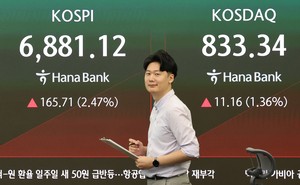
Kospi reclaims 6,800 as retail investors pile into leveraged ETFs
Kospi rises more than 2% in early trade, reclaims 6,800 Wall Street rebound, lower US rates lift sentiment KODEX Leverage tops retail net-buy list The Kospi rose more than 2% in early trade Friday, reclaiming the 6,800 level as investor sentiment improved following a Wall Street rebound and declines in US Treasury yields and global oil prices. Retail investors, who had watched the index retreat from the 7,000 mark to around 6,700, moved aggressively into leveraged exchange-traded funds in a bet on a recovery in the broader index and semiconductor shares. As of 10 a.m., the Kospi stood at 6,853.85, up 138.44 points, or 2.06%, from the previous session. The index had opened at 6,885.70, a gain of 170.29 points, or 2.54%. On the main Kospi market, foreign and institutional investors were net buyers of 80 billion won ($58 million) and 289.3 billion won, respectively, supporting the advance. Other corporations also posted net purchases of 192.3 billion won, while retail investors were net sellers of 561.8 billion won. Overnight on Wall Street, all three major indexes rebounded, shaking off the shock of the Federal Reserve's benchmark interest rate hike. The Dow Jones Industrial Average rose 0.61%, while the S&P 500 and Nasdaq gained 1.14% and 1.69%, respectively. The positive cues from Wall Street lifted domestic semiconductor stocks. Samsung Electronics and SK hynix rose roughly 4% and 2%, respectively, leading the index higher. The Kosdaq was up 6.58 points, or 0.80%, at 828.76 at the same time. Retail investors had been positioning for a rebound in the index and semiconductor shares since the Kospi pulled back from 7,000. According to Koscom ETF Check, individuals net-bought 256.7 billion won worth of KODEX Leverage in the week of Sept. 10–17, making it the top retail net-purchase among all domestically listed ETFs. KODEX Kosdaq150 Leverage also attracted net inflows of 83.4 billion won. Leveraged semiconductor products also ranked among the top retail net-buy names. Individuals purchased 68.7 billion won of KODEX Semiconductor Leverage, while KODEX SK hynix Single-Stock Leverage (66.4 billion won), TIGER SK hynix Single-Stock Leverage (44.8 billion won) and TIGER Semiconductor TOP10 Leverage (44.5 billion won) also drew strong inflows. Retail investors turned net buyers after the Kospi peaked at 7,000 and began to slide. They had been net sellers of more than 15 trillion won on the Kospi market from the start of this month through Sept. 9, but switched to net purchases of 6.97 trillion won over the following week. Samsung Electronics and SK hynix accounted for 1.61 trillion won and 1.32 trillion won of those purchases, respectively, as retail investors concentrated their buying in large-cap semiconductor names. As the index retreated from the 7,000 level, retail investors appear to have simultaneously accumulated both physical shares and leveraged ETFs in anticipation of a rebound. The Kospi had reclaimed the 7,000 mark on a closing basis on Sept. 9 for the first time in 33 trading sessions before turning lower. It slipped below 6,900 on Sept. 11 and was pushed down to around 6,700 on Thursday, as rising oil prices and interest rates ahead of the September FOMC meeting heightened market caution. Analysts say the conclusion of major central bank policy events has cleared much of the macroeconomic uncertainty, with sector rotation — rather than a clear directional trend — seen as the more likely market dynamic going forward. "Starting with the Fed's rate decision, this week's monetary policy meetings at major central banks including the Bank of Japan and the Bank of England are wrapping up, helping the market get past a key hurdle of macro uncertainty tied to rate decisions," said Lee Jun-hyung, a researcher at Eugene Investment & Securities. "US long-term bond yields have stabilized since the FOMC meeting, providing support for the index's downside, but the market remains in a trendless, directionless phase." Han Ji-young, a researcher at Kiwoom Securities, said the September FOMC marked a turning point at which macro uncertainty began to peak out. "It is worth noting that market sensitivity to the high-rate environment — including the US 10-year yield breaking above 5.0% — appears to be fading," she said. Analysts also advised paying close attention to sector differentiation. "The Kospi is moving sideways, but what we are seeing is sector rotation rather than a risk-off shift," said Kang Jin-hyeok, a researcher at Shinhan Securities. "Sector selection is critical during a period when prolonged high oil prices keep multiple compression in the driver's seat."
Sept. 18, 2026
-
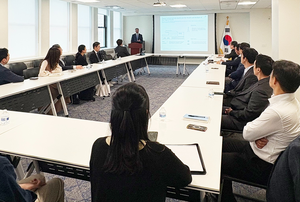
KIC discusses data center investment strategy with New York financiers as market seen topping $1tr
32nd New York Finance Forum draws about 40 officials from government and financial institutions AI-driven demand fuels data center growth; power supply seen as key investment variable The Korea Investment Corporation hosted the 32nd New York Finance Forum at the South Korean Consulate General in New York on Thursday (local time), the sovereign wealth fund said Friday. About 40 people attended the forum, including the deputy consul general and investment officials from government bodies, public investment institutions, securities firms, banks and insurers. Participants discussed the global data center market outlook and investment strategies. Matt Ahern, head of digital infrastructure at global asset manager Blue Owl Capital, who delivered the keynote presentation, forecast that the global digital infrastructure market would grow to more than $1 trillion driven by the spread of AI. "Given the scale of investment and the growth drivers behind data centers, a once-in-a-generation investment opportunity is opening up in digital infrastructure," Ahern said. "The first wave of rapid cloud market growth is now being joined by a second wave — AI — and the global digital infrastructure market is set to grow to well over $1 trillion." He identified power procurement as the critical variable in data center investment. "Securing power is becoming increasingly difficult in many countries, making it the single biggest constraint on expanding data center supply," he said. "The key question for any data center investment is when and how reliably you can secure the power you need." He also cited long-term lease agreements with major technology companies that dominate the AI market, along with their investments in servers and networking equipment, as factors underpinning stable cash flows for data centers. Kim Yul-young, head of KIC's New York office, said the forum offered a valuable opportunity to better understand the data center market, which has drawn growing attention alongside the spread of AI. "I hope this serves as a chance for domestic institutional investors to gain insights that help them diversify their portfolios," he said. KIC is also expanding its role beyond managing overseas assets into investment in South Korea's strategic industries. KIC President Park Il-young said at the "KBxAIMA Alpha Seoul" conference in Seoul on Sept. 10 that the corporation would use a newly established strategic investment account to help attract global capital into the country. "Through the strategic investment account, we will extend the trust KIC has built in global financial markets to Korea's strategic industries and channel global capital toward Korea," Park said.
Sept. 18, 2026
-

ArtistCompany activates internal controls after unregistered executive faces breach-of-trust allegations
Company launches probe into breach-of-trust charges against unregistered officer ArtistCompany, a comprehensive content company, activated its internal control system immediately after allegations of breach of trust surfaced against an unregistered executive. A company official said Friday that allegations of breach of trust had been raised against an unregistered executive surnamed Lee, adding that the company "will determine the specifics through an audit of the facts and the details of the conduct in question, as well as external legal counsel, and will confirm whether the company has suffered any damage and, if so, its extent." Depending on the findings of its internal control investigation, ArtistCompany plans to pursue legal action as necessary, including damage claims and recovery procedures against Lee. The company also said it would cooperate fully with any relevant regulatory investigations. ArtistCompany added that it will implement improvements to its internal controls to prevent a recurrence. To strengthen its planning and management functions, including finance, the company has brought in outside talent — among them Kim Hyung-seok as chief financial officer, who previously served as a finance executive at Kosdaq-listed companies including Itcen and Insanga. "The scale of the breach-of-trust allegations has not yet been determined, but we believe the impact on the company's financial soundness and management stability will be minimal or limited," Kim said. ArtistCompany also prevailed in an appeals court ruling in a damages suit it filed against the former chief executive of a drama production company it acquired in 2024. According to legal sources, the Seoul High Court's Civil Division 16-2, presided over by Judges Kim Seon-hui, Lee Won-seok and Jeong Jae-o, recently upheld a first-instance ruling in favor of the plaintiffs — ArtistCompany and Lee Jung-jae, among others — in their damages suit against Kim Dong-rae, the former head of Raemong Raein, now known as Artist Studio. ArtistCompany became the largest shareholder of drama production company Raemong Raein through a paid-in capital increase in March 2024, but subsequently clashed with founder Kim over the company's management direction. In June of that year, ArtistCompany filed the damages suit, alleging that Kim had refused to meet investors' demands and was blocking their participation in management. As of 10:42 a.m. Friday, ArtistCompany shares were trading at 2,990 won, down 930 won, or 23.72 percent, from the previous session.
Sept. 18, 2026
-
Samjong KPMG to host private IPO session for software companies
Event to cover profitability, business sustainability and valuation beyond growth potential Experts to walk through full IPO process from fundraising to listing review and accounting Samjong KPMG announced Friday it will host a private session for software companies preparing to go public. The event is scheduled for Oct. 1 at the firm's headquarters in Gangnam Finance Center in Yeoksam-dong, Gangnam-gu, Seoul. South Korea's IPO market has been shifting toward a "qualitative screening" approach that places earnings and profitability at the center of company evaluations. Tangible business results, visible profitability and reasonable valuation are increasingly the key benchmarks, eclipsing growth potential and revenue expansion. Technology-driven software companies — including those in AI, software-as-a-service, cloud and platform sectors — are no exception. The Korea Exchange and investors are scrutinizing more closely whether a company's technological capabilities can translate into actual sales and profitability, and whether its business model and customer base are sustainable. The Korea Exchange has been rolling out sector-specific listing standards since introducing them for the biotech sector in 2019, followed by AI, space and energy in December last year, and advanced robotics, K-content and cybersecurity in July. For companies listed under the technology special-exception regime, the rules governing exemptions from sales and large-loss delisting requirements have been tightened. The current system grants a three-to-five-year waiver on those requirements, but the exemption will now apply only when a special-exception listed company discloses a plan to enhance its corporate value during the grace period. A company's overall management and governance capabilities have also emerged as important evaluation factors, as the market has shifted toward long-term investment driven in part by expanded mandatory lock-up commitments from institutional investors. Companies preparing for a listing must build systematic frameworks for accounting transparency, internal controls, financial management and valuation logic from the earliest stages of IPO preparation. The session will feature speakers from the IPO, investment, listing review, and accounting and finance fields. They will share key issues that software companies must address when preparing for a listing in the changed market environment, covering practical strategies across the full IPO process — from pre-listing fundraising and responding to exchange reviews to building accounting and financial frameworks. Deputy CEO Kang In-hye, leader of Samjong KPMG's IPO Support Center, will open by presenting recent IPO market trends and the evolving investment landscape. She will analyze the tightening of qualitative screening in the IPO market and the key factors drawing investor attention, and outline what pre-IPO companies need to demonstrate their value and growth potential to the market effectively. Kim Tae-gyu, vice president at A Ventures, will present on strategies for attracting pre-listing investment. His session will examine how investors assess a company's growth potential, profitability and business model, and share strategies for enhancing corporate value and securing investment. Park Byung-jin, team leader at Daishin Securities, will cover recent listing review trends at the Korea Exchange and regulatory changes. He will explain the key risks that can arise during the listing review process and how to address them, focusing on practical checklist items companies should examine before a review and points to watch during the process. Closing the session, Kim Young-sun, managing director at Samjong KPMG, will present on an accounting and financial roadmap for pre-IPO companies. The presentation will examine the accounting and financial management frameworks needed during designated audits and IPO preparation, and present key accounting issues that arise in designated audits alongside practical case studies. "The IPO market is changing from one where companies were valued on growth potential alone to one where they must prove the sustainability of that growth through actual business results and profitability," Kang said. "Particularly for software companies where technological innovation moves fast, it is important to demonstrate through objective indicators that technological competitiveness can translate into sales, profitability and a stable business model."
Sept. 18, 2026
MOST READ
- 1Hyundai Motor unveils all-new Tucson with bigger body, smarter tech after 6-year wait
- 2Flat sneakers are back: Why Nike is reviving a 55-year-old running shoe
- 3Pope Leo XIV declines French honors and banquet, accepts only private meeting with Macron
- 428 illegal sports streaming sites found operating freely despite repeated blocks
- 5What was Rachmaninoff's performance fee? A 1928 price list tells all
- 6Samsung Biologics union's show of force backfires at the bargaining table
-
WORLD

US warns of punishment for anyone enabling Iran's Strait of Hormuz toll scheme
-
INDUSTRY
Toyota union puts productivity first; Hyundai Motor union demands bigger share of profits
-
FINANCE
National Growth Fund to invest $531M in FuriosaAI, which rebuffed Meta's $800M takeover bid
-
INDUSTRY

Korea Shipowners' Association holds amateur baduk tournament for Maritime Day