
- HOME
- STOCK
-
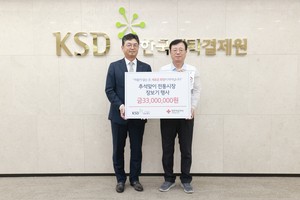
KSD Nanum Foundation donates W33m to help vulnerable families shop at traditional markets for chuseok
Warm gesture every holiday season — cumulative traditional market shopping support reaches 790 million won The Korea Securities Depository KSD Nanum Foundation is supporting vulnerable residents in Seoul in shopping at traditional markets ahead of chuseok. The foundation announced Wednesday that it donated 33 million won ($24,500) to the Seoul branch of the Korean Red Cross at its Seoul office on Tuesday to fund a chuseok traditional market shopping event. The donation will allow 220 households in Seoul — including elderly people living alone and grandparent-headed families — to each receive 150,000 won worth of Onuri gift vouchers for use at traditional markets. The shopping event is scheduled to take place at 23 traditional markets across Seoul before chuseok. Korean Red Cross volunteers will accompany each participating household on a one-on-one basis, helping with shopping and providing emotional support through conversation. The foundation has run its chuseok traditional market shopping support program every year since 2011, making this year the 16th consecutive edition. Last year, it donated the same amount of 33 million won to support 220 vulnerable households in Seoul. The number of participating traditional markets in Seoul has grown sharply, from 13 last year to 23 this year. The foundation holds the event in Busan for the Lunar New Year holiday and in Seoul for chuseok, supporting vulnerable families with holiday shopping while also contributing to the vitality of traditional markets and local economies. Including this year's contribution, the foundation's cumulative donations for traditional market shopping events have reached approximately 790 million won, benefiting more than 6,250 households over the years. "I hope our neighbors enjoy a bountiful chuseok," foundation Chairman Lee Yun-su said. "We will continue to make every effort to practice a spirit of sharing that strengthens our communities."
Sept. 16, 2026
-
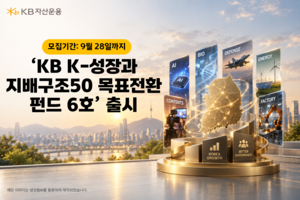
KB Asset Management launches sixth fund in K-Growth and Governance 50 target-return series
Fund targets key policy-backed sectors including AI, biotech, defense and energy Converts to bond-focused portfolio once 7% target return is reached KB Asset Management said Wednesday it has launched the "KB K-Growth and Governance 50 Target-Return Securities Investment Trust No. 6," a fund that concentrates its investments in stocks expected to benefit from government policy and deliver improved corporate value. The product is the latest in the "KB K-Growth and Governance 50 Target-Return Fund" series. The first three funds achieved their target returns ahead of schedule, while the fourth and fifth remain in operation. The sixth fund is a bond-mixed fund that selectively invests in stocks expected to gain from the government's priority "ABCDEF" initiative — covering AI, biotech, contents, defense, energy and manufacturing — as well as companies poised to benefit from improved corporate governance and expanded shareholder returns. On the equity side, the fund applies both quantitative and qualitative analysis to identify core companies within the ABCDEF industries and those benefiting from governance improvements, concentrating its holdings in roughly 20 to 30 stocks. The equity allocation can be raised to a maximum of 50 percent to enhance growth potential. On the bond side, the fund invests indirectly in short-term bond ETFs and money market funds that hold high-quality domestic bonds, securing stable interest income. The target return is set at 7 percent. Once the cumulative operating return for Class A units reaches 7 percent — equivalent to a cumulative net asset value of 1,070 won per unit — the fund will sell all equity-related assets and convert to a short-term domestic bond-focused portfolio to preserve the gains. It will then be managed around high-quality bonds with short durations to minimize interest rate risk. Beom Gwang-jin, head of KB Asset Management's pension wealth management division, said the structure — which pursues a target return in a volatile market and then converts to a bond portfolio once that target is met — "will be an attractive option for investors looking to reduce return volatility after locking in gains." KB Asset Management has been accelerating its new product launches in recent months. On Aug. 11, it released the "RISE US Space and Satellite Communications" ETF, which invests in 10 US companies across four segments: satellite manufacturing and launch, satellite communications equipment and networks, satellite communications services, and satellite data and services. Key holdings include SpaceX, Lumentum Holdings, Ciena and Rocket Lab. No single stock may exceed 25 percent of the portfolio, and weightings are rebalanced four times a year.
Sept. 16, 2026
-

Shinhan Securities sells out brokerage ISA repo product for third consecutive time
Limit exhausted within 10 business days Early redemption at contracted yield draws positive response Shinhan Securities said Wednesday that a special repurchase agreement product exclusively for customers of its Shinhan Premier brokerage ISA has sold out for the third consecutive time since its Sept. 1 launch. The product was designed for Shinhan Premier brokerage ISA customers. Following the first offering in May and the second in July, the third round in September brought total sales to 30 billion won ($22.3 million), with each 10 billion won tranche selling out within 10 business days of launch. The product is a 91-day term repurchase agreement offering a pre-tax annual yield of 3.65 percent. The contracted yield applies even upon early redemption, and the maximum purchase limit per customer is 20 million won. The company attributed the strong demand to a growing appetite for stable returns amid rising interest rate volatility and heightened attention to tax-saving products. It said the yield terms and the guarantee of the contracted rate upon early redemption were key factors in customers' decisions. The ability to manage a range of financial products within a single tax-advantaged account while also accessing repurchase agreement investment opportunities also drew a positive response, the company said. "All three special repurchase agreement offerings sold out within 10 business days, which showed us just how much interest and support our customers have shown," a Shinhan Securities official said. "We plan to continue introducing a variety of investment products and services that deliver real benefits to Shinhan Premier brokerage ISA customers."
Sept. 16, 2026
-
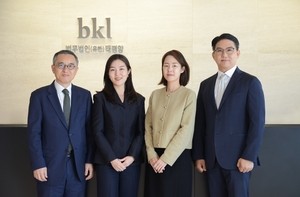
IPO bar rises as dual-listing rules reshape Korea's capital markets
[Interview with Bae, Kim & Lee's IPO team: Shin Hee-kang, Jung Hee-seok, Ha Young-jin, Hyun Ye-rim] Expanded regulation raises bar for subsidiary listings Group governance and parent shareholder impact require thorough review Best-efforts clauses and M&A among exit paths gaining traction The rollout of new dual-listing reform measures has sent shockwaves through Korea's capital markets. With the regulation's scope now extending beyond subsidiaries spun off through physical divisions to cover newly established or acquired subsidiaries and affiliates in vertical control relationships, companies are being forced to revisit M&A structures, pre-IPO investment arrangements and financial investor exit strategies that were built around the assumption of a subsidiary listing. Attorneys Shin Hee-kang, Jung Hee-seok, Ha Young-jin and Hyun Ye-rim of Bae, Kim & Lee's IPO team sat down Wednesday to discuss how the dual-listing regulation is reshaping Korea's capital markets and what strategies companies are adopting in response. Subsidiary IPOs evolve into 'governance transactions' — overseas listings also in regulators' sights The Bae, Kim & Lee IPO team said subsidiary IPOs have evolved into a form of "governance transaction." A subsidiary listing is no longer a standalone deal judged solely on the subsidiary's own listing eligibility — it has become a higher-order transaction that must account for the interests of the parent company's general shareholders and the capital allocation of the entire group. It is still too early to conclude that subsidiary IPOs are structurally declining, given that the reform measures only recently took effect, but the changes felt on the ground are significant. Companies are visibly revisiting the timelines and structures of planned subsidiary listings and working to flesh out shareholder protection measures for parent company investors. Shin, who leads the IPO team, said the dual-listing regulation "is operating less as an outright ban on subsidiary IPOs and more as a requirement to rigorously demonstrate the necessity of the listing and the adequacy of shareholder protections." He added that because parent company boards must now assess the listing's impact on shareholders and carry out shareholder communications, "changes to deal structure, preparation timelines and costs ahead of filing a preliminary review application have become unavoidable." Even listing an overseas subsidiary on a foreign exchange does not allow a company to fully escape the dual-listing regulatory net. The five core obligations — including a shareholder impact assessment and the preparation of protection measures — apply in principle regardless of where the listing takes place. While Korea Exchange cannot directly block an overseas listing, a domestically listed parent company that fails to fulfill those obligations could face sanctions. Hyun said overseas listings "come with a range of challenges, including meeting local listing requirements and schedules — governance included — filing registration statements, coordinating disclosure timing between Korea and the overseas market, and managing foreign exchange and tax risks." She added that while an overseas listing can be chosen as an alternative to a domestic one, "it cannot be seen as an easy option for circumventing the regulation." Pre-IPO contract terms shift — from guaranteed IPO to multiple exit paths The dual-listing regulation is also having a significant impact on investment contract terms across the capital market ecosystem. Pre-IPO investment contracts have traditionally required an IPO to be pursued and completed by a set date, with put options or return guarantees triggered in the event of failure. But as subsidiary listings have become harder to secure through the will of the company or its controlling shareholder alone, issuers and those seeking investment are increasingly inclined to adjust terms — replacing a firm commitment to complete an IPO by a specific date with a "best efforts" obligation. Moreover, because a failed IPO may now fall outside the control of the issuer or its largest shareholder, companies have little choice but to consider a broader range of exit paths, including attracting strategic investors, secondary transactions and M&A. Ha said future pre-IPO contracts will involve "more nuanced negotiations that set different trigger conditions and thresholds for investor protections such as put options, depending on whether an IPO failure stems from the controlling shareholder or the company itself, or from market conditions and regulatory changes." For deals already signed, there is a growing trend of revisiting IPO deadline extensions and existing put option and return guarantee clauses. When an IPO looks uncertain, parties are discussing realistic alternatives such as third-party sales, reinforcing drag-along rights and providing early liquidity on a portion of the stake. Ha said a structure in which a put option is triggered upon failure to complete an IPO "can become an unexpected financial risk for the parent company under the dual-listing regulatory environment," adding that "when exercising an option, one must comprehensively examine the parent company's financial soundness, whether the board has breached its duty of loyalty, and the fairness of the transaction terms." US biotech Ingenia lists on Kosdaq — attracting 'pure foreign companies' amid tighter rules As the bar for subsidiary listings rises, domestic securities firms and Korea Exchange have greater incentive to identify new listing candidates. Independent startups, family-owned businesses and foreign companies — entities less affected by dual-listing concerns — are emerging as prime targets. Against this backdrop, the recent Kosdaq listing of US biotech company Ingenia Therapeutics is drawing attention. Ingenia Therapeutics completed its Kosdaq listing on Aug. 18, and what sets it apart is that it is a "purely foreign company" — independently founded and grown in Boston — not an overseas subsidiary or affiliate of a Korean-listed company. Jung said Ingenia Therapeutics "was a case where domestic investors had a high level of familiarity, because while the company's business and R&D are centered in the United States, its core technology originated from KAIST and the Institute for Basic Science." He said the team focused on "harmonizing the governance and disclosure framework of the Delaware corporation with Korea Exchange standards, and on designing from scratch a Korean depositary receipt issuance and settlement structure based on US shares." The Bae, Kim & Lee IPO team agreed that improving the predictability of Korea Exchange's review process is the single most important factor in activating foreign company listings in Korea. They particularly advised adopting a "functional equivalence" perspective — recognizing that even when a foreign jurisdiction's rules differ in form from Korea's, they should be accepted if they offer the same substantive level of investor protection. Hyun said the real difficulty in listing foreign companies "often arises not from satisfying any single regulation, but from having to redesign articles of incorporation, board structures, committees and stock option schemes — already built to comply with the home country's law — to fit Korea's system in a way that Korea Exchange and Korean investors can understand." Jung said "there is a need to present predictable standards that allow companies to make maximum use of the governance and institutional frameworks already established under their home country's law, as long as there are no gaps in investor protection," adding that "an approach centered on the substantive level of investor protection, rather than formal identity, is important for attracting foreign companies." Shin noted that the Singapore Exchange recently introduced a system allowing companies listing on NASDAQ to simultaneously list in Singapore using only the disclosure documents filed for the NASDAQ listing and subsequent filings — without additional document reviews or disclosures. He said Hong Kong Exchange is also working to attract Korean companies under more relaxed standards, and that "domestic exchanges likewise need a more flexible shift in thinking to keep pace with these trends." A higher bar for IPOs — 'integrated strategy is the core competitive edge' Experts said the nature of IPO advisory work itself is changing since the regulation took effect. A piecemeal approach of simply checking listing requirement checklists has clear limitations. They said "integrated advisory" — covering not only the economic rationale for a listing and governance design, but also the alignment of interests between financial investors and general shareholders, as well as alternative financing and M&A structures in case an IPO falls through — has become essential. Shin said "it is increasingly important not only to review the legal and regulatory requirements of an IPO, but also to persuasively explain, through objective data and appropriate procedures, why the transaction is reasonable for both the company and its general shareholders." He added that the team works with corporate law and capital markets groups "to analyze individual precedents and applicable standards, and to help companies fulfill their shareholder protection obligations in accordance with proper procedures as they pursue a listing." Meanwhile, Bae, Kim & Lee's IPO team advises on the full range of initial public offerings — Kospi and Kosdaq listings for domestic and foreign companies, technology-exception listings, foreign company listings in Korea and pre-IPO investments. The team has advised on major IPOs including Samsung Biologics, LG Energy Solution and Big Hit Entertainment, and most recently handled the listings of K bank and Ingenia Therapeutics. The team has bolstered its IPO and capital markets advisory capabilities by bringing in foreign attorney Kim Hak-kyun, a former standing commissioner of the Financial Services Commission and former chairman of the Kosdaq Market Committee; senior specialist Kim Ki-yong, formerly head of the technology-listing review team at Korea Exchange's Kosdaq division; adviser Ra Seong-chae, a former executive director at Korea Exchange's Kospi division; and adviser Kim Kyung-kyu, formerly a department head at Korea Exchange's market surveillance division.
Sept. 16, 2026
-
JC Partners exits Goodrich after 4.5 years as founder buys back stake
Company valuation jumps from 350 billion to 600 billion won Founder exercises call option to reclaim control Deal seen as model private equity value-up in insurance sector Private equity fund manager JC Partners has completed its exit from general insurance agency Goodrich, selling its stake back to founder and CEO Han Seung-pyo roughly four and a half years after its initial investment. The exit caps a turnaround driven by financial restructuring, a revamped sales commission system and the development of the company's sales organization. JC Partners announced Wednesday that it had completed the sale of its Goodrich stake. The firm recovered 400 billion won ($297 million) from the transaction. The deal delivered a multiple on invested capital of 2.4 times and an internal rate of return of 21 percent, net of management and performance fees. JC Partners acquired roughly a 60 percent controlling stake in Goodrich — then known as Rich&Co — in 2022 for 185 billion won. Han, who founded the company, sold part of his stake to JC Partners while negotiating a call option allowing him to repurchase the shares four years later, and he remained involved in management throughout. Han formally notified JC Partners of his intention to exercise the call option in June, and the terms were finalized following an independent valuation and negotiations. Goodrich's enterprise value climbed from 350 billion won in 2022 to around 600 billion won this year. Han brought in Bayside PE and KL&Partners as financial investors to fund the buyback. JC Partners' investment in Goodrich drew attention as the first instance of a private equity fund acquiring a controlling stake in a general insurance agency. At the time, Goodrich was under mounting financial pressure — it had posted an operating loss of 16.1 billion won in 2021 — but JC Partners saw potential in the sector's growth trajectory and in Goodrich's brand strength and IT capabilities. After the acquisition, JC Partners injected 100 billion won in new equity while simultaneously paying down existing debt to shore up the balance sheet. It also overhauled the sales commission payment system. Working with primary insurers, Goodrich proactively introduced an installment-based commission disbursement model. Where it had been standard practice for agencies to pay out commissions received from insurers to agents in a lump sum, Goodrich switched to distributing payments across multiple tranches. The change reduced early cash outflows, stabilized monthly cash flow and encouraged agents to manage policies over the long term. The company also upgraded its proprietary IT platform, including the Goodrich app, to build a foundation for accumulating high-quality customer data in-house. It introduced an in-house training program called Financial Campus to develop agents with no prior experience, establishing a sustainable pipeline for sales force growth. The number of agents rose from 4,000 in 2022 to 6,000. Earnings improved sharply. Sales grew at a compound annual rate of 26.1 percent, rising from 321.3 billion won in 2022 to 644.6 billion won last year. Over the same period, operating profit swung from a loss of 2.7 billion won to a profit of 55.2 billion won. "After investing in Goodrich, we focused less on short-term top-line expansion and more on building a sustainable business structure and earnings base that could withstand future regulatory changes," a JC Partners official said. "Improving the financial structure and profitability while at the same time driving qualitative growth through proprietary IT capabilities and internal controls translated into a higher enterprise value and a successful exit — and that is what makes this investment meaningful."
Sept. 16, 2026
-
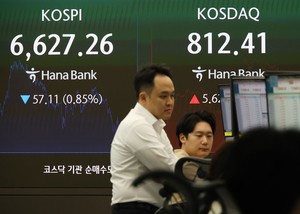
Kospi teeters near 6,600 as oil prices, US bond yields surge ahead of FOMC
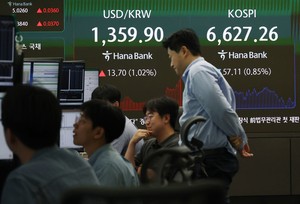
Oil prices, interest rates soar as Wall Street's three major indexes fall for second straight day Semiconductor shares hold up, but analysts warn of test for 6,600 support The Kospi is expected to remain in a cautious, wait-and-see mode Wednesday, with investors watching closely whether the benchmark index can hold the 6,600 line. While the recent string of losses has fueled talk of an oversold market, sentiment is likely to stay subdued amid a challenging macroeconomic backdrop and nerves ahead of the US Federal Reserve's policy rate decision, due in the early hours of Thursday Korean Standard Time. According to Korea Exchange, the Kospi closed at 6,627.26 on Tuesday, down 57.11 points, or 0.85 percent, from the previous session. Individual investors made net purchases of 831.9 billion won ($618 million) on the main board, but foreign and institutional investors sold a net 1.57 trillion won and 903.8 billion won, respectively, dragging the index lower. Foreign investors have now been net sellers on the Kospi for five consecutive sessions since Sept. 9. Analysts attributed the decline to a confluence of factors: a sharp rise in US Treasury yields and global oil prices, and growing concern over a potential slowdown in AI spending. In particular, the yield on the benchmark 10-year US Treasury note broke above the psychologically significant 5 percent threshold, chilling investor sentiment. It was the first time the yield had topped 5 percent since October 2023. Against this backdrop of external headwinds, Samsung Electronics fell 0.20 percent and SK hynix dropped 0.41 percent. Trading activity also dried up sharply as sentiment deteriorated, with the total value of transactions on the main board falling to 16.25 trillion won — a decline of 5.34 trillion won from Tuesday. "Early in the session, bargain buying in semiconductor stocks sparked a brief rebound, but with no bottom-up catalysts to sustain the move, fresh headwinds emerged — including clashes between Saudi Arabia and Houthi rebels — pushing oil prices higher, while the 10-year US Treasury yield broke back above 5 percent for the first time in roughly three years, dampening sentiment," said Kang Jin-hyeok, an analyst at Shinhan Securities. He added that with caution building ahead of the Federal Open Market Committee meeting, foreign investors had been net sellers of a combined 3 trillion to 4 trillion won per day in spot and futures for four straight sessions. The pressure from oil prices and bond yields carried over into overnight trading on Wall Street, where all three major indexes fell for a second consecutive day. The Dow Jones Industrial Average declined 0.63 percent, while the S&P 500 and the NASDAQ Composite fell 0.45 percent and 0.78 percent, respectively. Oil supply concerns intensified after Saudi Arabia's east-west pipeline was shut down following Houthi drone strikes, crude loading operations at the Yanbu terminal on the Red Sea were halted, and three oil fields in Libya were taken offline. November-delivery Brent crude futures settled up 2.90 percent at $108.75 a barrel, while October-delivery West Texas Intermediate rose 4.38 percent to $105.83 a barrel. The 10-year US Treasury yield climbed as high as 5.041 percent, its highest level since July 2007. AI-related stocks showed relative resilience on bargain hunting. Nvidia rose 0.57 percent and Micron gained 0.39 percent, while AMD climbed 2.19 percent. Seo Sang-young, a managing director at Mirae Asset Securities, said that if the Fed signals its September rate hike is not the start of a sustained tightening cycle, or if Fed Chair Kevin Warsh confirms that inflation is being driven by temporary oil price effects, long-term yields could stabilize and the equity market could regain its footing as uncertainty eases. The Kospi is expected to trade Wednesday caught between the perception that four straight sessions of losses have left the market oversold and lingering unease over the macro environment and the upcoming FOMC decision. Market sentiment indicators are sending mixed signals. The MSCI Korea ETF edged up 0.15 percent, while the MSCI Emerging Markets ETF fell 0.35 percent. The Philadelphia Semiconductor Index rose 0.40 percent, but the KOSPI 200 overnight futures slipped 0.17 percent. "Even as the consecutive declines this week have reinforced the view that the market is oversold, the rebound will likely be capped by the weight of rising US 10-year yields and oil prices stemming from macro uncertainty — keeping the market in a cautious, wait-and-see mode," said Han Ji-young, an analyst at Kiwoom Securities. Lee Kyung-min, an analyst at Daishin Securities, said the Kospi "is showing greater sensitivity to negative news than positive developments, with rate-hike fears running high ahead of the September FOMC." He added, however, that given a rate hike is already priced in, current bond yield levels appear to be near a peak while the equity market is approaching a trough — making the prospect of the 6,600 line holding as support still viable.
Sept. 16, 2026
-
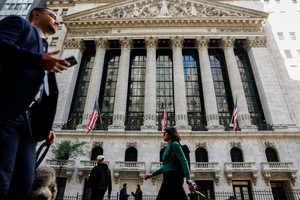
Wall Street falls for second day as oil tops $100, 10-year yield breaches 5% ahead of FOMC
Semiconductor stocks pare losses on bargain buying; big tech, consumer shares slide Market attention shifts to Fed's rate path after expected hike US stocks fell for a second straight session Tuesday as oil prices surged past $100 a barrel and the 10-year Treasury yield briefly topped 5% during trading. Renewed fears over inflation and a prolonged high-rate environment weighed on sentiment, with investors also growing wary of the possibility of further rate hikes even after the Federal Reserve's expected move at its meeting Wednesday. The Dow Jones Industrial Average dropped 328.09 points, or 0.63 percent, to close at 52,093.11 on Tuesday (local time). The S&P 500 fell 34.25 points, or 0.45 percent, to 7,585.73, while the NASDAQ Composite lost 204.84 points, or 0.78 percent, to finish at 25,981.57. Semiconductor stocks bucked the broader trend, rebounding on bargain buying after Tuesday's sharp selloff. Nvidia gained 0.6 percent and AMD rose 2.2 percent, as investors moved in to pick up chip shares hit hard by concerns over slowing AI development. Major big-tech names moved in the opposite direction, with Alphabet, Microsoft and Apple all finishing lower. Consumer-related stocks weakened on worries that high oil prices and rising interest rates would dampen spending. Chipotle and Dollar Tree each fell more than 5 percent. Virtual asset-related stocks also declined following the US Senate's failure to advance a crypto regulation bill, with Coinbase dropping more than 10 percent. Rising Treasury yields were a key drag on the market. The 10-year yield climbed as high as 5.041 percent during trading, its highest level since July 2007. As of 3 p.m., it stood at 4.995 percent, up 3.5 basis points from the previous session. The 30-year yield also rose, reaching 5.362 percent. Higher Treasury yields reduce the appeal of equities by lifting the return investors can earn from government bonds, which in turn raises the return they demand from stocks. Rising borrowing costs also weigh particularly on growth stocks, whose valuations rest heavily on expectations of future earnings. A sharp surge in oil prices added to rate concerns. West Texas Intermediate for October delivery settled up 4.38 percent at $105.83 a barrel, while Brent crude for November delivery rose 2.90 percent to $108.75 — the highest closing levels for both benchmarks since May 19. Supply worries intensified after disruptions hit Saudi Arabia's east-west pipeline and the Yanbu crude terminal on the Red Sea, compounded by a shutdown at Libyan oil fields. The oil rally adds to inflation pressure, complicating the Fed's rate decisions. Higher crude prices feed through to consumer prices via gasoline and transportation costs, and if inflation proves sticky, the Fed will find it harder to cut rates — raising the prospect of a prolonged high-rate environment. A rate hike at the September meeting is widely treated as a foregone conclusion. According to CME FedWatch, the probability of a 25-basis-point increase priced into the fed funds futures market on Tuesday rose to 94.5 percent. Against that backdrop, investor attention is shifting to whether additional hikes will follow and what the Fed's broader rate path will look like. In a recent Reuters survey of economists, 37 of 70 respondents — 53 percent — forecast at least one more rate increase by the end of March next year. Wednesday's Federal Open Market Committee meeting will also bring the release of the dot plot, which offers clues about the future rate path. The dot plot shows each FOMC member's projection for the benchmark interest rate going forward, with individual forecasts displayed anonymously, allowing markets to gauge the Fed's internal consensus by seeing where the dots cluster. Investors will parse both the dot plot and remarks by Fed Chair Jerome Powell for signals on the likelihood of further hikes after September and how long elevated rates may persist.
Sept. 16, 2026
-
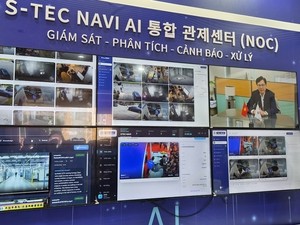
S-TEC System turns Vietnam into AI video surveillance testbed
AI screens real CCTV footage for theft, falls, fires and other anomalies Existing cameras kept in place to cut monitoring staff and boost efficiency Vietnam version already live; Korean edition targets year-end commercial launch S-TEC System, a South Korean integrated security and facility management company, is using its established Vietnam operations as a testbed for AI-powered video surveillance technology. The company feeds CCTV footage and incident data gathered at security sites into its AI development pipeline. S-TEC System, which has long deployed human guards and facility managers, plans to layer an AI-based video monitoring system on top of existing CCTV infrastructure to improve operational efficiency — letting the AI flag anomalies such as theft, falls and fires before a human operator ever sees them. At the company's booth at Secutech+ Vietnam 2026, held in Hanoi on Thursday, the centerpiece was the S-TEC NAVI AI integrated control center, or NOC. The hub aggregates CCTV feeds from multiple locations, runs AI analysis on the footage in real time and surfaces anomalies for operators. Access control, intrusion detection, fire detection and parking management can all be handled from a single system. A live demonstration at the booth showed the AI doing more than detecting movement. In one clip, a woman at a supermarket picked an item off a shelf and slipped it into her bag; the system tracked the action beyond the initial grab and classified the full sequence as theft. In another clip showing a worker smoking on camera, the AI identified the individual's face, cross-referenced the time against their scheduled shift and flagged the behavior as a workplace violation. The same smoking behavior by passersby in a separate clip drew no alert. The system integrates action, subject and context rather than reacting to motion alone. The AI also distinguishes situations that look similar at a glance, such as falls. Rather than triggering an alert simply because a person's position drops lower in the frame, the system analyzes the sequence of footage before and after the moment — so a person lying on a sofa scrolling through a phone is not misread as a collapse. It reads continuous video, not isolated frames. At the current stage of development, the AI can detect more than 20 types of anomalies, including theft, falls and fires. When it identifies an incident, it sends alerts to a control room and to managers' mobile phones, after which monitoring staff handle the response. The immediate goal is not to replace human operators but to let one person handle work that previously required two or three. Compatibility with existing cameras was a deliberate design choice to ease real-world deployment. Instead of installing new AI-dedicated cameras, the system connects software to existing CCTV hardware and control-room computers to add video-analysis capability. Facilities that already have cameras and a control room in place can adopt AI monitoring without replacing any hardware. S-TEC System's decision to use Vietnam as its AI testbed rests on a solid existing local business. Through its fire safety subsidiary S-TEC VINA, the company operates a production facility in Vietnam and supplies fire protection equipment to Samsung Electronics' research and development center, Lotte Mall and LG Group's production factory there. It later expanded into the security personnel business through a separate subsidiary, S-TEC SYSTEM VINA. Real footage and incident data collected at Vietnamese worksites serve as essential training data for AI development. Executive Vice President Lee Chung-yeon said Vietnam presents fewer legal restrictions on the use of surveillance footage for system development than South Korea does, giving the company an advantage in building out its AI capabilities there. Because the regulatory environment for AI development using real CCTV footage differs in South Korea, the company is developing a separate Korea-specific system. Domestically, a pilot program is underway at several sites with a target of commercial launch by year-end. Lee said S-TEC System's edge lies in nearly 20,000 incidents accumulated over decades, which allow the AI to analyze pre-crime behavioral patterns and anticipate incidents before they occur. He added that the company plans to roll out its business in line with a phased roadmap for developing an integrated AI monitoring system. S-TEC System is also pursuing an initial public offering. The company filed a preliminary listing application with Korea Exchange for a Kospi listing in August. Proceeds are expected to go toward operating costs, facility investment and research and development.
Sept. 16, 2026
-

Concentrated AI ETFs reshape South Korea's fund market
Under the sweeping theme of AI, South Korea's ETF market is evolving toward ever-narrower portfolios concentrated in a handful of stocks. Products with as few as 10 holdings — where the top two names alone account for half the portfolio — are arriving in rapid succession. Investors should exercise caution, however, as the highly concentrated structure can amplify losses during downturns or corrections when individual stocks swing sharply. Four AI and semiconductor-themed ETFs listed simultaneously Tuesday, according to the financial investment industry: Samsung Asset Management's KODEX US AI Memory TOP2 Plus, NH-Amundi Asset Management's HANARO US Agentic AI TOP2+, and Hanwha Asset Management's PLUS Korea HBM Semiconductor and PLUS AI Semiconductor Materials & Components Active. What stands out is how these products are built. Three of the four allocate 50 percent of their portfolios to just two stocks. KODEX US AI Memory TOP2 Plus holds SanDisk and Micron at 25 percent each; HANARO US Agentic AI TOP2+ holds Microsoft and Alphabet at 25 percent each; and PLUS Korea HBM Semiconductor holds Samsung Electronics and SK hynix at 25 percent each. All three fill the remaining 50 percent across eight stocks, keeping total holdings at no more than 10. ETF listing rules require a minimum of 10 holdings, and these products do just enough to meet that threshold — making them, in effect, vehicles for concentrated bets on a small number of names. KODEX US AI Memory TOP2 Plus allocates the remaining 50 percent across eight major memory chip companies, including Western Digital and Seagate. HANARO US Agentic AI TOP2+ selects its remaining holdings from agentic AI-related companies divided into two categories — large language models and AI hardware and infrastructure — compressing the total portfolio to 10 stocks. PLUS Korea HBM Semiconductor fills its remaining 50 percent with domestic equipment, materials, components and substrate companies involved in HBM and memory chip production, excluding Samsung Electronics and SK hynix, also capping the portfolio at 10 stocks. The pattern is clear: under the broad AI umbrella, fund managers are slicing the theme into ever-finer sub-segments — memory, agentic AI, HBM, materials and components — and then concentrating further within each segment on the top names. Concentrated ETFs have been consistently gaining ground. According to a research note on ETF strategy published by Mirae Asset Securities, the share of net assets held by "concentrated" Korean equity ETFs — those with between one and 20 holdings — nearly doubled from 20 percent in 2024 to 38 percent as of the end of August this year. As ETF holdings in individual stocks have grown larger, ETF rebalancing has begun to drive short-term supply-demand dynamics and performance for those stocks. When SK Square was reclassified from "diversified industrials" to "semiconductors and related equipment" under FnGuide's sector taxonomy, it was added to 25 ETFs between June 12 and July 2, and the rebalancing process channeled 6.1 trillion won ($4.53 billion) in net ETF inflows into SK Square in roughly 20 days. Over the same period, foreign investors net sold 5.9 trillion won of the stock, yet the share price still rose 24.2 percent. "ETF buying from the inclusion offset foreign selling during that period," said Yoon Jae-hong, a researcher at Mirae Asset Securities. "It is a case where short-term relative outperformance was observed during the ETF inclusion and rebalancing inflow process." Some in the industry warn that the ultra-concentrated design is a double-edged sword. Riding the right stock within a targeted sector can generate returns well above the broader index, but a single piece of bad news hitting a top holding can send the entire ETF sharply lower. KODEX AI Semiconductor TOP2 Plus posted a one-year return of 218.97 percent, but its three-month return has fallen to minus 23.94 percent as market volatility has increased. TIGER Semiconductor TOP10 similarly recorded a one-year gain of 165.25 percent, while its three-month return stood at minus 34.61 percent. "Individual stock trading feels risky because of single-stock setbacks and volatility, but a plain vanilla ETF spread across dozens of names makes it hard to fully capture a rally in market leaders — this is where retail demand and asset managers' strategies have converged," said an official at one asset management firm. "That said, investors should be aware that in a volatile environment, the drawdown can be steeper than with an index fund."
Sept. 15, 2026
-
Seven in 10 low-PBR firms yet to disclose value-up plans ahead of November listing
Korea Exchange begins notifying listed firms of low-PBR status Monday; first public list due Nov. 2 Samsung Securities estimates 146 of 203 expected candidates have yet to file value-up disclosures Companies face a dilemma: public naming as low-PBR firms, or committing to targets they must keep With the first public list of low price-to-book ratio companies set to be released in November, seven out of 10 firms expected to appear on it have yet to disclose corporate value enhancement plans. Listed companies find themselves in a bind: avoiding the low-PBR list requires filing such a plan, but doing so means committing to medium- and long-term targets that shareholders will expect them to meet. According to the financial investment industry, Korea Exchange began Monday allowing listed companies to check whether they meet the low-PBR criteria through its listed-company disclosure submission system. Companies can log in with their disclosure officer's account to view only their own low-PBR status and sector-level PBR figures — not those of other firms. The system displays low-PBR eligibility calculated as of each May and November. While only the individual company can currently see its own results, the full list of low-PBR firms will be made public starting Nov. 2. Korea Exchange plans to identify qualifying Kospi and Kosdaq companies and post the list on KIND, its corporate disclosure platform. It will be the first time such a list has been released to the public. Low-PBR firms are selected by market and Global Industry Classification Standard sector. Companies that have ranked in the bottom 25 percent on Kospi or the bottom 10 percent on Kosdaq for all six half-year periods over the past three years are included. The most recent PBR figure used for the Nov. 2 list will be calculated using net assets from this year's half-year reports and the average market capitalization over 20 trading days from Sept. 21 through Oct. 22. There is a way off the list: companies that meet the low-PBR threshold can be excluded from the public disclosure if they file a corporate value enhancement plan and attach a separate "PBR improvement plan" by Oct. 22. Most expected candidates, however, have yet to act. A review of disclosure records for 204 low-PBR candidates identified by Samsung Securities through its own simulation in late July found that only 57 of the 203 remaining companies — after excluding delisted Syswek — had filed a full corporate value enhancement disclosure, accounting for 28.1 percent. The remaining 146, or 71.9 percent, had not filed as of Tuesday. For companies, appearing on the low-PBR list is a burden, but so is filing a value enhancement plan to avoid it. A strategy planning official at one listed company said that even in disclosure education sessions, the public naming of low-PBR firms was described as a form of "public shaming." "Being selected does not result in sanctions, but having your company's name appear on KIND in an unflattering context is itself a burden," the official said. Among practitioners at listed companies, there are also concerns that appearing on the list could signal to the market that a company has given up on managing its share price. On the other hand, filing a value enhancement plan means the company must continually be mindful of whether it is living up to the goals and commitments it has made to shareholders. An official at another listed company said: "Once you disclose a value enhancement plan, the company has no choice but to work toward fulfilling it, and whether you follow through becomes critical. Since it is something announced to shareholders, failing to deliver invites criticism — and that is a burden for the company." However, a company will not be designated as an insincere disclosure entity simply for failing to meet the targets set out in its plan. A Korea Exchange official explained that missing a self-set target alone is not grounds for such a designation, and that companies may be exempt from insincere disclosure rules if they provide a reasonable basis for their projections and follow the disclosure procedures for forward-looking information under exchange regulations. Value enhancement measures are also not limited to shareholder returns. Companies may propose research and development investment, profitability expansion or growth initiatives. A Korea Exchange official said the appropriate approach to value enhancement may differ depending on a company's characteristics, stage of growth, sector and market strategy, adding that companies need to fully explain to shareholders and investors the reasons and objectives behind decisions such as increasing shareholder returns or expanding investment.
Sept. 15, 2026
-
Goldman Sachs PE unit closes West Street Capital Partners IX fund
Global PE unit raises about $11.7 billion in total 'Will identify differentiated investment opportunities' Goldman Sachs' alternative investments private equity unit said Tuesday it has completed fundraising for West Street Capital Partners IX (WSCP IX) and related investment vehicles, reaching a total of $9.6 billion. Goldman Sachs also said it has raised more than $1.6 billion through West Street Asia Equity Partners I (WSAEP I), a dedicated Asia-Pacific private equity strategy, and secured an additional $500 million through related co-investment vehicles. WSAEP I is a pan-Asia strategy focused on control buyouts and growth investments in the mid-market across the region. Combined, Goldman Sachs' global PE unit has raised approximately $11.7 billion on a vintage basis. WSCP IX is the ninth vintage of Goldman Sachs' alternative investments flagship buyout platform. The investment team has deployed more than $89 billion globally since 1986, working alongside companies and management teams to drive growth. Capital for the fund was raised from a diverse group of institutional and high-net-worth investors across North America, Europe and the Middle East, with Goldman Sachs and its employees also participating in significant size. WSCP IX will continue the firm's existing strategy of targeting high-quality mid-sized companies through control buyouts. The fund plans to invest across the services, financial, technology, healthcare, consumer and energy transition sectors, drawing on deep industry expertise. The fund has already deployed capital into a range of companies across geographies and industries, including Schellman, a US cybersecurity audit and certification services firm; Numantec, a European manufacturer of medical devices for intravenous infusion and vascular access; Excel Sports, a US independent sports management and marketing agency; and Mace, a Europe-based global project management services company. Portfolio companies will have access to the GS Value Accelerator, Goldman Sachs' proprietary platform that provides a network of world-class operational advisers and specialists. The platform supports companies across technology, data and AI transformation, sales expansion, talent strategy and operational efficiency. Brad Gross, global co-head of Goldman Sachs' alternative investments PE unit, said the close allows the firm to build on its reputation as a leading private equity platform. "We will leverage Goldman Sachs' global network and expertise to identify differentiated investment opportunities and accelerate value creation across our portfolio companies," he said. Michael Bruun, global co-head of Goldman Sachs' alternative investments PE unit, said the firm is prepared to execute a resilient investment strategy amid macroeconomic and geopolitical shifts. "We will actively draw on our extensive resources and expert network to help portfolio companies successfully navigate the ongoing AI transformation," he said. Meanwhile, Goldman Sachs' alternative investments division earlier this year demonstrated its deployment capabilities by acquiring a 100 percent stake in Burger King Japan from Affinity Equity Partners for 78.5 billion yen ($509 million).
Sept. 15, 2026
-
KRX after-hours market hit by volatility on day one, with circuit breakers firing 1,600 times
VI triggers surge to 4 times regular-session rate Mid- and small-cap stocks see thin order books Korea Exchange says overall price formation was stable Korea Exchange's newly launched after-hours market was swept by intense volatility from its opening session, with circuit breakers firing more than four times as often as during regular trading hours as thin order books — concentrated in mid- and small-cap stocks — sent some share prices surging more than 20 percent on small orders alone. Static and dynamic volatility interruption mechanisms, known as VI, were triggered a combined 1,637 times on the Kospi and Kosdaq during the KRX after-hours market's inaugural session Monday, which ran from 4 p.m. to 8 p.m., according to Korea Exchange. That was more than four times the 400 triggers recorded during the regular session, which runs from 9 a.m. to 3:30 p.m. The VI mechanism temporarily switches individual stocks to single-price auction trading for about two minutes when prices move sharply in a short period. The dynamic VI activates when a price moves more than 3 to 6 percent from the most recent execution price, while the static VI kicks in when a price deviates more than 10 percent from the single-price reference. Many of the stocks with the highest VI trigger counts had market capitalizations of around 30 billion won ($22.3 million). SG Healthcare was a notable case: the stock closed at 1,787 won during the regular session Monday, then climbed to 2,080 won — a gain of 16.85 percent — around 4:20 p.m., shortly after the after-hours market opened, briefly recovering a high it had last reached about a month earlier. The number of stocks available for after-hours trading expanded to 2,459 with the KRX after-hours market launch, up from the 606 previously accessible through the NXT after-hours platform. With trading extended to a broader range of mid- and small-cap stocks and relatively few market participants, the gap between regular-session and after-hours prices jumped more than 20 percent even on small orders. Some investors voiced concern that price volatility could worsen going forward, while others complained about the inconvenience of the KRX after-hours market. One source of friction is the different opening times: the NXT after-hours session begins at 3:40 p.m., while the KRX session starts at 4 p.m. Korea Exchange issued a press reference note Tuesday afternoon, saying that while volatility had risen for some stocks, "prices were formed stably overall." By stock-level high-low volatility, the Kospi's regular session came in at 4.1 percent versus 2.9 percent for the after-hours market, while the Kosdaq showed 5.8 percent in the regular session and 4.6 percent in after-hours trading, the exchange said. Excluding cases where static and dynamic VI triggered simultaneously, the exchange counted 391 VI activations during the regular session and 1,112 during the after-hours session Monday. "After-hours markets generally apply more relaxed trigger thresholds than regular sessions because liquidity is lower and volatility can be higher, but we set the same standards as the regular session to ensure stable operations," Korea Exchange said. The exchange added that it would "closely monitor market conditions, actively gather market feedback, and focus on ensuring the after-hours market takes firm root."
Sept. 15, 2026
-

Bond-equity ETFs wobble as US yields climb
Bond-equity ETFs, which grew on the back of demand from retirement pension accounts, are losing their defensive edge. Rising interest rates have pushed bond prices lower, and a simultaneous equity market correction has weakened the diversification benefit of holding both asset classes together. According to Korea Exchange data released Tuesday, the ACE US S&P500 Bond Mixed 50 Active ETF fell 6.03 percent over the past month — a decline 4.38 percentage points steeper than the S&P 500 index's drop of 1.65 percent over the same period. The KODEX 200 US Bond Mixed 50 ETF slid 5.8 percent, outpacing the KOSPI 200's decline of 1.91 percent. The TIGER US NASDAQ 100 Bond Mixed 50 ETF fell 4.59 percent, or 2.33 percentage points more than the NASDAQ 100's drop of 2.26 percent. Bond-equity ETFs hold both stocks and bonds to reduce portfolio volatility. Single-stock bond-equity ETFs can allocate up to 30 percent of their holdings to equities. Domestically listed examples include the KODEX Samsung Electronics Bond Mixed ETF and the ACE Nvidia Bond Mixed ETF. Index-tracking bond-equity ETFs can raise their equity allocation to as much as 50 percent. A relaxation of retirement pension regulations at the end of 2023 lifted the equity cap for index-type bond-equity ETFs from 40 percent to 50 percent. The KODEX 200 US Bond Mixed 50 ETF holds the KOSPI 200 and US 10-year Treasury futures in a 50-50 split. The TIGER US NASDAQ 100 Bond Mixed 50 ETF likewise divides its holdings equally between the NASDAQ 100 and government bonds. Bond-equity ETFs are designed to reduce volatility by exploiting the historically low correlation between stocks and bonds. Recently, however, inflation fears and concerns over deteriorating fiscal positions in major economies have pushed interest rates higher, causing stocks and bonds to fall together more frequently. As the correlation between the two asset classes has risen, the diversification benefit has weakened — bonds have failed to cushion equity losses, and some bond-equity ETFs have posted steeper declines than the underlying stock indexes. Products holding US Treasuries have been hit particularly hard. According to Investing.com, the yield on the 10-year US Treasury note climbed above 5 percent during trading Monday (local time), up from 4.69 percent on Aug. 14. When yields rise, existing bond prices fall, as newly issued bonds offer higher rates and make older, lower-yielding bonds less attractive. Surging Treasury yields also weigh on equity markets. When the yield on US Treasuries — the benchmark safe-haven asset — approaches 5 percent, the relative appeal of riskier equities diminishes. Park Woo-yeol, a researcher at Shinhan Securities, said at a press briefing at Korea Exchange in Yeouido, Seoul, that the classic 60-40 stock-bond strategy "is an old theory that no longer works well in today's market." He added: "There was an expectation that bonds would provide a buffer when stocks fell, but recently we are seeing stocks and bonds rise together and fall together." The bond-equity ETF market has expanded rapidly this year. According to Korea Exchange, the number of bond-equity ETFs — excluding target-date fund ETFs — stood at 66 as of Friday, with net assets totaling 18.55 trillion won ($13.8 billion), up nearly 12 trillion won from 6.89 trillion won at the start of the year. The range of products has also broadened. Six bond-equity ETFs combining Samsung Electronics or SK hynix shares with bonds have listed this year alone, and products pairing Kosdaq index exposure with bonds have recently entered the market as well. The growth of bond-equity ETFs has been driven by the expansion of the retirement pension market. According to the Financial Supervisory Service, retirement pension reserves reached 501.4 trillion won at the end of last year, surpassing 500 trillion won for the first time after growing by about 70 trillion won from the prior year-end. Defined-contribution and individual retirement pension accounts are subject to a 70 percent cap on risky asset investments. Qualifying mixed-asset products with an equity allocation of 50 percent or below are classified as safe assets and can be held at up to 100 percent of a retirement account's balance. Investors who have maxed out the 70 percent risky-asset limit have increasingly turned to bond-equity ETFs to deploy the remaining 30 percent, accelerating inflows into the segment. The ETF market has absorbed demand from retirement pension investors seeking to maintain equity exposure while using bonds to dampen volatility. An official at one asset management firm said investors should look beyond the equity allocation ratio when evaluating these products. "Since these are used as safe assets within retirement pension accounts, you also need to examine what bonds are held and how sensitive the product is to changes in interest rates," the official said.
Sept. 15, 2026
-
FSC chief warns of rising financial market volatility, vows stronger stability measures
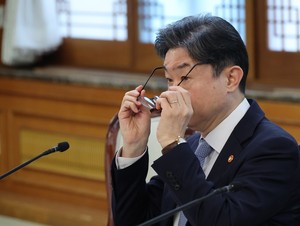
Meeting with German Bundestag finance committee 'Growth and financial stability must go hand in hand' Capital markets, digital finance cooperation also discussed Financial Services Commission Chairman Lee Eok-won said Tuesday that volatility in South Korea's financial markets has been rising amid shifting external conditions, including higher global interest rates, and that authorities are proactively reviewing risk factors and strengthening their market-stability response framework. Lee made the remarks during a meeting Tuesday at Government Complex Seoul in Jongno-gu with Christian Görke, chairman of the German Bundestag's finance committee, and six other members of the lower house, according to the FSC. The German delegation said it had visited South Korea to share experiences and draw lessons from the two countries' similarities — both have manufacturing- and export-driven economies and face comparable structural challenges such as low growth and demographic change. Lee said overhauling the financial system in response to structural shifts was critical, particularly in identifying new growth sectors capable of generating future value and ensuring that the necessary funding reaches them in a timely manner — what he described as the role of "productive finance." He went on to say that South Korea is expanding capital supply to future growth sectors through vehicles such as the National Growth Fund, while also pursuing regulatory reforms to develop the capital markets into a platform for innovation and growth. Lee added that, as rising global interest rates and other external changes continue to fuel volatility in domestic financial markets, authorities are proactively checking risk factors and reinforcing their response framework to prevent market instability from spreading across the broader financial system. Both sides agreed that effectively addressing the shared challenge of growing financial market uncertainty requires a policy approach that balances economic growth with financial stability, as well as close international cooperation.
Sept. 15, 2026
-

Heyholder claims credit for W65.4b shareholder return at Infinitt Healthcare
Infinitt Healthcare discloses cash dividend plan Result of 16-month campaign involving lawsuits and proxy battles Shareholder activism platform Heyholder said Tuesday it had secured a 65.4 billion won ($48.6 million) shareholder return from Kosdaq-listed Infinitt Healthcare, exceeding 30 percent of the company's market capitalization. According to Heyholder, Infinitt Healthcare on Friday disclosed its "2026–2027 cash dividend plan and shareholder return policy," committing to three rounds of cash dividends totaling 2,681 won per share, or 65.4 billion won in all. Heyholder said the outcome was the result of an intensive 16-month shareholder campaign aimed at resolving chronic undervaluation. Infinitt Healthcare had gone without dividends for more than a decade despite holding more than 120 billion won in retained earnings, while paying its largest shareholder, Solbon, hundreds of billions of won in management consulting fees since 2016. In response, Heyholder pursued more than 10 lawsuits and waged proxy battles at annual general meetings to normalize the company's governance. Heyholder said the result completes a clean sweep of shareholder value improvements across all three Kosdaq campaigns it has directly led. Earlier, at INFOvine, it rallied an 18 percent stake to push through a buyback worth about 24.2 billion won, more than tripling the share price. At Komelon, it passed a 40.5 billion won share buyback resolution through a proxy fight at the annual general meeting. "This shareholder return was not a unilateral decision by management — it is the result of minority shareholders banding together and consistently making their voices heard," said Heo Gwon, chief executive of Heyholder. "It carries great significance in that capital long locked inside the company is now being rightfully returned to shareholders." Heyholder also said Seoul Southern District Court had ruled that Infinitt Healthcare's invalidation of electronic proxies at an extraordinary general meeting was unlawful. According to Heyholder, the court on Aug. 24 voided a resolution passed at Infinitt Healthcare's extraordinary general meeting in June 2025 that had amended the company's articles of incorporation to tighten auditor eligibility requirements.
Sept. 15, 2026
-
Kospi falls for 4th straight session, retreating to 6,600s despite aftermarket debut
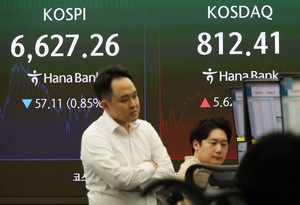
Foreigners net sellers for 5 consecutive sessions Wall Street decline dampens investor sentiment Kosdaq rebounds after 3-session losing streak Aftermarket volatility concerns mount The Kospi ended lower Tuesday after a volatile session, closing in the 6,620s as high oil prices and rising interest rates weighed on investor sentiment — even as the Korea Exchange launched its aftermarket for the first time Monday, opening the door to after-work stock trading. The Kospi closed at 6,627.26, down 0.85 percent from the previous session, according to Korea Exchange. It was the fourth consecutive session of losses since Thursday. The index opened down 0.38 percent at 6,659.25, fluctuated near the flat line, then turned lower. At one point during the session it slid as far as 6,582.2, a decline of 1.53 percent. Samsung Electronics, the largest stock by market cap, closed at 248,500 won ($185), down 0.20 percent. The stock opened at 248,000 won, briefly surged as much as 1.41 percent to 252,000 won in early trading, then reversed course in the afternoon. SK hynix, the second-largest by market cap, closed down 0.41 percent at 1.69 million won. It had risen as much as 2.73 percent to 1.729 million won at its intraday high, but like Samsung Electronics quickly gave back its gains in the afternoon. Overnight losses across all three major Wall Street indexes weighed on domestic investor sentiment Tuesday. The Dow Jones Industrial Average fell 0.29 percent and the S&P 500 dropped 0.48 percent, while the NASDAQ Composite declined 0.56 percent. The moves came after Saudi Arabia shut down its key East-West Pipeline, stoking fears of a supply disruption and sending crude oil prices sharply higher. The yield on the 10-year US Treasury note — a global benchmark — also surged past the psychologically significant 5 percent threshold ahead of the Federal Reserve's benchmark interest rate decision, marking the first time it has crossed that level since October 2023. Concerns about a slowdown in AI spending added further pressure on technology stocks. On the Kospi market Tuesday, foreign investors and institutions net sold 1.57 trillion won ($1.17 billion) and 904.9 billion won, respectively, while retail investors net bought 833 billion won. Foreign investors have been net sellers on the Kospi for five consecutive sessions since Wednesday. Other corporations — which have emerged as a major market force recently on the back of large-scale share buybacks by Samsung Electronics and SK hynix — net bought 1.64 trillion won. The Kosdaq, meanwhile, closed up 0.70 percent at 812.41, snapping a three-session losing streak to rebound for the first time since Thursday. Top-cap stocks Alteogen (up 0.19 percent), Ecopro (up 3.07 percent) and Ecopro BM (up 2.89 percent) all finished higher. Retail investors net sold 140.5 billion won, while foreign investors and institutions net bought 23.8 billion won and 111.4 billion won, respectively. Korea Exchange launched its aftermarket for the first time Monday, running from 4 p.m. to 8 p.m. Trading value on the inaugural session reached 1.8 trillion won, with volume of 72.24 million shares — equivalent to 6.6 percent of the exchange's total trading value of 27.6 trillion won that day. Price swings were sharp, however: the static and dynamic volatility interruption mechanism was triggered 1,637 times — roughly four times the 400 activations recorded during regular trading hours from 9 a.m. to 3:30 p.m. With the number of tradable stocks significantly expanded but capital inflows relatively thin, bid-ask spreads widened for small- and mid-cap stocks, and some investors voiced concern about the elevated volatility. Technical glitches at several brokerages before the aftermarket opened caused inconvenience for investors, though the issues have since been resolved. At Mirae Asset Securities, queries for Nextrade pre-market trading history were delayed on both its home trading system (HTS) and MTS. Samsung Securities also experienced failures to reflect cancellation and correction orders, as well as errors in deposit balances. "In the morning, buying by retail investors and other corporations helped support the index, but macro conditions deteriorated further and buying pressure weakened," said Lee Kyung-min, an analyst at Daishin Securities. "There were no new negative catalysts, but further rises in interest rates and oil prices eroded the appetite of bargain hunters."
Sept. 15, 2026
-

Taesuk Optical files for Kosdaq listing in first for domestic eyewear brand
Average annual sales growth of 115% over past 3 years Seongsu flagship store to anchor expansion into China, Asia and North America Taesuk Optical has filed a preliminary listing review application with the Korea Exchange, seeking to become the first domestic eyewear brand company to list on the Kosdaq. The eyewear and fashion product manufacturer and retailer said Tuesday it submitted the application for a Kosdaq listing on Monday. Founded in 2015, Taesuk Optical has built its eyewear business on experience accumulated in manufacturing and retail. The company has pursued a strategy of responding to market trends and consumer demand through rapid product planning and sourcing capabilities. The company currently operates its own brands — VIEWMAP and SUPPORT LIGHT — as well as acquired trademark brands BRERA and HARRY MASON. It has also secured distribution licenses for global fashion eyewear brands including Vera Wang, Tumi, Anna Sui, Maje and AllSaints, expanding its footprint in the global fashion eyewear segment. More recently, the company has been diversifying its product lineup in the broader fashion industry, drawing on capabilities built through its eyewear business. This strategy has driven average annual sales growth of 115 percent over the past three years. The company has built a brand portfolio spanning its own labels, licensed brands and global names to address demand across a wide range of age groups and price points. Its sales channels have expanded from home shopping to department stores, duty-free shops, online malls and a directly operated flagship store in Seongsu. The company plans to tailor its sales strategy to the characteristics of each channel's customer base, boosting both brand competitiveness and overall sales. Taesuk Optical is also stepping up its offline presence in South Korea. Using the Seongsu flagship store — which opened in December last year — as a base, the company plans to extend its offline reach into key commercial districts and create spaces where both domestic consumers and foreign visitors can experience its brands directly. "Under the management philosophy of 'not following the market but creating it,' we have proactively identified consumer demand and translated it into products and brands," a company official said. "We will continue to build a sustainable growth foundation in the eyewear and fashion industries, backed by our proven brand management systems and product planning capabilities." Separately, the Korea Exchange's Kosdaq Market Division said Monday it had also received preliminary listing review applications from two other companies, including C&M. C&M manufactures electric motors, generators, and electrical conversion, supply and control equipment; it posted consolidated sales of 238.5 billion won ($177 million) and operating profit of 21.3 billion won last year, with Korea Investment & Securities serving as its listing arranger. Activeon, which primarily produces antiseptic and preservation solutions, recorded consolidated sales of 33.5 billion won and operating profit of 1.6 billion won last year.
Sept. 15, 2026
-
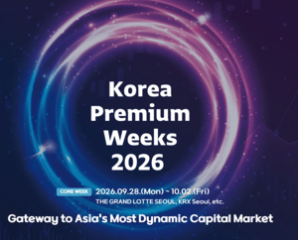
South Korea to launch first 'Korea Premium Weeks' capital market event
Three-week event from Sept. 28 brings BlackRock, Goldman Sachs together Samsung Electronics, SK hynix among flagship corporate IR sessions Korea Premium Weeks 2026, the country's first consolidated capital market event of its kind, will be held from Sept. 28 through Oct. 16. The event brings together investor relations sessions and conferences that had previously been held separately by individual institutions, consolidating them into a single concentrated program. Organizers plan to make it a recurring annual event. The Financial Services Commission announced Tuesday that the event will proceed under the slogan "Gateway to Asia's most dynamic capital market." Co-organized by the FSC and Korea Exchange, it is the largest capital market IR event ever held in South Korea, with 42 institutions — including stock market-related bodies, financial investment firms and media organizations — and 55 listed companies taking part. The decision to consolidate the events reflects moves by rival markets. Japan has held "Japan Weeks" under the Financial Services Agency since 2023, and Taiwan launched "Taiwan Weeks" under its Financial Supervisory Commission last year. About 25 events are scheduled over the three weeks. The first week, the core period, will feature a global conference for institutional investors. Opening with a launch ceremony and policy sessions on Sept. 28, the conference will cover capital market reform, progress and future direction on corporate governance improvements, and foreign exchange market reform. Speakers at the opening ceremony are expected to include Itoh Yutaka, commissioner of Japan's Financial Services Agency; Joud Abdel Majeid, co-head of BlackRock's Global Partners Office; and Kevin Sneader, Goldman Sachs' president for Asia-Pacific. Other prominent figures from global financial markets are also set to attend, including representatives from the UN Principles for Responsible Investment, NASDAQ, S&P, Dow Jones Indices and the Asia Securities Industry and Financial Markets Association. On Sept. 29, discussions will cover the vision and challenges for a Korea premium era, capital market infrastructure modernization — including extended trading hours and a shorter settlement cycle — and measures to strengthen Kosdaq's competitiveness. IR sessions and one-on-one meetings with flagship listed companies, including Samsung Electronics and SK hynix, will also be held that day. A closed-door roundtable involving more than 10 pension funds, sovereign wealth funds, and global long-short and hedge funds will also take place. Sept. 30 will feature a retail investor-focused program in which market experts offer guidance on asset management, along with seminars by securities industry officials. On Oct. 1, Korea Exchange will host its fair-market forum focused on eradicating unfair trading and protecting investors. On Oct. 2, Busan will host a derivatives and maritime finance seminar as well as The Herald Business's "Money Festa," where personal finance experts and seasoned investors will gather to discuss strategies for growing assets through real estate, shares, virtual assets and other investment products. In the second week, a market assessment seminar on Kosdaq revitalization and IR events for Konex- and Kosdaq-listed companies are planned. The third week will be led by private-sector financial firms — domestic securities companies and asset managers — along with a global bond market forum. The FSC said it plans to run the event as a regular fixture going forward, expressing hope that it will become South Korea's flagship annual IR and global conference for the capital markets.
Sept. 15, 2026
-
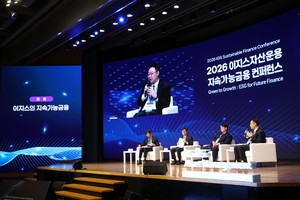
IGIS Asset Management holds inaugural sustainable finance conference
CEO Cho Kap-ju: 'Time to talk about what we will do' IGIS Asset Management held the 2026 IGIS Asset Management Sustainable Finance Conference on Monday at the Korea Chamber of Commerce and Industry's international conference hall in Jung-gu, Seoul. It was the company's first public event focused on environmental, social and governance issues. The conference was held under the theme "Green to Growth: ESG for Future Finance" and drew corporate social responsibility officers, academics and legal professionals. "We are past the stage of asking why we should do this — it is now time to talk about what we will do," Chief Executive Officer Cho Kap-ju said. "Sustainability is no longer a separate activity for doing good; it is becoming a factor that determines investment decisions, risk management and asset value itself." In a keynote address, Lee Hyeon-jong, head of corporate culture at IGIS Asset Management, introduced the firm's ecological social contribution activities and sustainable finance strategy. "In a borderless global financial competition, the standard for judging a partner is trust, and ESG is the language that demonstrates that trust," he said. The first session featured Moon Seong, a partner attorney at law firm Yulchon, presenting on ESG policy and regulation for financial companies, and Jeong Seung-tae, a center director at Daeshin Economic Research Institute, presenting on Korea's transition finance guidelines. Kang Sin-gu, director of the National Sejong Arboretum, outlined the direction for environmental social contribution in the era of biodiversity and Task Force on Nature-related Financial Disclosures reporting. In the second session, Oh Tae-seok, head of the infrastructure division at IGIS Asset Management, presented on investment strategies for data centers involving renewable energy and battery energy storage systems. Ban Jae-hwan, chief risk officer, presented a case study on the firm's proprietary system for quantifying risk in alternative investment funds. A panel discussion also took place with the participation of Jeong Byeong-uk, a professor at the University of Seoul, and Kim Sun-sin, managing director at Legal Times. IGIS Asset Management has also posted strong results in global ESG assessments. Last year, all four assets it entered in the Global Real Estate Sustainability Benchmark — Autoway Tower, Centerfield, Twin Tree Tower and Signature Tower — received the top "5-Star" rating.
Sept. 15, 2026
-
Ssec signs W7.4b supply deal with Hanwha Aerospace
Ssec disclosed Tuesday it had signed a contract to supply non-destructive testing equipment to Hanwha Aerospace. The contract is valued at 7.4 billion won ($5.5 million), equivalent to 12.5 percent of the company's 2015 sales. The contract runs through Sept. 30, 2029.
Sept. 15, 2026
MOST READ
- 1Hyundai Motor unveils all-new Tucson with bigger body, smarter tech after 6-year wait
- 2Flat sneakers are back: Why Nike is reviving a 55-year-old running shoe
- 3Pope Leo XIV declines French honors and banquet, accepts only private meeting with Macron
- 428 illegal sports streaming sites found operating freely despite repeated blocks
- 5What was Rachmaninoff's performance fee? A 1928 price list tells all
- 6Samsung Biologics union's show of force backfires at the bargaining table
-
WORLD
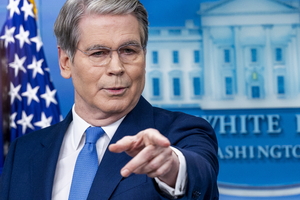
US warns of punishment for anyone enabling Iran's Strait of Hormuz toll scheme
-
INDUSTRY
Toyota union puts productivity first; Hyundai Motor union demands bigger share of profits
-
FINANCE
National Growth Fund to invest $531M in FuriosaAI, which rebuffed Meta's $800M takeover bid
-
INDUSTRY
Korea Shipowners' Association holds amateur baduk tournament for Maritime Day