
- HOME
- STOCK
-
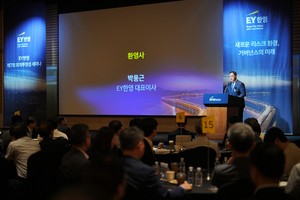
EY Han Young wraps 7th accounting transparency seminar amid rising corporate risks
Seminar held Friday at Yeouido FKI Tower addresses audit committee roles, risk management frameworks Amid growing corporate risks driven by amendments to the Commercial Act and the rapid spread of AI technology, industry leaders gathered to discuss ways to enhance accounting transparency and governance as a means of boosting corporate value. EY Han Young, a global accounting and consulting firm, said it held the 7th EY Han Young Accounting Transparency Seminar on Friday at the FKI Tower Conference Center in Yeouido, under the theme "A New Risk Environment: The Future of Governance." The seminar drew more than 250 executives, board members and audit committee officials from domestic companies, who shared insights on key accounting and internal accounting management system issues this year, responses to sustainability disclosure requirements, and the evolving roles of audit committees, boards and management. The event opened with a welcome address by EY Han Young CEO Park Yong-geun and congratulatory remarks by Park Min-woo, standing commissioner of the Securities and Futures Commission. Officials from the Financial Services Commission and the Financial Supervisory Service then outlined policy directions and supervisory priorities for improving accounting transparency. Lee Jeong-chan, an official at the Financial Services Commission, presented policy measures to raise audit quality in response to the implementation of the revised Commercial Act and the expanded use of AI. Lee Jae-hoon, director of the Financial Supervisory Service's first accounting inspection bureau, announced a shift toward a preventive supervisory framework — including shorter inspection cycles and stiffer financial penalties for serious accounting fraud — and urged companies and their management to build effective internal controls. The EY Han Young session that followed examined how shifts in the economic environment and business structures, the enforcement of the revised Commercial Act, and the introduction of K-IFRS 1118 are affecting financial reporting and year-end closing, along with strategies for responding to those changes. Yang Jun-kwon, head of quality control at EY Han Young, identified three priority tasks: overhauling control frameworks for AI use, redesigning authority and accountability structures, and strengthening audit committee oversight. Yang said companies must manage their data infrastructure and internal controls for sustainability disclosures with the same rigor applied to financial information in order to ensure reliability. In the final session, Chae Su-wan, a partner in EY Han Young's consulting division, analyzed how audit committee responsibilities have expanded since the Commercial Act revision — shifting from after-the-fact review toward an enterprise-wide risk oversight framework built on continuous monitoring. Chae proposed a six-part defense framework to protect organizations and their management: a continuous monitoring system, a fraud risk management program, strengthened internal controls, a compliance management system, decision-making procedures and documentation, and a reporting and escalation system. The urgency of building AI governance frameworks in line with South Korea's AI Basic Act and the EU AI Act, as well as addressing cybersecurity risks, was also underscored. Chae said waiting for regulatory guidelines before acting would be too late, and advised companies to immediately put in place AI governance systems that work in practice. "Risks surrounding companies are growing more complex amid the Commercial Act revision and the spread of AI, and the roles of management, boards and audit committees are becoming ever more critical," EY Han Young CEO Park said. "I hope the risk management and governance strategies discussed at this seminar will help companies not only improve accounting transparency but also strengthen corporate value and market trust." Meanwhile, EY Han Young posted total sales of 764.8 billion won ($570 million) and operating profit of 13.9 billion won for fiscal year 2024 (July 2024 to June 2025), continuing its growth trajectory.
Sept. 8, 2026
-

NH Investment launches first pension government bond subscription
First subscription opens Wednesday 10-year bond carries 4.415% coupon rate Bonus rate added for holders at maturity NH Investment & Securities will open its first subscription for "pension individual investment government bonds" — available through defined-contribution and individual retirement pension accounts — starting Wednesday. The subscription runs from Wednesday through Sept. 15, five business days in total, with hours from 9 a.m. to 4 p.m. on each business day. The minimum subscription amount is 100,000 won ($74), with additional subscriptions accepted in increments of 100,000 won. The bonds are issued monthly via subscription and can be applied for at branch offices, by phone, or through the company's mobile trading platforms N2 and Namu. Two products are available for this subscription: a 10-year bond and a 20-year bond. The 10-year bond carries a coupon rate of 4.415 percent per year with a bonus rate of 0.35 percentage points, while the 20-year bond carries a coupon rate of 4.570 percent per year with the same 0.35-percentage-point bonus rate. Investors who hold the bonds to maturity receive compound interest applied to the combined coupon and bonus rates. On a pre-tax basis, the total yield at maturity reaches approximately 59.28 percent for the 10-year bond and approximately 161.31 percent for the 20-year bond — equivalent to average annual pre-tax returns of about 5.92 percent and 8.06 percent, respectively. Early redemption may be requested starting in the 13th month after the bond's issuance date. However, early redemption within the first year is permitted in unavoidable circumstances, such as the payment of retirement benefits or mid-term withdrawals under the Act on the Guarantee of Workers' Retirement Benefits. In such cases, the bonus rate and compound interest benefits do not apply, and only simple interest based on the coupon rate is paid. Subscription allotments are filled in full within each bond's issuance limit. If demand exceeds the limit, all subscribers first receive a baseline allotment, with any remaining supply distributed in proportion to each subscriber's application amount. The addition of these bonds broadens the product lineup available to NH Investment & Securities customers holding defined-contribution and individual retirement pension accounts. With government-guaranteed principal and interest now joining existing options such as deposits, bonds, ETFs and equity-linked securities, customers can build pension portfolios that balance stability and long-term returns in line with their investment goals and retirement timelines. The bonds are expected to offer a new alternative for customers who favor long-term asset allocation strategies and seek stable management of their pension assets. Jung Hwan, head of the pension asset management division at NH Investment & Securities, said individual investment government bonds are "a representative long-term investment product that aligns with the long-term nature of pension management." He added that the company would "continue to expand the range of product choices so that customers can manage their pension assets in more diverse ways suited to their investment horizon and retirement timeline, moving beyond deposit-centered stable management." NH Investment & Securities has been accelerating the launch of new products. An IMA product called N2 IMA1 Mid-Term No. 3, which opened for subscriptions on Aug. 18, sold out in a single day. The product had a target fundraising goal of 120 billion won, with a scheduled closing time of 3 p.m. on Aug. 24, but subscriptions wrapped up ahead of schedule.
Sept. 8, 2026
-

Kospi reclaims 7,000 for first time in 15 sessions
Kospi opens at 7,045 Institutions net buy 89.2 billion won Kosdaq also edges higher The Kospi reclaimed the 7,000 mark during intraday trading Tuesday, for the first time in 15 sessions since Aug. 18. As of 9:14 a.m., the benchmark index stood at 7,053.62, up 57.67 points, or 0.82 percent, from the previous session. The index opened at 7,045.79, gaining 50.40 points, or 0.72 percent. On the Kospi market, institutions led the advance with net purchases of 89.2 billion won ($65.8 million), while other corporations added 80.6 billion won in net buying. Foreigners and retail investors were net sellers, offloading 142.5 billion won and 16.1 billion won, respectively. Foreigners, who are net sellers in the spot market, have been buying in the futures market, posting net purchases of 319.3 billion won in KOSPI 200 futures. On Monday, the Kospi closed up 308.18 points, or 4.61 percent, at 6,995.39. The rally was driven by growing expectations that memory chip prices will continue to rise, fueled by anticipated demand for high-capacity products following OpenAI's launch of its new AI model "Astra." Foreigners and institutions together bought more than 5 trillion won on the Kospi market Monday, lifting the index. Foreigners net bought 2.59 trillion won while institutions net bought 2.65 trillion won. Continued foreign buying is providing additional support to the index. "Foreign investors have net bought both Kospi spot shares and KOSPI 200 futures for three consecutive sessions," said Lee Jun-young, a researcher at Eugene Investment & Securities. "Three straight sessions of combined spot-and-futures net buying is the first time since June 16, and the buying intensity has been growing day by day." Han Ji-young, a researcher at Kiwoom Securities, said the key question is whether foreign net buying will remain consistent even during a price pullback. "At the same time, it will be worth watching whether sector rotation emerges — shifting from semiconductors during short-term consolidation into other AI infrastructure plays such as IT hardware and power equipment, or into consumer goods and shareholder return-focused sectors," Han said. US markets were closed overnight for Labor Day. The two semiconductor heavyweights were again in positive territory Tuesday. Samsung Electronics rose 1.11 percent to 273,000 won, while SK hynix jumped 3.59 percent to 1,847,000 won. Among large-cap stocks, SK Square gained 2.93 percent and Samsung C&T rose 0.91 percent. Samsung Electro-Mechanics fell 2.27 percent, LG Energy Solution dropped 1.93 percent, Hyundai Motor slipped 0.89 percent and Samsung Biologics declined 0.68 percent. The Kosdaq index was up 2.31 points, or 0.28 percent, at 824.52 at the same time, after opening at 825.03 — a gain of 2.84 points, or 0.35 percent — and trading in a narrow range since. On the Kosdaq market, retail investors net bought 20.1 billion won and foreigners net bought 21.8 billion won, while institutions were net sellers at 40.8 billion won. Among top Kosdaq stocks by market capitalization, semiconductor materials, parts and equipment names were advancing, with Jusung Engineering up 8.14 percent, Wonik IPS up 2.38 percent and Innotech up 2.52 percent.
Sept. 8, 2026
-
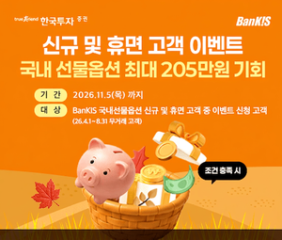
Korea Investment Securities launches domestic derivatives trading event for new, dormant BanKIS customers
Customers can earn up to 50,000 won in cumulative rewards for weekly trades Stock futures and US dollar futures traders also eligible for prize draws Korea Investment Securities, a subsidiary of Korea Investment, announced Tuesday it will run a domestic derivatives trading event targeting new and dormant customers who hold a BanKIS domestic futures and options account. The "Domestic Futures and Options Trading Event" runs through Nov. 5. It is open to customers trading domestic derivatives for the first time and to dormant customers who recorded no trading activity in the five months from April 1 through Aug. 31. Participants who register and complete at least one contract per week for one to three weeks can earn cumulative rewards of up to 50,000 won ($37), depending on how many weeks they meet the target. In addition, 20 customers will be selected by draw from among those whose cumulative domestic futures or options trading volume reaches a designated threshold during the event period; each winner will receive either 500,000 won or 2 million won. A separate event covers domestic stock futures and Korea Exchange US dollar futures. Dormant customers with no trading experience in those products — or no activity in the past five months — who register and trade a combined total of at least 100 million won in stock futures and US dollar futures will receive a mobile coffee coupon on a first-come, first-served basis, limited to 1,000 customers. A draw of 20 customers, tiered by cumulative trading volume, will also award prizes of up to 1 million won. "As exchange rate volatility and stock-specific divergence continue, customer interest in stock futures and dollar futures as hedging and investment tools has been growing," a Korea Investment Securities official said. "We hope this event gives customers a chance to fully understand the structure and risks of derivatives and to experience risk management and investment strategies suited to their own goals." Korea Investment Securities is also running its seventh domestic stock investment competition, "Han-tu Battle," for four weeks from Monday through Oct. 2. The competition features a "20s Rookie Challenge" for customers in their 20s to build hands-on investment experience, a "Weekly Trading Challenge" open to all age groups, and an "Open API League" for participants using open APIs and AI.
Sept. 8, 2026
-
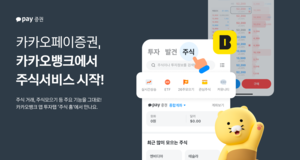
Kakao Pay Securities launches stock trading service on KakaoBank app
New 'Stock Home' tab added to KakaoBank's investment section Users can search, buy and sell shares without switching apps Kakao Pay Securities announced Tuesday that it has partnered with KakaoBank to launch a stock trading service within the KakaoBank app, with the feature going live on Friday under a new "Stock Home" section inside the app's investment tab. The integration allows users to trade domestic and overseas stocks, ETFs and exchange-traded notes — services previously available only through the "Securities" tab on the Kakao Pay app — directly within the KakaoBank app. Everything from browsing stock information to placing buy and sell orders can be done without switching between apps. The service comes with a full suite of features. Users can monitor stocks through charts, asking prices and watchlists, and exchange views with other investors in a community forum. A "Stock Accumulation" function lets users set up automatic recurring purchases of chosen stocks. The app also offers a personalized home screen that adapts to the user's investment experience, presenting different interfaces for first-time investors and those already active in the market. To use the service, users simply link a Kakao Pay Securities account in their own name to their KakaoBank account. Those without an existing account can open both a bank account and a brokerage account sequentially within the KakaoBank app. Deposits needed to buy shares and proceeds from sales are both handled through the KakaoBank account. "Having investment naturally begin where people manage their financial lives is the direction Kakao Pay Securities has envisioned," said Shin Ho-cheol, chief executive of Kakao Pay Securities. "We will support more users in easily understanding investment information and building an investment experience suited to their goals and preferences — within a seamless flow that connects payments, transfers, deposits and investments." Kakao Pay Securities said it plans to enhance the service in stages and expand synergies by deepening integration across Kakao's financial platforms. The company also intends to run a variety of events to broaden its touchpoints with users. One such promotion is currently underway: users who add the company's KakaoTalk channel as a friend for the first time are entered into a draw for free shares, with 10 winners each receiving one share of Samsung Electronics. The event runs through Sept. 30. Kakao Pay Securities said its KakaoTalk channel surpassed 1 million friends in June.
Sept. 8, 2026
-
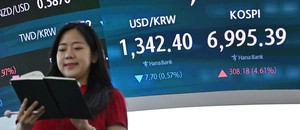
Kospi breaks 7,000 for first time in 15 trading days
The Kospi surpassed the 7,000 mark Tuesday, reclaiming the level for the first time in 15 trading days. The index opened up 50.40 points, or 0.72 percent, at 7,045.79, according to Korea Exchange.
Sept. 8, 2026
-
Chinhung International wins W90.4b street housing redevelopment project
Chinhung International disclosed Tuesday it has signed a contract for the Daegeun Yeonrip street housing redevelopment project, valued at 90.4 billion won ($66.7 million). The contract amount represents 15.69 percent of the company's 2025 sales.
Sept. 8, 2026
-

Kospi eyes 7,000 mark as profit-taking tests Samsung, SK hynix rally
US markets closed for Labor Day, leaving Kospi in wait-and-see mode European stocks mixed amid ECB meeting, oil prices, bond yields Analysts forecast sector divergence as rate and Middle East risks linger All eyes are on whether the Kospi can reclaim the 7,000 mark Tuesday, riding a semiconductor tailwind from OpenAI, even as analysts warn that profit-taking could produce a divergent session across sectors. Korea Exchange data show the Kospi closed Monday at 6,995.39, up 308.18 points, or 4.61 percent, from the previous session — leaving the index just 4.61 points short of the 7,000 threshold. The benchmark opened 223.57 points, or 3.34 percent, higher at 6,910.78 and held its gains throughout the session to finish firmly in positive territory. The rally was driven by expectations that OpenAI's launch of its new AI model "Astra" would stoke demand for high-capacity products and sustain a rise in memory chip prices. Foreign and institutional investors together poured more than 5 trillion won ($3.69 billion) into the Kospi market in a coordinated buying spree, lifting the index. Buying was concentrated in semiconductor stocks, with Samsung Electronics surging 5.68 percent and SK hynix jumping 8.26 percent. "The immediate catalyst was the revival of AI demand expectations following OpenAI's unveiling of Astra," said Lee Jae-won, an analyst at Yuanta Securities Korea. "The more limited gains in Kosdaq and small- and mid-cap stocks reflected not a broad easing of interest rate pressures, but rather a strengthening conviction in semiconductor earnings." US markets were closed Monday for Labor Day. European stocks ended mixed, weighed down by caution ahead of the European Central Bank monetary policy meeting, rising international oil prices and higher government bond yields in major economies. Germany's DAX and Britain's FTSE 100 fell 0.15 percent and 0.08 percent, respectively, while France's CAC 40 and the Euro Stoxx 50 gained 0.33 percent and 0.17 percent. Semiconductor-related names bucked the broader trend, however, with Infineon rising 6.91 percent and ASML advancing 2.25 percent. International oil prices and European government bond yields both moved higher. Brent crude briefly topped $98 a barrel as military clashes between the United States and Iran continued, Bloomberg reported. Bond yields rose as the ECB is widely expected to raise interest rates this week, while a landslide victory by the far-right Alternative for Germany party in the Saxony-Anhalt state assembly election brought fiscal deficit concerns back into focus. "European bond yields were driven by both the ECB's stance and political developments, and those issues are likely to continue exerting influence in the second half of the year," said Seo Sang-young, a managing director at Mirae Asset Securities. Tuesday's session is expected to hinge on whether the Astra-driven momentum can be sustained and how much profit-taking emerges following Monday's sharp advance. KOSPI 200 overnight futures, a gauge of early market direction, were up 1.22 percent as of the time of writing. In pre-market trading as of 8:35 a.m., Samsung Electronics was down 500 won, or 0.1 percent, at 269,000 won, while SK hynix was up 5,000 won, or 0.2 percent, at 1,788,000 won. "The market will likely see sector divergence as profit-taking from Monday's sharp short-term gains plays out, with intraday moves in US 10-year Treasury yields and news flow around the US-Iran situation also acting as key variables," said Han Ji-young, an analyst at Kiwoom Securities. She added that the key question is whether foreign investors can sustain consecutive net purchases even as share prices pull back. "At the same time, it will be worth watching whether rotation into other AI infrastructure plays — such as IT hardware and power equipment — or into consumer goods and shareholder return-focused sectors emerges during any short-term pause in semiconductor stocks," she said.
Sept. 8, 2026
-

Semiconductor rebound lifts chip ETFs, but retail investors rush to take profits
SK hynix single-stock leveraged ETFs sweep ranks 2–8 this month Covered-call, parking-type and US index ETFs draw retail buying Semiconductor-related ETFs have posted strong gains this month as share prices of Samsung Electronics and SK hynix climbed, but retail investors have been quick to lock in profits as the rally unfolded. According to Korea Exchange and Koscom CHECK, nine of the top 10 best-performing ETFs listed in South Korea from Sept. 1 to 7 were semiconductor-related products. Seven SK hynix single-stock leveraged ETFs swept ranks 2 through 8. ACE SK hynix Single Stock Leverage rose 12.65% over the period, making it the second-best performer behind TIGER Global Resource Producers, which gained 16.82%. It was followed by RISE SK hynix Single Stock Leverage (12.11%), KODEX SK hynix Single Stock Leverage (11.77%), SOL SK hynix Single Stock Leverage (11.76%), 1Q SK hynix Futures Single Stock Leverage (11.70%), TIGER SK hynix Single Stock Leverage (11.57%) and KIWOOM SK hynix Futures Single Stock Leverage (11.43%). TIGER Semiconductor TOP10 Leverage ranked ninth with a gain of 10.86%, while KODEX Semiconductor Leverage came in 10th at 9.80%. The ETF gains tracked a broader move in the underlying stocks: Samsung Electronics rose 3.85% and SK hynix advanced 6.51% over the same period. Despite the strong performance of semiconductor ETFs, investor sentiment toward these products remains largely frozen. From Sept. 1 to 7, KODEX SK hynix Single Stock Leverage recorded net retail selling of 94.3 billion won ($69.6 million), making it the third-heaviest net-sold ETF among retail investors, behind KODEX Leverage (230.1 billion won) and KODEX 200 (215.8 billion won). KODEX Semiconductor Leverage (52.3 billion won), TIGER Semiconductor TOP10 (50.1 billion won), TIGER 200 (49.2 billion won) and KODEX SK hynix Single Stock Leverage (48.4 billion won) followed. The selling pressure reflects profit-taking that emerged precisely because share prices had finally moved higher after a prolonged lull. Retail investors, by contrast, were net buyers of covered-call ETFs, so-called parking-type ETFs and products tracking major US indexes. TIGER US S&P500 attracted the largest net retail purchases at 125.9 billion won. Other US index ETFs also ranked among the top net-bought products, including KODEX US NASDAQ 100 (fifth, 69.3 billion won), KODEX US S&P500 (sixth, 66 billion won) and TIGER US NASDAQ 100 (seventh, 47.4 billion won). Retail investors also favored products suited to volatile markets, such as KODEX 200 Target Weekly Covered Call (fourth, 72.1 billion won) and KODEX Money Market Active (11th, 32 billion won). "Amid a mix of caution and expectation, covered-call ETFs — which can hedge against volatility — and insurance products with strong defensive characteristics in a rising interest-rate environment ranked among the top inflow categories in the domestic ETF market," said Jang Chi-young, a researcher at Hana Securities. "AI and other semiconductor-themed ETFs, which are growth-style products sensitive to interest rates, generally saw outflows."
Sept. 8, 2026
-

Konex touted as escape route for delisting-bound firms, but daily trading volume barely tops $1m
The government has put forward the Konex market as an exit option for companies on the verge of delisting, but industry observers say Konex itself must first be revitalized before the policy can have any real effect. Konex's market capitalization stands at just 3 trillion won ($2.21 billion), and daily average trading volume hovers in the low 1 billion won range. Industry participants say reviving the near-dormant market must come before any meaningful effort to soften the blow of delisting. According to financial investment industry sources, the government announced Friday that Kosdaq-listed companies placed under administrative watch for falling below the minimum market capitalization threshold since July 1 would be allowed to transfer their listing to Konex — without going through a liquidation trading period and at their existing share price — provided they meet certain financial requirements. To qualify, a company must have posted an operating profit in at least two of the past three fiscal years, or in one year while maintaining equity capital of at least 20 billion won; companies with capital impairment are excluded. The mandatory appointment of a designated adviser — a standard Konex listing requirement — will be waived for a set period to facilitate swift transfers. Of the 97 Kosdaq companies with a market capitalization below 20 billion won as of Aug. 26, an estimated 43, or 44.3 percent, are expected to be eligible. The core problem is that Konex remains far too small and illiquid. According to Korea Exchange, 109 companies were listed on Konex as of the end of July, with a combined market capitalization of 3.39 trillion won. Daily average trading volume stood at 287,000 shares, with a daily average trading value of 1.28 billion won. SK Signet led all Konex stocks in July trading value, recording a monthly cumulative total of 15.51 billion won. The top five stocks — SK Signet, followed by Ensol Biosciences (3.04 billion won), Jincostech (2.11 billion won), Pharmaresearch Bio (1.04 billion won) and Rapichi (780 million won) — together accounted for 22.48 billion won in cumulative trading value. Given that the market's total monthly trading value was approximately 28.2 billion won, the single top stock accounted for roughly half of all market activity, while the top five made up about 80 percent. The number of companies graduating from Konex to Kosdaq has also been declining. The figure dropped from 13 in 2021 to six in 2022, seven in 2023, and four each in 2024 and 2025. So far this year, the count stands at zero. Supply-and-demand dynamics also need improvement. Konex, where attracting early-stage investment is central to its purpose, was designed to be driven by institutional and other professional investors rather than retail participants. Yet retail investors accounted for roughly 90 percent of Konex trading value this year, while institutions made up 4.97 percent and foreign investors just 0.003 percent — leaving individual traders to prop up a market built for professionals. Kim Yong-jin, a business administration professor at Sogang University, said the market cannot function properly without information flow and capital circulation. "Even on Kosdaq, a significant number of stocks receive no research coverage from brokerages — Konex is bound to be even more overlooked," he said. Kim added that liquidity on the Kospi is not generated by individual stock trading alone, but through a range of products such as ETFs and the participation of liquidity providers. "Konex also needs to explore ways to create various derivative products and increase liquidity supply so that asking prices can form more densely," he said. Lee Jun-seo, a business administration professor at Dongguk University, said the Konex market must be normalized before delisting candidates are transferred there. "Moving companies to Konex under the current liquidity conditions is, in effect, not much different from delisting," he said. Lee added that a broader market restructuring should also be considered — including transferring competitive Konex companies to Kosdaq while routing the rest into the over-the-counter K-OTC market.
Sept. 7, 2026
-

Kospi surges 4.61% to within 5 points of 7,000 as foreigners, institutions pour in W5tr
Foreign, institutional investors drive dual buying spree Samsung Electronics up 5.68%, SK hynix up 8.26% in semiconductor rally Retail investors net-sell 6.82 trillion won, most in about a month The Kospi surged more than 4 percent Monday as semiconductor stocks rallied across the board following OpenAI's release of a new AI model and Nvidia's announcement that it would acquire AI model-sharing platform Hugging Face. Foreign and institutional investors combined for more than 5 trillion won ($3.69 billion) in net purchases, lifting the index to the 6,995 level and leaving it just 4.61 points short of reclaiming the 7,000 mark. According to Korea Exchange, the Kospi closed at 6,995.39, up 308.18 points, or 4.61 percent, from the previous session. The index opened at 6,910.78, already up 223.57 points, or 3.34 percent, and held its gains throughout the session to finish near the day's highs. The rally was driven by foreign and institutional investors, who net-bought 2.59 trillion won and 2.63 trillion won, respectively, on the main board. Other corporations also posted net purchases of 1.64 trillion won. Retail investors, by contrast, net-sold 6.82 trillion won as they locked in profits — the largest net-selling figure by individuals in about a month, since July 31, when they net-sold 8.28 trillion won. The Kospi's jump was fueled by a broad advance in semiconductor stocks on Wall Street on Friday, itself triggered by positive developments from OpenAI. OpenAI launched a new AI model called "Astra," rated at the "Critical" danger level on its internal security scale, and declared the arrival of the artificial general intelligence era. The announcement stoked expectations that demand for high-capacity products would expand, sustaining upward pressure on memory chip prices. Nvidia's official announcement that it would acquire Hugging Face, a platform for sharing AI models, further boosted investor sentiment toward semiconductors by reinforcing expectations for memory chip demand as the AI ecosystem expands. South Korea's two semiconductor giants led the charge: Samsung Electronics surged 5.68 percent and SK hynix jumped 8.26 percent. Related stocks also advanced, with SK Square rising 8.07 percent, Samsung Life gaining 4.87 percent and Samsung C&T climbing 4.63 percent. Among other large-cap stocks, Samsung Electro-Mechanics rose 3.78 percent, LG Energy Solution gained 1.12 percent and Hyundai Motor advanced 2.48 percent. On the downside, Hanwha Aerospace fell 1.52 percent, Samsung SDI dropped 1.28 percent and Celltrion slipped 0.96 percent. The Kosdaq also posted gains, closing at 822.19, up 8.69 points, or 1.07 percent, from the previous session. The index opened at 822.91, up 9.41 points, or 1.16 percent, and held a roughly 1 percent advance throughout the day. On the Kosdaq, retail investors net-bought 189.5 billion won, while foreign and institutional investors net-sold 71.7 billion won and 131 billion won, respectively. Among top-cap Kosdaq stocks, Ecopro rose 0.12 percent, Ecopro BM gained 0.66 percent and Jusung Engineering climbed 4.99 percent. Alteogen fell 0.87 percent, Rainbow Robotics dropped 2.40 percent and Robotis declined 0.99 percent. The won continued to strengthen against the dollar. As of 3:30 p.m., the won-dollar exchange rate stood at 1,340.5 won, down 9.9 won from the previous close, in Seoul foreign exchange trading.
Sept. 7, 2026
-
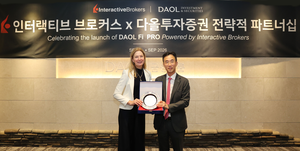
Daol Investment & Securities partners with IBKR to build two-way global trading platform
Tie-up with IBKR targets global market expansion Firm also eyes connecting overseas investors to Korean market Daol Investment & Securities announced Monday it is partnering with global online brokerage Interactive Brokers (IBKR) to build a two-way investment platform connecting Korean and global capital markets. The two companies have launched a global trading platform called DAOL Fi PRO, which integrates the entire transaction process — from customer authentication and single sign-on (SSO) to electronic signatures, order execution, payment, and fund and ledger management — into a single service. It is the first outbound commercial model of its kind in South Korea. The platform incorporates IBKR's smart-routing system, which compares asking prices and liquidity across multiple exchanges and alternative trading systems in real time to identify the optimal execution path, splitting or rerouting orders accordingly. The platform also offers a range of order types, currently supporting eight, which allow investors to adjust buy and sell prices and execution timing based on market conditions and investment strategy. The companies plan to add specialized orders, including algorithmic orders, in stages, expanding the total to more than 26 types. At launch, only overseas equities are available for trading. The brokerage commission for overseas stock transactions is 0.07 percent of the contract amount, and foreign exchange fees are applied at a 95 percent preferential rate. Daol Investment & Securities plans to gradually expand the service to more than 170 global markets accessible through IBKR and to broaden the range of financial products offered, including derivatives. A delegation from IBKR, including Senior Vice President Stacey Millers, visited Daol Investment & Securities on Thursday to discuss follow-up cooperation. "The fact that two companies with different strengths worked through countless challenges together to launch a service for customers means this is far more than simply unveiling a new product," Daol Financial Group Chairman Lee Byung-chul said. "This launch is not the completion of our partnership but a new beginning. We look forward to further developing DAOL Fi PRO and expanding our cooperation into new products and markets as we grow together."
Sept. 7, 2026
-
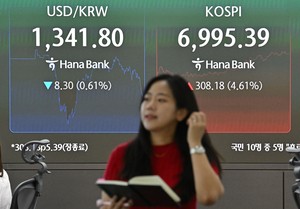
Kospi closes at 6,995.39, just shy of 7,000
The Kospi closed Monday at 6,995.39, about 5 points short of the 7,000 mark.
Sept. 7, 2026
-
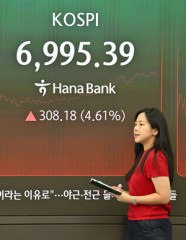
Kospi stops just short of 7,000 mark
The Kospi closed at 6,995.39 on Monday, about 5 points short of the 7,000 mark. The index was displayed on the board at the Hana Bank dealing room in Jung-gu, Seoul, that afternoon.
Sept. 7, 2026
-

Samsung Electronics, SK hynix surge over 7% as foreign investors return
Samsung Electronics and SK hynix surged in early trading Monday in the wake of OpenAI's next-generation AI model GPT-6 Astra, with foreign investors — who had dumped more than 1.6 trillion won ($1.18 billion) worth of the two stocks last week — returning as net buyers. Analysts say selling pressure on semiconductor shares has been easing after a recent round of corrections. A semiconductor rally that began on Wall Street carried over into the domestic market Monday. Samsung Electronics and SK hynix both jumped sharply at the open, with foreign investors net-buying the two stocks and helping drive a Kospi rebound — a marked shift from last week, when the pair accounted for roughly 81 percent of all foreign net selling on the Kospi. According to Korea Exchange data as of 9:17 a.m. Monday, Samsung Electronics was trading at 266,500 won, up 11,000 won, or 4.31 percent, from the previous session. SK hynix rose 96,000 won, or 5.83 percent, to 1.74 million won. The Kospi was up 227.12 points, or 3.40 percent, at 6,914.33 at the same time. Foreign investors were net buyers of more than 500 billion won on the Kospi Monday. Samsung Electronics and SK hynix ranked among the top net-purchase targets, drawing 65.2 billion won and 87.1 billion won in foreign net buying, respectively. The shift stands in sharp contrast to last week's flows. Korea Exchange data show that from Aug. 31 through Friday, foreign investors net-sold 1.99 trillion won worth of Kospi shares. Of that total, they net-sold 518.1 billion won in Samsung Electronics and 1.09 trillion won in SK hynix — a combined 1.61 trillion won, equal to roughly 81 percent of total foreign net selling over the period. Last week, retail and institutional investors also sold heavily. Other corporations, however, were large net buyers, recording 6.5 trillion won in net purchases, driven by buybacks at the two major semiconductor companies. "Over the past week, we saw the unusual situation of all three investor groups — retail, foreign and institutional — simultaneously net-selling," said Cho Jun-ki, a researcher at SK Securities. "While net buying by other corporations has been substantial due to semiconductor blue-chip buybacks, it is also true that, excluding that factor, there is a clear absence of a dominant buying force." The domestic semiconductor surge was underpinned by a strong performance on Wall Street on Friday (local time). The Philadelphia Semiconductor Index rose 3.37 percent, while SanDisk jumped 11.90 percent, SK hynix's American depositary receipts gained 8.14 percent, and Micron climbed 6.10 percent. That came even as the Dow Jones Industrial Average fell 0.51 percent, the S&P 500 dropped 0.38 percent and NASDAQ declined 0.29 percent on the same day. US nonfarm payrolls for August came in at 162,000, nearly triple the market consensus of 55,000 to 56,000. The strong jobs data heightened concerns about Federal Reserve interest rate hikes, yet semiconductor stocks rose anyway. Analysts attributed the divergence to renewed expectations for expanded AI infrastructure investment and higher demand for high-capacity memory chips following OpenAI's unveiling of GPT-6 Astra. Analysts also pointed to rebound buying after a steep price correction. "Positive news on the memory chip cycle and the GPT-6 Astra announcement likely played a role, but I believe the dominant dynamic was an oversold perception and short-covering in a segment that had seen a significant price pullback," Cho said. Analysts say selling pressure on semiconductor stocks has been easing through the recent correction. "As Friday's US semiconductor rally suggests, the persistent selling pressure on domestic and overseas chip stocks is increasingly likely to be running out of steam," said Han Ji-young, a researcher at Kiwoom Securities. "It is appropriate to set as the base scenario a path in which market recovery momentum strengthens compared with last week, as investors digest Oracle's earnings and the August US consumer price index."
Sept. 7, 2026
-
Big money sits on the sidelines — and watches Nov. 3
Don't bet on election outcomes. Spread your buys across the calendar. How to use autumn's US midterms as a purchase schedule What the storm left behind was silence. The brokerage floor was quiet in August. In the first half of this year, the Korean stock market doubled in six months. Then it shed 22 percent in July alone. Measured from peak to trough — the maximum drawdown — the decline reached 42 percent. Circuit breakers, which halt trading when an index plunges, were triggered four times in July alone. The pace was comparable to the 1997 Asian financial crisis. In August, the same market did not trip a single circuit breaker. Daily trading volume, which had touched 50 trillion won ($36.9 billion), fell by roughly half. What the storm left behind was neither fear nor euphoria. It was a long, drawn-out wait. The questions coming across the counter have changed, too. During the sharp sell-off in June, the most common question was: "Can I move up my scheduled installment purchases?" These days, the most frequent questions are: "How should I get through September and October?" and "What should I be watching as I wait out the rest of the year?" Questions about direction have given way to questions about timing. I see this as a lesson learned from surviving two bouts of extreme volatility. Behavioral shifts are also visible. A noticeably larger number of clients unwound leveraged positions and short-term trading strategies after July. Demand has grown to concentrate holdings in companies whose earnings are confirmed in actual numbers, rather than buying the broad index. Gold's double-digit gain in August alone and US long-term interest rates climbing toward the high 4 percent range have sparked a sharp rise in bond inquiries. There is little urgency to put fresh money into equities. The mood is less about growing assets and more about reorganizing positions for the period beyond year-end. In short, big money right now is neither selling nor rushing to buy. Instead, it is watching the calendar — and at the center of that calendar sits Nov. 3, the US midterm elections. Don't stake your portfolio on a cost that disappears when the votes are counted To understand why the market has stalled, one must first take stock of this year's lessons. What drove the index to double in the first half was not corporate earnings alone. Record levels of client deposits held at brokerages, margin financing, and the concentration of money in single-stock leveraged ETFs — instruments that track an individual stock's moves at twice the magnitude — amplified the upswing. In July, the same structure worked in precisely the opposite direction, amplifying the decline. What is striking is that fundamentals — the underlying health of companies — were not seriously damaged in the process. Semiconductor exports in August hit an all-time high of $46.65 billion, surpassing $40 billion for three consecutive months. Research notes from brokerages raising target prices have begun to reappear, driven by news of next-generation HBM mass production. Prices swung to extremes, but the direction of earnings never changed. What separated winners from losers this year was not what you bought, but when and how gradually you bought it. Now consider the schedule ahead. The Nov. 3 midterm elections will fill all seats in the House and one-third of the Senate. The presidential election was held in 2024 and the next is in 2028, making this year the precise midpoint of a four-year term. Historically, midterm election years have been the weakest of the four-year presidential cycle for share prices. The pattern has repeated itself. Markets tend to be suppressed in the months leading up to the election, with volatility rising, then recovering through year-end as uncertainty clears around election day. The two most recent midterm years — 2018 and 2022 — both saw a trough in autumn followed by a rebound in November. The reason is surprisingly simple. What markets dislike is not which party wins, but the cost of not knowing the outcome. And that cost vanishes the moment the votes are counted. Of course, this year cannot be mapped directly onto historical averages. Unlike a typical midterm year, US equities have already accumulated double-digit gains, and the counterargument — that a reversal could come around the election rather than a rally — carries real weight. Renewed tensions between the United States and Iran are keeping international oil prices and US gasoline prices elevated, while the yield on the 10-year US Treasury note hovers in the high 4 percent range, reflecting persistent inflation concerns. To summarize: the direction of earnings points upward, but September and October form a stretch where three obstacles — interest rates, oil prices and the election — converge. Calling the direction with confidence during this period is too much to ask even of professionals. That is why the conclusion big money has reached is not a bet on direction, but an allocation across time. Dates to mark on the calendar From September through early November, there are five dates worth marking. The first checkpoint comes in mid-September. The US August consumer price index is released on the 11th, followed by the FOMC meeting on Sept. 15-16. Within a single week, the market will learn whether inflation is rising again and how the Federal Reserve intends to manage interest rates through year-end. The key will be the dot plot released alongside the meeting's outcome — a chart showing each Fed official's individual rate projection. Since a minority already voted for a rate hike at the July meeting, an upward shift in those dots could reignite volatility. A week later, on the 24th, Chinese President Xi Jinping visits the United States. Given the timing — just weeks before the midterms — there is room for signals of agreement on US-China tensions and the US-Iran situation to emerge, which could pull oil prices and inflation lower together. If the FOMC is a risk factor, this visit leans toward being a relief factor. At the turn from September into October sits an event of an entirely different character: the initial public offering of Anthropic, with a target valuation of around $2 trillion and a fundraising size of up to $100 billion. More important than its record-breaking scale is the fact that the value of an AI company that has remained in private markets will, for the first time, face the test of public-market pricing. A mega-IPO of this size can siphon institutional money into the subscription process, creating a short-term supply gap for existing AI and semiconductor stocks. If the offering succeeds, it could conversely serve as a signal reigniting the broader AI rally. Either way, the weeks surrounding the listing should be treated as a period of heightened volatility across AI-related assets. The most densely packed stretch of the second half runs through mid-to-late October. The third-quarter earnings season kicks off, putting semiconductor profits into hard numbers. The September CPI is due on the 14th, and the final FOMC meeting before the midterms is scheduled for Sept. 27-28. Earnings, inflation and interest rates will all deliver their verdicts within two weeks. Then comes Nov. 3 — the midterms. As the inflection point where uncertainty is resolved, this date carries a different weight from the four that precede it. What matters to the market is not which side wins, but simply the fact that a result exists. Maintain your target allocation, but spread the pace at which you fill it. That single sentence captures the core of a second-half portfolio strategy. Keep the target weighting set at the start of the year, but distribute the pace of reaching that target according to the schedule. The dates listed above become the reference points. By spreading installment purchases across the periods before and after these events, a sharp sell-off triggered by any one of them becomes not an unexpected accident but a planned buying day. That difference matters more than it might seem. For equities, maintain the target allocation. As the August export data confirmed, semiconductor exports continue to set all-time highs. A strategy diversified around semiconductors as the core — extending into materials, components and equipment, power devices and secondary batteries — still looks sound. For accounts where the July correction pushed holdings below target, I would advise against filling the gap all at once now. Divide the period from September through around election day into several intervals and add mechanically on a date-based schedule. The idea is not to avoid the historically volatile pre-election period, but to use that entire stretch as a purchase timetable. Rather than trying to time the bottom, the goal is to ensure that whenever a sharp drop comes, that day is already one of the planned buying dates. For individual stocks, keep the core in semiconductors — where earnings are verified through export statistics and quarterly results. Do not increase exposure to theme-driven assets that will swing on election and policy news. Bonds are the asset class that has seen the largest increase in allocation in second-half portfolio design this year. US 10-year yields in the high 4 percent range offer the prospect of capital gains on top of coupon income if inflation eventually cools — and, more importantly, they reduce the overall portfolio's swings when equities are under pressure. Since inflation and oil prices still point upward, long-duration bonds should also be added gradually, splitting purchases across rate levels and dates rather than buying all at once. Gold proved its worth as a hedge asset again with a double-digit gain in August alone. For clients who already hold it, I am recommending they maintain their current position rather than chasing it higher now. The role of foreign-currency assets, including the dollar, was covered in detail in a previous column and need not be repeated here. Those principles remain fully valid in an election environment. In this asset allocation, risk management comes down to one thing: do not stake your portfolio's fate on an election outcome. Build a structure that survives largely intact regardless of which party wins, and the election becomes not a risk but simply another date on the calendar. You cannot win by betting The greatest danger for retail investors this autumn is betting on election outcomes. Predicting the result is hard enough, but the truly difficult part is predicting how the market will react to that result. Looking back at past elections, there are countless cases where the market moved in the opposite direction even when the predicted outcome proved correct. A game that requires two consecutive correct calls to make money is, by the odds, never favorable to the individual investor. Still, there is clearly something to learn from how big money operates. First, stop trying to time the market and instead build a strategy anchored to the schedule. The plan is not "I'll buy when it's cheap." The plan is writing down in advance exactly which dates from September through year-end you will buy, and how much on each. Second, money you cannot afford to leave untouched for two months is not suitable for investing right now. What tends to get shaken during the volatile pre-election period is usually not the stock itself, but the account holding money that will soon be needed. Third, watch export statistics, not election results. The export data released at the start of each month shows the direction of corporate earnings independent of politics, and it is available to everyone. As long as earnings are growing, every correction the election creates has ultimately met the same fate as every correction before it. After Nov. 3, the market will find its next worry. But the election passes in two months, and corporate earnings remain. What investors need to do this autumn is not to predict the outcome, but to write out a schedule in advance — one they can hold to without flinching whatever result comes — and then execute it. A second half spent that way will ultimately become the time spent preparing for 2027.
Sept. 7, 2026
-
Personnel — Korea Securities Depository
◇General managers (Transfers) Regional Service Department general manager Park In-seon; Public Relations Department general manager Yeo Sang-hyeon; Risk Management Department general manager Lee Jeong-uk; Next-Generation Project Office head Lee Hyeong-geun; Next-Generation Development Office head Son Yeong-il ◇Team leaders (New appointments) IT Infrastructure Operations Department System Management Team 1 leader Lee Gyu-ha; Securities Data Department Data Planning Team leader Seok Ji-ung (Transfers) Next-Generation Development Office IT Infrastructure Team leader Park Jun-ho; IT Service 2 Department Retail Registration Service Team leader Kim Min-ji; Next-Generation Development Office IT Development Team 3 leader Kim Hyeong-uk; Next-Generation Development Office IT Development Team 2 leader Kim Song-ju; Growth Innovation Office senior computer specialist Nam Gyu-hyeon; IT Service 2 Department Corporate Support Service Team leader Kim Seung-jun; Information Security Department IT Security Team leader Gwak Byeong-chan; Securities Data Department Securities Data Management Team leader Park Hwal; IT Service 2 Department Electronic Registration Service Team leader Shin Myeong-jin; Next-Generation Development Office IT Development Team 1 leader Park Seon-uk; Next-Generation Project Office Project Management Team leader U Jong-ha; Next-Generation Project Office BIZ Team 3 leader Gang Ji-hun; Next-Generation Project Office BIZ Team 2 leader Jo Hong-rae; Next-Generation Project Office BIZ Team 1 leader Jeong Cho-rong; Human Resources Department senior investigator Kim Sang-gyu; Regional Service Department Busan Customer Center team leader Kim Seong-bo; Securities Data Department Data Project Team leader Mun Hyang-mi; Global Markets 2 Department US Market Settlement Team leader Lee So-yeong; Share and Derivatives Registration Department Share Rights Management Team leader Heo Ju-hyeon
Sept. 7, 2026
-
Genersem signs W11.88b semiconductor back-end equipment supply deal
Genersem disclosed Monday it has signed a contract with Hana Micron to supply SAW Singulation Systems and other semiconductor back-end process equipment. The contract is valued at 11.88 billion won ($8.77 million), equivalent to 20.94 percent of the company's 2025 sales. The contract runs through July 1, 2027.
Sept. 7, 2026
-

Philoptics unveils 2.0mm glass substrate at KPCA SHOW, says global client orders 'virtually confirmed'
Zero-defect TGV drilling achieved at mass-production scale Thicker glass substrates seen gaining traction as AI accelerators grow larger Global customers complete technical validation; equipment orders in final stages Philoptics will make the domestic debut of a 2.0mm-thick glass substrate for next-generation semiconductor packaging, positioning its defect-free through-glass via (TGV) drilling technology as a key differentiator in the global market as AI accelerators grow larger and demand thicker substrates. The company said Monday it will showcase the 2.0mm TGV glass substrate at KPCA SHOW 2026, running Wednesday through Friday at Songdo Convensia in Incheon. The core of the technology lies in drilling TGVs without defects even in thick glass. TGV is a process that creates electrical connection pathways by boring microscopic holes through a glass substrate; as the glass gets thicker, drilling becomes more difficult and defect rates tend to rise. Philoptics said it applied its proprietary laser precision processing technology to achieve a TGV defective-hole rate of 0 parts per million (ppm) on a 510mm-by-515mm mass-production substrate — meaning not a single defective hole among 1 million drilled. The company said it also met all major quality benchmarks governing TGV performance, including penetration rate, taper angle, roundness, inner-wall roughness and hole-position accuracy. The push toward thicker glass substrates is driven by the growing scale of AI semiconductors. Next-generation AI accelerators are incorporating more GPUs and HBM chips within a single package, expanding the substrate footprint. Larger substrates are more prone to warpage — bowing caused by chip heat — and increasing glass thickness raises the substrate's physical rigidity to counter the problem, the company said. Thicker substrates also enable passive components such as multilayer ceramic capacitors (MLCCs) to be embedded inside. By using blind cavities — recesses machined to a set depth within the substrate — passive components can be placed closer to the chip, reducing signal loss, while the space they previously occupied on the surface can accommodate additional logic and memory chips. Philoptics said it has completed technical validation of the TGV technology with multiple global customers. Equipment adoption by key overseas customers that lead the global semiconductor value chain is in effect confirmed, with administrative procedures for final orders now under way, the company said. "We have stably achieved a TGV defective-hole rate of 0 ppm regardless of glass thickness, while also dramatically improving process speed," a Philoptics official said. "We will continue to introduce the highest-level laser precision processing equipment and set the global standard for next-generation glass substrate processing technology." KPCA SHOW 2026, where Philoptics will present the new technology, is being held at its largest scale ever. Now in its 23rd year, the event will bring together 229 domestic and international companies — including LG Innotek, Samsung Electro-Mechanics, Simtech, Hana Micron and Stats ChipPAC Korea — across 895 booths. Exhibits will cover semiconductor substrates, advanced packaging, and related materials, components and equipment.
Sept. 7, 2026
-

Hanwha Investment offers up to W1m in cash for new ISA customers
For non-face-to-face individual customers 5,000-won account-opening support for new brokerage ISA accounts Up to 1 million won for meeting deposit and trading conditions Hanwha Investment announced Monday it will run a "Start Investing with a Brokerage ISA" campaign through Oct. 30. The promotion targets customers who open a new brokerage individual savings account (ISA) or hold a dormant one. Customers who open a new brokerage ISA and register for the event will receive a 5,000-won account-opening bonus. Customers who deposit funds into their brokerage ISA and trade 10 million won ($7,380) or more in domestic shares, bonds, ETFs or funds can receive up to 1 million won in cash, with the payout determined by the net deposit amount. Customers transferring a brokerage ISA from another firm to Hanwha Investment will have their transferred amount counted at twice its value toward the qualifying threshold. Customers can sign up through the company's mobile app, Hanwha Investment MTS. Im Ju-hyeok, executive director of Hanwha Investment's asset management division, said the brokerage ISA is "an essential account that lets investors enjoy tax benefits while investing across a wide range of financial products." He added that he hopes investors use the brokerage ISA as a starting point to build a solid foundation for growing their assets. Hanwha Investment is also running a separate non-face-to-face campaign, "Start Investing This Autumn," through Oct. 30. The promotion is open to first-time customers opening a non-face-to-face general account for the first time in their lives, as well as dormant customers whose account balance remained below 100,000 won from March through August this year, with benefits of up to 20,000 won available.
Sept. 7, 2026
MOST READ
- 1Hyundai Motor unveils all-new Tucson with bigger body, smarter tech after 6-year wait
- 2Flat sneakers are back: Why Nike is reviving a 55-year-old running shoe
- 3Pope Leo XIV declines French honors and banquet, accepts only private meeting with Macron
- 428 illegal sports streaming sites found operating freely despite repeated blocks
- 5What was Rachmaninoff's performance fee? A 1928 price list tells all
- 6Samsung Biologics union's show of force backfires at the bargaining table
-
WORLD

US warns of punishment for anyone enabling Iran's Strait of Hormuz toll scheme
-
INDUSTRY
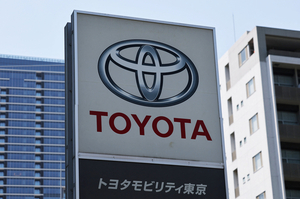
Toyota union puts productivity first; Hyundai Motor union demands bigger share of profits
-
FINANCE
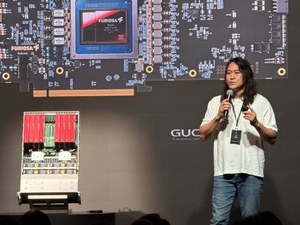
National Growth Fund to invest $531M in FuriosaAI, which rebuffed Meta's $800M takeover bid
-
INDUSTRY

Korea Shipowners' Association holds amateur baduk tournament for Maritime Day