![Nvidia CEO Jensen Huang holds an impromptu press conference after attending an AI ecosystem reception in Tokyo on July 16. [Reuters]](https://wimg.heraldcorp.com/news/cms/2026/09/08/news-p.v1.20260901.7f8dab9c29b648f7a67fcc0c445c9700_P1.jpg)
As semiconductor stocks including Samsung Electronics and SK hynix rebound from steep declines, investors are once again setting their sights on previous highs. For those who bought near the peak, the key question is not simply whether prices will recover — but whether they can reclaim their all-time highs.
Analysts say it is premature to call a full recovery, but argue that if chip earnings continue to grow as expected, the rally may not yet be over. Nvidia's own journey through correction and comeback is being cited as the leading reference case.
KB Securities, in a research report titled "A Case Study on the Possibility of Recovering Previous Highs," noted that the current earnings trajectory of memory chips closely mirrors the phase Nvidia went through in 2024 and 2025. The central insight is that growth rate and absolute profit do not necessarily move in the same direction.
The market's consensus view on memory chips can be summarized in three points: earnings growth will slow, but profit margins will remain high, and absolute profit will continue to expand modestly as sales increase. South Korea's semiconductor sector is expected to sustain operating profit margins of around 70 percent going forward.
Put simply: if a company's profit grew from 100 to 200 last year, the growth rate was 100 percent. If profit then rises from 200 to 240 the following year, the growth rate drops sharply to 20 percent — yet the company is actually earning more than before. A slowing growth rate, in other words, does not automatically mean earnings have peaked.
Nvidia followed exactly this pattern. After profits surged from 2023, its growth rate slowed sharply in the second half of 2024, and its operating profit margin stopped climbing meaningfully beyond the 60 percent range. Yet as sales kept rising, absolute profit continued to grow.
The share price, however, did not rise smoothly. Nvidia endured three major corrections beginning just before its earnings growth rate started to decelerate in earnest: a roughly 20 percent drop in the spring of 2024, a roughly 30 percent drop in the summer of that year, and a nearly 40 percent decline in early 2025 when the DeepSeek shock and tariff fallout hit simultaneously. Each time, the stock recovered and went on to surpass its previous high, resuming its advance at even higher levels.
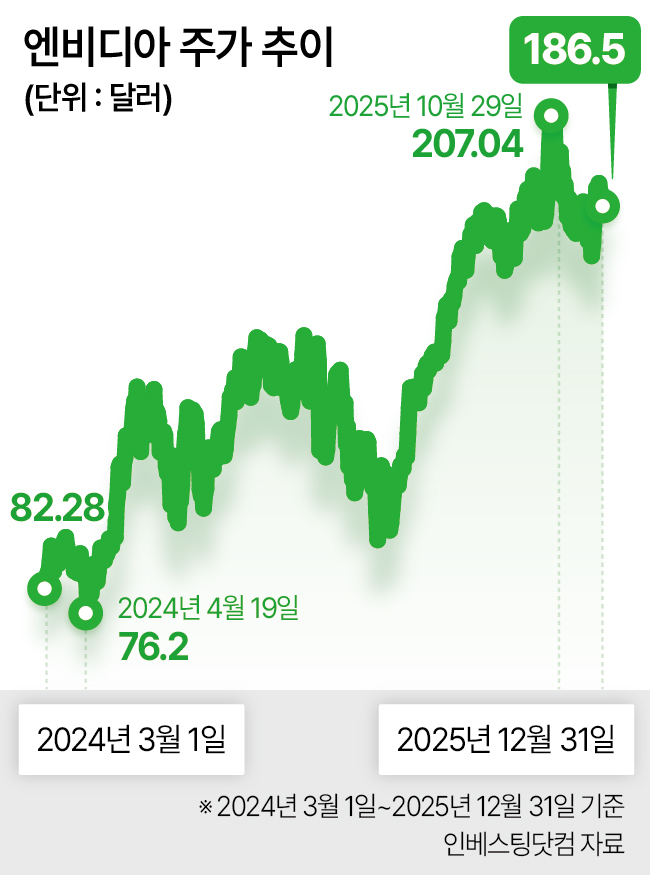
That pattern offers a useful lens for reading the recent moves in Samsung Electronics and SK hynix. When fears grow that the semiconductor cycle has peaked, investors tend to sell before earnings actually decline — because a slowdown in growth rate alone is enough to compress valuations.
But if earnings keep rising even after the share price has corrected sufficiently, the calculus changes. A lower price combined with continued profit growth creates fresh room for the stock to climb again.
The sequence, in other words, need not end at "slowing growth → falling share price." It can instead run through "fears of slowing growth → valuation compression → confirmation of rising earnings → share price re-rating."
"Nvidia's share price is a useful reference for how investors behaved in a similar environment of slowing growth, sustained high margins and rising absolute profit," said Lee Eun-taek, a director at KB Securities. "If high margins and growing absolute profit persist even as the growth rate slows, the share price could finish its rally at a level higher than where it stands today."
The broader market backdrop is also, for now, favorable for semiconductors. The Kospi fell 38.6 percent from its peak during this correction, compressing valuations sharply. The price-to-earnings ratio — the share price divided by expected earnings over the next 12 months — dropped from around 8 times in June to roughly 5 times.
That means buying the Kospi today implies recouping the investment through earnings alone in just over five years. Share prices fell first, while earnings forecasts were not cut by nearly as much.
Whether Samsung Electronics and SK hynix will trace Nvidia's historical path, however, remains uncertain. Absolute profit growth in the memory segment is expected to be lower than Nvidia's, and the overhang from the earlier price surge is heavier.
"Memory chips face some disadvantages compared with Nvidia," Lee said. "Nvidia's profit is growing more than 20 percent every quarter even as its margin plateaus, whereas memory is expected to grow at around 10 percent going forward." He added that "some near-term uncertainties still need to be resolved" and that "memory faces a relatively larger overshoot burden on the supply-demand side as well."
One particular obstacle is the wall of retail selling pressure built up along the index's path higher. Shares purchased by individual investors since late June are concentrated in the Kospi range of 7,500 to 8,500. In the 8,250–8,500 band alone, retail investors made net purchases of 18 trillion won ($13.4 billion). With that inventory still sitting at a loss, selling pressure from investors looking to break even could intensify as the index climbs.
"Resistance could be fierce once the index pushes above 7,000, and a tug-of-war between buyers and sellers may persist for some time," said Kim Jun-young, a researcher at iM Securities. "The second-half path looks likely to involve a period of consolidation around 7,000 before repeated attempts to clear 8,400." He added that "clearly demonstrating the durability of the memory cycle will be essential before the index can challenge its previous high."
th5@heraldcorp.com