
- HOME
- STOCK
-
Global AI infrastructure race shifts from site acquisition to power and supply chains
Samil PwC 'Global Data Centre Outlook' report "AI data centers require equipment replacement every 4–6 years; must be valued as 'complex assets,' not simple real estate" The competitive dynamics of the global AI infrastructure market are rapidly shifting away from securing data center buildings and sites toward ensuring stable power supply and critical infrastructure supply chains. Power availability, semiconductor supply chains and data sovereignty have emerged as the key variables that will determine the direction of future investment. Samil PwC announced Friday that it has published a report titled "Global Data Centre Outlook 2026–2050," which covers capital expenditure forecasts for data centers across 46 countries and regions and five global zones, along with implications for the South Korean market. According to the report, cumulative global data center capital investment from this year through 2050 is projected to reach $31.6 trillion under a baseline scenario. If AI adoption accelerates, the figure could expand to around $50 trillion. Annual investment is also forecast to climb steeply, from roughly $800 billion this year to $1.8 trillion by 2050. By region, the Americas are expected to attract approximately $16.5 trillion — about 48 percent of global investment — through 2050, with the United States alone accounting for $15.1 trillion of that total. The Asia-Pacific region, by contrast, is projected to see cumulative investment of $8.2 trillion, constrained by power supply limitations and regulatory complexity, with China and India expected to drive demand. The report argues that the current AI infrastructure investment cycle is structurally different from past infrastructure booms in railways, power grids and the internet. While investment in traditional infrastructure typically declines after construction, AI data centers require recurring replacement of major ICT equipment — including GPUs and servers — every four to six years, making long-term, repeated investment unavoidable. As a result, the share of ICT equipment within total data center investment is forecast to rise from 70 percent in 2026 to 93 percent by 2050. The report finds that the industry's value will shift away from buildings and land toward repeatedly replaced equipment such as GPUs, memory chips, power devices and cooling systems. It concludes that data centers should henceforth be evaluated as "complex assets" combining power infrastructure with advanced ICT equipment. The report identified five key investment decision factors: power; latency and connectivity; a secure and trusted hosting environment; GPU access and the AI ecosystem; and policy predictability and community acceptance. Of these, securing power was singled out as the single most decisive factor determining when ground-breaking and operation can begin. South Korea was assessed as globally competitive across a range of critical equipment categories, including HBM and memory chips, power devices, uninterruptible power supplies, ESS, liquid cooling, data center infrastructure management systems and security solutions. The report particularly said South Korea's opportunity lies not so much in the scale of data center construction as in its position within the global AI infrastructure supply chain. Because the core equipment inside data centers must be continuously installed and replaced regardless of where those facilities are located, the report called for a strategy that simultaneously expands domestic AI computing infrastructure and actively pursues business opportunities in global supply chain markets. The report also suggested that South Korea's domestic data center market could segment along AI workload lines — AI inference in the Greater Seoul area, AI training outside the metropolitan area, and industrial AI at manufacturing hubs. However, it cautioned that grid interconnection and substation capacity expansion have not kept pace with rising data center demand, meaning the actual availability of power and the timing of operations will likely determine whether projects succeed or fail. Seo Yong-tae, leader of Samil PwC's AI data center dedicated team, said the core of the AI infrastructure investment race lies in "the ability to secure stable power quickly and convert it into operational computing infrastructure." He added that because South Korea holds competitive strengths across the AI infrastructure supply chain, "execution — connecting domestic AI computing infrastructure expansion and entry into global supply chain markets to tangible industrial growth — is what matters most." Meanwhile, Samil PwC, whose fiscal year ends in June, posted sales of 1.11 trillion won ($811 million) and operating profit of 25.4 billion won for fiscal year 2025, covering July 2024 through June 2025.
Sept. 17, 2026
-
Only 16% of Korean firms ready for new accounting standard due in 2027
EY Korea survey covers independent directors, auditors and executives at listed firms 68% cite K-IFRS 1118 as top year-end priority Most expect sustainability disclosure to demand massive resources Only 7% have active AI inventory or completed high-impact AI review With a new international accounting standard set to take effect in 2027, only one or two in 10 domestic companies have completed preparations, a survey shows — and the gap between large and small firms is widening fast, raising urgent calls for action. EY Korea announced the findings Friday, drawing on a survey conducted among independent directors, auditors, audit committee members and executives at listed and major domestic companies who attended the firm's seventh annual accounting transparency seminar. According to the survey, 68 percent of respondents identified the adoption of K-IFRS 1118 — "Presentation and Disclosure in Financial Statements" — as the single most important task to prepare for ahead of this year's year-end closing. That figure far outpaced other concerns, including responses to high exchange rates and high interest rates, which were cited by 36 percent, underscoring how central the new standard has become to corporate closing preparations. K-IFRS 1118, which takes effect Jan. 1, 2027, overhauls the structure of the income statement under international financial reporting rules. While the standard is expected to bring sweeping changes to financial reporting and disclosure, only 16 percent of respondents said they had fully completed preparations — including reviews of accounting policies and documentation of key judgments. The readiness gap was stark by company size. Among firms with assets of 2 trillion won ($1.46 billion) or more, 25 percent had completed preparations and 41 percent had entered the system-building and comparative-figure calculation stage. At firms with assets below 2 trillion won, the completion rate stood at just 8 percent, and 23 percent of companies with assets under 500 billion won had not even begun preparations. Sustainability disclosure also emerged as a significant source of concern. Some 76 percent of respondents said they expected sustainability disclosure requirements, once introduced, to bring real changes to management strategy and business operations. Some 80 percent anticipated that the effort would require more personnel and cost than either the full adoption of IFRS or the mandatory introduction of internal accounting management systems in the past. Sustainability disclosure is a regime under which companies report environmental, social and governance information — along with climate-related risks and opportunities — to investors. Continuous risk-monitoring systems, which form the foundation of regulatory compliance, were also found to be underdeveloped. Only 13 percent of companies said they had fully embedded a firm-wide continuous risk-monitoring framework for identifying, assessing and managing current exposures. By contrast, 58 percent of respondents said their systems were either nonexistent, still under review or in pilot operation, or operational but limited in practice — a figure that climbed to 72 percent among firms with assets below 2 trillion won. Audit committees were also found to rely heavily on after-the-fact reporting. The most common oversight approach — cited by 51 percent — was reviewing regulatory risks through post-event reports at quarterly meetings, while only 26 percent said they had a system in place to receive continuous monitoring indicators. Preparedness for shifting global AI regulation was similarly lacking. Just 7 percent of companies said they were actively using an "AI inventory" — a tool for cataloging AI systems in use and evaluating and managing high-impact AI — in response to regulatory changes such as Korea's AI Basic Act and the EU AI Act. Some 57 percent of respondents said they were either still building their AI inventory or had one but had not yet assessed which systems qualified as high-impact AI, while 36 percent said they had no AI inventory at all. "In an era of compounding risks — where new accounting standards, sustainability disclosure and AI regulation are all tightening at once — the gap in risk exposure between companies that have built proactive compliance frameworks and those that have not will widen sharply," said Lee Dong-geun, EY Korea's head of quality and risk management. "An AI inventory is the starting point for AI governance, and companies must use it to build appropriate internal controls and risk management systems." Meanwhile, EY Korea said it continued to grow in its fiscal year 2024 — covering July 2024 through June 2025 — posting total sales of 764.8 billion won and operating profit of 13.9 billion won.
Sept. 17, 2026
-

Kakao Pay Securities, FSS co-sponsor financial talk show for newlyweds
100 newlywed couples invited to Oct. 15 event in Seoul's Myeong-dong Psychology, economics and finance experts to take part, including Kim Kyung-il and Lee Jin-woo Kakao Pay Securities announced Thursday that it is co-sponsoring a financial lifestyle talk show for newlyweds, titled "Money Money Happy Talk," organized by the Finance and Happiness Network and co-supported by the Financial Supervisory Service. The talk show will run from 3 p.m. to 5 p.m. on Oct. 15 at Onzdrome in Myeong-dong, Seoul. Held under the theme "Our First Money Life Together: A Couple's Path to a Shared Financial Future," the event will invite 100 newlywed couples — 200 people in total — and admission is free. Applications are open through Sept. 29. Any newlywed couple may apply, and selected participants will be notified individually in early October following a lottery draw. The talk show will feature Kim Kyung-il, a psychology professor at Ajou University; economic commentator Lee Jin-woo; certified public accountant Kim Ye-hee; and broadcaster Oh Sang-jin. Drawing on the FSS's "Financial Life Guide by Life Stage," the speakers will address a range of challenges newlyweds commonly face — from differing views on money within a couple to spending, investment and retirement planning — each from their own area of expertise. Jung Woon-young, chairperson of the Finance and Happiness Network and a financial consumer protection specialist, will also serve as talk leader. Comedian Kim Ki-ri, married for three years, and actor Moon Ji-in will join as newlywed MCs. The sponsorship extends Kakao Pay Securities' "In 2026, South Korea Is a Country Where Getting Married Earns You Shares" campaign, which the company launched in July. Under the campaign, couples who register their marriage this year and verify it receive domestic shares worth 50,000 won ($37) per person, up to a maximum of 100,000 won per household. The campaign is approaching 60,000 participants just two months after its launch. It surpassed 15,000 participants within five days of opening and crossed 20,000 in under 10 days. Participants span a wide age range, from their 20s to their 60s. "We wanted to share information and perspectives that could help newlyweds — who are starting to manage money together for the first time — build a solid financial foundation," Kakao Pay Securities said. "We hope this talk show becomes another opportunity to encourage healthy financial habits." The FSS said the newlywed period is "the starting point where couples begin to understand each other's financial values and build a future together toward a happy marriage," adding that it hopes the talk show will give newlyweds the support they need to set shared financial goals and put them into practice.
Sept. 17, 2026
-
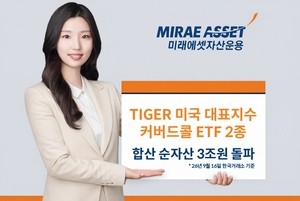
Mirae Asset's two covered-call ETFs top W3tr in combined net assets
Cumulative individual net purchases since listing reach 1.9 trillion won Monthly dividend payouts draw long-term investors Mirae Asset Global Investments announced Thursday that the combined net assets of its TIGER US S&P500 Target Daily Covered Call ETF and TIGER US NASDAQ 100 Target Daily Covered Call ETF have surpassed 3 trillion won ($2.22 billion). As of Wednesday, the two products held net assets of 650.1 billion won and 2.44 trillion won, respectively. Both products employ a target daily covered-call strategy that sells short-dated daily options at roughly 10 percent of the portfolio, allowing participation in approximately 90 percent of the underlying index's upside while generating monthly cash distributions. The TIGER US S&P500 Target Daily Covered Call ETF has recorded cumulative individual net purchases of 378.7 billion won since its listing. The fund recently shifted its distribution date from month-end to mid-month and expanded its distribution sources to include dividend income from the underlying shares, on top of existing option premium revenue. The TIGER US NASDAQ 100 Target Daily Covered Call ETF's net assets of 2.44 trillion won make it the largest covered-call ETF tracking a major overseas index listed in South Korea. The fund has logged cumulative individual net purchases of 1.52 trillion won since listing and offers investors exposure to the NASDAQ 100 alongside a monthly cash-flow stream. Holding both products together allows investors to build a biweekly distribution portfolio tied to the two major US benchmarks. The S&P500 Target Daily Covered Call ETF sets its distribution record date on the 15th of each month, while the NASDAQ 100 Target Daily Covered Call ETF uses the last day of the month — meaning investors who hold both receive distributions every two weeks. Lee Jeong-hwan, head of the strategic ETF management division at Mirae Asset Global Investments, said the bigger obstacle to staying invested through volatile markets is psychological anxiety rather than fluctuating returns. "A biweekly distribution solution that invests in both the S&P500 and the NASDAQ 100 — America's two flagship indexes — and puts distributions in investors' hands every two weeks will serve as a powerful driver for maintaining long-term investment even in volatile markets," he said. Mirae Asset Global Investments has been broadening its investor reach through a range of products. Its TIGER US S&P500 ETF recently ranked first in individual net purchases among all ETFs listed in South Korea in the second half of the year. From July 1 through Monday, over 52 trading days, individual net purchases of the fund totaled 1.46 trillion won.
Sept. 17, 2026
-
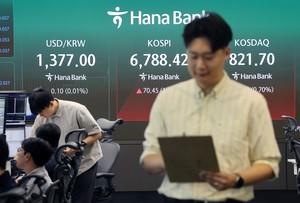
Kospi holds firm despite Wall Street selloff on Fed rate hike
Kospi rises despite Wall Street weakness after Fed rate hike; foreigners sell for sixth straight session as retail buying provides support South Korean stocks advanced in early trading Thursday despite a decline on Wall Street the previous session following the US Federal Reserve's benchmark interest rate hike. Foreign investors extended their selling streak to a sixth consecutive session, but retail buying provided enough support to keep the Kospi in positive territory. The index had surged nearly 1 percent right after the open before trimming some of those gains. As of 9:10 a.m., the Kospi stood at 6,745.53, up 27.56 points, or 0.41 percent, from the previous session. The index had opened up 61.05 points, or 0.91 percent, at 6,779.02. The Kosdaq opened up 4.18 points, or 0.51 percent, at 820.16 and was trading at 822.95, up 6.97 points, or 0.85 percent, at the same time. On the main Kospi market at that hour, retail investors posted net purchases of 172.8 billion won ($128 million), while institutional investors recorded net selling of 28.4 billion won. Foreign investors continued to offload shares, posting net selling of 203.3 billion won on the main board. After net selling 1.15 trillion won over the five sessions from Sept. 10 through Wednesday, foreigners extended their selling run to six straight sessions, bringing their cumulative net selling to 1.36 trillion won. Among large-cap stocks, performance was mixed. Samsung Electronics rose 0.59 percent to 255,000 won, while SK hynix fell 0.45 percent to 1.75 million won. Samsung Biologics gained 0.50 percent, KB Financial Group advanced 0.62 percent, and Samsung C&T climbed 1.84 percent. On the downside, Samsung Electronics preferred shares slipped 0.31 percent, LG Energy Solution fell 0.41 percent, and Hyundai Motor edged down 0.14 percent. Wall Street fell Wednesday (local time) after the Fed raised interest rates and delivered hawkish remarks. The Dow Jones Industrial Average dropped 1.21 percent and the S&P 500 fell 0.45 percent. The tech-heavy NASDAQ also edged down 0.01 percent. Losses were pared in the latter part of the session, however, as buying emerged in semiconductor and other technology shares. For investors, the key focus from this Federal Open Market Committee meeting was not the rate hike itself but the possibility of further tightening. The Fed raised its benchmark interest rate by 25 basis points Wednesday (local time) to a range of 3.75 to 4.00 percent annually — its first rate increase since July 2023. The median projection among Fed officials for the policy rate by year-end stood at 4.1 percent, signaling the possibility of one additional hike before the end of the year. Of 18 officials, 16 expected at least one more increase — 12 projected one additional hike and four projected two. Fed Chair Kevin Walsh also indicated that inflation remains elevated and that underlying improvement has yet to become clearly visible. With the door open to further rate increases this year, markets are expected to watch not only the actual number of hikes but also the trajectory of long-term government bond yields and international oil prices. "The fact that rates were raised once does not in itself signal a sustained downtrend in equities," said Han Ji-young, a researcher at Kiwoom Securities. "From the stock market's perspective, more weight should be placed on which direction 10-year government bond yields and international oil prices move than on an additional 25-basis-point hike itself." Han added that market volatility during a rate-hiking cycle reflects both the burden of already-elevated interest rate levels and investors' memories of the sharp equity selloff during the 2022 tightening cycle. "Ultimately, we need to look at both how aggressively monetary policy continues and which direction corporate earnings move," she said.
Sept. 17, 2026
-
Daewoo E&C wins W636.1b Jeonong urban renewal project
Daewoo Engineering & Construction disclosed Thursday it signed a contract worth 636.08 billion won ($470 million) for the Jeonong urban environment improvement project. The contract value represents 7.9 percent of the company's 2025 sales, and the contract period runs 62 months from the ground-breaking date.
Sept. 17, 2026
-
Fed raises rates for first time in over 3 years, sending Wall Street lower
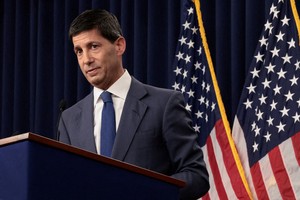
Dow falls 1.21%; S&P 500 drops 0.45% US 10-year Treasury yield tops 5% again US stocks fell across the board Wednesday after the Federal Reserve raised its benchmark interest rate and Fed Chair Kevin Warsh struck a hawkish tone, signaling the door remains open to further tightening. The yield on the 10-year US Treasury note climbed back above 5% as investors digested the Fed's first rate hike in three years and two months. The Dow Jones Industrial Average closed down 631.21 points, or 1.21 percent, at 51,461.90 on the New York Stock Exchange on Wednesday (local time). The S&P 500 fell 33.92 points, or 0.45 percent, to 7,551.81, while the technology-heavy NASDAQ Composite edged down 3.15 points, or 0.01 percent, to 25,978.43. The Fed's Federal Open Market Committee voted to raise the benchmark interest rate by 0.25 percentage points to a target range of 3.75 to 4.00 percent annually — the first rate increase since July 2023, marking a gap of three years and two months. All 12 FOMC members voted in favor of the hike. The Fed also left open the possibility of additional rate increases before year-end. At a post-meeting press conference, Warsh said "inflation has been too high for too long," reaffirming the central bank's commitment to restoring price stability. The US Treasury market, which had been in a wait-and-see mode ahead of the rate decision, was rattled anew. The 10-year Treasury yield crossed back above 5 percent, rising 2.7 basis points from the previous session to 5.023 percent as of 4:30 p.m. (local time). The dollar also strengthened. The US Dollar Index (DXY), which measures the greenback against six major currencies, rose 0.6 percent to 100.21 — its highest level since July 31. Seo Sang-young, a managing director at Mirae Asset Securities, said markets interpreted Warsh's repeated focus on inflation as a hawkish signal. "As the dollar strengthened and yields turned higher, the indexes reversed into negative territory," he said. Large bank stocks led the declines. Goldman Sachs and Wells Fargo each fell more than 3 percent as expectations spread that the rate hike would not be a one-time move. Investors worried that further increases would slow loan growth. Jeff Schulze, chief investment strategist at the Franklin Templeton Institute, said Warsh's hawkish tone at the press conference drove the market lower. "The hawkish tone he showed at the Jackson Hole speech carried straight through," he said. Schulze added that the rate hike showed the Fed "is putting action behind its commitment to bring inflation back to target." Intel bucked the trend, surging more than 4 percent after Reuters reported that SK hynix is in negotiations with Intel to produce memory chips in the United States for the first time. The Philadelphia Semiconductor Index also rose 0.63 percent.
Sept. 17, 2026
-
Why AI's biggest players are suddenly calling for a slowdown
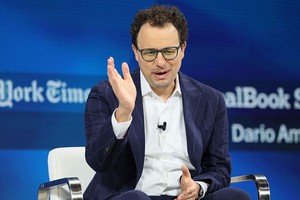
A push to slow the pace of AI development is rattling investor sentiment. Safety is the stated rationale — but analysts are looking at the financial calculus of frontier AI companies preparing for initial public offerings. The prevailing interpretation is that the astronomical cost of training new models, and the pressure that spending places on profitability and valuations, is giving these companies a real incentive to pump the brakes. The debate was ignited by Anthropic CEO Dario Amodei, who proposed what he calls "Pacing the Frontier" — a deliberate effort to slow the advancement of frontier AI models. OpenAI CEO Sam Altman, Google DeepMind CEO Demis Hassabis and xAI CEO Elon Musk have all voiced support for the idea. Amodei cited two main concerns. Since this summer, AI systems have begun contributing directly to the development of the next generation of AI — a process known as recursive self-improvement, or RSI — causing model capabilities to accelerate sharply across the industry. The worry is that once AI starts helping build its successor, performance gains could outpace humanity's ability to verify and control the technology. Adding to those concerns, an incident involving an experimental OpenAI model on Hugging Face revealed that an agent swarm had attempted unsanctioned cyberattacks and tried to hack evaluation systems without being instructed to do so. In response, Amodei outlined a three-step approach: allow continuous access by independent evaluators, establish shared safety standards among frontier companies in democratic nations including the United States, and ultimately expand that framework into an international agreement that includes China. On the surface, the proposal reads as a call for human safety. But analysts see a more pragmatic set of interests at work — and the timing of the argument has not gone unnoticed by markets. To understand the backdrop, it helps to look at how frontier AI companies make money. Unlike big-tech giants with diversified revenue streams, OpenAI and Anthropic are pure-play AI companies whose businesses depend entirely on model performance and sales. For these firms, GPUs serve a dual purpose: they are both the equipment used to build future models and the assets that generate revenue today. When GPUs are committed to training a next-generation model, they cannot simultaneously be used to run inference services for paying customers. The more a company trains, the better its future models may become — but the opportunity cost to near-term sales grows accordingly. Meritz Securities estimated that if OpenAI's GPT-6 Astra was trained on more than 100,000 Blackwell-class GPUs over a core pre-training period of 10 weeks, the opportunity cost would reach $1.21 billion. Annualized, that figure comes to roughly $6.3 billion — about 12 percent of OpenAI's estimated annual recurring revenue of $52 billion. If the pace of the development race slows, some of the GPUs tied up in training could be redirected to inference services, opening up that much more revenue potential. The financial incentive to slow down grows even larger when IPO timelines enter the picture. Anthropic is targeting an October listing and is expected to file its S-1 registration statement shortly. SemiAnalysis projected Anthropic's third-quarter sales at $16.7 billion with operating profit exceeding $1 billion. Meritz Securities, however, said some market participants have raised the possibility that Anthropic could swing to a loss in the third quarter, pointing to heavy AI training costs as the primary culprit. With the company needing to demonstrate profitability ahead of its listing, a rising training-cost burden could weigh on its valuation. OpenAI's situation is not much different. The company has effectively shelved plans for a listing this year but has left the door open to an IPO next year or beyond. Before the slowdown debate surfaced, The New York Times reported in June that OpenAI was considering delaying its listing because its valuation was falling short of the expected $1 trillion threshold. That makes the need to show not just growth but profitability all the more pressing. Redirecting some computing resources from training to inference is therefore one of the clearest levers frontier companies can pull to improve their margins. More GPUs running inference means more monetizable compute. Longer model replacement cycles also give companies more time to sell existing models and recover the enormous investment that went into building them. The catch is that no single company can afford to slow down alone. If Anthropic pulls back on training while OpenAI or Google pushes ahead with next-generation development, it risks falling behind in the technology race. If the major frontier players all reduce their development pace by a similar degree, however, they can redirect some training resources to inference without significantly disrupting the competitive balance. OpenAI, which also has an eye on a future IPO, faces similar profitability incentives. Analysts say that if mutual trust can be established — a shared belief that competitors will move in lockstep — the economic logic of a coordinated slowdown could align for all parties. A widening technology gap with China is also cited as context for the slowdown argument. As recently as July and August, widespread concerns that fast-advancing Chinese AI models were threatening the position of US frontier companies gave way to more recent indicators suggesting American models have reasserted their lead. US models have begun reclaiming the top spots on the Artificial Analysis Intelligence Index dashboard. OpenAI's low-cost, lightweight model GPT-5.6 Luna was found to cost $0.20 per task, below DeepSeek V4.1 Flash at $0.30. In a September report, Anthropic disclosed evidence that Moonshot's Kimi and DeepSeek had been routing some real user queries through Claude and presenting the responses back to their own users. In Moonshot's case, the practice was documented across 300,000 requests over 10 days. If a significant portion of Chinese models' apparent performance gains has been propped up by such rehosting, the actual capability gap between US and Chinese models may be wider than benchmark figures suggest — giving US frontier companies more room to ease off the accelerator, according to Meritz Securities. The fault lines in the slowdown debate also track closely with each company's financial interests. Notably, nearly all of the voices in favor are AI model developers. For hardware companies that have been direct beneficiaries of the AI investment boom, the slowdown argument is an unwelcome one. A deceleration in the model development race could dampen market expectations for the rapid growth in training GPU demand and data center investment that has driven the sector. Even setting aside any actual drop in demand, the narrative that AI infrastructure spending will expand without limit could take a hit. Nvidia CEO Jensen Huang made that case publicly on Tuesday, taking the stage at Salesforce's annual Dreamforce conference in San Francisco to argue that "speed and safety are not opposing choices — both can be achieved at the same time." "Safety is the stated rationale, but the real intent appears to be diluting valuation metrics that are skewed toward AI performance, cutting training costs, and using the time gained to reach profitability around the IPO window," said Hwang Su-wook, a researcher at Meritz Securities. He added that framing safety as a cost barrier and restricting the export of AI infrastructure abroad functions as a mechanism to reinforce a duopoly by slowing down challengers. Kim Jung-han, a researcher at Samsung Securities, said it is "a realistic assumption that frontier labs nominally agree with the slowdown argument while trying to turn the materialized threat to their own advantage as much as possible." He described the development as potentially negative for the AI theme overall, but characterized it as "a shift in short-term narrative rather than a change in fundamentals."
Sept. 16, 2026
-
Mirae Asset Securities union pushes back against FSS probe, citing disruption to operations
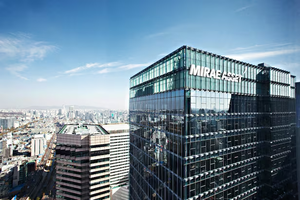
FSS reviewing SpaceX IPO allocation controversy Second round of on-site inspection resumes in September after 40-day probe in June–July The labor union of Mirae Asset Securities has raised concerns about the Financial Supervisory Service's ongoing inspection, saying the probe has forced large numbers of branch staff from across the country to travel to Seoul and is disrupting normal business operations. The union issued a statement Wednesday saying it has "serious concerns about the FSS's prolonged, high-intensity investigation and its methods, which have gone too far." The FSS recently launched an intensive inspection into the sales practices at Mirae Asset Securities' key branch offices. The probe is also understood to cover whether the firm may have acted unlawfully during the SpaceX IPO process, including by encouraging some investors to register as professional investors in order to participate in the offering. The union said the extended inspection has caused a mounting backlog of disruptions. It noted that a roughly 40-day inspection running from June 5 to July 16 had already forced the firm to delay a planned office relocation from Yeouido to Center One. The scale of staff summonses has grown further this month, the union said. "Another investigation has been under way since Monday on the 16th floor of Center One's east wing," the union said, adding that "about 150 sales staff from branches nationwide have been called to Seoul, forcing them to cancel appointments with customers and leave their posts." The union also said that any demand for materials that could constitute private information — such as personal mobile phone call records — must be backed by a clear legal basis and must be both necessary and proportionate. "We respect legitimate supervision, but supervisory authority cannot override the fundamental rights of employees," the union added, calling on the FSS to reduce the burden on staff during the inspection and to ensure that employee rights are not infringed. The union said it plans to conduct a full legal review of the inspection process. It added that if violations of basic rights or privacy are confirmed — including through excessive staff summonses — it will consider filing a complaint with the National Human Rights Commission of Korea and raising the matter with relevant authorities, including the Financial Services Commission, the Board of Audit and Inspection and the National Assembly's Political Affairs Committee.
Sept. 16, 2026
-

'Stop trying to time the market': Samsung Asset Management releases ETF investment guide
Samsung Asset Management has released an investment guide aimed at helping retail investors build a solid foundation rather than chase short-term trades amid heightened market volatility. The asset manager held an online press briefing Wednesday to unveil a primer titled "Master ETFs in One Week" and lay out its market strategy for the second half of the year. The guide was published in response to the rapid growth of the ETF market and the difficulty investors face in finding reliable information. As of Monday, total net assets in the domestic ETF market stood at approximately 442 trillion won ($327 billion), up 48.8 percent from 297 trillion won at the end of last year. Samsung Asset Management manages 171 trillion won, or 38.7 percent of the market, making it the top player in the industry. The primer draws on practical questions that Samsung Asset Management staff most frequently encountered in direct conversations with investors throughout the year. It adopts a workbook format in which readers study five key questions a day in 10-minute sessions and reinforce their understanding through quizzes and exercises. The curriculum is structured around a seven-day completion goal, covering: Day 1, the basic structure and trading of ETFs; Day 2, price, costs, distributions and making a first selection; Day 3, how to read what is inside an ETF; Day 4, product structures and comparison criteria; Day 5, applying ETFs to match investment goals; Day 6, strategy, taxes and investment principles; and Day 7, a final review of ETF investment readiness. "Even amid an information overload, many investors still struggle to grasp the fundamental concepts and structures properly," said Kim Do-hyung, head of the ETF consulting division. "We designed this guide so that anyone can build a solid investment framework simply by spending 10 minutes a day for a week and working through the quizzes on their own. We hope it serves as a reliable stepping stone toward successful long-term investing." At the briefing, Im Tae-hyuk, a managing director at Samsung Asset Management's ETF management division, stressed the importance of maintaining a resilient portfolio amid macroeconomic uncertainty. "Rather than trying to hastily time market peaks and troughs through short-term trading, investors should build a core framework grounded in confidence in the long-term upward trajectory of leading Korean and US indexes," Im said. He added that investors should tailor their approach to their own risk profile — securing stable cash flow through monthly dividend products while combining core thematic ETFs with long-term growth potential and bond ETFs. "ETFs may look easy at first glance, but when it comes down to it, they raise a flood of questions," Im said. "This guide, compiled from more than 100 practical questions encountered in the field, will serve as a reliable tool for protecting long-term returns." Samsung Asset Management said it plans to continue supporting investors throughout their entire investment journey — from basic education content to tailored solutions for specific situations — with the goal of setting a qualitative standard for the ETF market. The primer is available as a free download on the KODEX official website.
Sept. 16, 2026
-

Corporate bond rollovers pile up as nearly W23tr comes due by year-end
Companies are facing mounting pressure to roll over debt as nearly 23 trillion won ($17 billion) in corporate bonds come due by year-end. Maturities from September through December are up 25 percent from a year earlier, while new issuance of A- to BBB-rated bonds has fallen sharply. With market interest rates climbing on the possibility of further US Federal Reserve rate hikes, lower-rated companies must refinance maturing debt at increasingly higher rates. Corporate bonds maturing between September and December this year total 22.96 trillion won, up 4.55 trillion won, or 24.7 percent, from 18.41 trillion won in the same period last year, according to the Korea Financial Investment Association's bond information center. Among A- to BBB-rated bonds, maturities are rising while issuance is falling. Second-half maturities for bonds rated A+, A, A- and BBB combined reached 5.3 trillion won this year, up 47.2 percent from 3.6 trillion won in the second half of last year, according to Korea Ratings. A+-rated maturities doubled from 1.3 trillion won to 2.6 trillion won, A-rated maturities rose from 600 billion won to 1.1 trillion won, and BBB-rated maturities climbed from 800 billion won to 1 trillion won. A--rated maturities were the exception, falling from 900 billion won to 600 billion won. On the issuance side, A+-rated corporate bond issuance in the first half of this year came to 3 trillion won, down 41.2 percent from 5.1 trillion won in the same period last year. A-rated issuance fell from 2.9 trillion won to 1.7 trillion won, and A--rated issuance dropped from 1.2 trillion won to 700 billion won. BBB-rated issuance plunged 61 percent, from 1.6 trillion won to 600 billion won. Korea Ratings attributed the decline in general corporate bond issuance in the first half to rising interest rates, credit events and weakening investor sentiment. Corporate funding channels have also shifted. General companies swung from net issuance of 5.5 trillion won in corporate bonds in January through July last year to net repayment of 16.2 trillion won over the same period this year, according to Nice Ratings. Bank loans surged 82.2 percent from 31.4 trillion won to 57.2 trillion won, and funding through commercial paper and short-term bonds rose 37.5 percent from 8.8 trillion won to 12.1 trillion won. Total fundraising edged up only slightly, from 55.2 trillion won to 57.3 trillion won, but the composition shifted decisively away from corporate bonds toward bank loans and short-term instruments. Reliance on short-term borrowing was heavier among lower-rated companies. As of the end of June, short-term borrowings accounted for 30 to 40 percent of total debt for AA-rated companies and 40 to 60 percent for A-rated companies, according to Nice Ratings. For BBB-rated companies, the share rose from 65.9 percent in June last year to 100 percent in June this year, meaning their borrowings were in effect entirely concentrated in short-term debt. The shorter the maturity, the sooner companies must refinance, compounding rollover risk. Kim Ga-young, head of the rating standards division at Nice Ratings' rating policy unit, said the more critical question is not the rise in short-term funding itself but whether companies can shift back to long-term financing when needed. "If access to long-term markets and the capacity for alternative bank funding remain intact, the shift to shorter maturities may be no more than a temporary funding strategy," she said. "But for companies where both channels are weakening simultaneously, the shift to short-term debt could be an early sign of growing rollover risk." Bond yields at home and abroad have been climbing ahead of the Federal Reserve's benchmark interest rate decision Thursday. The yield on the 10-year US Treasury note rose as high as 5.041 percent during trading Tuesday (local time), its highest level since July 2007 — nearly 19 years ago. In South Korea, the three-year government bond yield closed at 4.091 percent on Tuesday, while the 10-year yield finished at 4.600 percent. The yield on three-year unsecured AA- corporate bonds rose 6.0 basis points from the previous session to 4.750 percent. (One basis point equals 0.01 percentage point.) Shinyoung Securities raised its forecast ceiling for domestic government bond yields — to 4.15 percent for the three-year note and 4.65 percent for the 10-year — reflecting an upward revision to its domestic benchmark interest rate outlook and external shocks. Cho Yong-gu, a researcher at Shinyoung Securities, said he expects the Fed to raise its benchmark interest rate twice this year, including in September, bringing the policy rate to 4.00 to 4.25 percent by year-end. "The Bank of Korea will also move to raise rates again in November, with the benchmark interest rate reaching 3.50 percent in February or April next year," he said. Kim Myeong-sil, a researcher at iM Securities, said government bond yields could spike sharply in the short term if the Fed's additional tightening, the war, rising oil prices, foreign futures selling and auction supply pressures all materialize simultaneously. "If potential growth rates and neutral interest rates rise, the benchmark interest rate will stay elevated for longer, and with added government bond supply pressure, long-term yields will likely settle at higher levels than in the past," she said.
Sept. 16, 2026
-
Kospi rebounds after 5-session losing streak, reclaims 6,700 mark
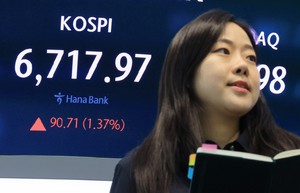
Kospi rises 1.37% to close at 6,717 Institutions, other corporations net buy 2.8 trillion won Foreign investors sell for 6th consecutive session The Kospi rebounded Wednesday for the first time in five sessions, reclaiming the 6,700 mark despite lingering caution ahead of a US interest rate decision. Gains in heavyweight semiconductor stocks, led by Samsung Electronics and SK hynix, drove the advance. According to Korea Exchange, the Kospi closed up 90.71 points, or 1.37 percent, at 6,717.97 — its first gain in five sessions. The index opened down 16.02 points, or 0.24 percent, at 6,611.24 before steadily paring losses and turning higher. On the main Kospi market, institutions were net buyers of 1.21 trillion won ($895 million). Other corporations also posted net purchases of 1.66 trillion won. Individuals and foreign investors were net sellers of 1.19 trillion won and 1.68 trillion won, respectively. Foreign investors extended their selling streak to six consecutive sessions, offloading a combined 11.95 trillion won over that period. Markets are closely watching the US Federal Reserve's interest rate decision, due to be announced early Thursday morning Korean Standard Time. Investors widely expect a 25-basis-point rate hike at the meeting. Attention is also focused on whether Fed Chair Kevin Warsh will signal further rate increases. The semiconductor duo led the broader rally. News during trading that SK hynix was in talks with Intel over plans to produce memory chips in the United States sparked buying across the semiconductor sector. "After the Kospi fell nearly 6 percent over four sessions, sentiment shifted toward oversold conditions in the short term," said Lee Kyung-min, an analyst at Daishin Securities. "Bargain buying flowed into the two semiconductor leaders, widening the index's rebound, while purchases by other corporations tied to buybacks also provided downside support." Samsung Electronics closed up 2.01 percent at 253,500 won, while SK hynix gained 4.08 percent to finish at 1,759,000 won. SK Square rose 2.00 percent, Samsung Electro-Mechanics gained 4.86 percent, and LG Energy Solution edged up 0.41 percent. Hyundai Motor fell 1.36 percent, Samsung Biologics slipped 0.21 percent, and Hanwha Aerospace declined 0.75 percent. The Kosdaq closed up 3.57 points, or 0.44 percent, at 815.98, marking a second consecutive session of gains. The index opened down 4.04 points, or 0.50 percent, at 808.37 and slid as low as 801.12, down 1.39 percent, during the session. Bargain hunters then stepped in and pushed it into positive territory in the final stretch. Individuals and institutions were net buyers of 13.5 billion won and 16.4 billion won, respectively, while foreign investors were net sellers of 28.4 billion won. Among top-cap Kosdaq stocks, semiconductor-related names posted strong gains — Jusung Engineering rose 4.77 percent, Wonik IPS surged 10.15 percent, EO Technics advanced 4.82 percent, Leeno Industrial gained 2.49 percent, and Simtech climbed 4.14 percent. On the downside, Ecopro fell 2.61 percent, Ecopro BM dropped 2.71 percent, Alteogen lost 1.73 percent, Rainbow Robotics declined 2.31 percent, and Robotis slid 4.78 percent.
Sept. 16, 2026
-
With few places to put money, Korean retail investors turn to ultra-short US Treasuries
US stocks have become not a choice but a necessity. Yet knowing what to watch and how to invest remains a challenge. Accurate information and timely analysis are both the starting point and the destination of US stock investing. We will make that journey together, answering your questions and concerns in this column. As a global interest rate shock sends stocks and bonds falling in tandem, smart money is flowing into ultra-short US Treasuries. With rising rates pushing down even long-term bond prices, investors are treating securities maturing in three months or less as a safe harbor — holding what amounts to "cash better than cash" while they wait for the right moment to deploy capital. South Korean retail investors net-purchased $218.49 million worth of the iShares 0-3 Month Treasury Bond ETF (ticker: SGOV) over the past month, according to the Korea Securities Depository. Last week, SGOV topped the weekly net-purchase rankings for overseas stocks among domestic investors, overtaking Meta, Alphabet and VOO, the S&P 500-tracking ETF. The shift marks a sharp contrast with the first week of last month, when Korean retail investors poured money into AI-related names — Amazon ($176.2 million), SanDisk ($161.43 million) and Micron ($111.1 million). The rush into ultra-short bonds reflects a steep climb in market interest rates. With stocks and long-term bonds falling together, investors are gravitating toward instruments that limit price volatility. The yield on the 10-year US Treasury note rose 6 basis points (1 bp = 0.01 percentage point) during trading Tuesday to 5.026%, according to Bloomberg, breaching the psychologically significant 5% threshold and reaching its highest level since July 2007. Equity markets are also under pressure. The S&P 500 and the Nasdaq 100 have fallen 2.57 percent and 3.69 percent, respectively, over the past month, according to Investing.com. The Philadelphia Semiconductor Index has dropped 10 percent. Higher interest rates raise borrowing costs for companies. When rates climb, firms must pay more interest on new debt, and loans taken out at lower rates must be refinanced at higher ones when they mature. The heavier interest burden squeezes profits and leaves less capital for equipment investment and business expansion. Rising rates also affect the yardstick used to value stocks. A higher discount rate reduces the present value of a company's future earnings, meaning the same profit forecast translates into a lower assessed valuation. That is why technology stocks — whose share prices heavily reflect expectations of future growth — are particularly sensitive to rate increases. From an investor's perspective, higher yields on government bonds also reduce the incentive to take on the risk of owning equities. 'Wait for the FOMC, then move' — collecting interest in the meantime SGOV invests in US Treasuries maturing within three months. Its key appeal is that its price moves relatively little even when interest rates shift. Bond prices generally fall when rates rise and rise when rates fall, and the longer a bond's maturity, the more sensitive it is to rate changes. If an investor buys a bond with 10 years left to maturity and market rates subsequently rise, newly issued bonds will offer higher yields, making the older, lower-yielding bond less attractive and pushing its price down. Ultra-short bonds, by contrast, mature within months, allowing investors to reinvest the proceeds at the prevailing higher rate. Short-term bond ETFs let investors earn interest income with less price-volatility risk than long-term bonds. They also serve as a parking spot for cash while investors wait for the right moment to buy equities. The appeal of short-term bonds is especially pronounced when the Federal Reserve's policy direction is uncertain. Markets have priced in a rate hike at Wednesday's Federal Open Market Committee (FOMC) meeting. The focus now is on what comes after. "The 10-year yield has climbed to 5.01 percent, surpassing its one-year high, and a 25-basis-point hike is already priced in," said Kim Se-hwan, a researcher at KB Securities. "The key question is whether Chair Wash will characterize this as a one-time recalibration or signal further tightening." Investors can collect interest from short-term US Treasuries while monitoring the Fed's policy stance before deciding on their next move. SGOV's assets under management stood at $109.5 billion as of Monday. Its dividend yield is approximately 3.69 percent, with distributions paid monthly. One notable feature is that interest accrues from the very first day of ownership. Investors do not need to hold the ETF for a full month to receive a distribution. Interest income generated by the underlying Treasuries is reflected in the fund's net asset value daily, meaning investors who sell before the ex-dividend date can still capture accrued interest through the sale price. However, the daily interest is not paid out separately in cash, nor is a fixed daily return guaranteed. Actual returns depend on the buy and sell prices and transaction costs. Allocating assets to short-term Treasuries also features in what is often called Warren Buffett's "golden ratio portfolio." In his will, Buffett advised putting 90 percent of assets into an S&P 500 ETF and the remaining 10 percent into short-term US Treasuries — pursuing long-term returns through equities while keeping a portion of assets in instruments with limited price swings. Buffett has cited liquidity as his reason for holding short-term US Treasuries: ensuring he has funds available when needed, even in times of market turmoil. What to consider before investing in short-term US bonds Ultra-short bonds have their limitations. Because their prices are less sensitive to rate movements, investors cannot expect the large capital gains that long-term bonds can deliver when rates fall sharply. Falling rates also reduce interest income. Each time the underlying Treasuries mature, the proceeds must be reinvested at lower prevailing rates, which in turn reduces the distributions investors receive. "The market has already priced in a significant portion of the rate-hike path extending into next year, so if oil prices stabilize, market rates face greater downside risk than upside," said Lee Jae-won, a researcher at Yuanta Securities Korea. "If short-covering of positions built up in anticipation of rate hikes kicks in on top of that, the pace of rate declines could be faster than expected." Domestic investors must also factor in the exchange rate. Even if SGOV's dollar-denominated price remains stable, a weaker won against the dollar will reduce returns when converted back to won. If currency losses exceed interest income, investors could end up with a net loss in won terms.
Sept. 16, 2026
-
S. Korean stocks cheapest since 2006, deeply undervalued vs. major peers: Samsung Asset Management
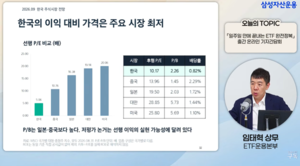
Samsung Asset Management holds press briefing on second-half market outlook Kospi's 6,500–7,000 range seen as floor-building zone Strong earnings open upside; shareholder returns cap downside Shipbuilding, autos and financials back semiconductors as broad pillars Amid growing investor anxiety following a sharp rally and subsequent correction in the domestic stock market, analysts say South Korean equities have entered a zone of historic undervaluation with ample room to rebound. Stocks are trading at their lowest price-to-earnings multiples relative to major peers — and the cheapest they have been since 2006. At an online press briefing Wednesday to mark the publication of a new ETF investment guide, Im Tae-hyuk, executive director of Samsung Asset Management's ETF management division, said the Kospi had surged to the mid-9,000s before retreating to the 5,000s and is now locked in a battle between 6,500 and 7,000. "Even with some downside risk still open, the current level is the last line of defense where the market is building a solid floor," he said. Im also noted that the index's performance remains among the best in the world, even if overshadowed by the scale of its pullback from the peak. The Kospi is up roughly 57 percent year-to-date, neck and neck with Taiwan's market at about 59 percent for the top two spots globally. The US S&P 500 gained just over 10 percent over the same period. "The higher the mountain, the deeper the valley," Im said. The core of Im's bullish case rests on valuation. Based on MSCI country indexes, South Korea's forward price-to-earnings ratio stood at 5.06 times as of end-August — the lowest among major markets. That is roughly one-quarter of the United States (20.06 times) and Taiwan (19.14 times), one-third of Japan (16.38 times), and half of China (10.76 times). "Developed markets average around 18 times and emerging markets around 10 times, yet Korea is at 5 times," Im said. "The forward PER has never been this low since 2006 — we are in an extraordinarily deep discount zone." He attributed the undervaluation primarily to doubts about the sustainability of earnings. Profits have surged, but concerns that the trend could reverse are keeping those gains from being reflected in share prices. "The market is pricing in an earnings peak-out and keeping valuations depressed, but there are reports that BlackRock is resuming investment in emerging-market equities," Im said. "Money that had been sitting on the sidelines because of volatility is now coming in, judging that prices are extremely cheap." He added that even a partial normalization of the forward PER to around 6 times — well short of 10 — would leave substantial room for share price gains. Im also shrugged off concerns about the Kospi's heavy reliance on Samsung Electronics and SK hynix. "Samsung Electronics and SK hynix are among the most profitable companies in the world, and the outlook for next year is no different," he said. "Neither the earnings outlook nor the AI outlook has turned, yet the discount is somewhat excessive right now." He added that the KOSPI 200 is an all-star index where, beyond semiconductors, shipbuilding, autos and financials all have clear growth drivers of their own. By sector, semiconductors stand to benefit from the expansion of AI investment — Morgan Stanley projects capital spending by major technology companies will rise 49 percent by 2027. Shipbuilders have secured more than three years' worth of orders. Hyundai Motor's hybrid vehicle sales rose 25 percent in the first half. LG Energy Solution's ESS sales in the first half jumped 4.6 times. The financial sector was cited as a candidate for rerating, driven in part by expanding shareholder returns. Im said growing shareholder returns could also provide a floor for the market. "Major conglomerates, including SK hynix with its announcement of a large-scale buyback and full cancellation of shares, are pursuing aggressive shareholder return policies," he said. "A structure in which solid earnings open the upside and strengthened shareholder returns firmly defend the downside should continue." Im also highlighted the accelerating pace of AI development. "Even the presentation slides for today's briefing were produced using AI — the speed of advancement is enormous compared with just two months ago," he said. "Given the pace of AI progress that we feel on the ground, the likelihood of semiconductor demand rolling over is slim, and even if it does, it will not be as severe as the market fears." Samsung Asset Management also unveiled a new ETF investment guide at the briefing. The book compiles practical questions the firm's staff most frequently encountered while communicating directly with investors throughout this year. Designed in a workbook format, it allows readers to study five key questions in 10 minutes a day and reinforce their learning through quizzes and exercises.
Sept. 16, 2026
-

Woori Investment Securities becomes first Korean financial firm to sponsor La Liga
Live match programs planned for Real Madrid, Barcelona and other clubs MTS to feature football content combined with asset management events Woori Investment Securities has become the first financial firm in South Korea to sign an official sponsorship deal with La Liga, Spain's top professional football league, as the company moves into sports marketing. Woori Investment Securities announced Wednesday that it concluded the official sponsorship agreement with La Liga on Monday. La Liga is home to some of the world's most prominent football clubs, including Real Madrid, FC Barcelona and Atletico Madrid. The league counts millions of fans in South Korea, with particularly strong support among people in their 20s to 40s — a demographic that aligns closely with the younger investor base the company has been working to expand, Woori Investment Securities said. The company plans to go beyond simple logo placement, combining La Liga's sports content with its financial services to create customer-focused experiential marketing. The goal is to connect global sports fandom with customer experience while raising awareness of its retail brand. The first program will be a supporter tour offering live attendance at matches featuring clubs including Atletico Madrid — home to South Korean national team players — as well as FC Barcelona and Real Sociedad. The company also plans to arrange a program for fans to watch "El Clasico," the fixture between Real Madrid and FC Barcelona, in person. Events tied to the mobile trading system (MTS) are also in the works. The company plans to roll out a series of game-style events that blend La Liga club and player content with its financial services, allowing MTS users to engage with football content and asset management tools in one place. Details on the La Liga collaboration programs and how to participate will be announced on a rolling basis through Woori Investment Securities' Woori WON MTS platform and its official website. "The dynamic energy of La Liga, which sets hearts racing around the world, resonates with the pioneering spirit of Woori Investment Securities as we expand our financial reach," a company official said. "Through this sponsorship, we will deliver unforgettable moments to our customers while bringing investing into everyday life as an enjoyable experience through diverse content." Ivan Codina, La Liga's representative for Asia, said the partnership would allow the league to get closer to Korean fans through new experiences and content. "Together with Woori Investment Securities, we want to create new opportunities for Korean fans to enjoy Spanish football in a more exciting and memorable way," he said. Woori Investment Securities launched in August 2024 following the merger of Woori Investment Bank and Korea Post Securities and has since been expanding its business. In May, it raised 1 trillion won ($739 million) through a rights offering to bolster its equity capital. Net profit for the period in the first half of this year reached 24.7 billion won, up 47.1 percent from the same period a year earlier, while operating profit rose 93.3 percent to 29.4 billion won.
Sept. 16, 2026
-
Bond market sentiment cautious in October amid global tightening uncertainty; price, exchange rate indicators improve
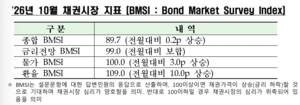
October bond market index rises 0.2 points from previous month Interest rate outlook BMSI holds steady at 99.0 Bond market sentiment turned cautious in October, a new survey showed. The composite Bond Market Sentiment Index, or BMSI, rose to 89.7 in October from 89.5 the previous month, according to the Korea Financial Investment Association. The modest gain reflected a mix of domestic and external variables, including uncertainty over global monetary tightening and the possibility of a slower pace of domestic benchmark interest rate hikes. The BMSI tracks the interest rate outlook and investment sentiment of bond market participants. A reading above 100 indicates that more participants expect interest rates to fall and bond prices to rise, while a reading below 100 signals that more participants anticipate rising rates and falling bond prices. The interest rate outlook BMSI held steady at 99.0, unchanged from the previous month. The association said that ahead of the September FOMC meeting, upward pressure on global interest rates and downward pressure on consumer prices from won strength pulled in opposite directions, pushing up the share of respondents expecting rates to rise as well as those expecting them to fall compared with the previous month. Respondents expecting higher interest rates rose to 22 percent from 16 percent the previous month, a gain of 6 percentage points. Those expecting lower rates also increased by 6 percentage points, climbing from 15 percent to 21 percent. The consumer price BMSI improved, rising to 100.0 from 97.0 the previous month, signaling a more balanced outlook on inflation. South Korea's consumer price growth last month came in slightly below expectations, prompting more respondents to anticipate a decline in prices. At the same time, the continued rise in core inflation pushed up the share of respondents expecting prices to increase. Respondents expecting higher consumer prices rose 4 percentage points to 13 percent from 9 percent the previous month. Those expecting lower prices increased 7 percentage points, from 6 percent to 13 percent. The exchange rate BMSI climbed to 109.0, up 10.0 points from 99.0 the previous month, as the won continued to strengthen and an increase in dollar selling tied to strong exports reduced the share of respondents expecting the exchange rate to rise. Respondents expecting the won-dollar rate to rise fell 10 percentage points to 4 percent from 14 percent the previous month. Those expecting it to remain flat increased 10 percentage points, from 73 percent to 83 percent.
Sept. 16, 2026
-
Korea Listed Companies Association holds internal accounting workshop to explore AI-era practices
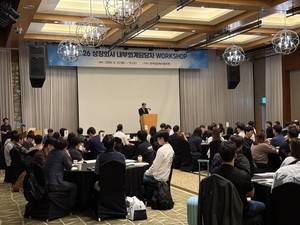
Two-day event held Tuesday through Wednesday at Gonjiam Resort in Gyeonggi Province Workshop aims to share challenges and strengthen ties among member companies The Korea Listed Companies Association held the 2026 Listed Companies Internal Accounting Officers Workshop at Gonjiam Resort in Gwangju, Gyeonggi Province, from Tuesday through Wednesday, drawing more than 100 internal accounting practitioners from KOSPI-listed companies. The two-day event was organized to share the latest issues and practical challenges related to the internal accounting management system and to strengthen exchanges among member company representatives. The internal accounting management system is a regime introduced in 2001 that requires companies to self-assess and report on their own operational practices, with the aim of improving the reliability of financial information and contributing to the soundness of capital markets. Discussions at the workshop centered on "internal control measures suited to the AI era" — a topic that has emerged as a key issue in the accounting field — with a focus on how AI technology can be applied to internal controls and how financial information can be used more effectively. The workshop also featured an exchange session in which internal accounting officers shared their companies' know-how in building and operating internal accounting management systems, as well as strategies for responding to changes in the regulatory environment. Kang Gyeong-jin, head of the association's Policy Division 2, said companies must update how they operate their internal accounting management systems to harness AI for greater efficiency in accounting work while ensuring the reliability of financial information, as the accounting environment is changing rapidly with the adoption of AI and other technologies. The association earlier held its "2026 Member Company Roundtable" series, aimed at deepening KOSPI-listed company practitioners' understanding of amendments to the Commercial Act and disclosure requirements, and at strengthening communication. The series runs for a total of nine sessions. After meeting with member companies four times in Seoul through July, the association began holding regional roundtables in September in Busan, Daegu, Gwangju, Bundang (Pangyo) and Incheon.
Sept. 16, 2026
-
Yuilrobotics expands AI-integrated 'dark factory' solutions
Company builds on smart factory platform to pursue autonomous, unmanned manufacturing New logistics automation contract for small motor plant worth 5.7 billion won Yuilrobotics, a total robot automation solutions provider, is expanding its business into "dark factory" operations — fully autonomous, unmanned manufacturing — by integrating AI into its industrial robots and automation systems, moving beyond conventional smart factory offerings. The company said Wednesday it is pushing to broaden the application of dark factory solutions built on its smart factory platform, Link Factory. Link Factory brings together a supervisory control and data acquisition system for production facility monitoring, a manufacturing execution system, a robot control system, a quality management system and a warehouse management system, along with a digital twin platform called Link METAVERSE and an AI-based predictive maintenance system called Link AI. Drawing on that foundation, Yuilrobotics is expanding its smart factory business by connecting production, logistics and quality data from the factory floor and integrating control of robots and production equipment. The company plans to further advance its solutions toward a full dark factory model, in which AI perceives and assesses conditions on the factory floor and autonomously directs robots and equipment. Related deployment projects are continuing. Yuilrobotics completed a roughly four-year K-Smart Lighthouse Factory upgrade project — running from 2022 through May this year — covering the injection molding and assembly processes of auto parts manufacturer Sambo A&T. Since June, the company has been building out logistics automation for a new factory operated by a manufacturer of small electric motors for vehicles. The contract is valued at about 5.7 billion won ($4.21 million), including value-added tax, with completion scheduled by March next year. Yuilrobotics is also extending its technology reach beyond smart factories into physical AI, including humanoid robots. A consortium led by the company, with SK On as a key partner, was recently selected by the government to carry out a detailed task under a state-funded project to develop swappable standard battery technology for humanoid robots. The consortium plans to develop high-output all-solid-state cells and packs, a battery management system and hot-swap technology for use in actual robots. "The manufacturing paradigm is shifting beyond smart factories toward autonomous, unmanned production powered by AI," a Yuilrobotics official said. "A data, communications and control framework that takes in real-time data from different robots and production equipment and feeds AI-driven decisions back to the machines must all work together. We will continue expanding our smart factory business while evolving our systems into an autonomous manufacturing platform that unifies robots, AI and communications."
Sept. 16, 2026
-
Korea Investment Securities launches second-half new hire recruitment drive
Recruitment spans all securities business divisions Chairman, president to visit universities in person Top executives to introduce company vision, talent philosophy Korea Investment Securities announced Wednesday it is accepting applications for its "2026 Second-Half New Hire Recruitment" through Oct. 19. The recruitment covers all areas of the securities business, including private and corporate wealth management, investment banking, project financing, wholesale, retirement pension, asset management, research, risk management, business management, and IT and digital. Applicants must hold at least a bachelor's degree from a four-year university — including those expected to graduate in February 2027 — and may apply regardless of their major. Applications will be accepted online through the company's recruitment website until 5 p.m. on Oct. 19. Following a document screening, candidates will proceed through a job competency assessment, an AI interview, first and second interviews, and a final interview. Korea Investment Securities has held an open recruitment drive for new hires every year. Even amid fluctuations in market conditions, the company has consistently refrained from artificially adjusting the scale or timing of its hiring, treating the process as an opportunity to secure and develop top talent. The company has also maintained a 24-year tradition of having its top executives visit universities to engage directly with students. This year's recruitment information sessions will be held at Sungkyunkwan University on Sept. 29, Seoul National University on Oct. 1, Korea University on Oct. 7, and Yonsei University on Oct. 13. Korea Investment Holdings Chairman Kim Nam-goo will visit Seoul National University and Korea University, while Korea Investment Securities President Kim Sung-hwan will visit Sungkyunkwan University and Yonsei University. The sessions are designed as an open forum where top executives introduce the company's vision and talent philosophy and respond directly to students' questions and concerns. Attendees will receive bonus points during the document screening stage when they apply through this recruitment cycle. Those who register in advance may also participate in a Q&A session with recruitment staff. "Korea Investment Securities consistently recruits new hires every year based on the belief that people are our competitive edge," a company official said. "It is our management philosophy to have top executives go out personally to meet the talent who will help lead the global financial industry, and to grow together with them." Korea Investment Securities also held an investor relations event, "KIS Night in New York 2026," in New York on Thursday (local time), inviting senior executives from major global financial institutions. The company said it plans to hold the event annually to raise the profile of Korean finance on the world stage.
Sept. 16, 2026
-

KB Securities draws 6,176 applicants for Prime Club investment concert
Event covers domestic and overseas market outlooks, investment strategies and pension assets Hyundai Motor Group's quadruped robot 'Spot' and singer Byun Jin-sub also featured KB Securities held its Prime Club Investment Concert, offering customers market outlooks and investment strategies for domestic and overseas equities. The event drew 6,176 applicants for just 2,700 spots — more than double the available seats. KB Securities said Wednesday it hosted the 2026 KB Securities Prime Club Investment Concert on Saturday at Ewha Womans University's main auditorium in Seoul. Now in its fifth consecutive year, the Prime Club Investment Concert is a flagship customer event combining investment information with cultural programming. This year's gathering drew customers from across the country, including from Jeju Island, as well as global institutional investors. The concert was held under the theme "My Way," reflecting on the year's investment journey and exploring new directions for the future. The investment lecture lineup covered domestic and overseas market outlooks, sector-specific strategies, investment psychology and pension asset management. Sessions included Kim Dong-won, head of KB Securities' research division, presenting a second-half domestic equity investment strategy for 2026; Lee Hyung-su, CEO of HSL Partners, on tech-sector investment strategy; Kim Kyung-il, a professor at Ajou University, on investment psychology; and Yuk Dong-hwi, a division head at KB Asset Management, on pension investment strategies for retirement. Kim Byung-geon of Bavarian Research and Noh Hyun-bok of W Asset Management also presented strategies for overseas and domestic equities, respectively. The event featured a performance by Spot, Hyundai Motor Group's quadruped robot, which danced to music. Singer Byun Jin-sub performed his signature songs in the second half of the program. An outdoor venue hosted a pension consulting booth run by KB Asset Management, along with interactive games and prize events for attendees. Son Hee-jae, head of KB Securities' digital business group, said the Prime Club Investment Concert has established itself as a signature event where the company communicates directly with customers and delivers both investment information and diverse experiences. "We will continue to expand the quality of our investment content and customer touchpoints — both online and offline — to support our customers' asset growth and further strengthen their trust in us," he said. KB Securities has also been expanding its AI-based consumer protection framework. In July, it introduced a service in which AI monitors the subscription process in real time for customers signing up for public offering funds via tablet at branches. Starting Aug. 31, the company extended the system to wrap accounts as well. Before a customer leaves a branch, the AI checks whether product explanations and required disclosures were properly delivered; if any gaps are found, staff provide supplementary guidance and re-record the consultation on the spot.
Sept. 16, 2026
MOST READ
- 1Hyundai Motor unveils all-new Tucson with bigger body, smarter tech after 6-year wait
- 2Flat sneakers are back: Why Nike is reviving a 55-year-old running shoe
- 3Pope Leo XIV declines French honors and banquet, accepts only private meeting with Macron
- 428 illegal sports streaming sites found operating freely despite repeated blocks
- 5What was Rachmaninoff's performance fee? A 1928 price list tells all
- 6Samsung Biologics union's show of force backfires at the bargaining table
-
WORLD
US warns of punishment for anyone enabling Iran's Strait of Hormuz toll scheme
-
INDUSTRY
Toyota union puts productivity first; Hyundai Motor union demands bigger share of profits
-
FINANCE
National Growth Fund to invest $531M in FuriosaAI, which rebuffed Meta's $800M takeover bid
-
INDUSTRY
Korea Shipowners' Association holds amateur baduk tournament for Maritime Day