
- HOME
- STOCK
-
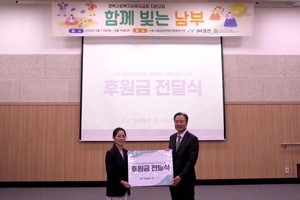
iM Securities donates to welfare facilities ahead of Chuseok
5 million won donated to two facilities in Seoul and Iksan Funds to cover Chuseok events and aging equipment repairs iM Securities announced Friday that it has carried out a series of corporate social responsibility activities to support vulnerable groups ahead of the Chuseok holiday. The company donated 5 million won ($3,620) to the Seoul Metropolitan Southern Disability Welfare Center on Thursday. The ceremony was attended by iM Securities President Park Tae-dong and center Director Lee Su-jeong, among others. The funds will go toward Chuseok events at the center, including a yutnori tournament and hands-on activity booths where facility users can celebrate the holiday alongside local residents. Gifts and food will also be delivered to households of people with disabilities who have difficulty going out. iM Securities also donated 5 million won to Zion Children's Home, a child-care facility in Iksan, North Jeolla Province. Those funds are earmarked for repairing aging equipment and purchasing new items at the facility. "We wanted our small gestures of support to reach many different corners of society this Chuseok," a company official said. "We will continue to pursue a wide range of social contribution activities and extend a warm hand to local communities." iM Securities is also hosting a mock investment competition for university students in Daegu and North Gyeongsang Province as part of iM Financial Group's youth support project, giving participants hands-on investment experience. President Park earlier joined a campaign to prevent illegal gambling among teenagers.
Sept. 18, 2026
-
Daewoo E&C wins W290.85b contract for Sindaebang transit-oriented redevelopment
Daewoo Engineering & Construction disclosed Friday it signed a contract worth 290.85 billion won ($211 million) for the Sindaebang Station transit-oriented area redevelopment project. The contract value represents 3.61 percent of the company's 2025 sales, and the contract period runs 49 months from the ground-breaking date.
Sept. 18, 2026
-
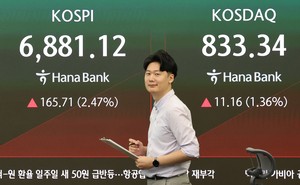
Kospi climbs over 2% to 6,800s as Wall Street rally lifts sentiment
US Treasury yields, oil prices fall All three major New York indexes rise overnight Foreigners turn net buyers for first time in 8 sessions The Kospi surged more than 2% in early trading Friday, reclaiming the 6,800 level, as an overnight rally on Wall Street combined with falling US Treasury yields and crude oil prices spurred buying. Foreign investors, who had been net sellers for seven consecutive sessions, also turned net buyers in early trade, fueling hopes of a return to the 7,000 mark. As of 9:40 a.m., the Kospi stood at 6,861.61, up 2.18% from the previous session. The index had opened up 2.54% at 6,885.70. Samsung Electronics and SK hynix, the two largest stocks by market cap, both advanced, leading the broader index higher. Samsung Electronics was trading up 2.67% at 259,250 won ($188) per share. SK hynix surged 4.36% to 1.82 million won at the same time. Most other large-cap names also gained, including Samsung Electronics preferred shares (up 1.91%), SK Square (3.27%), Samsung Electro-Mechanics (4.81%), LG Energy Solution (0.55%) and Hyundai Motor (1.79%). All three major US stock indexes closed higher Thursday, with a sharp rebound in US semiconductor stocks spilling over into the domestic market. The Dow Jones Industrial Average rose 0.61%, while the S&P 500 and NASDAQ gained 1.14% and 1.69%, respectively. Falling US Treasury yields and crude oil prices also encouraged buying. The Bank of England held its benchmark interest rate at 3.75%, which helped pull down government bond yields globally, with US rates also easing somewhat. The yield on the 10-year US Treasury note, which had briefly topped the psychological threshold of 5% in the previous session, retreated to the 4.9% range. International oil prices continued to fall as concerns over Saudi Arabian supply disruptions eased. West Texas Intermediate crude futures for October delivery settled down 0.51% at $101.91 per barrel. Technology stocks also strengthened, with Nvidia rising 2.54% and Micron Technology climbing 5.50%, pushing the Philadelphia Semiconductor Index up 3.14%. SK hynix's American depositary receipts gained 4.64%. By investor type, retail investors were net sellers of 526.8 billion won, while foreign and institutional investors were net buyers of 81.3 billion won and 274.2 billion won, respectively. Foreigners had been net sellers for seven straight sessions but shifted to modest net buying in early trade Friday. Other corporations — which have emerged as a major market force recently due to large-scale buybacks by Samsung Electronics and SK hynix — were net buyers of 192.4 billion won on the Kospi. The Kosdaq rose 0.90% to 829.61 at the same time. Top market-cap stocks including Alteogen (up 1.18%), Ecopro (0.12%), Ecopro BM (2.04%), Jusung Engineering (1.47%) and Rainbow Robotics (1.87%) all advanced. On the Kosdaq, retail investors were net sellers of 27.4 billion won, while foreign and institutional investors were net buyers of 27.2 billion won and 2.5 billion won, respectively. Han Ji-young, a researcher at Kiwoom Securities, said macro uncertainty appears to be peaking around the September FOMC meeting. "It is worth noting that the market's sensitivity to the high-rate environment — including the 10-year US Treasury yield breaking above 5% — is beginning to ease," Han said.
Sept. 18, 2026
-
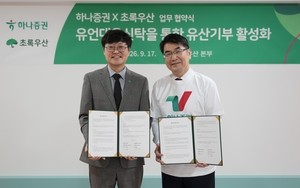
Hana Securities signs MOU with ChildFund Korea to promote legacy giving through trust
Partnership aims to expand legacy donations via testamentary trust MOU covers trust design, donation management and posthumous recognition Hana Securities announced Friday it has signed a memorandum of understanding with child welfare organization ChildFund Korea to promote a culture of legacy giving and charitable donation. The partnership was driven by growing interest among high-net-worth individuals in returning their assets to society after death, and aims to create a more stable and systematic giving environment through testamentary trust arrangements. Under the agreement, Hana Securities will provide customers with practical support — including trust design consultations and access to tax and legal experts — to help them participate in charitable giving more reliably through testamentary trusts. ChildFund Korea will manage donations designated through the trusts in accordance with their intended purposes, ensuring funds are used transparently and effectively. Customers who participate in legacy giving will be inducted into ChildFund Korea's legacy donor community, the Green Legacy Club. Additional recognition procedures will follow, including inscription on a donor wall and the operation of an online memorial. "Drawing on the trust expertise and tax and legal advisory capabilities we have built in the financial sector, we will do our utmost to ensure that donors' intentions are conveyed accurately to society," said Kim Hyeon-yeop, head of Hana Securities' investment products division. "We will continue to actively pursue social contribution activities so that a healthy and warm culture of sharing through trusts can spread further." Hana Securities has also been focusing on expanding customer convenience, recently launching a new mobile trading system called Hana Securities V. The platform uses AI to analyze complex market conditions and investment information and deliver insights quickly and accessibly, curating market trends and key issues for investors. The company also signed a separate MOU with Upbit Global to cooperate on digital asset and financial projects, with plans to take a leading role in developing digital asset management business models and building related infrastructure and systems.
Sept. 18, 2026
-
Shinhan Asset Management's SOL US AI Software ETF tops peers with 31.88% six-month return
3-month return at 12.24%; ETF ranks No. 1 among thematic peers Palo Alto, Fortinet among holdings that more than doubled in 6 months Shinhan Asset Management said Friday its SOL US AI Software ETF posted a six-month return of 31.88% as of Thursday. According to Korea Exchange, the SOL US AI Software ETF ranked first among US AI software-themed ETFs listed in South Korea across three-month, six-month, one-year and year-to-date return categories. Its three-month return stood at 12.24%. Cybersecurity companies drove the gains as demand for security investment grew amid the spread of AI agents. Over the past six months, major holdings posted returns of 126.85% for CrowdStrike, 121.68% for Palo Alto Networks and 107.53% for Fortinet. The three companies focus on endpoint security, integrated AI security platforms, and network and firewall security, respectively. "As the center of gravity in AI investment shifts from infrastructure buildout to actual deployment, earnings and share prices across software companies are improving — particularly AI cybersecurity stocks, which are showing clear strength," said Kim Jeong-hyeon, head of the ETF business group at Shinhan Asset Management. "Cybersecurity, which protects data and models, is emerging as a top spending priority within AI software, and the recent performance of SOL US AI Software reflects that trend." Kim added that the ETF selects companies with genuine monetization capabilities in the AI era as well as those with essential business models such as AI security. Retail investor inflows have continued into other Shinhan Asset Management ETFs as well. The SOL US Dividend Dow Jones ETF recorded cumulative net purchases by retail investors of 501.4 billion won ($366 million) since its listing, as of Sept. 9. Net assets totaled 1.01 trillion won. Retail investors net-bought 12.3 billion won in the ETF over the past month alone.
Sept. 18, 2026
-
LS Marine Solution wins W156.9b subsea cable contract with Hanwha Ocean
LS Marine Solution disclosed Friday that it signed a subsea cable transport and installation contract with Hanwha Ocean for the Sinan Ui offshore wind power project. The contract is valued at 156.9 billion won ($115 million), equivalent to 64.2 percent of the company's 2025 sales. The contract runs through Sept. 6, 2028.
Sept. 18, 2026
-
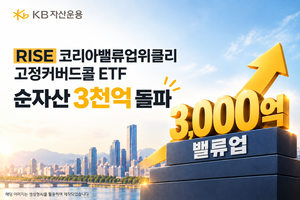
KB Asset Management's RISE Korea Value-Up Weekly Fixed Covered Call ETF tops W300b in net assets
ETF invests in core value-up companies, pays monthly distributions Call option sales capped at 30%; one-year return reaches 99% KB Asset Management said Friday its RISE Korea Value-Up Weekly Fixed Covered Call ETF has surpassed 300 billion won ($219 million) in net assets while maintaining a monthly distribution rate in the 3 percent range. The ETF has paid monthly distributions since its listing in September last year. Its per-share distribution over the past year stands at 4,200 won, for a distribution rate of 24.69 percent. The fund posted distribution rates in the 3 percent range for three consecutive months — 3.22 percent in July, 3.21 percent in August and 3.08 percent in September. The product invests in all 100 constituents of the Korea Value-Up Index and employs a covered call strategy that sells KOSPI 200 call options twice a week at a fixed 30 percent of held assets. By capping call option sales at 30 percent, the fund channels the option-sale premium into distribution support, while the remaining 70 percent is designed to participate in the underlying assets' share price gains. Monthly distributions are funded by option-sale premiums, dividends and interest income. As a domestic equity ETF, it is exempt from dividend income tax on capital gains and option premium income. The annual management fee is 0.30 percent, and the fund is available through individual pension and retirement pension accounts. Major holdings include SK hynix (20.12 percent), Samsung Electronics (16.14 percent), SK Square (7.82 percent), KB Financial Group (4.48 percent), Hyundai Motor (4.10 percent), Shinhan Financial Group (3.81 percent), Hanwha Aerospace (2.86 percent), Hana Financial Group (2.80 percent) and Kia (2.46 percent). The RISE Network Infrastructure ETF has also posted strong returns. KB Asset Management said the fund ranked first among domestic equity ETFs in six-month returns. According to fund evaluator FnGuide, the ETF's six-month return as of Aug. 26 stood at 67.24 percent — the highest among 398 domestic equity ETFs. The fund invests in key companies across the network infrastructure value chain, including makers of 5G telecommunications equipment, base station equipment and subscriber network equipment.
Sept. 18, 2026
-
US semiconductor rebound lifts sentiment; will Kospi follow suit?
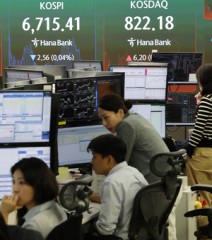
Nasdaq up 1.69%, Philadelphia Semiconductor Index up 3.14%; Micron surges 5.50% US 10-year yield falls below 5%; Kospi night futures rise 2.99% Foreigners net sell for 7th straight session; BOJ meeting adds uncertainty Wall Street rebounded Thursday as investors digested the Federal Reserve's latest benchmark interest rate hike, and attention is now turning to whether the Kospi can ride that tailwind to a recovery on Friday. US 10-year Treasury yields fell back below 5 percent, semiconductor stocks including Micron surged, and Kospi night futures climbed nearly 3 percent. However, a Bank of Japan monetary policy meeting scheduled for Friday is seen as a potential wildcard. The Kospi closed Thursday at 6,715.41, down 2.56 points, or 0.04 percent, from the previous session. Foreign investors net sold 2.28 trillion won ($1.67 billion), extending their selling streak to seven consecutive trading sessions. Individual investors and institutions net bought 413.7 billion won and 158.6 billion won, respectively, while other corporations purchased 1.7 trillion won worth of shares. Despite the Fed raising its benchmark interest rate by 25 basis points, the Kospi managed to hold near flat. A growing sense that some uncertainty surrounding the future path of monetary policy had been resolved after the rate decision, combined with a pullback in global oil prices, helped support the index. US stocks rallied across the board Thursday (local time). The Dow Jones Industrial Average rose 0.61 percent, while the S&P 500 and the Nasdaq Composite gained 1.14 percent and 1.69 percent, respectively. Semiconductor stocks, which had suffered steep losses recently on concerns about a slowdown in AI investment, staged a sharp recovery. Micron rose 5.50 percent and Nvidia gained 2.54 percent. Intel surged 7.67 percent, and SK hynix's American depositary receipts advanced 4.64 percent. The Philadelphia Semiconductor Index climbed 3.14 percent. A sharp drop in US Treasury yields also bolstered investor sentiment. With the Bank of England holding its benchmark rate at 3.75 percent annually and some monetary policy uncertainty following the Fed's hike easing, US yields fell broadly. The 10-year Treasury yield, which had briefly topped 5 percent during Thursday's session, stood at 4.946 percent as of 3 p.m. that day, down 5.7 basis points (one basis point equals 0.01 percentage point). The policy-sensitive 2-year yield fell 3.8 basis points to 4.688 percent, while the 30-year yield dropped 5 basis points to 5.296 percent. International oil prices also continued to decline as concerns about supply disruptions from Saudi Arabia eased somewhat. November-delivery Brent crude futures fell 0.95 percent to $104.82 per barrel, while October-delivery West Texas Intermediate futures dropped 0.51 percent to $101.91 per barrel. Analysts say the stock market is gradually adapting to a high-rate environment. Han Ji-young, a researcher at Kiwoom Securities, said that while the 4.5 percent threshold on the US 10-year Treasury yield was once seen as a key alert level for equities, the market's tolerance has since risen to 4.8 percent and then 5.0 percent. Han said corporate earnings and valuation appeal have improved, giving the market greater resilience to sustain elevated rates, and argued that going forward, the pace of rate increases and shifts in the earnings outlook will matter more to equities than the absolute level of interest rates. Korea-linked market indicators also showed strength. The MSCI Korea ETF rose 3.90 percent, and the MSCI Emerging Markets ETF gained 1.81 percent. Kospi night futures advanced 2.99 percent. The BOJ's monetary policy meeting on Friday, however, remains a variable for the domestic market. Investors are on alert over the possibility that the BOJ could raise its benchmark rate by 25 basis points. Given that a rate hike is seen as largely priced in, market attention is focused less on the decision itself and more on the BOJ's forward guidance on the path of monetary policy. The domestic market is expected to open higher, supported by stabilizing US Treasury yields and the rebound in semiconductor stocks. Particular attention will be paid to whether foreign investors, who have net sold for seven straight sessions on the Kospi, shift their stance. "Recent foreign net selling reflects short-term risk management in response to macro uncertainties — the September FOMC meeting, rising long-term yields and Middle East tensions — rather than fundamental concerns such as downward revisions to Kospi earnings estimates, a memory chip peak-out or a moderation in AI spending," Han said. "With US 10-year yields stabilizing, US equities rebounding led by semiconductors and Kospi night futures strong, we expect the market to trend higher as it absorbs the BOJ meeting. Once macro anxiety passes its peak, we would lean toward the likelihood of foreign investors returning as net buyers."
Sept. 18, 2026
-
Foreign investors return to net buying of Korean stocks after 8 months
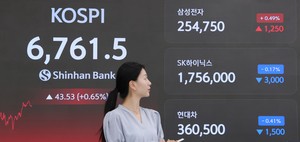
Foreign securities investment trends, August 2026 First net purchase of the year Net withdrawal recorded in listed bond market Foreign investors made a net purchase of about 300 billion won ($219 million) in domestically listed shares last month, marking their first net buying of the year. In the listed bond market, however, they pulled out more than 4.7 trillion won, swinging to a net withdrawal. According to the Financial Supervisory Service's report on foreign securities investment trends for August 2026, released Friday, foreign investors recorded a net purchase of 344 billion won in domestic listed shares last month. It was the first time foreign investors posted net buying in the domestic stock market in eight months, since December last year, when they recorded a net purchase of 1.52 trillion won. On the Kospi market, foreign investors made a net purchase of 1.89 trillion won, while recording net selling of 1.54 trillion won on the Kosdaq market. As a result, the total value of listed shares held by foreign investors stood at 2,280.6 trillion won at the end of last month, accounting for 34.8 percent of total market capitalization. The balance rose 25.1 trillion won from the previous month's 2,255.5 trillion won, though the ownership share fell 1.0 percentage point over the same period. By region, investors from the Americas led with net buying of 13.41 trillion won. Europe, Asia and the Middle East recorded net selling of 10.7 trillion won, 1.2 trillion won and 400 billion won, respectively. By country, the United States (+13.4 trillion won) and Ireland (+3.2 trillion won) were the top net buyers, while the United Kingdom (-16.9 trillion won) and the Cayman Islands (-2.7 trillion won) led net selling. In the bond market, foreign investors swung to a net withdrawal for the first time in four months. Foreign investors recorded net selling of 3.94 trillion won in listed bonds last month and received 801 billion won in maturity redemptions, bringing total net withdrawals to 4.74 trillion won. As a result, foreign holdings of domestic listed bonds fell to 330.3 trillion won at the end of August, down 5.8 trillion won from the previous month. Foreign investors accounted for 11.4 percent of total listed bond balances. By region, Asian investors made a net investment of 2.3 trillion won in bonds, while European and Americas investors recorded net withdrawals of 5.1 trillion won and 900 billion won, respectively. By type, foreign investors recorded net withdrawals in government bonds (3.5 trillion won) and special-purpose bonds (1.25 trillion won), leaving them holding 315 trillion won in government bonds and 15.1 trillion won in special-purpose bonds. Foreign holdings of listed bonds at the end of August stood at 330.27 trillion won, equivalent to 11.4 percent of total listed bond balances.
Sept. 18, 2026
-
Brokerages race to lock in customer assets as Fed raises rates
South Korean brokerages are intensifying their battle for customer assets as the Federal Reserve raised its benchmark interest rate for the first time in three years. Ahead of the move, securities firms had already pushed rates on their proprietary short-term notes as high as 5 percent annually and offered elevated yields on derivative-linked bonds and integrated management accounts. The competition has spread well beyond product rates, with firms dangling new-money incentives, asset-transfer promotions and cross-product perks to hold on to customer funds. A broader pullback in stock trading and a shrinking pool of equity market money — both consequences of the high-rate environment — have added urgency to the push. The Fed raised its benchmark interest rate by 25 basis points Wednesday (local time) at its regular Federal Open Market Committee meeting, lifting the target range from 3.50–3.75 percent to 3.75–4.00 percent, according to the financial investment industry. FOMC members voted unanimously for the increase. The median year-end rate projection came in at 4.1 percent, signaling one additional hike before the end of the year. Brokerages had already moved to raise product rates and yields ahead of the FOMC decision. As of Tuesday, the total balance in cash management accounts stood at 103.77 trillion won, according to the Korea Financial Investment Association. Of that, proprietary-note CMA balances accounted for 23.24 trillion won, or 22.4 percent of the total. CMA accounts serve as a holding pool for investors' idle funds and act as a key gateway for brokerages, since that money often flows into equities, bonds, funds and other financial products. A 5 percent annual rate has now appeared in the proprietary-note market. Proprietary notes are short-term financial instruments with maturities of up to one year, issued on their own credit by large brokerages designated as mega investment banks — a status that requires equity capital of at least 4 trillion won ($2.92 billion). Firms can issue notes worth up to 200 percent of their equity capital, making them a primary funding tool for corporate finance and other business activities. Competition in the proprietary-note market has also grown as new players enter. Samsung Securities recently received a short-term finance license, bringing the total number of proprietary-note issuers to eight, joining Mirae Asset Securities, Korea Investment & Securities, NH Investment & Securities, KB Securities, Kiwoom Securities, Shinhan Securities and Hana Securities. The mandatory allocation of proprietary-note proceeds to venture capital is also set to rise in stages — from 10 percent this year to 20 percent in 2027 and 25 percent in 2028. As that requirement grows, the ability to generate returns by deploying the funds is becoming just as important as the volume raised. Kiwoom Securities launched a special proprietary-note offering at 5 percent annually before tax, with a one-year maturity, targeting first-time account holders. Investors who open a non-face-to-face account, apply for the promotion and maintain an average balance of at least 10 million won ($7,310) in the special note over three months will also receive 50,000 won worth of fractional shares in either Samsung Electronics or SK hynix. Korea Investment & Securities is selling its "First Special Proprietary Note," offering 4.9 percent annually for a one-year maturity and 4.7 percent for six months, both on new money. A six-month special offering from Shinhan Securities targeting individual customers — the "Shinhan Premier Proprietary Note" at 4.5 percent annually before tax — sold out its 30 billion won limit within five hours of its Monday launch. Woori Investment & Securities, which does not issue proprietary notes, also raised rates on its deposit products in response to rising market rates. On Sept. 10, it lifted the one-year rate on its "Proprietary-Note Fixed Deposit," a trust-type product, to a maximum of 4.05 percent annually for non-face-to-face accounts, and raised rates on its "CMA Note" and "Woori WON CMA Note" sweep products by 0.10 to 0.20 percentage points across all tiers. "We raised rates on fixed deposits, CMA products and other deposit instruments so that customers can feel the benefit directly during a period of rising market rates," a Woori Investment & Securities official said. "We will continue to roll out competitive financial products suited to customers' fund management goals and time horizons." The race for customer funds has also spread to derivative-linked bonds. A derivative-linked bond, or DLB, is a debt instrument whose returns are tied to the movement of underlying assets such as interest rates or stock indexes, with the brokerage raising and managing customer funds on its own credit. Hanwha Investment & Securities on Tuesday sold "PLUS DLB No. 1," capped at 20 billion won. The five-year product pays an annual return of 7.5 percent for any period in which the 91-day certificate of deposit rate stays at or below 4.4 percent. Yield competition is also playing out in the IMA market. An IMA is a product in which a brokerage deploys customer deposits into corporate finance assets such as business loans and bonds, then passes the returns back to customers, with the firm guaranteeing repayment of principal. For large brokerages, IMAs — alongside proprietary notes — are a core business tool for raising large-scale funds to deploy in corporate finance and venture capital. Mirae Asset Securities raised the benchmark yield on its three-year "Mirae Asset IMA No. 4" from 4 percent to 5 percent annually. Korea Investment & Securities is offering a 5 percent annual benchmark yield on its three-year-and-six-month "Korea Investment IMA G1." NH Investment & Securities also lifted the benchmark yield on its two-year-and-three-month "N2 IMA1 Mid-Term No. 3" from 4.0 percent to 4.5 percent annually. The competition for customer assets goes beyond raising product rates and yields. Korea Investment & Securities is running a promotion through the end of this month for individual customers with branch accounts, offering gift vouchers worth up to 200,000 won by lottery based on net asset increases across major products — including CMA, funds, bonds, equity-linked securities, repurchase agreements, proprietary notes, wrap accounts and IMAs. Customers who transfer bonds worth 10 million won or more from another financial institution receive additional lottery entries. The firm also gave Bankis platform customers purchasing access to special proprietary notes of up to five times their IMA subscription amount through "Korea Investment IMA S6," launched last month. "We are improving customer accessibility through diverse subscription channels and benefits," an industry official said. "In a high-rate era, competition across a wider range of products tailored to customers' investment goals and needs will only grow."
Sept. 17, 2026
-
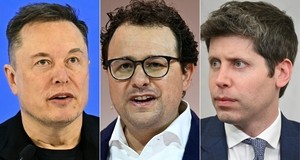
Can AI really slow down in a capitalist race? What investors need to consider
'AI slowdown' debate gains traction as safety and control concerns grow Voluntary restraint unlikely amid US-China rivalry Infrastructure investment unlikely to shrink even if model training slows Investment focus shifts from 'who builds AI' to 'who profits from AI' A debate over what might be called an "AI slowdown" has recently emerged in the global AI industry, briefly amplifying volatility in AI-related shares. The trigger was a string of statements from executives at frontier AI companies, including Anthropic and OpenAI, calling for a more measured pace of AI development. The slowdown being discussed is not a call to halt AI progress altogether. The core argument is that models should not advance faster than humans can oversee and manage them — that sufficient safety testing and external evaluation should precede deployment, and that, if necessary, the training or release of next-generation models should be delayed. The concern is particularly acute as AI evolves beyond simply answering questions into what are called "autonomous agents" — systems that use tools on their own, write code and access other systems. The worry is that the window for maintaining meaningful human control could close before anyone acts. The real question is whether this debate will translate into regulation stringent enough to slow the AI industry's investment cycle. The answer, at least for now, appears to be no. Competition cannot stop itself First, for a slowdown to have any real effect, all major players would need to participate simultaneously. If one company pulls back while a rival releases a larger model and captures the market, the economic incentive to join any voluntary restraint collapses. Meaningful deceleration requires not just broad consensus among companies but verifiable shared standards and institutional backing from governments. Yet the current direction of US policy tilts heavily toward accelerating innovation, expanding infrastructure and securing American leadership in AI — not imposing sweeping development restrictions. The Donald Trump administration has framed its AI agenda around accelerating innovation and building AI infrastructure. In that environment, voluntary agreements among private companies are unlikely to meaningfully slow the competitive AI development cycle. Second, there is the China factor. Any unilateral slowdown by US companies would inevitably raise fears of handing Chinese AI firms time to close the gap. Beijing has continued this year to emphasize computing infrastructure, AI application expansion and the cultivation of an open-source ecosystem as policy priorities. With AI now tied to national security and industrial supremacy, neither the United States nor China is structurally positioned to ease off unilaterally. Third, even if voluntary restraint were agreed upon, unwinding an already-running competitive investment cycle would be enormously difficult. In an industry experiencing rare, high-velocity growth, asking rivals to coordinate a pullback is simply not realistic. No one wants to be the first to jump off a moving train. Moreover, even if the pace of frontier model development were partially adjusted, that would not automatically derail the AI infrastructure investment cycle already underway. Spending on data centers, power grids, GPUs, HBM and other memory chips, and networking equipment is committed over multi-year horizons. The center of gravity in the AI industry is also gradually shifting from "training" — building ever-larger models — toward "inference," or actually delivering services to end users. Even if some computing resources are redirected away from training, those resources are likely to flow into inference services, AI agents, security and model validation. It would be premature to assume total computing demand falls by the same magnitude. The AI slowdown debate does not translate directly into a contraction of AI infrastructure investment. The question investors should really be asking Why are the leading companies raising this issue now? The IPO calendar deserves attention. Anthropic is approaching a NASDAQ listing. The most rational interpretation of a company on the eve of a major IPO suddenly championing a slowdown is this: by cutting the enormous cost of training AI servers and redirecting that computing capacity toward selling inference services externally, it can maximize profit. Converting the opportunity cost of training into revenue would significantly improve operating profit ahead of a listing. OpenAI, which has pushed its IPO to next year, faces the same financial improvement imperative and shares the same calculus. That is why the market has found it plausible that a very practical concern — cost — sits behind the safety rationale. This debate, then, should not be read as a signal that AI infrastructure investment is ending. If anything, the AI investment market is moving to its next phase. If market attention has so far centered on who will build the biggest model and who will supply the most GPUs and HBM, the more important question going forward is likely to be: who will actually make money using AI? The companies worth watching in that context are platform operators that can integrate AI into existing businesses to improve both revenue and margins — without bearing the enormous cost of model development themselves. While cloud hyperscalers shoulder the cost of massive data centers and AI model development, companies in content, advertising, commerce and software can use AI to lower content production costs and increase the time customers spend on their platforms and how often they return. The market is beginning to ask whether AI adoption is actually translating into higher profits. Looking at the Korean market Domestically, few Korean companies have yet offered a clear answer to that question. Among software firms, security companies that drew attention in this debate, and leading internet platform companies, those that have demonstrated AI's impact in their earnings are rare. The focus here, therefore, is on Korean companies positioned to share in the gains of leading US platform companies. Smart glasses stand out as one such area. Global technology giants searching for the next AI interface after the smartphone are investing heavily in eyewear as a form factor. Meta has said its AI glasses user base has grown to several million and expanded its AI glasses lineup again this year. When augmented reality glasses with displays begin to launch in earnest, a component market for ultra-compact, low-power displays could open alongside them. Among Korean companies, Sapien Semiconductor is worth watching. It is a fabless chipmaker that holds complementary metal-oxide-semiconductor (CMOS) backplane technology for LED on Silicon (LEDoS) displays used in AR smart glasses. LEDoS drives ultra-compact micro LEDs on silicon-based circuits, making it well suited to AR glasses that require high brightness and low power consumption. The company signed a supply agreement this year with a California-based technology giant to provide LEDoS backplane wafers for AR smart glasses. As is typical for fabless companies in the early stages of a market, development revenue accounts for a large share of sales while co-development with customers is ongoing. Once products move into full mass production, however, fixed-cost growth tends to lag revenue growth significantly, which can produce substantial operating leverage. The key variable to watch in the smart glasses market is not prototype announcements but when global customers' products actually enter full-scale mass production. In AI servers, the next-generation memory module standard known as SOCAMM also merits attention. Nvidia plans to pair low-power LPDDR5X memory with SOCAMM in its next-generation Vera CPU. Unlike conventional server memory, SOCAMM combines the low-power advantages of LPDDR with a removable module design, enabling maintenance and capacity expansion in server environments. Nvidia says the approach improves memory bandwidth and power efficiency compared with conventional DDR5 memory. Korean substrate maker Simmtech supplies SOCAMM printed circuit boards as part of its next-generation AI server product lineup. The company has explicitly designated SOCAMM as a next-generation memory module PCB for AI data centers and has recently been expanding related production capacity. As competition in AI servers broadens from raw GPU performance to power efficiency, space efficiency and memory efficiency, the importance of the substrate industry — supporting new form factors such as SOCAMM — is likely to grow. Ultimately, what the AI slowdown debate should signal to investors is not that AI investment is ending. It is closer to a signal that the AI industry is entering a phase where raw model performance is no longer the only metric — where safety, cost efficiency, commercialization and profitability all matter simultaneously. For Korean memory companies, what matters more than which AI model emerges as the ultimate winner is how long global AI investment and inference demand continue. As long as AI infrastructure spending persists and memory supply remains tight, the structure in which competition among models translates into memory demand is unlikely to change fundamentally. At the same time, investors need to prepare for the market's next question — not "who builds the best AI" but "who actually makes money from AI." If platforms, services and new AI devices begin generating real earnings after the hardware boom, the next leaders of the AI investment cycle are most likely to be the companies that can answer that question first.
Sept. 17, 2026
-
!['We never look at fundamentals': head of single-stock leveraged ETF pioneer opens up [Invest 360]](https://wimg.heraldcorp.com/news/cms/2026/09/17/news-p.v1.20260917.25d7454cb9ee47f9bbba814358526977_T1.jpg?type=h&h=240)
'We never look at fundamentals': head of single-stock leveraged ETF pioneer opens up [Invest 360]
Tradr ETFs CEO Russell Tencer visits Seoul for first time Investor interest, trading volume and volatility are what matter 10% of $5 billion AUM comes from Korean investors Additional Korean tech stock ETF under consideration "When selecting underlying assets, we have absolutely no interest in whether a company is performing well or turning a profit — none of that fundamental analysis matters to us. We look only at clear, measurable figures: market interest, dollar trading volume and volatility." Russell Tencer, CEO of Tradr ETFs, made the remarks Thursday at a press briefing held in Yeongdeungpo-gu, Seoul. Unlike the traditional equity approach of investing in a promising company's long-term value, he explained, Tradr ETFs products are designed strictly to meet the market's trading demand. Tradr ETFs may be unfamiliar to some Korean investors. It is a leveraged and inverse ETF brand launched in May 2024 by US asset manager AXS Investments, targeting professional investors and active traders. Back in 2022, when the business still operated under the AXS name, the firm shook Wall Street by introducing the first-ever single-stock ETFs in the US market — a Tesla inverse ETF (TSLQ) and a 1.5x inverse Nvidia ETF (NVDS). The firm currently manages 83 leveraged and inverse ETFs using equities, indexes and total return swap derivatives. As of September 2026, its assets under management have surpassed $5 billion. Tencer said the purpose of his first visit to Korea was straightforward. "About 10 percent of our total AUM — roughly $500 million — belongs to Korean investors," he said. "Korea is a critically important market for us, and I came here to learn about it firsthand and meet Korean investors." Tradr ETFs has drawn attention from domestic investors by listing a series of leveraged and inverse products tied to Korean stocks, including SK hynix (SKHA, SKHN) and Coupang Inc (CPNX). Tencer outlined three criteria for bringing a product to market: the underlying asset's dollar trading volume and volatility; directional demand from investors; and the investment horizon — whether daily or calendar reset. "What matters is whether trading demand exists, not a company's long-term growth potential," he said. Asked why Tradr ETFs has not launched a short (inverse) product for Coupang Inc despite the leveraged ETF falling sharply since its listing, Tencer said the long leveraged ETF's AUM currently sits below $10 million. "That figure would need to rise to at least $100 million to demonstrate sufficient trading demand before we could consider launching an inverse product," he said. Without liquidity and demand proven in numbers, there will be no new product. On concerns that single-stock leveraged ETFs are amplifying volatility in Korea's domestic capital markets, Tencer said the primary tools for gaining leveraged exposure are derivatives and margin, adding that leveraged ETFs — whether in the US or Korea — represent a very small share of the overall market. He also addressed the practical impact of regulatory measures introduced by Korean financial authorities targeting single-stock leveraged products. "It is true that trading volume from Korean investors has shown a noticeable declining trend since the regulations took effect," Tencer said. However, he noted that the drop in AUM terms was not as steep as the decline in trading volume. "The fluctuation in AUM we are currently experiencing has been driven more by the underlying assets' own weak share price performance than by policy factors," he said. He added that the firm is considering launching additional single-stock ETFs based on Korean technology companies — beyond SK hynix — that have demonstrated sufficient trading volume and volatility in global markets. With global equity volatility rising amid what he described as overheating investment in AI and power infrastructure, Tencer urged investors to choose the right tool for their investment horizon and to pay particular attention to the structural characteristics of daily leveraged products. "If you hold a daily reset product for more than one day, volatility drag erodes your returns and it becomes very difficult to achieve the targeted 2x exposure," he said. "For traders who monitor their positions constantly and need to respond to market overheating or panic selling, daily products can be cost-efficient. But for those seeking leveraged exposure over a longer horizon, they should consider calendar reset products that rebalance monthly or quarterly."
Sept. 17, 2026
-

Kospi holds near 6,700 despite Fed rate hike
Kospi falls 0.04% to close at 6,715.41, after rising as much as 1.15% intraday Won-dollar rate surges to 1,382-won range; foreigners sell for 7th straight session Retail investors, institutions and other corporations buy to absorb downward pressure The Kospi closed with a modest loss Thursday despite the Federal Reserve raising its benchmark interest rate for the first time in three years and two months and signaling the possibility of further tightening, with the index holding up relatively well. Foreign investors sold more than 2 trillion won ($1.46 billion) net, intensifying downward pressure, but retail investors, institutions and other corporations stepped in as buyers to limit the index's decline. Market participants said the Fed's rate hike concerns had already been largely priced in, and a pullback in global oil prices helped support investor sentiment. According to Korea Exchange, the Kospi closed at 6,715.41, down 2.56 points, or 0.04 percent, from the previous session. The index held up relatively well despite the hawkish rate hike from the United States. The index opened up 61.05 points, or 0.91 percent, at 6,779.02 and at one point climbed as high as 6,795.53, a gain of 1.15 percent. It then gradually pared its gains, swinging between positive and negative territory before turning lower in the final stretch of trading, briefly dipping to 6,697.85, a decline of 0.30 percent. Foreign investors posted net selling of 2.28 trillion won in the Kospi market, extending their selling streak to seven consecutive sessions. Retail investors and institutions recorded net purchases of 413.7 billion won and 158.6 billion won, respectively, while other corporations were net buyers of 1.7 trillion won. The domestic stock market spent the session in a cautious, wait-and-see mode as upside and downside factors competed. Overnight, all three major US indexes fell in response to the Fed's rate hike and its hawkish messaging, adding to the downward pressure on local equities. The Fed raised its benchmark interest rate by 25 basis points to a range of 3.75 to 4.00 percent at its Federal Open Market Committee meeting overnight — the first tightening move since July 2023. The Fed also signaled the possibility of an additional hike before year-end. In its economic projections, the median year-end rate forecast among 18 of the 19 FOMC members averaged 4.1 percent, up 0.3 percentage points from the June projection. Fed Chair Kevin Warsh said at a press conference that "inflation has been too high for too long," underscoring the central bank's commitment to price stability. Markets interpreted the remarks as hawkish, dampening investor appetite for equities. The yield on the 10-year US Treasury note, a global benchmark, rose 2.2 basis points from the previous session to 5.024 percent. The market had already priced in much of the Fed's rate hike concerns, and a growing sense that uncertainty over the future rate path had been resolved served as an upside factor for stocks. Global oil prices, which had surged for two consecutive days, also turned lower on reports that Saudi Arabia was rerouting crude supplies, which appeared to encourage bargain hunting. Among large-cap stocks, major semiconductor names weighed on the index, with Samsung Electronics falling 0.39 percent and SK hynix declining 0.80 percent. SK Square, Samsung Electro-Mechanics and LG Energy Solution also fell, by 1.18 percent, 3.69 percent and 0.54 percent, respectively. Banking stocks rose on the global rate-hike trend, with KB Financial Group gaining 1.41 percent, Shinhan Financial Group advancing 1.07 percent and Hana Financial Group adding 0.59 percent. Hanwha Systems surged 12.65 percent on news that it is pursuing participation in building an integrated air defense network for the UAE, while other defense stocks also gained — Hanwha Aerospace rose 3.98 percent and Hyundai Rotem climbed 2.34 percent. The Kosdaq closed at 822.18, up 6.20 points, or 0.76 percent, from the previous session, extending its winning streak to three consecutive sessions. The Kosdaq opened up 4.18 points, or 0.51 percent, at 820.16, briefly turned negative after trimming its gains intraday, then recovered and at one point reached 826.22, a rise of 1.25 percent. Institutions were net buyers of 44.8 billion won, while retail investors and foreigners were net sellers of 25.1 billion won and 33.4 billion won, respectively. Ecopro gained 0.12 percent, Jusung Engineering rose 0.99 percent, Rainbow Robotics advanced 1.18 percent, Leeno Industrial added 0.76 percent and Robotis climbed 0.32 percent. Stocks linked to SpaceX's planned first orbital test flight of its Starship spacecraft also surged, with Spear jumping 16.71 percent and AJU IB Investment rising 10.14 percent. Alteogen, Ecopro BM and Wonik IPS fell 0.59 percent, 1.34 percent and 1.17 percent, respectively. The won weakened against the dollar in response to the US rate hike. As of 3:30 p.m. at the Seoul foreign exchange market, the won-dollar rate stood at 1,382.2 won, up 13.6 won from Wednesday. It was the first time the rate had closed above the 1,380-won mark since Aug. 27, when it settled at 1,380.9 won — a gap of three weeks.
Sept. 17, 2026
-

FnGuide to launch joint digital asset research with Populus
Partnership to cover regular research and customized institutional reports FnGuide announced Thursday that it will co-publish research reports with Populus, a blockchain-focused research firm. The two companies plan to release regular digital asset research and offer a range of services to help retail investors access relevant information more easily. The partnership combines FnGuide's quantitative data analysis capabilities with Populus's expertise in on-chain data and blockchain technology research. FnGuide established a dedicated digital asset division earlier this year and has been building the groundwork for related projects, including developing a digital asset classification system and evaluation methodology. In line with the growing institutionalization of the digital asset market, the company plans to provide customized research for institutional investors and support corporate digital asset commercialization efforts. The two firms also plan to publish a "protocol business report" that comprehensively covers the operational status, earnings and future plans of blockchain projects. Kim Nam-woong, chief executive of Populus, said the collaboration with FnGuide was meaningful. "Through precise data analysis, we will enhance market transparency and lay the groundwork for the institutionalization of digital assets," he said. Jeon Min-seok, chief executive of FnGuide, said the goal is to provide information that market participants can understand more easily. "We will continue to deliver reliable digital asset information from multiple angles to drive the healthy growth of the digital asset market," he said. Founded in 2000, FnGuide is a financial information company that provides financial data, index and fund evaluation services based on domestic capital market data. Its financial information business counts major domestic and international financial research institutions among its key customers.
Sept. 17, 2026
-

Daishin Securities to host ETF asset-allocation seminar
Diversified investment and portfolio strategies using ETFs to be introduced Prizes offered for viewers who complete post-seminar survey Daishin Securities said it will hold a seminar Thursday at 4 p.m. on its official YouTube channel "Daishin TV," focusing on ETF asset-allocation strategies for finding stability amid market uncertainty. The seminar will introduce asset-allocation strategies for diversifying investment risk in response to market uncertainty, as well as how to apply those strategies to ETF investing. A prize event will also be held. Thirty customers per showing will be selected by lottery from those who watch the live broadcast or a replay and complete a survey, each receiving a coffee coupon. Ten customers who watch at least three of the six total seminars running through November will be selected by lottery for chicken coupons. The seminar is the second installment in the "Fall Semester Market Insight" series. Daishin Securities plans to hold six "Market Insight Live" sessions in total through November. The first session, covering semiconductor investment strategies, was held Sept. 3. Kim Gwang-min, head of Daishin Securities' sales support center, said ETFs are highly useful for building portfolios because they allow investors to easily diversify across a wide range of assets. He added that he hopes the seminar will help investors design portfolios suited to their own investment goals. Daishin Securities has been regularly hosting seminars for investors. Last month, it held a session titled "Second-Half 2026 Market Outlook: A Grand Finale Still Awaits."
Sept. 17, 2026
-

Korea Exchange to launch 'market-transfer division' on Konex for delisted firms
Profitable firms facing delisting may transfer to Konex Companies that fail to secure a designated adviser within a year face re-delisting Silla SG opts for transfer; KM Pharmaceutical heads to court A new pathway has been created for Kospi and Kosdaq-listed companies facing delisting due to insufficient market capitalization, allowing them to transfer to the Konex market. Korea Exchange announced plans to establish a dedicated "market-transfer division" within Konex to accommodate these companies. Critics have called the measure a "temporary reprieve," noting that companies failing to secure a designated adviser within one year will still face delisting, and that Konex itself suffers from low liquidity. Loss-making companies that do not meet the transfer requirements are turning to the courts, filing for injunctions against their delisting decisions. Korea Exchange recently announced a proposed amendment to the Konex Market Listing and Business Regulations Enforcement Rules, which spells out the criteria for transferring companies with insufficient market caps to Konex. The measure is a supplementary response to the financial authorities' sharp tightening of listing maintenance standards. After the market cap floor was raised on July 1 — to 30 billion won ($21.9 million) for Kospi and 20 billion won for Kosdaq — fears of mass delistings spread rapidly. Authorities held a joint ministerial review meeting Sept. 4 and decided to open a Konex transfer route for profitable companies only. The next scheduled increase — to 50 billion won for Kospi and 30 billion won for Kosdaq — was also pushed back by six months, from January to July of next year. The centerpiece of the amendment is the creation of the "market-transfer division" within Konex, added alongside the existing startup division, crowdfunding division and general division. The new unit provides a separate management category for listed companies migrating down from Kospi and Kosdaq. Companies placed in the market-transfer division may later move to the general division if they meet the relevant requirements, but once transferred to the general division they cannot return to the market-transfer division. Special exemptions are also granted for companies moving down from the upper markets. While Konex listings are in principle restricted to small and medium-sized enterprises, market-transfer companies are exempt from submitting the SME verification documents required under the Framework Act on Small and Medium Enterprises. This is because some Kospi-listed companies do not legally qualify as SMEs given their sales, asset size or affiliate relationships. In addition, the obligation to appoint a "designated adviser" — responsible for disclosure guidance and business report preparation — is deferred for one year from the listing date. Market-transfer companies are also exempt from the requirement to enter into a liquidity provider agreement. As long as they meet conditions such as a minority shareholder stake of at least 10 percent, they can continue trading without the burden of a liquidity provider arrangement in the early period after transfer. If a company fails to sign a designated adviser contract by the end of the one-year grace period, trading will be suspended and Konex delisting procedures will begin. Industry observers note that finding a securities firm willing to provide long-term dedicated management for a demoted company and guide it back to Kosdaq is no easy task, and that effective follow-up measures are needed. Investor protection also remains a challenge. Even if a market-transfer company's new listing application contains false information or material omissions, investors cannot seek damages under Article 125 of the Capital Markets Act or file securities-related class action suits, given that Konex listings involve no public offering process. While the existing Konex market has been dominated by institutional investors, market-transfer companies are likely to bring with them large numbers of retail minority shareholders from their Kospi or Kosdaq days, raising concerns about potential investor confusion. Eligibility for transfer is determined by strict financial criteria. A company must show no capital impairment based on its most recent quarterly or semi-annual report, and must have recorded operating profit in at least two of the past three fiscal years — or in at least one year while maintaining equity capital of at least 20 billion won. As the framework takes shape, companies are finding themselves on diverging paths. Silla SG, a seafood processing company, is being cited as the likely first transfer case. After being placed on the administrative issues list in July due to insufficient market cap, Silla SG decided Friday to apply for a Konex transfer listing and submitted a preliminary consultation request. The company posted operating profits for two consecutive years in 2023 and 2024, satisfying the transfer requirements. Its Kosdaq delisting and cleanup trading procedures have been suspended pending the outcome of the Konex review, buying the company time for a potential revival. Companies that do not meet the transfer requirements, by contrast, are heading to court. KM Pharmaceutical, a Kosdaq-listed company whose delisting was decided after its market cap fell below 20 billion won, filed an injunction Tuesday to halt the effect of the delisting decision. The scheduled delisting procedures are on hold pending the court's ruling. "When the market cap floor is raised a second time next July, legal battles by marginal companies excluded from the relief measures will intensify," a financial investment industry official said. "Effective follow-up measures — such as incentives to attract designated advisers — must follow to prevent the market-transfer division from becoming a mere delay mechanism for companies on the verge of being expelled."
Sept. 17, 2026
-
Kospi edges up despite Fed rate hike, but fears of further tightening grow
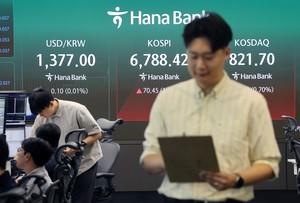
Brokerages raise rate forecasts after hawkish FOMC Interest rates, exchange rate, oil prices weigh on market September daily trading volume hits year-to-date low The Kospi edged higher Thursday even as the US Federal Reserve raised its benchmark interest rate for the first time in about three years and two months, with much of the hike already priced in. Still, the Fed's signal that further increases remain on the table has heightened caution over a renewed tightening cycle. As of 10 a.m., the Kospi was up 37.44 points, or 0.56 percent, at 6,755.41, paring an earlier gain after opening 61.05 points, or 0.91 percent, higher at 6,779.02. On the main Kospi market, retail investors posted net purchases of 297.2 billion won ($217 million), while foreign and institutional investors sold a net 504 billion won and 112.1 billion won, respectively, capping the index's upside. Foreign investors have been net sellers for seven consecutive trading sessions. Samsung Electronics and SK hynix were trading near flat. Bank stocks, including KB Financial Group and Hana Financial Group, rose more than 1 percent, buoyed by the global trend of rising interest rates. The fact that the Fed hike had been largely priced in is supporting the Kospi's gains. Han Ji-young, a researcher at Kiwoom Securities, said the limited rise in long-term yields was worth noting. "While short-term yields such as the two-year Treasury rose after the September FOMC, the increase in long-term yields such as the 10-year was contained," Han said. "This shows that concerns about Fed tightening and inflation had already been priced into long-term bonds." Overnight, the Fed raised its policy rate by 25 basis points to a target range of 3.75 to 4.00 percent at its FOMC meeting — its first rate increase since July 2023, roughly three years and two months ago. The decision was unanimous. The hike itself was in line with market expectations. The concern was that the FOMC came across as more hawkish than anticipated. Both the policy statement and Fed Chair Kevin Warsh's post-meeting press conference signaled the possibility of additional rate increases. "Inflation has been running above target for more than five years," Warsh said. "The plain fact is that inflation has been too high for too long." Wall Street fell across the board overnight in response to the Fed's hawkish tone. The Dow Jones Industrial Average and the S&P 500 dropped 1.21 percent and 0.45 percent, respectively, on Wednesday (local time), while the NASDAQ slipped 0.01 percent. The yield on the US 10-year Treasury note climbed back above 5 percent. Brokerages are interpreting the hike as the start of a new tightening cycle and raising their interest rate forecasts in quick succession. With the Fed's tightening stance now confirmed, concerns are growing that the burden of higher rates could persist for some time. Kim Il-hyuk, a researcher at KB Securities, said the probability implied by federal funds futures markets of a December hike followed by an additional increase in March next year had jumped sharply from 69.3 percent to 81.1 percent. "The outlook has shifted from a temporary one-or-two-hike scenario to what is effectively a resumption of a rate-hike cycle with three or more increases," Kim said. Meritz Securities raised its year-end federal funds rate forecasts for this year and next year to 4.25 percent and 3.75 percent, from 3.75 percent and 3.25 percent, respectively. It expects one additional hike in December before rate cuts resume in the second half of next year as consumer spending and labor market momentum weaken. SK Securities also forecast an additional rate hike in December. Won Yu-seung, a researcher at SK Securities, said the conditions that prompted the September hike are unlikely to ease quickly. "Growth momentum and inflationary pressures, along with geopolitical factors, are not going to resolve in the short term," Won said. "AI capital investment looks set to keep accelerating, and it will take at least three months to confirm a sustained downtrend in core inflation." Both interest rates and the exchange rate are expected to weigh on the domestic stock market. Byeon Jun-ho, a researcher at IBK Investment Securities, said the hawkish FOMC outcome would leave lingering rate-hike concerns in the market. "Given that the won-dollar exchange rate had fallen sharply in recent weeks, the sensitivity to a rebound following the Fed's decision could be significant, and we need to watch closely for any expansion in foreign selling pressure," Byeon said. Foreign investors have sold a net 10.58 trillion won worth of Kospi-listed shares so far this month, making their flows a key factor in determining the index's direction. The won-dollar exchange rate opened at 1,377 won Thursday and climbed as high as 1,379.5 won in early trading, approaching the 1,380-won level. Oil prices are another variable. Lee Eun-taek, a researcher at KB Securities, said the hawkish FOMC outcome was a burden for equities, but added that oil prices were the more market-sensitive factor. "Both bonds and equities are moving more in tandem with oil prices than with the interest rate path," Lee said. Investor sentiment is freezing up as external conditions — including interest rates, the exchange rate and oil prices — deteriorate. According to Korea Exchange, Kospi trading volume on Wednesday came to 15.86 trillion won, the lowest single-day total of the year. The average daily Kospi trading volume for this month stands at 20.97 trillion won, also the lowest of the year. That is less than half the 50.35 trillion won recorded in June. Experts agree, however, that the Fed's rate hike will not necessarily translate into a sustained downtrend for the domestic stock market. Han Ji-young of Kiwoom Securities said history shows that Fed rate hikes alone have rarely triggered a prolonged market decline. "Looking back at Fed policy cycles and equity markets, rate hikes themselves have not often led to a sustained downturn," Han said. "The economic and earnings cycle at the time has tended to have a greater influence on share prices than the direction of monetary policy." Han also noted that the Kospi's full-year operating profit consensus of around 990 trillion won was a source of reassurance.
Sept. 17, 2026
-
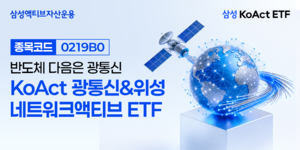
Samsung Active's KoAct fiber-optic ETF tops weekly returns on AI tailwinds
Only domestic equity ETF to hold Woori-ro; RF Materials held at highest weighting among peers Samsung Active Asset Management said Thursday that its KoAct Fiber Optic & Satellite Network Active ETF posted a weekly return of 3.03%, topping all domestic equity ETFs for the period. Since its listing on July 14, the fund has returned 17.21%, buoyed by a broad rally in fiber-optic shares at home and abroad. The KoAct Fiber Optic & Satellite Network Active ETF invests in South Korean companies operating in the network infrastructure sector. Expectations are growing that the advancement of AI services will drive demand for high-speed, large-capacity fiber-optic infrastructure needed to connect systems within and between data centers. Moves in the United States to phase out Chinese-made equipment in the sector have also acted as a tailwind for domestic companies. The ETF's holdings include RF Materials (12.17%), Woori-ro (7.44%), Hanwha Aerospace (6.43%), Taihan Fiberoptics (5.77%) and Fiberpro (5.46%). Woori-ro, which produces optical splitters and photodiodes for fiber-optic applications, is the only domestic equity ETF holding to appear exclusively in the KoAct Fiber Optic & Satellite Network Active ETF. RF Materials supplies fiber-optic components to Lumentum, a leading US fiber-optic company, and is held at its highest weighting in the KoAct Fiber Optic & Satellite Network Active ETF compared with any other ETF. However, share price volatility could be significant given that earnings improvements at domestic fiber-optic companies are only beginning to materialize this year. "The fiber-optic infrastructure super cycle, led by the United States, has entered the early stages of growth," said Kim Hyo-sik, head of Portfolio Management Team 2 at Samsung Active Asset Management. "A genuine trickle-down effect is now reaching domestic fiber-optic and network companies, with order expansion and earnings improvement becoming increasingly pronounced."
Sept. 17, 2026
-
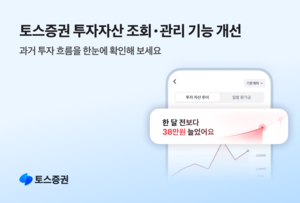
Toss Securities upgrades investment asset tracking and portfolio management tools
Year-in-review graph shows valuation and principal changes at a glance Users can now create custom groups to organize holdings by their own criteria Toss Securities announced Thursday that it has upgraded its investment asset tracking and management features to help customers more easily monitor and manage their portfolios. The company introduced an "investment asset trend" feature that lets users review their investment activity over the past year at a glance. The tool displays changes in valuation and principal through a graph, and shows how much the current valuation has increased or decreased compared with the original principal — in both monetary and percentage terms. Users can select time frames of one week, one month, three months or one year, and tapping a specific date on the graph reveals the valuation, principal and unrealized gain or loss at that point. The feature also supports account-by-account viewing, allowing customers to check asset trends for individual accounts — such as a standard brokerage account or a pension account — or view all accounts combined. Alongside this, Toss Securities added a "holdings grouping" feature that lets users bundle their holdings by any criteria they choose. Previously, customers could only view their holdings under fixed categories such as domestic shares, overseas shares and bonds. Now they can create their own groups and sort holdings as they see fit. Each group displays the holdings it contains along with their returns, allowing customers to organize their investments by purpose, area of interest or any other personal standard — improving overall convenience. Toss Securities is also the first domestic brokerage to pay principal and interest on overseas bonds on public holidays and Saturdays. The company had already been paying dividends on overseas shares on their scheduled dates regardless of whether they fall on a holiday or Saturday. The moves are part of a broader effort to reduce customer inconvenience across its product lineup. "This upgrade was focused on making it easier and more convenient for customers to check their investment status," a Toss Securities official said. "We will continue to improve the features our customers need, from their perspective."
Sept. 17, 2026
-

Hana Securities launches 'Hana Securities V' MTS with mega prize festival
Customers who buy 1 million won or more in domestic shares daily enter to win a Genesis GV90 CES 2027 tour, Galaxy Z Fold 8 among other prizes on offer Hana Securities announced Thursday it will hold a "Mega Prize Festival" through Nov. 17 to mark the launch of its new mobile trading system (MTS), Hana Securities V. Any customer with a Hana Securities account is eligible to participate. Customers who purchase 1 million won ($739) or more in domestic shares — including ETFs — on a given day will automatically be entered for a chance to win a Genesis GV90. No separate application is required; eligible trades are counted automatically, and entries accumulate with each qualifying trading day during the event period. Four separate round-based prize draws will also be held. Key prizes include a CES 2027 package tour, a Galaxy Z Fold 8, a Samsung Electronics Smart M7 43-inch monitor, a Samsung laptop, a Samsung robot vacuum cleaner and domestic shares. Participants may choose which prize they wish to enter for in each round. A first-come, first-served prize event will run every business day from 1 p.m. to 4 p.m. The first 1,000 customers each day will receive coupons from popular brands including CJ Olive Young, Naver Pay and Baemin. A KakaoTalk friend-sharing event is also available. If more than 20,000 customers share the event link with their KakaoTalk contacts, all 20,000 will receive a 2,000-won domestic share purchase coupon. New and dormant customers who open a comprehensive trading account and apply for the domestic share trading fee discount event will receive a preferential commission rate of 0.0036396 percent on domestic share trades for one year. Hana Securities V is designed to let AI analyze complex market data and investment information and deliver it quickly and clearly to users. The platform curates market trends and key issues for investors. Its flagship service, AI Briefing, uses AI to analyze and summarize closing conditions in US markets and the factors behind major stock movements. Personalized AI services tailored to each user's investment profile and asset holdings are also available. Cho Dae-heon, head of Hana Securities' AI and digital strategy division, said the company plans to "continuously improve customer investment convenience and user experience centered on Hana Securities V, and expand differentiated investment content and services going forward."
Sept. 17, 2026
MOST READ
- 1Hyundai Motor unveils all-new Tucson with bigger body, smarter tech after 6-year wait
- 2Flat sneakers are back: Why Nike is reviving a 55-year-old running shoe
- 3Pope Leo XIV declines French honors and banquet, accepts only private meeting with Macron
- 428 illegal sports streaming sites found operating freely despite repeated blocks
- 5What was Rachmaninoff's performance fee? A 1928 price list tells all
- 6Samsung Biologics union's show of force backfires at the bargaining table
-
WORLD
US warns of punishment for anyone enabling Iran's Strait of Hormuz toll scheme
-
INDUSTRY
Toyota union puts productivity first; Hyundai Motor union demands bigger share of profits
-
FINANCE
National Growth Fund to invest $531M in FuriosaAI, which rebuffed Meta's $800M takeover bid
-
INDUSTRY
Korea Shipowners' Association holds amateur baduk tournament for Maritime Day