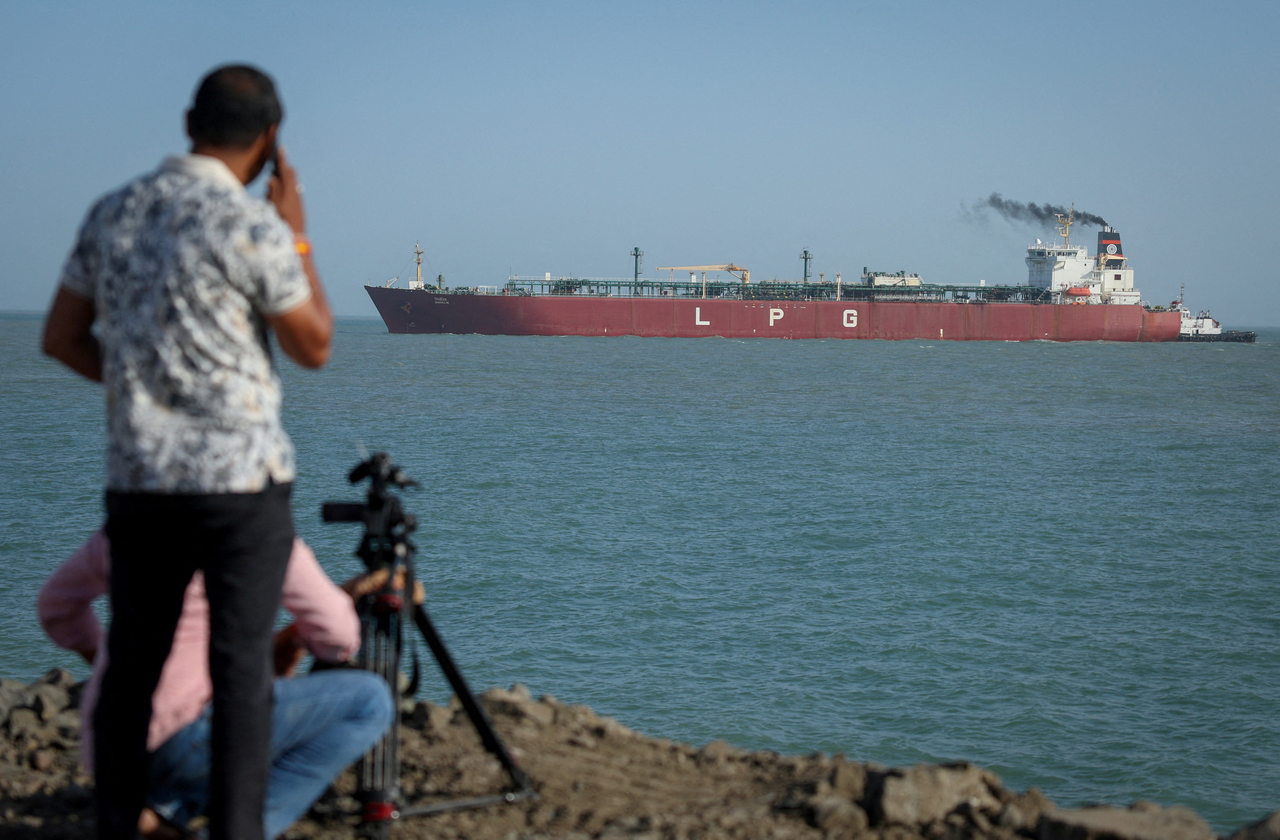
Domestic crude oil exchange-traded funds have surged more than 25 percent in the past month as supply worries persist across the Middle East. The rally accelerated recently after clashes between the United States and Iran combined with an attack on a Saudi Arabian energy facility. That combination pushed global oil prices back toward $100 a barrel. Goldman Sachs raised its December price outlook and said Brent crude could climb as high as $120 a barrel if supply disruptions worsen. High oil prices are expected to add to US inflationary pressure and weigh on monetary policy. Markets are now focused on the August consumer price index due Friday and the Federal Open Market Committee meeting scheduled for Sept. 15-16.
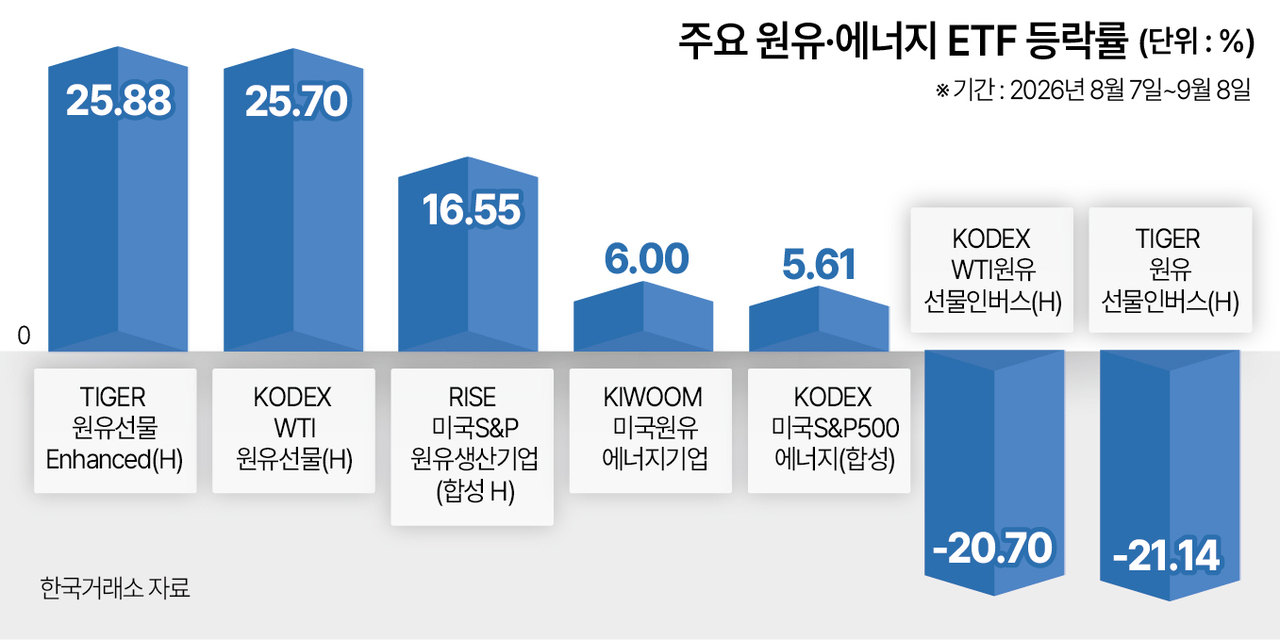
According to the Korea Exchange, TIGER Crude Oil Futures Enhanced (H) rose 25.88 percent and KODEX WTI Crude Oil Futures (H) rose 25.70 percent from Aug. 7 to Tuesday. RISE US S&P Oil Producers (Synthetic H) climbed 16.55 percent, while KIWOOM US Oil & Energy Enterprise and KODEX US S&P500 Energy (Synthetic) advanced 6.00 percent and 5.61 percent, respectively. By contrast, KODEX WTI Crude Oil Futures Inverse (H) and TIGER Crude Oil Futures Inverse fell 20.70 percent and 21.14 percent, respectively. As geopolitical tensions stemming from the Middle East persisted, products betting on rising oil prices and those betting on a decline posted starkly divergent returns.
As armed conflict in the Middle East escalated recently, oil and energy products gained not only in South Korea but also in global markets. According to Mirae Asset Securities, the Invesco DB Energy Fund (DBE), which invests broadly across the energy sector, rose 7.3 percent from Aug. 31 to Sunday. ProShares K-1 Free Crude Oil Strategy ETF (OILK) gained 5.7 percent in the same period. The iShares Global Energy ETF (IXC), which invests in global energy companies, also advanced 2.3 percent. "The renewed fighting between the United States and Iran, a tightened blockade of the Strait of Hormuz, and armed conflict around the Bab-el-Mandeb Strait have all combined to heighten supply risks in the oil market," said Yoon Jae-hong, a researcher at Mirae Asset Securities.
Supply worries stemming from the Middle East pushed global oil prices close to $100 a barrel. Brent crude for November delivery settled at $97.92 a barrel, up $0.92, or 0.95 percent, from the previous session — its highest level since July 24. During trading, the price topped $99. West Texas Intermediate for October delivery rose $1.55, or 1.69 percent, to $93.03 a barrel. Iran-aligned Houthi rebels in Yemen attacked Saudi Arabian energy facilities and air bases, raising concerns that supply disruptions could spread beyond the Strait of Hormuz to the Red Sea. That fear drove prices higher.
Some analysts expect oil prices to climb further. Goldman Sachs raised its December forecasts for Brent and WTI by $5 each, to $85 and $80 a barrel, respectively. The bank also said Brent could rise as high as $120 a barrel if oil supply disruptions in the Gulf region persist at a significant scale. Dan Struyven, co-head of global commodities strategy at Goldman Sachs, warned in a Monday interview with Bloomberg TV that Brent could climb to $120 a barrel. He said this could happen "if attacks on vessels expand and intensify." He added that a recent string of incidents was also raising concerns about disruptions to maritime shipping.
While rising oil prices lifted crude ETFs, they also weighed on stock markets broadly. The Dow Jones Industrial Average fell 1.18 percent, the S&P 500 dropped 0.58 percent, and the NASDAQ slipped 0.32 percent on Tuesday (local time). The yield on the 10-year US government bond climbed back above 4.8 percent, reaching 4.805 percent. "As the conflict between the United States and Iran persisted, and reports emerged of an attack on Saudi Arabian oil facilities, international oil prices kept climbing," said Lee Kyung-min, a researcher at Daishin Securities. "Appetite for risk assets weakened as a result."
While high oil prices weigh on the broader stock market, the energy sector benefits from rising crude prices. Park Woo-yeol, a researcher at Shinhan Investment, named the Energy Select Sector SPDR Fund (XLE), which invests in US energy companies, as a product to address geopolitical risk. XLE rose 2.2 percent last week and is up 45.3 percent since the start of the year. Park said that as oil prices rise, energy companies' sales and profits are likely to increase as well.
As inflation concerns grow again amid higher oil prices, attention has also turned to the Federal Reserve's rate decision. BlockBeats reported, citing CME's FedWatch tool, that the probability of the Fed raising its benchmark interest rate by 0.25 percentage point in September stood at 60.4 percent. "Uncertainty in the Middle East pushed international oil prices to the brink of $100 a barrel, raising government bond yields and adding to valuation pressure on the stock market," said Min Kyung-won, a researcher at Woori Bank. Woori Bank said bets on a Fed rate hike had grown since the situation in the Middle East deteriorated.
The US August consumer price index, due Friday, will be the key indicator shaping the Federal Open Market Committee's rate decision at its Sept. 15-16 meeting. Markets expect that if the CPI comes in above forecasts amid mounting inflation concerns driven by high oil prices, expectations for a Fed rate hike will gain further momentum.

hajun825@heraldcorp.com