2026 Korea Herald HIT Forum held
Morgan Stanley, JPMorgan among panelists
Defense, nuclear power in spotlight; chip upside remains
Governance reform, investor communication remain challenges
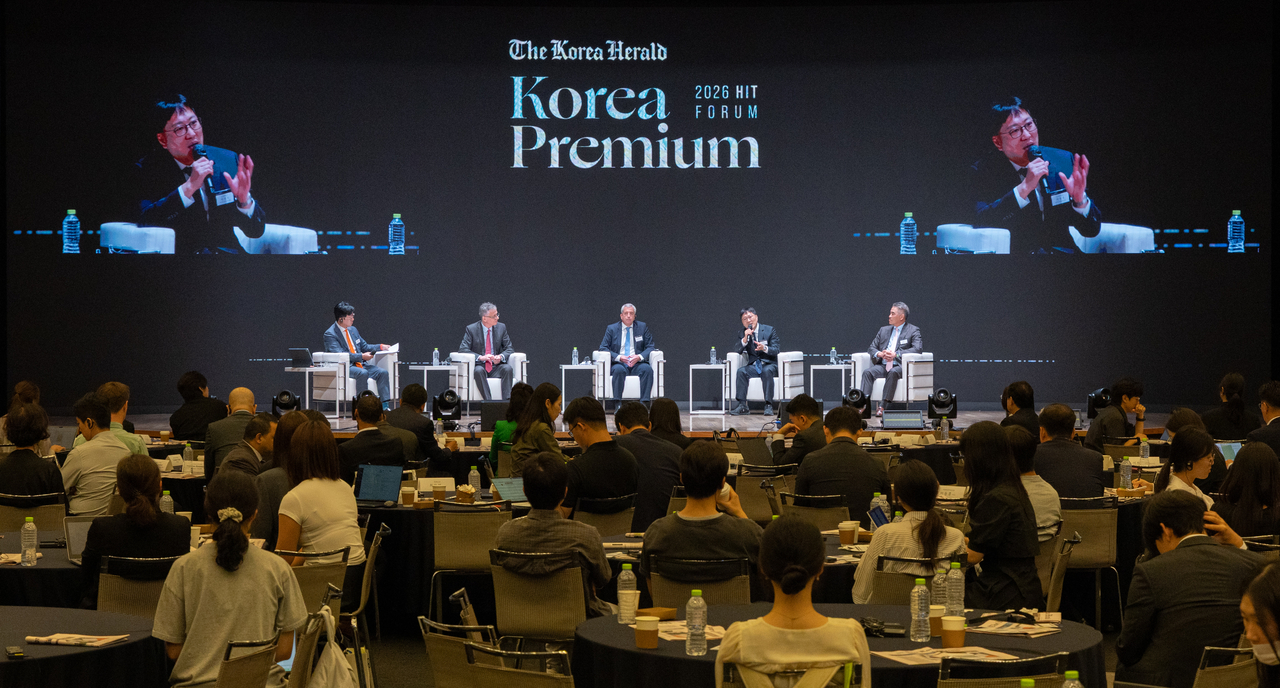
Global financial experts have named defense and nuclear power as the next drivers of South Korea's stock market rally, which has so far been led by the semiconductor "super cycle."
They said the spread of Korea's industrial leadership could lead to a structural rerating of the Kospi. However, they pointed to challenges that remain to be addressed, including overconcentration in a handful of stocks, closed corporate governance structures and a lack of communication with investors.
The discussion took place during a panel session titled "Can Korea Become a Key Investment Destination for Global Capital?" at the "2026 Korea Herald HIT Forum," held Tuesday at the Korea Chamber of Commerce and Industry in Jung-gu, Seoul.
Suk Jun, Morgan Stanley's head of Korea strategy, said defense companies in Europe and the United States are grappling with capacity shortages. He said Korea is filling that gap by advancing its defense technology through the localized production of the K2 tank and K9 self-propelled howitzer.
"For about 25 years since the Gulf War, the average global defense budget hovered around 2 percent of gross domestic product, but it has continued to rise since Russia's invasion of Ukraine in 2022, and we believe this ratio could climb to 3.5 percent," Suk said. "As Korea's defense industry enters a new era, its technological range keeps expanding, and given the demand to replace aging conventional weapons and platforms, there is significant room to expand overseas."
"When considering the three themes of a multipolar world, AI and the energy transition, Korea is the most suitable investment destination, particularly among emerging markets," he added.
Park Jung-woo, chief economist at Nomura Securities, said a "rediscovery of manufacturing" is underway. Concerns are growing over overreliance on a single supply chain -- China -- in the wake of the COVID-19 pandemic. Manufacturing was once regarded as an industry for low-wage countries with a low return on equity. It is now being reevaluated as an asset nations must hold to secure a voice amid geopolitical conflict, he said.
In this context, panelists said defense and nuclear power go beyond simple industrial growth, directly reflecting Korea's strategic position amid a rapidly shifting global order.
Frank Benzimra, head of Asia equity strategy at Societe Generale, said, "In the US stock market, there is still no strong global player in several industrial engineering fields, including batteries, shipbuilding and nuclear power." He added, "A handful of Korean conglomerates are filling that vacuum."
The panelists said this spread of industrial leadership is driving a structural rerating across the Kospi as a whole. According to Park, Korea is expected to post growth of more than 3 percent this year for the first time since 2017. That excludes 2021, when growth reflected a base effect from the pandemic.
"Countries that exceed the global growth rate of 3 percent are typically markets worth watching -- ones that command a 'growth premium,'" he said. "The won, which had weakened to as much as around 1,500 won against the dollar, is strengthening again, and the interest rate gap between Korea and the US is also narrowing -- a signal that points to an improving growth outlook ahead."
Alexander Treves, managing director at JPMorgan Asset Management, stressed that investment opportunities in Korea should not be limited to memory chips. "If every investor is talking about the exact same stock, that is a sign you should be looking elsewhere," he said. He drew a line, however: "It is true that the memory chip market is generating large profits right now, but that does not mean an entire portfolio should be built around memory chips."
"There are many other companies that could be candidates for a value-up rerating, and how quickly investors can seize new opportunities amid a shifting geopolitical landscape will be key," he added.
The panel also flagged risks that warrant caution alongside the optimistic outlook. Treves pointed to corporate governance issues. "A structure in which a controlling shareholder with a low stake can exert outsized influence over a company's overall decision-making can lead to abnormal outcomes," he said. "Narrowing the gap between ownership and voting rights will be important from an investor's perspective."
Park also pointed to limits in corporate communication. "When I look at how Korean companies communicate with investors at earnings conferences and elsewhere, I feel they fall considerably short compared with overseas companies," he said. "Investor communication and access to corporate information remain conservative overall."
Park also said the semiconductor boom is likely to continue for now. "When a chip shortage is 'supply-constrained,' unlike a typical cycle, it tends to last about three years," he said. "This cycle, which began in the second half of 2025, could continue for roughly three more years."
"As chipmaking grows more technologically demanding, the average annual growth rate of semiconductor supply keeps slowing, making it increasingly difficult to expand supply," he added.
jiyun@heraldcorp.com