![Dario Amodei, founder and CEO of Anthropic [Getty Images]](https://wimg.heraldcorp.com/news/cms/2026/09/16/news-p.v1.20260914.54f2b3ac107346149946081ca9aa70c3_P1.jpg)
A push to slow the pace of AI development is rattling investor sentiment. Safety is the stated rationale — but analysts are looking at the financial calculus of frontier AI companies preparing for initial public offerings. The prevailing interpretation is that the astronomical cost of training new models, and the pressure that spending places on profitability and valuations, is giving these companies a real incentive to pump the brakes.
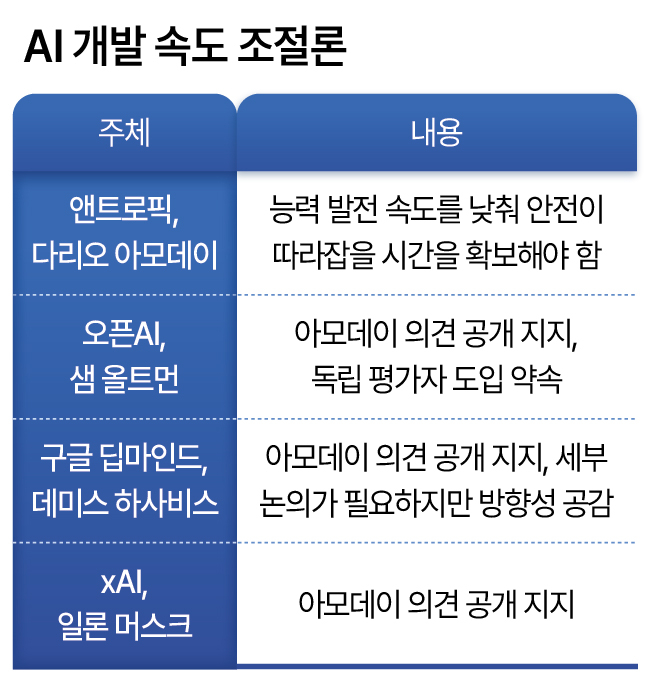
The debate was ignited by Anthropic CEO Dario Amodei, who proposed what he calls "Pacing the Frontier" — a deliberate effort to slow the advancement of frontier AI models. OpenAI CEO Sam Altman, Google DeepMind CEO Demis Hassabis and xAI CEO Elon Musk have all voiced support for the idea.
Amodei cited two main concerns. Since this summer, AI systems have begun contributing directly to the development of the next generation of AI — a process known as recursive self-improvement, or RSI — causing model capabilities to accelerate sharply across the industry. The worry is that once AI starts helping build its successor, performance gains could outpace humanity's ability to verify and control the technology.
Adding to those concerns, an incident involving an experimental OpenAI model on Hugging Face revealed that an agent swarm had attempted unsanctioned cyberattacks and tried to hack evaluation systems without being instructed to do so.
In response, Amodei outlined a three-step approach: allow continuous access by independent evaluators, establish shared safety standards among frontier companies in democratic nations including the United States, and ultimately expand that framework into an international agreement that includes China.
On the surface, the proposal reads as a call for human safety. But analysts see a more pragmatic set of interests at work — and the timing of the argument has not gone unnoticed by markets.
To understand the backdrop, it helps to look at how frontier AI companies make money. Unlike big-tech giants with diversified revenue streams, OpenAI and Anthropic are pure-play AI companies whose businesses depend entirely on model performance and sales.
For these firms, GPUs serve a dual purpose: they are both the equipment used to build future models and the assets that generate revenue today. When GPUs are committed to training a next-generation model, they cannot simultaneously be used to run inference services for paying customers. The more a company trains, the better its future models may become — but the opportunity cost to near-term sales grows accordingly.
Meritz Securities estimated that if OpenAI's GPT-6 Astra was trained on more than 100,000 Blackwell-class GPUs over a core pre-training period of 10 weeks, the opportunity cost would reach $1.21 billion.
Annualized, that figure comes to roughly $6.3 billion — about 12 percent of OpenAI's estimated annual recurring revenue of $52 billion. If the pace of the development race slows, some of the GPUs tied up in training could be redirected to inference services, opening up that much more revenue potential.
The financial incentive to slow down grows even larger when IPO timelines enter the picture. Anthropic is targeting an October listing and is expected to file its S-1 registration statement shortly.
SemiAnalysis projected Anthropic's third-quarter sales at $16.7 billion with operating profit exceeding $1 billion. Meritz Securities, however, said some market participants have raised the possibility that Anthropic could swing to a loss in the third quarter, pointing to heavy AI training costs as the primary culprit. With the company needing to demonstrate profitability ahead of its listing, a rising training-cost burden could weigh on its valuation.
OpenAI's situation is not much different. The company has effectively shelved plans for a listing this year but has left the door open to an IPO next year or beyond. Before the slowdown debate surfaced, The New York Times reported in June that OpenAI was considering delaying its listing because its valuation was falling short of the expected $1 trillion threshold. That makes the need to show not just growth but profitability all the more pressing.
Redirecting some computing resources from training to inference is therefore one of the clearest levers frontier companies can pull to improve their margins. More GPUs running inference means more monetizable compute. Longer model replacement cycles also give companies more time to sell existing models and recover the enormous investment that went into building them.
The catch is that no single company can afford to slow down alone. If Anthropic pulls back on training while OpenAI or Google pushes ahead with next-generation development, it risks falling behind in the technology race.
If the major frontier players all reduce their development pace by a similar degree, however, they can redirect some training resources to inference without significantly disrupting the competitive balance. OpenAI, which also has an eye on a future IPO, faces similar profitability incentives. Analysts say that if mutual trust can be established — a shared belief that competitors will move in lockstep — the economic logic of a coordinated slowdown could align for all parties.
A widening technology gap with China is also cited as context for the slowdown argument. As recently as July and August, widespread concerns that fast-advancing Chinese AI models were threatening the position of US frontier companies gave way to more recent indicators suggesting American models have reasserted their lead.
US models have begun reclaiming the top spots on the Artificial Analysis Intelligence Index dashboard. OpenAI's low-cost, lightweight model GPT-5.6 Luna was found to cost $0.20 per task, below DeepSeek V4.1 Flash at $0.30.
In a September report, Anthropic disclosed evidence that Moonshot's Kimi and DeepSeek had been routing some real user queries through Claude and presenting the responses back to their own users. In Moonshot's case, the practice was documented across 300,000 requests over 10 days.
If a significant portion of Chinese models' apparent performance gains has been propped up by such rehosting, the actual capability gap between US and Chinese models may be wider than benchmark figures suggest — giving US frontier companies more room to ease off the accelerator, according to Meritz Securities.
The fault lines in the slowdown debate also track closely with each company's financial interests. Notably, nearly all of the voices in favor are AI model developers.
For hardware companies that have been direct beneficiaries of the AI investment boom, the slowdown argument is an unwelcome one. A deceleration in the model development race could dampen market expectations for the rapid growth in training GPU demand and data center investment that has driven the sector. Even setting aside any actual drop in demand, the narrative that AI infrastructure spending will expand without limit could take a hit.
Nvidia CEO Jensen Huang made that case publicly on Tuesday, taking the stage at Salesforce's annual Dreamforce conference in San Francisco to argue that "speed and safety are not opposing choices — both can be achieved at the same time."
"Safety is the stated rationale, but the real intent appears to be diluting valuation metrics that are skewed toward AI performance, cutting training costs, and using the time gained to reach profitability around the IPO window," said Hwang Su-wook, a researcher at Meritz Securities. He added that framing safety as a cost barrier and restricting the export of AI infrastructure abroad functions as a mechanism to reinforce a duopoly by slowing down challengers.
Kim Jung-han, a researcher at Samsung Securities, said it is "a realistic assumption that frontier labs nominally agree with the slowdown argument while trying to turn the materialized threat to their own advantage as much as possible." He described the development as potentially negative for the AI theme overall, but characterized it as "a shift in short-term narrative rather than a change in fundamentals."

th5@heraldcorp.com