
- HOME
- REAL ESTATE
-
BS Group, KB Financial ally in 'productive finance' push
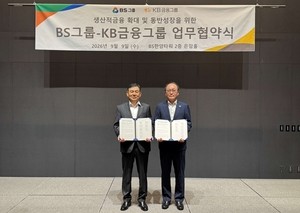
BS Group to handle project discovery, development and operation KB Financial to provide funding, corporate finance advisory and more BS Group and KB Financial Group will build a strategic partnership to jointly pursue future growth businesses in renewable energy, AI data centers and urban development. BS Group announced Wednesday that it signed a memorandum of understanding titled "Expanding Productive Finance and Mutual Growth" with KB Financial Group at BS Hanyang Tower in Munjeong-dong, Songpa-gu, Seoul. Three BS Group affiliates — BS Boseong, BS Hanyang and BS Industries — took part in the agreement, along with five KB Financial Group affiliates, including KB Financial Group itself, KB Kookmin Bank, KB Securities, KB Asset Management and KB Capital. The two groups plan to combine their industrial and financial expertise to maximize business synergy and jointly identify new growth engines. Their cooperation will center on renewable energy and eco-friendly power plants, energy infrastructure such as energy hub terminals, ports and utilities, and real estate supply including residential and industrial complexes. It will also cover AI- and energy-focused new towns, AI data centers, financial services tied to corporate growth such as mergers and acquisitions and initial public offerings, and ESG management. BS Group, known for its apartment brand Sujain, has been expanding beyond construction and real estate development into renewable energy and energy infrastructure. The company is currently running large-scale projects including a 98-megawatt Solasido solar power project, a land-and-water solar power project in Goheung and Haechangman, a Northeast Asia LNG hub terminal, and a combined heat and power plant. In particular, the Solasido development — the country's largest public-private urban development project, pursued jointly with the South Jeolla-Gwangju Integrated Special City and Haenam-gun — is gaining momentum. Following the ground-breaking of a national AI computing center in August, Samsung Electronics announced plans to invest 17 trillion won ($12.7 billion) in an AI data center there. A large-scale data center and a 5.4-gigawatt renewable energy complex are planned for the Solasido area going forward. KB Financial Group, too, has been strengthening financial support for advanced strategic industries and infrastructure. The group has been recognized for its competitiveness in the infrastructure finance market, having arranged financing for the Sinan Ui offshore wind power project and secured the right to arrange financing for the district energy project at the Yongin Semiconductor Cluster. "Cooperation with a financial partner is essential to carry out large-scale projects such as housing, urban development, energy infrastructure and AI data centers without disruption," a BS Group official said. "Our partnership with KB Financial Group, the largest financial group in the country, will speed up our project execution and create synergy in identifying new growth engines." The two groups plan to form sector-specific working councils to identify concrete joint projects going forward, continuing to strengthen competitiveness and pursue shared growth in renewable energy and future industries. Meanwhile, BS Group affiliate BS Hanyang posted sales of 758.9 billion won, operating profit of 97.3 billion won and net profit for the period of 65.5 billion won on a consolidated basis in the first half of last year. Sales rose 52.5 percent from the same period a year earlier, while operating profit more than doubled, surging 101.4 percent. The company's order backlog stood at 7.3 trillion won as of the end of the first half.
Sept. 9, 2026
-
SH reissues notice for 3,821 redevelopment rental units, subscriptions to open Sept. 29
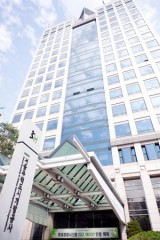
Scoring for vulnerable groups kept, age-based points scrapped Open to non-homeowning Seoul residents earning up to 70% of average income The Seoul Housing & Communities Corporation, or SH, will recruit occupants and preliminary occupants for 3,821 redevelopment rental housing units. The recruitment, originally announced in late July, was postponed and is now being relaunched under revised occupant-selection criteria. SH said Wednesday at 4 p.m. that it had issued a notice for the redevelopment rental housing recruitment and that subscription applications will be accepted starting Sept. 29. The units on offer total 3,821 — comprising 1,675 leftover vacant units across 162 complexes and 2,146 units reserved for preliminary occupants. The reissued notice replaces the "2026 Redevelopment Rental Housing Occupant Recruitment Notice," which was first announced July 30 and then postponed Aug. 10. At the time, SH cited the need to more fully reflect social consideration factors following a change to its scoring criteria, prompting the delay. In the reissued notice, scoring for socially vulnerable groups has been restored, but age-based points have been eliminated. The change is intended to expand move-in opportunities for low-income young people, who were relatively disadvantaged under the previous scoring system. The redevelopment rental units being offered this round are first provided to tenants displaced by redevelopment demolition, with any remaining vacancies opened to general applicants. All units are small, with an exclusive use area of 39 square meters or less. General applicants must be members of non-homeowning households residing in Seoul as of Wednesday, the date the notice was issued. Eligibility is limited to households earning up to 70 percent of the average monthly income for urban workers, with first-priority applicants capped at 50 percent and second-priority applicants at 70 percent. Total household assets must not exceed 345 million won ($257,000), and the value of any vehicle owned must not exceed 45.42 million won. Applications will be accepted online and via mobile app. First-priority applicants may apply from Sept. 29 to Oct. 2, while second-priority applicants may apply on Oct. 8. If the number of first-priority applicants exceeds 200 percent of the available units, the second-priority application period will not be held. In-person applications will also be available for elderly and disabled applicants and others who have difficulty using the internet. These can be submitted at the large auditorium on the second floor of SH's headquarters from Sept. 30 to Oct. 2. Applicants selected for document screening will be announced Oct. 23, with final winners to be announced March 30, 2027. Move-in is expected around April 2027. Meanwhile, the Seoul Metropolitan Government plans to gradually reclaim long-term jeonse housing units as their 20-year terms expire, starting with 310 units reaching maturity next year, and reissue them to new occupants through 2031, when the total reclaimed will reach 9,300 units. Long-term jeonse housing accounts for about 12 percent of the public rental housing held by SH in Seoul, with roughly 38,296 units supplied to date.
Sept. 9, 2026
-

Gangnam reconstruction union scraps bonus apartment after residents fight back
Union members pool funds to fight back; liquidator, auditor dismissed High bonus disputes persist at major redevelopment sites Supreme Court: Excessive bonuses can void general meeting resolutions A plan to award former executives of the Gaepo Jugong Complex 2 reconstruction union in Gangnam-gu, Seoul — now redeveloped as Raemian Blesstige — a Gangnam apartment worth up to 4 billion won ($2.98 million) as a performance bonus has been completely scrapped. After residents pushed back, the previous leadership was dismissed and a court suspended the general meeting resolution approving the payout. The newly installed leadership has now finalized the bonus at zero. Industry sources said Wednesday that the Gaepo Jugong Complex 2 housing reconstruction association held a liquidation general meeting Saturday at the Gangnam-gu Community Center and passed a resolution setting the liquidator's bonus at zero. A total of 1,277 members participated in the vote — 1,100 by written ballot and 177 in person — with 1,114, or 87 percent, voting in favor. Eighteen voted against, and 145 ballots were invalid or abstentions. The same meeting also approved a separate resolution scrapping the bonus payment resolution passed at the previous liquidation meeting on Sept. 29, 2025. The repeal measure passed with 1,126 in favor and four opposed. The conflict first flared at the union's initial liquidation general meeting last year. At the time, the union proposed distributing about 145 billion won in profit generated from completing the reconstruction project among its members, while also awarding a single 84-square-meter apartment unit — whose general pre-sale contract had previously been canceled — as a bonus to the leadership, including former union head A. The controversy over the multibillion-won bonus erupted after an apartment of the same size sold for 3.6 billion won around that time. At that meeting, the payout plan passed with 648 of 1,182 union members voting in favor. But opposition from union members persisted. They argued it was excessive for the executives — who had already drawn salaries throughout the reconstruction project and the liquidation corporation's operation — to also receive an apartment worth billions of won as a separate bonus. In response, some union members pooled money to retain a law firm and launched legal action disputing the validity of the general meeting resolution. In October 2025, they formed an emergency response committee to protect the union's existing assets and collected 651 signatures on a petition to dismiss the liquidator. A dismissal general meeting was ultimately held on Dec. 27, 2025, removing A and all remaining liquidators and auditors. The court then granted an injunction suspending the effect of the original general meeting resolution in February this year. That same month, the court appointed B as the new liquidator. The new leadership conducted an external audit and held briefing sessions for union members before convening the latest liquidation general meeting. About a year after the original resolution to award an apartment worth billions of won as a bonus passed, the plan was scrapped and the new liquidator's bonus was set at zero. Resident C said, "We already thought the bonus the previous leadership was set to receive was excessive, and there was strong backlash against also giving away an entire apartment as a bonus. Residents each contributed money to hire a lawyer and volunteered for related work." New liquidator B said, "There was a perception that even if union members felt something was unfair, it was difficult to push back when they were at a disadvantage in organization or funding. It is encouraging that union members were able to show that pooling their strength can change the outcome." Disputes over large bonuses have continued at redevelopment project sites. Courts have issued differing rulings case by case, weighing factors such as the bonus amount and the project's results. At Acro River Park (formerly Sinbanpo Complex 1), union members filed a lawsuit disputing the validity of a general meeting resolution after it emerged that about 13 billion won in bonuses would go to 10 executives, including the union head. The Supreme Court ruled that a general meeting resolution could be nullified if the bonus amount was excessive and there were grounds to view it as inequitable. The ruling reflected the view that, given the public nature of reconstruction projects, bonus payments cannot be left solely to the decision-making of a private organization. By contrast, in a separate lawsuit over a 1 billion won bonus set for the union head at Raemian One Bailey (formerly Sinbanpo Complex 3 and Gyeongnam Apartment), the court reached a different conclusion. Considering the additional profit the union gained through the project, it ruled that 1 billion won was not an excessive bonus. Experts say that paying bonuses to union executives is not prohibited in itself, but that the core issues in these disputes are whether the amount is excessive relative to the project's results and whether the payment's rationale and voting procedures were appropriate. Kim Je-kyung, director of Tumi Real Estate Consulting, said, "Given that the complex was completed a considerable time ago, the union head likely received no small salary before this liquidation meeting. It is unusual that this outcome emerged in a situation where interest among union members has waned long after completion, making it difficult even to meet the quorum for a vote." He added that the case raises questions about how to distribute profits at the final stage of a redevelopment project.
Sept. 9, 2026
-
Second 'university innovation park' completed at Kangwon National University's Chuncheon campus
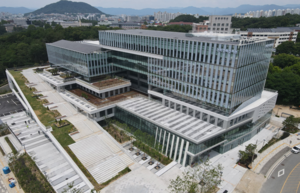
Four companies move in... First Vice Minister Kim Yi-tak: 'Hope it becomes a growth hub bringing together regional firms and talent' The Ministry of Land, Infrastructure and Transport, the Ministry of Education and the Ministry of SMEs and Startups completed and opened an industry-academia-research innovation hub at Kangwon National University's Chuncheon campus on Wednesday. The innovation park project is a joint effort by the government, universities and the Korea Land and Housing Corporation to build innovation hub buildings on university campuses. These buildings support the move-in of startups and growth companies as well as industry-academia-research cooperation. Since 2019, nine universities have been selected through four rounds of public bidding to develop advanced urban industrial complexes. Among the universities picked in the first round, Hanyang University's Erica campus is scheduled to be completed in the first half of next year. This marks the first opening among regional flagship national universities under the government-led project, and the second nationwide after Hannam University, which was completed in late 2024. Kangwon National University and LH jointly served as project operators. LH developed the first-phase site, spanning 28,000 square meters, before completing the industry-academia-research innovation hub there. The second-phase site, covering 38,000 square meters, is currently being developed under the university's leadership. The newly opened hub sits on a 14,765-square-meter site and comprises one basement level and eight above-ground floors, with a total floor area of 22,285 square meters. It houses 98 independent office spaces for companies and institutions, advanced research equipment and facilities shared by campus researchers and students, and comfortable support spaces tailored to tenant companies. As of August, 44 companies had signed contracts for 53 units and are in the process of moving in. Tenant companies can stay for up to 10 years at rents lower than the surrounding market price. The site has also been designated as part of the Gangwon Province biotech and pharmaceutical national advanced strategic industry complex, the Gangwon research and development special zone, and a green biotech industry promotion zone, allowing tenant companies to receive support tailored to their industry and growth stage from among various special zone benefits. The Ministry of Education plans to expand opportunities for Kangwon National University students to participate through project labs and research and development internships. It will also focus support on equipment for prototype production and testing and evaluation, as well as programs to help companies grow through technology development, commercialization and marketing. The Ministry of SMEs and Startups plans to support tenant companies at the innovation park by linking them organically with key support projects. This will strengthen the park's role as a hub for the region's innovation and startup ecosystem. First Vice Minister of Land, Infrastructure and Transport Kim Yi-tak, who attended the completion ceremony that day, said, "I hope Kangwon National University's campus innovation park will go beyond simply being rental space for companies, and instead become a growth hub where young people's startups and growth companies' innovative ideas take shape, and where companies and talent in the Gangwon region gather to communicate with the local community."
Sept. 9, 2026
-
Pyeongtaek, Gyeongju win top honors at Korea City Awards
Land ministry cites carbon neutrality, urban regeneration in naming top sustainable cities Pyeongtaek in Gyeonggi Province and Gyeongju in North Gyeongsang Province were recognized as outstanding sustainable cities. The Ministry of Land, Infrastructure and Transport said it would hold the "2026 Korea City Awards" ceremony at 2 p.m. Wednesday at BEXCO in Busan, presenting Pyeongtaek the presidential award and Gyeongju the prime minister's award. The two cities were honored for driving change in residents' lives and local economies — from carbon neutrality built on the hydrogen industry to resident-led urban regeneration. Pyeongtaek put forward a new model of urban growth that combines carbon neutrality with industrial growth. The city earned high marks for pursuing carbon-neutral policies suited to an industrial city, including expanding clean hydrogen supply infrastructure such as hydrogen production bases and pipeline networks, and growing renewable energy and urban forests. The city drew particular praise for the carbon-reduction impact of operating the nation's first commercial carbon dioxide capture facility, equivalent to planting about 620,000 trees. It also received praise for running a hydrogen production base for a year, equivalent to planting about 5.58 million trees. Gyeongju breathed new life into the declining Hwangchon village through resident-led urban regeneration. Building on public-private-industry-academia governance with resident participation, the city revived its alley commercial district and pursued projects tailored to local characteristics, such as urban homestays. As a result, foot traffic rose 319 percent and average stay time increased 62 percent, while satisfaction with walkability and residential welfare rose 38 percent and 21 percent, respectively — changes that were assessed as translating into real improvements in residents' lives and the local economy. Paju also received the land ministry's award, for a power purchase agreement that supplies renewable energy produced using idle sites and existing facilities directly to local companies. Jongno-gu received the award for creating the Jongno Fashion Support Center out of an idle building, linking traditional downtown industry with urban regeneration. Dong-gu of the South Jeolla-Gwangju Integrated Special City received the award for solutions tailored to local characteristics, including incorporating AI into medical infrastructure. Lee Ki-bong, director general for urban policy at the Ministry of Land, Infrastructure and Transport, said, "The answers to the problems cities face can differ from region to region." He added, "We will actively support policies that make use of local conditions and strengths so that they can bring real change to residents' lives, and help spread those achievements to other cities." Meanwhile, the Korea City Awards evaluate the sustainability and quality-of-life infrastructure of the country's 229 cities, counties and districts. This year's ceremony is being held alongside the "2026 World Smart City Expo," which opens Wednesday at BEXCO in Busan. Last year, Suwon received the presidential award and Goyang the prime minister's award, while Jongno-gu, Paju and Mokpo were among those receiving the minister's award.
Sept. 9, 2026
-
![Where to find Seoul multi-family homes priced under W400m [Real Estate 360]](https://wimg.heraldcorp.com/news/cms/2026/09/09/news-p.v1.20260402.2208f144f0fc4eaaacdd7f0753a6b2d1_T1.png?type=h&h=240)
Where to find Seoul multi-family homes priced under W400m [Real Estate 360]
Analysis of multi-family home deals by district Gangseo-gu leads all 25 districts in share and volume Seoul's average multi-family home price hits 430 million won as non-apartment prices climb The Youth Future Bogeumjari Loan is a state-backed, low-interest mortgage program for young first-time buyers of non-apartment housing. Set to launch next January, it has drawn growing attention to multi-family homes in Seoul priced at 400 million won ($298,000) or less, which will qualify for the loan. Deals under 400 million won this year were notably concentrated in western Seoul, particularly in Gangseo-gu, Eunpyeong-gu and Yangcheon-gu. However, some in the industry expect the pool of such affordable properties to shrink, given that the recent rally in housing prices has begun spreading to multi-family homes as well. Zigbang provided the market analysis to The Herald Business on Wednesday, covering multi-family home sales with an exclusive floor area of 85 square meters or less. A total of 26,815 such deals were recorded in Seoul between January and August this year. Of those, 16,421 — or 61.2 percent — were priced at 400 million won or less. By district, deals under 400 million won were most numerous in Gangseo-gu, with 1,846 transactions. Sales at or below that price accounted for 93.9 percent of all multi-family home deals in the district. Eunpyeong-gu (1,708 deals), Yangcheon-gu (1,173), Songpa-gu (1,054) and Gwanak-gu (1,040) followed Gangseo-gu, each recording more than 1,000 multi-family home sales priced at 400 million won or less. In both Eunpyeong-gu and Yangcheon-gu, more than 80 percent of multi-family home transactions fell under that threshold. Dobong-gu (90.6 percent), Guro-gu (90 percent), Gangbuk-gu (88.1 percent) and Geumcheon-gu (87.6 percent) followed Gangseo-gu in the share of deals under 400 million won within each district. These are mostly outlying districts. In terms of price alone, these are the districts where young buyers seeking non-apartment housing under 400 million won are most likely to focus their search. Yongsan-gu recorded the fewest multi-family home sales under 400 million won in Seoul. Over the past eight months, it was the only district citywide with fewer than 100 such transactions, at 44. Deals under 400 million won made up just 7.2 percent of all multi-family home transactions in Yongsan-gu. Gangnam-gu and Seocho-gu recorded 216 and 164 such deals, respectively. Industry watchers, however, expect the share of deals under 400 million won to shrink as non-apartment housing prices continue climbing. The Korea Real Estate Board's July housing price survey showed Seoul's sale price index for multi-family housing, including multi-household homes, rose 5.27 percent from a year earlier. That is sharply up from 1.19 percent growth in the same month the previous year. Zigbang's analysis found that the average sale price of multi-family homes across Seoul in July already stood at 432.33 million won, surpassing the Youth Future Bogeumjari Loan's price threshold. As a result, some expect buying interest to shift away from Seoul toward outlying areas. "Since Seoul multi-family home prices have already climbed considerably, if there is an area where exiting is easy — meaning you can resell and recover your money quickly — buying newly built housing in areas near transit hubs in Gyeonggi Province that are in demand, such as Gwangmyeong or Bundang, could be one alternative," said Ham Young-jin, head of Woori Bank's real estate research lab. "One needs to decide whether they want newly built housing to live in themselves, or whether they want non-apartment housing for a move-in right at a redevelopment site," Ham said. "If targeting a redevelopment site, focus mainly on ones where the project has already progressed, such as those that have already received association establishment authorization. But since prices could rise while waiting for the new policy loan to be introduced, buying before the end of the year may be the better option, depending on the site."
Sept. 9, 2026
-
Hyundai E&C to launch presale of Hillstate Godeok Ellist in September
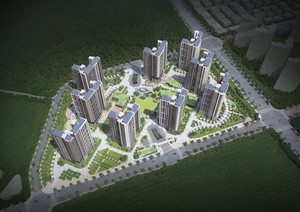
Price ceiling on new apartments to apply Hyundai Engineering & Construction said Wednesday that it will launch the presale of Hillstate Godeok Ellist in Godeok International New Town in Pyeongtaek, Gyeonggi Province, in September. Hillstate Godeok Ellist will rise on blocks A12 and A65 of the Godeok International Zone in Pyeongtaek. Block A12 will have 942 units across one basement floor and 23 floors above ground, while block A65 will have 837 units across two basement floors and 27 floors above ground. In block A12, unit types will be allocated as follows: 401 units of 84-square-meter Type A, 176 of Type A1, and 178 of Type B. The block will also have 23 units of Type B1 and 164 units of Type C, all sized at 84 square meters. Block A65 will comprise 500 units of 84-square-meter Type A and 155 units of Type A1. It will also have 155 units of Type B and 27 units of Type B1, all sized at 84 square meters. Notably, the complex consists exclusively of 84-square-meter units, a size favored by many real end-users. Hillstate Godeok Ellist is subject to the government's price ceiling on new apartments, meaning its presale price is expected to be set reasonably below the surrounding market price. The complex sits near Samsung Electronics' Pyeongtaek Campus, the company's largest semiconductor production line in the world, offering residents a short commute to work. As Samsung moves ahead with plans to expand the factory's production capacity, demand from the workforce is expected to grow further by the time residents move into Hillstate Godeok Ellist. Godeok International New Town is also growing into a self-sufficient mini new town that combines administrative, educational and industrial functions. An administrative town centered on Pyeongtaek City Hall's planned new building, along with infrastructure in the central commercial district, is set to take shape in stages. Residents will also be able to use the existing commercial infrastructure around Seojeong-ri Station, giving them access to two overlapping living zones. Transportation access is another strength of the complex. Its proximity to Seojeong-ri Station on Line 1 and Pyeongtaek Jije Station on the Suseo High Speed Railway (SRT) makes travel to Seoul and the wider metropolitan area convenient. A planned stop on the bus rapid transit line that circles Godeok International New Town will also make it easier to move around the city itself. The KTX direct connection project departing from Suwon is targeted for completion in the second half of this year. It is also expected to further improve access to Seoul and other parts of the Greater Seoul area, including Anyang and Suwon. The complex will feature specialized design elements befitting Hyundai Engineering & Construction's premium Hillstate brand. Many units will use a four-bay, slab-type layout to improve natural lighting and ventilation. Interiors will include ample storage, such as a large walk-in closet in the primary bedroom and an entryway pantry, and every unit will come with an alpha room to maximize usable space. Meanwhile, Hyundai Engineering & Construction's Hillstate brand ranked as the No. 1 apartment brand expected to see future growth, in a survey of consumer perceptions of apartment brands. Real Estate R114 conducted the survey among 2,843 consumers nationwide from Aug. 18 to Aug. 24. "Hillstate Godeok Ellist combines the pricing advantage of the price ceiling on new apartments with proximity to Samsung Electronics and excellent living conditions," a presale official said. "Backed by the premium of the Hillstate brand town, it will emerge as a new landmark in Godeok." The model home for Hillstate Godeok Ellist is set to open in Godeok-dong, Pyeongtaek, in September.
Sept. 9, 2026
-
LH unveils 'future AI city' at World Smart City Expo
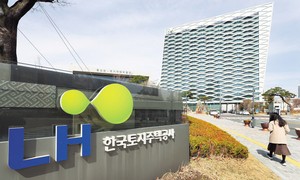
Showcase aims to boost AI utilization Korea Land and Housing Corporation will run an exhibition hall at the 2026 World Smart City Expo, held Wednesday through Friday at Bexco in Busan, the corporation said Wednesday. Now marking its 10th anniversary, the World Smart City Expo is hosted by the Ministry of Land, Infrastructure and Transport, the Ministry of Science and ICT, and the Busan city government. It is Asia's largest event dedicated to promoting smart city policy and supporting the global expansion of Korean companies. At this year's expo, LH will present "WONDER LH: AI ON THE LAND," an exhibition that presents the concept of an AI-powered city through a theme park format. The exhibition hall is divided into five sections designed to let visitors experience and easily understand the future of AI cities and the role AI technology will play in them. Its centerpiece, "CITY BRAIN," illustrates the mechanics of an AI city by combining footage projected on a large media tower with performances by a humanoid robot. During the expo, LH also plans to run a range of programs centered on AI- and data-driven urban planning and global smart city cooperation. LH has already been expanding its use of AI, including through an AI-based smart monitoring system that strengthens safety management of retaining walls at its rental housing complexes.
Sept. 9, 2026
-
HUG adopts AI screening for jeonse housing purchase reviews, cutting processing time 93%
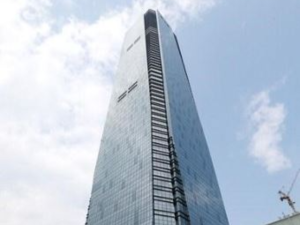
Review time drops from 2 minutes 30 seconds to 10 seconds The Korea Housing and Urban Guarantee Corporation said Wednesday that it has adopted an artificial intelligence-based support system to screen properties acquired through court auctions and public sales. The system is used for its Deundeun Jeonse Housing program. Deundeun Jeonse Housing is a public rental housing program in which the corporation directly purchases or leases newly built multiplex homes and officetels. It supplies them safely to households that do not own homes, at prices below market rate. The program has proven popular among youth because it allows long-term residence without the risk of jeonse fraud. Using an AI-based automated analysis program, HUG now extracts information needed for preliminary screening — such as housing type and rights-related details — directly from real estate registration certificates and generates the basic data for that screening automatically. Previously, staff had to review each registration certificate individually and manually enter the relevant information. A pilot run showed that the time needed to prepare basic screening data per registration certificate fell from about 2 minutes 30 seconds to 10 seconds, cutting overall processing time by 93 percent. HUG plans to expand the scope of automated analysis to appraisal reports and property sale specifications, among other documents. It is also pursuing the development of an AI-based platform to support screening for court auctions and public sales.
Sept. 9, 2026
-
Shindongah wins W250b Beomcheon Zone 1 redevelopment contract in Busan
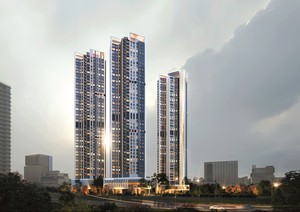
Cumulative urban redevelopment orders top W350b this year Shindongah Construction has won the contract for a street housing redevelopment project in Beomcheon Zone 1, Busan, worth about 250 billion won ($186 million). The win pushed the company's cumulative order value from urban redevelopment projects this year past 350 billion won. Shindongah Construction said Wednesday that it was selected as the contractor after receiving more than 90 percent approval from association members at a general meeting for the Beomcheon Zone 1 street housing redevelopment project held Sunday. The project covers an area near 737-7 Beomcheon-dong, Busanjin-gu, Busan, and will build three residential buildings with five basement floors and up to 42 stories above ground, comprising apartments, officetels and other amenity facilities. The complex will include 499 apartment units and 76 officetel units. Total construction cost is estimated at about 250 billion won. Shindongah Construction has continued to win small-scale urban redevelopment contracts this year. It recently secured the Yongsan headquarters development and the Dongjak-gu Capital Defense Command public housing project, followed by the Gangbyeon Hyundai apartment redevelopment project in Pungnap-dong. In June, the company won a 50.3 billion won contract for a street housing redevelopment project in Bisan-dong, Anyang, Gyeonggi Province. In August, it secured construction rights for a similar project in Pungnap-dong, Songpa-gu, Seoul, worth about 54 billion won. The company plans to expand the use of its Pamillie brand, focusing on residential projects along the Han River. Including the Beomcheon Zone 1 win, Shindongah Construction's cumulative order value from redevelopment projects this year has surpassed 350 billion won. The company plans to focus its capabilities not only on street housing redevelopment projects in Seoul and the Greater Seoul area but also on profitable urban redevelopment projects in regional cities. A Shindongah Construction official said, "We are concentrating our capabilities on street housing redevelopment projects in Seoul and the Greater Seoul area, as well as highly profitable urban redevelopment projects in regional cities. We plan to continue high-quality order-winning activity centered on areas with strong locations and low risk."
Sept. 9, 2026
-
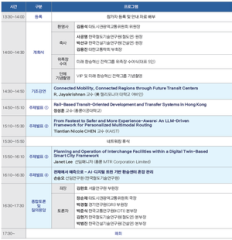
Transport authority to host forum on AI-powered transit hub innovation
Land Ministry's metropolitan transport commission to hold fourth transit hub innovation forum Thursday The Metropolitan Transportation Commission, under South Korea's Ministry of Land, Infrastructure and Transport, will hold the fourth Metropolitan Transit Hub Innovation Forum on Thursday. The event will take place at the Peace and Park Convention Park Hall in Yongsan-gu, Seoul, under the theme "Connected Mobility, Connected Regions." The forum aims to raise the quality of fast, convenient transit services and build broader social consensus on the issue. For the first time this year, organizers have invited a large group of overseas experts to share leading global transit hub cases and the latest technology trends. The forum's central topics are advanced transit hub development cases from the United States and Hong Kong. Another key focus is the direction for developing "intelligent future transit hubs" that combine AI and digital twin technology. Keynote speaker R. Jayakrishnan, a professor at the University of California, Irvine, will present a vision for how future transit hubs can drive innovation in metropolitan transportation. Following him, Jang Sung-hoon, a professor at Hong Kong Polytechnic University, will draw on Hong Kong's MTR system — which has achieved a 90 percent public transit mode share — to propose ways to apply its lessons to South Korea's transit policy. "As metropolitan transportation networks expand and new technologies such as AI advance, building a technology-intensive transit system centered on major transportation hubs and improving services for the public have become more important than ever," said Kim Yong-seok, chairperson of the Metropolitan Transportation Commission. "We will actively incorporate the overseas best practices and expert recommendations shared at this forum into future transit policy to build a transit system that is convenient for all citizens." Meanwhile, the commission finalized its "Fourth Basic Plan for the Construction of Transit Hubs and Multimodal Transit Hubs (2026-2030)" last month to improve public transit convenience. The plan calls for doubling the number of transit hubs over the next five years. It includes nine new hubs in the Greater Seoul area, including at Yangjae and Changdong stations, and 15 in other regions.
Sept. 9, 2026
-

Half of Seoul's mid-priced apartment deals now paid in cash as Songdo, Dongtan buyers pile in
Registry review of July-September ownership transfers Half of homes priced above 1.5 billion won and up to 2.5 billion won show no mortgage lien 3 in 10 buyers live outside Seoul, reflecting demand for a single prized home A, who lives in Icheon, Gyeonggi Province, bought an apartment in Sincheon-dong, Songpa-gu, Seoul, for 2.29 billion won early last month. He completed the ownership transfer this month after paying the balance, and since the registry showed no separate mortgage lien, he is presumed to have paid the full amount in cash. B and C, residents of Dongtan-gu, Hwaseong, Gyeonggi Province, jointly purchased an apartment in Sadang-dong, Dongjak-gu, Seoul, for 1.82 billion won in July. The ownership transfer for the unit, completed late last month, likewise shows no mortgage lien registered. Half of Seoul's mid-priced apartment transactions -- priced above 1.5 billion won and up to 2.5 billion won -- over the past two months were completed without a mortgage, a review found. As the Oct. 15, 2025 measures lowered loan limits, demand from buyers seeking to move up to higher-tier housing with mortgage financing has shrunk, while buyers with strong cash reserves have increasingly come to dominate the mid-priced market. Amid a continuing preference for a single prized home, more than 3 in 10 buyers were found to live outside Seoul. A review of registry records for 38 mid-priced apartment transactions in Seoul completed between July 10 and Wednesday, excluding direct deals between individuals, found that 19 of them -- half the total -- were closed without any mortgage lien registered. That suggests the buyers paid the full purchase price in cash, without a loan from a financial institution. The trend is attributed to the Oct. 15, 2025 measures, which cut the mortgage limit for homes priced between 1.5 billion and 2.5 billion won from 600 million won to 400 million won. Tighter government controls on aggregate lending, aimed at managing household debt, have also raised the bar for securing loans from financial institutions, contributing to the roughly 50 percent cash-purchase rate. Not only the high-end market above 2.5 billion won, where the loan limit was slashed to 200 million won, but also the mid-priced segment is now being driven mainly by buyers with cash liquidity. Nam Hyuk-woo, a researcher at Woori Bank Real Estate Research Institute, said, "Not only has the loan limit been reduced, but stricter control over aggregate lending has also led to cases in which buyers simply could not secure a loan." He added, "As raising funds through financial institutions has become more difficult, transactions are increasingly led by buyers who have relatively ample cash on hand, making it inevitable that the share of cash purchases will keep rising." Some also attribute the trend to cash raised by selling stocks and other financial assets amid the Kospi's rally, which has flowed into Seoul's mid-priced housing market. Such investors are channeling gains from the stock market into relatively safer mid-priced apartments in Seoul. Nam said, "The Kospi briefly hit a peak and is now in a correction phase, alternating between recovery and decline." "There are likely cases of investors, frustrated with stocks stuck in a trading range, selling their holdings and buying apartments in Seoul instead," he said. At the same time, some buyers who took out the maximum 400 million won mortgage have also resorted to a debt-maximizing buying spree, tapping private loans backed by personal bonds or promissory notes. One buyer of an apartment in Dongjak-gu, Seoul, for instance, took out a 400 million won loan from a primary bank and supplemented it with a private loan carrying a maximum bond amount of 640 million won. As the preference for a single prized home in Seoul intensifies overall, buyers from outside Seoul continue to purchase mid-priced apartments in the capital. Among the July-September transactions with completed ownership transfers, 12 -- about 32 percent -- involved buyers whose registered address was outside Seoul. Cash purchases of prime Seoul properties by residents of key metropolitan-area locations stood out -- from Dongtan, where apartment prices have surged this year, to Icheon, home to SK hynix's headquarters, as well as Bucheon, Guri and Suwon, all in Gyeonggi Province, and Songdo-dong in Yeonsu-gu, Incheon. Cash-rich buyers from regional cities such as Pohang, North Gyeongsang Province, and Busan also joined in purchasing Seoul apartments. Nam said, "The segment priced above 1.5 billion won and up to 2.5 billion won has the most diverse mix of demand." "It appears to be a combination of non-Seoul residents looking to trade up as well as prospective buyers who currently don't own a home seeking to purchase a single prized home," he said. He added, "Because regional apartment markets, outside a few major areas, remain mired in a prolonged slump, a safe-asset mentality that 'Seoul is safer' also appears to be at work."
Sept. 9, 2026
-
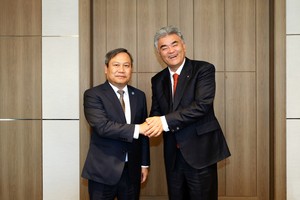
Daewoo E&C chief meets Hanoi mayor, vows to expand Vietnam investment in new towns, infrastructure, energy
Push to complete Starlake New Town underway Hanoi, Daewoo also discuss further investment cooperation Chung Won-ju, chairman of Daewoo Engineering & Construction, met with Vu Dai Thang, chairman of the Hanoi People's Committee, during Vu's recent visit to Korea. The two discussed the state of Daewoo's projects in Vietnam and future cooperation. According to Daewoo Engineering & Construction on Wednesday, Vu traveled to Korea for a four-day trip starting Sunday, together with Tran Thanh Man, chairman of Vietnam's National Assembly. On Tuesday, Vu held talks with Korean companies, including Daewoo Engineering & Construction, at The Grand Lotte Seoul in Sogong-dong, Seoul, to discuss ways to boost infrastructure investment in Hanoi. Earlier, in June, Hanoi unveiled a "100-Year Vision Master Plan," declaring plans to overhaul the city's spatial structure around the Red River. The plan aims to transform Hanoi into a multilayered, multipolar city with global competitiveness. "Over the past 30-odd years, Daewoo Engineering & Construction has carried out a range of projects in Vietnam and grown alongside the local economy," Chung said. "In particular, we have served as a platform connecting investment from local and Korean companies through the Starlake New Town project, and going forward, we will continue to expand our investment in new towns, infrastructure, energy and other areas by drawing on the experience and achievements we have accumulated in Vietnam." "For the successful completion of Starlake New Town and Hanoi's balanced urban development, it is important that administrative procedures such as the relocation of government agencies, land compensation and permitting proceed swiftly and smoothly," Chung added. "We ask for Hanoi's active support, and Daewoo Engineering & Construction will also do its utmost to bring the Starlake project to completion through continued investment, including additional office development tied to the relocation of government agencies." Daewoo Engineering & Construction is pursuing Starlake New Town, a massive Korean-style new town development, with the goal of creating "the Gangnam of Hanoi" in the Vietnamese capital. The company holds a 100 percent stake in the mixed-use development project and is continuing to restructure the business. In response, Vu said, "We highly value Daewoo Engineering & Construction's contribution to Hanoi's development. Daewoo's technological capabilities will be essential for Hanoi's future, and we ask for a great deal of support in this regard." He added, "We will actively support land compensation for the Starlake City project site and the relocation of government agencies, and let us work together to ensure the remaining phases of the new town are completed as soon as possible." A Daewoo Engineering & Construction official said the company is considering new business models, such as a K-smart city concept that combines Korean technology with culture and content. The concept is in line with Hanoi's 100-year vision and urban development strategy. "We hope to go beyond simple urban development to realize a future-oriented city that incorporates culture and content, thereby strengthening Hanoi's global competitiveness and contributing to expanded exchange between Korea and Vietnam," the official said.
Sept. 9, 2026
-
!['Better to give it to my child than pay more tax': Seoul housing gifts to those in their 20s hit 110-month high [Real Estate 360]](https://wimg.heraldcorp.com/news/cms/2026/09/09/rcv.YNA.20260831.PYH2026083109570001300_T1.jpg?type=h&h=240)
'Better to give it to my child than pay more tax': Seoul housing gifts to those in their 20s hit 110-month high [Real Estate 360]
41 gift filings by people in their 20s in August 7 of every 10 filings concentrated in Seongdong-gu Year-to-date total up 3.8-fold from last year "Tax overhaul stokes asset-transfer demand" The number of people in their 20s who received gifts of condominiums and other collective-titled properties in Seoul hit a roughly nine-year high last month, following the government's announcement of a real estate tax overhaul. Analysts say heavier holding and capital gains taxes on multiple-home owners are accelerating parents' decisions to hand properties down to their children. Tougher loan regulations have also made it harder for young people to buy homes on their own, adding to the trend. 41 gift filings for Seoul homes by people in their 20s in August, 68 percent in Seongdong-gu According to the court's Registry Information Plaza on Wednesday, 41 gift-registration filings for collective-titled properties by Seoul residents ages 19 to 29 were submitted last month. That is the highest monthly tally in 110 months, since June 2017, when 53 such filings were recorded. By district, Seongdong-gu accounted for the largest share by far, with 28 filings, or 68.3 percent of the total. The average apartment market price there stands at 1.94 billion won ($1.45 million), according to KB Real Estate data. In other words, roughly seven out of every 10 gift filings by people in their 20s took place in Seongdong-gu. Guro-gu followed with four filings, Dobong-gu with three, Gwanak-gu with two, and Gangseo-gu, Geumcheon-gu and Yeongdeungpo-gu with one each. Gifts targeting people in their 20s, who typically have limited home-buying power, have surged sharply this year. From January to August, 93 gift filings for collective-titled properties by people in their 20s were submitted in Seoul. That is about 3.88 times the 24 filings recorded over the same period last year. Analysts say the government's revamped tax policy has played a role in the sharp rise in gifts to young people. Last month's surge in filings coincided with the announcement of the tax overhaul. Analysts say this points to asset-transfer demand driven by the coming change in tax burdens. On Aug. 3, the government unveiled its 2026 tax overhaul plan, which strengthens taxation on multiple-home owners and non-resident housing. The plan centers on raising the comprehensive real estate tax on "homes that are not lived in" and following through on the planned heavier capital gains tax on multiple-home owners. In particular, the plan introduces a cap on the long-term holding special deduction, halting a structure in which the deduction amount grows in proportion to capital gains. After a one-year grace period, the cap will be set at 2 billion won in 2028 and lowered to 1 billion won starting in 2029. Analysts say the government's announcement that it would overhaul the deduction system — shifting the basis from simple ownership to residency — has accelerated this trend. Many parents are now deciding it is better to hand properties down to their children instead. Under the government's plan, the ownership-based deduction will be eliminated starting in 2029, leaving only a residency-based deduction of 8 percent per year, for a maximum deduction of 80 percent. Gifting erases capital gains tax; loan curbs push parents to build children's housing ladder As a result, multiple-home owners who hold "homes they do not live in" are increasingly weighing whether to sell or gift them. Transferring a home to a child in advance allows parents to reduce the number of homes they own, lowering their future comprehensive real estate tax and capital gains tax burden. Looking at the family as a whole, this can also help maintain the overall "total" number of properties held. "If parents give a house to their child, it can effectively bring the capital gains tax down to zero," said Nam Hyuk-woo, a researcher at Woori Bank's real estate research institute. "However, whether a low-price sale or an outright gift results in a bigger tax reduction varies case by case." Some analysts caution that the recent rise in gifts to people in their 20s cannot be explained solely by an attempt to avoid taxes on high-priced homes. As Seoul home prices have risen sharply and loan regulations have tightened further, parents are increasingly gifting homes in outlying areas to help their children secure funds. "In reality, more parents are choosing to pass down homes in outlying areas such as Guro-gu, Dobong-gu and Gwanak-gu that are not selling," Nam said. "With loans so restricted, this also appears to be an attempt to give children a stepping stone toward securing a home." This has raised concerns that the gap in housing conditions could widen between young people who inherit assets from their parents and those who do not. As a result, young people's housing circumstances increasingly hinge on the size of their parents' assets. "As tighter loan regulations and high interest rates make parents' financial power a key variable in determining whether young people can enter the housing market, gifts to people in their 20s ahead of time are becoming concentrated," said Jung Jae-hoon, an assistant professor of urban planning and real estate at Dankook University. "While young people who receive support in transferring assets can secure housing stability early, the majority of young people who must raise funds on their own face high barriers to entry — a structural inequality at the starting line."
Sept. 9, 2026
-
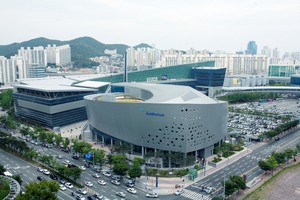
Land Ministry unveils 5-point roadmap for 'K-AI City' project
AI services and infrastructure, domestic and overseas expansion, legal framework and more The government has unveiled a detailed roadmap for building a "K-AI City," a project it is pursuing as a key state initiative. The plan aims to integrate AI and robot technology across urban spaces to create a people-centered city of the future that residents can experience in everyday life. It also aims to cultivate the city into South Korea's flagship export model. The Ministry of Land, Infrastructure and Transport announced the "K-AI City Implementation Strategy" on Wednesday at the 2026 World Smart City Expo at Bexco in Busan. The strategy pursues five key tasks under three basic directions. These directions are building a people-centered city of the future, creating an environment for the free testing of technology and robots, and realizing an export-oriented city model. The ministry will first introduce AI into highly visible public sectors such as urban administration and planning, and identify "AI City+X" services through private-sector open calls. It will also draw up a technology roadmap dividing urban development into five stages, from foundation-building (Level 1) to a fully autonomous city (Level 5), to systematically manage progress. It will secure national standard technologies through data standardization and research and development on urban operating technology. Urban infrastructure will also be upgraded into a three-layer system. It includes an urban intelligence center serving as the brain, a data pipeline functioning as the nervous system, and physical AI and intelligent facilities acting as the body. Existing facilities will be made smarter, centered on the country's five growth hubs and three special zones. The ministry will also introduce "smart-plus buildings," in which the building itself functions as an AI platform, along with guidelines for autonomous-driving- and robot-friendly facilities. These measures will expand the approach citywide. Pilot city projects that apply AI technology to actual urban spaces will also move forward in earnest. Wonju and the Cheonan-Asan area will be developed as "testbed-type" cities, where private companies build services using public infrastructure. Saemangeum and Gwangju will become "model-type" cities that incorporate AI and robot technology from the urban design stage. To build an industrial ecosystem, the ministry will restructure projects so that local governments, companies and universities collaborate. It will also open an "AI and Smart City Solution Market" for trading solutions. In addition, it will draw up tailored export strategies combining leading services and reorganize the K-City Network project around AI to support overseas expansion. To lay an institutional foundation, the ministry will rename the existing Smart City Act as the AI and Smart City Act. It will also introduce regulatory exemptions along with a planning-type regulatory sandbox. The ministry plans to complete the legislative overhaul by 2027, finish building pilot cities by 2030, and then spread successful outcomes both domestically and abroad. Kim Yun-deok, minister of land, infrastructure and transport, said, "Whether the K-AI City succeeds depends less on how advanced the technology looks and more on whether it actually works in the city to make people's lives more convenient and safer." He added, "We will build an AI city centered on people, not one where technology is an end in itself." Meanwhile, the WSCE, the largest smart city event in the Asia-Pacific region, opened in Busan this year, marking its 10th anniversary. The WSCE is co-hosted by the Ministry of Land, Infrastructure and Transport, the Ministry of Science and ICT, and the Busan city government. It was launched to help domestic smart city technology expand overseas and to broaden global networks. The event runs for three days, from Wednesday through Friday, at Exhibition Hall 1 of Bexco. This year's event adopted the slogan "Beyond Smart City, Into AI City." Moving beyond simple urban digitization and intelligence, it aims to accelerate the spread of "K-AI City," a key state initiative under the Lee Jae Myung administration. It also aims to present a new vision for the cities of the future.
Sept. 9, 2026
-
Land Ministry to expand wireless vehicle switching system to prevent accidents
Remote control without a locomotive engineer The Ministry of Land, Infrastructure and Transport announced Wednesday that it will step up efforts to prevent recurring accidents during train switching operations. The efforts include expanding its wireless-controlled vehicle switching system, improving work procedures and strengthening on-site safety management. The wireless-controlled vehicle switching system allows workers to remotely control train cars using wireless devices during switching operations, without a locomotive engineer on board. The system is designed to eliminate accidents caused by miscommunication between engineers and workers, creating a safer work environment. According to the ministry, Korea Railroad Corporation has pursued regulatory improvements and equipment introduction since piloting the system at Daejeon Marshalling Yard Station in 2021. It is now expanding the rollout in phases according to conditions at each station. In response, the ministry plans to introduce 11 wireless-controlled vehicle sets at eight stations by October — Yeongju, Gwaedong, Jecheon Marshalling Yard, Susaek, Dodam, Daejeon Marshalling Yard, Donghae and Obong (two locations). The vehicles will operate sequentially, following worker training and pilot runs. Three stations — Yeongju, Gwaedong and Jecheon Marshalling Yard — are already in full operation following pilot runs. The latest inspection will focus on checking the status of system operations and work management at these sites. The ministry also focused discussions on safety measures to prevent accidents during vehicle switching operations. It plans to further expand the wireless-controlled vehicle switching system at major work sites, including Uiwang Station. It will also use advanced technology such as AI video analysis to minimize workers' exposure to danger. It is also reviewing ways to ensure workers can, in principle, safely carry out operations from outside the locomotive. The wireless-controlled vehicle switching technology currently in use was developed for medium-sized locomotives. The ministry plans to expand its application by developing technology for large locomotives or by deploying dedicated medium-sized locomotives. In addition, the ministry will deploy railway safety inspectors to carry out special inspections of major vehicle switching work sites. The Korea Transportation Safety Authority will conduct parallel checks of the railway safety management system. Any shortcomings identified on-site will be corrected immediately. The ministry plans to review work procedures and the overall safety management system based on the inspection results, pursuing any necessary regulatory improvements. Kim Tae-byung, director general of the Railroad Bureau, said, "Fatal accidents during vehicle switching operations that keep recurring must not happen again." He added, "We take the recent fatal accident during vehicle switching work at Uiwang Station very seriously. We will thoroughly investigate the cause of this accident and the entire work process, and reflect any deficiencies in the regime or procedures, as well as on-site risk factors identified during the investigation, in the railway safety enhancement measures to be established in the second half of this year."
Sept. 9, 2026
-

LH to supply 20,000 purchased rental homes in Seoul city center within 3 years
15,000 units for youth, 3,400 for newlywed couples The Korea Land and Housing Corporation announced it will supply 20,000 purchased rental housing units in central Seoul over the next three years. Units on the scale of the Bucheon Daejang district project will be distributed across the city, with 15,000 units set aside for young people and 3,400 for newlywed couples. LH held a field meeting on Tuesday at a newly built purchased youth housing unit in Jongno-gu, Seoul, to discuss solutions to housing problems facing young people. At the gathering, LH officials discussed ways to swiftly supply quality youth housing in the city center. The meeting was arranged to hear directly from young people about their housing concerns and to explore solutions together, with the aim of maximizing the effectiveness of youth housing supply in the city center. Attendees included Kim Yi-tak, first vice minister of the Ministry of Land, Infrastructure and Transport; Democratic Party of Korea lawmakers Kim Nam-geun, Oh Gi-hyeong and Lee Yong-sun; LH President Lee Seong-hoon; and roughly 20 people in total, including young city council members. Participants toured the newly built purchased youth housing units LH has secured in central Seoul, checking floor plans, finishes and built-in appliances, before moving on to the field meeting and discussion. Purchased rental housing is a rental system offering several advantages. Units are located in city centers, near transit stations and close to workplaces. Rent for first-priority applicants is set at 40 percent of market price. Residents can stay for up to 10 years, or up to 20 years for married couples, with rent increases capped at 5 percent. Units come with built-in appliances and a simple application process. LH has been putting significant effort into expanding its supply of purchased rental housing. This includes running a public call for a "nonresidential-use conversion remodeling" purchase-agreement project that repurposes vacant commercial spaces and offices in city centers. Purchased rental units in Seoul are particularly popular among young people because of their excellent access to public transportation and affordable rental terms. The average subscription competition rate for youth purchased rental housing in Seoul reached 130 to 1 last year. In response to this demand from young people, LH is focused on significantly improving its newly built purchase project and speeding up supply so it can quickly secure quality housing in city centers. At the meeting, LH presented the progress of various system improvements, including providing initial support for land-purchase funds and disbursing purchase payments in installments. The corporation said it is also working to secure valuable sites by giving extra points to locations with high demand from young people, such as areas near university campuses.
Sept. 8, 2026
-
Korea Real Estate Board partners with IAAO to modernize property tax assessment system
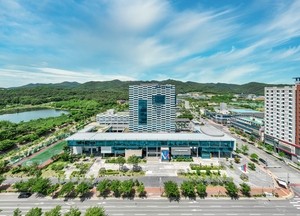
MOU aims to improve real estate tax assessment regime and appraisal techniques The Korea Real Estate Board is launching an international joint research project to incorporate global property tax assessment standards into the country's real estate valuation system. The project also aims to expand the global reach of Korea's valuation system. The board said Tuesday that it signed a memorandum of understanding with the International Association of Assessing Officers on Aug. 31 to improve real estate tax assessment regimes and appraisal techniques. The two organizations will conduct joint research on tax assessment systems and advanced appraisal methods going forward. They plan to benchmark cutting-edge property technology, including the latest appraisal models, artificial intelligence and geographic information systems, while also working to introduce Korea's real estate valuation system abroad. To carry out the agreement, the board will dispatch one of its valuation experts to IAAO headquarters in Kansas City, Missouri. Alternatively, the expert could be sent to a US local government that partners with the association. The IAAO is a nonprofit education and research organization with about 8,000 tax assessment professionals active across more than 80 countries. It sets international standards for property valuation, taxation and assessment administration. The board has been a member since 2010 and has served since 2025 on the association's research and standards committee, which oversees the establishment of assessment and administrative standards. Through the partnership, the board plans to adapt advanced international standards to domestic conditions while using its global network to boost international confidence in Korea's property valuation system. "This agreement will serve as an opportunity for Korea's property valuation system to advance to the next level in line with international standards," said Lee Heon-wook, president of the Korea Real Estate Board. "We hope this will help introduce the strengths of Korea's valuation system, which is already being exported to developing countries such as Vietnam and Laos, to advanced markets in North America and Europe as well." Meanwhile, the Korea Real Estate Board is accepting reports of false real estate transaction price reporting during a roughly six-week crackdown period running from Aug. 13 to Sept. 18. Targets of the crackdown include so-called "down-contracts," in which parties draw up agreements listing a lower price than the actual transaction to evade taxes. Also targeted are "up-contracts," in which parties inflate the contract price to manipulate market prices or secure higher loan limits. Both practices violate the Act on Report of Real Estate Transactions. Helping or abetting false price reporting is also subject to the crackdown.
Sept. 8, 2026
-
Vice minister: 'Incentives for fast-tracked redevelopment projects'
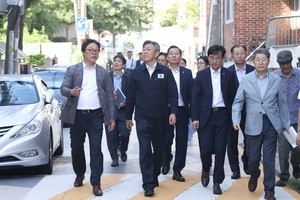
Remarks made during visit to Geoyeo Saemaul redevelopment site in Songpa-gu "We will provide benefits such as real estate acquisition tax reductions and higher purchase prices for rental housing at sites that push ahead with fast-tracked redevelopment." First Vice Minister of Land, Infrastructure and Transport Kim Yi-tak made the remarks Tuesday during a visit to the Geoyeo Saemaul public redevelopment site in Songpa-gu, Seoul. He called for swift project execution. The visit sought to encourage the early launch of redevelopment and reconstruction projects in line with the government's "just supply housing" policy drive. The government's Aug. 13 rapid housing supply plan aims to fast-track about 234,000 units' worth of reconstruction, redevelopment and other urban renewal projects by 2030, offering tax and other incentives. The plan includes exempting or cutting by 75 percent the real estate acquisition tax on properties purchased from cash-settlement recipients through 2028. It also raises the purchase price for public-contribution rental housing to 100 percent of the standard construction cost, a 20-percentage-point increase from the current level. This higher price applies to projects that receive management and disposal plan approval after the announcement and break ground by 2028. The site Kim visited struggled for years to advance a resident-led redevelopment project before being selected as a public redevelopment candidate site in March 2021. It received approval for its project implementation plan in February, five years later. About 1,700 apartment units are planned for the site. During the visit, Kim received a briefing on the project's progress and inspected residential conditions along with local government officials, resident representatives, and officials from the Korea Land and Housing Corporation and the Korea Housing and Urban Guarantee Corporation. He also received a report on plans to speed up the project. "For sites that move quickly like Geoyeo Saemaul, we will actively support early ground-breaking by offering benefits such as real estate acquisition tax reductions and higher purchase prices for rental housing," Kim said, asking the Korea Land and Housing Corporation and the Korea Housing and Urban Guarantee Corporation to "communicate sufficiently with residents throughout the project and carefully manage the process to minimize any inconvenience that could arise during relocation." "So that the rapid pursuit of redevelopment projects does not lead to instability in the jeonse and monthly rent market, the Ministry of Land, Infrastructure and Transport will operate a relocation-demand management council together with local governments and the Korea Land and Housing Corporation to manage relocation demand across redevelopment projects and support an orderly relocation process," he added. "We will closely monitor the progress of redevelopment projects and come up with ways to significantly shorten project timelines, including permitting procedures, so that the public can feel the acceleration of redevelopment on the ground."
Sept. 8, 2026
-
Real estate board chief vows targeted support for small redevelopment projects
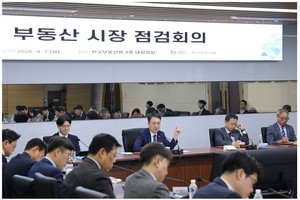
Housing Supply Support Bureau launched under July reorganization Lee Heon-wook, head of the Korea Real Estate Board, held a real estate market inspection meeting at the board's headquarters on Monday and said, "As the government has prepared regimes and policy measures to expand housing supply, what matters now is making sure that supply actually reaches the market on the ground." He stressed the need for swift support to carry out the government's supply measures. The Korea Real Estate Board plans to focus its capabilities on strengthening the on-the-ground execution of redevelopment and reconstruction projects, moving beyond simple market monitoring. This aligns with the direction of the government's Aug. 13 measures, announced last month. The Aug. 13 measures included a plan to supply more than 230,000 additional housing units in the Greater Seoul area. The goal was to stabilize the jeonse and monthly rent market as well as the sales market. At the meeting, Lee reviewed changes in the sales and jeonse-monthly rent markets, as well as in supply volume, across Seoul and the greater metropolitan area since the government's announcement. He also instructed the board to discuss ways to diversify support for redevelopment and reconstruction projects, in order to close gaps in redevelopment project support. This includes targeted, "pinpoint" support for small complexes with fewer than about 500 households. He further directed the board to concentrate its capabilities on reducing bottlenecks that arise as such projects move toward actual housing supply. For redevelopment projects that are delayed or facing difficulties, the Korea Real Estate Board will identify the progress made at each project stage and the causes of delay. It will then provide support by linking its existing expert functions, such as construction cost verification and dispute mediation. In particular, the board will strengthen its ability to identify and mediate construction cost disputes and conflicts among stakeholders such as associations and contractors. These disputes are a leading cause of delays in redevelopment projects. It also plans to expand its role in quickly relaying institutional difficulties found on the ground to the government to help drive policy improvements. The move carries added significance as it formalizes on-the-ground support for the government's supply policy. This follows the Korea Real Estate Board's establishment of its Housing Supply Support Bureau in a July reorganization. The Korea Real Estate Board plans to expand its role beyond its existing functions of real estate price and transaction investigation and market management. It aims to become a "real estate policy infrastructure institution" that uses data and on-the-ground information to help the government's housing policy function effectively in the actual market. Accordingly, the board plans to build a policy support system running from market data analysis to checking supply progress at each project site. The system will also identify the causes of delays, mediate conflicts and disputes, and support government policy improvements. Lee also said at the meeting, "As the government is swiftly pushing forward various policies to stabilize the real estate market, our institution must also closely monitor how those policies are being implemented on the ground and how the market is responding, so that they can function effectively." He added, "In particular, we must carefully check whether there are project sites experiencing delays or difficulties in redevelopment, and quickly relay any need for institutional improvement to the government."
Sept. 8, 2026
MOST READ
- 1Hyundai Motor unveils all-new Tucson with bigger body, smarter tech after 6-year wait
- 2Flat sneakers are back: Why Nike is reviving a 55-year-old running shoe
- 3Pope Leo XIV declines French honors and banquet, accepts only private meeting with Macron
- 428 illegal sports streaming sites found operating freely despite repeated blocks
- 5What was Rachmaninoff's performance fee? A 1928 price list tells all
- 6Samsung Biologics union's show of force backfires at the bargaining table
-
WORLD

US warns of punishment for anyone enabling Iran's Strait of Hormuz toll scheme
-
INDUSTRY
Toyota union puts productivity first; Hyundai Motor union demands bigger share of profits
-
FINANCE
National Growth Fund to invest $531M in FuriosaAI, which rebuffed Meta's $800M takeover bid
-
INDUSTRY
Korea Shipowners' Association holds amateur baduk tournament for Maritime Day