Housing Supply Support Bureau launched under July reorganization
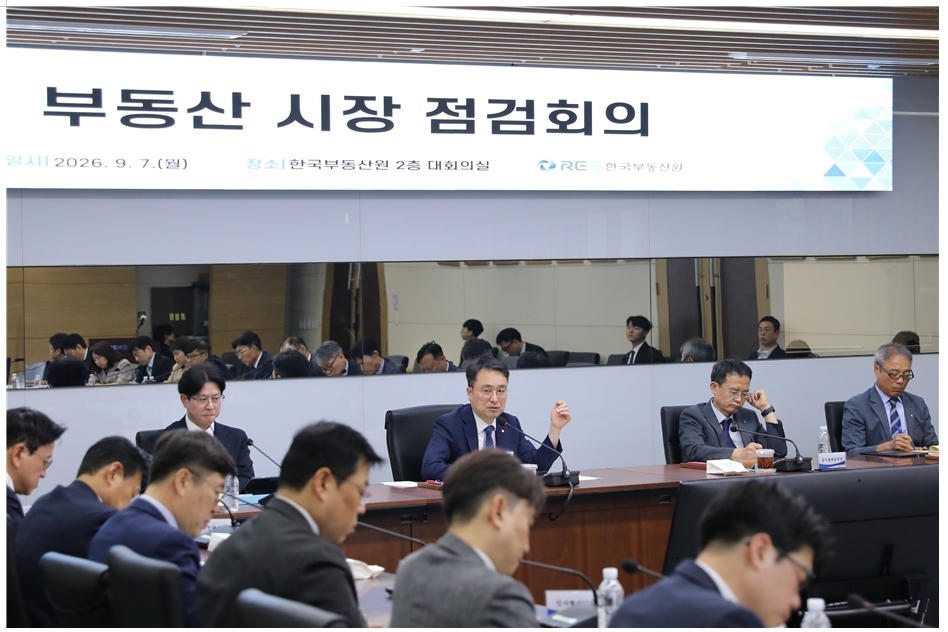
Lee Heon-wook, head of the Korea Real Estate Board, held a real estate market inspection meeting at the board's headquarters on Monday and said, "As the government has prepared regimes and policy measures to expand housing supply, what matters now is making sure that supply actually reaches the market on the ground." He stressed the need for swift support to carry out the government's supply measures.
The Korea Real Estate Board plans to focus its capabilities on strengthening the on-the-ground execution of redevelopment and reconstruction projects, moving beyond simple market monitoring. This aligns with the direction of the government's Aug. 13 measures, announced last month. The Aug. 13 measures included a plan to supply more than 230,000 additional housing units in the Greater Seoul area. The goal was to stabilize the jeonse and monthly rent market as well as the sales market.
At the meeting, Lee reviewed changes in the sales and jeonse-monthly rent markets, as well as in supply volume, across Seoul and the greater metropolitan area since the government's announcement. He also instructed the board to discuss ways to diversify support for redevelopment and reconstruction projects, in order to close gaps in redevelopment project support. This includes targeted, "pinpoint" support for small complexes with fewer than about 500 households. He further directed the board to concentrate its capabilities on reducing bottlenecks that arise as such projects move toward actual housing supply.
For redevelopment projects that are delayed or facing difficulties, the Korea Real Estate Board will identify the progress made at each project stage and the causes of delay. It will then provide support by linking its existing expert functions, such as construction cost verification and dispute mediation.
In particular, the board will strengthen its ability to identify and mediate construction cost disputes and conflicts among stakeholders such as associations and contractors. These disputes are a leading cause of delays in redevelopment projects. It also plans to expand its role in quickly relaying institutional difficulties found on the ground to the government to help drive policy improvements.
The move carries added significance as it formalizes on-the-ground support for the government's supply policy. This follows the Korea Real Estate Board's establishment of its Housing Supply Support Bureau in a July reorganization.
The Korea Real Estate Board plans to expand its role beyond its existing functions of real estate price and transaction investigation and market management. It aims to become a "real estate policy infrastructure institution" that uses data and on-the-ground information to help the government's housing policy function effectively in the actual market.
Accordingly, the board plans to build a policy support system running from market data analysis to checking supply progress at each project site. The system will also identify the causes of delays, mediate conflicts and disputes, and support government policy improvements.
Lee also said at the meeting, "As the government is swiftly pushing forward various policies to stabilize the real estate market, our institution must also closely monitor how those policies are being implemented on the ground and how the market is responding, so that they can function effectively." He added, "In particular, we must carefully check whether there are project sites experiencing delays or difficulties in redevelopment, and quickly relay any need for institutional improvement to the government."
hss@heraldcorp.com