
Registry review of July-September ownership transfers
Half of homes priced above 1.5 billion won and up to 2.5 billion won show no mortgage lien
3 in 10 buyers live outside Seoul, reflecting demand for a single prized home
A, who lives in Icheon, Gyeonggi Province, bought an apartment in Sincheon-dong, Songpa-gu, Seoul, for 2.29 billion won early last month. He completed the ownership transfer this month after paying the balance, and since the registry showed no separate mortgage lien, he is presumed to have paid the full amount in cash.
B and C, residents of Dongtan-gu, Hwaseong, Gyeonggi Province, jointly purchased an apartment in Sadang-dong, Dongjak-gu, Seoul, for 1.82 billion won in July. The ownership transfer for the unit, completed late last month, likewise shows no mortgage lien registered.
Half of Seoul's mid-priced apartment transactions -- priced above 1.5 billion won and up to 2.5 billion won -- over the past two months were completed without a mortgage, a review found. As the Oct. 15, 2025 measures lowered loan limits, demand from buyers seeking to move up to higher-tier housing with mortgage financing has shrunk, while buyers with strong cash reserves have increasingly come to dominate the mid-priced market. Amid a continuing preference for a single prized home, more than 3 in 10 buyers were found to live outside Seoul.
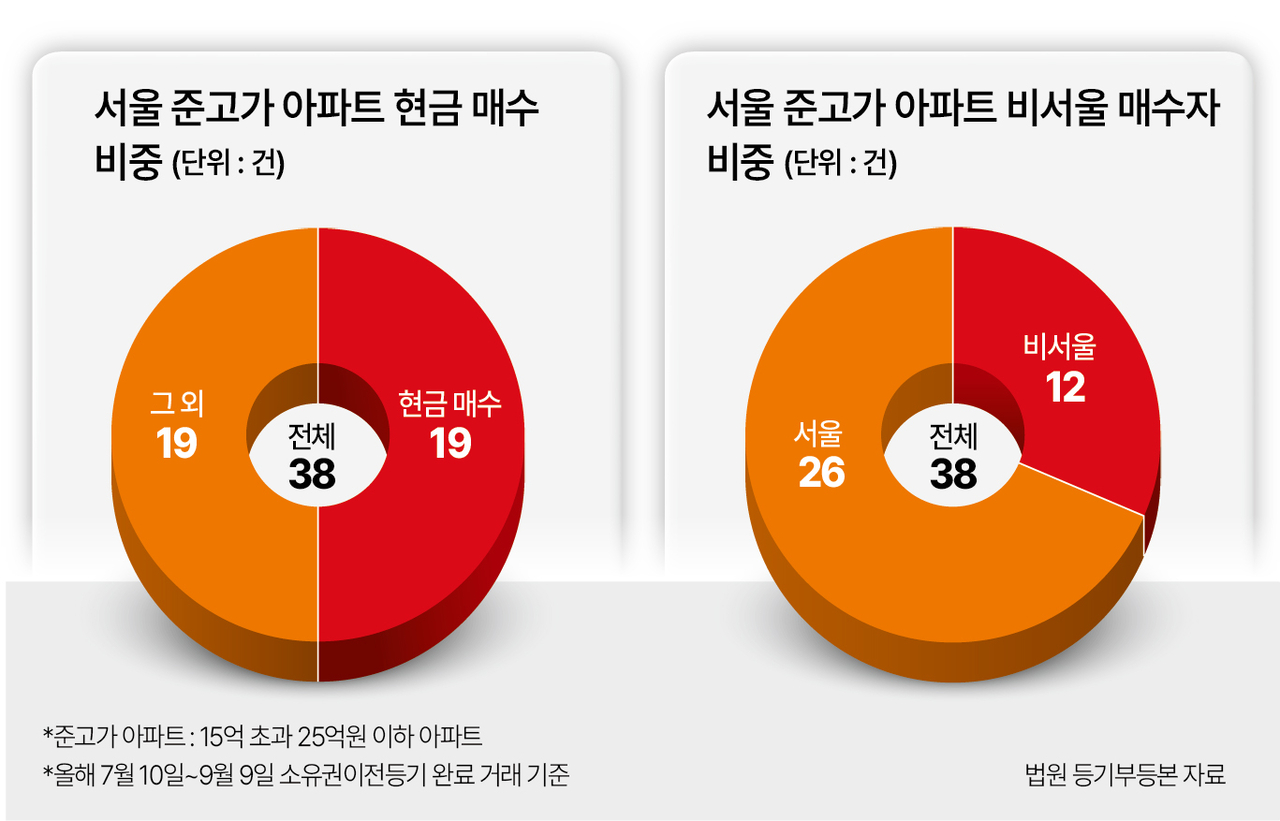
A review of registry records for 38 mid-priced apartment transactions in Seoul completed between July 10 and Wednesday, excluding direct deals between individuals, found that 19 of them -- half the total -- were closed without any mortgage lien registered. That suggests the buyers paid the full purchase price in cash, without a loan from a financial institution.
The trend is attributed to the Oct. 15, 2025 measures, which cut the mortgage limit for homes priced between 1.5 billion and 2.5 billion won from 600 million won to 400 million won. Tighter government controls on aggregate lending, aimed at managing household debt, have also raised the bar for securing loans from financial institutions, contributing to the roughly 50 percent cash-purchase rate. Not only the high-end market above 2.5 billion won, where the loan limit was slashed to 200 million won, but also the mid-priced segment is now being driven mainly by buyers with cash liquidity.
Nam Hyuk-woo, a researcher at Woori Bank Real Estate Research Institute, said, "Not only has the loan limit been reduced, but stricter control over aggregate lending has also led to cases in which buyers simply could not secure a loan." He added, "As raising funds through financial institutions has become more difficult, transactions are increasingly led by buyers who have relatively ample cash on hand, making it inevitable that the share of cash purchases will keep rising."
Some also attribute the trend to cash raised by selling stocks and other financial assets amid the Kospi's rally, which has flowed into Seoul's mid-priced housing market. Such investors are channeling gains from the stock market into relatively safer mid-priced apartments in Seoul.
Nam said, "The Kospi briefly hit a peak and is now in a correction phase, alternating between recovery and decline." "There are likely cases of investors, frustrated with stocks stuck in a trading range, selling their holdings and buying apartments in Seoul instead," he said.
At the same time, some buyers who took out the maximum 400 million won mortgage have also resorted to a debt-maximizing buying spree, tapping private loans backed by personal bonds or promissory notes. One buyer of an apartment in Dongjak-gu, Seoul, for instance, took out a 400 million won loan from a primary bank and supplemented it with a private loan carrying a maximum bond amount of 640 million won.
As the preference for a single prized home in Seoul intensifies overall, buyers from outside Seoul continue to purchase mid-priced apartments in the capital. Among the July-September transactions with completed ownership transfers, 12 -- about 32 percent -- involved buyers whose registered address was outside Seoul.
Cash purchases of prime Seoul properties by residents of key metropolitan-area locations stood out -- from Dongtan, where apartment prices have surged this year, to Icheon, home to SK hynix's headquarters, as well as Bucheon, Guri and Suwon, all in Gyeonggi Province, and Songdo-dong in Yeonsu-gu, Incheon. Cash-rich buyers from regional cities such as Pohang, North Gyeongsang Province, and Busan also joined in purchasing Seoul apartments.
Nam said, "The segment priced above 1.5 billion won and up to 2.5 billion won has the most diverse mix of demand." "It appears to be a combination of non-Seoul residents looking to trade up as well as prospective buyers who currently don't own a home seeking to purchase a single prized home," he said. He added, "Because regional apartment markets, outside a few major areas, remain mired in a prolonged slump, a safe-asset mentality that 'Seoul is safer' also appears to be at work."
hwshin@heraldcorp.com




