
- HOME
- REAL ESTATE
-
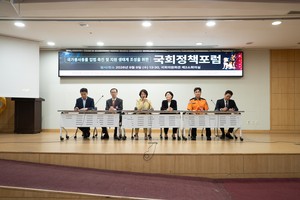
'They served the nation — don't abandon them at retirement,' advocates say
Calls are growing for legislation to guarantee post-retirement care for animals that have spent their lives serving the state. Machimp, a nonprofit organization, said Friday it held a National Assembly policy forum on Wednesday at the National Assembly Members' Hall to promote legislation and build a support ecosystem for service animals. The forum was co-hosted by 15 ruling and opposition lawmakers — including Cho Seung-hwan, Park Deok-heum, Lee Heon-seung, Han Jeong-ae, Jin Seon-mi, Seong Il-jong, Kang Seung-gyu, Kim Seon-gyo, Kim Ye-ji, Park Soo-young, Seo Yeong-seok, Lee Seong-gwon, Ko Min-jeong, Jeon Yong-gi and Kim Yong-tae — and organized by Machimp. The Ministry of Agriculture, Food and Rural Affairs, the Ministry of National Defense, the Ministry of Land, Infrastructure and Transport, the Korean National Police Agency, the Korea Customs Service, the National Fire Agency, the Korean Veterinary Medical Association and the Animal Welfare National Assembly Forum also sponsored the event. The forum took place amid progress on an amendment to the Animal Protection Act that would legally guarantee post-retirement treatment for national service animals. The bill has cleared the National Assembly's Agriculture, Food, Rural Affairs, Oceans and Fisheries Committee and awaits review by the Legislation and Judiciary Committee before a full plenary vote. The government is also preparing to establish an animal welfare policy bureau within the Ministry of Agriculture, Food and Rural Affairs, along with a budget for adoption support and a dedicated support center for retired service animals. Even if the amendment passes, support will not begin immediately. Under the bill's supplementary provisions, it takes effect one year after promulgation — meaning that even if it clears the Assembly this year, it would not come into force until late 2027. Until then, a gap remains in the system for supporting retired service animals after they leave duty. About 1,106 national service dogs are currently on active duty, and roughly 150 retire each year. As of 2024, only about 22 percent find new homes, while the remaining 78 percent are transferred to institutional shelters or die under unexplained circumstances. At Wednesday's forum, veterinary teaching hospitals affiliated with the National Council of University Animal Hospital Directors agreed to cover medical costs for adopted retired service animals. The Gyeonggi Province Veterinary Medical Association is also preparing to bring additional regional animal hospitals on board, expanding the medical support network beyond university hospitals to local clinics. Harim Pet Food, Interpet Korea and Raham pledged to provide feed and supplies. Lee Young, chair of Machimp, said that animals whose every record is meticulously managed while they carry out national duties are "pushed outside the boundaries of care the moment they retire." She vowed to "pool all efforts to the end so that legislation is completed within this year, through the Legislation and Judiciary Committee review and the plenary session." She added that the organization also plans to establish an integrated management center covering medical care, adoption, rehabilitation and aftercare for national service animals. Meanwhile, Machimp is a nonprofit that pursues a range of public-interest projects focused on social safety nets, including respect for life and support for youth aging out of the care system. Last year, it held a National Assembly policy forum to improve conditions for "service animals" — including military dogs, police dogs, detection dogs and search-and-rescue dogs — and to strengthen post-retirement support systems, among other activities.
Sept. 11, 2026
-

Lee vows Sejong presidential office era within his term as government doubles construction team
New 'National Symbol Zone Division' to be established within construction unit Unit chief post to become full-time role to sharpen execution Move-in target set for August 2029 Amid President Lee Jae-myung's pledge to "open the era of the Sejong presidential office within his term," the government is moving to significantly expand and reorganize the Presidential Sejong Office Construction Unit under the Multifunctional Administrative City Construction Agency, known as MACCA. The plan calls for establishing a dedicated National Symbol Zone Division within the unit and doubling its staff to accelerate work on the presidential office and the National Assembly's Sejong chamber as part of the broader National Symbol Zone development. According to government sources Friday, the Ministry of Land, Infrastructure and Transport and MACCA are preparing to amend the agency's organizational regulations to reflect the changes. The core of the reorganization is splitting the unit's current single division — the Presidential Office Division — into two: the existing Presidential Office Division and a newly created National Symbol Zone Division. The new division will absorb work currently handled by the overloaded Presidential Office Division and will focus exclusively on developing the master plan and infrastructure for the National Symbol Zone, including coordination with the National Assembly's Sejong chamber. The overhaul also includes bolstering frontline staff and elevating the unit's command structure. Four additional civil servants at Grade 5 to 7 will be recruited, bringing the unit's total headcount to roughly double its current size. In addition, the unit chief position — previously held concurrently by the director of the facilities and projects bureau — will be converted to a full-time dedicated post, and the grade of assigned division chiefs will be raised from Grade 4.5 to Grade 4 to strengthen project execution. The restructuring reflects the surge in administrative workload since construction of the presidential office and the National Assembly's Sejong chamber got underway in earnest last year, with completion targeted for 2029 and 2033, respectively. The aim is to expand frontline capacity ahead of the period when construction activity peaks. President Lee has repeatedly emphasized the relocation to Sejong and the completion of the administrative capital. At a policy briefing in December 2025, he said he hoped the Sejong office project would move quickly, and in April he ordered officials to "push construction forward swiftly so the Sejong office can be used within my term." Cheong Wa Dae at the time set August 2029 — within the president's term — as the move-in target. At a Cabinet meeting on Aug. 11, Lee urged officials to "give everything we have, with the determination to open the era of the Sejong presidential office within this administration's term and to hold our final Cabinet meeting there as well." MACCA established the Presidential Office Construction Unit earlier this year, but the rapid growth in operational demand has prompted another round of restructuring and staff expansion just months later. "The development of the National Symbol Zone, which had stalled for years, has picked up in earnest since last year, increasing the workload, and we are getting ahead of the construction activity to come," a Ministry of Land, Infrastructure and Transport official said. "Think of it as a small bureau being created within MACCA to handle the National Symbol Zone development." The official added that the agency aims to implement the changes by the end of this month, pending Cabinet approval. The reorganization will be backed by a sharp increase in funding. The government's proposed budget for Sejong city construction in 2027 totals 568.9 billion won ($425 million), a jump of 95.9 percent from this year's 290.4 billion won — nearly double. If the project proceeds on schedule, the presidential Sejong office is set to be completed in August 2029 and the National Assembly's Sejong chamber in 2033. The National Symbol Zone is a roughly 2.1 million-square-meter administrative and cultural landmark being developed in Sejong-dong (S-1 zone) in Sejong. The project envisions a layered urban space combining key national government facilities — including the presidential office and the National Assembly chamber — with a central park, a national museum complex and a waterfront area along the Geum River.
Sept. 11, 2026
-
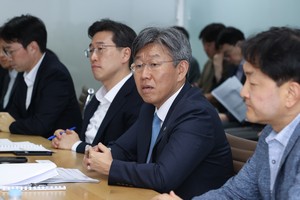
LH headquarters to stay in Jinju after split, vice minister confirms
Headquarters location reaffirmed at LH restructuring kickoff meeting Friday It has been reaffirmed that the Korea Land and Housing Corporation will keep its headquarters in the Jinju innovation city in South Gyeongsang Province after the planned corporate split. First Vice Minister of Land, Infrastructure and Transport Kim I-tak said Friday at the "LH Organizational Restructuring Kickoff Meeting," held with LH President Lee Seong-hun and others, that "since LH has already relocated to a regional area, we plan to keep the headquarters of each entity in Jinju even after the organization is divided." The government's "Public Institution Functional Reform Plan," announced Sept. 3, calls for splitting LH into two separate entities — a housing and urban development corporation and a housing and urban asset corporation. The development arm would handle land development and housing construction, while the asset arm would oversee residential welfare and asset reserves. At the meeting, the Ministry of Land, Infrastructure and Transport and LH discussed the preparations and key considerations needed to carry out the restructuring process, and agreed to maintain close consultation going forward. Kim said that "now that the direction of LH's organizational restructuring — which has been under discussion since August last year through the LH Reform Committee and other channels — has been decided, it is time for the ministry and LH to move forward as one team." He added that "starting with today's meeting, we must draw up a concrete restructuring roadmap, address each necessary preparation item one by one, and ensure that follow-up procedures are carried out." Addressing concerns raised mainly by the union over potential disadvantages in working conditions stemming from a unilateral organizational split, Kim said "the restructuring must be pursued on the basis of trust and communication among the government, the institution and its employees." He also urged LH to "actively listen to employees' difficulties and suggestions, as the government will do its part as well." Kim further said the government would "carefully ensure that employees do not suffer any disadvantages in pay or other working conditions as a result of the split," adding that the ministry would "actively consult with related ministries, including the Ministry of Economy and Finance." Kim also said that "core services directly affecting the public — such as housing supply and residential welfare — must continue without disruption throughout the restructuring process," and that "the ministry and LH must work closely together to carry out pressing tasks without setbacks while also advancing the restructuring in a stable manner."
Sept. 11, 2026
-
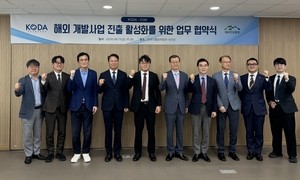
Korea Developer Association, Overseas Construction Association sign MOU to share global project expertise
MOU aims to boost overseas development project activity Convergence platform to identify promising projects 'Combining global networks with development know-how' The Korea Developer Association and the Overseas Construction Association have joined forces to expand overseas development project activity for domestic developers and construction companies. The two organizations signed a mutual cooperation MOU on Friday to promote overseas development projects. They plan to refine a combined investment-development model aligned with global market trends, secure new business opportunities and strengthen the competitiveness of domestic companies. Under the agreement, the two organizations will combine developers' project planning and development capabilities with the overseas project experience and global networks built up by the overseas construction industry. The aim is to go beyond simple construction work — covering everything from land sourcing and project planning to financing and operations management — to reduce the risks of entering overseas markets and raise the overall quality of projects. The MOU includes provisions for using a convergence platform to identify promising projects and share relevant information. It also covers the establishment of strategic collaboration models between developers and construction companies, the sharing of information on policies, systems, and financial and guarantee support related to overseas expansion, and the joint hosting of professional training sessions and seminars. "In advanced development markets, quality and crisis-response capacity are maximized when specialized players in each field work together organically," Korea Developer Association Chairman Kim Han-mo said. "Combining the technical capabilities and global networks of the overseas construction industry with developers' planning skills and development know-how will allow us to secure competitiveness in the global market." Overseas Construction Association Chairman Han Man-hee said global demand for urban and infrastructure development is growing. "We expect that cooperation with developers who have strong project planning and development capabilities will serve as an opportunity to enhance the competitiveness of domestic companies in overseas business," he said. The two organizations said they will work out specific follow-up cooperation measures through practical consultations going forward. Meanwhile, the Korea Developer Association represents domestic real estate developers and works to protect the interests of its members and foster the industry through policy recommendations and other support. The association has also been playing a key role in promoting urban development projects and expanding into global markets, including signing an MOU with the Korea Overseas Infrastructure and Urban Development Corporation in June.
Sept. 11, 2026
-
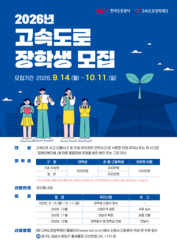
Korea Expressway Corporation opens applications for 2026 highway scholarship program
Open to children of highway accident victims Applications accepted from Monday through Oct. 11 Korea Expressway Corporation and the Highway Scholarship Foundation announced Friday they will accept applications for their 2026 highway scholarship program from Monday through Oct. 11, aiming to reduce the educational cost burden on families affected by highway accidents and ensure meaningful learning opportunities. This year, the program overhauled its selection criteria in line with the government's low birth rate policy. The previous limit of two children per household has been scrapped entirely, allowing all eligible children in multi-child families to receive support without a numerical cap. The change is intended to significantly ease the financial strain on large families hit by unexpected accidents. Eligible applicants include children of those who died in highway traffic accidents or in accidents during construction or maintenance work, as well as individuals who sustained severe disabilities in such accidents and their children. About 300 recipients will be selected this year. Scholarships range from 2 million won ($1,490) to a maximum of 5 million won, distributed on a sliding scale based on school level and household income, covering preschoolers through university students. Applicants should check the required documents on the Highway Scholarship Foundation's website and submit them by mail. Final recipients will be selected in November following a review, with scholarships to be disbursed in December. Since its founding in 1996, the Highway Scholarship Foundation has awarded approximately 15 billion won in scholarships to 8,236 recipients. "The highway scholarship program is a representative corporate social responsibility initiative that supports accident-affected families in direct connection with Korea Expressway Corporation's core business," said Korea Expressway Corporation President Yu Jeong-hun. "We will continue to provide tailored support so that scholarship recipients can grow into outstanding talent." Meanwhile, Korea Expressway Corporation is hosting its 15th Road Landscape Design Competition, with submissions accepted through Oct. 29.
Sept. 11, 2026
-
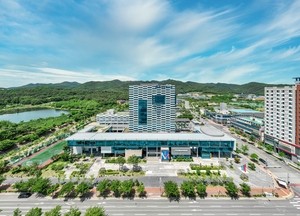
Korea Real Estate Board to hold real estate data academy
Training specialists for emerging industries The Korea Real Estate Board announced Friday it will hold the "2026 Second Real Estate Data Academy" at its Seoul Gangnam branch from Sept. 29 through Oct. 1. The Real Estate Data Academy was established as part of the Ministry of Land, Infrastructure and Transport's big data platform construction and operation project, aimed at opening up high-quality real estate data and supporting the growth of emerging real estate industries such as proptech. The real estate big data platform is an information system the Ministry of Land, Infrastructure and Transport built through public-private collaboration. Sixteen public institutions and private companies participate in the platform, including the Korea Real Estate Board, the Korea Proptech Forum, Zigbang and R Square. The platform distributes and trades diverse real estate data and services held by both public and private entities. The platform currently offers 279 types of real estate data covering development, supply, transactions, management and income-generating properties, along with 10 public-interest data services, including building energy consumption information by commercial district nationwide. The academy targets company employees and members of the general public who want to apply real estate data in their work. Up to 30 participants will be accepted on a first-come, first-served basis, and the curriculum centers on hands-on training using data analysis tools and datasets available within the big data platform. Korea Real Estate Board President Lee Heon-wook said he hopes the academy will serve as an opportunity to share practical methods for using data — a core resource for emerging real estate industries — and pledged to continue contributing to the growth of data-driven new businesses in the sector through ongoing specialist training. Applications can be submitted through the real estate big data platform portal and the Korea Proptech Forum website.
Sept. 11, 2026
-
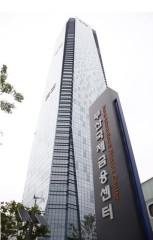
HUG partners with Busan court to launch dedicated auction unit, quadrupling case throughput
Dedicated auction unit launched July 1 Monthly average cases jump from 43 to 181 The Korea Housing and Urban Guarantee Corporation has set up a dedicated auction unit at the Busan District Court, pushing the processing speed of auction cases in the region up roughly fourfold. The move is expected to accelerate both the recovery of subrogation bonds and the supply of jeonse public rental housing in the area. According to HUG, the dedicated unit — established at the Busan District Court on July 1 — handled an average of 181 auction cases per month in July and August. That is about 4.2 times the monthly average of 43 cases recorded in the first half of this year, before the unit was created. The improvement stems from transferring HUG-related cases out of the general auction division, where they had previously been handled alongside unrelated cases, and concentrating them in a dedicated department. The unit was established after the Court Administration Office, the Busan District Court and HUG agreed on the need to expedite auction proceedings tied to jeonse deposit returns. HUG plans to hold regular working-level meetings with the Busan District Court to discuss ways to further shorten processing times. The faster pace is also expected to speed up the supply of Deundeun Jeonse Housing — a public rental program under which HUG directly acquires auctioned properties and leases them at below-market rates — in the Busan area. "The new dedicated auction unit has significantly strengthened the foundation for swift recovery of subrogation bonds in Busan," HUG President Choi In-ho said. "We hope this can serve as a model for cooperation that spreads to courts in other regions facing similar challenges, while also shortening bond recovery timelines." Meanwhile, HUG recently built an AI-powered system that automatically generates pre-screening documents for property acquisitions through auction and public sale under the Deundeun Jeonse Housing program. The system extracts and converts key review items — such as housing type and ownership rights — directly from real estate registry records, cutting the time previously required for manual processing by 93 percent.
Sept. 11, 2026
-
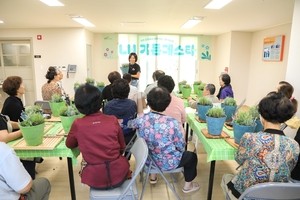
LH expands resident-led garden program to more apartment complexes
'Garden Festa 2.0' rolls out across Greater Seoul new towns The Korea Land and Housing Corporation (LH) announced Friday that it is running Garden Festa 2.0, a resident-led garden culture program at its apartment complexes. Garden Festa 2.0 brings together residents of all ages — children, young adults and seniors — to tend and beautify the outdoor landscaped spaces within their apartment complexes, fostering communication and community across generations. The program launched last year at three complexes, including Pyeongtaek Godeok 2 and Hwaseong Namyang New Town 20, drawing strong interest and participation from residents. A satisfaction survey at two of those complexes found that about 92 percent of respondents gave positive ratings on average. This year's Garden Festa 2.0 kicked off at Goyang Janghang 1 complex in July and will run through November at Incheon Geomdan complexes 37 and 38, Hwaseong Dongtan 2 complex 38 and Pyeongtaek Godeok 12 complex, among others. All are representative second-generation new towns in the Greater Seoul area. On Thursday, complexes 37 and 38 in Incheon Geomdan hosted a session called "My Neighborhood, Making Tree Friends," aimed at children of residents. The children designated a tree within the complex as their personal "tree friend," learning to care for it and connect with nature at the community facility. On Friday, the same complexes held an aromatherapy gardening session for elderly residents. Participants learned about herb plants that can be easily grown at home and shared tips on incorporating wellness practices into daily life. "We hope these activities, in which residents take an active role, will strengthen bonds between neighbors and serve as an opportunity to build a shared residential culture," an LH official said. "We will continue to develop a variety of nature-centered participatory programs to create a living environment that residents can truly feel the difference in."
Sept. 11, 2026
-

Mokdong complexes 9 and 10 close gap as complex 13 stumbles in reconstruction race
Complex 10 pursues integrated review and contractor selection simultaneously Complex 9 nears main committee submission Residents race to avoid overlap of 26,000-unit relocation demand A race to accelerate reconstruction is intensifying among the so-called "rear complexes" — complexes 8 through 14 — of Mokdong New Town in Yangcheon-gu, Seoul. While complex 13 hit a snag at the Seoul Metropolitan Government's integrated review stage, complex 10 has been pushing ahead on multiple fronts, advancing its integrated review, contractor selection and appraisal-related procedures in parallel. With complex 9 also nearing submission to the main integrated review committee, competition among the complexes over the order of future relocations is expected to intensify further. According to Seoul's urban renewal project information portal, the reconstruction association for Mokdong complex 10 posted a tender notice Monday for the selection of a real estate appraisal firm to assess neighborhood commercial facilities within the complex, with a submission deadline of Wednesday. While separate from the full appraisal of all union members' existing assets, the move is seen as an effort to get ahead of subsequent procedures before project implementation authorization is granted. Complex 10 is advancing other project procedures at the same time. On Aug. 28, it completed steps related to the integrated review subcommittee, and on Aug. 26 it designated Hyundai E&C — which had submitted the sole bid on two separate occasions — as its preferred negotiating partner for the contractor role. The project calls for rebuilding the existing 2,160 units into a complex of up to 4,248 units across buildings of up to 40 stories, with construction costs estimated at around 2.6 trillion won ($1.94 billion). Hyundai E&C's status as contractor is subject to final confirmation through a general meeting of landowners and other steps. Complex 13, which had been leading the pack, received a deferral at Seoul's integrated review in July. It was the second complex among the 14 in Mokdong New Town to reach the main committee, after complex 6, but its plan to build a large share of residential towers at up to 49 stories — without sufficient variation in height between buildings — became a sticking point. Seoul city officials determined that, given the overall skyline and visual character of the Mokdong area, the proportion of maximum-height towers needed to be reduced and floor counts distributed more diversely. Complex 13 must now revise its tower placement and floor-count plan before resubmitting for integrated review. In the meantime, other rear complexes are working through the integrated review process. A Seoul city official said complex 9 is expected to be submitted to the main integrated review committee soon, making it the third Mokdong complex to reach that stage after complexes 6 and 13. Complexes 8, 10, 11 and 14 are currently at the subcommittee stage of the integrated review. Complex 12 is also in consultations ahead of its integrated review. A complex 12 association official said the complex plans to revise its high-rise tower placement before proceeding with the review. Unlike complex 13, which was deferred after reaching the main committee, complex 12 is adjusting its plans before the main review. Behind the push to accelerate is a shared concern that large-scale relocations across the complexes could converge around the same time. Although each of the 14 complexes is pursuing reconstruction independently, their timelines are closely aligned, raising the possibility that project implementation authorizations and management and disposal plan approvals could come in rapid succession — concentrating relocation demand over a short period. Yangcheon-gu has already completed a relocation demand survey of residents across all 14 complexes in preparation. The survey asked how many school-age household members each unit has and how far residents would be willing to relocate during reconstruction. The district is now conducting a research project to analyze relocation demand and likely destination patterns based on the results, with findings expected after October. However, no separate criteria currently allow authorities to artificially adjust the relocation schedule for individual complexes. A Yangcheon-gu district office official said there are no guidelines permitting arbitrary adjustment of relocation timing. While clearing the integrated review first does not guarantee a complex will relocate first, observers note that since no fixed relocation order exists, the timing will ultimately depend on which complex completes subsequent steps — such as project implementation authorization and management and disposal plan approval — ahead of the others. Kim Je-kyung, director of Toomi Real Estate Consulting, said that with revised altitude restrictions from the International Civil Aviation Organization potentially taking effect after 2030, Mokdong residents may feel that year functions as a kind of deadline. He noted that while local authorities have not officially announced any intention to set a relocation order, there is precedent — during then-Seoul Mayor Park Won-soon's tenure in 2015, the city delayed the management and disposal plan approval for Gaeposhiyeong by four months, citing the need to stabilize the jeonse market. Kim added that with all 14 Mokdong New Town complexes combined exceeding 26,000 units, residents cannot help but suspect that relocation timing could be adjusted if projects proceed around the same time. "In that kind of situation, it is only natural that a race emerges among complexes to complete project procedures ahead of one another," he said.
Sept. 11, 2026
-
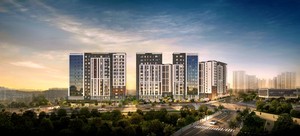
Samwhan opens model home for Hwaseo Station Lake Park Honorsville in Suwon
The complex sits adjacent to Seoho Park in one of Suwon's rare lakeside locations, with access to Starfield Suwon and a planned Sinbundang Line extension among its infrastructure highlights. Nearby development projects — including Tapdong Innovation Valley, Suwon R&D Science Park and the Seoho District New Village project — add to its appeal. Located in Gwonseon-gu, the only unregulated zone in Suwon, the complex carries no owner-occupancy requirement and no re-winning restriction. Samwhan, the construction arm of SM Group — one of South Korea's top-30 conglomerates — opened the model home for Hwaseo Station Lake Park Honorsville on Friday, marking the official launch of pre-sales for the residential complex to be built at 212-1 Seodun-dong, Gwonseon-gu, Suwon, Gyeonggi Province. The complex will rise up to 15 stories and comprise 476 units in total, with exclusive use areas ranging from 84 to 99 square meters — a mid-to-large configuration that tends to attract owner-occupiers. One of the development's key selling points is its proximity to Seoho Park, a lakeside setting that has become rare in Suwon since the development of the Gwanggyo new town. Select unit types will offer direct views of the park's lake. Seoho Park, a 10-minute walk from the complex, features walking trails including the Seoho Dulle-gil loop, as well as Yeogisan Park, a soccer field and a gateball court. The park is also slated for expansion under Suwon's 2040 urban master plan. Transport links are a further draw. The complex sits near both Suwon Station and Hwaseo Station, and will fall within the transit-oriented area of the planned Guun Station on the Sinbundang Line extension from Gwanggyo to Homaesil — once that line opens, travel to Gangnam will be possible in around 40 minutes without a transfer. When the GTX-C line opens, Suwon Station is expected to be roughly 18 minutes from Yangjae Station and about 28 minutes from Samsung Station. Everyday amenities are equally strong. The complex boasts what its developer calls a "triple mall" location, with Starfield Suwon, Lotte Mall Timevillas and AK Plaza all within easy reach. Tapdong Elementary School and Guwun Middle School are nearby, and the broader Hwaseo Station area offers a wide range of educational facilities. Large-scale development projects in the vicinity add further upside. On an approximately 267,000-square-meter site in Tapdong, Gwonseon-gu, Tapdong Innovation Valley — an advanced industrial complex focused on semiconductors, AI and biotech — broke ground in March and is targeting completion in 2029. Suwon R&D Science Park and the Gosaeok-dong Deltaplex development are also under way nearby, and authorities are pursuing a designation of roughly 3.3 million square meters of the surrounding area as a Suwon free economic zone. A New Village project for the Seoho district is also in the pipeline, with the Seodun-dong area expected to emerge as a leading residential hub for western Suwon. The units themselves have been designed to stand out. The exterior features a three-dimensional curtain-wall look on select buildings, while certain unit types offer living rooms up to 5.6 meters wide with glass railings to maximize the sense of openness. Each unit comes with an average of about 1.65 parking spaces. The complex is also notable as the first in Suwon to introduce an AI-based building management system. A smart parking guidance system directs residents to available spaces in real time, and facial-recognition technology allows hands-free access to both the main entrance and individual unit doors. The development has also partnered with telemedicine firm Soldoc to provide remote medical consultations and healthcare services. A street-level retail arcade and an arcade plaza within the complex will allow residents to shop and dine without leaving the grounds. A commercial lot in the Seoho district sits roughly 20 meters from the complex, promising additional shopping, dining and cultural options close at hand. The developer has also structured the purchase terms to ease the burden on owner-occupiers. The down payment is set at 5 percent of the pre-sale price, with a fixed initial deposit of 5 million won ($3,740) and interest-free financing covering 60 percent of the interim payments. Balcony expansion and a range of other options will be provided at no additional cost. Gwonseon-gu, where the complex is located, is the only unregulated zone within Suwon, which lowers the bar for apartment subscriptions. Greater Seoul residents aged 19 or older who have held a housing subscription account for at least 12 months and meet the deposit requirements for their area and unit size can apply as first-priority subscribers, whether they are the head of household or a household member. There is no re-winning restriction or owner-occupancy requirement, and pre-sale rights can be transferred one year after winning a subscription. "Hwaseo Station Lake Park Honorsville combines the Seoho Park and Hwaseo Station lifestyle with strong transport links, everyday amenities and major development catalysts nearby," a sales official said. "We expect sustained interest from owner-occupiers, drawn by the subscription advantages of an unregulated zone and the project's differentiated design." The model home is located at 533-1 Gosaeok-dong, Gwonseon-gu, Suwon, Gyeonggi Province.
Sept. 11, 2026
-

'Pro-government housing trio' turns on Lee administration over soaring apartment prices
Han Moon-do, an adjunct professor at Myongji University who had long defended the Lee Jae Myung administration's housing policy, has voiced sharp concern over the government's response to rising apartment prices in Seoul, which have climbed for more than 80 consecutive weeks. Lee Gwang-su, head of Gwangsu's Real Estate Agency, also launched a pointed attack on the government's housing policy before abruptly declaring he would stop commenting on real estate altogether. Chae Sang-wook, head of Connected Ground, similarly expressed disappointment with government policy earlier this year — meaning all three figures once known as the "pro-government housing trio" have now broken ranks. Speaking on YTN Radio's "Vivid Economy" program on Thursday, Han referenced the government's announcement of a tax reform plan and said he had concluded that officials had no intention of reining in housing prices. "I get the strong sense that vested interests and cartels have been moving in a big way," he said. He added that the government's measures had failed to adequately account for market realities. Using a soccer field analogy, Han said: "If you decide no one can play in the mud, you have to build a grass pitch. If you don't, and you just tell people not to play in the mud, where are they supposed to go?" He also said the government's plan was missing any measures for the jeonse and monthly rent market. "If supply has clearly run short, any package should include steps to stabilize jeonse and monthly rent — what we're seeing feels forced," he said. Han went on to say that housing issues had also weighed on President Lee Jae Myung's approval rating. "I understand the president's approval rating has fallen considerably," he said. "Housing is the single biggest factor behind that decline." A Gallup Korea poll released Friday showed President Lee's job approval at 38 percent — the lowest since he took office. Other real estate experts who had previously leaned toward the ruling camp have also been voicing concern about government policy in recent weeks. Lee Gwang-su appeared on the YouTube channel "Choi Wook's Maebulshow" on Monday and said the Democratic Party and the government were being "extremely complacent." "If things continue like this, housing prices will keep rising, the market will fall into chaos and it will ultimately drag down the administration," he warned. On the government's housing supply measures, Lee said the approach was like "deciding to farm rice paddies when a war has just broken out." Lee, who had argued for eight years that housing prices would fall, reversed course on the program, citing Bank of Korea money supply data and trends in apartment move-in volumes in the greater Seoul area to warn of a potential price surge. "As the money supply keeps growing, the value of money falls and a gravitational pull pushes up real asset prices," he said. "Even if interest rates rise, inflation is outpacing them, leaving real rates in negative territory, and a shortage of move-in supply in the metropolitan area will persist through 2028, stoking demand for jeonse and monthly rent and driving buyers into the market," he said. He then said he would no longer comment on real estate. "I'm going to talk about something more relaxing — semiconductor shares going up," he said. Chae Sang-wook, the third member of the so-called pro-government housing trio alongside Han and Lee, had already broken with the government in May, saying that if the administration failed to produce credible measures to stabilize home sales and the lease market within a year, "it would be right not to remain pro-government." Kim In-man, head of Kim In-man Real Estate Economic Research Institute, also criticized the government's policy approach for treating even single-homeowners as speculative buyers. "I believe single-home ownership should never be touched under any circumstances, yet even non-resident single-homeowners are being treated as speculators," he said. "I cannot shake the feeling that this was reform that was not ready." He warned that the policy burden could end up falling on the very people it was meant to protect. "Tenants and people without homes are the ones who need protecting — they are also the government's support base — and right now they are being pushed to the edge of a cliff," he said.
Sept. 11, 2026
-

Shin Se-kyung said to have purchased unit at ultra-luxury Samseong-dong villa complex
Actor Shin Se-kyung is reportedly preparing to move into Labre27, an ultra-luxury residential complex under development in Samseong-dong, Gangnam-gu, Seoul, next year. Shin purchased a unit at Labre27 in Samseong-dong, Gangnam-gu, according to Ten Asia on Thursday. Labre27 is a high-end residential development built by Hyundai E&C, comprising 27 units across two buildings. The complex consists of garden houses, terrace houses and penthouses, with two penthouse units available. According to pre-sale industry sources, terrace house units start at 14 billion won ($10.5 million), and the sixth-floor terrace house Type C7 was pre-sold at 19.5 billion won. Garden house units start at 26 billion won. The super penthouse Types P1 and P2 carry pre-sale prices in the 40 billion won range. It has not been confirmed which type Shin purchased. Shin's agency, The Present Company, told multiple outlets that it could not confirm the matter as it involves her private life. Samseong-dong, where Labre27 is located, sits adjacent to Cheongdam-dong and is close to major Gangnam lifestyle hubs including COEX, Bongeunsa Temple and the Han River. Shin returned to the big screen this year in the film "Humint," playing Chae Seon-hwa alongside Jo In-sung and Park Jung-min. She won the best supporting actress award in the film category at the 62nd Baeksang Arts Awards. Meanwhile, Shin is set to star opposite Jung Hae-in in "Love Virus," a Tving original series scheduled for release in 2027.
Sept. 11, 2026
-

Seoul to spend $18.9m fixing parking, fire access in Namsan hillside village
Combined parking tower, smart parking tower planned for Hoehyeon-dong Seoul will carry out five projects in an aging low-rise residential area of Hoehyeon-dong, Jung-gu, at the foot of Namsan. The projects include building parking towers, improving fire truck access roads and upgrading pedestrian paths. The total project cost is 25.3 billion won ($18.9 million). The Seoul Metropolitan Government said Friday that its second Urban Planning Committee's regeneration subcommittee had conditionally approved a revision to the "Seoul Station Area Urban Regeneration Activation Plan" on Thursday. The revision incorporates a support project for redeveloping the aging residential area of Hoehyeon-dong. The Hoehyeon-dong area was selected in December 2024 as a leading site under the Ministry of Land, Infrastructure and Transport's "New Village" initiative. The initiative has since been renamed the "support project for redeveloping aging residential areas." The latest revision incorporates the project's contents into a legally binding plan, laying the groundwork for it to move forward in earnest. The site in question is located around 164 Hoehyeon-dong 1-ga. It is a low-rise residential neighborhood that developed naturally on a hillside at the foot of Namsan. Narrow roads, a shortage of parking spaces and steep slopes have long caused inconvenience for residents there. Of the buildings on the site, 214, or 87.3 percent, are more than 20 years old. Given that large-scale redevelopment is difficult in the area, the city has focused on improving parking, safety and pedestrian conditions rather than pursuing full-scale redevelopment. It plans to spend a total of 25.3 billion won by 2029 to carry out the five projects in phases. The funding includes 10.1 billion won in state funds and 15.2 billion won in local funds. The city will first use the sites of existing public facilities that will be freed up when the Hoehyeon-dong community service center and a day care center relocate. It will build a combined parking tower and a separate smart parking tower there, each with four above-ground floors and three below-ground floors. The city will improve roads on narrow, dead-end alleys to allow fire trucks to enter. It will also add safety facilities such as security lights and handrails on sloped areas. The city also plans to improve pedestrian conditions by upgrading alleys and green spaces connected to the Namsan Old Trail. The city will link the project with an ongoing revision of the district unit plan for the Hoehyeon-dong area. It will review measures to improve the aging residential environment and secure infrastructure such as roads and parking lots, so future development directions and individual projects are managed in tandem. "Hoehyeon-dong has the locational advantage of connecting downtown Seoul with Namsan, but it has long needed basic improvements to living conditions such as parking, fire safety and pedestrian access," said Myeong No-jun, head of the Seoul Metropolitan Government's housing bureau. "We will move forward with the project focused on resolving, one by one, the inconveniences residents face every day."
Sept. 11, 2026
-
![[Exclusive] USFK base cleanup costs top W576.2b, threatening Yongsan housing plan [Real Estate 360]](https://wimg.heraldcorp.com/news/cms/2026/09/11/rcv.YNA.20260826.PYH2026082611260001300_T1.jpg?type=h&h=240)
[Exclusive] USFK base cleanup costs top W576.2b, threatening Yongsan housing plan [Real Estate 360]
42 bases targeted for decontamination since 2008 Yongsan's Camp Kim alone cost 30.6 billion won to clean up Community opposition has delayed some sites, with costs and timelines varying widely Nearly 600 billion won ($448 million) in taxpayer money has gone toward decontaminating US military bases returned to South Korea since the 2000s. Concerns are mounting that Yongsan Park — long used as a US military site and now under consideration for housing development — could see cleanup costs and timelines balloon depending on its contamination levels. According to data on the state of contamination cleanup at returned USFK bases, obtained from the Ministry of National Defense by the office of People Power Party Rep. Sung Il-jong, a member of the National Assembly's National Defense Committee, the ministry has spent 576.2 billion won since 2008 to decontaminate a total of 42 returned bases, as of the end of August. That marks an increase of more than 200 billion won from September 2024, when 21 bases had been returned and cleanup costs stood at 370.5 billion won, according to an analysis at the time by the office of then-Democratic Party lawmaker Choo Mi-ae. Among them, Camp Kim, a major returned base in Yongsan, cost 30.6 billion won to decontaminate. Cleanup at three other Yongsan-area sites — the 8th Army Religious Retreat, Niblo Barracks and the Seobinggo site — cost a combined 15.2 billion won. These three sites are among the 12 bases nationwide whose return was decided at the 201st SOFA Joint Committee meeting in December 2020. Cleanup costs and timelines varied widely across sites, ministry data showed. Decontaminating the 5,000-square-meter Seobinggo site took about 40 months, from August 2021 to December 2024 — nearly a year longer than the six-times-larger Niblo Barracks (30,000 square meters), which was cleaned up from August 2021 to September 2023. The Seongnam Golf Course in Hanam, Gyeonggi Province, returned in December 2020, is scheduled for cleanup through February 2028 at a cost of 82.1 billion won. Camp Kim, whose cleanup was originally scheduled to finish this month, took longer than expected after cultural artifacts were discovered during decontamination work. The 50,000-square-meter site's cleanup began in August 2021, was suspended for a cultural heritage survey, and has now stretched to about five years, with completion nearing. Soil decontamination costs at Camp Kim, initially estimated in 2021 at around 10 billion won, have since risen into the 30-billion-won range because of the extended timeline and other factors. Some sites have yet to see cleanup work begin, depending on when they were returned and their individual characteristics. Zone C (60,000 square meters) of Camp Market in Incheon, formerly a sewage treatment lot, was decontaminated in about four months at a cost of 50 million won. But Zone D (230,000 square meters), the site of a former bread factory returned in December 2023, still has no confirmed cleanup timeline or cost. Camp Red Cloud in Uijeongbu (830,000 square meters), returned in February 2022, also has no cleanup cost set because basic and detailed design work remains unfinished more than four years after its return. Other sites have seen work delayed by conflicts with local communities. Camp Market in Incheon is divided into four zones. Zone A (110,000 square meters, cleanup cost 90.3 billion won) began decontamination in June 2020 and finished in September 2024. Zone B (100,000 square meters, cleanup cost 10 billion won), which began cleanup around the same time, was delayed by disputes over demolishing a hospital building from the former Japanese army arsenal and was not completed until June this year — six years later. The Yongsan Park housing supply plan has drawn opposition not only from the Seoul Metropolitan Government and Yongsan-gu but also from residents in the area. "Astronomical amounts of taxpayer money — already nearing 600 billion won — have gone into decontaminating returned US military bases, and it has been proven on the ground that costs and timelines increase exponentially depending on contamination levels," Rep. Sung said. "Rather than forcing ahead with the Yongsan housing supply plan without even properly grasping the extent of contamination, the government should first conduct a transparent review of safety and fiscal requirements." Meanwhile, the Ministry of Climate, Environment and Energy has been pushing to revise its enforcement rules to speed up soil decontamination, a prerequisite for housing supply. The core change would allow "off-site cleanup" — moving contaminated soil discovered at state project sites, including public housing sites, to other locations for treatment. If Yongsan Park is eventually designated a public housing site, it could fall under this regime. The government believes expanding off-site cleanup could move up housing supply by about six months, but that projection could also prove variable, since soil contamination differs depending on the area, degree of contamination and the substances involved.
Sept. 11, 2026
-
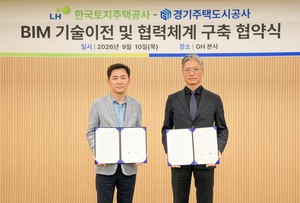
LH transfers BIM technology to GH
Follows earlier tech transfer to Busan The Korea Land and Housing Corporation said Friday that it will transfer its independently developed core "building information modeling" (BIM) technology for housing complexes to the Gyeonggi Housing & Urban Development Corporation (GH) to promote wider use of BIM in the public sector. BIM combines three-dimensional models with construction data to manage the information and processes needed throughout a building's life cycle, from planning and design to construction and maintenance. LH was the first public institution to establish BIM application guidelines and has developed its own "BIM design support core technology." The software supports automated construction cost calculations, water and sewage hydraulic calculations, and earthwork design during BIM-based complex design, boosting work efficiency. Through the transfer of these guidelines and technology, LH aims to minimize redundant investment across institutions and unify BIM application standards. The goal is a single standardized BIM system for public-sector housing complex projects. LH signed an MOU with GH on Thursday to transfer BIM technology and build cooperation across various sectors, including the development of third-phase new towns. Under the agreement, LH plans to transfer its self-developed "BIM application guidelines for housing complexes" and "BIM design support core technology." Earlier, in August, LH signed a similar MOU with the Busan Metropolitan City Development Corporation and completed a BIM technology transfer to the organization. "Following the Busan Metropolitan City Development Corporation and GH, we will continue transferring BIM technology to institutions that need it," an LH official said. "By actively sharing the BIM technology we independently developed and hold with the public sector, we will lead the way in building a BIM technology ecosystem for public institutions." Meanwhile, LH earlier completed development of an AI-based automated earthwork design software to support BIM design and has already distributed it to the private sector.
Sept. 11, 2026
-
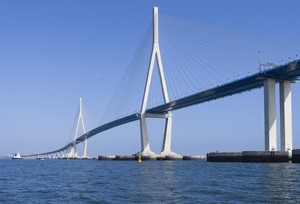
Incheon Bridge tops private expressway review; 4 others rated 'excellent'
Incheon Bridge boosts safety management with in-house technology The Incheon Bridge Expressway, operated by Incheon Bridge Co., was named the top performer in the 2025 evaluation of privately funded expressway operations. Four other expressways were rated "excellent": the Oksan-Ochang Expressway, operated by Oksan Ochang Expressway Co., and the Gwangju-Wonju Expressway, operated by J Yeongdong Expressway Co. The Yongin-Seoul Expressway, operated by Gyeongsu Expressway Co., and the Seosuwon-Pyeongtaek Expressway, operated by Gyeonggi Expressway Co., also received the rating. The Ministry of Land, Infrastructure and Transport released these findings Friday, unveiling the 2025 operational performance evaluation results for 23 privately funded expressways nationwide. The ministry evaluates and announces the operational performance of privately funded expressways that have been open for more than a year, based on the Toll Road Act. The annual review aims to improve user convenience and safety and boost management efficiency. This year's evaluation involved experts in roads, traffic, safety and accounting, along with expressway users who took part directly in on-site inspections of every route. In particular, civic groups representing truck and bus drivers were enlisted as evaluators. They assessed items that matter most from users' perspectives, including road surface conditions such as potholes, and the convenience of rest areas and drowsy-driving rest stops. The evaluation also incorporated on-the-ground feedback on inconveniences and areas needing improvement. Incheon Bridge, named the top performer, has been working to strengthen its safety and management capabilities. It has developed and deployed its own accident-prevention radar sensors to prevent autonomous vehicles from rear-ending road workers, a risk that has recently surged. Other privately funded expressways have also made various efforts to ease chronic traffic bottlenecks and respond to electric vehicle fires. The Gwangju-Wonju Expressway reorganized lanes at a bottleneck section, raising traffic speeds by 13 kilometers per hour. The Seosuwon-Osan-Pyeongtaek Expressway partnered with relevant agencies to secure electric vehicle fire-suppression equipment, boosting its ability to respond to accidents. The ministry plans to strengthen follow-up management by promptly addressing shortcomings identified in the evaluation. It will also share best practices and award ministerial commendations and cash prizes to the operators of the highly rated expressways. Kim Hyo-jung, director general of the ministry's Road Bureau, said, "We plan to continuously improve road safety and convenience, as well as our operational and management standards, by strengthening proactive road maintenance and cleaning systems so that people can use privately funded expressways with confidence."
Sept. 11, 2026
-
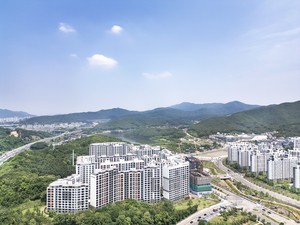
No more rent shocks: why senior housing is booming amid Korea's rental squeeze
Loan curbs, supply shortage deepen rental crunch Meals, health care and daily support all in one place Baegun Lake Prugio Sup-sok-ui Achim draws attention With jeonse listings shrinking and prices climbing, weakening the rental market, interest is rising in corporate rental housing and senior housing. Amid tighter household loan regulations and a supply shortage, these options are drawing attention for offering stable residence without sudden rent hikes. Jeonse gives way to monthly rent: monthly-rent share hits 68.3% in July According to the Ministry of Land, Infrastructure and Transport's July housing statistics released Thursday, nationwide jeonse transactions fell 22.3 percent year-on-year. As renters who could not find jeonse units or faced reduced loan limits shifted to monthly rent, the share of monthly rent contracts in all lease transactions from January through July rose to 68.3 percent. As the shift from jeonse to monthly rent accelerates, tenants' monthly housing costs are rising with it. Market watchers point to loan regulations and supply lags as the key drivers. The Financial Services Commission has announced it will raise its 2026 household debt growth target to 3 percent but has yet to release specific criteria, while maintaining a strict overall debt-management stance. In the Greater Seoul area and other regulated regions, mortgage loan limits vary by home price, and for single-home owners, interest payments on jeonse loans are now factored into the debt service ratio. As a result, borrowers' income and existing debt have become more important than before — not only for home purchases but also for financing jeonse deposits. Supply-side lags are also weighing on the jeonse market. The government has officially acknowledged the contraction in housing supply that has continued since 2022. The decline in permits and ground-breakings from that period is translating into fewer move-ins scheduled for 2026, and the government's announcement in August of plans to add more than 230,000 housing units in the Greater Seoul area underscores how serious concerns over the mid- to long-term supply shortage have become. It will take time, however, before newly designated sites and ground-breakings translate into actual move-ins. Higher holding costs for landlords — including interest expenses, property tax and comprehensive real estate tax — are also cited as a factor reducing jeonse listings. The 2026 tax reform is being discussed with an eye toward protecting owner-occupants of a single home while adjusting the tax burden on high-value homes, non-resident homes and multiple-home ownership. Registered rental housing can be excluded from comprehensive real estate tax aggregation if certain conditions are met, but ordinary landlords must weigh taxes, financing costs and lease management costs together. As landlords weigh holding taxes and financing costs, long-term rental housing draws interest With homeownership and finding a desired jeonse unit both increasingly difficult, corporate rental housing and senior housing are emerging as new options, offering stable long-term residence without sudden rent hikes. Senior housing, in particular, stands apart from ordinary jeonse and monthly-rent arrangements by providing not only tax advantages but also meals, health care and daily living support services. Aging demographics and the growing number of one- and two-person elderly households are reinforcing this trend. Consumers who once compared only floor area and price have begun weighing the "sustainability of daily life" — including fall prevention, meals, emergency response and social interaction. Senior apartments are increasingly viewed not just as a real estate product but as infrastructure for later-life living. Senior housing is expanding nationwide, no longer confined to a handful of upscale complexes in the Greater Seoul area. The government supplies about 3,000 units annually of elderly welfare housing that combines residential and welfare services, while diversifying housing types to include Silver Stay for middle-class and homeowning seniors, as well as private silver towns. Prominent examples include Noble County, operated by Samsung; KB Golden Life Care Jongno Pyeongchang County, run by KB Group; Baegun Lake Prugio Sup-sok-ui Achim, built by Daewoo Engineering & Construction and operated by MDM Group; and VL Le West, built by Lotte Engineering & Construction with operational support from Lotte Hotel. Public elderly housing led by the Korea Land and Housing Corporation and local governments is also being supplemented by service-based housing from private companies and real estate investment trusts, giving rise to residential models that combine medical care, caregiving and leisure — not only in the Greater Seoul area and major cities but also in smaller provincial cities. Among privately operated senior housing complexes, Baegun Lake Prugio Sup-sok-ui Achim, near Baegun Lake in Uiwang, Gyeonggi Province, has recently earned the highest resident satisfaction ratings. The complex comprises 536 units of elderly welfare housing and 842 residential officetel units. Visitors inquiring at the complex's information desk or at nearby real estate offices ask not only about floor area or views but also whether meals can be arranged daily, how conveniently they can access hospitals and health care services, and who would respond and how in the event of an emergency while living alone. Stepping inside a unit, the layout designed for daily living is immediately apparent. Thresholds and floor-level differences are minimized, and bathroom handrails, an entryway bench and an emergency call device are installed to guard against falls and other emergencies. According to a complex official, the focus was not on adding complicated equipment but on lowering barriers to movement and use, extending the period residents can live independently. The complex links meals, health care, housekeeping, laundry and daily living guidance into a single, convenient service for residents. A health care nurse is on-site full time, and the complex has established cooperative arrangements with medical institutions including Asan Medical Center and Hallym University Medical Center. The premise is that in-home safety design and daily living services must work together for independent living to be sustained over the long term. "The burden of preparing every meal on my own has eased, and knowing I can immediately ask a nurse for help when needed puts my mind at ease," said a resident identified as Y, 75. Meals, exercise, social ties: layouts optimized to give residents reasons to step outside In a roughly 11,000-square-meter community space at the center of the complex, residents eat together at a shared dining hall, exercise at the pool and fitness area, and meet neighbors and friends through various classes and clubs. At a stage of life when social ties tend to shrink after retirement, the complex builds regular activity and natural social interaction into daily life. What matters more than the scale of the facilities is ensuring that participation continues consistently. The quality of senior housing does not end when a building is completed — it depends on how consistently meals, health care, programs and resident relationships are managed over time. MDM Group has established M Fore, a firm dedicated to operating elderly welfare housing, to help residents redirect the time and energy they once spent on home maintenance toward health, hobbies and social interaction. "Being able to share meals with acquaintances and friends has added vitality to my life," said a resident identified as H, 68. "The emergency call buttons placed throughout the unit also ease my worries about safety." Among elderly welfare housing complexes, the biggest advantage of Baegun Lake Prugio Sup-sok-ui Achim in Uiwang is its structure: elderly welfare housing and officetel units sit within the same complex, creating a multigenerational community where parents and children can maintain separate lives while staying close. Parents can live independently while using the services they need, and children can visit frequently without shouldering the full burden of daily caregiving. It narrows the gap between living together under one roof to provide care and living far apart in independence. For senior housing to become a mainstream option, consumers need to be able to easily compare move-in costs and monthly living expenses, the consistency of service quality, the stability of the operating entity, and the scope of medical and care services. Standards are also needed to assess how consistently essential daily services are actually delivered, rather than how lavish the facilities appear. Even so, experts say senior housing — which pairs stable residence with daily living services — is taking on greater significance amid growing uncertainty in the jeonse and monthly rent market driven by loan regulations, supply shortages and rising housing holding costs. "A housing model that lets seniors take charge of their own lives while receiving the help they need close at hand is likely to become a practical option for living longer, more stably and independently in a super-aged society," an industry official said.
Sept. 10, 2026
-

Korea National Railway wins PM's award for railway-zone reporting service
Achievement recognized at Korea Knowledge Grand Prize The Korea National Railway said Thursday that it received the prime minister's award in the knowledge management category at the 15th Korea Knowledge Grand Prize, hosted by the Ministry of Interior and Safety, at the Shilla Hotel in Jung-gu, Seoul. The Korea Knowledge Grand Prize is a government award that recognizes institutions for achievements in government innovation and improved corporate competitiveness through knowledge administration and management, and spreads best practices. This year's competition focused on cases in which institutions actively adopted the latest digital technology to streamline public services and improve working methods. The railway agency was recognized for converting the once-complicated process of reporting activities in railway protection zones into a digital system based on the Railway Comprehensive Information System, improving both public convenience and administrative efficiency. Reporting activities in railway protection zones is a system under the Railway Safety Act. The zones cover areas within 30 meters of a railway boundary. Anyone planning excavation, new construction or similar work there must report to the Korea National Railway, which manages the zones. Previously, the process required a total of 11 steps from filing a report to confirming the outcome. The agency streamlined the system so that all steps can now be processed at once. This cut document output by 88.9 percent, from about 19,224 cases to 2,136, and shortened the processing period from about 30 days to 22 days. The agency also introduced automated KakaoTalk notifications to inform applicants of their case's progress at each stage in real time, and built an AI chatbot incorporating about 200 consultation scenarios so the public can check laws and procedures related to protection zones at any time. "It is meaningful that our efforts to improve public convenience and administrative efficiency by actively utilizing innovative technologies such as AI have been recognized externally," said Jeong Jin-hyeok, president of the Korea National Railway. "We will focus the capabilities gained through this work innovation on protecting railway facilities and inspecting high-risk construction sites, and do our best to ensure that the results of our digital transformation lead to a safer railway environment." Meanwhile, the Korea National Railway is an organization under the Ministry of Land, Infrastructure and Transport responsible for building and upgrading the national railway network. Jeong took office as its ninth president on Sept. 1.
Sept. 10, 2026
-
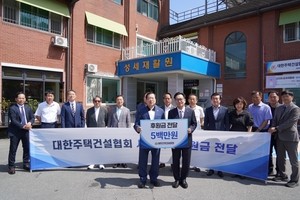
Korea Housing Builders Association delivers over W100m in chuseok donations to welfare facilities
The Korea Housing Builders Association said Thursday that it delivered donations to social welfare facilities across the country ahead of chuseok. On Wednesday, the association visited 13 regional facilities, including the social welfare corporation Seongjaewon in Yuseong-gu, Daejeon, for its "2026 Social Welfare Facility Donation Ceremony." The event, joined by the association's headquarters and 13 city and provincial chapters, delivered a total of 106 million won ($79,200) in donations to social welfare facilities nationwide, including child care institutions and support centers for people with disabilities. Key executives who attended the headquarters ceremony included Association Chairman Kim Seong-eun, Vice Chairman Jeon Moon-su, Seoul Chapter Head Kim Young-gon and Daejeon-Sejong-South Chungcheong Province Chapter Head Kim Yong-gwan. The association's executives met Yoon Yeo-woong, chairman of Jeil Construction and CEO of Seongjaewon, to personally deliver a 5 million won donation and review the facility's work. "We hope this chuseok brings warmth to those in our community who need attention and care," Kim said. "We will continue listening to the voices of local welfare facilities like Seongjaewon and underserved communities, and keep expanding our support and sharing efforts." Founded in 1985, the Korea Housing Builders Association is a leading organization in the housing industry with about 8,300 member companies, and it has fulfilled its social responsibility through various philanthropic activities. These include a housing improvement project for national merit recipients that marks its 33rd year this year, along with ongoing support for disaster recovery and other assistance for vulnerable groups.
Sept. 10, 2026
-

Korea Specialty Construction Association marks 2nd Specialty Construction Day
Ceremony highlights achievements, roles of 60,000 member firms, 1.7 million workers The Korea Specialty Construction Association held its second Specialty Construction Day ceremony to discuss the role of specialty contractors and the future direction of the construction industry. The association said it held the ceremony on Thursday at Maronier Hall on the fourth floor of the Specialty Construction Center in Dongjak-gu, Seoul. About 550 people attended, including lawmakers, central government officials, heads of construction-related organizations, heads of research institutions and specialty construction professionals. The program opened with a performance, followed by a commemorative address, congratulatory speeches and awards for meritorious individuals. Deputy National Assembly Speaker Park Deok-heum, Land, Infrastructure and Transport Committee Chairman Yu Eui-dong and Rep. Na Kyung-won gave congratulatory remarks. Bok Gi-wang, who leads his party's side on the committee, also spoke. Yoon Hak-su, chairman of the Korea Specialty Construction Association, said in his address, "The starting point for resolving challenges in the construction industry and reforming the system is the field itself. Fairness and common sense are the surest standards for translating on-site difficulties into policy improvements." He added, "Coexistence and shared growth must become the most important values in the construction industry. Let specialty and general contractors each demonstrate their own roles and strengths, and let all stakeholders in construction — manpower, equipment and beyond — respect one another's roles as we build a future of growth together." The ceremony also honored individuals who contributed to the development of the specialty construction industry and to raising the association's standing. In the social contribution category of the Construction Merit Award, Kwon Jin-o, CEO of Youngin Industry Co., and Park Jong-shin, CEO of IL E&C Co., were selected. Lim Chul-gyu, CEO of Cheonji Development Co., was also selected. In the technical contribution category, Kwon Oh-bong, CEO of Ubok E&C Co.; Kim Eun-young, CEO of Okdang Industry Co.; and Oh Mun-taek, CEO of SJ Waterworks Co., received awards. Special commemorative commendations went to Kim Jung-hee, CEO of KN Global Co., in the distinguished enterprise category, and Yoon Ki-hyun, CEO of Dawoo Industry Co., in the master craftsman category. Hwang Soon-bum, CEO of Cheonil ENS Co., received the commendation in the trailblazer category. Alongside this, 18 individuals who contributed to the development of the specialty construction industry received merit commendations from the National Assembly speaker and deputy speaker. They also received citations from the Land, Infrastructure and Transport Committee chairman, the interior and safety minister, the Fair Trade Commission chairperson and the commissioner of the Public Procurement Service. Twelve members who contributed to the development of the construction industry and the association received construction development merit awards. Through Specialty Construction Day, the association aims to promote the achievements and roles of its 60,000 member firms and 1.7 million specialty construction workers. It also seeks to share pressing issues facing the industry. The association plans to pursue securing adequate construction costs, establishing fair trade practices, building a more rational production system, and creating a safer construction environment. Meanwhile, Yoon said at a recent press briefing that the mutual opening of the general and specialty construction markets is deepening the financial strain on small and midsize specialty contractors. He urged reform of the system. "The specialty construction market has opened 56.7 percent, while the general construction market's opening rate stands at just 8.7 percent," he said.
Sept. 10, 2026
MOST READ
- 1Hyundai Motor unveils all-new Tucson with bigger body, smarter tech after 6-year wait
- 2Flat sneakers are back: Why Nike is reviving a 55-year-old running shoe
- 3Pope Leo XIV declines French honors and banquet, accepts only private meeting with Macron
- 428 illegal sports streaming sites found operating freely despite repeated blocks
- 5What was Rachmaninoff's performance fee? A 1928 price list tells all
- 6Samsung Biologics union's show of force backfires at the bargaining table
-
WORLD

US warns of punishment for anyone enabling Iran's Strait of Hormuz toll scheme
-
INDUSTRY
Toyota union puts productivity first; Hyundai Motor union demands bigger share of profits
-
FINANCE

National Growth Fund to invest $531M in FuriosaAI, which rebuffed Meta's $800M takeover bid
-
INDUSTRY
Korea Shipowners' Association holds amateur baduk tournament for Maritime Day