
- HOME
- REAL ESTATE
-

Government extends owner-occupancy waiver for tenanted homes in land-transaction zones, but supply concerns linger
Owner-occupancy deferral extended one year through end of next year; renewal contracts now included Tax reform aligned with measures to encourage listings; analysts split on rental market impact The government has extended a temporary owner-occupancy deferral that allows people without homes to purchase tenanted apartments in land-transaction permit zones, pushing the deadline to the end of next year. Experts say the move — which now covers lease renewal contracts as well — could unlock more listings and ease what has been a near-frozen housing sales market in Seoul. At the same time, concerns are growing that the measure may shrink the private rental supply as multi-home owners sell to owner-occupiers, and that a surge in lease renewals could sharply reduce new jeonse and monthly-rent listings in the short term, aggravating rental shortages. According to the Ministry of Land, Infrastructure and Transport on Thursday, the deadline to apply for the owner-occupancy deferral — previously set for Dec. 31 this year — will be extended by one year to Dec. 31 next year. The government had originally allowed the deferral from May, permitting buyers without homes to postpone moving in until the remaining term of an existing tenant's contract had expired when purchasing a home in a land-transaction permit zone. The extended measure now covers not only the remaining term of an existing lease but also one renewal contract — up to two additional years — that a tenant may exercise. As a result, buyers without homes will be able to defer their move-in date by up to three years and three months (15 months of application period plus 24 months of renewal) from the measure's effective date of Oct. 1, pushing their actual move-in as late as 2029. To block speculative demand, however, eligibility is limited to buyers who have remained without a home continuously since May 12, when the deferral was first announced. After the lease ends, buyers must move in and reside in the unit for at least two years. 'Broader conditions for selling' — analysts expect more listings through next year The government's decision to roll out a supplementary measure just four months after announcing the original deferral in May reflects its intent to preemptively remove barriers to listings by multi-home and high-value property owners ahead of the Aug. 3 tax reform package. The tax reform plan includes a significant tightening of residency requirements for the long-term holding deduction available to single-homeowner households starting in 2028, along with a new cap on the deduction, while temporarily easing the capital gains tax surcharge on multi-home owners in 2027 and 2028. The government's aim to encourage listings of multi-home and high-value properties through next year was built into the plan, but repeated complaints that the existing deferral deadline — capped at year-end — made it difficult to trade tenanted homes prompted the additional fix. Yang Ji-young, a senior adviser at Shinhan Premier Pathfinder, said many homeowners were already weighing a sale given the tax reform's implications for holding costs and future capital gains tax burdens, but transactions involving tenant-occupied homes in land-transaction permit zones had been hard to complete in practice. "If the tax reform gave people a reason to sell, this measure — extending the owner-occupancy deferral — has broadened the conditions under which they actually can," she said. With the barriers to trading tenanted homes now eased, market observers broadly expect more tax-motivated listings to emerge and transaction volumes to recover at least partially. Ham Young-jin, head of Woori Bank's real estate research lab, said the measure lowers the threshold for trading homes with sitting tenants that had been effectively blocked after year-end, opening the possibility of a modest increase in tradeable listings into next year. "Particularly if the planned reduction in the capital gains tax surcharge on multi-home owners in regulated zones next year and the revisions to the long-term holding deduction are confirmed, that could help increase listings and support a transaction recovery," he said. Ham added that properties with good prices or locations that had been difficult to trade due to the owner-occupancy requirement could now re-enter the market. "From a seller's perspective, the pool of potential buyers grows, which increases the incentive to list rather than pull a property," he said. Yang also described the measure as focused on normalizing end-user-driven transactions and improving market liquidity. "In areas like Seoul, where a high proportion of listings involve sitting tenants, there is a reasonable chance this will contribute in the short term to expanding the pool of tradeable properties and recovering transaction volumes," she said. However, some analysts warn that because gap investment — buying a home with an existing jeonse tenant in place — has in effect become possible for buyers without homes, last-minute buying demand could concentrate through the end of next year and push prices higher. Song Seung-hyun, chief executive of Urban and Economy, said listings may increase somewhat next year but prices could actually rise further. "With more than three years given for financing, there is a real possibility that a rush of late buyers concentrates at the end of the window," he said. Yang also acknowledged the price impact cuts both ways. "More listings are a factor that eases upward price pressure, but at the same time, buyers without homes gaining the ability to purchase preferred complexes in advance could also expand buying demand," she said. Existing tenants spared eviction anxiety, but new rental supply seen shrinking over time For the rental market, analysts see short-term residential stability but longer-term supply contraction as likely outcomes pulling in opposite directions. Existing tenants can secure additional time in their homes through renewal contracts, easing immediate fears of eviction — but rising demand for renewals could reduce the flow of new jeonse and monthly-rent listings. Ham said that under the previous rules, a buyer of a rental home in a land-transaction permit zone could block a tenant's renewal right in order to move in, but the new measure recognizes one renewal of up to two years, strengthening tenant security of tenure. "In the short term, the measure is expected to have some effect in preventing a further reduction in jeonse listings," he said. Yang also offered a positive assessment, saying the measure could help reduce unnecessary tenant relocations and ease jeonse market instability in areas where jeonse listings are already scarce. Song, however, cautioned that an increase in sales transactions resulting from the extended deferral would not automatically translate into more jeonse listings. "With renewal contracts now covered by the deferral, existing tenants will try to hold on as long as possible, which could actually deepen rental market instability," he said. The fact that the main sellers expected to bring tax-motivated listings to market through next year are predominantly multi-home owners is also cited as a longer-term source of rental market risk. When tenanted homes held by such owners are sold to buyers intending to live in them, the private rental supply those units previously provided through jeonse and monthly-rent arrangements shrinks. Nam Hyeok-woo, a real estate researcher at Woori Bank, said that if sales listings from rental business operators, non-resident homeowners and multi-home owners concentrate as a result of the measure, jeonse and monthly-rent listings would decline in tandem. "There is also a possibility that volatility in jeonse and monthly-rent prices will increase," he said. Ham stressed that it will be necessary to monitor whether the rental supply holds up over the longer term, given that buyers are scheduled to move in after their deferral periods end — in 2029 and beyond. "Rather than viewing this measure as a policy that dramatically expands the jeonse supply, it is more appropriate to see it as a regulatory fix that eases the friction between the sales market and the rental market," he said.
Sept. 17, 2026
-
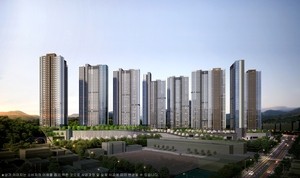
Taeyoung E&C to launch pre-sales for Gumi Park One Desiang complex in November
1,355-unit complex with specialized community facilities Gumi housing market rebounds amid supply drought; semiconductor and robot investment add tailwind Taeyoung Engineering & Construction announced Thursday that it plans to launch pre-sales for Gumi Park One Desiang, a large residential complex in Doryang-dong, Gumi, North Gyeongsang Province, in November. Developed through a private park special project, the complex will be built alongside a large neighborhood park — marking the first brand-name large-scale complex to come to market in Gumi after a prolonged supply drought. The complex will consist of 10 buildings rising from three basement levels to 40 above-ground floors, with a total of 1,355 units ranging from 84 to 110 square meters in exclusive use area. Gumi's real estate market has been recovering in tandem with a sharp drop in new supply. The number of new apartment units offered for pre-sale in Gumi plunged roughly 89 percent over four years, from 3,583 units in 2021 to 403 in 2025. This year, only about 60 remaining units from earlier projects are being offered. As a result, unsold units in Gumi fell about 70 percent — from 2,076 at the end of 2024 to 613 as of late August — in just one year and eight months. Price trends are also shifting. An 84-square-meter unit at Gumi i'Park the Sharp traded at 655 million won ($479,000) at the end of last year, setting an all-time high for that unit size, and record-high transactions have continued this year, particularly in newer complexes. The Doryang-dong site is the first private park special project in Gumi, developed in conjunction with a large neighborhood park spanning 550,000 square meters — equivalent to more than 70 soccer fields — which residents will be able to enjoy as an extension of their front yard. The complex is also close to Geumosan mountain. The area offers strong school access as well. Residents will be within walking distance of Munjang Elementary School, Gumi Middle School, and two high schools — Gumi High School and Gumi Girls' High School — both ranked among the top performers in academic achievement. Residents will have walkable access to the Doryang-dong commercial district as well as the nearby Wonho-ri shopping area, with the Bonggok-dong neighborhood also close by. The Buk-Gumi interchange on the Gyeongbu Expressway provides convenient road access to Daegu, Gimcheon and other nearby cities, as well as major urban centers nationwide. Gumi Station serves as a rail hub, and the Daegyeong Line regional rail service connecting Gumi and the greater Daegu area allows residents to travel between the two cities as if they shared a single living zone. A new Dong-Gumi Station on the Daegu-Gyeongbuk metropolitan rail line passed a preliminary feasibility study this year, and the Gumi–Gunwi expressway cleared the same hurdle last year. The improvements are expected to put the planned Daegu-Gyeongbuk New Airport within roughly 10 minutes of Gumi, significantly enhancing the area's transport connectivity. The industrial foundation is equally strong. Gumi has secured a series of national projects — including a semiconductor materials and components specialized complex and a defense industry innovation cluster — as it positions itself as an advanced-industry city. Samsung Electronics and Samsung SDS recently announced a 19 trillion won ($13.9 billion) investment plan in Gumi, covering a humanoid robot mass-production line and an AI data center. SK Siltron is also expanding its semiconductor wafer production lines in the city. The complex will feature an extensive range of community facilities designed to maximize resident convenience — a golf practice range, screen golf, an indoor gymnasium with a running track, a sauna, a coin laundry, a private cinema, a shared kitchen and dining party room, and a multipurpose hall. Parking will be provided at a ratio of 1.64 spaces per unit, with about 80 percent of spaces designed in an extended format for added ease. "There is strong interest from local end-users given the location next to a 550,000-square-meter park and a top-tier school district, and the fact that this is a rare brand-name large complex in Gumi," a pre-sales official said. "Inquiries have already been coming in steadily, as this is the first large complex to come to market in Gumi in quite some time amid the shortage of new supply." The Gumi Park One Desiang model home will open next month in Goa-eup, Gumi. A promotional center near Gumi Station is already in operation ahead of the opening. Meanwhile, Taeyoung Engineering & Construction completed sales contracts for all units at Metro City Jasan Desiang, a complex it supplied in Jasan-dong, Masanhappo-gu, Changwon, South Gyeongsang Province, in July. The sellout was attributed to the complex's rarity as the first brand-name large apartment complex in Masanhappo-gu in about five years, as well as its diverse community facilities that set it apart from neighboring developments.
Sept. 17, 2026
-
LH union threatens general strike if government pushes ahead with spinoff plan
'8,000 members have begun dispute procedures' 'Spinoff would disrupt housing supply' The union of Korea Land and Housing Corporation (LH) said Thursday that its roughly 8,000 members have begun strike procedures and will launch a general strike if the government presses ahead with plans to split up the state housing developer. The LH union made the announcement at a press conference held Thursday morning in front of Cheong Wa Dae Sarangchae in Seoul, where public-sector unions affiliated with the two major labor federations declared a joint campaign against the government's public institution reform drive and LH spinoff plans. The government unveiled its "public institution functional reform plan" on Sept. 3, signaling its intention to split LH into two separate corporations — one handling land development and housing construction, and the other overseeing residential welfare and asset reserves. The Ministry of Land, Infrastructure and Transport is expected to announce a separate, detailed "LH reform plan" outlining the specific functional restructuring for each organization. "Eight thousand union members have already entered dispute procedures, including a general strike," the union said. "If the government ultimately forces through its unilateral, hastily drawn-up breakup plan, we will join forces with the 550,000 public-sector workers under the joint committee of the two major labor federations and wage an all-out fight against the government." The union argued that splitting LH would actually hinder, rather than help, efforts to expand housing supply. According to the union, LH's housing supply achievement rate relative to its targets hovered around 100 percent from 2017 to 2020, but tumbled to 38.3 percent in 2021, 44.1 percent in 2022 and 50.9 percent in 2023 after the government rolled out reform measures following allegations of real estate speculation by LH employees that year. "The rate recovered to 100 percent in 2024, but fell again to 84.3 percent last year as the LH Reform Committee's spinoff push resurfaced," the union said. The union added that the number of employees taking leave or resigning has run at roughly 1,000 a year since the government's unilateral reform announcement in 2021 — 908 in 2021, 931 in 2022, 821 in 2023, 1,012 in 2024 and 1,027 last year. The union called on the government to reverse its unilateral reform measures and restore staffing levels. It also urged the government to establish a labor-management consultative body to assess the impact of a forced LH breakup on housing supply and debt resolution, and demanded that the government's accountability for policy outcomes be codified in writing. On LH's 174 trillion won ($127 billion) debt load, the union described it as "policy-driven debt accumulated in the course of supplying public rental housing," arguing that expanded government fiscal support and improvements to the rental fee structure were needed rather than an organizational split. "The government demands record-high housing supply while cutting staff and forcing a 200 percent debt-ratio cap — and now it wants to split us into a factory that bakes the bread and a factory that manages it," said Jang Hyo-su, co-chairman of the LH union. "It is the government, not LH, that needs to be reformed."
Sept. 17, 2026
-
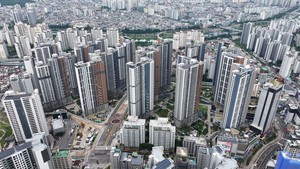
'Imun New Town hits W2b mark' as Imumdong apartment prices surge
Imunje IPark Xi's 84-square-meter unit sells for 2.06 billion won — up 560 million won in a year La Grande, Decencia asking prices also reach 2 billion won as Imumdong market reprices The price of a standard 84-square-meter apartment in Seoul's Imun New Town has climbed to the 2 billion won mark — up from around 1.5 billion won ($1.1 million) just a year ago. As newly built large complexes that were pre-sold roughly three years ago begin welcoming residents, price expectations in the area have risen sharply. According to the Ministry of Land, Infrastructure and Transport's actual transaction price disclosure system, an 84-square-meter unit at Imunje IPark Xi in Imumdong, Dongdaemun-gu sold for 2.06 billion won on Aug. 18. It was only the third time an 84-square-meter unit in Dongdaemun-gu had traded above 2 billion won, following a March deal at Raemian Eliniti in Yongdu-dong at 2 billion won (18th floor) and a July transaction at Cheongnyangni Station Lotte Castle SKY-L65 at 2.14 billion won (43rd floor). The latest deal stands out because it marks the first time a new large-scale complex in Imumdong itself — beyond the Cheongnyangni area — has crossed the 2 billion won threshold for the standard unit type. The same unit type at Imunje IPark Xi last traded at 1.5 billion won in September last year, on the 14th floor. Compared with that transaction, the price has risen 560 million won, or 37.3 percent, in a single year. Imunje IPark Xi drew attention at its general pre-sale in October 2023 for its high pre-sale prices. The average pre-sale price at the time was about 35.5 million won per 3.3 square meters, with 84-square-meter units offered at up to 1.21 billion won to 1.44 billion won depending on the unit type. Compared with the current actual transaction price of 2.06 billion won, that represents a gap of about 620 million won above the highest pre-sale price — and more than 800 million won above units offered in the 1.2 billion won range. Because its pre-sale prices were set higher than those of Raemian La Grande and Hwigung Xi Decencia, which launched pre-sales earlier that same year, the market at the time viewed the complex as expensive. Some 84-square-meter unit types failed to attract five times the number of applicants per available unit in the first-round subscription. Yet roughly three years after the pre-sale, actual transaction prices have far surpassed the 1.2 billion to 1.4 billion won range that was once considered steep, now settling in the 2 billion won range. Nearby new complexes are following a similar trajectory. An 84-square-meter unit on the 13th floor of Raemian La Grande — built on the redeveloped Imun District 1 site — sold for 1.45 billion won in September last year. The same unit type is now listed at around 2 billion won, meaning asking prices have risen about 550 million won from the actual transaction price a year ago. At the time of its 2023 pre-sale, the highest pre-sale price for an 84-square-meter unit at Raemian La Grande was 1.1 billion won. Hwigung Xi Decencia, developed through the redevelopment of Hwigung District 3, also saw its 84-square-meter unit trade at 1.37 billion won in September last year, but asking prices for the same unit type have since climbed to as high as 1.95 billion won — some 580 million won above last year's transaction price. The highest pre-sale price for an 84-square-meter unit at Hwigung Xi Decencia in 2023 was 976 million won, meaning current asking prices are approaching nearly double the original pre-sale price. "All 84-square-meter units in Imun New Town's new complexes now start at 2 billion won in asking price," said the head of a real estate agency in Imumdong who asked to be identified only by the agency's initial. "However, transaction volume has dropped sharply given how much prices have risen." Some end-users, deterred by the price increases, are shifting their attention to other neighborhoods or older apartment buildings. "A newlywed couple who had been considering a purchase a year ago came back recently, only to leave in dismay at how much prices had gone up," the agent said. "We are seeing demand divert away from Imun New Town new builds toward relatively cheaper older apartments elsewhere in Dongdaemun-gu." Apartment prices across Dongdaemun-gu as a whole have posted double-digit gains this year. According to the Korea Real Estate Board's weekly apartment market report for the second week of September, apartment prices in Dongdaemun-gu have risen 10.59 percent so far this year — the seventh-highest increase among Seoul's 25 autonomous districts. The district trails Seongbuk-gu (14.01 percent), Seodaemun-gu (11.45 percent), Gangseo-gu (11.35 percent), Guro-gu (11.32 percent), Gwanak-gu (10.80 percent) and Nowon-gu (10.73 percent). Analysts say the sharpest price gains this year among Seoul's outer districts have been concentrated in areas where large new complexes have been built. "The areas that have seen the biggest price increases this year are on Seoul's outskirts, and among those, Seongbuk-gu and Dongdaemun-gu have risen the most, driven by new builds in Jangwi-dong and Imumdong," said Ham Young-jin, head of the real estate research lab at Woori Bank. "As new pre-sale prices along the Han River have approached nearly 80 million won per 3.3 square meters this year and jeonse prices have surged, end-user demand has flowed into new towns with relatively good living conditions, and that has fed through into prices." Ham added that asking prices are high even as transaction volume remains low, and when a single deal goes through at those prices, it sets a new market benchmark. "That pattern looks likely to continue for now," he said.
Sept. 17, 2026
-
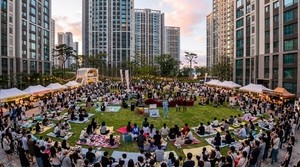
Hillstate Hwanho Park holds community event for residents
A community gathering for residents was held at Hillstate Hwanho Park in Pohang. According to the complex's developer, the "Resident Harmony Festival" was held Sept. 5 inside the complex to promote interaction and communication among residents. The event, held at Block 1 of Hillstate Hwanho Park, featured a flea market, a food zone, experience booths and a children's market. Prize draws and celebratory performances were also organized for families. Local figures attended alongside residents, including a National Assembly member from the area and officials from the city of Pohang. Attendees toured the event grounds and spent time engaging with residents. The event centered on the complex's outdoor spaces. Residents took part in the flea market and hands-on programs, watched performances and made use of the complex's facilities throughout the day. Hillstate Hwanho Park comprises two blocks and 20 buildings with a total of 2,994 units — 1,590 in Block 1 and 1,404 in Block 2. The complex rises up to 38 above-ground floors with three below-ground floors. The complex is located near Hwanho Park and features community facilities including a sky lounge, a guesthouse, a golf practice range, a fitness center and a small library. The developer said it plans to continue operating programs for residents within the complex and to create further opportunities for interaction among them. Meanwhile, the developer is currently conducting pre-sales for units it holds at Hillstate Hwanho Park.
Sept. 17, 2026
-
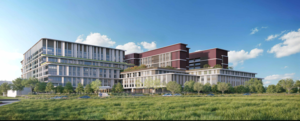
Ssangyong E&C wins record $2.15b Singapore hospital contract
Contract awarded by Singapore's Ministry of Health; Korean firm beats Japanese, Chinese rivals on technical merit Seven-building, 1,534-bed complex with three below-ground and nine above-ground floors Ssangyong Engineering & Construction has won a sole contract to build the Tengah General Hospital in Singapore, commissioned by the country's Ministry of Health, in what the company says is the largest single-project award in its history. Ssangyong E&C announced Thursday it secured the contract for approximately $2.15 billion, a sum that far exceeds the company's annual sales. Last year, Ssangyong E&C posted consolidated sales of 1.8 trillion won ($1.31 billion) and operating profit of 64.3 billion won. The hospital, to be built in the Tengah district in western Singapore, will comprise seven buildings with three below-ground and nine above-ground floors, totaling 1,534 beds. The total construction period, including the design phase, is 63 months. Designated as a key national healthcare infrastructure project for western Singapore, the facility will be operated by the National University Health System. It is planned as a large integrated medical campus incorporating cutting-edge clinical research and digital healthcare solutions. Eleven companies entered the bidding process. Ssangyong E&C was the only Korean construction company to pass the pre-qualification screening, and four firms ultimately competed in the final round. Although it did not submit the lowest bid, the company was selected after outscoring Japanese and Chinese rivals in technical evaluations covering design quality, construction risk management and hospital-project track record. Ssangyong E&C said the win is particularly significant because it was secured on the strength of technology rather than price. Hospital construction demands a high level of precision given its direct link to patient safety, and is classified as a highly complex building type — one that requires comprehensive consideration of mechanical systems, patient and staff circulation, and vibration and noise control. "This project marks the first time the Singapore government has issued a full design-and-build contract covering every phase from design to construction, which makes it enormously meaningful for construction companies operating in Singapore," a Ssangyong E&C official said. "It is the result of having our technical competitiveness — not our price — recognized, built on years of hospital construction experience accumulated in Singapore." The official added that the company plans to further strengthen its position in the Singapore construction market through a successful completion of the project. Ssangyong E&C has built up extensive local experience in Singapore through major architectural and healthcare projects. Its portfolio there includes the Marina Bay Sands hotel — an iconic structure often likened to a modern Leaning Tower of Pisa — as well as Raffles City, the W Hotel and the Grand Hyatt Hotel. In the hospital sector, the company successfully completed Woodlands Health in 2024, KK Women's and Children's Hospital in 1999 and Tan Tock Seng Hospital in 1998. It is currently working on the Alexandra Hospital project. Meanwhile, since joining the Global Saea Group in December 2022, Ssangyong E&C has been improving its business performance with the group's backing. The company has expanded its overseas order book — securing six large international projects in Dubai since 2023 worth around 1.4 trillion won ($1.02 billion) — while stabilizing its domestic and overseas project portfolio and improving both sales and profitability. Operating profit has risen for three consecutive years. The company's construction capability ranking climbed from 33rd in 2022 to 19th in 2026, a rise of 14 places.
Sept. 17, 2026
-
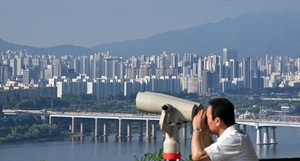
Seoul apartment prices near record winning streak as outer-district surge continues
Seongbuk-gu up 0.43%; Dongdaemun-gu, Dobong-gu also accelerate Songpa-gu, which turned negative last week, deepens its decline Seoul apartment prices have risen for 84 consecutive weeks, closing in on the all-time record of 85 straight weeks set during the Moon Jae-in administration. Seongbuk-gu has led the charge, with prices climbing 14 percent so far this year, while outer districts including Dongdaemun-gu, Dobong-gu and Jungnang-gu have also sustained strong momentum. Analysts say tightening loan regulations are pushing owner-occupiers toward more affordable units on the city's periphery. The Korea Real Estate Board's weekly apartment price survey for the second week of September — based on data as of Monday — showed Seoul apartment prices rose 0.16 percent this week, narrowing from the 0.20 percent gain recorded the previous week. The moderation was attributed to a continued flow of price-reduced listings in the three Gangnam districts — Gangnam-gu, Seocho-gu and Songpa-gu — offset by rising contract prices centered on mid-to-low-priced complexes. Surging jeonse and monthly rent prices, combined with a sharp drop in available listings, have drawn owner-occupiers including young adults in their 20s and 30s and newlyweds toward complexes priced at or below 1.5 billion won ($1.1 million), where lending restrictions are comparatively lighter. Several districts posted wider weekly gains. Dongdaemun-gu accelerated from 0.34 percent last week to 0.36 percent this week. Dobong-gu rose from 0.43 percent to 0.47 percent over the same period, and Jungnang-gu climbed from 0.40 percent to 0.51 percent. Among Seoul's 25 districts, Seongbuk-gu recorded the highest cumulative gain this year at 14.01 percent. On a weekly basis, the district rose 0.43 percent this week, slightly faster than the 0.42 percent gain posted the previous week. Several other districts also surpassed a 10 percent cumulative gain for the year: Seodaemun-gu at 11.45 percent, Gangseo-gu at 11.35 percent, Guro-gu at 11.32 percent, Gwanak-gu at 10.80 percent, Nowon-gu at 10.73 percent, Dongdaemun-gu at 10.59 percent and Jung-gu at 10.45 percent. Nam Hyeok-woo, a real estate researcher at Woori Bank, said that as high interest rates increase borrowing costs and mid-tier areas sustain prolonged price strength, owner-occupiers are moving to outer districts as their next-best option. He added that in areas such as Jungnang-gu and Dobong-gu, a shortage of jeonse and monthly rental listings — more acute than in other parts of the city — has prompted some tenants to shift toward buying. Nam said he expects price strength centered on lower-to-mid-tier Seoul districts and Gyeonggi Province, where latent demand remains deep, to continue for now. In contrast, Songpa-gu — which turned negative in September for the first time in about five months — fell 0.12 percent this week, steepening from a 0.02 percent decline the previous week. Seocho-gu and Gangnam-gu fell 0.26 percent and 0.36 percent, respectively. Gangnam-gu, which has been declining since the second week of August, has seen its cumulative gain for the year shrink to just 0.72 percent. Nam said key factors weighing heavily on capital gains tax burdens for high-priced homes — including a newly introduced cap on the long-term residency income deduction — continue to pressure sellers. He said the localized price correction centered on the Apgujeong and Banpo areas is spreading to neighboring Songpa-gu. Nam added that some Songpa-gu apartment owners looking to upgrade to properties in the two core Gangnam districts have belatedly adjusted their asking prices downward, a move he said also contributed to this week's price decline.
Sept. 17, 2026
-
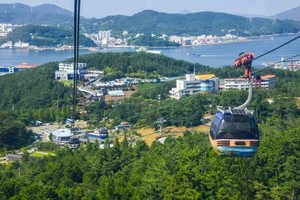
Cable cars, monorails to require re-licensing within 20 years
Ministry of Land, Infrastructure and Transport revises track transport law, tightens safety management Licensing standards and safety oversight for cable cars, monorails and other track-based transport operations will be significantly tightened under new regulations taking effect Friday. South Korea's Ministry of Land, Infrastructure and Transport said revised enforcement decrees and rules under the Track Transport Act take effect Friday, clarifying license validity periods and re-licensing criteria while strengthening safety management requirements, including the preparation and implementation of safety plans and corrective measures. The parent law was amended in March to require operators to obtain re-licensing within 20 years in order to reinforce the public-interest character of track transport businesses. The enforcement decrees and rules set out the detailed provisions. The move aims to put to rest controversy over whether operators — such as those running the Namsan cable car — had been allowed to run their businesses indefinitely on the strength of a single initial license, effectively enjoying a permanent concession. Under the revised rules, operators must apply to their local government for re-licensing no earlier than two years and no later than one year before their license expires. When granting or renewing a license, local governments will set an appropriate validity period by reviewing materials submitted by the operator, including the purpose of the operation, the type and method of service, operating plans, financing arrangements and projected annual ridership. Track operators will also be required to draw up safety management plans covering inspection and maintenance schedules, staffing and emergency procedures, and to submit any revisions or updates within 30 days of making changes. Local governments may review the adequacy of such plans and order operators to supplement, improve or correct them if they fall short. Operators that fail to establish a safety management plan or comply with a corrective order face administrative sanctions scaled to the number of violations — ranging from a 10-day, 30-day or 60-day suspension of operations to revocation of their license or approval. In addition, local governments must factor in safety inspection results, user safety considerations and the appropriateness of operating performance when setting validity periods at the time of licensing or re-licensing. The revisions also strengthen the public-interest dimension of track transport by requiring operators to submit plans for environmental conservation and the promotion of public welfare when local governments decide whether to grant or renew a license and for how long. Jo Seong-gyun, the ministry's director of railway safety policy, said track facilities had been difficult to supervise after initial licensing because management had largely been left to operators' discretion. "We expect that the legal revisions — by enhancing the safety, environmental soundness and contribution to public welfare of track transport businesses — will allow the public to use these facilities more safely," Jo said.
Sept. 17, 2026
-
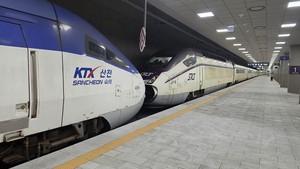
Land ministry to tighten high-speed rail safety ahead of Chuseok
Inspection to cover engineer training, crowd management and railway crime prevention The government is stepping up safety management checks ahead of the Chuseok holiday. The Ministry of Land, Infrastructure and Transport said it will hold an inspection meeting Friday morning at Suseo Station, reviewing Korea Railroad Corporation's (Korail) high-speed rail engineer training programs and examining plans to manage crowd congestion and strengthen security on trains. The ministry has conducted three on-site inspections during the high-speed rail integration process, continuously reviewing the overall safety management system, including engineer training and drill programs. Friday's meeting will follow up on those inspections by assessing Korail's earnings and implementation progress. The meeting will cover engineer recruitment in response to increased train frequency, supervised driving by experienced engineers, training programs to ensure crew members respond swiftly and appropriately to emergencies, and measures to bolster crowd management and combat railway crime ahead of the expected passenger surge during the Chuseok holiday. Particularly for major stations expected to see heavy holiday congestion — including Seoul Station, Suseo Station and Busan Station — the ministry will review plans to deploy additional safety personnel and separate passenger flow for boarding and alighting to maintain order. "Safety must be firmly in place for the high-speed rail integration to translate into tangible benefits for the public," said Jo Seong-gyun, the ministry's railway safety policy director. "The ministry plans to regularly monitor the progress of regulatory improvements to ensure Korail can establish and maintain a system that keeps railway workers — engineers and crew members alike — professionally qualified on an ongoing basis."
Sept. 17, 2026
-
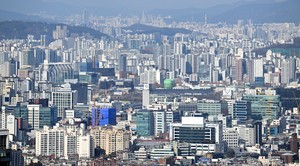
S. Korea extends owner-occupancy waiver in land-transaction zones by one year
Ministry extends move-in deferral deadline to end of next year Extension aligned with Aug. 3 tax reform to spur listings by 2027 Buyers now have until 2029 to complete move-in The deadline to apply for an owner-occupancy deferral when purchasing a tenant-occupied home in a land-transaction permit zone will be extended to the end of next year. The expanded measure will also cover lease renewals exercised under a tenant's right to request contract renewal, not just the remaining term of an existing lease. The Ministry of Land, Infrastructure and Transport said Thursday it would extend the application deadline for the owner-occupancy deferral measure — first announced in May — by one year, from Dec. 31, 2026, to Dec. 31, 2027. The government had allowed homeownership-free end-users purchasing a tenant-occupied home in a land-transaction permit zone from May 12 this year to defer moving in until the existing lease expired, rather than requiring immediate occupancy. To prevent speculative purchases, the measure imposed a strict no-homeownership requirement on buyers and required two years of actual residence after the lease ends. The one-year extension reflects the impact of the Aug. 3 tax reform package, through which the government in effect signaled to multi-home owners and holders of high-value properties to sell by 2027. The reform includes a significant tightening of residency requirements for the long-term holding special deduction for single-homeowner households starting in 2028, a new cap on the deduction, and a temporary easing of the capital gains tax surcharge on multi-home owners for 2027 and 2028. The extension responds to criticism that the government's push to bring multi-home and high-value listings to market by next year was undercut by the year-end deferral deadline, which made it difficult to trade homes still under lease. At the ruling party's floor leadership meeting on Tuesday, party leaders also strongly urged the government to ease transaction restrictions on tenant-occupied homes in land-transaction permit zones to strengthen the effectiveness of the tax reform. An amendment to the enforcement decree of the Real Estate Transaction Reporting Act incorporating the supplementary measures will be open for public comment starting Friday before taking effect Oct. 1. The changes will apply to all homes that are under lease or subject to a jeonse right as of the effective date. The existing condition requiring buyers to complete acquisition — registration — within four months of receiving a permit remains unchanged. Where the timing of tax benefits is pushed back — such as when a mandatory rental period remains on a registered rental apartment in a regulated zone, or when the transfer of cooperative membership is restricted due to reconstruction or redevelopment in a speculation-overheated zone — buyers may apply for a 15-month deferral starting from the relevant date, such as the end of the mandatory rental period or the date of a relocation notice. Beyond extending the application deadline, the amended enforcement decree significantly broadens the scope of eligible deferrals. Previously, move-in could be deferred only through the end of the current tenant's remaining lease term. Going forward, buyers will be able to defer for one additional renewal period of up to two years. Combined with the 15-month application window from the Oct. 1 effective date and the 24-month renewal period, buyers can delay move-in by up to three years and three months, meaning they must complete their move-in by 2029 at the latest. Including lease renewals in the deferral scope is intended to ease pressure on tenants to vacate due to owner-occupancy obligations and to address supply-demand imbalances and housing instability in the jeonse and monthly rent market. However, the end-user eligibility requirements and the residency obligation remain strictly in place to block speculative demand. Buyers must have no existing home ownership and must live in the property for two years after moving in. Kim I-tak, first vice minister of land, infrastructure and transport, said the measures were designed to "uphold the owner-occupancy principle of the land-transaction permit system while addressing the practical difficulties in trading tenant-occupied homes and improving housing stability for tenants." He added that the ministry would "ensure transactions remain driven by genuine end-users by maintaining the no-homeownership requirement and the two-year residency obligation, and thoroughly block speculative demand."
Sept. 17, 2026
-

Korea Expressway Corporation uses AI to crack down on toll evaders
Habitual toll dodgers face surcharges 10 times the original fee Korea Expressway Corporation said it is stepping up enforcement against habitual and deliberate toll evaders while expanding payment options for ordinary drivers, as unpaid highway tolls continue to rise. Vehicles that fail to pay tolls 20 or more times within a year face a surcharge of up to 10 times the original toll amount. For repeat or high-value delinquents, the corporation is pursuing strong legal and administrative measures, including bank account seizures, forced vehicle impoundment and criminal referrals. The corporation also plans to use AI technology to predict and track the movements of vehicles with unpaid tolls, further improving enforcement efficiency. The impact of AI-assisted enforcement has grown sharply. Before the technology was introduced, enforcement efforts recovered around 1.3 billion won ($950,000) in 2023. Last year, that figure jumped to approximately 2.28 billion won. The corporation is also expanding joint crackdowns with the Korean National Police Agency and local governments, and is pushing to introduce a license plate confiscation regime for habitual evaders. Such joint enforcement is already permitted under several existing laws, including the Local Tax Act, the Act on the Regulation of Violations of Public Order, the Compulsory Automobile Liability Security Act, the Road Traffic Act and the Automobile Management Act. When a missed payment stems from a simple mistake or oversight, the corporation said it will notify drivers promptly to prevent the debt from growing and make it easier to settle unpaid tolls quickly. Payments can be made at Korea Expressway Corporation offices and highway rest stops, as well as at convenience stores nationwide. Drivers can also pay through the corporation's website, its mobile app, the National Secretary platform and other private apps, or by calling its customer center. The corporation also plans to send immediate notifications via KakaoTalk alerts and public and private app notifications whenever a toll goes unpaid, to encourage prompt settlement. "Going forward, we will establish a virtuous cycle of management — preventing missed payments before they occur, providing swift notification, enabling convenient payment and responding firmly to habitual evasion — to reduce the number of unpaid tolls at the source," a Korea Expressway Corporation official said.
Sept. 17, 2026
-
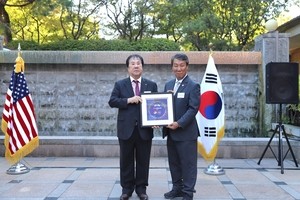
SM Group chairman receives Korea-US Alliance Foundation's corporate supporter award
SM Group has backed alliance activities through private-sector cooperation, including providing hotel accommodations SM Group Chairman Woo Oh-hyun has received a corporate supporter plaque from the Korea-US Alliance Foundation in recognition of his private-sector efforts to advance the Korea-US alliance. SM Group announced Thursday that Woo received the plaque from Foundation President Lim Ho-young at a sponsor meeting held Wednesday by the Korea-US Alliance Foundation and the Korean Defense Veterans Association (KDVA) at Dragon Hill Sables in Yongsan-gu, Seoul. The corporate supporter plaque is awarded to companies that have backed the foundation's activities and contributed to strengthening the alliance. The Korea-US Alliance Foundation has previously presented the plaque to major sponsors including Hanwha and SK Group. SM Group has supported the foundation's key activities and events, including the Korea-US Alliance Forum. The group also backed private-sector exchange programs, providing Hotel Top10 Gangneung as accommodation for a spouses' program jointly run by the Korea-US Alliance Foundation and the KDVA. "The Korea-US alliance is the bedrock that has safeguarded South Korea's security and peace on the Korean Peninsula," Woo said. "I am deeply grateful to everyone who has dedicated themselves to the alliance from their respective positions." He added that the private sector and businesses have a role just as important as that of the government and military in advancing the alliance. "SM Group will continue to offer its full support and cooperation for the sustained development of the Korea-US alliance and the promotion of friendship between the two countries," he said. The event drew about 40 attendees, including Foundation President Lim Ho-young, board chairman Yoo Myung-hwan, former Joint Chiefs of Staff Chairman Jung Seung-jo, honorary board chairman Lee Geon-su, SM Group Chairman Woo Oh-hyun and Misto Holdings Chairman Yoon Yoon-soo, along with other Korea-US Alliance Foundation and KDVA officials and representatives of sponsoring companies. Meanwhile, Samwhan, SM Group's construction arm, opened a model home Friday for "Hwaseo Station Lake Park Honorsville," a housing development in Seodun-dong, Gwonseon-gu, Suwon, Gyeonggi Province, kicking off its pre-sale schedule.
Sept. 17, 2026
-
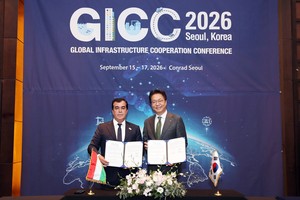
Korea National Railway signs MOU with Tajikistan at GICC 2026
Back-to-back meetings with 9 agencies from 8 countries, including Laos and Panama Korean transit-oriented development model showcased to overseas clients Korea National Railway said Thursday it had expanded railway cooperation with major overseas clients and partner agencies at the Global Infrastructure Cooperation Conference (GICC) 2026, held at the Conrad Seoul in Yeouido from Tuesday through Thursday, strengthening the foundation for Korean railway's advance into international markets. Hosted by the Ministry of Land, Infrastructure and Transport and organized by the Overseas Construction Association of Korea, GICC is an international forum that brings together senior officials — including ministers, vice ministers and CEOs — from major overseas project owners alongside domestic agencies and companies to build cooperation on global infrastructure projects. During the conference, Korea National Railway organized a transportation cooperation seminar and delivered a presentation on Korea's transit-oriented development (TOD) model. The session allowed the agency to share Korea's experience integrating railway development with urban planning to improve accessibility and raise the value of transit-oriented areas. In addition, Korea National Railway signed an MOU with Tajikistan's national railway, agreeing to pool efforts in four areas: sharing information and providing advice on railway project issues, exchanging information and technology in the railway sector, strengthening the capacity of railway professionals, and operating a working-level consultative body to identify areas for cooperation. The agency had previously signed a railway cooperation MOU with Tajikistan's Ministry of Transport in 2022. With this latest agreement extending that framework to Tajikistan's national railway operator, Korea National Railway said it plans to intensify bilateral exchanges and working-level consultations to actively pursue opportunities to participate in local railway projects. Alongside the MOU signing, the agency held a series of meetings with senior overseas officials, including Laos' minister of public works and transport and the director general of Panama's national railway authority. The talks covered local railway and transport infrastructure development plans and the status of key projects, while exploring multiple avenues for cooperation drawing on Korea National Railway's technical expertise and project management capabilities. Korea National Railway engaged with nine agencies from eight countries at this year's GICC, significantly broadening its network of key project owners. The agency said it will continue to identify promising railway projects based on outcomes from the MOU and bilateral meetings, and will actively support Korean companies in entering global markets. "GICC is an important venue for gauging infrastructure development needs across countries and finding new possibilities for cooperation," Korea National Railway Chairman Jung Jin-hyuk said. "We will do our utmost to further solidify trust with major project owners through this event, and to ensure that the outstanding technology and experience of Korean railway translates into greater results and opportunities in overseas markets." Meanwhile, Korea National Railway on Wednesday unveiled a new management philosophy called "BASE: Building the Future on Fundamentals and Principles." The acronym stands for Best Safety, Accountable Fairness, Systematic Field and Evolving Mobility — the four management directions Jung emphasized when he took office Sept. 1.
Sept. 17, 2026
-

Government holds firm on Yongsan Park housing; Seoul city hall pushes alternative sites
Hong Ji-sun says Yongsan Park and alternative sites are separate issues, leaving supply option open Seoul proposes additional sites including Jungnang-gu and Mapo-gu rail depots Experts say it is time to formalize public debate on site selection If Hong Ji-sun is confirmed as minister of land, infrastructure and transport, stalled negotiations between the ministry and the Seoul Metropolitan Government over housing supply sites are expected to resume in earnest. The central government has kept open the possibility of using part of Yongsan Park for housing, while Seoul city hall has been pushing the discussion away from Yongsan by proposing a series of alternative sites, including rail depots in Jungnang-gu and Mapo-gu. Hong also signaled at her confirmation hearing that she would pursue housing development at Yongsan Park if there is public consensus, making it a key question how the two sides will find common ground on where to build youth housing. At her confirmation hearing at the National Assembly on Wednesday, Hong said that converting the former US military base in Yongsan into a park remains the guiding principle, but added that "if there is public consensus, I believe we can pursue the question of whether there is room to supply housing for future generations and young people in the peripheral areas." The remarks suggest the government is still considering the Yongsan Park area as one of its primary housing supply candidates. In a written response submitted ahead of the hearing, Hong said the Yongsan Park site and the Tancheon water reclamation center site — which Seoul Mayor Oh Se-hoon has proposed as an alternative — should be treated as separate questions, and that it was necessary to examine whether the Yongsan site could independently contribute to housing stability for future generations. While the central government leans toward Yongsan, Seoul city hall has been actively seeking alternatives. At its "Global Top 3 Seoul Plan" announcement last Friday, the city proposed three additional substitute sites beyond the Tancheon location: the National Institute of Health site in Eunpyeong-gu, the Susaek rail depot in Sangam-dong, Mapo-gu, and the Sinnae rail depot in Jungnang-gu. The city envisions developing these sites into "Youth Future Towns" that combine residential and industrial hubs, aiming to address both the housing shortage and the jobs crisis at the same time. Lee Chang-moo, a professor of urban engineering at Hanyang University, said the Yongsan Park site carries hidden variables that are difficult to schedule — including negotiations with the US military and soil decontamination — whereas the sites proposed by Seoul have relatively clear procedural paths, allowing for faster project execution. "There is also a meaningful difference in that the concept is not simply about supplying housing, but a mixed-use development combining residential, employment and lifestyle infrastructure," he added. The sites Seoul has proposed differ fundamentally from the Yongsan Park land in that they are not new development targets but extensions of urban planning the city has already been pursuing. Among them, the National Institute of Health site in Eunpyeong-gu — a city-owned parcel designated as the lead project site — was put up for sale last year at around 450 billion won ($329 million) as part of a creative industry hub initiative, but the auction drew no bids. The city plans to relaunch the sale and eventually develop the site into a youth innovation district combining youth housing, startup spaces, a job center and cultural facilities. The Susaek rail depot in Sangam-dong, Mapo-gu, is an area where the city has long envisioned large-scale mixed-use redevelopment. Seoul has sought to turn it into a growth hub for the city's northwestern corridor in connection with the Sangam Digital Media City, but the project has been deadlocked due to friction among local governments, requiring coordination with Goyang and Korail. For Seoul, having the site designated as a youth housing supply location would give the project fresh momentum while also delivering housing units — two goals at once. For the Sinnae rail depot in Jungnang-gu, a study on development strategy and master planning for the surrounding area was launched this year, with work underway to map out a development approach linking office, transportation, residential and commercial functions. The site is also close to the parcel where the Seoul Housing & Communities Corporation is planning to relocate its headquarters. However, if development proceeds simultaneously with the Taereung Golf Course — where the government is pushing to build 6,800 homes — the projects would require a more comprehensive regional and local transportation plan. The city has said it is too early to estimate specific housing unit counts for these sites. Park Hap-su, an adjunct professor at Konkuk University's graduate school of real estate, said all the proposed sites — including the Sinnae rail depot, which serves as a prime eastern gateway to Seoul, as well as the Susaek depot and the National Institute of Health site — have strong locational advantages. "It appears Seoul has put forward a sufficiently robust set of alternative supply site options," he said. Experts say that as the debate over youth housing supply sites drags on, the discussion needs to be formalized through a public deliberation process. One real estate expert said that with public opposition to Yongsan development already confirmed, no proper public consultation schedule has yet emerged. "It is time to step away from the turf war between the Ministry of Land, Infrastructure and Transport and Seoul city hall and focus on reaching a rational solution," the expert said. Park also stressed that establishing public consensus on whether the government should break with the principles of the Special Act on Yongsan Park to supply youth housing must come first. "A formal public opinion-gathering process, such as a public hearing, needs to happen as soon as possible," he said.
Sept. 17, 2026
-
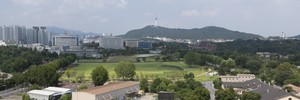
'12,000 units possible even without children's garden' — government, ruling camp push Yongsan housing plan
Government and ruling camp review supply options including Camp Coiner site; 12,000 units seen immediately available, with up to 28,000 possible in the medium to long term The government is reviewing plans to expand housing supply in the Yongsan area, including on the Camp Coiner site returned by the US military. Even without converting the Yongsan Children's Garden into residential land, the government could immediately supply more than 12,000 units by using sites it already controls — including the former Defense Acquisition Program Administration (DAPA) headquarters, military apartment complexes, officer quarters and Camp Coiner. If medium- to long-term candidate sites are also included, the total could exceed 28,000 units, giving fresh momentum to discussions on Yongsan housing supply. Yongsan Park seen able to yield 12,000 units immediately, 28,000 over the longer term Democratic Party lawmaker Yun Jong-gun, a member of the National Assembly's Land, Infrastructure and Transport Committee, released estimates Thursday based on data submitted by the Ministry of Land, Infrastructure and Transport. Applying floor-area ratios equivalent to quasi-residential and second-class general residential zones to some of the government's Yongsan sites and building apartment units of 82.95 square meters each could yield a total of 12,453 units immediately, the estimates showed. The first-phase candidate sites for rapid supply are Camp Coiner, Officer Quarters Complex 5, the former DAPA headquarters site and military apartment complexes. Camp Coiner, returned in 2022 and covering about 97,000 square meters, is estimated to yield about 5,847 units. Officer Quarters Complex 5 could provide 3,134 units, the former DAPA headquarters site 2,315 units, and the military apartment complexes 1,157 units. Combined, the four sites total 12,453 units. Particularly notable is that more than 10,000 units can be secured without converting the Yongsan Children's Garden into residential land. The children's garden has long been the most sensitive point in Yongsan housing discussions, with concerns that development there could damage the surrounding landscape, including views from the National Museum of Korea. Expanding the candidate sites to include medium- to long-term options would push the total above 28,000 units. Adding amenity facilities near the War Memorial of Korea, non-commissioned officer quarters, schools, a hospital and Officer Quarters Complexes 4 and 7 as additional candidate sites could yield a further 15,973 units, according to the lawmaker's office. Combined with the first-phase sites, the total would reach 28,426 units. However, some of the additional candidate sites require soil decontamination, relocation of existing facilities or consultations with the US military, making it difficult to advance those projects in the short term. Within the government, officials are said to be discussing prioritizing sites where conditions are relatively more favorable and pursuing the rest in stages. Yun said the unit figures were "a simple estimate to gauge the potential scale of supply based on each site's area, applicable floor-area ratio and public rental housing type," but added that "even if the supply volume is adjusted downward due to factors such as views, preservation facilities, infrastructure, roads and building layout, a 10 percent reduction would still allow 25,600 units and a 20 percent reduction 22,700 units — meaning at least 20,000 units can be supplied." Minister nominee Hong vows site visit with housing experts; Seoul consultations in focus Voices within the ruling camp continue to call for using the returned Yongsan sites to supply public housing for young people and newlyweds. The sites are seen as a strong housing supply option because they represent large-scale public land in a prime Seoul location where the central government can determine the development plan directly, without relying on private redevelopment projects. Democratic Party lawmaker Kim Nam-geun argued at the confirmation hearing for Land Minister nominee Hong Ji-sun on Wednesday that the government should engage more actively with the Seoul Metropolitan Government on Yongsan housing supply. "The previous land minister and Seoul worked to address Seoul's housing shortage, but I get the impression the ministry was too passive," Kim said. "There are things the central government needs to obtain through consultations with Seoul, and I do not think taking a negotiating posture is the right approach for the central government." Earlier, Kim had also argued at a Democratic Party Seoul chapter special committee meeting on housing supply policy that the government should consider supplying 13,000 to 20,000 youth housing units on the outer edges of the main Yongsan Park site. As discussions between the government and the ruling camp on Yongsan housing supply resurface, consultations with the Seoul Metropolitan Government are seen as the key variable going forward. The central question is how much of the site can be used for housing while preserving the existing plan to develop Yongsan Park as a public green space. Whether the government will move into full-scale on-site reviews and Seoul consultations after Hong takes office is also drawing attention. At Wednesday's confirmation hearing, when Yun proposed that Hong visit the Yongsan Park site together with housing experts, the nominee said, "I will look into doing that." Experts agree that any plan premised on building housing in Yongsan Park requires extensive deliberation and broad social consensus. Some also say the overall urban development framework — including expanding both housing and green space — must be considered together. Lee Chang-moo, a professor of urban engineering at Hanyang University, said Yongsan Park is "land where no one knows what will happen once ground is broken," adding that "it is not a place where supply can be accelerated, given secondary issues such as soil contamination." He added that "the entire framework of Yongsan urban development, including the Yongsan International Business District, would need to be revised," and that "sufficient deliberation and social consensus appear to be necessary."
Sept. 17, 2026
-
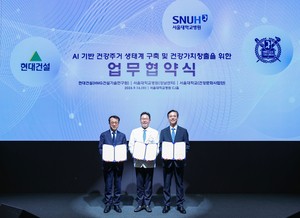
Hyundai E&C teams up with Seoul National University Hospital, SNU to develop AI-based healthy housing model
First industry-academia-hospital tripartite collaboration in Korean construction sector Joint research to develop lifestyle data-driven residential health services Hyundai Engineering & Construction will jointly develop an AI-based healthy housing model with Seoul National University Hospital and Seoul National University. Hyundai E&C signed a memorandum of understanding with the two institutions Wednesday at Seoul National University Hospital in Jongno-gu, Seoul, to build an "AI-based healthy residential ecosystem and create health value." The signing ceremony was attended by Hyundai E&C CEO Lee Han-woo, Seoul National University Hospital Director Baek Nam-jong and Seoul National University Health Culture Project Director Yoon Young-ho, along with other key officials. The three organizations outlined plans to develop a personalized AI precision-health service that links health checkup results with lifestyle data — including sleep patterns, physical activity and daily routines collected from residential spaces — to analyze individual health conditions and risk factors and support improvements in health behavior. The collaboration aims to build a new residential service model that goes beyond diagnosing and treating disease to support everyday health management and extend healthy life expectancy. The agreement marks the first industry-academia-hospital tripartite collaboration in the domestic construction sector, with a construction company, a university hospital and a university joining forces to develop an AI-based healthy housing model. The three partners plan to combine Hyundai E&C's expertise in residential living, Seoul National University Hospital's medical capabilities and Seoul National University's research strengths to jointly realize a next-generation healthcare model spanning health checkups, health behavior improvement and healthy housing. Key areas of collaboration include developing a residential health service model using health checkup data and lifestyle data, building an AI-based healthy housing platform that integrates health checkups, health management and precision health medicine, developing holistic health management services covering sleep, exercise, nutrition and mental wellness, and establishing and operating a pilot complex for healthy housing services. Hyundai E&C plans to conduct a pilot project based on the joint research findings to verify the effectiveness and applicability of the services in real residential environments. Services that pass verification will be developed into products applicable to the company's residential brands, expanding living spaces into everyday health management platforms. "This agreement is the first step toward building a preventive healthcare ecosystem that links health checkups, health behavior and healthy housing into a single framework to support residents' sustainable health management," a Hyundai E&C official said. "We will combine the smart residential technology of HMG Construction Technology Research Institute, the medical expertise of Seoul National University Hospital, and Seoul National University's research capabilities in health behavior, healthy life expectancy and health community culture to deliver differentiated residential services that contribute to healthy living and longer healthy lives." Meanwhile, Hyundai E&C is also advancing AI-powered digital residential solutions. Last year, the company signed an MOU with Soldoc, a remote medical solution specialist, to develop an AI chatbot-based remote health management solution for residents of apartment complexes.
Sept. 17, 2026
-
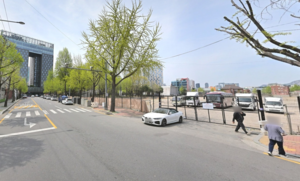
DDP area to become K-culture hub; Yonsei University to build new medical school
Entertainment firms to receive up to 200% floor-area ratio incentive; hotels up to 240% New AI convergence college, cardiovascular center also planned The area around Seoul's Dongdaemun Design Plaza is set to be transformed into a K-culture hub anchored by entertainment companies, performance venues and tourist hotels. Yonsei University's Sinchon campus will also see the construction of an innovation complex housing an AI convergence college and a cardiovascular specialty clinic, along with a new medical school building. The Seoul Metropolitan Government said Wednesday it approved, with modifications, a plan to designate redevelopment zones and set improvement guidelines for the DDP 1, 2 and 3 urban renewal projects at its 15th Urban Planning Committee meeting. The redevelopment sites cover the Euljiro 6-ga area, the vicinity of Sindang-dong 773 and the area around Euljiro 299. Once the heart of Dongdaemun's fashion industry, the district has seen its commercial vitality erode under pressure from the growth of online shopping and the advance of Chinese e-commerce platforms. The city said vacancy rates at some fashion arcades in the area have exceeded 70 percent. The city plans to turn the DDP area into a K-culture hub through private-led redevelopment, concentrating entertainment industry tenants alongside tourism and cultural facilities. Developers that bring in entertainment companies will receive a floor-area ratio incentive of up to 200 percent, with an additional allowance of up to 50 percent available for securing beauty or fashion tenants. Tourist hotels and K-content experience facilities will also be expanded. Developers introducing three-star or higher tourist hotels will receive incentives of up to 150 percent of the permitted floor-area ratio or up to 240 percent of the maximum floor-area ratio, depending on scale. Tourist information centers and luggage storage facilities will qualify for incentives of up to 100 percent, as will K-content interactive entertainment facilities. Registered performance venues will be allowed an additional building height of up to 20 meters. A 30-meter-wide east-west green corridor linking DDP to the Sewun district will also be created. It will connect to a north-south green axis running between Jongmyo Shrine and Namsan, expanding parks and open green spaces throughout the area. Along Jangchungdan-ro, the city will encourage the creation of nighttime streetscapes using media facades and similar installations. However, the improvement plan serves as a master plan setting the framework for future private redevelopment projects; the specifics of individual projects will be finalized through resident proposals and subsequent procedures. Two large-scale education and medical facilities will also be built at Yonsei University's Sinchon campus, following approval by the same committee on Wednesday. On the site of the existing alumni hall, an innovation growth complex will rise to 17 above-ground floors with a total floor area of approximately 109,000 square meters. The building is planned to house an AI convergence college and a cardiac and cerebrovascular specialty clinic. The innovation complex will also include about 13,000 square meters of community-benefit facilities, among them an AI career exploration and startup education program open to local youth, a community cultural classroom and a shared parking facility. On the site of the existing Allen Hall and the Yonsei Medical Center administrative building, a new medical school will be constructed to 11 above-ground floors with a total floor area of approximately 97,000 square meters. The medical school is scheduled to break ground in June next year and be completed in June 2030, while the innovation complex is set to begin construction in March 2028 and be completed in August 2031. "We plan to support urban planning that reshapes the DDP area into a mixed-use space combining a K-culture-centered tourism and cultural hub with green spaces, while helping Yonsei University expand its education, research and medical functions," a Seoul Metropolitan Government official said.
Sept. 17, 2026
-
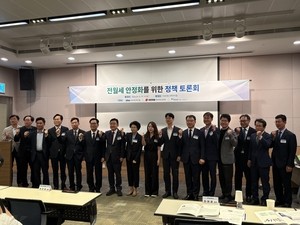
HUG's jeonse trust program tops W1tr in commitments
LH, AMC agreements push potential pipeline to 2-3 trillion won Mortgage guarantee ceiling hike, bond securitization under review HUG chief: 'We will invest in PF projects we have guaranteed' The government's new jeonse-and-monthly-rent trust program has surpassed 1 trillion won ($731 million) in commitments, officials said. Korea Housing and Urban Guarantee Corporation President Choi In-ho made the announcement Wednesday afternoon at a policy forum on jeonse and monthly rent stabilization held at FKI Tower in Yeongdeungpo-gu, Seoul. "Commitments to the trust program — including from Korea Land and Housing Corporation rental housing and asset management companies — have now exceeded 1 trillion won, with a potential pipeline of 2 to 3 trillion won already secured," Choi said. Choi outlined the structure and benefits of the program at the forum. Under the scheme, HUG enters into a three-way agreement with landlords and tenants to convert market-rate monthly-rent units into jeonse supply. HUG collects tenants' jeonse deposits, manages them through a fund, and pays landlords a fixed monthly amount from the returns. The fund's capital will be invested in project financing loans to help expand housing supply. "The current jeonse guarantee system provides relief after the fact, but the trust program is a preventive measure that protects deposits from the outset — making a zero-incident rate achievable," Choi said. "Tenants, landlords and the broader public and market all stand to benefit." Because participation is voluntary, securing sign-ups from both landlords and tenants is the program's top priority. Landlords in particular face a significant reduction in liquidity by entrusting their jeonse deposits to HUG, making tangible incentives essential. Choi said a return of around 4.35 percent per year is the likely rate, and that participants would be exempt from the mandatory rental deposit guarantee, reducing fee burdens. As an example, a landlord who entrusts a 300 million won jeonse deposit to HUG would receive roughly 1.09 million won per month. HUG also said properties with existing collateral mortgages would be eligible for the program, which it expects to ease recruitment of participants. HUG is also pursuing a reduction in the current 14 percent rental income tax. "We have reached an agreement with the Ministry of Economy and Finance and others on the cut," Choi said. "A specific figure has not been finalized, but a single-digit rate is the likely outcome." Landlords who relocate from regulated areas such as Seoul to other regions would also be able to continue receiving a housing pension of 1 to 3 percent per year on top of trust returns. To ease the liquidity strain on corporate rental housing operators joining the program, HUG plans to offer mortgage guarantee support — raising the ceiling from the current 60 percent of appraised value to 70 to 75 percent to facilitate smoother financing. The corporation is also considering securitizing four years' worth of monthly payments into bonds for sale on the securities market. Tenants, meanwhile, would benefit from protection against jeonse fraud and lower housing costs, as well as access to low-interest loans. "We plan to work with commercial banks to launch a low-interest jeonse loan product exclusively for tenants enrolled in the trust program," Choi said. Following the presentation, a panel discussion moderated by Jin Mi-yun, a professor at Myongji University's Graduate School of Real Estate, drew both optimism and concern about the trust program ahead of its planned landlord and tenant recruitment drive later this month. Kim Jong-eon, head of the policy management division at the Korea Housing Builders Association, said member companies have consistently raised concerns that the program could eventually become mandatory. "The principle of voluntary participation must be maintained so that operators can freely choose between stable returns and securing their own capital," Kim said. Kim also called for easing conflicts with existing regulations on multi-home owners. He proposed that when a landlord purchases a non-apartment property as a condition of joining the trust program, that property should be excluded from the home count for acquisition and capital gains tax purposes and from the comprehensive real estate tax base. Lee Dan-bi, chairperson of the Jeonse Fraud Victims' Committee, said tenant demand would be high but warned that the program would be meaningless — no matter how safe — if the actual supply of trust-backed jeonse units on the market remains extremely limited. "Offering additional benefits to long-term participating landlords could help establish a sustainable long-term jeonse supply structure," she added. Concerns were also raised about potential losses in managing the deposits. Choi said HUG would lend only to project financing sites it has already guaranteed. "We have provided more than 50 trillion won in guarantees since 2013, and the incident rate has been no more than 0.8 percent," he said. "Even in the event of a total loss of principal, the state would ultimately bear responsibility," he added. HUG will hold an inauguration ceremony Tuesday to formally launch the jeonse and monthly rent stabilization body. Landlord and tenant recruitment is set to begin later this month, with contracts and move-ins scheduled from January. The housing supply activation fund will select a managing financial institution by December, with investor recruitment and full operations to begin next year.
Sept. 17, 2026
-
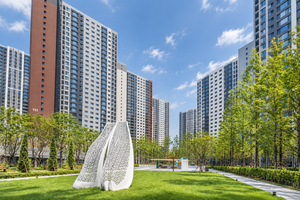
Hanwha Forena ranks 3rd among apartment brands expected to grow in survey
Urban redevelopment contracts this year top 1.3 trillion won, surpassing full-year 2025 tally Hanwha Forena, the residential brand of Hanwha's construction division, has placed near the top of multiple domestic apartment brand surveys in recent months. According to Hanwha's construction division, Forena ranked third in the "brands expected to grow" category of an apartment brand image survey conducted by real estate data firm Real Estate 114 among 2,843 consumers nationwide. Hyundai Engineering & Construction's Hillstate led with 37.4 percent, followed by GS Engineering & Construction's Xi at 33.6 percent, with Forena close behind at 32.2 percent. Forena was launched in 2019. The company said it is the only brand introduced by any of the top 20 construction companies by construction capability assessment over the past decade or so to have broken into the top three of the growth-expectations category in this survey. In the 2026 Apartment Brand Quality Index (ABQI) conducted by Gallup Korea, Forena ranked fifth overall. The ABQI measures interior and exterior space satisfaction among residents of branded apartment complexes built by top-ranked construction firms. Forena scored 87.6 points in the interior materials and finishing quality category, placing second. The brand also drew relatively strong marks for design. In the Real Estate 114 survey, consumers most commonly associated Forena with the word "sophisticated," and 15 percent of respondents cited it as their top choice for exterior design. Hanwha's construction division said it has been reinforcing brand differentiation by applying Forena's signature design not only to building exteriors but also to entrances, landscaping, community spaces and elevators throughout its complexes. The division has also been expanding its urban redevelopment business. Its cumulative urban redevelopment contracts this year reached about 1.3 trillion won ($961 million), surpassing last year's full-year total of about 770 billion won. This year's wins include the Seokgwan-dong row-housing zones 1-1 and 1-7, the Sindaebang transit-oriented area and Busan's Yeonji 3 zone. The company said that if it also secures the Haan Jugong 5 complex — a project worth around 1 trillion won — its total urban redevelopment contracts for the year would exceed 2 trillion won. "It is significant that Hanwha Forena has been consistently placing near the top of brand surveys, as it shows consumers are recognizing the brand's competitiveness," a company official said. "We will continue to strengthen Forena's differentiated design and product competitiveness going forward." Meanwhile, Hanwha's construction division plans to launch pre-sales in October for Hanwha Forena Jije Station, a large-scale complex of more than 1,000 units in Segyo-dong, Pyeongtaek, Gyeonggi Province.
Sept. 17, 2026
-
Lotte E&C repays W1.2tr in senior debt from 'Project Charlotte' fund
Key project sites complete shift to permanent financing; contingent liabilities at 2.4 trillion won Second-quarter operating profit surges 230% to 122.4 billion won in earnings surprise Lotte Engineering & Construction is accelerating efforts to strengthen its financial position by dramatically reducing contingent liabilities tied to real estate project financing. The builder has repaid a large portion of borrowings under "Project Charlotte," a project financing fund established at the group level, while also posting strong first-half earnings — a combination analysts say has bolstered both its financial stability and core business competitiveness. According to the construction industry, Lotte Engineering & Construction completed full repayment of the 1.2 trillion won in senior-tranche borrowings under Project Charlotte — a 2.3 trillion won project financing fund established in March 2024 — at the end of August. Project Charlotte was structured at launch with three tranches: 1.2 trillion won in senior debt, about 400 billion won in mezzanine debt, and about 700 billion won in junior debt, with five banks participating as senior lenders. The fund underwent a 1.9 trillion won refinancing in July last year that lowered its borrowing costs, and the full repayment of senior debt this year has dramatically reduced the company's financial burden, analysts said. The rapid clearance of large-scale contingent liabilities was underpinned by the successful conversion of key project sites to permanent financing. Lotte Engineering & Construction secured a total of 1.5 trillion won in permanent project financing and launched pre-sales at Sangdong-yeok Lotte Castle Signature in Bucheon, Gyeonggi Province — built on the site of the Homeplus Sangdong branch. A development project on the site of the Homeplus Dongdaemun branch in Yongdu-dong, Seoul, also recently completed 350 billion won in fundraising and is now ready to proceed with a 49-story mixed-use residential complex. The company also completed permanent financing conversions without disruption at other key sites, including Ssangnyeong Park in Gwangju, Gyeonggi Province, and the Hyangnam Sangsin district in Hwaseong, sharply reducing its overall contingent liability exposure. The remaining borrowings under Project Charlotte currently stand at around 1 trillion won ($739 million). Lotte Engineering & Construction plans to make additional repayments and restructure the fund by year-end, bringing the balance down to the 800 billion won range and further strengthening the fund's stability. As of the end of August, Lotte Engineering & Construction's total contingent liability balance stood at around 2.4 trillion won. The company expects to cut that figure by an additional 200 billion won by year-end, bringing it down to the 2.2 trillion won range. Credit support extended by affiliates for the fund's senior and mezzanine tranches has also fallen sharply. The affiliate credit exposure stood at 1.6 trillion won when the fund was established; as of the end of August it had dropped to the 300 billion won range — a reduction of about 1.3 trillion won — substantially easing the burden on group affiliates. The financial stability built through contingent liability reduction is compounding with a rebound in core business earnings. Lotte Engineering & Construction posted second-quarter operating profit of 122.4 billion won, a 230% surge from the same period a year earlier, delivering an earnings surprise. First-half cumulative operating profit reached 172.3 billion won, surpassing the company's full-year operating profit for last year of 105.4 billion won in just half the time. Cost-control efforts pushed the second-quarter cost ratio down to 88.8%, while the debt-to-equity ratio held at a stable 162.8%. "Through the successful conversion of key project sites to permanent financing and rigorous risk management, we were able to dramatically reduce our contingent liability burden," a Lotte Engineering & Construction official said. "In the second half as well, we will continue to pursue sound management and profitability-focused project execution to further solidify the trust of financial markets and lay the groundwork for sustainable growth."
Sept. 17, 2026
MOST READ
- 1Hyundai Motor unveils all-new Tucson with bigger body, smarter tech after 6-year wait
- 2Flat sneakers are back: Why Nike is reviving a 55-year-old running shoe
- 3Pope Leo XIV declines French honors and banquet, accepts only private meeting with Macron
- 428 illegal sports streaming sites found operating freely despite repeated blocks
- 5What was Rachmaninoff's performance fee? A 1928 price list tells all
- 6Samsung Biologics union's show of force backfires at the bargaining table
-
WORLD

US warns of punishment for anyone enabling Iran's Strait of Hormuz toll scheme
-
INDUSTRY
Toyota union puts productivity first; Hyundai Motor union demands bigger share of profits
-
FINANCE
National Growth Fund to invest $531M in FuriosaAI, which rebuffed Meta's $800M takeover bid
-
INDUSTRY
Korea Shipowners' Association holds amateur baduk tournament for Maritime Day