
42 bases targeted for decontamination since 2008
Yongsan's Camp Kim alone cost 30.6 billion won to clean up
Community opposition has delayed some sites, with costs and timelines varying widely
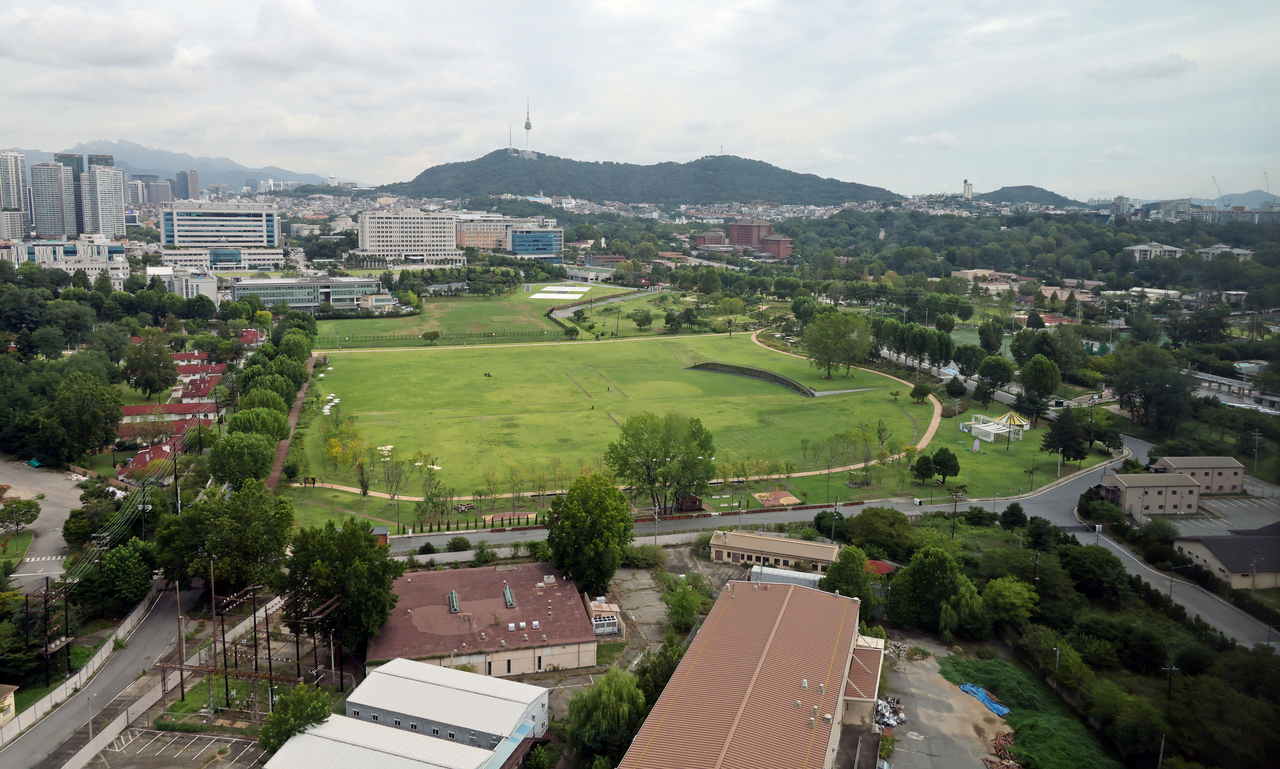
Nearly 600 billion won ($448 million) in taxpayer money has gone toward decontaminating US military bases returned to South Korea since the 2000s. Concerns are mounting that Yongsan Park — long used as a US military site and now under consideration for housing development — could see cleanup costs and timelines balloon depending on its contamination levels.
According to data on the state of contamination cleanup at returned USFK bases, obtained from the Ministry of National Defense by the office of People Power Party Rep. Sung Il-jong, a member of the National Assembly's National Defense Committee, the ministry has spent 576.2 billion won since 2008 to decontaminate a total of 42 returned bases, as of the end of August.
That marks an increase of more than 200 billion won from September 2024, when 21 bases had been returned and cleanup costs stood at 370.5 billion won, according to an analysis at the time by the office of then-Democratic Party lawmaker Choo Mi-ae.
Among them, Camp Kim, a major returned base in Yongsan, cost 30.6 billion won to decontaminate. Cleanup at three other Yongsan-area sites — the 8th Army Religious Retreat, Niblo Barracks and the Seobinggo site — cost a combined 15.2 billion won. These three sites are among the 12 bases nationwide whose return was decided at the 201st SOFA Joint Committee meeting in December 2020.
Cleanup costs and timelines varied widely across sites, ministry data showed. Decontaminating the 5,000-square-meter Seobinggo site took about 40 months, from August 2021 to December 2024 — nearly a year longer than the six-times-larger Niblo Barracks (30,000 square meters), which was cleaned up from August 2021 to September 2023. The Seongnam Golf Course in Hanam, Gyeonggi Province, returned in December 2020, is scheduled for cleanup through February 2028 at a cost of 82.1 billion won.
Camp Kim, whose cleanup was originally scheduled to finish this month, took longer than expected after cultural artifacts were discovered during decontamination work. The 50,000-square-meter site's cleanup began in August 2021, was suspended for a cultural heritage survey, and has now stretched to about five years, with completion nearing. Soil decontamination costs at Camp Kim, initially estimated in 2021 at around 10 billion won, have since risen into the 30-billion-won range because of the extended timeline and other factors.
Some sites have yet to see cleanup work begin, depending on when they were returned and their individual characteristics. Zone C (60,000 square meters) of Camp Market in Incheon, formerly a sewage treatment lot, was decontaminated in about four months at a cost of 50 million won. But Zone D (230,000 square meters), the site of a former bread factory returned in December 2023, still has no confirmed cleanup timeline or cost. Camp Red Cloud in Uijeongbu (830,000 square meters), returned in February 2022, also has no cleanup cost set because basic and detailed design work remains unfinished more than four years after its return.
Other sites have seen work delayed by conflicts with local communities. Camp Market in Incheon is divided into four zones. Zone A (110,000 square meters, cleanup cost 90.3 billion won) began decontamination in June 2020 and finished in September 2024. Zone B (100,000 square meters, cleanup cost 10 billion won), which began cleanup around the same time, was delayed by disputes over demolishing a hospital building from the former Japanese army arsenal and was not completed until June this year — six years later. The Yongsan Park housing supply plan has drawn opposition not only from the Seoul Metropolitan Government and Yongsan-gu but also from residents in the area.
"Astronomical amounts of taxpayer money — already nearing 600 billion won — have gone into decontaminating returned US military bases, and it has been proven on the ground that costs and timelines increase exponentially depending on contamination levels," Rep. Sung said. "Rather than forcing ahead with the Yongsan housing supply plan without even properly grasping the extent of contamination, the government should first conduct a transparent review of safety and fiscal requirements."
Meanwhile, the Ministry of Climate, Environment and Energy has been pushing to revise its enforcement rules to speed up soil decontamination, a prerequisite for housing supply. The core change would allow "off-site cleanup" — moving contaminated soil discovered at state project sites, including public housing sites, to other locations for treatment. If Yongsan Park is eventually designated a public housing site, it could fall under this regime. The government believes expanding off-site cleanup could move up housing supply by about six months, but that projection could also prove variable, since soil contamination differs depending on the area, degree of contamination and the substances involved.
hope@heraldcorp.com




