Complex 10 pursues integrated review and contractor selection simultaneously
Complex 9 nears main committee submission
Residents race to avoid overlap of 26,000-unit relocation demand
![Apartment complexes in Mokdong New Town, Yangcheon-gu, Seoul. [Herald Business DB]](https://wimg.heraldcorp.com/news/cms/2026/09/11/news-p.v1.20260812.6a6171a4b4a541d091deff8f0cc09269_P1.jpg)
A race to accelerate reconstruction is intensifying among the so-called "rear complexes" — complexes 8 through 14 — of Mokdong New Town in Yangcheon-gu, Seoul. While complex 13 hit a snag at the Seoul Metropolitan Government's integrated review stage, complex 10 has been pushing ahead on multiple fronts, advancing its integrated review, contractor selection and appraisal-related procedures in parallel. With complex 9 also nearing submission to the main integrated review committee, competition among the complexes over the order of future relocations is expected to intensify further.
According to Seoul's urban renewal project information portal, the reconstruction association for Mokdong complex 10 posted a tender notice Monday for the selection of a real estate appraisal firm to assess neighborhood commercial facilities within the complex, with a submission deadline of Wednesday. While separate from the full appraisal of all union members' existing assets, the move is seen as an effort to get ahead of subsequent procedures before project implementation authorization is granted.
Complex 10 is advancing other project procedures at the same time. On Aug. 28, it completed steps related to the integrated review subcommittee, and on Aug. 26 it designated Hyundai E&C — which had submitted the sole bid on two separate occasions — as its preferred negotiating partner for the contractor role. The project calls for rebuilding the existing 2,160 units into a complex of up to 4,248 units across buildings of up to 40 stories, with construction costs estimated at around 2.6 trillion won ($1.94 billion). Hyundai E&C's status as contractor is subject to final confirmation through a general meeting of landowners and other steps.
Complex 13, which had been leading the pack, received a deferral at Seoul's integrated review in July. It was the second complex among the 14 in Mokdong New Town to reach the main committee, after complex 6, but its plan to build a large share of residential towers at up to 49 stories — without sufficient variation in height between buildings — became a sticking point. Seoul city officials determined that, given the overall skyline and visual character of the Mokdong area, the proportion of maximum-height towers needed to be reduced and floor counts distributed more diversely. Complex 13 must now revise its tower placement and floor-count plan before resubmitting for integrated review.
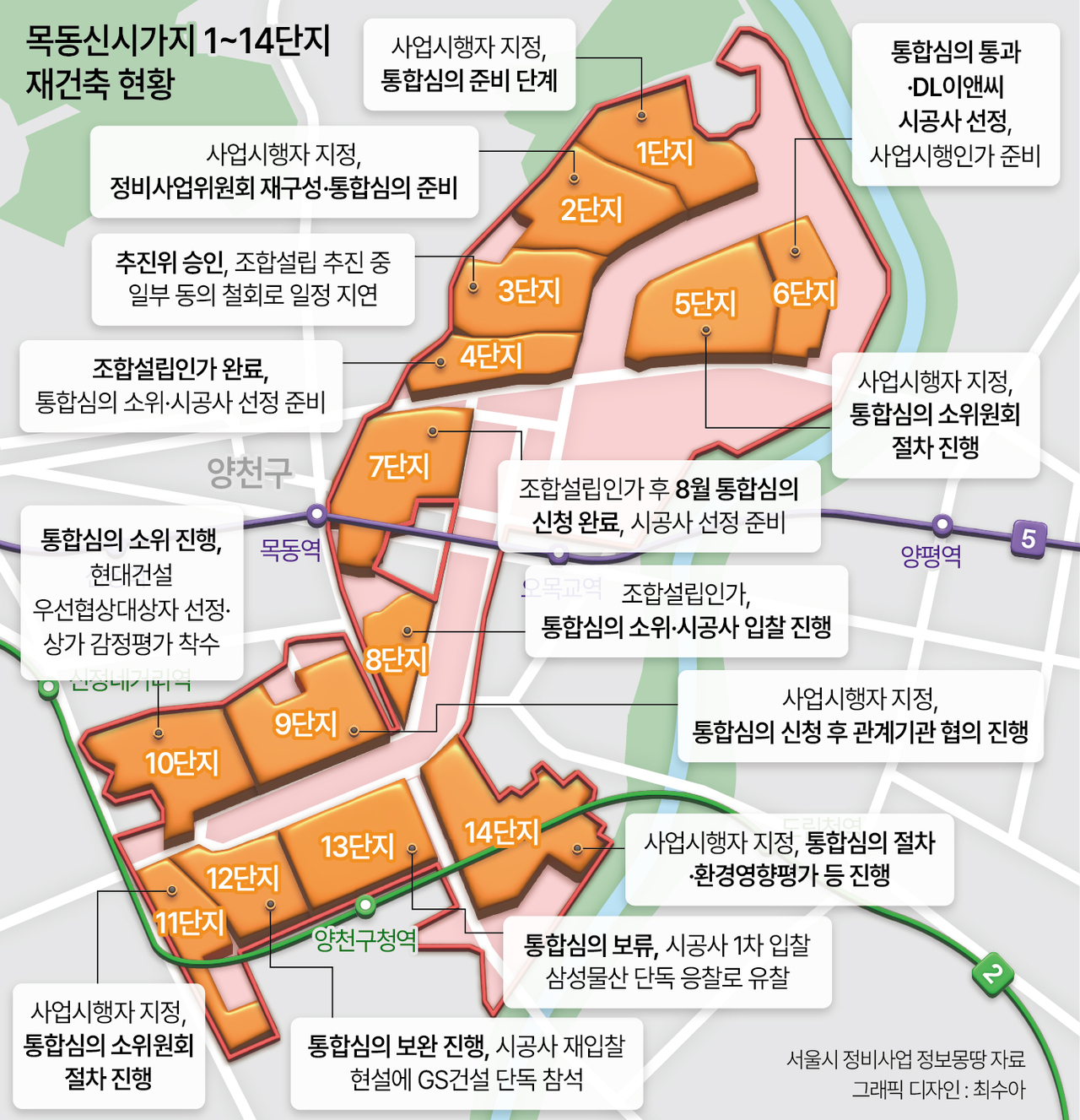
In the meantime, other rear complexes are working through the integrated review process. A Seoul city official said complex 9 is expected to be submitted to the main integrated review committee soon, making it the third Mokdong complex to reach that stage after complexes 6 and 13. Complexes 8, 10, 11 and 14 are currently at the subcommittee stage of the integrated review.
Complex 12 is also in consultations ahead of its integrated review. A complex 12 association official said the complex plans to revise its high-rise tower placement before proceeding with the review. Unlike complex 13, which was deferred after reaching the main committee, complex 12 is adjusting its plans before the main review.
Behind the push to accelerate is a shared concern that large-scale relocations across the complexes could converge around the same time. Although each of the 14 complexes is pursuing reconstruction independently, their timelines are closely aligned, raising the possibility that project implementation authorizations and management and disposal plan approvals could come in rapid succession — concentrating relocation demand over a short period.
Yangcheon-gu has already completed a relocation demand survey of residents across all 14 complexes in preparation. The survey asked how many school-age household members each unit has and how far residents would be willing to relocate during reconstruction. The district is now conducting a research project to analyze relocation demand and likely destination patterns based on the results, with findings expected after October.
However, no separate criteria currently allow authorities to artificially adjust the relocation schedule for individual complexes. A Yangcheon-gu district office official said there are no guidelines permitting arbitrary adjustment of relocation timing. While clearing the integrated review first does not guarantee a complex will relocate first, observers note that since no fixed relocation order exists, the timing will ultimately depend on which complex completes subsequent steps — such as project implementation authorization and management and disposal plan approval — ahead of the others.
Kim Je-kyung, director of Toomi Real Estate Consulting, said that with revised altitude restrictions from the International Civil Aviation Organization potentially taking effect after 2030, Mokdong residents may feel that year functions as a kind of deadline. He noted that while local authorities have not officially announced any intention to set a relocation order, there is precedent — during then-Seoul Mayor Park Won-soon's tenure in 2015, the city delayed the management and disposal plan approval for Gaeposhiyeong by four months, citing the need to stabilize the jeonse market.
Kim added that with all 14 Mokdong New Town complexes combined exceeding 26,000 units, residents cannot help but suspect that relocation timing could be adjusted if projects proceed around the same time. "In that kind of situation, it is only natural that a race emerges among complexes to complete project procedures ahead of one another," he said.
quq@heraldcorp.com