
- HOME
- IT·SCIENCE
-
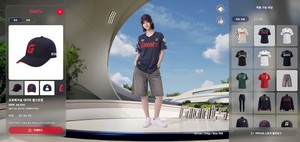
Lotte Innovate's Caliverse opens virtual styling shop for Lotte Giants fans
AI avatars try on uniforms, caps before linking to purchase page Virtual space features professional uniform hall, flagship store hall Lotte Innovate's Caliverse has launched a virtual styling shop aimed at baseball fandom, seeking to help consumers make purchase decisions while expanding its footprint in immersive commerce. Lotte Innovate said Thursday that its subsidiary Caliverse had rolled out the "Lotte Giants virtual styling shop," an immersive commerce service. Immersive commerce refers to technology that lets consumers directly experience products in virtual or augmented reality environments to help them decide what to buy. Lotte Innovate said it launched the service in response to growing fan demand for baseball merchandise. Fans can dress an AI avatar in the virtual styling shop with uniforms, caps and other goods before deciding whether to make a purchase. The Lotte Giants virtual styling shop consists of an "AI styling shop" and an "immersive store." In the AI styling shop, users can choose from 33 types of merchandise actually used at the ballpark. Selecting an item for purchase takes users directly to the Lotte ON page, allowing them to browse and buy in one step. In the immersive store, users can explore two virtual spaces: a "professional uniform hall" and a "Giants flagship store hall." Selecting a displayed product in either space also leads to a purchase page. The Lotte Giants virtual styling shop can be accessed through a Lotte Giants-related banner on the Lotte ON homepage. It requires no separate app installation and works on both PC and mobile. Caliverse plans to draw on its operational experience in immersive commerce to widen its customer touch points. The company also plans to expand into a range of business areas by upgrading features that include personalized product recommendations and styling functions, season-specific planned content, and virtual-space-based experiential content. "The Lotte Giants virtual styling shop was designed to let fans mix and match clothing and merchandise that suit them, browse products in a virtual store and experience fan culture," a Caliverse official said. "We will continue to build on AI technology to upgrade fans' shopping experience and roll out differentiated immersive commerce services." Meanwhile, Lotte Innovate acquired virtual reality content company VisionVR in July 2021 for 12 billion won ($8.97 million). VisionVR later changed its name to Caliverse and took charge of Lotte Group's metaverse project. Caliverse officially launched its ultra-realistic metaverse platform, also named Caliverse, in August 2024, and is pursuing projects in cooperation with various business areas, including group affiliates.
Sept. 10, 2026
-
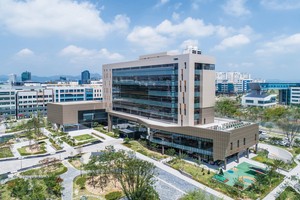
Cybersecurity gaps widen as KISA loses 50 investigators a year
56 employees left last year, 55 more by September this year Mass departures threaten investigative expertise in cyber breach probes Corporate obstruction, including by KT, under scrutiny More than 50 key personnel at the Korea Internet & Security Agency, or KISA, have left the agency this year, following a similar exodus last year. KISA, along with the Ministry of Science and ICT, is responsible for investigating cyber breach incidents. The mass departures raise concerns not only about a decline in investigative expertise but also about the agency's ability to properly probe cyber breaches involving companies. An analysis of KISA workforce data obtained from Kim Jang-gyeom, a lawmaker with the People Power Party, showed that 56 employees left the agency last year. Another 55 left through September this year. The departures amount to more than 10 percent of KISA's roughly 500-member workforce, with most moving on to jobs at companies. Most of those who left worked in teams that play key roles during investigations. They included the Forensic Analysis, Leak Investigation, Information Security, Vulnerability Analysis, Detection Investigation, Physical Security and Personal Information Policy teams. KISA serves as the backbone of joint public-private investigation teams formed with the Ministry of Science and ICT whenever a major corporate cyber breach occurs. Under the enforcement decree of the Act on Promotion of Information and Communications Network Utilization and Information Protection, such a joint team must be formed whenever a cyber breach occurs. The team comprises about 20 members from the ministry, KISA and other agencies. The ministry leads the team, while a KISA division director serves as deputy head. The problem is that such frequent, large-scale departures could erode the expertise needed to investigate cyber breaches. As more former employees move into corporate jobs, concerns are mounting over whether investigations into cyber breaches at companies can be carried out properly. Former KISA staff with investigative expertise could end up playing a role in downplaying the scale of incidents once they move to companies. Concerns have grown particularly acute after companies were found to have obstructed investigations into cyber breaches. In practice, the Ministry of Science and ICT determined in October 2025 that KT Corp had intentionally obstructed a government probe into the company's unauthorized micropayment and hacking case. The ministry referred the case to police for investigation. It marked the first time the government had requested a criminal investigation over a telecom carrier's security probe. The joint investigation team found that KT had submitted false data regarding the timing of its server disposal. KT also failed to inform the joint investigation team that backup logs from the discarded servers still existed. Concerns are growing that former KISA employees who moved to companies could be mobilized in similar cases. "As cyber breaches grow more sophisticated and larger in scale, it is critical to prevent the loss of personnel with accumulated experience and expertise," Kim said. "The government is calling for stronger AI and cybersecurity measures, yet it cannot even retain the core personnel on the front lines." He continued, "If former KISA employees end up helping companies downplay cyber breaches, weakening the nation's cyber investigation capabilities, then no countermeasure will be meaningful." He added, "We need effective institutional measures to ensure that the repeated loss of core personnel does not weaken the nation's cyber response capabilities."
Sept. 10, 2026
-
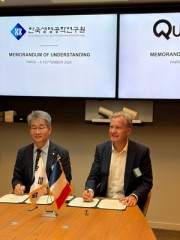
KRIBB, France launch biotech-quantum alliance to cut drug development time
- Cooperation spans plant science, synthetic biology and quantum-computing drug development The Korea Research Institute of Bioscience and Biotechnology, known as KRIBB, is teaming up with French research institutes, universities and a deep tech company. The partnership will launch a wide-ranging joint research program spanning plant science, biotechnology and quantum computing. KRIBB is particularly focused on applying quantum computing to drug development, aiming to shorten the time and cost typically needed to identify new drug candidates. This process usually takes more than 10 years. KRIBB signed separate MOUs with the Institute of Plant Sciences Paris-Saclay, the National Institute of Applied Sciences Toulouse and photonic quantum computing company Quandela in Paris on Monday and Tuesday, the institute said Thursday. The agreements were reached to coincide with the president's state visit to France. KRIBB plans to build a multilayered international research network linking institutes, universities and deep tech companies across plant science, biotechnology and bio-quantum technology. With the Institute of Plant Sciences Paris-Saclay, known as IPS2, KRIBB will expand cooperation centered on AI-based functional genomics research. KRIBB is currently conducting joint research with Seoul National University to identify the functions of non-coding RNA in plants resistant to drought and high temperatures. The partnership with IPS2 grew out of the first KRIBB Overseas Scientific Advisory Committee meeting, held in May. With the National Institute of Applied Sciences Toulouse, known as INSA Toulouse, KRIBB will pursue joint research in life sciences and biotechnology along with exchanges of researchers and students. The university's Toulouse Biotechnology Institute has more than 40 years of research experience in enzyme engineering and synthetic biology. It previously worked with French company Carbios to commercialize a biodegradable enzyme for PET bottles. Quandela is a photonic quantum computing company founded in 2017, built on research from the French National Centre for Scientific Research and Paris-Saclay University. In 2023, it became the first in Europe to operate a commercial production facility for photonic quantum computers. KRIBB and Quandela will work together to combine AI and quantum computing in biotechnology research. The goal is to reduce the time and cost involved in identifying new drug candidates, a process that on average takes more than 10 years. "Plant science, biotechnology and quantum technology are different fields, but all are key pillars of the future bio industry," said Kwon Seok-yoon, president of KRIBB. "I hope this agreement becomes a turning point that leads to concrete joint research results."
Sept. 10, 2026
-
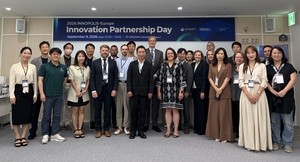
European science, innovation officials gather at Daedeok Innopolis to expand global partnerships
- Event links Innopolis firms' technology and products with European cooperation demand, supports market entry The Innopolis Foundation held the "2026 Innopolis-Europe Innovation Partnership Day" on Wednesday at the D-Unicorn Lounge in Daejeon's Science Complex, aiming to find European cooperation partners for South Korea's research and development special zones and to build a sustainable cooperation framework. The event was designed to expand contact points between cooperation officials in the science, research and innovation fields from various European countries and Innopolis companies, and to lay the groundwork for Innopolis firms to find local partners and pursue follow-up cooperation. About 40 people attended the event. They included the EU Delegation to Korea and science, research, innovation, higher education and technology cooperation officials from the embassies of 10 European countries, including France, Germany and Italy. Innopolis companies also took part. European officials introduced their countries' industrial and technological cooperation needs, while Innopolis companies gave IR presentations showcasing technologies and products in fields such as energy storage, advanced materials, mobility, and environment and biotech. Participants then visited three Daedeok Innopolis companies -- Standard Energy, Narma and Contec -- to observe their research and business operations firsthand and discuss potential cooperation. Gwangju Innopolis company Greenerlab presented its tree environmental data management technology, built around an AI-based electronic tree history management system called TreeAiD and an internet-of-things environmental sensor called Sentinel. Blue Magnet, a company based in the Ulsan Ulju Special Zone, unveiled a water treatment solution that uses magnetic Prussian blue material to remove and recover radioactive substances such as cesium. Daedeok Innopolis company Standard Energy introduced ESS and large-capacity power storage technology based on vanadium ion batteries, while MCE presented technology and products that use mealworm-based bioconversion to break down waste styrofoam and convert it into organic fertilizer and protein materials. Building on this exchange, the Innopolis Foundation plans to form a multinational council with officials from the participating countries to regularly share each country's cooperation needs and identify suitable local partners for Innopolis companies. Through this, the foundation aims to flesh out follow-up cooperation tailored to each company's needs, ranging from technology exchange to joint research and development, demonstration projects and market entry. Jung Hee-kwon, chairman of the Innopolis Foundation, said, "This event carries great significance in that officials from various fields across European countries and deep tech companies from Innopolis met directly to explore ways to cooperate." He added, "We will expand our overseas cooperation network so that the research and development special zones can grow into a global innovation hub connecting the world's research and industrial ecosystems, and we will support Innopolis's excellent technologies in creating new business opportunities in overseas markets." Gwangju Innopolis company Greenerlab presented its tree environmental data management technology, built around an AI-based electronic tree history management system called TreeAiD and an internet-of-things environmental sensor called Sentinel. Blue Magnet, a company based in the Ulsan Ulju Special Zone, unveiled a water treatment solution that uses magnetic Prussian blue material to remove and recover radioactive substances such as cesium. Daedeok Innopolis company Standard Energy introduced ESS and large-capacity power storage technology based on vanadium ion batteries, while MCE presented technology and products that use mealworm-based bioconversion to break down waste styrofoam and convert it into organic fertilizer and protein materials.
Sept. 10, 2026
-
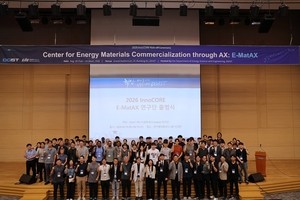
DGIST launches fusion research units to train future AI, energy and brain-science talent
- Four InnoCORE research organizations officially launched - Postdoctoral researchers to lead fusion research on future strategic technologies DGIST (Daegu Gyeongbuk Institute of Science and Technology) has begun training a new generation of researchers to lead future strategic technologies, spanning AI-driven energy materials, brain digital twins and physical AI. DGIST said Thursday that it has launched its 2026 InnoCORE project in earnest, holding a series of launch ceremonies for new research organizations under the initiative from Aug. 18 to Sept. 8. InnoCORE supports outstanding postdoctoral researchers, called "InnoCORE Fellows," in leading fusion research across future strategic technology fields. A core aim of the project is to build a cooperative framework between universities and government-funded research institutes. DGIST launched four innovative research organizations in total: two "institute-led" research groups carrying out large-scale fusion research, and two "institute-linked" research groups conducting strategic joint research with government-funded institutes. The institute-led groups are focused on advanced energy materials research and biotech and brain science research. The E-MatAX Research Group for Energy Materials Commercialization is building an integrated platform that uses AI to overhaul every stage of energy material development, from design to demonstration. The Multiscale Brain Digital Twin Fusion Research Group, launched Sept. 3, is developing technology to precisely model brain diseases by recreating the actual human brain in virtual space. The institute-linked research groups are focused on joint research that breaks down barriers between institutions. At the first launch ceremony, the heads of five core research projects and their fellows shared their research plans. At the second, participants discussed detailed implementation plans for each linked project and ways to strengthen the joint research framework. DGIST also plans to expand "institute-fusion" research carried out in cooperation with other science and technology institutes. The Bio-Embodied Physical AI Research Group, launched last year, plans to hold a joint workshop this year and move forward in earnest with fusion research on AI technology that interacts directly with the real world. DGIST also runs multi-mentoring programs and customized career development tracks tailored to academia, industry and entrepreneurship. The institute said it aims to give young researchers a high degree of research autonomy, help them grow into independent researchers, and cultivate them into key talent capable of leading future strategic technology fields. "We will establish an open fusion research platform where capable young researchers can freely collaborate beyond the boundaries of their institutions and fields," said Koo Jae-hyung, head of DGIST's InnoCORE project. "We will provide full support so that they can produce world-class research results."
Sept. 10, 2026
-
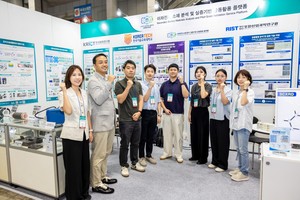
Chemical institute opens $41.9m battery R&D platform to smaller firms
- KRICT builds joint-use platform for secondary battery material analysis and demonstration - One-stop support spans material analysis, electrode manufacturing and coating, and performance and safety evaluation A new national joint-use platform will allow companies and researchers to analyze secondary battery materials, manufacture electrodes and evaluate performance and safety all in one place. They will no longer need to secure advanced analytical equipment worth hundreds of millions of won on their own. The Korea Research Institute of Chemical Technology said Thursday it will unveil its "Joint-Use Platform for Secondary Battery Material Analysis and Demonstration" at K-Battery Show 2026, running from Wednesday to Friday at Kintex's second exhibition hall in Goyang, Gyeonggi Province. The platform's core function is to link high-priced research equipment and specialized personnel that are currently scattered across different institutions. It offers one-stop support covering the entire process, from elemental and structural analysis of battery materials to electrode manufacturing and coating, and accelerated degradation and reliability testing. Secondary batteries combine a range of materials, including cathodes, anodes, separators and electrolytes. The microstructure and chemical properties of these materials, along with the characteristics of the resulting electrodes and cells, directly affect performance and safety. That is why developing a new material requires comprehensive verification, from analysis and evaluation to electrode manufacturing, charge-discharge testing, and degradation and reliability assessment. Small and medium-sized enterprises and individual researchers, however, have struggled to secure all the expensive equipment and expert personnel this process demands. They also faced heavy costs in time and money from having to track down and individually request access from institutions that held the necessary equipment and expertise. The institute will draw on research infrastructure centered in Daejeon, comprising about 225 pieces of advanced analytical and pilot-scale coating equipment worth some 56 billion won ($41.9 million). Forty-six experts from its chemical analysis center, reliability evaluation center and coating-based solutions center will provide support ranging from material analysis and evaluation to process demonstration and technical consulting. Regional specialized research institutions are also being linked into the network. The Korea University of Technology and Education in Cheonan will support material analysis and prototype production. The Research Institute of Industrial Science and Technology in Pohang will handle "operando" analysis, which examines material changes while a battery is actually operating, along with cell evaluation and air-isolated analysis. The Korea Conformity Laboratories in Suwon will oversee performance evaluation — including charge-discharge, safety and long-life testing — from the material level up to modules and packs. Companies and researchers will be able to access the equipment and specialized services they need through the joint-use system, instead of having to search separately at each institution. The platform will run a one-stop service window based on ZEUS, the national reservation system for shared research facilities and equipment. Small and medium-sized enterprises in the secondary battery sector will also receive vouchers to ease the cost of using research facilities and equipment. The project also includes training for hands-on specialists who can operate the equipment on-site. The project is part of the "National Research Support Facility Advancement Project" run by the Ministry of Science and ICT and the National Facilities and Equipment Center. Groundwork began last year, with the upgrade of hub and partner research facilities and the establishment of a cooperative system planned for 2026-2028, and operations set to continue through 2034. "We will connect the equipment and expertise held by our institute and partner institutions into a single network, so that companies and researchers can more easily and quickly receive the research support they need," said Shin Seok-min, president of the Korea Research Institute of Chemical Technology.
Sept. 10, 2026
-
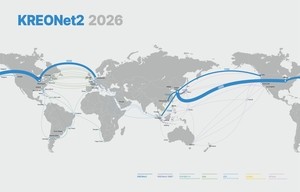
KISTI opens Korea's first 400G international research network, cutting 100TB transfer time to 33 minutes
- Daejeon-Chicago international backbone expands from 100 to 400 Gbps, quadrupling transfer capacity - Ultra-large research data in AI, astronomy, space and biotech to see faster global access An ultra-high-speed international research network capable of transferring up to 100 terabytes of ultra-large research data from Korea to the United States in just 33 minutes has been built. The Korea Institute of Science and Technology Information (KISTI) said Thursday that it has expanded the Daejeon-Chicago international backbone of the National Research Network, known as KREONET, fourfold, from 100 Gbps to 400 Gbps. The new international line is the first single-wavelength 400 Gbps international circuit built in South Korea, across both private telecom carriers and the public sector. Spanning more than 10,000 kilometers across the Pacific, the link secured stable single 400 Gbps transmission quality, with its performance verified under actual research traffic conditions. The theoretical maximum transfer capacity of the international line has quadrupled, from 12.5 gigabytes per second to 50 gigabytes per second. Transferring 100 terabytes of data, which previously took about two hours and 13 minutes under the 100 Gbps system, now takes about 33 minutes under 400 Gbps. The upgrade will be particularly useful for research fields that handle data sets ranging from tens of terabytes to petabytes. These include AI training data, astronomy and space science, high-energy physics, and biotech. It will allow Korean researchers to access overseas supercomputers, large-scale research facilities and AI resources more quickly and reliably. KISTI built the international backbone on an international optical circuit that includes a Korea-US submarine cable segment provided by KT Corp. KREONET is a national research network built on 18 regional network centers across the country, capable of transmitting up to 1.2 Tbps. Through its international research network, it is connected to about 30,000 research networks worldwide. On Tuesday (local time), KISTI visited StarLight, an international research network interconnection hub operated by the International Center for Advanced Internet Research at Northwestern University in the United States, to establish the international backbone. StarLight is a key hub connecting major research networks and advanced research infrastructure across North America and the rest of the world. Global research networks are also rapidly advancing to the 400 Gbps tier. On the North America-Europe route, major US and European research networks are building single 400 Gbps systems. On the Asia-North America route, Japan's National Institute of Informatics has upgraded to a single 400 Gbps system. With this latest expansion, Korea has secured international research network infrastructure on par with the best in the Asia-Pacific region. KISTI plans to extend its 400 Gbps international backbone to Europe as well, to keep pace with the growing volume of large-scale research data expected from major projects. These include CERN's High-Luminosity Large Hadron Collider, the International Thermonuclear Experimental Reactor and the Square Kilometre Array radio telescope. "This international circuit build-out goes beyond simply scaling up network capacity -- it represents an upgrade of the country's research infrastructure to a world-class level," said Jo Bu-seung, director of KISTI's Science and Technology Research Network Center. "Since research networks are core infrastructure for the future, essential to securing AI sovereignty and data sovereignty, we will continue to upgrade the Korea-Europe route going forward."
Sept. 10, 2026
-
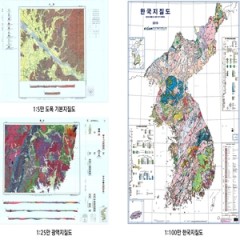
Korea completes national geologic map after century-long effort
- KIGAM finishes all 357 sheets of 1:50,000 national geologic map - Map serves as key infrastructure for resource exploration, disaster response, underground space use South Korea has completed its national geologic map, a project capturing hundreds of millions of years of the peninsula's geological history, after more than a century of work. The Korea Institute of Geoscience and Mineral Resources will hold an international academic forum on the completion of the national geologic map at its headquarters in Daejeon on Thursday. It will officially declare the completion of all 357 sheets covering South Korea at a scale of 1:50,000. The national geologic map is the country's standard geological dataset, compiled through surveys of rock types, formation periods, strata distribution and geological structures such as faults and folds. Unlike ordinary maps that show surface locations and terrain, it also captures how the land was formed over hundreds of millions of years, earning it the nickname "history book of the land." Producing a single geologic map sheet is no simple task. Geologists travel to mountains, fields, rivers and coastlines to directly observe rocks, strata and geological structures. After collecting samples, they analyze mineral composition, microstructure and geochemical characteristics in the laboratory, and use isotope analysis to determine the absolute age of the rocks. South Korea's national geological survey began with the establishment of the Geological Survey in 1918, and gained momentum after the first 1:50,000 geologic map was published in 1924. Generations of geologists crisscrossed the country's mountains, fields, rivers and coastlines to survey rocks and strata. This year, researchers filled in the last blank spots in mountainous, border and island areas, completing all 357 sheets covering the entire South Korea. The national geologic map serves as key national infrastructure, used in mineral resource exploration, road and tunnel construction, groundwater and underground space use, as well as in responding to geological hazards such as landslides and earthquakes and in carbon dioxide geological storage. The institute plans to standardize and digitize the accumulated geological data to upgrade it into a "boundary-integrated geologic map" that removes the borders between individual sheets. It also plans to build a three-dimensional national geological information system that combines AI and digital twin technology to provide a comprehensive view of underground resources and risks from faults and geological hazards. "We will fuse geological data with AI and digital twin technology to create new value that supports the nation's resource security and public safety," said Kwon Yi-kyun, president of the Korea Institute of Geoscience and Mineral Resources. "The national geologic map will become a trustworthy treasure map guiding South Korea's resource security, carbon neutrality and safe use of underground space."
Sept. 10, 2026
-
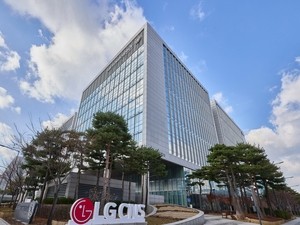
LG CNS to hire new employees in 9 fields including AI, robotics this fall
Company hires new graduates every spring and fall to secure talent Recent recruiting event in US led by CEO Hyun Shin-kyun LG CNS will begin hiring new graduates for the second half of the year. The company aims to secure future talent through triple-digit hiring across nine job categories, including artificial intelligence and robotics. LG CNS said Thursday that it will accept applications through Monday for positions spanning its major business areas. These include AI, robotics, consulting, DX engineering, cloud application modernization, architecture, ERP, smart factory and convergence engineering. The company named AI as a core business area. Employees in AI roles will design and build AI models and services optimized for client businesses. New hires in this field can plan specialized agentic AI services across industries such as finance, the public sector, manufacturing and logistics. They also have the potential to grow into AI transformation experts who drive clients' business innovation. LG CNS also described robotics as a field that will drive future growth. Employees in robotics roles will apply robots to industrial settings such as manufacturing and logistics, and test the feasibility of deploying next-generation robot technology on-site. The company said it has been focusing on robot transformation. In May, it launched Physical Works, an integrated robot learning and operations platform — the first such platform released by a Korean company. Building on this, the company said new hires will be able to gain hands-on experience with robots and automation technology across various industrial sites. Consulting roles involve analyzing business issues to develop AI and digital transformation strategies. DX engineers develop core systems and services for industries such as digital finance, the public sector and telecommunications. Anyone holding a bachelor's degree or higher, or expected to graduate by February 2027, with IT capabilities may apply regardless of major. LG CNS said it will give preference to applicants with relevant experience and expertise in each of the nine job categories. The hiring process consists of document screening, a written test, a job-specific interview and a final interview, in that order. The written test comprises an aptitude test and a newly introduced "CNS specialized test." The CNS specialized test is a newly created screening step designed to assess candidates' interest in the latest technology trends and their ability to use AI. It will evaluate understanding of global technology and industry trends common to all positions. It will also include a test of generative AI skills, divided into coding-based and planning-based formats depending on the job applied for. LG CNS said it hires new graduates twice a year, in spring and fall, and secures talent by strengthening industry-academia partnerships with various universities. The company recently held the "LG Connect N Sync" event in San Francisco, inviting master's and doctoral students from major local universities. Senior executives, including CEO Hyun Shin-kyun, attended the event. According to LG CNS, Hyun has often emphasized that "success in technological competition ultimately depends on the people who execute the technology." Based on this philosophy, the company has made securing top talent a key management priority and is putting its full effort into discovering talent both in Korea and abroad. An LG CNS official said, "We are focused on securing and developing talent who can turn technology into real value in core business areas such as AI and robotics," adding, "We will support new employees so that they can grow into experts in their respective fields through diverse project experience and systematic skill development after joining the company."
Sept. 10, 2026
-
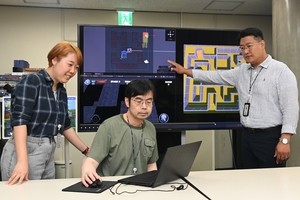
'AI developer' rises to build games and judge the fun, no humans needed
- ETRI develops 'zero-data generation AI' for making games - 16 puzzle games launched worldwide, technology transferred to Mgame "AI can build a game in place of a person, then play it directly to find bugs and even gauge how fun it is." The Electronics and Telecommunications Research Institute (ETRI) said Thursday it has developed an AI-based platform that automates game production and quality verification to support small, midsize and indie game companies. Building game content such as maps and items, along with the repeated quality assurance work required before launch, demands significant manpower and cost. Unlike large game companies with dedicated development and QA teams, small, midsize and indie studios often struggle to secure enough staff and testing infrastructure. To address this, ETRI developed a "production AI engine" that automatically creates game content and a "verification AI engine" that automatically inspects finished games. At the core of the system is what ETRI calls "zero-data content generation technology." Rather than training on data sets of human-made correct answers, the AI generates game maps on its own through trial and error. Using reinforcement learning-based procedural content generation (PCGRL), it produces content tailored to various conditions, including maze path length, the number and placement of enemies, item composition and map size. According to the researchers, this approach cuts the cost of building large-scale training data while also easing copyright concerns tied to using existing content. AI also handles verification. Multiple AI agents, each specialized in tasks such as exploration, combat or mission completion, play the game like real users to uncover errors that surface under a range of conditions. In particular, an "Auto QA" function powered by a large language model detects irregular errors that are difficult to catch through standard test items alone. A separate "Fun QA" technology analyzes gameplay data to quantitatively predict how much fun users will experience before launch. This means AI is used not just to catch bugs, but also to gauge a game's commercial potential. The platform is linked with the commercial game engine Unity, allowing it to be used in actual game production workflows. The technology has already moved into industry use. Sublevel Games launched 16 puzzle games built with the technology in global markets. Mgame received a technology transfer and is applying it to a spinoff of Yeolhyeolgangho and its new title, NUMI HUNTERS. Goblin Games also released Mech Forge, built using the technology, on the Apple App Store. ETRI is also providing free technology transfers and QA process support to small game companies that lack the resources to build their own AI infrastructure. The project is the result of collaboration among industry, academia and research institutions, led by ETRI. ETRI oversaw the overall research and development, handling the creation of the production AI engine that automatically generates game content and the verification AI engine that automatically inspects games. Korea University developed multi-agent technology in which several AI systems divide roles to find game errors. Hongik University developed the Auto QA technology that automatically checks game quality and the Fun QA technology that predicts a game's fun factor numerically. Mgame took part in developing technology that analyzes problems arising during actual game service operations and recommends response scenarios. "It is meaningful that we secured the core AI technology needed for game production and verification and made it accessible to small, midsize and indie game companies," said Jang Si-hwan, a senior researcher at ETRI. "We will advance our zero-data-based content generation and automated verification technologies to actively support Korean game companies' expansion into global markets."
Sept. 10, 2026
-
Anonymous reports expose misconduct at food and drug safety ministry
The Ministry of Food and Drug Safety has confirmed a range of misconduct among its employees, including personal attacks on colleagues and senior staff assigning personal errands to junior employees, prompting calls for countermeasures. Data submitted to Democratic Party of Korea lawmaker Seo Mi-hwa showed that 19 employees, including those at affiliated institutions, were disciplined for misconduct uncovered through anonymous reports. Seo is a member of the National Assembly's Health and Welfare Committee. The cases occurred between 2022 and last month, a span of about five years. Of these, three cases occurred between January and August this year. An employee who made inappropriate remarks and behaved improperly at a work dinner received a three-month suspension in May. Another employee who directed inappropriate remarks and behavior toward junior staff was given a one-month pay cut in July. There was also a case in which an employee received a "Caution" in June for giving outside lectures without reporting them. Last year, two disciplinary cases stemmed from anonymous reports, both involving personal attacks on colleagues. In 2024, there were five disciplinary decisions in total, two of which involved receiving goods from individuals related to the employees' official duties. The remaining three cases involved using budget funds for unauthorized purposes, improper exercise of official authority, and aggressive language and behavior toward a colleague, respectively. In 2023, there were six disciplinary actions in total, four of which involved failing to report outside lectures. The remaining two cases involved improper handling of hiring procedures for public service workers and carrying out official duties based on improper requests, respectively. In 2022, three disciplinary actions were taken over dehumanizing remarks toward a specific employee, discriminatory treatment, and assigning personal errands to subordinates. "The repeated emergence of misconduct cannot be seen merely as individual deviance," Seo said. "The Ministry of Food and Drug Safety must review its overall organizational culture and substantially strengthen its prevention, reporting and protection systems."
Sept. 10, 2026
-
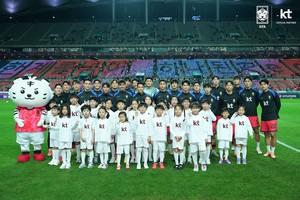
KT to give 88 children a chance to walk out with national football team
KT is giving 88 children the chance to serve as player escorts for South Korea's national football team, through its long-term-customer program. KT said Thursday it will give 88 children the opportunity to escort national team players at upcoming friendly matches, as part of the program for its long-term customers. The player escort program allows children to walk onto the pitch alongside national team players before kickoff. KT will offer the experience at two September matches: against Ecuador at Suwon World Cup Stadium on Sept. 24 and against Uruguay at Seoul World Cup Stadium on Sept. 28. It will also be held against Venezuela at Ulsan Munsu Football Stadium on Oct. 2 and against Uzbekistan at Yongin Mireu Stadium on Oct. 6. KT included three matches in the Greater Seoul area — in Seoul, Suwon and Yongin — along with the Ulsan match. This allows customers in both the Ulsan region and the metropolitan area to take part at a stadium near them. KT is running the program as a family invitation, letting children of its long-term customers enter the stadium alongside the players while their guardians watch the match together. Long-term customers with children ages 6 to 10 can apply, with 22 children to be selected for each match, for a total of 88. Winning families will receive tickets for one child and two guardians to watch the match together, with a total of 264 customers and family members to be invited. Applications are open through the long-term-customer benefits section of KT's website until Monday, and winners will be individually notified Sept. 17. Customers whose combined mobile, internet and IPTV subscription periods total five years or more are eligible to apply. Alongside the player escort experience, KT is also running a customer invitation program for a camping zone at KT Wiz Park. Selected customers can watch a baseball game while enjoying a barbecue meal in a dedicated camping area at KT Wiz Park in Suwon. The camping zone is equipped with tents, camping chairs and electric grills. Along with the sports and cultural experience program, KT also runs a coupon-based benefits program that offers discounts on Millie's Library as well as data and V Coloring vouchers. Kim Young-geol, managing director and head of the Customer Business Unit within KT's Customer Division, said, "We wanted to show our gratitude to customers who have used KT for a long time by giving their children a special experience of walking onto the pitch with national football team players." He added, "We will continue to expand a variety of hands-on programs that customers and their families can enjoy together." Meanwhile, the program, which KT has run since 2024, is part of the company's broader appreciation initiative for long-term customers. That initiative combines a coupon-based benefits program offering 15 types of perks across KT's subscription, mobile, internet and TV services with monthly invitations to cultural events for long-term customers.
Sept. 10, 2026
-
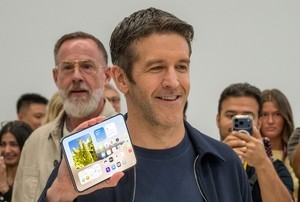
Heavier, thicker, W1m pricier: can Apple's foldable succeed?
Apple joins foldable market in earnest after 7 years Gap with Samsung in tech, price seen as key challenge 'Foldable know-how cannot be caught up with overnight' Apple's entry into the foldable phone market in earnest, seven years after launching its first smartphone, is set to intensify competition with Samsung Electronics, the market's "first mover." Following the strong launch of the Galaxy Z Fold8, Apple appears to be countering with its iPhone Duo. However, the technology gap with Samsung Electronics — which has led the foldable market for years — along with price competitiveness, works against Apple. Industry observers expect Samsung Electronics to hold onto its firm grip on the foldable phone market for now. A challenger to the Galaxy Z Fold8? Closing the technology and price gap remains Apple's challenge. On Wednesday (local time), new Apple CEO John Turners unveiled the iPhone Duo at Apple Park, the company's headquarters in Cupertino, California. It is the first foldable phone Apple has introduced since launching its first iPhone in 2007. Apple trails Samsung Electronics in AI, and now, in the foldable phone market as well. Although Apple adopted a "passport-style" form factor similar to the Galaxy Z Fold8, it remains closer to a fast follower than a technology leader. The iPhone Duo is heavier and thicker than the Galaxy Z Fold8. It weighs 254 grams and measures 5.2 millimeters at its thickest point along the side, compared with the Galaxy Z Fold8's mere 201 grams and 4.5 millimeters. The iPhone Duo's screen measures 5.2 inches when folded and 7.6 inches when unfolded — similar to the Galaxy Z Fold8 — but Apple has fallen short of its rival in slimming down the hardware. Still, the iPhone Duo carries a higher price tag, coming in roughly 1 million won ($746) more expensive than the Galaxy Z Fold8. The iPhone Duo's 256-gigabyte model is priced at $1,999, compared with 2.28 million won for the equivalent Galaxy Z Fold8 model in South Korea. The iPhone Duo also presents a higher barrier to entry than the Galaxy Z Fold8's US launch price of roughly $1,900, excluding value-added tax. "There are expectations that the iPhone Duo could become a challenger to the Galaxy Z Fold8, but Apple has only just entered the foldable phone market," an industry official said. "Narrowing the gap in technology and price competitiveness is Apple's challenge." Despite Apple's aggressive entry into the market, many in the industry expect Samsung Electronics to retain the top spot in the foldable phone market. Even accounting for Apple's loyal iPhone customer base worldwide and demand for the passport-style form factor, industry observers say Apple is unlikely to catch up with Samsung Electronics anytime soon. Since unveiling the Galaxy Z Fold8 in July, Samsung Electronics has repeatedly broken its own smartphone sales records. It surpassed last year's combined Galaxy Z Fold7 and Flip7 pre-orders of about 1.04 million units over a seven-day period. It also topped the 2019 Galaxy Note10's previous record of 1.38 million units sold over 11 days, the best-selling record among Galaxy smartphones. In practice, according to Counterpoint Research's weekly smartphone sales tracker, the Galaxy Z8 series outsold the Galaxy Z7 series by more than 8 percent within two weeks of its official launch on Aug. 7. The Galaxy Z Fold8 alone accounted for 57 percent of total sales, driving the strong performance. Samsung Electronics is projected to lead the global foldable phone market this year with a 38 percent share, followed by Apple at 25 percent and Huawei at 22 percent. Roh Tae-moon, president of Samsung Electronics' Device Experience Division, addressed Apple's entry into the foldable phone market at the Galaxy Unpacked 2026 press conference held in London in July. "Samsung will continue to lead the foldable phone market," he said, and went on to say, "The technology and understanding of customers we have built over the seven years since introducing the first foldable smartphone cannot be caught up with overnight."
Sept. 10, 2026
-

KT, Asan Medical Center team up to build 'AI hospital'
Partnership targets clinical decisions, patient experience Working group to form by end of month KT Corp said Thursday that it will partner with Asan Medical Center to build an artificial intelligence-powered hospital and jointly develop AI-based medical services for clinical use. KT signed a memorandum of understanding with Asan Medical Center that day at KT's Gwanghwamun Building West in Jongno-gu, Seoul, to cooperate on AI transformation in the medical field. The two organizations will work together to build an "AI hospital" in line with the government's AI-based primary care strategy. Once realized, the AI hospital would allow AI to assist with reading medical images and automatically collecting and analyzing health records scattered across multiple systems when patients visit Asan Medical Center. This would enable medical staff to make faster, more accurate diagnoses, while patients would experience shorter wait times and better quality of care. The two organizations aim to grow Asan Medical Center into a leading hub for testing and validating next-generation medical AI technologies. They will pursue the identification and application of AI transformation models in the medical field, including a next-generation hospital information system. They also plan to cooperate on other challenges in the medical field, such as AI transformation-based clinical decision support and improving patient experience. KT will support the development of service models and technology verification using its core infrastructure and AI transformation platform capabilities. It will also take part in planning and developing AI medical services for clinical application. Asan Medical Center will identify needs from clinical, treatment and research settings, and provide clinical advice and effectiveness evaluations during the development, testing and validation of AI services. The two organizations also plan to form and operate a working group starting late this month to continue pursuing detailed tasks. They will jointly explore ways to apply and expand medical AI technology in clinical settings. "The future competitiveness of medicine depends on how safely and effectively data and AI can be integrated into actual clinical settings," said Park Seung-il, president of Asan Medical Center. "Through our cooperation with KT, Asan Medical Center will identify and apply AI medical services that can be validated in clinical settings, leading medical innovation that improves patient safety and treatment outcomes." "KT plans to bring together core technologies and capabilities with Asan Medical Center to build an AI hospital, and to jointly develop AI medical services that can be applied in clinical settings," said Kim Bong-kyun, executive vice president and head of KT's Enterprise division. "Based on our AI transformation platform capabilities spanning AI, cloud and data, we will accelerate AI transformation innovation in medical settings and lead the future of medical AI." Meanwhile, KT signed a separate MOU with Yonsei University Health System last month to strengthen the use of medical data. The two organizations agreed to expand the foundation for medical data standardization, upgrade data utilization infrastructure, research ways to apply AI-based medical services, and build a mid- to long-term cooperation framework to promote the use of medical data.
Sept. 10, 2026
-
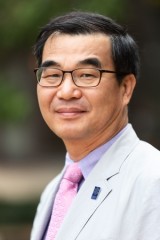
KASI researcher wins 2026 award for telescope leadership
- Park Byeong-gon honored for leading international research including Giant Magellan Telescope project The Korea Astronomy and Space Science Institute said Thursday that it has selected Park Byeong-gon, a senior researcher at its Large Telescope Center, as the recipient of the "2026 KASI Award." Park has planned and led key national astronomy projects since 1992, including South Korea's participation in the Giant Magellan Telescope, the construction of the Korea Microlensing Telescope Network and involvement in the Rubin Observatory, helping build the foundation for the country's optical astronomy research. Since 2009, he has served as the institute's representative and a board member at the Giant Magellan Telescope Organization, leading strategic planning and major decision-making for the international construction project. He also laid the groundwork for South Korea's participation in the joint development of key GMT observation instruments, including G-CLEF and GMTNIRS. This contributed to strengthening the country's competitiveness in international research and development. He was particularly recognized for successfully overseeing the GMTO board meeting and related international events held in Seoul in June. The role was credited with raising the standing of both South Korea's astronomy community and the institute. The Giant Magellan Telescope is a next-generation extremely large telescope with a 25.4-meter aperture, targeting completion sometime in the 2030s. Its final design is set to be completed in 2027, when full-scale construction is expected to begin, with a total of 16 institutions from six countries participating in the project. The telescope will offer four times sharper resolution and 200 times higher sensitivity than the James Webb Space Telescope. Its light-collecting area, a key factor determining a telescope's performance, will measure 368 square meters — sensitive enough to distinguish the image on a coin from 160 kilometers away. Once operational, the Giant Magellan Telescope is expected to surpass the capabilities of existing large observatories and mark a new era in the history of astronomical observation.
Sept. 10, 2026
-
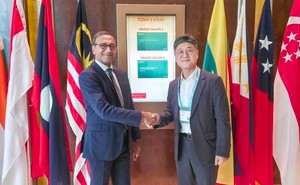
SK Telecom CEO discusses AI growth strategy with global telecom leaders at GSMA M360 ASEAN
AI growth talks with GSMA director general Trust-based cooperation with Asian telecom, tech firms SK Telecom is stepping up cooperation with major players across the global telecom industry to build new growth strategies and strengthen digital trust for the AI era. SK Telecom said Thursday that CEO Jung Jae-heon met with major global telecom industry leaders at the GSMA M360 ASEAN event in Kuala Lumpur, Malaysia, on Wednesday (local time), where they discussed new growth strategies for the AI era and ways to build digital trust. GSMA M360 is a series of regional events held by GSMA across major regions. This year's M360 ASEAN brought together telecom carriers, tech companies and policy authorities from East Asia and ASEAN to address key industry issues, including AI transformation, AI sovereignty, stronger security and trusted networks. On Wednesday morning, Jung met with GSMA Director General Vivek Badrinath to discuss uncovering next-generation growth opportunities for the telecom industry through AI, along with strategies for shifting telecom infrastructure toward an AI-centered model. In particular, Jung and Badrinath explored cooperation around SK Telecom's AI full-stack strategy and blueprint, spanning infrastructure, models and services. This included the company's ambition to become an "Asian AI infrastructure hub." The two also exchanged views on building digital trust, including strengthening information security systems, preventing digital crime and advancing AI-based network upgrades. At the event, Jung also held a series of meetings with executives from GSMA, Malaysian companies and major Asian telecom and tech firms, broadening cooperation centered on AI and digital trust. Jung met with Syed Danial Albukhary, a director at Tradewinds, the investment arm of Malaysia's Al-Bukhary Group, and the two agreed to explore cooperation opportunities between their companies. Al-Bukhary Group is a Malaysian conglomerate that leads key national infrastructure industries, including ports, automobiles, energy, finance and media. On Wednesday afternoon, Jung joined a roundtable with executives from major telecom and tech companies across Japan, Malaysia, Indonesia and Singapore. Participants agreed that securing the trust of customers and society is emerging as a key factor in future competitiveness in the AI era. This can be achieved through stronger security, technological sovereignty and reorganized governance. They also shared experience and know-how on building digital trust and worked out a range of cooperation plans. "In the AI era, a company's ability to earn the trust of customers and society will determine its competitiveness as much as the pace of technological innovation," Jung said. "We will work with global telecom carriers to flesh out cooperation in digital trust and build a sustainable AI ecosystem." Meanwhile, SK Telecom said last month that it would establish SK Horizon, a dedicated AI data center company, through a spin-off of SK Broadband. SK Telecom will oversee the SK Group's overall AI data center project, while SK Hyper, established in July, will focus on developing new AI data center projects. Through this, the company plans to position itself as an AI infrastructure hub for Asia.
Sept. 10, 2026
-

SK Broadband to give fans free tickets to 2026 KBO postseason games
From wild card game to Korean Series -- up to 130 tickets For B tv+, B tv+ max subscribers -- winners announced Sept. 30 SK Broadband will hold an event to give fans a chance to watch the 2026 KBO postseason live. On Thursday, SK Broadband said it would run an event offering 2026 KBO postseason tickets to subscribers of its internet TV subscription products, B tv+ and B tv+ max. Earlier, through the "B tv+ max Festival," SK Broadband gave users the chance to attend the 2026 KBO All-Star Game and the "KBS Chuseok Grand Project: Lee Seung-chul Concert." The latest event is also part of the B tv+ max Festival and will run from Friday to Sept. 27. Participants will have a chance to watch games live, from the wild card game through the Korean Series. SK Broadband plans to give away two tickets each to five winners per game, for a total of up to 130 tickets. Through a separate raffle, it will also give 100 people a 30,000 won ($22) Shinsegae gift certificate. Subscribers to B tv+ or B tv+ max can apply on the entry page for the "B tv+ max Festival." After installing the mobile B tv app on a smartphone or tablet and connecting it to the set-top box, the application is complete. Winners will be announced Sept. 30. "The joy of watching a game in person, rather than through a broadcast, is different," said Park Cham-sol, head of the platform division at SK Broadband. "Since the B tv experience does not end on the screen, we will keep expanding the moments our customers can enjoy in practice through the 'B tv+ max Festival.'" Meanwhile, the 2026 KBO regular season will run through Oct. 7. Once the regular season ends, the 2026 KBO postseason will begin with the wild card game.
Sept. 10, 2026
-
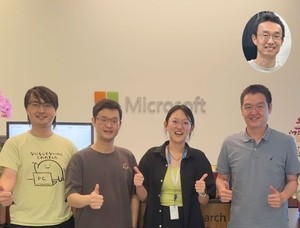
AI learns to sense unspoken 'that's not it' brain signals, corrects itself
- KAIST, Microsoft Research Asia develop brain-computer interface technology - Expected to benefit physical AI, autonomous driving, medical robots Researchers have developed technology that allows AI to detect the unspoken "that's not it" reaction that arises in the human brain. The AI then adjusts its own behavior accordingly, without requiring any verbal correction from the person. KAIST said Thursday that a research team led by Chair Professor Lee Sang-wan of the Department of Brain and Cognitive Sciences developed the technology in collaboration with Microsoft Research Asia. The brain-computer interface, or BCI, technology — called Neural Value Alignment, or NVA — uses human brainwaves to align AI behavior with human goals in real time. Conventional AI infers human intent based on outwardly visible cues such as speech, actions or gestures. But the same action can stem from different goals, meaning AI systems have often misread a person's actual intent. The research team focused on the "prediction error" that occurs unconsciously in the brain when a person encounters a situation that differs from what they expected. The team distinguished between a "reward prediction error," which appears when AI misunderstands the ultimate goal, and a "state prediction error." The latter occurs when the goal is correct but the AI's actions unfold differently than expected. By measuring the real-time electroencephalogram, or EEG, signals of a person observing the AI at work, the team confirmed that different brain signals appear. These signals varied depending on whether the goal itself was wrong or the method of achieving it was wrong. Applying deep learning, the researchers built an algorithm that distinguishes between these signals and lets the AI correct its behavior in real time. When a state prediction error is detected, the AI determines that its goal is correct but its method is wrong, and adjusts its behavior accordingly. When a reward prediction error appears, the AI concludes that it misunderstood the goal itself and searches again for what the user actually wants. In simulations, the system adapted to sudden changes in a person's goals, or to situations involving missing signals, faster than existing methods. The technology is expected to be used in fields that require close collaboration between humans and AI, including physical AI robots, autonomous driving, medical and rehabilitation robots, and personalized education. "This technology has the potential to be introduced as an additional feedback channel across a wide range of existing AI systems," said Lee. "It could be applied to any field where AI must continuously adapt to a person's goals and preferred behavior, including physical AI, collaborative robots, BCI, autonomous driving, medical and assistive robot control, and personalized education." The findings were published online in the journal IEEE Transactions on Cybernetics in August.
Sept. 10, 2026
-
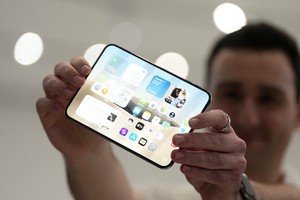
Apple finally unveils its first foldable, the iPhone Duo
Apple has finally unveiled its first foldable phone, the iPhone Duo. The device uses a passport-style ratio, resembling the structure of Samsung's Galaxy Z Fold8, which the Korean tech giant introduced in July. Apple has now followed Samsung into the foldable phone market in earnest, seven years after Samsung's own foldable debut. The foldable phone war between the two tech giants has begun in full swing. Apple's new CEO John Ternus unveiled the iPhone Duo at Apple Park, the company's headquarters in Cupertino, California, on Wednesday (local time). The device marks Apple's first foldable design since the company launched the original iPhone in 2007. The iPhone Duo measures 5.4 inches when folded and 7.6 inches when unfolded. When opened, it also supports multitasking, letting users run different apps simultaneously on each of its two screens. The device also supports Apple Pencil input, a feature previously available only on iPads. The new phone does not include Face ID, Apple's facial recognition unlock feature. Instead, it uses Touch ID, the fingerprint recognition function. The 256GB model is priced at $1,999, or 3.29 million won ($2,450) in South Korea. Preorders open Oct. 16, with in-store sales starting Oct. 23. However, Apple did not announce which countries will get the iPhone Duo at Wednesday's event. Apple also unveiled the iPhone 18 Pro series, its AirPods 5 wireless earbuds, and its Apple Watch Series 12 and Apple Watch Ultra4 smartwatches the same day. The iPhone 18 Pro starts at $1,199, while the Pro Max starts at $1,299. Preorders begin Friday, with in-store sales starting Sept. 18. The event marked Ternus's first official appearance as CEO since he took the helm this month. "I want to start by saying what a special honor it is to represent Apple's incredible team," he said. He went on to say, "What I really love is that the products we make help people work more creatively and productively, and let them achieve things once thought impossible." Meanwhile, Apple's foldable phone launch sets up head-to-head competition with Samsung's Galaxy Z Fold8. Samsung's Fold8, the company's first product to adopt a passport-style ratio, broke Galaxy smartphone preorder records and has been selling well worldwide.
Sept. 10, 2026
-
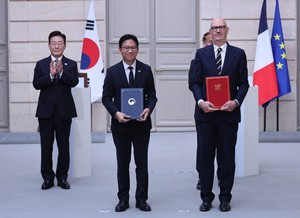
Korea, France deepen AI, quantum, biotech alliance
- Ministry of Science and ICT signs MOU on AI, semiconductor, quantum cooperation - Joint research, startup projects to advance quantum computing, drug development South Korea and France are strengthening cooperation in future strategic technologies, including artificial intelligence, semiconductors and quantum technology. During President Lee Jae Myung's state visit to France, South Korea's Ministry of Science and ICT signed a memorandum of understanding in Paris on Tuesday (local time) to strengthen cooperation in AI, semiconductors and quantum technology, the ministry said. Under the agreement, the two countries will hold regular meetings on AI and quantum technology. They also plan to cooperate on joint research between scientists, identify promising startup projects and attract investment to help each other enter each other's markets. The aim is to move beyond one-off exchanges and build a framework for sustained technology cooperation. Bae, who also serves as deputy prime minister, met with France's minister of higher education, research and space on Wednesday to discuss expanding cooperation in AI and science and technology. The two countries agreed to strengthen ties between universities and research institutions and expand joint R&D and personnel exchanges. In advanced biotechnology, the Korea Research Institute of Bioscience and Biotechnology will build a joint research framework with France's National Institute of Applied Sciences of Toulouse covering life science and biotechnology. It will also work with the Institute of Plant Sciences Paris-Saclay to develop next-generation crop technology using AI to address climate change. The two countries will also pursue cooperation applying quantum technology to biotech research. The bioscience institute will conduct joint research with Quandela, a French photonics-based quantum computing company, on next-generation drug development using quantum computing. Talent exchanges between universities will also expand. K-STAR, an alliance of science and technology-focused universities made up of KAIST, DGIST, GIST, UNIST and POSTECH, signed an MOU with Paris-Saclay University. The two sides plan to send graduate students for lab internships, support young researchers and hold joint networking events. The Korea Institute for Advanced Study also agreed to cooperate with Paris-Saclay University on joint research in basic sciences such as mathematics and physics, as well as quantum technology and AI, and to run a student researcher program. "The two countries have firmly established themselves as a genuine 'science and technology-digital alliance' in future strategic technology fields such as AI, quantum and advanced biotechnology," Bae said. "We will ensure this leads to tangible outcomes in joint R&D and talent exchange."
Sept. 9, 2026
MOST READ
- 1Pope Leo XIV declines French honors and banquet, accepts only private meeting with Macron
- 2KAIST develops high-performance bio-based adhesive using E. coli instead of petroleum
- 3Daimler Truck unveils next-generation transport solutions at IAA 2026
- 4What was Rachmaninoff's performance fee? A 1928 price list tells all
- 5Samsung Biologics union's show of force backfires at the bargaining table
- 6APR says hair-loss treatment research published in international journal
-
WORLD

US warns of punishment for anyone enabling Iran's Strait of Hormuz toll scheme
-
INDUSTRY
Toyota union puts productivity first; Hyundai Motor union demands bigger share of profits
-
FINANCE
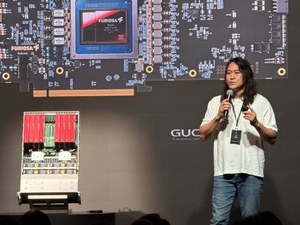
National Growth Fund to invest $531M in FuriosaAI, which rebuffed Meta's $800M takeover bid
-
INDUSTRY
Korea Shipowners' Association holds amateur baduk tournament for Maritime Day