Lithium-ion transport path improved 2.5-fold, reducing battery damage and fire risk
A new technology that can simultaneously reduce electric vehicle charging times and extend battery life has been developed.
KAIST announced Monday that a joint research team led by chemistry professors Yoon Dong-ki and Byun Hye-ryung has developed a next-generation battery separator that improves the speed and stability of lithium-ion transport by controlling the molecular alignment of liquid crystal polymers.
Lithium metal batteries can store more energy than conventional lithium-ion batteries, drawing attention as a next-generation electric vehicle battery. However, a phenomenon known as "dendrite" growth — in which lithium forms sharp, branch-like structures during charging — has been a major obstacle to commercialization.
Dendrites shorten battery life and can damage separators, causing internal short circuits and fires. During fast charging in particular, the risk increases when lithium accumulates unevenly.
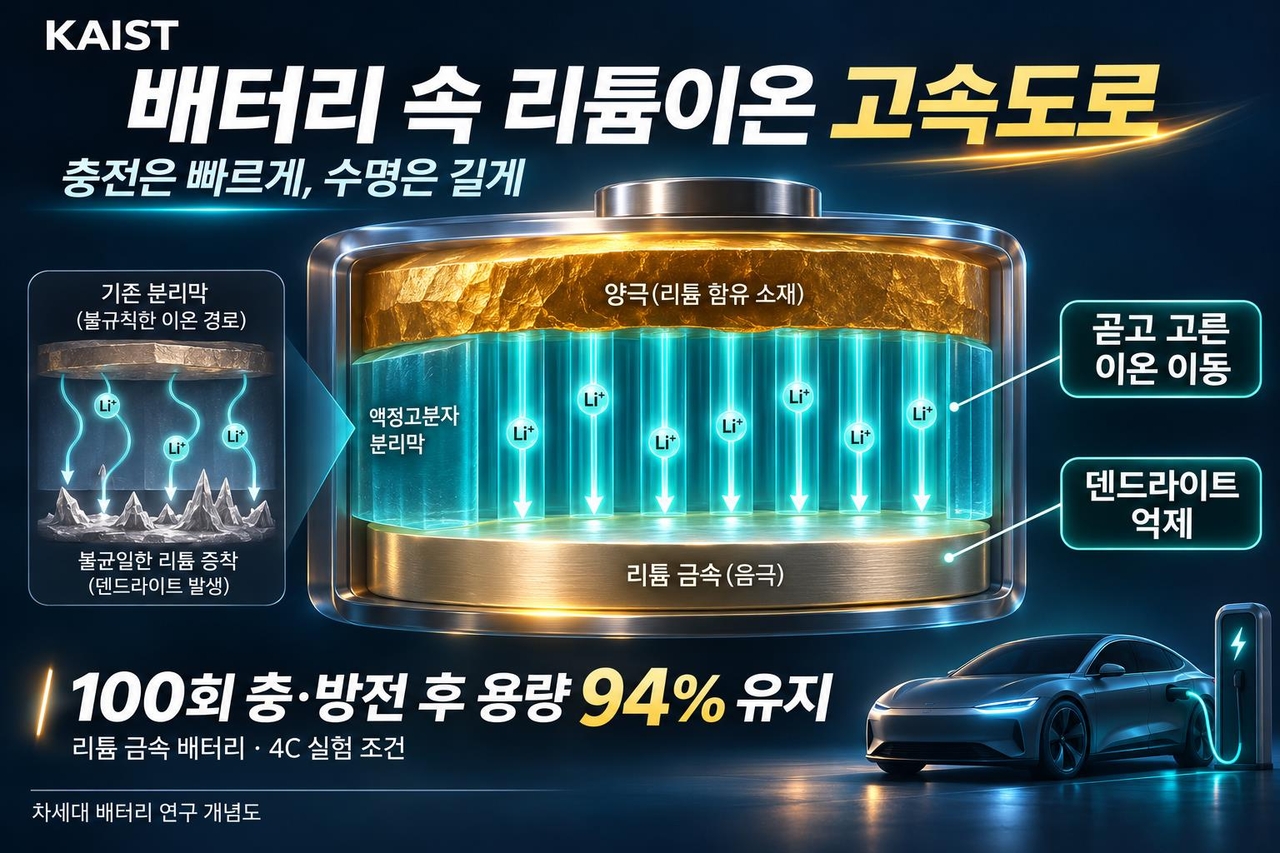
The research team tackled the problem by redesigning the path along which lithium ions travel — engineering the ions to move straight and uniformly toward the electrode rather than along a winding route.
To achieve this, the team fabricated a liquid crystal polymer separator with nanometer-scale pores and introduced polyethylene glycol (PEG) chains to facilitate lithium-ion transport. The liquid crystal molecules were then aligned vertically to straighten the ion-transport channels.
The vertically aligned separator reduced the tortuosity of the lithium-ion transport path by about 2.5 times compared with a horizontally aligned separator. With ions moving faster and more uniformly, dendrite formation — the primary cause of battery degradation — was also effectively suppressed.
When the separator was applied to a lithium metal battery, the cell retained 94 percent of its initial capacity after 100 charge-discharge cycles under 4C conditions, equivalent to a theoretical 15-minute charge.

The research is significant in that it demonstrates charging performance and stability can be improved through precise control of internal molecular alignment, without altering the battery materials themselves.
The technology is expected to contribute to shorter charging times and greater driving range when applied to electric vehicle batteries, which demand high energy density and rapid charging. However, commercialization will require securing large-area separator manufacturing technology and verifying long-term durability.
"We have shown that by controlling the molecular alignment of liquid crystal polymers, it is possible to efficiently design lithium-ion transport pathways and improve battery performance and stability," Professor Yoon said. "This will contribute to the development of next-generation high-energy-density batteries where long driving range and fast charging are essential."
The findings, with KAIST doctoral candidate Lee Geun-jung and Dr. Choi Rak-hyeon as co-first authors, were published in the September issue of the international journal ACS Nano.
nbgkoo@heraldcorp.com