
- HOME
- IT·SCIENCE
-

Baidu follows Waymo in setting up Korean unit as robotaxi race heats up
Baidu Apollo Korea established in Gangnam VP Yang Nan, who oversees Apollo Go's overseas operations, listed as director Move follows Waymo and Google's high-precision map approval Competition with domestic platforms such as Kakao intensifies Baidu, China's largest search portal, has established a Korean subsidiary to pursue its driverless robotaxi business in South Korea. The move comes after Google's Waymo — widely regarded as the world's top robotaxi operator — set up its own Korean unit in July, deepening the battle between global technology companies and domestic platform firms for control of South Korea's autonomous driving market, a contest that has intensified since restrictions on the use of high-precision maps were eased. According to the IT industry on Friday, Baidu registered the entity under the name "Baidu Apollo Korea" at an address in Gaepo-dong, Gangnam, Seoul, on April 30. The company's stated business purposes include autonomous driving and mobility technology research, development and services; automobile import, export, sales, retail and leasing; mobility service operations covering ride-hailing, carpooling and shuttle services; and the collection, production, processing and sale of high-precision digital map data. "Apollo," which appears in the subsidiary's name, is the brand representing Baidu's autonomous driving business. Baidu operates a driverless robotaxi service called Apollo Go and has been expanding the business overseas. Users hail a vehicle through a dedicated app, and a driverless autonomous vehicle then transports them to their destination. Baidu is considered one of the global leaders in the robotaxi market alongside Waymo. As of the second quarter, Apollo Go operated in 28 cities outside China. Its cumulative autonomous driving distance has surpassed 350 million kilometers. The company also runs the Apollo RT6, a fully driverless electric vehicle with no steering wheel. Yang Nan, a Baidu vice president, has been named director of the Korean subsidiary. Yang oversees the international operations division of Baidu's intelligent driving business group. She joined Baidu in January and is responsible for Apollo Go's business outside mainland China. The industry is paying close attention to the fact that Baidu has established a standalone Korean entity even as it is reportedly pursuing a joint venture with domestic firm HIM. HIM was formed through the merger of Unmanned Solution, a first-generation South Korean autonomous driving company, and Biotr Korea, a subsidiary of auto parts maker Hyorim Precision. Industry observers interpret this as a dual-track structure in which Baidu Apollo Korea serves as the local base for Baidu's headquarters operations while the joint venture handles service delivery. Under this arrangement, the wholly owned subsidiary would manage government licensing for autonomous driving and handle technology cooperation with domestic partners, while actual services would be rolled out jointly with local operators. South Korea's robotaxi competition has taken on a global dimension since the government approved the export of Google's high-precision map data in February. Waymo established its Korean subsidiary in July and is currently working with Hyundai Motor Company to verify fully driverless commercial operations using the Ioniq 5. Competition between global players and domestic platforms is expected to intensify further. Kakao Mobility has been running an autonomous taxi service using its own self-driving technology in the Gangnam area of Seoul since March, and expanded its fleet from two vehicles at launch to six last month. A consortium of Hyundai Motor and T-money Mobility was recently selected as an operator for Seoul's autonomous taxi service and is participating in domestic pilot operations.
Sept. 11, 2026
-

Samsung trolls Apple with 'Tim Cook switched to Galaxy' post — with a twist
Samsung Electronics has been drawing attention online for a witty jab at Apple following the iPhone maker's unveiling of its first foldable phone, the iPhone Duo. Samsung Mobile New Zealand's official Instagram account posted a photo Friday (local time) with the caption: "Tim Cook just switched to a Galaxy phone." The photo shows a man named Tim Cook sitting in a chair holding a Galaxy Z Fold 8 — but he is an ordinary resident of Palmerston North, New Zealand, not the Apple CEO. The post played on the fact that the man shares his name with Apple's chief executive, turning the coincidence into a tongue-in-cheek marketing stunt. Samsung Electronics' New Zealand operation captioned the post: "Big news: Tim Cook has switched to Galaxy." It then added: "Yes. THE Tim Cook. Tim Cook from Palmerston North" — before cheekily asking, "Why? Which Tim Cook did you think we meant?" Samsung Mobile has kept up a steady stream of social media barbs aimed at Apple since the iPhone Duo's debut. Shortly after Apple unveiled the iPhone Duo, Samsung Mobile's official US account on X posted: "Let us know when you're done reheating our leftovers." When Apple's foldable announcement was pushed back in the event's running order, Samsung fired off another post: "Making us wait? Fine. We'll just be over here folding in three." The volleys drew reactions from users abroad, with one comment going viral: "The best thing about Friday's Apple event wasn't the iPhone Duo — it was Samsung absolutely losing it on Twitter." Meanwhile, Apple CEO John Ternus unveiled the iPhone Duo on Wednesday (local time) at Apple Park, the company's headquarters in Cupertino, California. The iPhone Duo is Apple's first foldable iPhone in the 19 years since the company launched the original iPhone in 2007.
Sept. 11, 2026
-
S. Korea to select 20 'national team' scientists, offering W500m in research funding over 5 years
- Ministry of Science and ICT launches selection process for 'leader-level national scientists' - Candidates evaluated on growth potential over 5–10 years, not just past achievements The government will select 20 "national team" scientists to lead South Korea's science and technology sector, providing each with 100 million won ($74,700) per year for up to five years. The Ministry of Science and ICT announced Friday it had launched the selection process for the "2026 National Scientist Support Project (Leader-Level National Scientists of Science and Technology)." The national scientist system was established to recognize outstanding researchers and engineers as core national assets and to elevate their research quality and international influence to world-class levels. This year's inaugural cohort of leader-level national scientists will be drawn from researchers in industry, academia and government research institutes who hold South Korean citizenship, conduct research and technology innovation activities domestically, and are 55 or younger. The government plans to select 20 scientists annually starting this year, building toward a total pool of 100. The selection will not focus solely on existing achievements such as published papers and research results. Evaluators will also assess each candidate's potential to sustain and advance world-class research over the next five to 10 years, as well as the broader impact they could have on the national science and technology ecosystem. Candidates may apply through a recommendation from their affiliated institution, which may nominate up to three researchers after applying its own selection criteria and procedures. Applications are also accepted through recommendations from at least three internationally recognized scholars or through a data-driven discovery committee. The review will proceed in two stages: a field-specific screening and a final selection review. Evaluators will comprehensively assess each researcher's achievements and influence, potential to grow into a world-leading researcher, and contributions to the nation, economy and society. The process will also consider balance across academic disciplines, drawing on the research characteristics of different institutional types — universities, government-funded research institutes and industry — as well as the 16 national science and technology standard classifications. Selected researchers will receive the title of "National Scientist of Science and Technology" along with a certificate issued in the president's name. They will also participate in shaping major national science and technology policies and research and development strategies. Additional benefits include invitations as guests of honor at major national science and technology events, domestic and international promotional support, and fast-track immigration processing. Each selected researcher will receive 100 million won in annual support for up to five years. The funding will be administered more flexibly than existing research and development grant systems, allowing researchers to pursue their work with greater autonomy. Applications will be accepted through the Integrated Research Support System (IRIS) from Sept. 21 to Oct. 12. Deputy Prime Minister and Minister of Science and ICT Bae Kyung-hoon said, "Ultimately, people are the key to a nation's scientific and technological competitiveness." He added that the ministry would "actively support the selected leader-level national scientists so they can further enhance their research quality and international influence and contribute to scientific and technological advancement as researchers representing South Korea."
Sept. 11, 2026
-
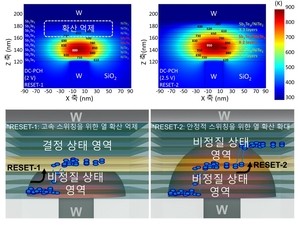
Korean researchers develop next-gen AI phase-change memory chip with 76% less power, 110% greater durability
Korea University Professor Kim Tae-geun's team controls heat diffusion with dual isolation structure South Korean researchers have succeeded in developing a next-generation phase-change memory technology that significantly reduces power consumption by blocking heat diffusion while stably storing multiple data states in a single cell. The National Research Foundation of Korea announced Friday that a research team led by Korea University Professor Kim Tae-geun had developed a dual-isolation phase-change heterojunction memory that combines two materials with distinct properties to control heat diffusion and phase-change regions inside the memory in a stepwise manner. As data processing demands surge with the rise of generative AI and large language models, the importance of next-generation memory technology capable of delivering fast operating speeds, low power consumption and high storage density simultaneously has grown considerably. Conventional phase-change memory, however, has faced a key limitation: heat generated during data writing spreads to surrounding areas, wasting energy and making it difficult to control the phase-change region. A particularly difficult trade-off existed in which materials that lower operating voltage are vulnerable to heat, while heat-resistant materials require higher voltage. The research team introduced a new structure that pairs two types of transition metal dichalcogenides — NiTe2 and MoTe2 — both of which can remain in a crystalline state without undergoing phase change during operation. NiTe2 serves as a thermal conduction layer, efficiently generating and transferring heat even at low voltages, while MoTe2 acts as a thermal barrier layer that suppresses heat diffusion. This design allows the team to engineer the heat transfer pathway inside the memory, enabling precise control over where and to what extent phase changes occur. The team verified the operating principles of the proposed structure through electrical characterization, thermal simulation, high-resolution transmission electron microscopy and X-ray diffraction analysis. As a result, they were able to engineer the heat transfer pathway inside the memory as intended, cutting operating energy by 76 percent and improving durability by 110 percent compared with conventional designs. The significance of the research lies in its departure from the conventional approach of improving a single material's properties. Instead, the team combined NiTe2's high electrical conductivity with MoTe2's high thermal stability within a single device, effectively engineering the flow of heat itself. "It will be important to further miniaturize the device to actual semiconductor process standards and to secure process stability so that each cell operates uniformly in large-scale memory arrays," Kim said. "We expect this technology to serve as a core memory solution for next-generation semiconductor systems, including high-density AI memory, neuromorphic computing and in-memory computing." The team plans to conduct follow-up research to verify that multiple resistance states remain stable under repeated operation and extended use, and to ensure compatibility with existing semiconductor manufacturing processes. The research, supported by the Ministry of Science and ICT and the National Research Foundation of Korea through the Next-Generation Intelligent Semiconductor Technology Development project, was published in the international journal International Journal of Extreme Manufacturing.
Sept. 11, 2026
-
Kakao adds 7 partners to Kakao Tools, widening AI agent ecosystem
Second partner collaboration since March expansion Daiso Mall, Looxroo, Shinsegae Duty Free among new links Kakao is linking new partner services to Kakao Tools, marking another round of collaboration since the platform's expanded overhaul in March. The company aims to broaden the use of artificial intelligence in daily life and expand its agentic AI ecosystem. Kakao said Friday that it has added services from seven partner companies to Kakao Tools within ChatGPT for Kakao. This follows an earlier round of integration with OP.GG, Zigbang and Hanatour Service, bringing the total number of partners newly onboarded to Kakao Tools to 10. The newly joined partners are Daiso Mall, Looxroo, Spacecloud, Shinsegae Duty Free, Shinhan Card, LF Mall and Cheongyeon. Kakao Tools is an AI agent that connects with a range of services both inside and outside Kakao. Users can access partner services simply by chatting in the ChatGPT for Kakao window. Since March, Kakao has been working with outside partners to widen the points of contact where people can use AI in daily life. Kakao said the latest collaboration has diversified the categories of services linked to Kakao Tools. The lineup now spans gaming, with OP.GG; space rental, with Spacecloud and Zigbang; lifestyle, with Cheongyeon; finance, with Shinhan Card; and travel, with Hanatour Service. Shopping has also expanded, with Daiso Mall, Looxroo, Shinsegae Duty Free and LF Mall joining the platform. Kakao said it plans to keep working with partners that bring expertise in their respective fields to enhance the usability of Kakao Tools. In addition, Kakao will unveil the finalist services of "Agentic Player 10" through the "Tool Challenge" menu starting Sept. 16. Agentic Player 10 is a development contest for Kakao Tools based on PlayMCP that began in June. The finalists are 20 services that passed the contest's preliminary review. Kakao Tools currently links a total of 28 services, including those from Kakao and its affiliates as well as partner companies. Kakao said the addition of original tools built by independent developers has also widened the range of services available to users. "With this second round of collaboration, the scope of Kakao Tools now spans gaming content, space, lifestyle, finance, travel and shopping," said Yoo Yong-ha, performance leader of Kakao AI Connect. "We will continue working with a diverse range of partners to expand everyday AI experiences that match users' needs and interests."
Sept. 11, 2026
-

Korea targets 2035 for small modular reactor rollout as special act takes effect
Special law backs public-private joint ventures and R&D hubs to support SMR development from research to commercialization Joint detailed design work to begin in 2027; construction of non-light-water SMRs targeted for the 2030s The government is moving to accelerate the commercialization of small modular reactors, the next-generation nuclear power technology. A legal and institutional framework to support the entire development cycle — from research and development to demonstration and commercialization — has gone into full operation. The goal is to commercialize light-water SMRs by 2035. The Ministry of Science and ICT said the Special Act on the Promotion and Support of Small Modular Reactor Development and its enforcement decree took effect Friday. The special act was enacted in March to systematically promote SMR research and demonstration and to build a pan-government support system that turns research outcomes into actual commercialization and industry. The law's implementation is expected to speed up SMR development in tandem with the government's "7 SEED Projects" initiative for future growth engines, which was unveiled last month. The government has set a goal of commercializing light-water SMRs by 2035 and beginning construction of non-light-water SMRs in the 2030s. Under the special act, the Ministry of Science and ICT will draw up a basic SMR system development plan every five years and an annual implementation plan. The basic plan will cover not only technology development but also nuclear fuel supply chains, training of specialized personnel and securing public acceptance. It will also cover the designation and operation of research and development hubs. The SMR System Development Promotion Committee will deliberate on major SMR development matters. It will bring together 11 central government agencies covering energy, industry, defense, maritime affairs and small and medium-sized enterprises, along with more than 10 private-sector experts. The committee will discuss technology development, demonstration, corporate cooperation and regulatory improvements for a range of SMR applications, including land-based power generation, ship propulsion and industrial heat supply. The government will also support private-sector-led SMR commercialization. It plans to help establish companies jointly funded by private firms and public institutions and to provide budgetary support for related project costs. Through SMR research consortiums involving industry, academia and research institutes, the government will support research and development, technology transfer and commercialization. It will also support training of specialized personnel and the shared use of facilities and equipment. Regions with concentrated SMR research and development capabilities may be designated as SMR System Research and Development Zones. Eligible areas must have universities, research institutions and companies with sufficient personnel and infrastructure, and must have established a cooperative framework with local governments. Starting next year, the government will begin joint public-private detailed design work on SMRs. It plans to shorten verification and demonstration periods by operating large research facilities and equipment in a concentrated manner and by using advanced technologies such as digital twins. For non-light-water SMRs, the government will foster specialized commercialization companies — including SPCs jointly funded by the public and private sectors — from the early stages of development. It also plans to expand SMR applications beyond power generation to industrial complex process heat, and to maritime, defense and space uses. Deputy Prime Minister and Minister of Science and ICT Bae Kyung-hoon said, "The implementation of the special SMR act and its enforcement decree marks an institutional starting point for connecting our accumulated nuclear R&D capabilities to demonstration and commercialization and expanding them into an industry." He added, "We will push forward with technology development and institutional improvements at speed so that Korea can lead the global SMR market."
Sept. 11, 2026
-

Naver Labs unveils VR tour of Kansong Art Museum
Exhibition halls, artifacts viewable anytime, anywhere Following National Museum of Korea, cultural heritage becomes digital asset Naver is launching a "VR tour" service that lets users view Kansong Art Museum's exhibition spaces and key holdings in virtual reality. Naver Labs and the Kansong Art and Culture Foundation said Friday that they are rolling out a VR tour service. The service allows visitors to explore Kansong Art Museum without any constraints of time or place. Kansong Art Museum, located in Seongbuk-gu, Seoul, is South Korea's first private art museum, known for its focus on collecting and researching artifacts to preserve the country's cultural heritage. According to Naver, the VR tour is built on digital twins of the museum's exhibition space and the works featured in its "Munhwa Boguk" ("Safeguarding the Nation Through Culture") exhibition. Both digital twins were created by Naver Labs. Users can explore Bohwagak, the museum's exhibition hall, following a set route as if visiting in person, and select any artifact on display to view a detailed description. Kansong Art Museum has traditionally been open to the public only during its regular spring and fall exhibition periods. Naver said the new VR tour service allows anyone to view the museum's collection without such time or place restrictions. Naver also pointed to the ability to view artifacts that no longer exist as another advantage of the VR tour. A prime example is the Qing-era stone lion statue that once stood guard at the museum's main gate before it was donated to China in July. It has now been preserved as digital data. Other artifacts were difficult to access because they stood outdoors, including the octagonal stupa from Goesan and a stone octagonal monk's stupa. These can also be viewed through the VR tour. Naver said the project marks a significant step toward permanently preserving cultural heritage in digital space through Naver Labs' spatial AI technology. Naver Labs built digital twins of Kansong Art Museum's spaces and artifacts for the VR tour. The company used its vision technology, which can perform 3D mapping with only a smartphone camera and without specialized equipment such as high-precision scanners. This makes it possible to easily convert a wide range of spaces and objects into digital data. This is not the first time Naver Labs has recreated a cultural space through virtual content. The company has operated an augmented reality navigation service at the National Museum of Korea since 2022. It has also introduced Flying View 3D on Naver Maps, a service that uses its Noble View Synthesis technology. The service lets users explore historic sites, such as Cheomseongdae in Gyeongju, in 360 degrees. "Following the National Museum of Korea, we have now recreated Kansong Art Museum's cultural heritage in digital space, allowing anyone to enjoy it without any restrictions of time or place," said Lee Dong-hwan, leader of Naver Labs' Vision Group. "We will continue to advance our spatial AI technologies — including digital twins, positioning and 3D reconstruction — to create new cultural experiences."
Sept. 11, 2026
-
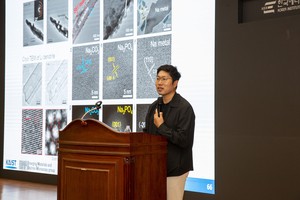
Battery degradation traced at atomic level: energy institute shares next-gen material analysis tech
- Holds Energy Materials Analysis Conference with National NanoFab Center Experts from Korean industry, academia and research institutes came together to share advanced analysis technologies and research know-how for examining materials down to the nanometer and atomic scale. These materials determine the performance of next-generation solar cells, secondary batteries and hydrogen fuel cells. The Korea Institute of Energy Research said it held the 2026 Second Energy Materials Analysis Conference together with the National NanoFab Center on Thursday and Friday. The event was designed to share cutting-edge analysis technologies and research know-how in the field of energy materials. It also aimed to strengthen researchers' capabilities in using advanced research equipment and interpreting data. The conference was also intended to promote joint use of national research facilities and equipment and expand cooperation among industry, academia and research institutes. Researchers and electron microscopy analysis experts from universities, research institutes and companies took part, including those from KAIST, Pusan National University and the Korea Institute of Energy Technology. A seminar featuring invited experts was held Thursday at the Korea Institute of Energy Research's headquarters in Daejeon. Park Yun-chang, a center director at the National NanoFab Center, KAIST Professor Yang Yong-su and Pusan National University Professor Koo Gun-mo presented advanced transmission electron microscopy, or TEM, analysis techniques. They also shared the latest research cases used in next-generation energy material research. TEM is an advanced analysis instrument that passes an electron beam through a sample to observe its internal structure and composition at the nanometer and atomic scale. It plays a key role in identifying the interfaces, defects and chemical states of materials used in next-generation solar cells, secondary batteries and hydrogen fuel cells. On Friday, hands-on training using actual advanced analysis equipment took place at the National NanoFab Center. Participants practiced basic TEM techniques and learned 4D-STEM, or four-dimensional scanning transmission electron microscopy, analysis firsthand. 4D-STEM is a technique that collects two-dimensional electron diffraction patterns from each point on a sample and reconstructs them into four-dimensional data, allowing precise analysis of a material's structure and deformation. "In energy material research, advanced analysis is an important starting point that scientifically identifies how a material performs and why it degrades, pointing the way for future research," said An Byung-sun, head of the Test and Analysis Center at the Korea Institute of Energy Research. "As energy technology advances, the ability to precisely measure small changes at the nanometer and atomic scale and interpret the resulting data will determine research competitiveness." "I hope this becomes an opportunity to further expand cooperation among industry, academia and research institutes, centered on the advanced research facilities and equipment our institutions hold," said Park Yun-chang, a center director at the National NanoFab Center. Building on the conference, the Korea Institute of Energy Research plans to expand the spread of advanced analysis technologies specialized for energy materials. It also aims to broaden joint use of national research facilities and equipment.
Sept. 11, 2026
-
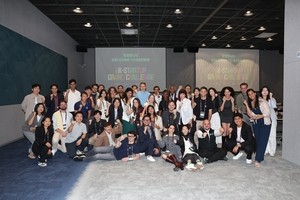
Baemin shares growth know-how with global startups to build up entrepreneurial ecosystem
Baemin Startup Square hosts exchange event for 'K-Startup Grand Challenge' 38 foreign participants learn growth story, tour facility Baemin has shared the growth know-how it built up over the past 16 years with global startups, as part of its plan to nurture the domestic and international startup ecosystem in cooperation with government agencies and support organizations. Woowa Brothers, which operates Baemin, said Friday that it held an on-site exchange event Thursday with participating companies and officials of the "2026 K-Startup Grand Challenge." The event took place at Baemin Startup Square in Pangyo, Seongnam, Gyeonggi Province. The K-Startup Grand Challenge is a global startup support project hosted by the Ministry of SMEs and Startups and organized by the Gyeonggi Center for Creative Economy and Innovation. The program aims to attract promising global startups and build Korea into Asia's top startup business hub. The exchange event was arranged as part of the program. Baemin began its startup incubation project last year when it built Baemin Startup Square in the second Pangyo Techno Valley. The company has offered part of the space rent-free for 10 years to specialized organizations that support startups with investment, legal and networking services. About 60 startups spanning fields from food tech to robotics, AI and eco-friendly technology have moved into the space so far. At the event, Baemin held a session to share its growth story with 38 officials from overseas startups. Kim Eun-hye, head of the Baemin Startup Square operations team at Woowa Brothers, said, "Baemin, which started with 30 million won ($22,400) in capital, has achieved growth that reads like a textbook case among fiercely competitive startups." She added, "We aim to become an irreplaceable delivery platform through continued innovation, rather than settling for where we are now." A tour of the facility followed. The tour featured an 80-seat conference hall that can host large-scale events, along with open spaces and lounges where resident startups can freely interact. In a closing question-and-answer session, participants asked about Baemin's growth strategy, the characteristics of the Korean market and the company's core values. Asked about the values Baemin has upheld, Kim said, "It is about recognizing the fast-paced, high-standard nature of Korean consumers and delivering good food quickly." Mark Belneger, the head of a Dutch startup who attended the event, said, "It was a chance to really appreciate Woowa Brothers' ability to run its business successfully." He added, "Baemin Startup Square is also appealing because it brings various companies together to communicate in one space." Kim Ju-yeon, head of the management strategy division at Woowa Brothers, said, "We are glad to be building a startup incubation ecosystem together with the Ministry of SMEs and Startups and the Gyeonggi Center for Creative Economy and Innovation." She added, "We will continue contributing to fostering an entrepreneurial environment in Korea through public-private cooperation."
Sept. 11, 2026
-
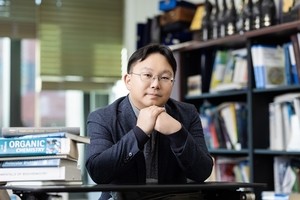
KAIST professor becomes first Korean editor at 105-year-old chemistry journal
- Han Soon-gyu joins as one of 14 editors of Organic Syntheses - Role includes reproducing and verifying other researchers' synthesis methods KAIST said Professor Han Soon-gyu of its Department of Chemistry has become the first Korean elected as an editor of Organic Syntheses, a 105-year-old journal in the field of organic chemistry. Over the next five years, Han will be responsible for proposing, inviting and selecting research for publication in the journal. He will also personally reproduce and verify synthesis methods developed by other researchers in his own laboratory. His term can be extended up to three years. Founded in 1921, Organic Syntheses differs from typical academic journals in that its checking editors repeat the organic synthesis experiments presented in submitted papers in their own laboratories. A paper is published only after its yield, selectivity and purification process are confirmed and its reproducibility proven. As a result, the synthesis methods included in the journal are regarded as highly reliable, standard experimental guidelines used by organic chemists around the world. Serving as a checking editor requires more than reviewing papers — editors must personally carry out the described experiments and vouch for their reliability. The role demands a high level of academic judgment and experimental skill. The journal currently has 14 editors in total, including its editor-in-chief and deputy editor-in-chief. Prominent chemists from Japan, China and Hong Kong have served on the board, including 2001 Nobel Prize in Chemistry laureate Ryoji Noyori. Han is the first Korean chemist ever elected to the position. Han has built his research career around the chemical synthesis of complex natural products. After joining KAIST in 2014, he successfully synthesized a number of structurally complex alkaloid natural products derived from Securinega suffruticosa, a medicinal plant native to Korea. More recently, he has expanded his research to include molecular photoswitches, which use light to control the structure and function of molecules. He has also pursued the development of anticancer drugs and treatments for degenerative brain diseases such as Alzheimer's, using derivatives of synthetic natural products. Since June last year, Han has also served as deputy editor-in-chief of the international organic chemistry journal Organic Letters. The selection reflects international recognition of Han's expertise and research capabilities in organic synthesis. With Han's election, KAIST will also be able to host the Organic Syntheses Distinguished Lecture Series during his term as a checking editor. With support from the journal's foundation, the university plans to invite renowned organic chemists from around the world to KAIST, expanding opportunities for exchange with students and young researchers. "Through diligent work as a checking editor, I hope to contribute to chemists around the world and help accumulate reliable chemical knowledge, thereby contributing to the advancement of chemistry for humanity," Han said.
Sept. 11, 2026
-

Chinese short-drama apps overtake Tving, Coupang Play in new downloads
Chinese short-drama platforms swept the top rankings for new entertainment app installations in Korea last month, overtaking domestic OTT services such as Tving and Coupang Play within just three months. The rapid rise of Chinese short-drama apps has heightened tensions across Korea's OTT industry. Short dramas consist of brief episodes running one to three minutes each. They quickly establish conflict from the outset and pack in dramatic twists in rapid succession to keep viewers watching the next episode. As short dramas have spread, some viewers have begun saying things like, "A 12-episode drama is too long now," or "I watched one episode and stopped there." According to Mobile Index on Thursday, Chinese short-drama platforms claimed all of the top three spots in new entertainment app installations in Korea in August. DramaWave ranked first with 840,000 installs, followed by NetShort with 800,000 and DramaBox with 740,000. The figures show a gap of nearly 200,000 installs compared with domestic OTT platforms. Tving ranked fifth with 570,000 installs, while Coupang Play came in sixth with 540,000. The reversal has drawn particular attention because the rankings looked completely different just three months ago. In May, Korea's own OTT platforms dominated the top spots, with Coupang Play first at 470,000 installs and Tving second at 420,000. NetShort followed in fourth place with 340,000, and DramaBox ranked fifth with 320,000. Industry watchers say Chinese operators, having already established production and monetization formulas amid the rapid growth of short-form content, are now moving to dominate the Korean market as well. They are expanding into overseas markets by supplying large volumes of content quickly through mass-production expertise and combining freemium models with advertising-based revenue. In fact, China's short-drama market has already grown to a scale rivaling its film industry. According to the "China Micro-Short Drama Industry Development White Paper" published by the China Netcasting Services Association, China's short-drama market was estimated at about 50 billion yuan ($7.46 billion), or roughly 10 trillion won ($7.47 billion), in 2024 — surpassing the country's film box office revenue for the same year. DramaWave's parent company, Kunlun Tech, disclosed in June that the global monthly transaction volume of its AI short-drama business had surpassed $65 million. Korea's OTT industry is also on edge over the rapid rise of Chinese short-drama apps. "Until last year, short dramas were widely viewed as a niche market distinct from existing OTT services, but the recent pace of growth has changed the picture," an industry official said. "Chinese companies have already established their production methods and revenue models and are rapidly expanding into the Korean market, leaving domestic operators with no choice but to consider their own response strategies."
Sept. 10, 2026
-
!['Only the old worry about the planet?' Why young Koreans seem so calm about climate change [What's Earth Saying?]](https://wimg.heraldcorp.com/news/cms/2026/09/10/news-p.v1.20260910.310bc460db334ce696c6d978ce22d760_T1.jpg?type=h&h=240)
'Only the old worry about the planet?' Why young Koreans seem so calm about climate change [What's Earth Saying?]
Do people in their 20s and 30s not worry about matters of life and death? Young adults in their 20s and 30s will face a much longer future than older generations. It would seem only natural, then, that they would carry deeper worries about a changing world. Climate change is the clearest example. Extreme weather can upend daily life with little or no warning. People in their 20s and 30s, in particular, are the generation that will bear the brunt of climate disasters such as heat waves, floods and wildfires, since such disasters are expected to grow more frequent and severe over time. But reality tells a different story. Adults aged 60 and older turn out to view the climate and environmental crisis as more serious than those in their 20s and 30s do. Analysis shows that the younger the age group, the weaker the sense of crisis over humanity's survival — a pattern that holds regardless of country or region. Does only the older generation worry about the world? Experts say there is a clear explanation for why people in their 20s and 30s show relatively low awareness of the climate and environmental crisis. The younger the age, the less climate worry — Korea included This tendency stands out in the "2026 Environmental Crisis Clock," recently released by the Environmental Foundation and Japan's Asahi Glass Foundation. The Environmental Crisis Clock is an indicator that expresses, in the form of a "time," how seriously environmental problems threaten humanity's survival. Measured since 1992 through surveys of environmental experts worldwide, a later time signals a more serious threat. This year's global Environmental Crisis Clock read 9:39, six minutes later than last year's 9:33, marking a "very dangerous" level. Korea's clock moved from 8:53 last year to 9:34 this year, advancing roughly 41 minutes closer to midnight in just one year. A breakdown by age revealed a different pattern. The clock for people aged 60 and older stood at 9:48, while for those in their 20s and 30s it read 9:25 — about 23 minutes earlier. Those in their 40s and 50s fell in between, at 9:39. In short, the older people are, the more seriously they perceive the survival threat posed by climate change. Nor is this pattern unique to climate experts. The Asahi Glass Foundation also conducted a separate survey this year of 1,302 ordinary Japanese people aged 15 to 69. Generation Z respondents aged 18 to 24 recorded an Environmental Crisis Clock reading of 6:36, while adults aged 25 to 69 recorded 7:27 — a sizable gap. A similar pattern holds within Korea. In the National Environmental Awareness Survey conducted last year by the Korea Environment Institute on 3,008 adults nationwide, the share of respondents who said climate change has a serious impact on society overall rose with age, from 79.2 percent among people in their 20s to 87.6 percent among those in their 60s. Everyday interest in environmental issues followed the same upward trend, from 3.62 points among people in their 20s and 3.58 among those in their 30s to 3.80 among those in their 50s and 3.96 among those in their 60s. The gap widened further when it came to actual behavior. Only 38.3 percent of people in their 20s said they prioritize eco-friendly behavior even when it is somewhat inconvenient, compared with 72.1 percent of those in their 60s — nearly double. A changing climate and environment are directly tied to humanity's survival. According to the Intergovernmental Panel on Climate Change, about 3.3 billion to 3.6 billion people worldwide currently live in environments highly vulnerable to climate change — meaning roughly half of humanity already faces a threat to its survival. Korea is no exception. This summer alone brought record-breaking heat waves and torrential rain in succession. Temperatures in some areas soared to record highs while record rainfall drenched other regions, making clear that climate change is no longer a distant concern. The public is well aware of this. In last year's National Environmental Awareness Survey, 88.3 percent of respondents expected "future generations" to suffer from climate change, and 70.7 percent said Korea is already experiencing its negative effects. The vast majority of Koreans, in other words, anticipate a looming crisis for humanity's survival. 'I'll just give up' — the hidden helplessness of Korea's youth So do people in their 20s and 30s really have no worries about the world? There is a hidden twist. Rather than milder emotions like "worry" or "crisis," they may in fact feel a considerable degree of helplessness — a result, analysts say, of believing the problem is beyond their control or resolution. In other words, a lower outward level of worry does not mean this generation views climate change with optimism. When researchers at the Korea Institute for Health and Social Affairs surveyed 2,000 adults aged 19 to 65 nationwide in 2023, 87.6 percent of people in their 20s and 98.3 percent of those in their 60s said they "worry" about climate change. The share who said they feel "anxious" was likewise higher among older respondents: 83.8 percent for those in their 20s versus 94.4 percent for those in their 60s. But when researchers measured "climate anxiety" — combining thoughts, emotions and disruptions to daily life caused by climate change — the results flipped. On the five-point Climate Change Anxiety Scale, people in their 20s scored highest at 2.02, with scores declining steadily with age: 1.99 for those in their 30s, 1.94 for those in their 40s, 1.77 for those in their 50s and just 1.75 for those in their 60s. The gap was especially stark on "helplessness." Among people in their 20s, 59.3 percent said they feel helpless because they believe climate change cannot be controlled or solved — 13 percentage points higher than the 46.3 percent recorded among those in their 60s. Their outward sense of crisis may appear relatively low, but younger people feel more strongly that the problem cannot be solved anyway. This sense of helplessness can also lead to "climate depression" — a psychological state in which the belief that the climate crisis is worsening and the future is uncertain gives rise to negative emotions such as sadness, loss, anger and helplessness. A follow-up study released by the Korea Institute for Health and Social Affairs in December 2025 captured the same trend. When researchers analyzed climate anxiety levels among 2,000 adults, the "potentially high climate anxiety group" — those at risk of moderate or higher depression — made up 34.3 percent of young adults aged 19 to 34, compared with 25.8 percent of the middle-aged group aged 35 to 64. Given this, it is hard to write off the relatively low crisis awareness among people in their 20s and 30s as simple indifference or optimism. Even when their outward worry appears muted, they may feel greater anxiety and helplessness underneath, believing the climate crisis is beyond their control. Experts said easing younger generations' sense of helplessness requires moving beyond traditional climate communication that emphasizes alarm, and instead offering more information that helps people feel a genuine sense of efficacy in responding to the crisis. Researchers at the Korea Institute for Health and Social Affairs likewise said those who deliver climate information, including the government, should not simply repeat warnings that the situation is "dangerous." Young people need to see response methods they can actually follow, along with real-world solutions, so they can build the confidence that their own actions can make a difference. "It should include not just knowledge about the causes and phenomena of climate change, but also specific behavioral guidance for adaptation, or information about best practices adopted by the government," the researchers said.
Sept. 10, 2026
-
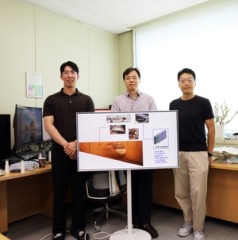
Korean 'K-air purification' technology set to tackle India's severe fine dust on trains
- Machinery research institute develops compact electrostatic module based on 'Air Five' platform - Technology cuts filter clogging and fits directly into existing train ventilation systems - After India field trials, expansion planned to airports, hospitals and Southeast Asian markets South Korean air purification technology is heading to India's railway market, which has long struggled with extremely high levels of fine dust. The technology maintains performance over long periods even in heavily polluted environments and can be installed directly into existing train ventilation systems without major modifications. The Korea Institute of Machinery and Materials said Thursday that its research team has begun developing a compact electrostatic precipitation module for Indian trains, in partnership with affiliate company THN. The team, from the institute's Department of Environmental and Energy Systems Research, is led by Principal Researchers Kim Sang-bok and Park In-yong and Senior Researcher Kim Young-hoon. The technology is being developed under Air Five, the institute's flagship air purification brand. The electrostatic precipitation method charges fine dust particles in the air before collecting them on a precipitation plate. Conventional filters that rely on filtration tend to clog quickly and generate greater air resistance as dust concentration rises. Electrostatic precipitation, by contrast, keeps the air passage from clogging easily, allowing it to reliably purify large volumes of air even in highly polluted environments. The research team is designing the module in a compact form that can be installed without altering the structure of existing train ventilation systems. The goal is to achieve fine dust reduction performance at the MERV 15 level, comparable to high-performance filtration-based air purification technology. MERV is an index that measures a filter's ability to remove fine particles, with higher numbers indicating better removal performance. The project began after an Indian railway company proposed developing air purification technology for train cabins. The research team plans to install the developed module on actual trains in India to verify its dust removal performance, durability and energy efficiency. It will also confirm whether the purification performance remains stable over long periods of operation. The team is also incorporating technology that removes infection-transmitting substances in addition to fine dust. In cooperation with Chonnam National University, the researchers plan to apply a function to the electrostatic precipitator that treats airborne infection-transmitting substances. Once field trials in India are complete, the institute plans to expand the technology's application beyond railways to airports, hospitals, and government and public institutions with high foot traffic. Following India, the institute is also pursuing entry into railway and public facility markets in Southeast Asian countries with high fine dust levels, including Thailand and Vietnam. "It is meaningful that we are directly applying domestically developed air purification technology to Indian trains, where fine dust concentration is high, to verify its performance and reliability," said Kim Sang-bok, principal researcher. "We plan to expand the scope of application beyond railways to various ventilation markets, including hospitals, airports and public facilities, contributing to the overseas expansion of Korean air purification technology."
Sept. 10, 2026
-
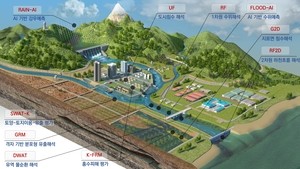
New Korean model predicts flood damage risk in one integrated system
- Institute links 10 models into 'WaterKICT model chain' A new technology can predict, in a single integrated process, where water will flow during heavy rainfall, how much river levels will rise, which areas will flood and how severe the damage will be. The Korea Institute of Civil Engineering and Building Technology said Thursday it has developed an integrated simulation model called the WaterKICT model chain, which predicts and assesses the entire process of water-related disasters, including floods, urban flooding and droughts. The model links 10 individual models into a single system that analyzes the full chain of events in a water disaster -- from rainfall to runoff, river flow, flooding and damage assessment. Nine of the 10 models have already been developed to a level ready for immediate field application. Until now, water disaster analysis in South Korea has relied mainly on models developed overseas. Such models have struggled to fully reflect the characteristics of Korean rivers, climate and terrain, and come with costs for adopting and maintaining the technology. Critics have also warned that using domestically accumulated analytical know-how to improve the performance of foreign models risks deepening the country's technological dependence. A research team at the institute, led by Research Fellow Choi Yun-seok, upgraded its own individually developed simulation technologies to a practical, field-ready level and linked them into a single system. The effort established a foundation for analyzing the entire process of a water disaster -- from its onset to the resulting damage -- using homegrown technology. The model has been listed as a recommended model by the World Meteorological Organization, a UN body, and has been incorporated into the government's preliminary feasibility study guidelines and river design standards. It has also been applied to the national flood forecasting system, where it is used for actual flood prediction. The institute expects the new technology to reduce reliance on foreign models while establishing a foundation for South Korea's technological independence in water disaster analysis and forecasting. It said the model can also improve prediction accuracy for recurring disasters such as heavy rainfall and urban flooding, and provide a scientific basis for disaster response. "The WaterKICT model chain is a meaningful case of localizing technology that has been recognized for its excellence both at home and abroad," said Park Sun-kyu, president of the Korea Institute of Civil Engineering and Building Technology. "It will contribute to protecting public safety from water disasters and to raising the level of the nation's water resource management technology."
Sept. 10, 2026
-

Expert calls for new body to set cable TV content fees amid prolonged slump
Lee Jong-kwan of Shin & Kim proposes 'broadcasting review committee' to set distribution standards, mediate disputes Says content fees should be tied to broadcasters' sales The slump in the cable TV industry is dragging on. A new "broadcasting review committee" should be established to calculate and adjust content usage fees more rationally, an expert said. The same expert also called for a "sales-linked ratio distribution system" that would set the ratio of content fees based on cable TV operators' broadcasting sales. Lee Jong-kwan, senior expert adviser at Shin & Kim, presented the proposal at a seminar titled "Policy Paradigm Shift for Overcoming the Crisis and Securing the Sustainability of Cable TV." The event was held Thursday at the Kim Dae-jung Convention Center and hosted by the Korean Society for Journalism and Communication Studies. Lee first proposed considering the establishment of a "broadcasting review committee" as a way to rationalize content fees. He said the body could set effective standards for evaluation and distribution and mediate disputes. He also raised the need to introduce a "sales-linked ratio distribution system" that would set content fee ratios based on cable TV operators' sales. He argued that the burden of content fees is growing even as cable TV sales continue to fall sharply. In fact, concerns have persisted that the cable TV system operator (SO) market has seen its total sales, broadcasting sales and operating profit continuously decline since 2013. Meanwhile, the burden of content usage fees has grown heavier. Lee also stressed that securing the sustainability of cable TV should be the top priority in media policy. He argued that to keep cable TV functioning as an essential medium, the policy paradigm needs to shift toward two pillars: "ensuring sustainability" and "enhancing regionality." To ensure sustainability, he proposed key policy tasks such as expanding universal broadcasting welfare support, reducing retransmission fees, and switching to a self-reporting system for terms of service. As a locally focused medium suited to an era of five megacities and three special zones, he suggested pursuing measures to enhance regionality. These include reducing contributions to the Broadcasting and Communications Development Fund, supporting investment in local channel production, and giving local governments and public institutions priority in advertising allocation.
Sept. 10, 2026
-
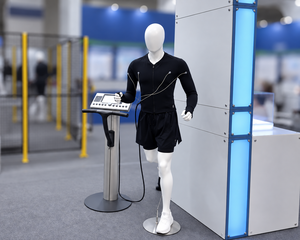
From cutting to sewing, robots build custom-fit smartwear
- KITECH implements micro-factory covering 3D design, cutting and sewing - Combines digital twin, machine vision and robotic automation for small-batch, high-mix production "A smart garment tailored exactly to your body, made automatically by robots." Researchers have developed a technology that designs clothing to fit an individual's body measurements and verifies the production process in a virtual environment. Robots then automatically handle everything from fabric cutting to sewing. The Korea Institute of Industrial Technology said a joint research team developed the technology. Dr. Lim Dae-young, Dr. Won Chan-hee and Dr. Kang Bong-gu led the team, integrating 3D custom design, digital twin process verification, and automated robotic cutting and sewing into one system. The result is an on-demand micro-factory for small-batch, high-mix production of smartwear. Smartwear refers to clothing that incorporates electronic components such as sensors and electrodes. Examples include EMS training suits, undershirts that measure heart rate, heated jackets, and socks that analyze foot pressure and correct gait. Because body shapes vary from person to person, the placement of electrodes and wiring must be designed differently for each wearer. The production process must also be revised whenever product specifications change. This is why conventional mass-production systems have struggled to manufacture individually customized products. To overcome this limitation, the research team integrated 3D custom design, digital twin process verification, and automated robotic cutting and sewing into a single continuous process. First, when a wearer's body measurements and desired design are entered, a 3D garment model and a 2D cutting pattern are automatically generated. Electrode positions and wiring are also adjusted in real time to match the wearer's body shape. The system then verifies which equipment to use and in what order within a digital twin that faithfully replicates the actual factory. It simulates various production scenarios to identify the optimal process sequence and production time. Real-time integration between actual manufacturing process data and the virtual model also allows the system to monitor production conditions as they happen. Robots carry out the final step. Once the fabric is automatically cut according to the input 2D pattern, machine vision precisely recognizes the shape and position of the fabric. A "multi-degree-of-freedom needle-type gripper," developed in-house by the research team, picks up the fabric and moves it to an automatic sewing machine. The machine then stitches it according to a preset program, completing a prototype EMS smartwear garment. "The key is simulating the entire production process in advance and organically integrating it with the actual robotic manufacturing process," said Lim Dae-young, principal researcher at KITECH. "We will continue to upgrade the on-demand micro-factory to expand the production base for individually customized smartwear."
Sept. 10, 2026
-
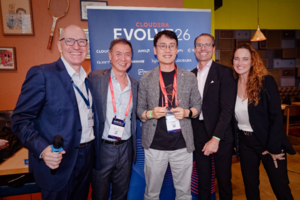
Kolon Benit named Cloudera APAC 'Breakthrough Partner,' to speed up AX business expansion
First South Korean firm to earn 'Breakthrough Partner' status Support spans data management to AI operations and security Kolon Benit has been selected as a key partner of Cloudera. The company plans to deepen its cooperation with Cloudera and accelerate its business supporting corporate AI transformation (AX). Kolon Benit said Friday that it was recently named a "Breakthrough Partner" for the Asia-Pacific region by Cloudera, a global hybrid data and AI platform company. The Breakthrough Partner designation is awarded to companies that have delivered notable achievements in the AI field over the past year. Kolon Benit is the first South Korean company to receive the recognition. Kolon Benit has used Cloudera's data and AI platform to build data management environments for domestic manufacturing and financial companies, helping them apply AI to core business operations. The company said Cloudera recognized it, in particular, for securing real-world use cases that extend to AI model inference and operations infrastructure. Kolon Benit plans to strengthen sales and technology cooperation with Cloudera going forward and expand related projects. The company will also assess how businesses use their data and provide end-to-end support, from building data management systems to operating and securing AI models. In addition, it plans to work with Cloudera and AI specialist firms to help bring AI services that are still in trial stages into actual business use. "This recognition reflects our track record of translating data and AI engineering capabilities into tangible business outcomes for our customers," said Lee Kyung-kuk, head of Kolon Benit's data platform business. "Building on our partnership with Cloudera, we will strengthen our role as an AX enabler that connects customer data to AI and AI to real business value."
Sept. 10, 2026
-
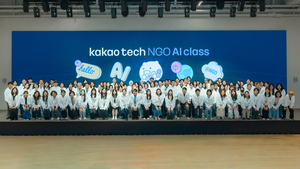
Kakao wraps up AI training program for NGO workers
106 participants from 53 organizations selected Program taught generative AI use, work automation Kakao has stepped up efforts to strengthen the AI capabilities of workers at South Korean nonprofit organizations. Kakao said Thursday that it had successfully wrapped up its NGO worker training program, the Kakao Tech NGO AI Class. The program was designed to help nonprofit workers apply generative AI to their jobs and to raise AI capabilities across their organizations. During the recruitment period, 206 people from 106 organizations applied for the training. Of those, 106 participants from 53 organizations were ultimately selected. The participating organizations spanned 10 fields: consumer and economic justice; environment and climate; international cooperation, development and aid; children, women and family; human rights and peace; intermediary support; social welfare and housing; civic participation and political reform; disability and minority rights; and youth and education. The training ran over two days. The introductory course covered hands-on exercises directly applicable to daily work, including using generative AI for work automation, creating PowerPoint presentations and drafting Excel quotes. The advanced course focused on using AI to streamline tasks NGO workers actually perform, with practice sessions covering customized AI environment setup, monitoring key issues, producing newsletters and automating data management. Kakao said the program aimed to expand AI use organization-wide. To that end, the training was designed so that each organization's leader (team manager or above) and a staff member would participate together as a pair. All those who completed the training received a one-month subscription to the paid AI service Claude Pro. Lee Sung-bum, head of the nonprofit Wonders International, who took part in the training, said, "Through the education and hands-on practice, I learned methods I can apply directly to our work, and it gave me time to think concretely about how to spread this across the organization." Hong Shin, Kakao's ESG cooperation performance leader, said, "We will continue to design practical training that matches the needs of workers in the field and expand our support to more fields going forward." Meanwhile, Kakao ran a similar program for small-business owners last year, the Kakao Tech AI School Boss Class, aimed at helping them use AI effectively to boost their competitiveness. Kakao said it plans to keep expanding AI training programs across civil society.
Sept. 10, 2026
-

Seoul Arena, backed by Kakao, opens booking for second half of next year
Music venue with capacity for up to 28,000 Seoul Arena, a performance venue backed by Kakao as its lead investor, will begin accepting official booking applications for the second half of next year. Seoul Arena said Thursday that it will accept official booking applications from performance planning agencies and entertainment companies for the second half of next year through Sept. 18. Seoul Arena is the largest performance venue under construction in South Korea, with Kakao participating as its lead investor. The project follows a build-transfer-operate scheme. Ownership of the facility will be transferred to the Seoul Metropolitan Government upon completion. A project company in which Kakao holds a stake will operate the venue for 30 years. Two spaces are available for booking: the "arena" and the "mid-sized performance hall." Companies seeking to apply can submit requests through Seoul Arena's official booking webpage. Seoul Arena plans to review applications comprehensively, taking into account performance schedules, content, execution capacity and marketing plans, before deciding on approvals. Once a booking is approved, the venue will coordinate detailed matters concerning production and operations with the client company after signing a contract. Kakao cited the venue's design, which was planned from the outset to specialize in music performances, as one of its key strengths. Seoul Arena is equipped with retractable seating that can be reconfigured depending on the type of event. It also features an LED seating system and sound infrastructure that work in sync with stage direction. The venue also features the "arena," which can hold up to 28,000 people, and the "mid-sized performance hall," which can accommodate about 7,000. Together, the two spaces are designed to handle a wide range of live performances — from global tours to festivals, concerts, fan meetings and showcases. The two venues can also be used in conjunction with each other when needed. Seoul Arena has also been designed to make production easier for booking clients. Its stage and seating can be reconfigured according to the scale and style of an event. In addition, the venue has installed a large-scale stage equipment lift system in its ceiling for lighting, sound and video equipment. It also includes pathways that allow cargo vehicles to drive directly into the venue. With this round of booking applications, Seoul Arena plans to accelerate efforts to secure its performance lineup ahead of its planned opening in the first half of next year. Having been selected as the venue for "2027 Phenomenon," the arena will work to attract a range of performances while strengthening its support system for clients' production and operations. "We are preparing to allow for greater freedom in staging performances and to offer audiences immersive live experiences that have been difficult to find until now," said Oh Ji-hoon, chief executive of Seoul Arena. "Starting with this round of booking applications, we will present performances, together with performance planning agencies from both Korea and abroad, that showcase what makes Seoul Arena unique."
Sept. 10, 2026
-
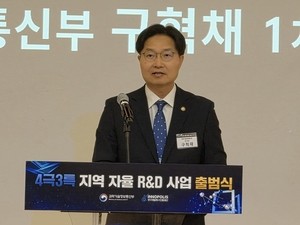
Gov't launches W78.9b regional R&D push
'4 mega-regions, 3 special zones regional autonomous R&D' initiative launches, 18 key technologies to be developed KAIST, GIST, DGIST, UNIST and government-funded institutes to lead regional projects The government will move away from its traditional practice of designating research and development projects centrally and handing them down to regions. It is launching a full-fledged "regional autonomous R&D" initiative under which localities choose and invest in the technologies they actually need. The government will allocate a combined 78.9 billion won ($59 million) across seven regions nationwide, including Daejeon, Sejong and the Chungcheong provinces. The Ministry of Science and ICT held the launch ceremony for the "4 mega-regions, 3 special zones regional autonomous R&D project" at KAIST on Thursday, announcing that it would push forward with region-led R&D initiatives in earnest. The four mega-regions are the central region (Daejeon, Sejong, North Chungcheong Province and South Chungcheong Province), the Honam region (Gwangju and South Jeolla Province), the Daegyeong region (Daegu and North Gyeongsang Province), and the Dongnam region (Busan, Ulsan and South Gyeongsang Province). The three special zones are Gangwon Province, North Jeolla Province and Jeju Special Self-Governing Province. The project shifts from the previous model — centered on the central government and individual projects — to a regional "block funding" approach. Under the new system, each region analyzes its own industrial and scientific technology capabilities together with corporate demand, then selects the fields it needs and designs everything from R&D investment to demonstration and commercialization on its own. This year, a combined 78.9 billion won will go to the seven regions. The four mega-regions each selected three key technology fields, and the three special zones each selected two, for a total of 18 priority technology areas. The government aims to establish a science and technology-based regional growth model for each region by 2030. The country's four science and technology institutes — KAIST, GIST, DGIST and UNIST — along with government-funded research institutes, will take the lead in regional R&D. KAIST will head the project consortium for the central region, GIST for Honam, DGIST for Daegyeong and UNIST for Dongnam. In Gangwon and North Jeolla provinces, the Korea Institute of Science and Technology's Gangneung and Jeonbuk branches will take the lead, while in Jeju, the Korea Institute of Industrial Technology's Jeju Technology Commercialization Center will do so. The central region will receive 13.1 billion won to foster the semiconductor, advanced biotech and advanced mobility industries. The project will link Daejeon's basic R&D capabilities, Sejong's policy and demonstration functions, and the manufacturing and industrialization capacity of South and North Chungcheong provinces to build a "mega-regional deep tech demonstration ecosystem." The Honam region will also receive 13.1 billion won to connect AI and optical semiconductors with renewable energy and future mobility. The Daegyeong region will likewise receive 13.1 billion won to build a "robot belt" linking mobility, robots and system semiconductors. It will use physical AI and edge AI to help push the region's existing manufacturing industries toward advanced technology sectors. The Dongnam region will receive 13.1 billion won to develop shipbuilding AI transformation, power semiconductors and advanced aviation propulsion technology. The project will combine the shipbuilding, machinery and aviation manufacturing base of Busan, Ulsan and South Gyeongsang Province with the technological capabilities of research institutes. This will establish a system to verify and commercialize developed technologies directly on manufacturing sites. Gangwon, North Jeolla and Jeju will each receive 8.8 billion won. Gangwon Province will focus on functional biomaterials and ceramic materials, while North Jeolla Province will concentrate on composite material-based special-purpose machinery and microbe-based food and health technology. Jeju will build a carbon-neutral new industry ecosystem centered on distributed energy and agriculture, livestock and fisheries biotech. "It is important to identify R&D projects tailored to each region's specific circumstances," said Jeong Hee-kwon, chairman of the Innopolis Foundation. "The foundation will do its utmost to serve as a hub that maximizes the characteristics and strengths of each region." "This is the first project pursued as region-led autonomous R&D at the mega-regional level," said Koo Hyuk-chae, first vice minister of the Ministry of Science and ICT. "We will actively support the effort so that a virtuous cycle takes root in each region — one in which research outcomes lead to corporate growth and good jobs, and new talent and investment in turn spur further R&D."
Sept. 10, 2026
MOST READ
- 1Pope Leo XIV declines French honors and banquet, accepts only private meeting with Macron
- 2KAIST develops high-performance bio-based adhesive using E. coli instead of petroleum
- 3Daimler Truck unveils next-generation transport solutions at IAA 2026
- 4What was Rachmaninoff's performance fee? A 1928 price list tells all
- 5Samsung Biologics union's show of force backfires at the bargaining table
- 6APR says hair-loss treatment research published in international journal
-
WORLD

US warns of punishment for anyone enabling Iran's Strait of Hormuz toll scheme
-
INDUSTRY
Toyota union puts productivity first; Hyundai Motor union demands bigger share of profits
-
FINANCE
National Growth Fund to invest $531M in FuriosaAI, which rebuffed Meta's $800M takeover bid
-
INDUSTRY
Korea Shipowners' Association holds amateur baduk tournament for Maritime Day