- KAIST and UNIST confirm wide variation in degradation rates by material type in landfill conditions
- Research team identifies candidate microbes and enzymes involved in plastic breakdown, with potential waste-treatment applications
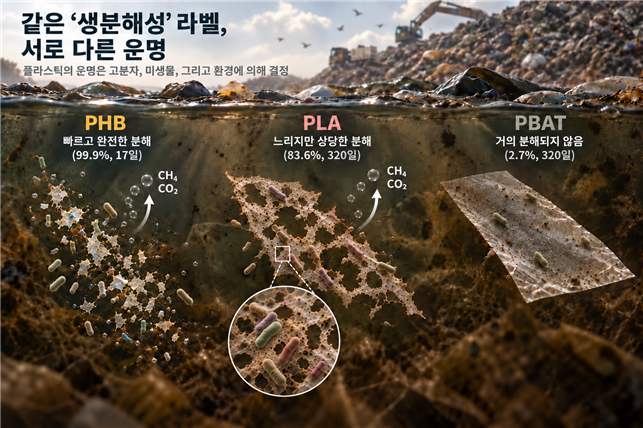
Biodegradable plastics, widely promoted as eco-friendly materials, can break down at vastly different rates depending on their composition, new research shows. One type degraded by 99.9% in just 17 days, while another broke down by only 2.7% after 320 days.
KAIST announced Tuesday that a research team led by Professor Myung Jae-wook of its Department of Civil and Environmental Engineering, working jointly with a team led by Professor Lee Chang-soo of the Ulsan National Institute of Science and Technology (UNIST), had identified the degradation characteristics of biodegradable plastics in oxygen-free landfill conditions and discovered candidate microorganisms and enzymes potentially involved in the breakdown process.
The research team placed three representative biodegradable plastics — polyhydroxybutyrate (PHB), polylactic acid (PLA) and polybutylene adipate terephthalate (PBAT) — in landfill leachate and conducted degradation experiments for up to 320 days in an oxygen-free environment at 35 degrees Celsius.
As a result, PHB achieved a mineralization rate of 99.9% in just 17 days. The mineralization rate refers to the proportion of carbon in the plastic converted into methane, carbon dioxide or other compounds through microbial activity, and serves as a measure of actual biodegradation.
PLA showed a degradation lag of about 20 days initially but then broke down gradually, reaching 83.6% after 320 days. PBAT, by contrast, was limited to 2.7% over the same period. Low-density polyethylene (LDPE), a conventional plastic used as a reference, registered just 0.4%.
Particularly notable was the finding that PLA — generally known to degrade well under high-temperature composting conditions — also broke down to a significant degree in an oxygen-free environment at 35 degrees Celsius.
The research team also tracked the activity of microorganisms involved in plastic degradation. Using metagenomics and metatranscriptomics, which analyze both DNA and RNA from microbial communities, the team examined the genetic activity of microorganisms attached to the plastic surfaces.
The analysis found candidate genes for PHB- or PLA-degrading enzymes in 118 of 238 microbial genomes. Of those, 49 genomes showed confirmed gene expression.

However, the research team said confirmed gene activity alone does not prove that a given microorganism or enzyme actually degrades plastic, and that further functional verification will be needed.
The study demonstrates that assessing the environmental credentials of biodegradable plastics requires consideration not only of the material's inherent properties but also of the conditions in which it is actually discarded.
The findings are expected to inform the selection of plastic materials suited to landfill environments and the development of biodegradability assessment standards, as well as to contribute to biogas production from organic waste and the development of plastic-degrading microorganisms and enzymes.
"How much a biodegradable plastic breaks down depends greatly on where it is discarded and which microorganisms are active there," Professor Myung said. "I hope this research helps establish biodegradability assessment standards suited to different disposal environments and aids in identifying the microorganisms and enzymes capable of breaking down plastics."
The findings were published in the Oct. 20 issue of Nature Communications.
nbgkoo@heraldcorp.com