A long-running dispute over the use of Chinese characters in international traditional medicine standards reaches a resolution at a global assembly
International standards for traditional Korean medicine will now prioritize English terminology, with hanja — Chinese characters — permitted only as a supplementary notation when necessary.
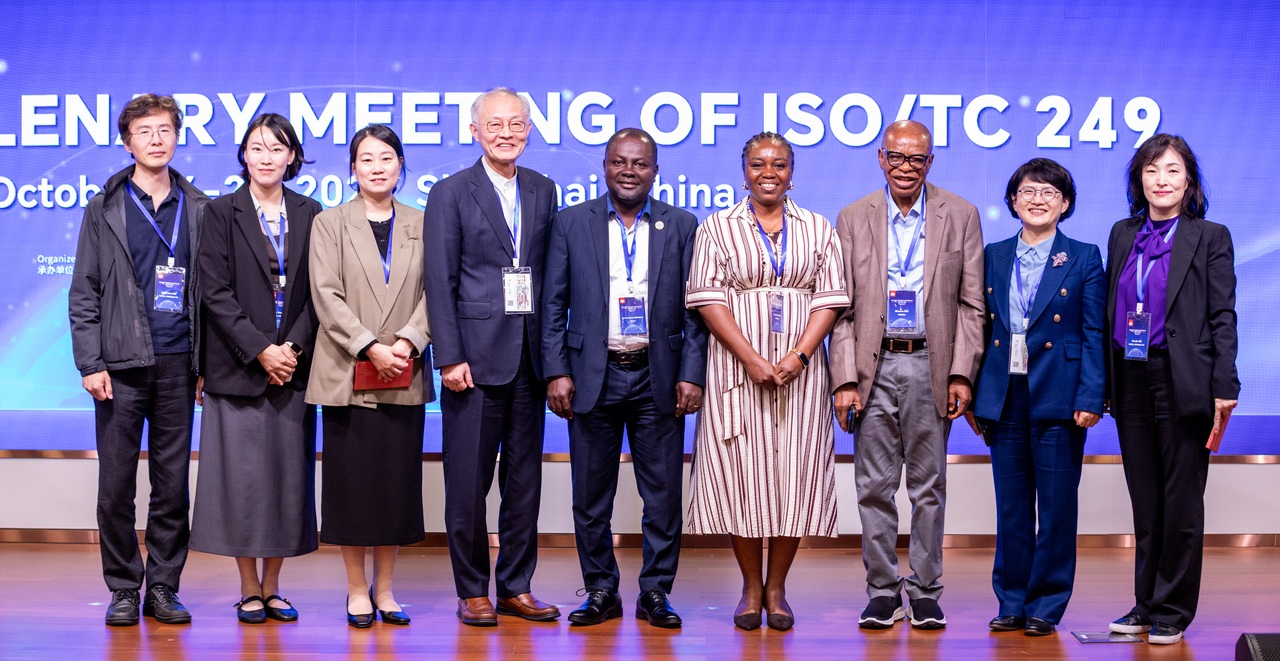
The Korea Institute of Oriental Medicine announced Tuesday that the agreement was reached at the 16th plenary session and language principles meeting of ISO Technical Committee 249 on traditional medicine, held Oct. 26-27 in Shanghai.
The use of hanja in international traditional medicine standards had been a major point of contention among member states, and the meeting placed the issue at the center of its agenda.
Some member states argued that English should be the sole language used in drafting international standards documents, in line with established ISO principles, while others insisted that the unique nature of traditional medicine required English and hanja to appear together.
Korea had consistently pushed for the exclusive use of English terminology to ensure the universality and consistency of international standards.
Member states attending the meeting agreed that English would serve as the default language for international standards, while hanja could be included in a "Note to entry" when needed to clarify the meaning of a term.
Participants also confirmed that the existing practice of placing hanja directly beneath an English term does not conform to ISO document drafting principles.
When hanja is used, it will appear in simplified or traditional Chinese character form, taking into account differences in usage across countries. Pinyin romanization will be restricted to annexes only.
The agreement prevents the script of any single country from being uniformly listed alongside basic terms in international traditional medicine standards, and establishes a terminology framework that can be applied universally.
The plenary was also the first held since ISO/TC 249 expanded its standardization scope beyond East Asian traditional medicine to encompass traditional medicine systems worldwide.
Participants reviewed the potential for broader participation in international standardization, including traditional Persian medicine, homeopathy and African traditional medicine.
The meeting also examined a draft strategic business plan reflecting the expanded scope, and discussed medium- and long-term standardization priorities covering the quality and safety of traditional medicine raw materials and products, medical devices, and terminology and medical information.
Kim Yong-seok, a Kyung Hee University professor and head of the Korean delegation, said the strategic business plan should be developed in a way that applies equitably to the diverse traditional medicine systems of countries around the world.
Lee Yu-jeong, head of the institute's performance and standards dissemination division, said the outcome was significant. "It is an important achievement that we were able to reach a consensus while maintaining the principle of using English terminology — something Korean experts have consistently advocated throughout the long-running debate over hanja notation in international traditional medicine standards," Lee said.
"We will continue to participate actively in the development of international standard terminology so that the unique concepts of Korean medicine and domestic research findings can be accurately expressed in terms that are recognized internationally," Lee added.
nbgkoo@heraldcorp.com