- Superconducting qubit coherence time reaches 100 microseconds
- Advances made in quantum repeaters and ultra-precise cardiac sensor
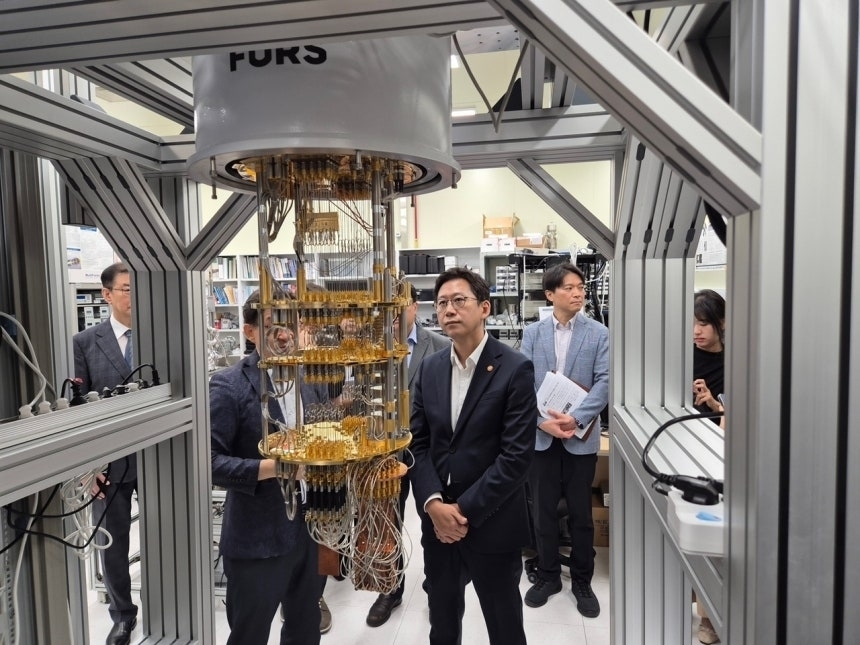
South Korean researchers have succeeded in extending the information retention time of a quantum computer to twice the originally targeted level, while also achieving 99 percent accuracy in two-qubit entanglement operations — a key measure of quantum computing precision.
The Ministry of Science and ICT held the annual meeting of the Quantum Science and Technology Flagship Project on Tuesday at Hotel Onoma in Daejeon, unveiling major research results across three fields: quantum computing, quantum communication and quantum sensing.
The Quantum Science and Technology Flagship Project is a large-scale national research and development initiative aimed at securing core technologies on par with leading nations and advancing commercialization. The government is investing about 360.4 billion won ($266 million) in the first phase of the project, running from 2025 to 2029. The initiative supports 26 key tasks in total — seven in quantum computing, six in quantum communication and 13 in quantum sensing.
The most notable achievement is an improvement in the performance of superconducting qubits, the fundamental building blocks of quantum computers.
Researchers extended the coherence time of superconducting qubits to more than 100 microseconds — double the 50-microsecond target set for 2027.
Coherence time refers to how long a qubit, the basic unit of information in a quantum computer, can maintain its quantum state. A longer coherence time allows for more complex quantum operations to be performed.
Researchers also confirmed 99 percent accuracy in two-qubit entanglement operations, a core computation in quantum computing. The result is considered a critical technology for reducing operational errors between qubits and is expected to serve as an important foundation for developing high-performance quantum computers.
Building on these results, the government plans to develop an error-corrected 100-qubit-class superconducting quantum processor by 2029.
Meaningful progress was also made in quantum communication.
Researchers developed a solid-state quantum repeater capable of generating quantum entanglement on demand, as well as an all-photon quantum repeater that connects quantum entanglement using light. Patent applications have been filed for both technologies.
In quantum sensing, researchers unveiled a compact magnetic field sensor designed for use in diagnosing heart conditions.
The sensor uses nitrogen-vacancy centers — microscopic defects inside diamonds — to measure the extremely faint magnetic fields generated by the heart's electrical activity.
The government plans to accelerate the early commercialization of quantum technologies on the back of these results. Quantum technology has been designated as one of the "7 SEED" future growth engines, with support expanding from securing core technologies to building an industrial ecosystem.
Yun Gyeong-suk, director general for basic and original research policy at the Ministry of Science and ICT, said the flagship project is "a core research and development initiative for securing South Korea's competitiveness in quantum technology," adding that the ministry would "actively support collaboration among researchers and the acceleration of innovative research outcomes."
nbgkoo@heraldcorp.com