
Don't bet on election outcomes. Spread your buys across the calendar.
How to use autumn's US midterms as a purchase schedule
![US President Donald Trump leaves the stage with Sen. Lindsey Graham (R-S.C.) after a campaign rally in Myrtle Beach, South Carolina. [Getty Images]](https://wimg.heraldcorp.com/news/cms/2026/09/07/news-p.v1.20260826.97fcdbca4f2c4562acc488b50990cb2d_P1.jpg)
What the storm left behind was silence. The brokerage floor was quiet in August.
In the first half of this year, the Korean stock market doubled in six months. Then it shed 22 percent in July alone. Measured from peak to trough — the maximum drawdown — the decline reached 42 percent. Circuit breakers, which halt trading when an index plunges, were triggered four times in July alone. The pace was comparable to the 1997 Asian financial crisis.
In August, the same market did not trip a single circuit breaker. Daily trading volume, which had touched 50 trillion won ($36.9 billion), fell by roughly half. What the storm left behind was neither fear nor euphoria. It was a long, drawn-out wait.
The questions coming across the counter have changed, too. During the sharp sell-off in June, the most common question was: "Can I move up my scheduled installment purchases?" These days, the most frequent questions are: "How should I get through September and October?" and "What should I be watching as I wait out the rest of the year?" Questions about direction have given way to questions about timing. I see this as a lesson learned from surviving two bouts of extreme volatility.
Behavioral shifts are also visible. A noticeably larger number of clients unwound leveraged positions and short-term trading strategies after July. Demand has grown to concentrate holdings in companies whose earnings are confirmed in actual numbers, rather than buying the broad index.
Gold's double-digit gain in August alone and US long-term interest rates climbing toward the high 4 percent range have sparked a sharp rise in bond inquiries. There is little urgency to put fresh money into equities. The mood is less about growing assets and more about reorganizing positions for the period beyond year-end.
In short, big money right now is neither selling nor rushing to buy. Instead, it is watching the calendar — and at the center of that calendar sits Nov. 3, the US midterm elections.
Don't stake your portfolio on a cost that disappears when the votes are counted
To understand why the market has stalled, one must first take stock of this year's lessons. What drove the index to double in the first half was not corporate earnings alone. Record levels of client deposits held at brokerages, margin financing, and the concentration of money in single-stock leveraged ETFs — instruments that track an individual stock's moves at twice the magnitude — amplified the upswing. In July, the same structure worked in precisely the opposite direction, amplifying the decline.
What is striking is that fundamentals — the underlying health of companies — were not seriously damaged in the process. Semiconductor exports in August hit an all-time high of $46.65 billion, surpassing $40 billion for three consecutive months. Research notes from brokerages raising target prices have begun to reappear, driven by news of next-generation HBM mass production.
Prices swung to extremes, but the direction of earnings never changed. What separated winners from losers this year was not what you bought, but when and how gradually you bought it.
Now consider the schedule ahead. The Nov. 3 midterm elections will fill all seats in the House and one-third of the Senate. The presidential election was held in 2024 and the next is in 2028, making this year the precise midpoint of a four-year term. Historically, midterm election years have been the weakest of the four-year presidential cycle for share prices.
The pattern has repeated itself. Markets tend to be suppressed in the months leading up to the election, with volatility rising, then recovering through year-end as uncertainty clears around election day. The two most recent midterm years — 2018 and 2022 — both saw a trough in autumn followed by a rebound in November.
The reason is surprisingly simple. What markets dislike is not which party wins, but the cost of not knowing the outcome. And that cost vanishes the moment the votes are counted.
Of course, this year cannot be mapped directly onto historical averages. Unlike a typical midterm year, US equities have already accumulated double-digit gains, and the counterargument — that a reversal could come around the election rather than a rally — carries real weight. Renewed tensions between the United States and Iran are keeping international oil prices and US gasoline prices elevated, while the yield on the 10-year US Treasury note hovers in the high 4 percent range, reflecting persistent inflation concerns.
To summarize: the direction of earnings points upward, but September and October form a stretch where three obstacles — interest rates, oil prices and the election — converge. Calling the direction with confidence during this period is too much to ask even of professionals. That is why the conclusion big money has reached is not a bet on direction, but an allocation across time.
Dates to mark on the calendar
From September through early November, there are five dates worth marking. The first checkpoint comes in mid-September. The US August consumer price index is released on the 11th, followed by the FOMC meeting on Sept. 15-16.
Within a single week, the market will learn whether inflation is rising again and how the Federal Reserve intends to manage interest rates through year-end. The key will be the dot plot released alongside the meeting's outcome — a chart showing each Fed official's individual rate projection. Since a minority already voted for a rate hike at the July meeting, an upward shift in those dots could reignite volatility.
A week later, on the 24th, Chinese President Xi Jinping visits the United States. Given the timing — just weeks before the midterms — there is room for signals of agreement on US-China tensions and the US-Iran situation to emerge, which could pull oil prices and inflation lower together. If the FOMC is a risk factor, this visit leans toward being a relief factor.
At the turn from September into October sits an event of an entirely different character: the initial public offering of Anthropic, with a target valuation of around $2 trillion and a fundraising size of up to $100 billion.
More important than its record-breaking scale is the fact that the value of an AI company that has remained in private markets will, for the first time, face the test of public-market pricing. A mega-IPO of this size can siphon institutional money into the subscription process, creating a short-term supply gap for existing AI and semiconductor stocks. If the offering succeeds, it could conversely serve as a signal reigniting the broader AI rally. Either way, the weeks surrounding the listing should be treated as a period of heightened volatility across AI-related assets.
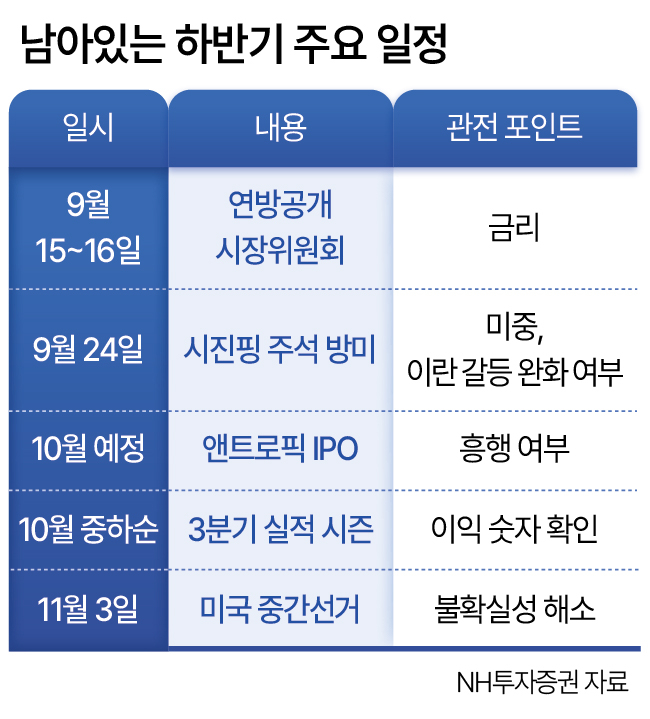
The most densely packed stretch of the second half runs through mid-to-late October. The third-quarter earnings season kicks off, putting semiconductor profits into hard numbers. The September CPI is due on the 14th, and the final FOMC meeting before the midterms is scheduled for Sept. 27-28. Earnings, inflation and interest rates will all deliver their verdicts within two weeks.
Then comes Nov. 3 — the midterms. As the inflection point where uncertainty is resolved, this date carries a different weight from the four that precede it. What matters to the market is not which side wins, but simply the fact that a result exists.
Maintain your target allocation, but spread the pace at which you fill it. That single sentence captures the core of a second-half portfolio strategy. Keep the target weighting set at the start of the year, but distribute the pace of reaching that target according to the schedule.
The dates listed above become the reference points. By spreading installment purchases across the periods before and after these events, a sharp sell-off triggered by any one of them becomes not an unexpected accident but a planned buying day. That difference matters more than it might seem.
For equities, maintain the target allocation. As the August export data confirmed, semiconductor exports continue to set all-time highs. A strategy diversified around semiconductors as the core — extending into materials, components and equipment, power devices and secondary batteries — still looks sound.
For accounts where the July correction pushed holdings below target, I would advise against filling the gap all at once now. Divide the period from September through around election day into several intervals and add mechanically on a date-based schedule.
The idea is not to avoid the historically volatile pre-election period, but to use that entire stretch as a purchase timetable. Rather than trying to time the bottom, the goal is to ensure that whenever a sharp drop comes, that day is already one of the planned buying dates.
For individual stocks, keep the core in semiconductors — where earnings are verified through export statistics and quarterly results. Do not increase exposure to theme-driven assets that will swing on election and policy news.
Bonds are the asset class that has seen the largest increase in allocation in second-half portfolio design this year. US 10-year yields in the high 4 percent range offer the prospect of capital gains on top of coupon income if inflation eventually cools — and, more importantly, they reduce the overall portfolio's swings when equities are under pressure. Since inflation and oil prices still point upward, long-duration bonds should also be added gradually, splitting purchases across rate levels and dates rather than buying all at once.
Gold proved its worth as a hedge asset again with a double-digit gain in August alone. For clients who already hold it, I am recommending they maintain their current position rather than chasing it higher now.
The role of foreign-currency assets, including the dollar, was covered in detail in a previous column and need not be repeated here. Those principles remain fully valid in an election environment.
In this asset allocation, risk management comes down to one thing: do not stake your portfolio's fate on an election outcome. Build a structure that survives largely intact regardless of which party wins, and the election becomes not a risk but simply another date on the calendar.
You cannot win by betting
The greatest danger for retail investors this autumn is betting on election outcomes. Predicting the result is hard enough, but the truly difficult part is predicting how the market will react to that result. Looking back at past elections, there are countless cases where the market moved in the opposite direction even when the predicted outcome proved correct. A game that requires two consecutive correct calls to make money is, by the odds, never favorable to the individual investor.
Still, there is clearly something to learn from how big money operates. First, stop trying to time the market and instead build a strategy anchored to the schedule. The plan is not "I'll buy when it's cheap." The plan is writing down in advance exactly which dates from September through year-end you will buy, and how much on each.
Second, money you cannot afford to leave untouched for two months is not suitable for investing right now. What tends to get shaken during the volatile pre-election period is usually not the stock itself, but the account holding money that will soon be needed.
Third, watch export statistics, not election results. The export data released at the start of each month shows the direction of corporate earnings independent of politics, and it is available to everyone. As long as earnings are growing, every correction the election creates has ultimately met the same fate as every correction before it.
After Nov. 3, the market will find its next worry. But the election passes in two months, and corporate earnings remain. What investors need to do this autumn is not to predict the outcome, but to write out a schedule in advance — one they can hold to without flinching whatever result comes — and then execute it. A second half spent that way will ultimately become the time spent preparing for 2027.

th5@heraldcorp.com




