
- HOME
- FINANCE
-
South Korea expands 'productive finance' target to W1,560tr
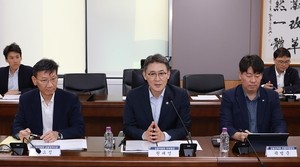
Target raised by 310 trillion won from earlier 1,250 trillion won 272.3 trillion won disbursed through July; white paper due in December South Korea's financial sector is set to significantly expand its "productive finance" funding, with the five-year supply target raised to 1,560 trillion won ($1.16 trillion) from the previous 1,250 trillion won. The increase comes as the Export-Import Bank of Korea and Suhyup Bank have brought their existing funding plans under the productive finance framework, and Samsung Securities has joined the initiative for the first time. Financial authorities said they plan to accelerate the spread of productive finance by broadening both the range of participants and the scale of funding. The Financial Services Commission said it held the fifth meeting of the "Financial Sector Productive Finance Council" on Sunday at Government Complex Seoul, chaired by Vice Chairman Kwon Dae-young, to review progress and future plans for the initiative. The updated five-year supply plan totals 1,560 trillion won — 628 trillion won from the private financial sector and 932 trillion won from policy finance institutions. That is 310 trillion won more than the 1,250 trillion won target announced in July, which comprised 624 trillion won in private finance and 626 trillion won in policy finance. Of the increase, 306 trillion won comes from the policy finance side and 4 trillion won from the private sector. Much of the expansion reflects the incorporation of funding plans that institutions had previously been pursuing independently. The Export-Import Bank of Korea and Suhyup Bank had each drawn up their own supply plans from the start of the year and have now formally joined the government's productive finance initiative. "The Export-Import Bank of Korea and Suhyup Bank each had their own funding supply plans," an FSC official said. "Rather than pursuing them separately, the intent was to bring them together under the common framework of productive finance." The Export-Import Bank of Korea is providing 78.5 trillion won in credit this year under four core pillars: fostering AI and advanced industries, supporting overseas strategic project wins, managing external economic risk, and promoting balanced regional growth. Samsung Securities, which received a short-term finance business license on Wednesday, plans to join the productive finance initiative and expand its supply of venture capital. The financial sector had disbursed 272.3 trillion won under the productive finance framework as of the end of July. The FSC also plans to accelerate the establishment of internal implementation systems at financial firms. To that end, it will begin compiling a "fact book" summarizing productive finance performance starting in the fourth quarter. Each financial firm is expected to publish a white paper in December covering the definition and scope of productive finance, its goals, organizational roles, progress and best practices, followed by an annual report on full-year performance in May next year. The FSC will also broaden liability exemptions to encourage financial firms to invest and lend more actively under the productive finance framework. Following the introduction of exemptions for investment and lending by institutions participating in the National Growth Fund in March, the commission plans to develop additional exemption measures applicable across productive finance activities more broadly. "It will not be easy to quickly change the longstanding financial sector practice of demanding collateral and guarantees while seeking rent," Vice Chairman Kwon said. "Continuous effort from the financial sector is needed to ensure that productive finance capabilities are genuinely internalized and systematized — not just productive finance in name only."
Sept. 15, 2026
-
South Korea's export prices fall 3.7% in August, hitting lowest in nearly 4 years on weaker won
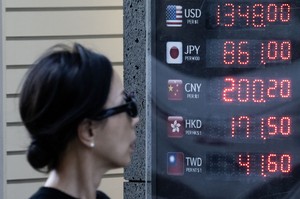
Bank of Korea releases August trade price data Export prices broadly down, including semiconductors 'Underlying semiconductor prices remain solid,' official says Import prices fall for third consecutive month Net barter terms of trade index hits all-time high South Korea's export prices fell at their steepest pace in three years and eight months in August, as a weaker won more than offset a rise in global oil prices. Import prices also declined for a third consecutive month. According to the Bank of Korea's provisional August export and import price index and trade index released Tuesday, import prices in won terms fell 2.4 percent from the previous month — extending a decline that began in June, when they dropped 4.2 percent. Compared with a year earlier, import prices were up 15.6 percent. "Although international oil prices rose, the won's depreciation pushed down prices of chemical products and primary metal products, resulting in a 2.4 percent month-on-month decline," said Lee Heung-hu, head of the Bank of Korea's price statistics team. The monthly average price of Dubai crude oil rose 15.6 percent in August to $88.8 per barrel, up from $76.8 the previous month. Over the same period, the won-dollar exchange rate fell 6.1 percent, from 1,497.4 won to 1,406.3 won per dollar. Breaking down import prices by end use, raw materials rose 1.5 percent month-on-month, led by a 2.1 percent gain in mining products as crude oil prices climbed 6.8 percent. Intermediate goods fell 4 percent, dragged down by chemical products — including lithium hydroxide, down 9.1 percent, and chemical additives, down 5.7 percent — and primary metal products such as refined aluminum, which fell 4.1 percent. Capital goods and consumer goods declined 4.2 percent and 4.4 percent, respectively. Looking ahead to September, Lee said the exchange rate had fallen 3.7 percent through Friday while international oil prices had surged 23.8 percent as conflict in the Middle East resumed. "Both upward and downward factors — including the exchange rate and global oil prices — are mixed," he said. On a year-on-year basis, he forecast that the sharp widening of the oil price increase would sustain double-digit gains in September as well. The export price index fell 3.7 percent from the previous month, its lowest reading since December 2022, when it dropped 6.1 percent. While coal and petroleum products rose on higher global oil prices, most other categories declined due to the weaker won. Year-on-year, export prices rose 42.4 percent, extending a streak of gains to 12 consecutive months. By category, manufactured goods fell 3.7 percent month-on-month. Coal and petroleum products edged up 0.3 percent — with diesel up 2.8 percent and jet fuel up 2.4 percent — but chemical products fell 5.3 percent, dragged down by cosmetics, down 6.1 percent, and polyethylene resin, down 4.2 percent. Semiconductor-related items also declined, with DRAM falling 3.4 percent and computer memory devices down 1.9 percent. Lee said a weaker won can reduce the won-denominated value of chipmakers' earnings, but added that underlying semiconductor export prices, stripped of the currency effect, continue to trend solidly higher. "From the perspective of the overall economy, corporate profits may shrink on the export side, but importers and consumers may benefit, so a comprehensive view is needed," he said. Agricultural, forestry and fishery products fell 2 percent, with frozen seafood down 2.6 percent. Turning to trade volume data, the export volume index rose 25.9 percent year-on-year in August, driven by gains in computers, electronics and optical instruments as well as chemical products — a 10th consecutive month of increases. The export value index climbed 75.8 percent over the same period. The import volume index rose 12 percent, boosted by computers, electronics and optical instruments as well as machinery and equipment. The import value index gained 23.1 percent. The net barter terms of trade index — which measures how many units of imports one unit of exports can buy — rose 27.1 percent year-on-year in August, as export prices climbed 39.6 percent while import prices rose 9.9 percent. The reading surpassed the previous all-time high set in July, when the index gained 24.7 percent, setting a new record within a month. Lee attributed the improvement to a widening in semiconductor-led export price gains, while import price increases — led by mining products — held steady at the prior month's pace. The income terms of trade index — which measures the volume of imports that total export revenues can purchase — surged 60 percent year-on-year, as both the net barter terms of trade index, up 27.1 percent, and the export volume index, up 25.9 percent, advanced together. That marks the largest increase since the statistics were first compiled in 1988.
Sept. 15, 2026
-
Policy finance institutions supply W42tr in climate finance through July, hitting 74% of annual target
Supply performance reviewed across 5 policy finance institutions; transition finance standards due in October South Korea's financial authorities have channeled 42 trillion won ($31.2 billion) in climate finance through policy finance institutions as of July, with practical standards for transition finance screening and product development set to be finalized in October. The Financial Services Commission held the inaugural meeting of its Climate Finance Activation Task Force at Government Complex Seoul on Monday, reviewing progress on climate finance disbursements and the development of a transition finance regime. The five policy finance institutions — Korea Development Bank, the Export-Import Bank of Korea, Industrial Bank of Korea, Korea Credit Guarantee Fund and Korea Technology Finance Corporation — had collectively supplied 42 trillion won in climate finance as of the end of July, reaching 74.1 percent of the annual target of 56.7 trillion won. The figure also represents 127 percent of the cumulative July target of 33.1 trillion won. The government announced in February a plan to supply a total of 790 trillion won in climate finance over the 2026–2035 period. By institution, Korea Development Bank supplied 14.9 trillion won, the Export-Import Bank of Korea 12 trillion won, Industrial Bank of Korea 3 trillion won, Korea Credit Guarantee Fund 7.8 trillion won and Kibo 4.3 trillion won. Authorities are also moving to flesh out practical standards for transition finance. The Financial Supervisory Service completed a draft set of best-practice guidelines for transition finance at the end of last month and plans to finalize them by the end of October after gathering feedback from the financial sector. The Ministry of Trade, Industry and Energy will develop carbon-reduction roadmaps for five industries — steel, petrochemicals, cement, oil refining and electronics assembly — and link them to transition finance screening criteria. Korea Credit Information Services is supporting the identification of eligible companies, assessments of K-Taxonomy compliance and post-disbursement management through a climate finance web portal that launched officially in August. Starting next year, the agency plans to centrally manage green lending and transition finance data at the account level and provide related statistics. The FSC said it plans to use the interagency task force to discuss improvements to climate finance-related laws and regulations, sustainability disclosure requirements and measures to link them with transition finance.
Sept. 14, 2026
-
Korea Inclusive Finance Agency marks 10th anniversary with new mid-term strategy
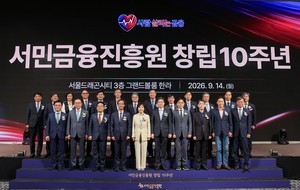
2027–2031 mid-term management strategy unveiled New vision: 'from financial safety to economic independence' Assembly committee chair raises possibility of merger with credit recovery body The Korea Inclusive Finance Agency marked its 10th anniversary Monday by unveiling a 2027–2031 mid-term management strategy built around four goals: strengthening the financial safety net, improving financial resilience, innovating the financial system, and building public trust while reinforcing sustainable management. The agency set a new vision of becoming "a steadfast partner accompanying the public from financial safety to economic independence," aiming to evolve beyond its role as a crisis buffer into an institution that guarantees basic financial rights. The agency announced the strategy — along with a broader 10-year roadmap for inclusive finance — at a 10th anniversary ceremony held at Dragon City Seoul's Halla Hall. Under the four strategic goals, the agency outlined 12 initiatives designed to restructure its support framework so that financially vulnerable groups are protected without gaps and can achieve economic self-sufficiency. "This year, our 10th anniversary, is a turning point for a new leap forward," President Kim Eun-kyung said. "We will be a steadfast partner — one that reaches out first at the moment of need and offers tailored support so that those struggling financially can achieve economic independence and be protected without falling through the cracks." Founded on Sept. 23, 2016, the agency has worked to support the economic independence of financially vulnerable groups under the mission of "stabilizing the livelihoods of ordinary people and promoting balanced economic and social development." The ceremony was structured in three parts tracing the agency's past, present and future, drawing about 250 government and National Assembly officials, executives and staff. The first session was attended by Prime Minister Chief of Staff Chae Yi-bae, standing in for Prime Minister Han Seong-sook, along with Political Affairs Committee Chairman Yoo Dong-su, FSC Chairman Lee Eok-won, National Assembly member Min Byeong-deok, heads of related institutions and former agency presidents. "Inclusive finance going forward must become more than a means of weathering crises — it must be a sturdy ladder for upward mobility," FSC Chairman Lee said. "The government will spare no effort in providing institutional backing and policy support." In a congratulatory address read on her behalf by Chief of Staff Chae, Prime Minister Han said, "You — the users of inclusive finance who have overcome hardship and risen again — are the meaning and the reason for the Korea Inclusive Finance Agency's existence," adding that the government would take the lead in protecting the daily lives of ordinary people and reviving the livelihoods economy. Political Affairs Committee Chairman Yoo pledged to "work hard on institutional improvements to protect the financial lives of ordinary people, including consumer protection and the eradication of illegal private lending." Yoo went further in his remarks, signaling the possibility of merging the Korea Inclusive Finance Agency with the Credit Counseling and Recovery Service. Citing the government's "Public Institution Functional Reform Plan" announced Sept. 3, Yoo said the goal was to consolidate overlapping functions and reduce the number of public institutions by 109. "The Korea Inclusive Finance Agency and the Credit Counseling and Recovery Service must also streamline their overlapping functions and build an integrated financial safety net combining lending, debt adjustment, employment and welfare," he said. He added that this direction "aligns with the basic financial rights that President Lee Jae Myung has emphasized," and pledged National Assembly support for the necessary legislation. The second session featured a community service initiative involving about 140 staff members. The agency donated daily necessities to "Ongi Changgo," a warehouse-style shop for residents of Seoul's single-room housing districts operated by the Seoul Metropolitan Government, and set up a counseling space on the shop's ground floor to provide integrated financial, employment and welfare support. President Kim and staff visited five households in the district to deliver gift packages and hear residents' concerns. At the venue, employees assembled 120 "Hickman pouches" for children with pediatric cancer to donate to the Korea Leukemia Children's Foundation. Earlier, the agency's seven regional offices across the country also donated daily necessities and held integrated counseling sessions for underprivileged residents in partnership with local food banks. If you have been exposed to illegal private lending, you can report it to the Financial Supervisory Service (☎1332) for assistance. Those struggling with excessive debt can seek help from the Korea Inclusive Finance Agency (☎1397) or the Credit Counseling and Recovery Service (☎1600-5500). Loan contracts with an annual interest rate exceeding 60 percent are void in both principal and interest.
Sept. 14, 2026
-
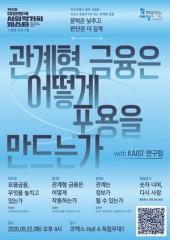
Social Solidarity Bank to present 'relationship finance' cases and research at social value festival
Kakao Bank partnership experience and joint KAIST research findings to be unveiled; inclusive finance session and experience booth at COEX on Sept. 21-22 Hamkke Mandeuneun Sesang (Social Solidarity Bank), a specialized social finance institution, will participate in the 3rd Korea Social Value Festa at COEX in Seoul next week, presenting real-world applications of "relationship finance" and the results of a joint study with KAIST for the first time. On the second day of the event, Social Solidarity Bank will host a special program titled "How Does Relationship Finance Create Inclusion?" at 4 p.m. on the independent stage in Hall A at COEX. The session will draw on the organization's experience running a partnership project with Kakao Bank and joint research with KAIST to discuss how to assess and support people who struggle to access finance through conventional credit scoring alone. The session focuses on broadening the scope of inclusive finance beyond simply expanding the supply of funds to improving the way applicants are evaluated. While lowering interest rate burdens and increasing the scale of lending are important, the organizers argue that conventional credit assessment systems often fail to adequately capture an applicant's current circumstances or potential for recovery. Standard credit evaluations gauge future repayment capacity based on past repayment history and financial transaction records. However, when a person's financial record has deteriorated due to job loss, illness or an interruption in income, improvements in their current economic situation may not be immediately reflected in their credit score. The "relationship finance" model Social Solidarity Bank advocates uses quantitative data as a baseline while also examining an applicant's present situation, economic context and potential for change. The core principle is to verify repayment capacity so that a loan does not become a new burden — without letting a credit score alone determine whether financial support is granted. Since its founding in 2003, Social Solidarity Bank has spent 23 years running alternative finance programs for people who face barriers to mainstream financial services, accumulating this approach along the way. The first presentation will be delivered by Kim Se-kwon, head of Social Solidarity Bank's future business division. Kim will introduce how relationship finance is applied in practice during the screening process, drawing on case studies from the partnership project carried out with Kakao Bank. He will explain — based on concrete field experience — how assessors identify and evaluate an applicant's current situation and economic circumstances that cannot be fully captured through documents and credit scores alone. The second presentation will be given by Kim Ga-on, a doctoral candidate in IT management at KAIST's Graduate School of Management Engineering, who will share the findings of the joint research conducted by Social Solidarity Bank and the KAIST research team. The research team analyzed telephone interview data gathered during the Kakao Bank partnership project to examine how information about applicants that does not fully appear in written documents emerges through actual conversations. This is the first time the findings have been made public. A general discussion will follow, examining the possibilities and limitations identified in applying relationship finance in the field and exploring the conditions needed to advance the assessment and evaluation framework for inclusive finance. Ahn Jun-sang, standing director of Social Solidarity Bank and moderator of the session, said expanding the supply of finance to lower the barriers to inclusive finance is important, "but at the same time, we also need a discussion about how to more deeply understand and assess the situations of people who need financial support." He added that the session would be an opportunity to explore the potential of relationship finance through the field experience Social Solidarity Bank has accumulated and the results of the joint research. Social Solidarity Bank will also operate an experience booth in Hall A at COEX on both days of the event. Visitors can respond to a short questionnaire via a kiosk and receive one of six possible results. The booth is designed to help the public more easily understand the role of nonprofit organizations that use finance to address social problems, as well as the diverse approaches within social finance. Since its founding in 2003, Social Solidarity Bank has been a specialized social finance institution supporting the self-reliance of individuals who face barriers to mainstream financial services and the growth of social economy organizations. Registration for the session is free and available through the official website of the Korea Social Value Festa.
Sept. 14, 2026
-

Shinhan Bank's Ddaenggyeoyo surpasses 10 million members in just over 4 years
From 2022 launch to leading public delivery platform Discount coupons, support for 1,000 top merchants Brokerage fees waived for new merchants through year-end Shinhan Bank announced Monday that its online food delivery platform Ddaenggyeoyo has surpassed 10 million members in just over four years since its launch. With small business owners still struggling under high delivery commissions, Ddaenggyeoyo has earned recognition as a leading model combining a lifestyle platform with inclusive finance through low fees and financial products designed to support small merchants. Officially launched in January 2022, Ddaenggyeoyo has expanded on the strength of a brokerage commission of about 2 percent and consumer discount benefits. The platform has also partnered with local governments to link regional currency payments with area-specific discount programs, further easing costs for small business owners. Support for small merchants runs alongside those efforts. The top 1,000 merchants by customer recommendations receive an in-app "verified badge" and a 100,000 won ($74) owner support grant. Brokerage commissions are waived for newly registered merchants through the end of this year. Shinhan Bank is also strengthening financial support for small business owners by drawing on order and sales data accumulated through Ddaenggyeoyo. Last month, the bank launched the Ddaenggyeoyo Top Merchant Loan, which factors a merchant's actual sales and business performance into credit assessments and loan limit calculations, offering up to 100 million won in financing. To mark the 10 million member milestone, customers who tap the "Recommend" button on a merchant's page in the Ddaenggyeoyo app and write a text review will receive a 1,000 won discount coupon. Those who post a photo or video review will receive a 2,000 won coupon. An additional 10,000 won discount coupon will be awarded by lottery to 1,000 customers who recommend a merchant. "Reaching 10 million members is the result of many customers joining Ddaenggyeoyo's shared-growth vision, where consumers and small business owners grow together," a Shinhan Bank official said. "We will continue developing the platform into a leading model of mutual prosperity — delivering more benefits to customers and meaningful, practical support to small business owners."
Sept. 14, 2026
-

Kakao Pay becomes first simple-payment service to support Seoul Pay+
Users can earn Kakao Pay points up to four times per transaction when paying via Seoul Pay+ Kakao Pay announced Monday that it will become the first simple-payment and app-card service in South Korea to support Seoul Pay+ transactions. With the addition of Seoul Pay+, users can now pay through Kakao Pay across Samsung Pay and Zero Pay as well, giving the platform the broadest offline payment network among domestic simple-payment services. Even at merchants not affiliated with Kakao Pay, users can open the app and switch seamlessly between Seoul Pay+, Zero Pay and Samsung Pay (Android only) from a single payment screen. Seoul Pay+ is the Seoul Metropolitan Government's mobile simple-payment platform, supporting the purchase and use of Seoul Love Gift Certificates as well as the disbursement and spending of policy allowances. Each Seoul Pay+ transaction made through Kakao Pay earns Kakao Pay points up to four times per payment. On top of the base rewards tied to individual payment methods — such as credit cards and local gift certificates — Kakao Pay offers additional point accumulation of up to 30,000 points per month. To pay via Seoul Pay+ through Kakao Pay, users select the "QR Scan" menu in the upper right corner of the payment tab in the Kakao Pay app, or through the payment menu in KakaoTalk's More tab, then scan the Seoul Pay+ QR code displayed at the store. Kakao Pay Money is supported as the payment method. "It is now easier and faster to pay with Kakao Pay at 270,000 Seoul Pay merchant locations across Seoul," the company said, adding that it aims to "break down the barriers dividing the offline payment market so that opening Kakao Pay anywhere delivers the most convenient and rewarding payment experience, without a second thought."
Sept. 14, 2026
-
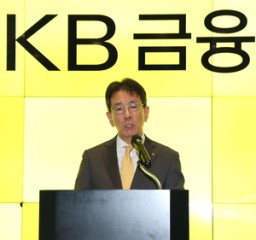
KB Financial taps Lee Jae-geun as next chairman, signaling generational shift across banking sector
KB succession committee opts for change despite record earnings Lee Jae-geun vows 'system- and process-driven' organization Eyes on Kookmin Bank chief, key subsidiary CEO appointments KB's generational shift expected to ripple across year-end banking appointments KB Financial Group is preparing to transition to a new era under Lee Jae-geun, even as the group posts record earnings. Lee, the group's head of global, wealth management and small and medium-sized enterprise divisions, was named the sole chairman candidate Monday. He outlined "systems and processes" as his organizational philosophy. With his inauguration set for November, attention is already turning to year-end leadership changes at KB Kookmin Bank and other key subsidiaries. The question now is whether Lee can cement the group's standing as the country's top banking group while pushing forward priorities such as productive finance and wealth management. Speaking to reporters Monday morning at KB Financial's annex building in Yeouido, Lee said, "I believe the larger a financial group is, the more it must be driven by systems." He added that he would focus on building "an organization that moves through systems and processes rather than one where power is concentrated in the chairman — a decentralized, sustainable organization." Asked about the possibility of year-end personnel changes, Lee said he had "not yet given it much thought." He said appointments of subsidiary chiefs would need to go through the relevant recommendation committees. On the "generational shift" cited by KB Financial's chairman candidate recommendation committee when it announced its decision, Lee said it was "not a generational shift defined by age, but about enabling faster and more accountable decision-making," emphasizing competence over seniority. KB Financial's net profit for the period grew from 4.63 trillion won ($3.44 billion) in 2023 to 5.08 trillion won in 2024 and 5.84 trillion won last year. The group also posted 3.88 trillion won in the first half of this year, a record for any half-year period. Despite that performance, the recommendation committee passed over incumbent Chairman Yang Jong-hee and selected Lee as its final candidate, emphasizing "change" and "generational renewal." Committee Chairman Jo Hwa-jun said the group had reached "a point where bold change and a generational shift are needed to strengthen the group's fundamental competitiveness and secure future growth engines, rather than resting on its current strong results." KB Financial also moved up the succession process by more than a month compared with previous years, extending the candidate vetting period and reducing the disadvantage faced by external candidates. Lee served as president of Kookmin Bank for three years starting in 2022 and has overseen the group's global, wealth management and SME divisions at the holding company since last year. If approved at an extraordinary shareholders' meeting on Nov. 20, he will begin a three-year term as chairman the following day. Organizational restructuring and subsidiary CEO appointments are expected to begin in earnest from late November. KB Financial has typically convened its subsidiary CEO recommendation committee in mid-December to select candidates for positions expiring at year-end. This year, the presidents of several major subsidiaries — including Kookmin Bank, as well as the securities, insurance, credit card and asset management units — are approaching the end of their terms. Lee's move to the chairmanship will also require a successor in his current divisional role at the holding company, potentially widening the scope of year-end personnel changes. Alongside the year-end appointments, attention is turning to the business agenda Lee will need to tackle. KB Financial plans to deploy a total of 110 trillion won by 2030 — 93 trillion won in productive finance and 17 trillion won in inclusive finance. Of the 93 trillion won earmarked for productive finance, 10 trillion won will go to a national growth fund, 15 trillion won to direct investment through asset management, securities and investment units, and 68 trillion won to corporate lending in strategic industries. KB Financial's medium- to long-term strategy also includes redesigning its wealth management and pension business model, strengthening its competitiveness in small and mid-sized corporate banking, expanding group-wide corporate and investment banking collaboration, improving insurance competitiveness and advancing its AI transformation. The central challenge will be sustaining stable bank-centered earnings while driving growth in capital markets, corporate finance and non-banking businesses. Particularly amid ongoing shifts of funds out of deposits, strengthening wealth management, pension and capital market capabilities — and translating the productive finance push into real profitability — are seen as the defining tasks for the incoming leadership. The failure of KB Financial Group Chairman Yang Jong-hee to secure a second term has cast uncertainty over the futures of other financial sector CEOs whose terms expire this year. Convention in the banking industry has been for CEOs to serve an initial two-year term followed by a one-year extension. But KB Financial's abrupt break with that tradition has left bank chiefs and other financial executives with no guarantee of renewal, according to industry insiders. A prominent case is Lee Chan-woo, chairman of NH NongHyup Financial Group, whose term ends in February next year. Lee took office in February last year. NongHyup Financial is expected to begin its search for a successor before year-end. The group has no precedent for a chairman serving beyond a two-year term, apart from former chairmen Kim Yong-hwan and Kim Gwang-su. Former chairmen Son Byung-hwan and Lee Seok-jun both stepped down after completing two-year terms. Year-end appointments for bank presidents — the core subsidiaries of financial holding companies — are also on the horizon. The terms of Lee Hwan-ju of KB Kookmin Bank, Jeong Sang-hyeok of Shinhan Bank, Lee Ho-seong of Hana Bank, Jeong Jin-wan of Woori Bank and Kang Tae-yeong of NH NongHyup Bank all expire at year-end. Of the five, four are approaching their first renewal; only Jeong Sang-hyeok of Shinhan Bank has previously been reappointed, having received a one-year extension in 2023. Lee Hwan-ju is widely seen as likely to be reappointed, given that his tenure has been shorter than those of other subsidiary chiefs who have served more than three years. Jeong Sang-hyeok is being discussed as a candidate for a divisional role at the holding company level. Lee Ho-seong, Jeong Jin-wan and Kang Tae-yeong are also considered likely to be renewed on the strength of their management track records. However, with KB Financial's board having made "generational shift" a watchword, no one in the industry feels entirely secure, according to a broad consensus among financial sector officials. The ruling party and the government are also working toward announcing a plan to improve governance at financial companies by the end of this month, adding further pressure on incumbents hoping to follow established practice. An official at one financial holding company said the governance reform plan was focused on holding company chairmen, but noted "there is no reason it cannot apply to subsidiary CEOs as well," adding that Cheong Wa Dae's criticism of "entrenched positions" was "a message directed at the financial sector as a whole, not just financial holding companies." A total of 54 CEOs across the five major financial groups have terms expiring at year-end: 10 at KB Financial Group, 12 at Shinhan Financial Group, 13 at Hana Financial Group, 12 at Woori Financial Group and seven at NongHyup Financial Group. Korea Federation of Banks Chairman Cho Yong-byoung's term also expires in November. Former KB Financial Group Chairman Yoon Jong-kyoo, former SC First Bank President Park Jong-bok and Industrial Bank of Korea President Yoon Jong-won have been mentioned as potential candidates. Sh Suhyup Bank will select its final candidate for bank president on Sept. 22, with incumbent President Shin Hak-gi and Korea Financial Intelligence Unit Director Lee Hyeong-ju seen as the two main contenders.
Sept. 14, 2026
-

Hyundai Card joins Korean Air's high-speed in-flight Wi-Fi service
Hyundai Card invests in Starlink rollout and system buildout Card company to take active role in Wi-Fi-based marketing Hyundai Card said Monday it will join Korean Air's service innovation drive as a strategic partner, supporting the airline's rollout of high-speed in-flight Wi-Fi. Korean Air adopted Starlink, a low-earth-orbit satellite communications service, to power the new offering. Hyundai Card plans to invest in the Starlink adoption and system buildout, and will take an active role in Wi-Fi-based marketing campaigns going forward, deepening its collaboration with the airline. The two companies are building on a partnership that has now spanned seven years. They launched the "Korean Air Card" in 2020 — the first private-label credit card (PLCC) dedicated to a domestic airline — and followed it in 2024 with the "Korean Air Card Edition2," a product with enhanced benefits for Korean Air customers. The Edition2 card awards 30,000 miles once a year when cardholders meet an annual spending threshold. In 2022, the pair also introduced a "mileage emergency accrual" service that lets members who need miles earn them in advance, making it easier to redeem rewards. The two companies also collaborate across data-science marketing and branding. Since 2025, they have run more than 100 marketing campaigns using Hyundai Card's AI-powered hyper-personalization marketing solution. In 2021, Hyundai Card produced a limited-edition luggage tag made from a retired Korean Air aircraft, and in 2025 the two signed a memorandum of understanding under which Korean Air handles the exclusive transport of artworks exhibited at Hyundai Card Storage, the card company's exhibition and cultural space, further strengthening their collaboration. "On the strength of our wide-ranging partnership, Hyundai Card has decided to lend its support so that Korean Air can deliver its high-speed in-flight Wi-Fi service on a stable footing," a Hyundai Card official said. "Hyundai Card and Korean Air will continue to develop a diverse range of benefits to provide customers with an ever-higher level of experience." Meanwhile, the Starlink-based in-flight Wi-Fi Korean Air has adopted uses low-earth-orbit (LEO) constellation satellites to offer passengers a broad range of digital experiences. Travelers on Korean Air flights can now conveniently use high-bandwidth services such as online gaming, streaming video and cloud applications. The airline plans to roll out the service on wide-body aircraft first, then expand it gradually across its fleet.
Sept. 14, 2026
-
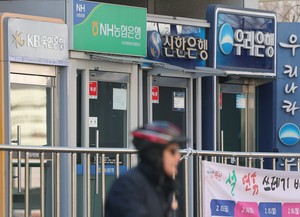
Average overdraft balance hits W14.24m per account as debt-fueled investing drives 7-month surge
Overdraft balances rise from 63.6 trillion to 69.7 trillion won Balances jump as share prices begin to correct Nearly 68 trillion won in unused credit lines remains available Warning signs emerge in bank credit loan delinquency rates Outstanding balances on bank overdraft accounts — a common source of quick cash for ordinary households — have swelled to nearly 70 trillion won ($52.3 billion) so far this year, raising concerns that the loans represent a blind spot in the country's debt management framework, critics say. According to data on bank overdraft utilization rates that People Power Party lawmaker Park Sung-hoon of the National Assembly's Political Affairs Committee obtained from the Financial Supervisory Service, outstanding overdraft balances at domestic banks rose from 63.64 trillion won at the end of last year to 69.73 trillion won at the end of July — an increase of 6.09 trillion won in just seven months. Over the same period, the number of overdraft accounts grew only marginally, from about 4.87 million to about 4.89 million — a gain of 24,317 accounts, or 0.5 percent. The number of accounts barely budged while the amount actually borrowed jumped 9 percent. Analysts say this indicates that existing overdraft holders are drawing more heavily on credit lines they already have, rather than a wave of new accounts being opened. The average balance per account also jumped sharply. The per-account balance, which stood at about 13.06 million won at the end of last year, climbed to about 14.24 million won by the end of July — meaning the average debt per account rose by 1.17 million won, or 9 percent, in just seven months. The surge in overdraft balances is widely attributed to a wave of debt-fueled investing, as the Kospi more than doubled over the past year and drew a broad swath of investors into leveraged positions. The increase in overdraft balances this year was concentrated in the April–July period, when share price volatility widened. Balances grew by 5.78 trillion won during those four months, accounting for 95 percent of the cumulative increase for the year. Even in July, when share prices fell sharply, overdraft balances still rose by 1.15 trillion won. Despite the sharp rise in outstanding balances, the pool of funds borrowers could still draw on stood at nearly 68 trillion won. According to data obtained from the Financial Supervisory Service by Han Chang-min, a lawmaker of the Social Democratic Party also on the Political Affairs Committee, the total contracted overdraft limit at the end of August stood at 132.1 trillion won. Of that, the actual outstanding loan balance was 64.2 trillion won, leaving 67.9 trillion won — 51.4 percent of the total — still unused. However, as the share price correction has dragged on, the pace at which overdraft lines are being drawn down slowed in August. Outstanding balances fell by 400 billion won, from 64.6 trillion won at the end of July to 64.2 trillion won at the end of August. The utilization rate — the ratio of outstanding balances to contracted limits — also edged down 0.1 percentage point, from 48.7 percent to 48.6 percent. The sharp expansion in overdraft balances is expected to bring bank soundness concerns to the fore. According to the Financial Supervisory Service, the delinquency rate on other loans, including unsecured credit loans, rose from 0.76 percent at the end of March to 0.90 percent at the end of May. It then fell back to 0.77 percent in June as banks moved to write off and sell delinquent bonds.
Sept. 14, 2026
-
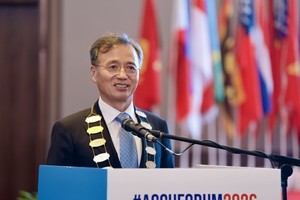
Ko Young-chul elected president of Asia Confederation of Credit Unions
Elected at 45th annual general meeting in Kuala Lumpur; two-year term through 2028 Korea's credit unions introduce co-growth partnership system to 22 Asian nations Ko Young-chul, chairman of the National Credit Union Federation of Korea, has been elected president of the Asia Confederation of Credit Unions, known as ACCU. His two-year term runs from 2026 to 2028. The election marks the fifth consecutive time South Korea's credit union federation has held the ACCU presidency since 2018. The federation said Monday it participated in the 2026 Asia Credit Union Forum and ACCU annual general meeting, held in Kuala Lumpur, Malaysia, from Friday through Sunday. Ko was elected president at the 45th annual general meeting on Sunday. ACCU holds the Asia Credit Union Forum each year to share best management practices among Asian credit unions and explore directions for the credit union movement. This year's forum drew 571 credit union representatives from 22 Asian countries. ACCU currently counts 220 cooperative organizations from the Asia-Pacific region as sponsoring members supporting credit union development in developing countries, of which 152 are South Korean credit unions. Twenty-nine domestic sponsoring member credit unions sent representatives to this year's forum. The theme of this year's forum was "Unspoken Realities, Bold Bridges: Credit Union Transformation and Resilience Era 2026+." Participants discussed the role credit unions should play and strategies for growth in a rapidly changing financial environment, focusing on digital transformation, AI adoption, governance and organizational innovation, and member-centered management. South Korea's credit union federation presented its co-growth partnership system under the theme "Connecting Growth Beyond the System," sharing the program's operational experience and outcomes. Introduced in 2014, the system pairs larger credit unions — designated as "partner unions" — with smaller ones, called "growth unions," to share management expertise and human resources in a mutual-cooperation model. The federation shared with member countries cases in which inter-union cooperation strengthened individual unions' competitiveness and self-sufficiency, leading to sustainable growth. "For credit unions to grow sustainably amid a rapidly changing financial environment, countries must share their experiences and capabilities and find solutions together," Ko said. "We will work to share the cooperative experience South Korea's credit unions have built with member countries and to strengthen the competitiveness and sustainability of credit unions across Asia." South Korea's credit union federation hosted the first Asia Credit Union Conference domestically in 1971 and played a leading role in founding ACCU, contributing since then to the development of the Asian credit union movement through education and international cooperation projects. The federation plans to continue expanding exchanges and best-practice sharing among member countries and to strengthen solidarity and cooperation in addressing common challenges facing Asian credit unions.
Sept. 14, 2026
-
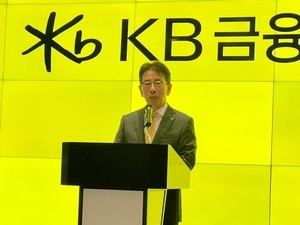
KB Financial chair candidate Lee says 'generational change' is about faster decisions, not age
First doorstep remarks after nomination as final candidate 'Can't rest on being No. 1 … prepare for change over next 3-5 years' Productive finance 93 trillion won, inclusive finance 17 trillion won On personnel: 'Will build a system-driven organization' "I take it as a message that we must not grow complacent just because we are No. 1." Lee Jae-geun, the candidate nominated to become the next chairman of KB Financial Group, made the remarks Monday when he met with reporters — his first appearance before the press since the group's chairman recommendation committee selected him as its final candidate on Friday. Lee said he saw his selection against a backdrop of record earnings and an all-time high share price as a call for change rather than a reward for current performance. He interpreted it as a directive to stop resting on present results and instead prepare for the shifts that AI, the MoneyMove trend and an aging population will bring to the financial industry over the next three to five years. Speaking to reporters at KB Financial's annex building in Yeouido, Seoul, Monday morning, Lee said: "We posted record first-half earnings of nearly 3.9 trillion won ($2.91 billion) and our share price keeps hitting all-time highs — I believe my appointment in that environment is a message that we cannot afford to be complacent as the industry leader." He added that AI, MoneyMove and aging were driving sweeping change across the financial industry, warning that "the next three to five years will be a period when the fate of a financial group could hinge on whether it responds properly to these shifts." He particularly noted that "the biggest change is the flow toward a capital-market-centered economy," and said KB Financial must also fulfill its social role through productive finance and inclusive finance. On year-end personnel decisions, Lee said no specific direction had been set. "I haven't yet thought about how to handle personnel matters," he said, adding that he believed a financial group of KB's scale should be driven by systems rather than concentrated in the hands of a single chairman. On the "generational change" cited by the recommendation committee, Lee drew a line between the concept and any age-based personnel overhaul. "Generational change means making decision-making faster and more accountable — not change defined by age," he said. "Rather than limiting it to age, I will think about it on the basis of capability." KB Financial is pursuing a total of 110 trillion won in financing, comprising 93 trillion won in productive finance and 17 trillion won in inclusive finance. "Being a leader is not just about generating large profits — it is about growing in a healthy way together with customers and investors," Lee said. On organizational management, Lee emphasized systems and processes over the authority of any single chairman. "Rather than having power concentrated in the chairman, I want to build an organization that moves on systems and processes," he said. "I will focus on building a decentralized, sustainable organization." Lee is set to be formally appointed as the next chairman at an extraordinary shareholders' meeting on Nov. 20. "Shareholder approval is still pending, so it is difficult to go into detail at this point," he said, adding that he would lay out his specific management plans after taking office.
Sept. 14, 2026
-
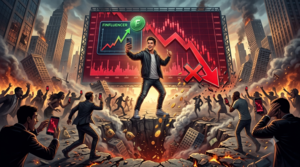
Over 70% of investors lose money following finfluencer tips on SNS: report
Hana Financial Research Institute releases report on finfluencer regulation Finfluencers proliferate amid stock market boom Financial Supervisory Service flags 5,511 suspected illegal videos Report calls for legal definition of finfluencers as prerequisite for oversight "Buy XX Power stock now. It's guaranteed to shoot up next week!" "Check the link in the video comments if you want exclusive information." As the Kospi more than doubled in just one year, the influence of "finfluencers" — individuals who produce financial and investment content through YouTube and other SNS platforms — has grown steadily. Illegal finfluencers have multiplied rapidly, sharing investment tips through unlicensed advisory channels and impersonating celebrities, prompting the government to urge investors to exercise caution. Experts say regulators must close the blind spots in the quasi-investment advisory framework that leave finfluencers largely unregulated, while also introducing indirect oversight through licensed financial institutions. According to financial industry sources, the Hana Financial Research Institute, a research arm of Hana Bank, published a report titled "Finfluencers: Balancing Freedom and Responsibility" on Friday. "In international usage, a finfluencer refers to an individual who shares investment content — including financial education and stock recommendations — through SNS, with the vast majority operating independently without any organizational affiliation," said researcher Noh Hye-ryeon. "As retail investing has gone mainstream, demand for information channels among young, small-scale investors has surged, giving rise to a culture of learning about finance through SNS, where freedom of expression and accessibility are guaranteed." Finfluencer influence grows since COVID-19, and so do follower losses The rise of digital platforms such as YouTube has lowered the barriers to content creation, fueling a rapid increase in one-person media channels that publish financial content without professional qualifications. According to the Financial Supervisory Service, the number of registered quasi-investment advisory firms rose from 132 in 2018 to 1,724 in 2024. The influx of investors in their 20s and 30s is widely cited as a key driver of finfluencers' growing reach. During the COVID-19 pandemic, a wave of new investors — many of them young people with little investment knowledge or experience — entered the market during the rebound that followed the sharp stock market decline. "Drawing on the openness and accessibility of SNS, a new culture has taken hold, particularly among the MZ generation, of consuming financial information through finfluencers rather than traditional professional media," Noh said. "In an intensely competitive environment, market forces have pushed finfluencers to make financial content more entertaining in order to survive." The problem is that as finfluencers' influence has grown, so have the financial losses and harm suffered by their followers. A 2024 survey by Capital One found that 74 percent of people who made investments based on SNS advice suffered losses, including financial damage and drops in credit scores. "While freedom of expression has no inherent limits, a lax accountability structure that allows information to spread indiscriminately without professional verification is expanding follower losses and harm — separate from outright fraud," Noh said. International bodies have begun regulating unregistered or unqualified finfluencers. The International Organization of Securities Commissions identified six key risks posed by finfluencers last year: unregistered or unqualified advice, fraud and market manipulation, unsuitable product recommendations, misleading content, undisclosed conflicts of interest, and the misuse of celebrity endorsements. The United States, the United Kingdom, France and other countries are building regulatory frameworks to bring finfluencers under oversight. FSS refers 33 channels for investigation; impersonation of prominent finfluencers also detected In South Korea, however, a formal regulatory definition of finfluencers has yet to be established. The Financial Services Commission introduced a conceptual definition for the first time in March, but Noh said a normative definition remains absent. Evidence of illegal activity by finfluencers has also been mounting. According to data submitted to the office of People Power Party lawmaker Park Sung-hoon of the National Assembly's Political Affairs Committee by the Financial Supervisory Service, the FSS reviewed 369 stock and economics finfluencer channels between April 13 and Aug. 21 this year and found signs of illegal activity in 151 of them, spanning 5,511 videos. The FSS referred a total of 33 channels for criminal investigation and requested that authorities block 47 videos. Among the most common violations was the creation of fake channels impersonating well-known finfluencers. Some operators presented schemes as investment projects involving financial institutions, built websites impersonating those institutions, collected investment funds and then disappeared. Authorities also uncovered cases in which operators purchased channels with large subscriber bases, converted them into stock-related channels and lured subscribers into unlicensed investment advisory groups. Experts call for legal definition of finfluencers and indirect regulation through financial firms Noh identified the legal codification of finfluencers as the top priority for financial regulators. Under current quasi-investment advisory rules, finfluencers who receive fixed compensation can be subject to legal oversight, but most finfluencer activities — including education, advertising, sponsorships and platform revenue — fall outside the regulatory scope. Because there is no concept of "registration" for finfluencers to begin with, oversight is entirely reactive, with no mechanism for preemptive action. "There is still no normative definition of finfluencers, which makes it unclear who should be subject to strict monitoring, and limits the ability to comprehensively manage the wide range of risks they pose," Noh said. The need for indirect regulation through financial institutions has also been raised. In the United States in 2024, a brokerage firm was fined $850,000 after regulators held it responsible for posts made by finfluencers it had paid. "Some countries hold financial institutions accountable for content produced in partnership with finfluencers, and domestic financial firms need to prepare for the introduction of similar regulations," Noh said.
Sept. 13, 2026
-
Why global trade stays resilient amid the US-China trade war — the secret of 'connector countries'
'Connector countries' bridging US and Chinese economies Korea linked to both markets through Vietnam Report urges reducing reliance on specific production hubs Even as the US-China trade war drags on, global trade has remained relatively stable — and a new analysis points to "connector countries" such as Vietnam, India and Mexico as a key reason why. These nations have emerged as intermediate hubs linking China's production networks to the US consumer market, effectively serving as bridges that prevent the complete severing of economic ties between the two powers. According to a report released Sunday by Jeong Seon-yeong, head of the Bank of Korea's Asia-Pacific Economy Team, and her co-authors, global trade has maintained a comparatively stable trajectory despite the prolonged US-China rivalry and other geopolitical tensions, including the war in Russia and Ukraine. The report identifies "connector countries" as the driving force behind that stability. The term refers to nations closely integrated with both the US final market and China-centered production networks, allowing them to sustain economic linkages between the two powers. Vietnam, India and Mexico are cited as prime examples. These countries function as intermediate nodes in production and procurement networks, filling gaps left by direct US-China trade friction. More recently, their role has deepened beyond simple transit — expanding into local production and foreign direct investment, strengthening their function as actual manufacturing bases. A defining characteristic of connector countries, the report finds, is what it calls "dual alignment." An analysis of countries' relationships with the US and China using UN General Assembly voting data found that connector countries have moved closer to the US on political and security matters, while maintaining or even shifting further toward China on economic and development issues. This divergence between political alignment and economic interest amounts to a form of decoupling between strategic choices and commercial realities. By contrast, South Korea, Japan and Australia broadly maintained a middle position between the US and China on both political and economic dimensions. The shift has left a clear imprint on South Korea's supply chains. A Bank of Korea analysis of OECD Inter-Country Input-Output tables from 2016 to 2022 found that the share of value added generated by South Korea's exports to Vietnam that ultimately linked to US demand rose from 11.1 percent in 2016 to 18.5 percent in 2022, while the share linked to Chinese demand climbed from 7.3 percent to 13.9 percent. In other words, South Korea's export value added became more deeply connected to both the US and Chinese markets through Vietnam's production networks. The trend was particularly pronounced in semiconductors and the broader computers, electronics and optical equipment sector. Over the same period, the share of value added routed to the US through Vietnam jumped from 12.8 percent to 21 percent, while the share linked to China rose from 11.2 percent to 19.4 percent. The pathways through which South Korean value added reaches the US market have also shifted. The share flowing directly from South Korea to the US held roughly steady, edging down from 73.1 percent in 2016 to 72.4 percent in 2022. Among indirect routes — where Korean intermediate goods pass through third-country production bases before reaching the US — the share transiting through China fell from 10.7 percent to 6.8 percent, while the share routed through five ASEAN countries including Vietnam rose from 4.9 percent to 8.3 percent. In the computers, electronics and optical equipment sector, the ASEAN-5 share consistently climbed and by 2022 had surpassed the China share, at 18.6 percent versus 17 percent. "Despite recent geopolitical fragmentation, economic linkages between countries have not been severed," the report said. "Rather, established global supply chain routes are being reconfigured and sustained." The report added that South Korea's ability to maintain connections to both the US and Chinese markets by leveraging existing ASEAN production networks "acts as a factor enhancing supply chain resilience, as it broadens the options available for production and export routes when geopolitical shocks occur." It recommended that South Korea "diversify its supply chains in a direction that reduces dependence on specific production hubs or routes, while also making use of the buffer function provided by connector countries."
Sept. 13, 2026
-

Deposit-backed credit cards for students, foreigners in the works
FSC targets December launch for deposit-backed credit cards Repay balance, restore limit — reusable on a revolving basis Alternative credit data to broaden access for low-credit users Issuers cut default risk; users build credit history "Even an unemployed college student can use a credit card just by putting down a deposit?" A new type of credit card that allows thin-filers — young adults, foreigners and others with little or no credit history — to obtain a card by placing a cash deposit is set to launch by the end of this year. Unlike unconditional loan support programs, the deposit acts as a safeguard against delinquency, and the product is being described as a practical pathway for thin-filers to enter the mainstream financial system. The Financial Services Commission plans to introduce a credit card issuance framework in December that can accommodate people with limited financial histories, including young adults and foreign residents. Under the scheme, applicants who cannot demonstrate repayment capacity through conventional financial records would place a cash deposit with the card issuer and be granted a credit line within that amount. The specific deposit amount and credit limit have not yet been finalized. The FSC plans to gather input and proposals from the card industry before settling on the details. Alternative credit assessments — drawing on non-financial data such as mobile phone bill payment records and online shopping histories — are also expected to be factored into the card approval process. Within the industry, a deposit and credit limit in the range of 1 million to 2 million won ($747) is being discussed as the most workable option. "If the deposit is too high, it becomes yet another barrier for young people who are short on funds; if it is too low, the card loses its practical value as a payment tool," one card industry official said. Spending patterns among young adults are also expected to inform the limit-setting process. According to the Korea Inclusive Finance Agency's 2024 Youth Finance Survey, the average monthly credit card bill among young adults stood at 1.47 million won. By spending bracket, the largest share — 50.4 percent — fell below 250,000 won per month, followed by the 1 million to 2 million won bracket at 16.2 percent and the 500,000 won to 1 million won bracket at 11.2 percent. The existing monthly purchase cap on prepaid cards, prepaid electronic payment instruments and gift vouchers bought with credit cards is also being cited as a reference point. To prevent cash conversion — a practice known locally as "card-kkang" — credit card purchases of such products are currently capped at a combined 1 million won per month. Taking this into account, the industry is considering setting 1 million won as the baseline limit, with individual card issuers able to raise it to a maximum of 2 million won following their own credit review. For foreign applicants, additional discussions are needed on income criteria, visa status and remaining length of stay. Banks and card companies have long applied strict conditions — including residency period requirements — even when issuing savings-deposit-backed cards to foreigners. If the new system lowers those barriers, competition among card issuers to attract foreign customers is expected to intensify. Some may wonder how a deposit-backed credit card differs meaningfully from a debit card. The key distinction is that a debit card draws money from the account the moment a transaction is made, whereas a deposit-backed credit card keeps the deposit intact while extending credit for a set period. With a debit card, for instance, once the 1 million won in the linked account is spent, no further purchases can be made until the account is topped up. With a deposit-backed credit card, the credit limit is restored once the monthly bill is paid on time. Cardholders can also enjoy the perks of a regular credit card, including discounts and reward points. The biggest advantage is the ability to build a legitimate credit history. Paying the monthly bill on time accumulates a record of normal credit transactions, which helps improve a credit score. For young adults and foreigners who have long been shut out of credit cards and loans due to a lack of financial history, the product could serve as a kind of "credit ladder." Card companies are also welcoming the new framework. Because any unpaid balance can be offset against the deposit, the risk of delinquency and default is lower than with a conventional credit card. From the issuers' perspective, the product offers a way to secure young adults as future customers while also opening the door to foreign residents who have little domestic financial history. "Card companies can keep delinquency risk in check, and young adults and foreigners can build a credit history," one card industry official said. "It is a positive development in that the burden does not fall entirely on one side — neither the financial institution nor the consumer." Savings-deposit-backed credit cards already exist, but their use has been limited in practice. Customers must visit a bank in person to place a lien on their deposit, and separate coordination between the bank and the card issuer is required. Standalone card companies without an affiliated bank face an even steeper hurdle, as they must partner with an outside bank to offer the product. In response, the industry is calling for the deposit-backed credit card to be designed so that customers place the deposit directly with the card issuer. This would allow standalone card companies to launch the product without a separate bank partnership, cutting out the cumbersome procedures associated with existing savings-deposit-backed cards. It would also open the door to a wider range of products combining each issuer's own perks, such as discounts and reward points.
Sept. 13, 2026
-
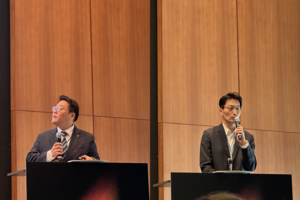
Shinhan Financial targets global RWA market with won-based tokenized MMF
Government bonds and monetary stabilization bonds to back settlement and collateral use Offshore issuance via Hong Kong approval, in partnership with Plume 4% yield floor seen as key hurdle to attract global investors Shinhan Financial is moving to capture a share of the global real-world asset (RWA) market by launching a tokenized money market fund (MMF) backed by short-term won-denominated assets. The strategy calls for issuing the product offshore first — before South Korea's domestic STO regime takes full effect — to validate the business model, then using that foundation to develop new products and build a global distribution network. Shinhan Asset Management and Shinhan Investment unveiled the plan Thursday at a summit titled "Start of Won-Based Real Asset Tokenization and Capital Market Opportunities," held in Yeongdeungpo-gu, Seoul. Shinhan Asset Management is pursuing the offshore commercialization of "K-BUIDL," a product that issues a won-based MMF investing in short-term assets as blockchain-based tokens. The plan is to tokenize an MMF holding government bonds and monetary stabilization bonds, turning it into a reserve asset usable for settlement and collateral in on-chain financial transactions. The product K-BUIDL benchmarks is BUIDL, a tokenized fund launched in 2024 by BlackRock, the world's largest asset manager. BUIDL invests in US Treasuries, repurchase agreements and cash equivalents, and is used in on-chain markets as collateral and derivatives margin. Shinhan Asset Management chose an MMF as its first tokenized product because its composition of ultra-short-term bonds and cash equivalents keeps net asset value fluctuations low, and because it can leverage existing financial infrastructure for custody, accounting and auditing. The firm also sees strong potential for the product to serve as collateral in on-chain financial markets. "MMFs require fewer new internal control elements to be designed from scratch compared with other financial products," said Lee Jin-hyeok, a director at Shinhan Asset Management. "Shinhan has focused on building the foundation for on-chain finance rather than simply growing the size of the product." The offshore version of K-BUIDL is expected to draw dollar funding from foreign institutional investors. A domestic financial institution would convert those dollars into won, and Shinhan Asset Management would then invest the proceeds in short-term assets such as government bonds and monetary stabilization bonds. Redemptions would follow the reverse path. Shinhan Asset Management will handle product design, portfolio management, internal controls and regulatory compliance. For tokenization and global distribution, it is partnering with Plume, a global RWA platform. Plume is working to list Shinhan Asset Management's product on multiple blockchains — including Ethereum and Solana — and to enable its use within on-chain protocols. The first MMF product is also planned for distribution following regulatory approval from Hong Kong's Securities and Futures Commission. "McDonald's adapts its products to local markets and generates 60 percent of its total sales outside the United States," said Chris Yin, co-founder and CEO of Plume. "The on-chain market can be thought of as its own country." He added that Plume is supporting Shinhan's asset tokenization efforts and that the partnership would allow more global investors to access the assets, expanding both assets under management and the range of use cases. The push for offshore issuance of K-BUIDL reflects the differing pace and direction of tokenization regulation at home and abroad. Domestically, the focus has been on supplying retail investors with non-standard assets such as music royalties, artwork and small-scale real estate, while overseas markets have centered tokenization on instruments familiar to institutional investors — credit assets, MMFs and government bonds. "The domestic STO policy direction was recently announced, but phases two and three are structured to open conditionally, with no fixed implementation schedule," said Choi In-su, head of the digital assets division at Shinhan Investment, at the summit. Earlier, the Financial Services Commission announced Sept. 4 that it would gradually expand the tokenized securities infrastructure, starting in February next year with privately placed MMFs and bonds for institutional investors. The timing of phases two and three — which would extend to publicly offered securities and on-chain settlement — is to be determined based on market and regulatory conditions. Against that backdrop, Shinhan Financial plans to issue and operate products offshore while waiting for the domestic regime to expand, building up a track record of use cases in the meantime. "We need to reach phase three, where on-chain connectivity and interoperability are secured, before we can see expansion into global markets encompassing the securities and banking sectors," Choi said. Tokenization could offer securities firms — which are heavily dependent on domestic revenue — a new avenue for overseas expansion. More than 90 percent of domestic brokerages' revenue is generated at home, and Shinhan Investment is no exception. Profitable overseas operations are concentrated in markets such as the United States and Hong Kong, and a number of foreign subsidiaries are running at a loss. "For a domestic financial firm to expand overseas, building a local presence, staffing, infrastructure and networks requires at least 20 billion won ($14.9 million) — and in some cases hundreds of billions of won — along with considerable time," Choi said. "Tokenization is a new opportunity for overseas business because it allows each firm to connect its strengths in customers, products and infrastructure through collaboration, securing a foothold in global markets in a short period of time," he added. Attracting global investors in the offshore market will also require competitive returns. Overseas tokenized products — including BlackRock's BUIDL, Franklin Templeton's BENJI and Ondo Finance's USDY — currently offer yields in the 4 percent range. A won-based MMF product must compete with those offerings while also managing exposure to exchange rate fluctuations. "If we operate offshore, the minimum yield floor at this point would be at least in the 4 percent range," Choi said. "Creating a product structure that can offset exchange rate risk and other challenges is the homework for securities firms and banks." He also stressed the importance of consistent issuance capacity. "The outcome in tokenization depends less on what you have issued and more on who can issue well, repeatedly and sustainably," he added.
Sept. 13, 2026
-
Visa says stablecoin card payments surged 15-fold in a year
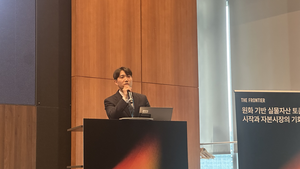
Payment funds from digital wallets Approval through existing card networks 'Stablecoins are the payment layer for tokenized assets' 'Must connect to existing card and settlement networks' Industry experts are calling for stablecoins to serve as the payment layer for tokenized assets — including real-world assets — and for those stablecoins to be connected to existing card and settlement networks if the tokenized asset market is to achieve meaningful scale. The argument is that on-chain assets must be easily usable through conventional payment infrastructure before tokenization can truly go mainstream. Moon Sung-gil, a director at Visa Korea, made the case at "The Frontier: The Start of Won-Based Real Asset Tokenization and Opportunities in Capital Markets" summit, hosted by Tiger Research and Deloitte at IFC in Yeongdeungpo-gu, Seoul, on Friday. "Simply putting real-world assets on-chain is not enough to fully capture the efficiency gains of tokenization," Moon said. "Efficiency is maximized when payment assets like stablecoins are connected to tokenized assets." Moon cited three reasons stablecoins are essential to the real-world asset ecosystem: improving transaction and operational efficiency, enabling links to overseas-issued tokenized assets, and broadening the domestic investor base. He noted that stablecoins are highly liquid payment assets convertible into other currencies, and that they are well suited to sophisticated financial techniques such as leverage looping as well as around-the-clock trading. Stablecoins have recently been expanding their role beyond digital asset trading into everyday payment and settlement. Monthly transaction volumes have roughly doubled year-on-year since late 2024, reaching a peak of around $1.8 trillion. Their role as a payment instrument is also growing as stablecoin-linked card spending rises. Visa data show stablecoin card payment volumes increased roughly 15-fold compared with the previous year. "The absolute scale is still modest, but it has been growing sharply — doubling every half-year," Moon said. "That pace is far faster than the growth in stablecoin circulation itself." Among the most prominent products currently on the market are the Redot Pay card, the Ether.fi Cash Visa and the KAST Visa card. These products have drawn on-chain asset holders into everyday spending by offering streamlined payment experiences, customer-tailored services and rewards such as points. Stablecoin card services do not process every step of a transaction on the blockchain. When a consumer pays using stablecoins held in a digital wallet, authorization runs through the existing card network, and the stablecoins are converted into fiat currency at the settlement stage. The consumer spends on-chain assets while the merchant receives payment in the conventional way — the only change is that the source of funds shifts from a bank account to a digital wallet, while the card network itself remains intact. "For stablecoins to establish themselves as a payment instrument in the real economy, integration with existing systems is critical," Moon said at the event. "But technical interoperability is only a necessary condition for connecting the on-chain world to the real economy — it is not sufficient on its own." Ultimately, he argued, card issuers and intermediaries must expand consumer benefits and lower transaction costs to grow the user base. Moon proposed that stablecoin issuers share a portion of the returns earned from managing their reserve assets with distribution partners such as card companies, with those funds then channeled into card rewards. Open Standard, a stablecoin issuance consortium launched in June, distributes operating returns based on each participant's contribution to distribution. The consortium counts more than 180 members — including Visa, BlackRock, Standard Chartered and Stripe — and plans to launch a dollar stablecoin called Open USD (OUSD) before the end of the year. Open Standard operates as an independent entity overseen by a board made up of its members, with no single issuer holding ownership. Profits from managing reserve assets such as government bonds — after costs — are distributed to participants according to their contribution to the ecosystem. The consortium is also pursuing a fee-free model for OUSD issuance and redemption, regardless of transaction size. "In South Korea, the relevant legislation and financial regulatory guidance would need to permit it, but once those regulatory constraints are resolved, domestic financial institutions will be able to enter the OUSD ecosystem through Visa's Visa Stablecoin Platform," Moon said. "Financial institutions that are not existing Visa members will also be able to onboard onto the platform." He added that the on-chain economy need not insist on a purely blockchain-based framework. "The on-chain economy can spread quickly in the real world only by making the most of the systems and networks that traditional finance has already built," he said.
Sept. 13, 2026
-

Why Bithumb reshuffled its holding company chief ahead of IPO, crypto tax changes
Kim Ki-bum, a government-relations veteran, takes helm of Bithumb Holdings New chief seen as close ally of former Chairman Lee Jung-hoon Lee Jae-won steps down from holding company to focus solely on exchange Bithumb Holdings, the holding company of South Korea's Bithumb cryptocurrency exchange, has replaced its top executive — a move analysts see as a bid to strengthen regulatory engagement and external communications as the company navigates sweeping policy changes and prepares for a public listing. According to court registry filings, Kim Ki-bum, formerly Bithumb's head of external affairs, was appointed as an inside director and chief executive of Bithumb Holdings on Aug. 25. Lee Jae-won, who had concurrently served as chief executive of both Bithumb and Bithumb Holdings, stepped down from both roles at the holding company on the same day. Kim, born in 1976, holds a bachelor's degree in law from Chungbuk National University and a master's degree in business administration from Sungkyunkwan University. He began his career in 2004 as head of the legal team at Itembay, a game-item trading brokerage, and later served as policy director at the Digital Asset Distribution Promotion Association. In 2008, he joined IMI — the operator of Itemmania, a game-item trading platform founded by former Bithumb Chairman Lee Jung-hoon — where he served as director of the legal and external affairs division and head of the strategic business unit. He subsequently moved to Bithumb, where he built his career in external affairs, legal matters and policy response. Kim is widely regarded as a close associate of former Bithumb Holdings Chairman Lee Jung-hoon. "There has been a tendency for people with deep ties to former Chairman Lee to lead Bithumb Holdings," one industry insider said. Lee Jae-won is also an IMI alumnus, and Bithumb co-founder and Vice President Lee Jung-ah — who has served as Bithumb Holdings chief executive twice — has similarly been seen as a close ally of the former chairman. Industry observers view Kim's appointment as a signal that Bithumb is placing greater weight on government relations and policy response. The company faces a series of regulatory shifts, including legislation on a basic digital asset law and virtual asset taxation, and has set its sights on an initial public offering in 2028 — making communication with regulators increasingly critical. Bithumb plans to complete the strengthening of its internal control framework and its transition to Korean International Financial Reporting Standards by the end of this year, file a preliminary listing review application next year, and complete the IPO in 2028. Former Chairman Lee is currently designated as the "controlling individual" of the Bithumb corporate group — a term referring to the person or entity that effectively controls a conglomerate. Lee holds a 4.46 percent stake in Bithumb Holdings directly, but when shares held by affiliated companies and registered executives are included, the controlling individual's combined stake exceeds a majority. Bithumb Holdings is Bithumb's largest shareholder with a 73.56 percent stake and serves as the group's holding company. Among Bithumb's other major shareholders, Vidente holds 10.22 percent and T Scientific holds 7.17 percent. Other shareholders account for 8.86 percent, with treasury shares at 0.19 percent. Beyond its Bithumb stake, Bithumb Holdings also holds a 73.56 percent stake in Bithumb Asset, a 100 percent stake in Bithumb Investment and a 33.17 percent stake in Code. Bithumb Asset was spun off from Bithumb last year as a newly established entity responsible for holding company operations and investment activities. Bithumb said Lee Jae-won stepped down from his directorship at Bithumb Holdings "to maximize Bithumb's management capabilities ahead of sweeping institutional changes across the virtual asset industry, including the enactment of the Digital Asset Basic Act." The company added that Lee "plans to focus on strengthening the company's fundamentals at this critical juncture as market competition intensifies." Meanwhile, Bithumb Holdings also appointed Park Do-hyun, a senior attorney at law firm Urim, as an inside director alongside the leadership reshuffle. Bithumb Holdings now has four inside directors: former Chairman Lee Jung-hoon, Director Choi Dae-yeol, Chief Executive Kim Ki-bum and Director Park Do-hyun.
Sept. 13, 2026
-
Record earnings, yet KB Financial opts for generational change over Yang's reappointment
Governance, tax probe and audit scrutiny all weighed in Search committee cites 'change and generational shift' Year-end reshuffle at subsidiaries likely Productive finance, non-bank growth top agenda Despite record-breaking earnings, KB Financial Group Chairman Yang Jong-hee will not be reappointed. The chairman search committee has instead selected Lee Jae-geun — head of KB Financial Group's Global, Wealth Management and SME divisions and the youngest person ever to lead KB Kookmin Bank — as its final candidate. Industry observers say the committee placed greater weight on governance reform and generational change than on financial performance. Should Lee be formally appointed as the next chairman, a broad reshuffling of KB Financial's subsidiary leadership at year-end is widely expected. Having served as president of KB Kookmin Bank and as a group-level division head, Lee is expected to place executives he has worked closely with in key positions. Governance reform pressure a key factor Sources in the financial industry and political circles say KB Financial's search committee was acutely aware of regulators' push for stronger governance. After the Financial Supervisory Service's inspection of Hana Financial Group flagged problems with CEO succession procedures, age-limit rule changes and post-retirement advisory arrangements, KB is understood to have paid close attention to procedural fairness and equal treatment of candidates throughout its own selection process. A ruling-party official said the committee had examined the Hana Financial inspection findings in detail, adding that it appeared to have wrestled with how to reduce the built-in advantage enjoyed by the incumbent candidate and the corresponding disadvantage faced by outside contenders. The Financial Supervisory Service publicly disclosed seven management-advisory notices and 20 improvement recommendations stemming from its regular inspection of Hana Financial. Among the issues cited were a change to internal rules made just before the candidate pool was finalized, insufficient vetting procedures for external candidates, and the lack of objective criteria governing the post-retirement advisory system. Against that backdrop, political observers believe KB may have grown more conscious of the fairness and independence of its own succession process. KB Financial said it launched this year's succession process more than a month earlier than in previous years and focused on reducing factors that could disadvantage outside candidates. The search committee applied five evaluation categories and 25 detailed criteria — covering work experience, expertise, leadership and integrity, among others — in selecting the final candidate. An unscheduled tax audit of KB Kookmin Bank under way since last month is also cited in financial circles as a complicating factor. The Seoul Regional Tax Office's Investigation Bureau 4 dispatched auditors to KB Kookmin Bank on Aug. 13, securing accounting records and other documents; the audit is expected to continue through year-end. The specific grounds for the investigation have not been disclosed. Political considerations are also thought to have played a role. A ruling-party official said lawmakers had considered summoning KB executives as witnesses at the upcoming parliamentary national audit. KB may have been mindful that a controversy over the chairman appointment, if it spilled into the national audit, could reignite governance concerns and damage the group's reputation. Financial regulators, however, were reportedly caught off guard by the outcome. Many in the financial industry argue that Yang's departure cannot be explained by management performance alone, given that he showed no obvious weakness in earnings or business results. The prevailing view is that the search committee factored in the broader environment — the regulatory push for governance reform, the KB Kookmin Bank tax audit and the threat of parliamentary scrutiny — alongside its assessment of the candidates. Why the committee chose change — and why it chose Lee The surprise of Yang's non-reappointment is inseparable from KB Financial's track record. Under his tenure, the group posted consecutive record profits, and annual net profit of 6 trillion won ($4.48 billion) was being discussed as a realistic target for this year. The fact that a sitting chairman was passed over in favor of an internal candidate — at a time when the heads of other major financial holding companies had secured reappointment one after another — struck the industry as highly unusual. The search committee's stated rationale was "change" and "generational renewal." Committee Chairman Jo Hwa-jun said the panel concluded that "bold change and a generational shift are needed at this juncture — not to rest on the group's current strong performance, but to strengthen its core competitiveness and secure future growth engines." Lee joined Housing Bank in 1993 and went on to serve as head of KB Financial Group's financial planning division, chief financial officer of the holding company, CFO of KB Kookmin Bank and head of its retail banking group, among other roles. He was appointed president of KB Kookmin Bank in 2022 and led the bank for three years before moving to KB Financial Group in 2025 to oversee the Global, Wealth Management and SME divisions. WM and SME are areas KB Financial has been cultivating as future growth engines. Lee has been consistently mentioned as an internal candidate for generational succession not only because of his banking experience but also because he has directly overseen the group's forward-looking businesses at the holding-company level. The search committee noted that Lee had experience across both banking and non-banking operations and a strong grasp of finance, strategy and global affairs. Jo said the panel "judged that the results and management capabilities he demonstrated as bank president and as a group division head were more than sufficient to lead the group." A new chairman means a new lineup — year-end reshuffle in focus If Lee is formally appointed at an extraordinary shareholders' meeting scheduled for Nov. 20, KB Financial will transition from the Yang Jong-hee era to the Lee Jae-geun era. His term would run three years from Nov. 21. Market attention is now turning to year-end personnel changes at KB's subsidiaries. Given that Lee served three years as KB Kookmin Bank president and has since overseen key group divisions, changes in the KB Kookmin Bank presidency and the leadership of major affiliates are widely anticipated. Particular attention is focused on how sweeping the reshuffle will be, as some executives who worked under Lee during his time as bank president currently hold senior positions across the group. Among the most pressing tasks awaiting Lee after he takes office is expanding what the group calls productive finance. KB Financial has committed to supplying a total of 110 trillion won ($82.2 billion) by 2030 — 93 trillion won in productive finance and 17 trillion won in inclusive finance. Of the productive finance total, 10 trillion won is earmarked for a national growth fund, 15 trillion won for direct investment through asset management, securities and investment units, and 68 trillion won for corporate lending to strategic industries. Shifting the group's funding focus away from household and real estate lending toward corporations and advanced industries means Lee's execution record in this area will be closely watched throughout his term. Reducing reliance on banking and building a stronger non-banking earnings base is another priority. KB Financial posted a record first-half net profit of 3.88 trillion won, and non-banking affiliates' contribution to group profit rose to 44 percent. With the non-banking share already substantially higher than before, the key question going forward is how much additional synergy can be extracted across securities, insurance and asset management subsidiaries. The WM and SME businesses that Lee has directly overseen at the holding-company level are also seen as core priorities. KB Financial has been working to capture customer assets migrating toward capital markets by strengthening its wealth management, retirement pension and asset management capabilities, while also expanding a group-wide asset management platform that links banking, securities, asset management and insurance. A parallel strategy to redesign operations on an AI-driven basis is also under way. Global business rounds out the agenda. Having directly overseen the group's international operations as a division head, Lee will find the performance of those businesses difficult to separate from any future assessment of his leadership. With KB Financial having secured its position as the country's leading financial group domestically, expanding the profitability and scale of its overseas operations is expected to be a central medium- to long-term challenge for the incoming leadership.
Sept. 13, 2026
-

Should you invest in the government's wealth-building products?
First growth fund returns -1% FSC: too early to judge short-term performance Second fund to raise 720 billion won total 20-year retail government bond: 10 million won grows to 26.13 million won before tax Youth Future Savings premium tier: 18 million won in, up to 22.55 million won out The government has been rolling out a series of asset-building products that stack tax benefits, government contributions and compound interest. Later this month, the second tranche of the People's Participation Growth Fund — whose first tranche sold out at 600 billion won ($448 million) in May — goes on sale. Retail government bonds are now available through retirement pension accounts for the first time, and the Youth Future Savings account offers a government top-up of up to 12 percent of deposits. Each product, however, earns money differently and comes with its own conditions. The growth fund offers substantial tax breaks but carries the risk of principal loss, while retail government bonds reward investors who hold to maturity with compounding returns. The Youth Future Savings account provides a direct government contribution but restricts who can join. How much can investors actually gain from each product, how long will their money be tied up, and what should they watch out for? Growth fund that sold out at 600 billion won posts -1% return after three months The Financial Services Commission will sell 600 billion won worth of second-tranche People's Participation Growth Fund units on a first-come, first-served basis over 10 business days from Sept. 30 to Oct. 15 — the same size as the first tranche launched in May. The first fund sold out within a week of going on sale, but its investment performance has yet to turn positive. As of Monday, the average return stood at around -1 percent, narrowing from a loss of about 3.7 percent in early August. Financial regulators say it is too early to judge the fund's five-year prospects based on current returns. Son Yeong-chae, head of the FSC's People's Growth Fund task force, said on the Cheong Wa Dae YouTube channel "Fact Bangatgan" that the product requires investors to lock up their money for five years. "We will aggregate the total returns of all 10 asset managers at the five-year maturity date, calculate a single rate of return, and distribute that to investors," he said. Son added that each sub-fund would publish a detailed asset management report — covering returns and investment targets — every three months. "Given the fundamental nature of this product, returns at this point in time should not be a concern," he said. The first fund began operating on June 11, and its first asset management report is scheduled to cover the period through mid-September. The second fund will pool 600 billion won from the public with 120 billion won in subordinated government fiscal contributions, bringing the total to 720 billion won. Ten sub-fund managers will divide and invest the capital, and the three public offering funds available to retail investors will invest in the same 10 sub-funds, resulting in an identical final portfolio and return. Because the growth fund invests more than 60 percent of its assets in advanced strategic industries and related companies, losses can occur depending on market conditions. The government contributes 120 billion won — equivalent to 20 percent of public investment — on a subordinated basis as a buffer, but principal is not guaranteed. In return, investors using a dedicated account can claim income deductions of up to 18 million won, and dividend income is subject to a separate flat tax of 9.9 percent for up to five years. Mid-term redemptions are not permitted during the five-year period, and transferring units within three years triggers a clawback of tax benefits. Annual fees and commissions run about 1.2 percent, or about 1.0 percent for online purchases. In the second sale, half of the first week's allocation — 300 billion won — will be reserved for lower-income investors. Anyone who actually invested in the first tranche is not eligible to subscribe to the second. 10 million won becomes 26.13 million won in 20 years — time is the return on retail government bonds Unlike the People's Participation Growth Fund, retail government bonds allow investors to calculate their maturity payout with relative precision based on the interest rate and holding period. The 20-year bond issued this month carries a coupon rate of 4.570 percent per year plus a 0.35 percentage point premium, for an effective annual compound rate of 4.920 percent through maturity. The pre-tax total return is about 161.3 percent, meaning 10 million won held for 20 years would grow to about 26.13 million won in principal and interest. The 10-year bond has a combined effective rate of 4.765 percent per year, yielding a pre-tax total return of about 59.3 percent at maturity. An investment of 10 million won would return about 15.93 million won. The high cumulative returns, however, depend on holding the bonds to maturity. Early redemption forfeits the premium rate and the compound interest benefits that come with holding to term. Starting this month, investors can buy 10-year and 20-year retail government bonds not only through dedicated retail bond accounts but also through defined-contribution and individual retirement pension accounts. A commercial bank official said the retail government bond is well suited to the retirement pension customer base. "Retirement pension customers tend to favor stable, long-term management over active trading, which gives us an edge in selling retail government bonds," the official said. "The bonds' focus on stable returns through long-term holding is expected to align well with the investment preferences of bank retirement pension customers." 18 million won in, up to 22.55 million won out — Youth Future Savings The Youth Future Savings account is structured so that the government directly adds a contribution on top of each subscriber's deposits. Young people between the ages of 19 and 34 can deposit up to 500,000 won per month for three years. The government tops up deposits by 6 percent for the standard tier and 12 percent for the premium tier. Interest income is also tax-exempt. Depositing 500,000 won a month for 36 months brings the subscriber's total contribution to 18 million won ($13,500). Assuming a maximum annual interest rate of 8 percent, the standard tier pays out up to about 21.38 million won at maturity — including the government contribution and interest — while the premium tier pays up to about 22.55 million won. That represents a gain of about 3.38 million won and 4.55 million won over the principal, respectively. The premium tier, however, requires subscribers to meet income and employment conditions, including working at a small or medium-sized enterprise. Early withdrawal under standard conditions forfeits both the government contribution and the tax exemption.
Sept. 12, 2026
MOST READ
- 1KAIST develops high-performance bio-based adhesive using E. coli instead of petroleum
- 2Daimler Truck unveils next-generation transport solutions at IAA 2026
- 3Samsung Biologics union's show of force backfires at the bargaining table
- 4Trump pushes back on AI slowdown calls, vows to 'keep it that way'
- 5APR says hair-loss treatment research published in international journal
- 6Beyond 125 years of alliance, South Korea and Belgium forge ties in biotech and advanced industry
-
WORLD
US warns of punishment for anyone enabling Iran's Strait of Hormuz toll scheme
-
INDUSTRY
Toyota union puts productivity first; Hyundai Motor union demands bigger share of profits
-
FINANCE
National Growth Fund to invest $531M in FuriosaAI, which rebuffed Meta's $800M takeover bid
-
INDUSTRY

Korea Shipowners' Association holds amateur baduk tournament for Maritime Day