
Kakao Bank partnership experience and joint KAIST research findings to be unveiled; inclusive finance session and experience booth at COEX on Sept. 21-22
Hamkke Mandeuneun Sesang (Social Solidarity Bank), a specialized social finance institution, will participate in the 3rd Korea Social Value Festa at COEX in Seoul next week, presenting real-world applications of "relationship finance" and the results of a joint study with KAIST for the first time.
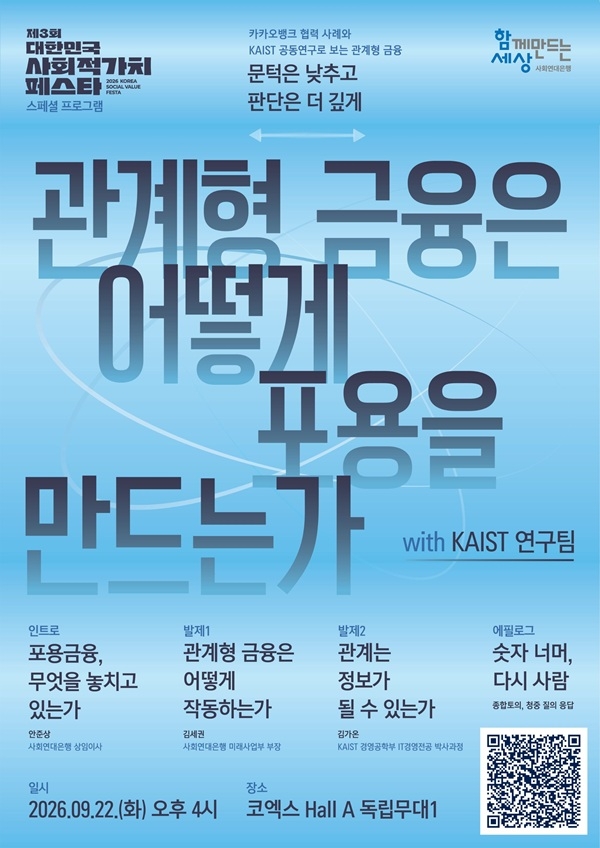
On the second day of the event, Social Solidarity Bank will host a special program titled "How Does Relationship Finance Create Inclusion?" at 4 p.m. on the independent stage in Hall A at COEX. The session will draw on the organization's experience running a partnership project with Kakao Bank and joint research with KAIST to discuss how to assess and support people who struggle to access finance through conventional credit scoring alone.
The session focuses on broadening the scope of inclusive finance beyond simply expanding the supply of funds to improving the way applicants are evaluated. While lowering interest rate burdens and increasing the scale of lending are important, the organizers argue that conventional credit assessment systems often fail to adequately capture an applicant's current circumstances or potential for recovery.
Standard credit evaluations gauge future repayment capacity based on past repayment history and financial transaction records. However, when a person's financial record has deteriorated due to job loss, illness or an interruption in income, improvements in their current economic situation may not be immediately reflected in their credit score.
The "relationship finance" model Social Solidarity Bank advocates uses quantitative data as a baseline while also examining an applicant's present situation, economic context and potential for change. The core principle is to verify repayment capacity so that a loan does not become a new burden — without letting a credit score alone determine whether financial support is granted.
Since its founding in 2003, Social Solidarity Bank has spent 23 years running alternative finance programs for people who face barriers to mainstream financial services, accumulating this approach along the way.
The first presentation will be delivered by Kim Se-kwon, head of Social Solidarity Bank's future business division. Kim will introduce how relationship finance is applied in practice during the screening process, drawing on case studies from the partnership project carried out with Kakao Bank.
He will explain — based on concrete field experience — how assessors identify and evaluate an applicant's current situation and economic circumstances that cannot be fully captured through documents and credit scores alone.
The second presentation will be given by Kim Ga-on, a doctoral candidate in IT management at KAIST's Graduate School of Management Engineering, who will share the findings of the joint research conducted by Social Solidarity Bank and the KAIST research team.
The research team analyzed telephone interview data gathered during the Kakao Bank partnership project to examine how information about applicants that does not fully appear in written documents emerges through actual conversations. This is the first time the findings have been made public.
A general discussion will follow, examining the possibilities and limitations identified in applying relationship finance in the field and exploring the conditions needed to advance the assessment and evaluation framework for inclusive finance.
Ahn Jun-sang, standing director of Social Solidarity Bank and moderator of the session, said expanding the supply of finance to lower the barriers to inclusive finance is important, "but at the same time, we also need a discussion about how to more deeply understand and assess the situations of people who need financial support." He added that the session would be an opportunity to explore the potential of relationship finance through the field experience Social Solidarity Bank has accumulated and the results of the joint research.
Social Solidarity Bank will also operate an experience booth in Hall A at COEX on both days of the event. Visitors can respond to a short questionnaire via a kiosk and receive one of six possible results.
The booth is designed to help the public more easily understand the role of nonprofit organizations that use finance to address social problems, as well as the diverse approaches within social finance.
Since its founding in 2003, Social Solidarity Bank has been a specialized social finance institution supporting the self-reliance of individuals who face barriers to mainstream financial services and the growth of social economy organizations.
Registration for the session is free and available through the official website of the Korea Social Value Festa.
mhj@heraldcorp.com




