Government bonds and monetary stabilization bonds to back settlement and collateral use
Offshore issuance via Hong Kong approval, in partnership with Plume
4% yield floor seen as key hurdle to attract global investors
Shinhan Financial is moving to capture a share of the global real-world asset (RWA) market by launching a tokenized money market fund (MMF) backed by short-term won-denominated assets. The strategy calls for issuing the product offshore first — before South Korea's domestic STO regime takes full effect — to validate the business model, then using that foundation to develop new products and build a global distribution network.
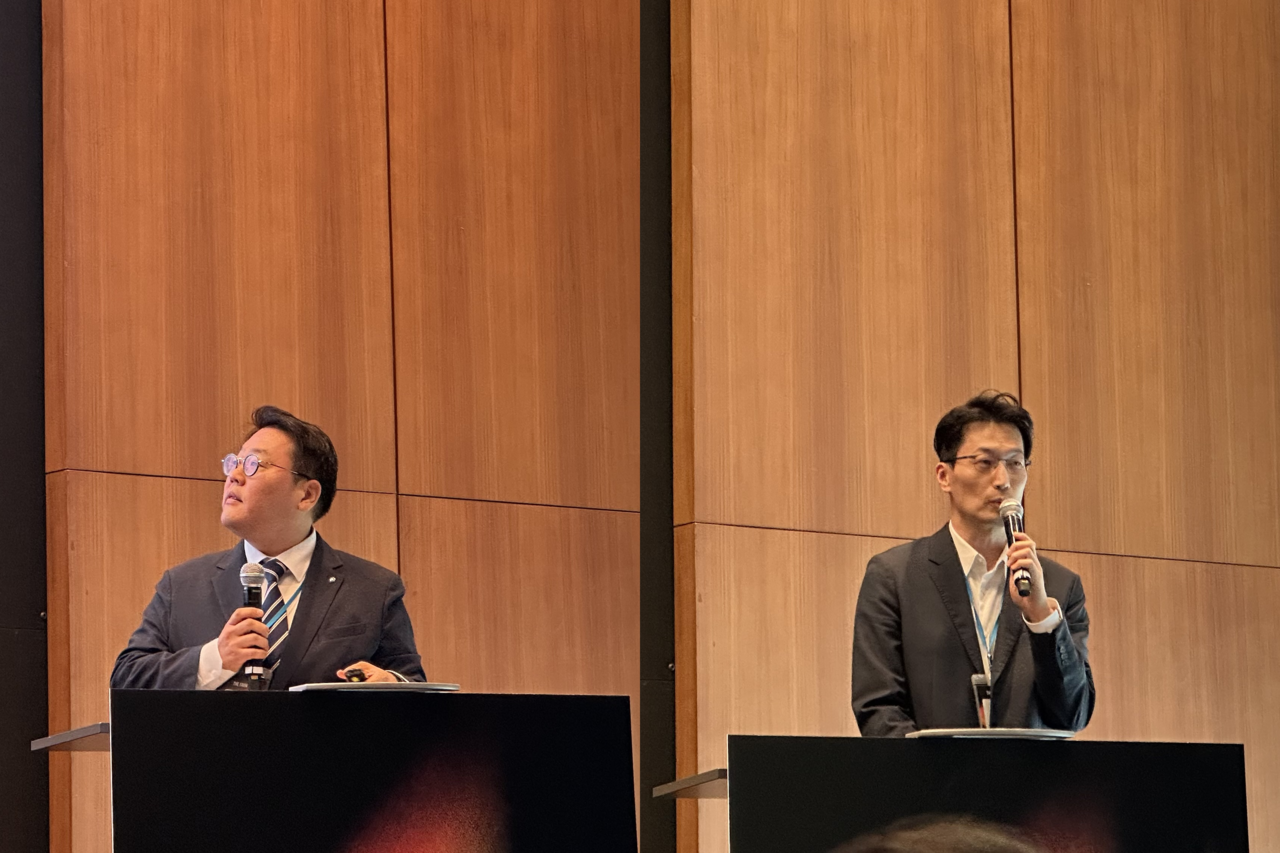
Shinhan Asset Management and Shinhan Investment unveiled the plan Thursday at a summit titled "Start of Won-Based Real Asset Tokenization and Capital Market Opportunities," held in Yeongdeungpo-gu, Seoul.
Shinhan Asset Management is pursuing the offshore commercialization of "K-BUIDL," a product that issues a won-based MMF investing in short-term assets as blockchain-based tokens. The plan is to tokenize an MMF holding government bonds and monetary stabilization bonds, turning it into a reserve asset usable for settlement and collateral in on-chain financial transactions.
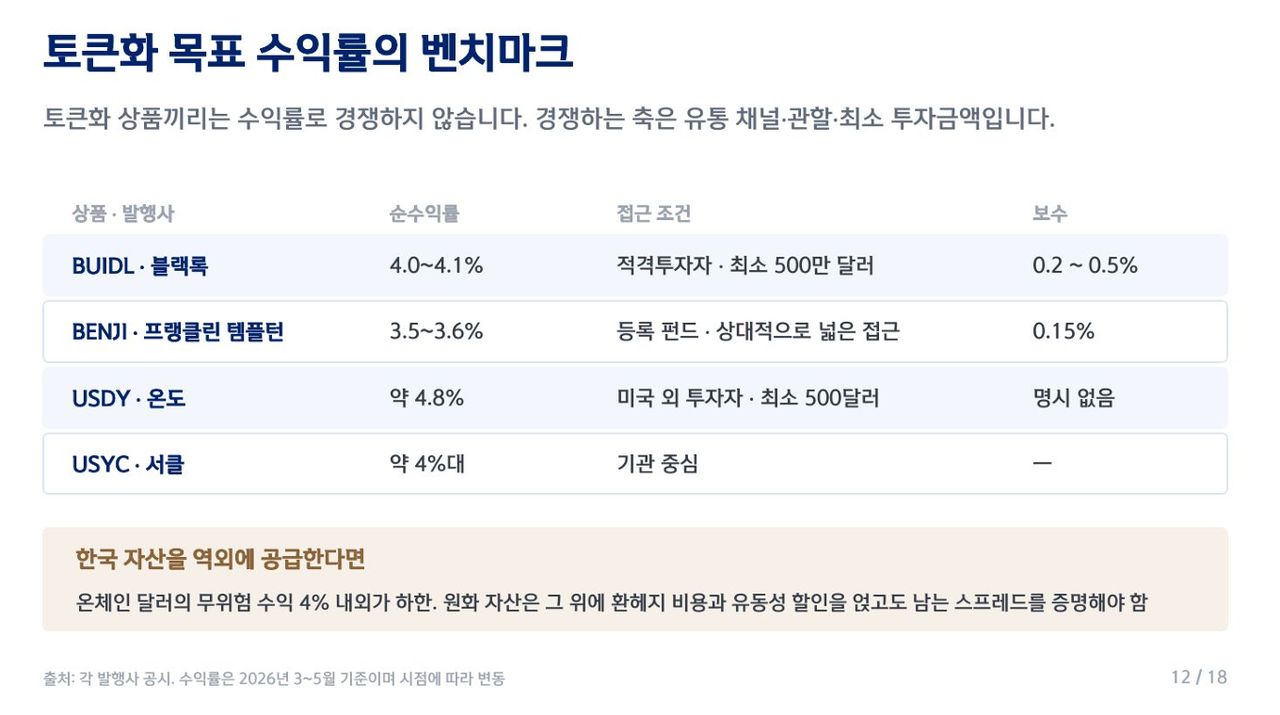
The product K-BUIDL benchmarks is BUIDL, a tokenized fund launched in 2024 by BlackRock, the world's largest asset manager. BUIDL invests in US Treasuries, repurchase agreements and cash equivalents, and is used in on-chain markets as collateral and derivatives margin.
Shinhan Asset Management chose an MMF as its first tokenized product because its composition of ultra-short-term bonds and cash equivalents keeps net asset value fluctuations low, and because it can leverage existing financial infrastructure for custody, accounting and auditing. The firm also sees strong potential for the product to serve as collateral in on-chain financial markets.
"MMFs require fewer new internal control elements to be designed from scratch compared with other financial products," said Lee Jin-hyeok, a director at Shinhan Asset Management. "Shinhan has focused on building the foundation for on-chain finance rather than simply growing the size of the product."
The offshore version of K-BUIDL is expected to draw dollar funding from foreign institutional investors. A domestic financial institution would convert those dollars into won, and Shinhan Asset Management would then invest the proceeds in short-term assets such as government bonds and monetary stabilization bonds. Redemptions would follow the reverse path.
Shinhan Asset Management will handle product design, portfolio management, internal controls and regulatory compliance. For tokenization and global distribution, it is partnering with Plume, a global RWA platform. Plume is working to list Shinhan Asset Management's product on multiple blockchains — including Ethereum and Solana — and to enable its use within on-chain protocols. The first MMF product is also planned for distribution following regulatory approval from Hong Kong's Securities and Futures Commission.
"McDonald's adapts its products to local markets and generates 60 percent of its total sales outside the United States," said Chris Yin, co-founder and CEO of Plume. "The on-chain market can be thought of as its own country." He added that Plume is supporting Shinhan's asset tokenization efforts and that the partnership would allow more global investors to access the assets, expanding both assets under management and the range of use cases.
The push for offshore issuance of K-BUIDL reflects the differing pace and direction of tokenization regulation at home and abroad. Domestically, the focus has been on supplying retail investors with non-standard assets such as music royalties, artwork and small-scale real estate, while overseas markets have centered tokenization on instruments familiar to institutional investors — credit assets, MMFs and government bonds.
"The domestic STO policy direction was recently announced, but phases two and three are structured to open conditionally, with no fixed implementation schedule," said Choi In-su, head of the digital assets division at Shinhan Investment, at the summit. Earlier, the Financial Services Commission announced Sept. 4 that it would gradually expand the tokenized securities infrastructure, starting in February next year with privately placed MMFs and bonds for institutional investors. The timing of phases two and three — which would extend to publicly offered securities and on-chain settlement — is to be determined based on market and regulatory conditions.
Against that backdrop, Shinhan Financial plans to issue and operate products offshore while waiting for the domestic regime to expand, building up a track record of use cases in the meantime. "We need to reach phase three, where on-chain connectivity and interoperability are secured, before we can see expansion into global markets encompassing the securities and banking sectors," Choi said.
Tokenization could offer securities firms — which are heavily dependent on domestic revenue — a new avenue for overseas expansion. More than 90 percent of domestic brokerages' revenue is generated at home, and Shinhan Investment is no exception. Profitable overseas operations are concentrated in markets such as the United States and Hong Kong, and a number of foreign subsidiaries are running at a loss.
"For a domestic financial firm to expand overseas, building a local presence, staffing, infrastructure and networks requires at least 20 billion won ($14.9 million) — and in some cases hundreds of billions of won — along with considerable time," Choi said. "Tokenization is a new opportunity for overseas business because it allows each firm to connect its strengths in customers, products and infrastructure through collaboration, securing a foothold in global markets in a short period of time," he added.
Attracting global investors in the offshore market will also require competitive returns. Overseas tokenized products — including BlackRock's BUIDL, Franklin Templeton's BENJI and Ondo Finance's USDY — currently offer yields in the 4 percent range. A won-based MMF product must compete with those offerings while also managing exposure to exchange rate fluctuations.
"If we operate offshore, the minimum yield floor at this point would be at least in the 4 percent range," Choi said. "Creating a product structure that can offset exchange rate risk and other challenges is the homework for securities firms and banks." He also stressed the importance of consistent issuance capacity. "The outcome in tokenization depends less on what you have issued and more on who can issue well, repeatedly and sustainably," he added.
kyoung@heraldcorp.com