
First growth fund returns -1%
FSC: too early to judge short-term performance
Second fund to raise 720 billion won total
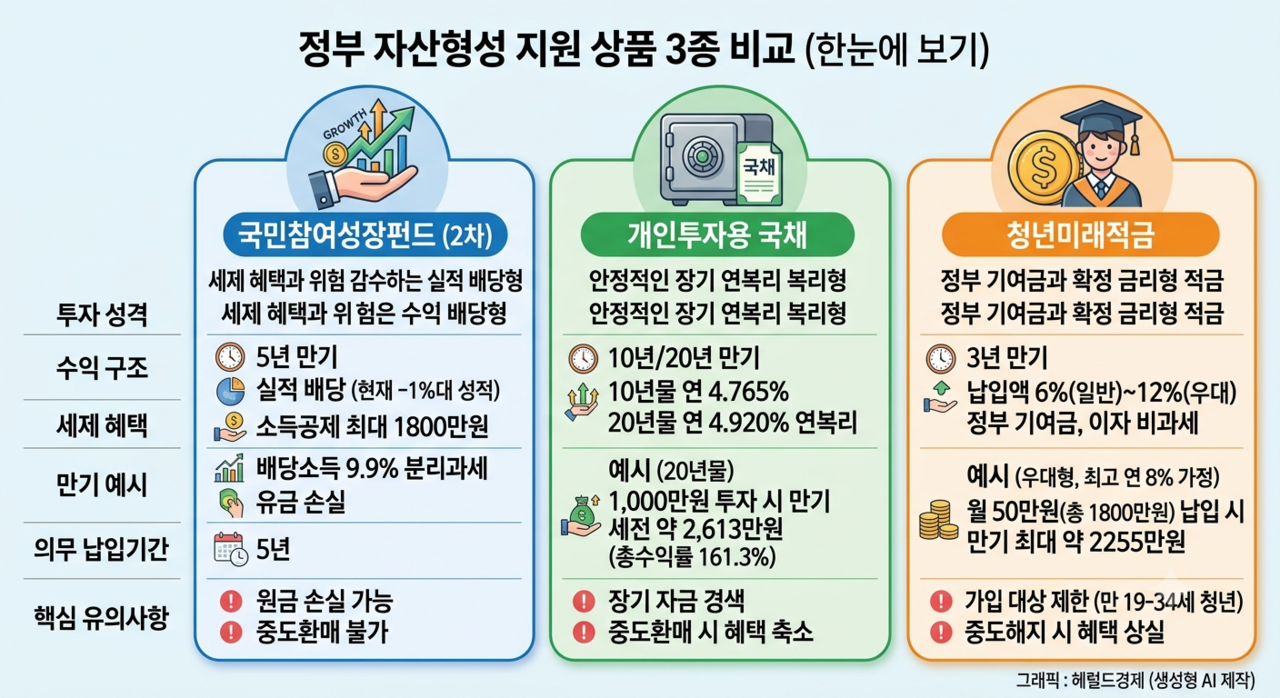
20-year retail government bond: 10 million won grows to 26.13 million won before tax
Youth Future Savings premium tier: 18 million won in, up to 22.55 million won out

The government has been rolling out a series of asset-building products that stack tax benefits, government contributions and compound interest. Later this month, the second tranche of the People's Participation Growth Fund — whose first tranche sold out at 600 billion won ($448 million) in May — goes on sale. Retail government bonds are now available through retirement pension accounts for the first time, and the Youth Future Savings account offers a government top-up of up to 12 percent of deposits.
Each product, however, earns money differently and comes with its own conditions. The growth fund offers substantial tax breaks but carries the risk of principal loss, while retail government bonds reward investors who hold to maturity with compounding returns. The Youth Future Savings account provides a direct government contribution but restricts who can join.
How much can investors actually gain from each product, how long will their money be tied up, and what should they watch out for?
Growth fund that sold out at 600 billion won posts -1% return after three months
The Financial Services Commission will sell 600 billion won worth of second-tranche People's Participation Growth Fund units on a first-come, first-served basis over 10 business days from Sept. 30 to Oct. 15 — the same size as the first tranche launched in May.
The first fund sold out within a week of going on sale, but its investment performance has yet to turn positive. As of Monday, the average return stood at around -1 percent, narrowing from a loss of about 3.7 percent in early August.
Financial regulators say it is too early to judge the fund's five-year prospects based on current returns. Son Yeong-chae, head of the FSC's People's Growth Fund task force, said on the Cheong Wa Dae YouTube channel "Fact Bangatgan" that the product requires investors to lock up their money for five years. "We will aggregate the total returns of all 10 asset managers at the five-year maturity date, calculate a single rate of return, and distribute that to investors," he said.
Son added that each sub-fund would publish a detailed asset management report — covering returns and investment targets — every three months. "Given the fundamental nature of this product, returns at this point in time should not be a concern," he said. The first fund began operating on June 11, and its first asset management report is scheduled to cover the period through mid-September.
![FSC Chairman Lee Eok-won visits NH NongHyup Bank inside Government Complex Seoul in May to subscribe to the People's Participation Growth Fund. [FSC]](https://wimg.heraldcorp.com/news/cms/2026/09/12/news-p.v1.20260522.3c6dbc04f93e4902829d87f252154674_P1.jpg)
The second fund will pool 600 billion won from the public with 120 billion won in subordinated government fiscal contributions, bringing the total to 720 billion won. Ten sub-fund managers will divide and invest the capital, and the three public offering funds available to retail investors will invest in the same 10 sub-funds, resulting in an identical final portfolio and return.
Because the growth fund invests more than 60 percent of its assets in advanced strategic industries and related companies, losses can occur depending on market conditions. The government contributes 120 billion won — equivalent to 20 percent of public investment — on a subordinated basis as a buffer, but principal is not guaranteed.
In return, investors using a dedicated account can claim income deductions of up to 18 million won, and dividend income is subject to a separate flat tax of 9.9 percent for up to five years. Mid-term redemptions are not permitted during the five-year period, and transferring units within three years triggers a clawback of tax benefits. Annual fees and commissions run about 1.2 percent, or about 1.0 percent for online purchases.
In the second sale, half of the first week's allocation — 300 billion won — will be reserved for lower-income investors. Anyone who actually invested in the first tranche is not eligible to subscribe to the second.
10 million won becomes 26.13 million won in 20 years — time is the return on retail government bonds
Unlike the People's Participation Growth Fund, retail government bonds allow investors to calculate their maturity payout with relative precision based on the interest rate and holding period.
The 20-year bond issued this month carries a coupon rate of 4.570 percent per year plus a 0.35 percentage point premium, for an effective annual compound rate of 4.920 percent through maturity. The pre-tax total return is about 161.3 percent, meaning 10 million won held for 20 years would grow to about 26.13 million won in principal and interest.
The 10-year bond has a combined effective rate of 4.765 percent per year, yielding a pre-tax total return of about 59.3 percent at maturity. An investment of 10 million won would return about 15.93 million won.
The high cumulative returns, however, depend on holding the bonds to maturity. Early redemption forfeits the premium rate and the compound interest benefits that come with holding to term.
Starting this month, investors can buy 10-year and 20-year retail government bonds not only through dedicated retail bond accounts but also through defined-contribution and individual retirement pension accounts.
A commercial bank official said the retail government bond is well suited to the retirement pension customer base. "Retirement pension customers tend to favor stable, long-term management over active trading, which gives us an edge in selling retail government bonds," the official said. "The bonds' focus on stable returns through long-term holding is expected to align well with the investment preferences of bank retirement pension customers."
![[The Herald Business DB]](https://wimg.heraldcorp.com/news/cms/2026/09/12/9/news-p.v1.20250627.e4b811719da549a1b9fe45ddcdb31424_P1.jpg)
18 million won in, up to 22.55 million won out — Youth Future Savings
The Youth Future Savings account is structured so that the government directly adds a contribution on top of each subscriber's deposits.
Young people between the ages of 19 and 34 can deposit up to 500,000 won per month for three years. The government tops up deposits by 6 percent for the standard tier and 12 percent for the premium tier. Interest income is also tax-exempt.
Depositing 500,000 won a month for 36 months brings the subscriber's total contribution to 18 million won ($13,500). Assuming a maximum annual interest rate of 8 percent, the standard tier pays out up to about 21.38 million won at maturity — including the government contribution and interest — while the premium tier pays up to about 22.55 million won. That represents a gain of about 3.38 million won and 4.55 million won over the principal, respectively.
The premium tier, however, requires subscribers to meet income and employment conditions, including working at a small or medium-sized enterprise. Early withdrawal under standard conditions forfeits both the government contribution and the tax exemption.
rim@heraldcorp.com



