
- HOME
- FINANCE
-
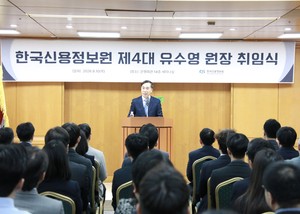
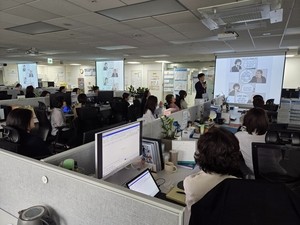
Yoo Su-young takes office as new chief of Korea Credit Information Services
Former Finance Ministry spokesperson Yoo Su-young becomes 4th president The Korea Credit Information Services said Thursday that it has appointed Yoo Su-young, a former spokesperson for the Ministry of Economy and Finance, as its fourth president. Yoo, born in 1968, was appointed following a resolution at the organization's general assembly. His three-year term began Thursday. On his first day in office, he toured the organization's departments to greet staff before beginning his official duties. In his inaugural address, Yoo laid out the expansion of inclusive finance and the shift toward productive finance as key tasks ahead. He particularly stressed that the Korea Credit Information Services should expand its role beyond simply providing financial data. It should become a core piece of infrastructure that links disparate data sets to support the financial industry's transition to AI. "I will do my utmost to help our organization leap forward from a data-supply function for the financial industry into a future-oriented innovation infrastructure that connects different data sets and accelerates the financial sector's AI transformation," he said. Yoo also called for stronger communication with the financial industry. He said the organization should widen its contact with the field so it can make a real contribution to solving the problems financial firms face. He named data protection and security management as another core task. He asked staff to run an airtight security system for the financial data under the organization's management so it can establish itself as a trusted core financial data institution. Meanwhile, the Korea Credit Information Services is also working to expand infrastructure that supports the financial industry's use of data. Since Aug. 25, it has been running the full-service version of its "climate finance web portal," which supports assessments of compliance with the K-taxonomy, the identification of green companies and follow-up management.
Sept. 10, 2026
-

Korea Eximbank to expand support for Africa's AI, critical minerals, infrastructure
MOU with African Development Bank on financial cooperation The Export-Import Bank of Korea (Korea Eximbank) will expand joint financing with the African Development Bank (AfDB) for strategic sectors including artificial intelligence, critical mineral supply chains and eco-friendly infrastructure. The move aims to broaden opportunities for South Korean companies to participate in large-scale projects and supply chain initiatives across Africa. Korea Eximbank said Thursday it signed a memorandum of understanding with the AfDB to promote sustainable growth and expand financial cooperation in Africa. The agreement was signed on the sidelines of the eighth Korea-Africa Economic Cooperation (KOAFEC) Ministerial Conference held in Seoul on Wednesday. Hwang Ki-yeon, governor of Korea Eximbank, and Sidi Ould Tah, president of the AfDB, signed the memorandum on behalf of their respective institutions. The two institutions plan to pursue joint financing centered on three areas: AI and digital transformation, stabilizing critical mineral supply chains, and eco-friendly and renewable infrastructure. The focus will be on linking Africa's resources and development needs with the technological and business capabilities of South Korean companies to increase their participation in local projects. Critical minerals and infrastructure offer particularly promising opportunities for cooperation, both for South Korean companies expanding into Africa and for diversifying supply chains. Through financial cooperation with the AfDB, Korea Eximbank plans to support South Korean companies' participation in large-scale infrastructure and supply chain projects. The new agreement marks a complete overhaul of the memorandum the two institutions first signed in 2005, 21 years ago. Marking the 20th anniversary of their co-hosting of KOAFEC, the two sides expanded the scope of cooperation to include future industries and supply chains. "It is meaningful to redefine our partnership with the AfDB, which has continued for more than 20 years, and we will pursue financial diplomacy that connects South Korea's technological capabilities with Africa's future development needs," Hwang said. He added, "We will strengthen strategic cooperation with major multilateral development banks, including the AfDB, to actively support South Korean companies' expansion into global markets." Africa is a massive market with a population of about 1.55 billion as of 2025, and a key supplier of critical minerals. According to the UN, Africa's population is expected to grow to about 2.5 billion by 2050. The AfDB estimates that Africa holds about 30 percent of the world's reserves of major critical minerals, including cobalt, lithium, graphite, rare earths, platinum group metals, copper, manganese and nickel.
Sept. 10, 2026
-
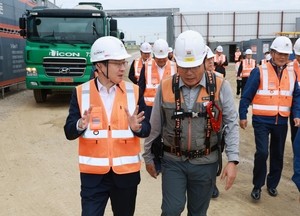
Housing finance guarantee revives 2,700-unit apartment project in Gimpo
FSC holds on-site meeting on Gimpo PF project KHFC's 600 billion won PF guarantee normalizes stalled project Guarantee supply target immediately raised from 6 trillion to 9 trillion won Financial authorities are pushing project financing and other funding support to boost housing supply. A 2,700-unit apartment construction project in the Greater Seoul area has been normalized through a project financing guarantee from the Korea Housing Finance Corporation. Authorities urged the financial sector to actively support funding to spread such success stories. Lee Eok-won, chairman of the Financial Services Commission, visited the Pungmu transit-oriented urban development project site in Gimpo, Gyeonggi Province, on Thursday and presided over a meeting on the Gimpo project financing site. Attendees included Hoban Construction, the project operator, along with officials from Gimpo Urban Corporation, the Korea Housing Finance Corporation, KB Kookmin Bank and the Korea Federation of Banks. The site is home to a 2,700-unit project for which the Korea Housing Finance Corporation recently provided a 600 billion won ($448 million) project financing guarantee. The project had struggled from 2022 to 2023 amid a real estate slowdown and rising construction costs, but it was normalized after receiving the guarantee and has now entered the pre-sale process. Park Chul-hee, president of Hoban Construction, who attended the meeting, said, "Even amid uncertainty in the pre-sale market and construction industry, we were able to steadily advance the project as our funding conditions improved through the Korea Housing Finance Corporation's project financing guarantee and other support." He added, "Financial support is essential for advancing projects without setbacks and supplying housing quickly, so we ask for the financial sector's continued active cooperation." Kim Kyung-hwan, president of the Korea Housing Finance Corporation, said, "Following the Aug. 13 measures, we immediately expanded our guarantee supply target from 6 trillion won to 9 trillion won." He added, "We will continue to steadily carry out tasks to promote housing supply, including creating new guarantee products to support redevelopment projects and rental business operators." Lee praised the Pungmu transit-oriented urban development project as a success story and urged the financial sector to actively supply funding. "This is a success story showing how financial support for project financing leads to actual housing supply," Lee said. "As this case shows, ensuring rapid housing supply requires the efforts and achievements of every party involved in a project financing deal to come together organically — the developer's active commitment to advancing the project, the contractor's steady construction progress, reliable funding from private financial institutions backed by the Korea Housing Finance Corporation's public project financing guarantee, and the government's continued monitoring and system improvements." The Financial Services Commission held a meeting on Wednesday, presided over by Jeon Yo-seop, director general of the Financial Policy Bureau, to review progress on financial support measures for promoting housing supply, checking the status of 21 detailed supply-related tasks under the Aug. 13 financial measures. Authorities have so far implemented 12 of the 21 supply-related tasks. They decided to suspend, for two years, the project financing equity capital ratio regulation for residential projects to promote housing supply. After gathering opinions from the financial and construction industries this month, they plan to announce detailed plans as early as September.
Sept. 10, 2026
-
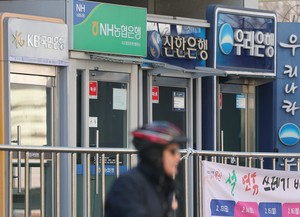
Push for low-interest loans to bottom 30% credit tier raises bank funding, soundness concerns
Ruling party pushes 'basic finance' package of loans, counseling, insurance and savings Basic loans aim to guarantee financial access, curb illegal private lending Financial, insurance sectors seen benefiting most, but risk management concerns loom Funding remains a challenge, with securities, virtual asset industries floated as contributors Concerns are deepening in the financial sector over a push to guarantee "basic financial rights" — a plan centered on long-term loans of up to 10 million won ($7,470) at annual interest rates of 2 to 3 percent for borrowers in the bottom 30 percent of credit scores. The government and ruling party argue that easing high-interest burdens on vulnerable groups would increase disposable income and reduce the social costs of loan delinquencies and defaults, but the financial industry warns that the expanded funding burden could undermine financial soundness. At the third policy forum on realizing the public's basic financial rights, held at the National Assembly on Thursday by Democratic Party of Korea Rep. Min Byung-duk, the Korea Inclusive Finance Agency and the Basic Society Committee, Kim Sang-bong, a professor at Hansung University, said an industrial linkage analysis reflecting policy demand related to basic financial rights as final demand estimated the total economic ripple effect at about 127 trillion to 223 trillion won. He forecast that in the long term, this could contribute an economic effect equivalent to about 4.7 to 8.4 percent of nominal GDP. The government and ruling party are pushing to enact the National Basic Financial Guarantee Act, which would secure basic financial rights for low-credit and vulnerable groups. The bill divides basic financial rights into five categories — the right to access, survival, recovery, self-reliance and asset building — and centers on establishing a basic finance system to realize them. Specifically, it would introduce four "basic finance" programs: a "basic loan" offering long-term loans of up to 10 million won at annual interest rates of 2 to 3 percent to borrowers in the bottom 30 percent of credit scores, along with basic consultation and debt adjustment, basic insurance and basic savings. The study ran under two scenarios, setting policy demand related to basic financial rights as final demand at 51.17 trillion won and 89.62 trillion won, respectively. Increases in production and value added, as well as employment effects generated as financial supply flows into consumption and investment, were calculated using an input-output table. Kim said, "For every 100 million won of final demand tied to basic financial rights, employment is expected to increase by 0.488 people and the number of people employed by 0.551." He added, "Under the maximum scenario, the employment inducement effect would reach about 440,000 people and the job inducement effect about 490,000 people, contributing to GDP growth and job creation." By industry, the financial and insurance sector showed the largest ripple effect. Based on final demand of about 51 trillion won, the production inducement effect for financial and insurance services was estimated at about 62 trillion won, and the value-added inducement effect at about 39 trillion won. The sector also generated the most jobs of any industry, with both employment and job inducement figures at around 180,000 each. Ripple effects also extended to business support services, information and communication and broadcasting services, professional, scientific and technical services, and food and accommodation services. Yoo Kyung-won, a professor at Sangmyung University, suggested that authorities build a comprehensive database on policy-based inclusive finance to regularly assess the effectiveness of fund supply. There is, however, no shortage of issues to resolve before basic financial rights can actually be introduced, since operating low-interest loans and insurance premium support as a permanent system requires a stable funding source. Kim Eun-kyung, who serves as both head of the Korea Inclusive Finance Agency and chair of the Credit Counseling and Recovery Service, earlier proposed expanding the pool of entities required to contribute to the agency's fund to include the financial investment and virtual asset industries. Future legislative discussions are expected to see repeated sharp disagreements over who should bear the funding burden, how much each should contribute and how the funds should be distributed. Risk management pressure on banks is also cited as a challenge. There are significant concerns that supplying policy-based finance could destabilize existing credit assessment systems and encourage moral hazard among borrowers. Lee Min-hwan, a professor at Inha University who moderated the discussion, said, "Future legislation must also address who is covered and to what extent, how services are delivered, how to secure stable funding, and a data-based performance evaluation system." An official at a financial holding company said, "Ultimately, where the money comes from and who takes on the bad debt if delinquencies occur will be the key issue," adding that simply stacking a new product on top of the many similar policy-based financial products already available, without consolidation, could make handling and management more complicated. Another bank official said a mechanism to ensure fairness in selecting who receives basic loans is also needed.
Sept. 10, 2026
-

Hanwha Life: 300,000 visit 63 Building in 100 days since reopening
Global multipurpose cultural complex unveils renewed spaces Hanwha Life Insurance said Thursday that 300,000 people have visited the 63 Building over the 100 days since its reopening. The 63 Building will mark 100 days since its reopening on Friday. The building reopened in June as a global multipurpose cultural complex. The renovation reorganized the building's spaces entirely, encompassing the new Centre Pompidou Hanwha along with the observatory, gardens, and dining and lifestyle spaces. Centre Pompidou Hanwha has drawn as many as 7,000 visitors a day since it opened. Its inaugural exhibition, "Cubists: Innovators of Vision," unveiled alongside the opening, runs through Oct. 4. During the exhibition period, every Wednesday is designated Culture Day, offering a 50 percent discount on admission. Beyond the exhibition, the venue hosts a range of performances, including harp and classical guitar recitals and swing dance shows. It also runs programs for children and families, along with an "Art Salon." Since Sunday, the 63 Oudolf Garden has been presenting "Garden Project: Things Inscribed," featuring artists Kim Yun-shin, Shin Mi-kyung and Oh Myo-cho. Centre Pompidou Hanwha opened in May, marking the 140th anniversary of diplomatic relations between South Korea and France. French architect Jean-Michel Wilmotte designed the renovation, which overhauled the entire annex building of the 63 Building. The renovation created two large exhibition halls across four above-ground floors, spanning a total of 1,650 square meters. The renovation also brought in 25 new tenants, including restaurants recognized by the Michelin Guide, global coffee and dessert brands, and lifestyle concept stores. The retail section gathered concept stores selling global design items, traditional Korean crafts and art postcards. In the dining area, Hawaii's Island Vintage Coffee opened its first store in Korea. French dessert brand Pierre Hermé Paris introduced its first flagship store in the country. Japanese ramen brand Ramen Yashima also made its Korean debut. The building's signature restaurant, 63 Buffet Pavilion, reopened as 63 Buffet Pavilion The Premium. Hanwha Life said the cumulative number of visits to the dining and lifestyle spaces has reached about 150,000 since the renovation. The building's signature observatory has also been transformed. The 60th-floor 63 Sky Picnic added media art and interactive content to its existing views of downtown Seoul and the Han River. Visitor numbers at 63 Sky Picnic have risen about 20 percent since the renovation. The "BE ART" project to discover emerging artists is also underway. To mark the 100th day since reopening, Hanwha Life is holding an appreciation event. On Friday, visitors to 63 Sky Picnic who follow the official Instagram account and verify it on-site will receive a Seoul Picnic Tin Cookie. The cookies will be given one per team, on a first-come, first-served basis, to the first 100 teams. "This renewal goes beyond simply redecorating the space -- it is meaningful in that it recreates the value of the time and experience visitors spend at the 63 Building," a Hanwha Life official said. "We will continue to build it into a multipurpose cultural complex that citizens and tourists keep coming back to, through a variety of exhibitions, performances and brand collaborations."
Sept. 10, 2026
-
![Banks raise time deposit rates, signaling reverse money move [Money Mwoni]](https://wimg.heraldcorp.com/news/cms/2026/09/10/rcv.YNA.20260218.PYH2026021806170001300_T1.jpg?type=h&h=240)
Banks raise time deposit rates, signaling reverse money move [Money Mwoni]
Hana, Woori raise time deposit rates as market rates climb Major bank time deposit products now yield mid-3% range Time deposits at top 5 banks top 1,000 trillion won for first time Rising deposit rates set to push up new COFIX as well South Korean banks have begun raising interest rates on time deposits as market rates climb. According to industry officials Thursday, Hana Bank raised the one-year rate on its "Hana Time Deposit" product to 3.3 percent from 3.2 percent. The move follows an earlier increase in July, when the rate rose 0.3 percentage points from 2.9 percent. Woori Bank also recently raised the rate on its flagship "WON Plus Deposit" product by 0.2 percentage points, to 3.4 percent from 3.2 percent. On top of the Bank of Korea's benchmark interest rate hikes, market rates have been climbing worldwide, pushing banks' time deposit rates toward the mid-3 percent range. According to the Korea Federation of Banks, KB Kookmin Bank is offering its "KB Star Time Deposit" at 3.2 percent, while Shinhan Bank is offering its "Shinhan My Plus Time Deposit" at 3.3 percent. NH NongHyup Bank is selling its "NH Waltz Rotating Deposit II" at 3.25 percent. As time deposit rates climb, a reverse money move — funds flowing back into bank deposits — is also gaining momentum. Time deposit balances at the five major lenders — KB, Shinhan, Hana, Woori and NH — reached 1,005.23 trillion won ($2.48 trillion) as of the end of August. It marks the first time the combined balance has topped 1,000 trillion won. Compared with the buoyant first half of the year, a prolonged correction in the stock market has fueled a rush into time deposits, particularly among retail investors. Companies are also actively parking settlement funds, money they cannot afford to lose, in time deposits, according to industry officials. According to the Korea Financial Investment Association, investor deposits held in brokerage accounts awaiting stock investment rose from 87.83 trillion won at the end of last year to 121.63 trillion won in June. The figure then plunged to 99.70 trillion won by the end of August. However, rising deposit rates are not good news for borrowers. The new Cost of Funds Index, or COFIX, which serves as the benchmark rate for variable-rate mortgages, is a weighted average of banks' funding costs, including those from time deposits and bank bonds. As deposit rates rise, so does the new COFIX, which in turn pushes up interest rates for borrowers with variable-rate loans. With bank bond yields already climbing amid rising market rates, the added increase in deposit rates is expected to accelerate the pace of the new COFIX's rise.
Sept. 10, 2026
-
![Korea's STO market can learn from Japan's six-year head start [Crypto Insight]](https://wimg.heraldcorp.com/news/cms/2026/09/10/news-p.v1.20260909.1457c4d2769d401e821a02491c523b91_T1.png?type=h&h=240)
Korea's STO market can learn from Japan's six-year head start [Crypto Insight]
Lee Sung-hoon, CEO of Bitplanet The Korea Herald presents "Crypto Insight," a column featuring expert perspectives on digital asset policy, technology and markets. It offers in-depth analysis of digital asset market conditions, the latest global developments and the trend toward institutional adoption — topics of keen interest to readers. "Crypto Insight" aims to serve as a compass for clearly understanding complex market structures and gauging the future value of digital assets. When security token offerings, or STOs, come up for discussion, the United States and Europe are the countries most often cited. But the practical model Korea should look to is Japan. Unlike the United States, which relies on case law and regulatory enforcement, or Europe, which created entirely new rules, Japan folded STOs into its existing Financial Instruments and Exchange Act. That approach closely mirrors Korea's own design. Korea is incorporating STOs as a new "issuance and distribution format" through amendments to the Act on Electronic Registration of Stocks, Bonds, Etc. and the Capital Markets Act. The resemblance extends further: trust companies and securities firms lead issuance in both countries, and fractional-investment demand concentrates in real estate. Both markets also place investor protection at the center of policy. Japan's legislation came six years before Korea's. Japan enforced its revised Financial Instruments and Exchange Act in May 2020. It classified rights with Type 2 securities characteristics — which carried looser disclosure obligations — as "electronically recorded transferable rights" once tokenization enabled electronic transfer. It then applied regulations equivalent to those governing Type 1 securities. The first lesson from Japan's six years of operating its STO regime is the importance of tax rules and detailed operating regulations. Publicly offered ST issuance in fiscal year 2024 totaled 46.4 billion yen ($302 million), more than half less than the previous year. BOOSTRY pointed to financial institutions temporarily suspending issuance to assess system impacts after a September 2024 request to reform trust taxation as the main cause. The issuance market only began to recover after Japan's tax reform outline was announced that December. Fiscal year 2025 issuance in fact surged roughly 3.6-fold from the previous year to 165 billion yen, while cumulative issuance also doubled year-on-year to 333.3 billion yen. A prominent example is MUFG Group's 22.4 billion yen public offering of real estate ST backed by Dojima Hamatower in Osaka. In July, Daiwa House Group also completed a 7.7 billion yen public offering backed by logistics facilities. The second lesson concerns securing liquidity in the secondary market. Japan built its issuance and distribution infrastructure in parallel, opening a dedicated secondary market called START in December 2023. Even so, only eight securities trade there, with a combined market capitalization of just 33.6 billion yen — still marginal next to cumulative issuance. Compared with the pace of growth in the STO issuance market, liquidity and depth in the secondary market remain shallow. Taking Japan's trial and error as a cautionary lesson, Korea has moved to respond preemptively, focusing on firming up detailed rules before its own regime takes effect. The Financial Services Commission recently laid out a three-phase roadmap for STO policy. Under the plan, Korea will tokenize institution-only private money market funds, trust-based unlisted shares, and publicly offered fractional-investment securities when the new regime takes effect in February 2027. It will then check market stability and demand before expanding the scope to general public offering securities. Finally, it will build out on-chain settlement infrastructure that uses stablecoins as a means of payment. Alongside this, work is also underway to complete secondary-market infrastructure early. The FSC granted preliminary authorization for over-the-counter brokerage of beneficiary certificates to the NXT consortium and Korea Exchange in February. It then proposed capping retail investors' net purchases per exchange at 100 million won ($74,600). In effect, Korea is preparing to launch an over-the-counter exchange and design its distribution system at the same time. Korea is a latecomer to the STO market, but it gets to take its first steps having already absorbed the lessons of Japan's six years of trial and error. With the broad legal and policy framework now in place, the priority is to finalize detailed rules quickly so that issuance, distribution and settlement can proceed without friction. As the rollout advances in phases, keeping policy predictable — in step with changes such as the legislation of stablecoins — will also be essential. Japan's six years amount to a useful "answer key" of past mistakes that Korea does not have to repeat.
Sept. 10, 2026
-
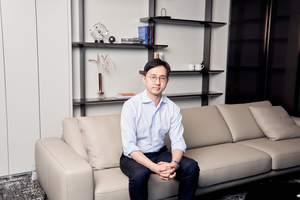
Bitplanet secures 1,204 bitcoin mining rigs, aims to mine 7 BTC a month
Noncurrent assets up 43.9%, diversifying revenue with mining project Operations in Oman, Paraguay to begin as early as this week Bitplanet has completed the transfer of 1,204 bitcoin mining rigs and is set to launch full-scale mining operations in Oman and Paraguay. Bitplanet said Wednesday it had completed the transfer procedures for the bitcoin mining equipment under a contract signed in June. The total transfer value came to $9,999,228. The equipment secured includes 454 units of Bitmain's S21 XP Hydro and 750 units of the S21e XP Hydro, totaling 1,204 rigs. Each unit has a maximum hash rate of 473 terahashes per second and a power efficiency of about 12 to 13 joules per terahash. The mining rigs have been deployed to sites in Oman, in the Middle East, and Paraguay, in South America, both regions with low electricity costs. Bitplanet plans to run the equipment through a combination of outsourced operation and joint venture arrangements, aiming to mine at least 7 BTC a month, or more than 84 BTC a year. The bitcoin mined will be recognized as sales on the company's books. With the acquisition, Bitplanet's noncurrent assets rose to about 62.3 billion won ($46.5 million), up 43.9 percent from before the mining rig transfer. Total assets climbed 14.6 percent to about 72.8 billion won. The transfer process was completed about three months after Bitplanet disclosed its decision to acquire the equipment in June. Bitplanet said the deal involved multiple overseas counterparties and foreign exchange settlement procedures for the equipment purchase and financing, requiring the company to review the transaction structure and related procedures with accounting, legal and foreign exchange advisers. Bitplanet plans to diversify its revenue by adding bitcoin mining to its existing system integration business. The company also intends to apply the experience it gains from managing power procurement and operating rates for the mining equipment to its AI data center project. "With few domestic precedents to draw on, we reviewed everything from the contract terms to accounting treatment, disclosure and foreign exchange procedures with legal and accounting advisers," said Lee Sung-hoon, CEO of Bitplanet. "Now that we have completed the related procedures, we will prove ourselves through stable equipment operation and tangible operating results." Bitplanet plans to bring the acquired mining rigs into full operation as early as Friday, and by sometime next week at the latest.
Sept. 10, 2026
-
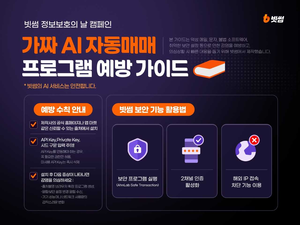
Bithumb warns of fake AI trading malware promising high returns
September Information Protection Day campaign Bithumb advises blocking withdrawal permissions and immediately discarding exposed API keys Bithumb said Thursday that it is running a campaign to prevent malware damage from fake artificial intelligence auto-trading programs and investment analysis tools, marking Information Protection Day in September. Cases have recently emerged in which scammers lure investors with claims such as "AI trades automatically for high returns" or "connect your API key for loss-free automatic trading," only to induce them to install unauthorized malware that steals sensitive information. Such malware carries a high risk of leaking not only usernames, passwords and login session cookies stored in browsers but also the private keys and seed phrases of personal wallets. Attackers have been found to use stolen login sessions to access user accounts without passwords, or to exploit API key permissions to siphon off assets without authorization. Bithumb urged users not to download unauthorized programs distributed as executable or compressed files through search ads, SNS or messenger links. It added that users should exercise caution even with websites disguised as legitimate services if the distribution path is unclear. For automatic trading, users should rely only on official services, and it is advisable not to grant withdrawal permissions even when issuing an API key, Bithumb said. Users should allow only essential permissions such as viewing or ordering, and immediately discard any key that is unused or has been exposed externally, the exchange explained. In particular, Bithumb warned users never to directly enter information that grants asset access — such as API keys, private keys or seed phrases — into external programs, websites or AI services. If an unauthorized program has been installed and an unfamiliar browser extension is added, or a notification about changed security settings appears, users should immediately suspect a malware infection. They should disconnect from the internet and, using a separate device, change their passwords, delete API keys and check withdrawal addresses. "Unauthorized information-stealing malware that exploits expectations around AI and the psychology of chasing high returns is running rampant," a Bithumb official said. "We will strengthen our security systems and expand our prevention campaigns so that users can safely use official AI services." Meanwhile, Bithumb released a guide on preventing AI supply chain attacks last month as part of its information protection campaign. A supply chain attack refers to a method in which malicious code is planted during the software development process, and Bithumb stressed that users should verify a program's official developer name before installing it.
Sept. 10, 2026
-
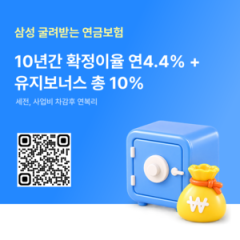
Samsung Life: 'W100m grows to W150m in 10 years' with new lump-sum pension policy
Fixed 4.4% rate applies for 10 years 5%, 10% loyalty bonuses for maintaining policy 5, 10 years Enrollment open from age 20 to 80, starting at 2 million won No interest income tax on insurance gains Samsung Life said Thursday it has launched a digital pension insurance product called "Samsung Grow-and-Receive Pension Insurance." The product allows customers to prepare for retirement by paying a lump sum upfront. Under the structure, policyholders pay the premium in full at enrollment, then let it grow for at least 10 years before receiving it as a pension. As of September, enrollees receive a fixed annual compound interest rate of 4.4 percent (pretax, after deducting operating costs) for the first 10 years. After that period, the accumulated funds will be managed under a floating rate tied to market conditions. During the initial 10-year period, the fixed rate applies regardless of market interest rate fluctuations. After 10 years, a floating rate reflecting the company's asset management returns and market interest rates will apply, and this rate can change monthly. The product comes in two types: a basic version and a pension-enhanced version. Policyholders who choose the pension-enhanced version and maintain it long-term receive a loyalty bonus equal to 5 percent of the bonus base amount at both the five-year and 10-year marks, for a combined bonus of 10 percent. If a policyholder cancels the contract before a scheduled loyalty bonus date and before the pension payments begin, any accumulated loyalty bonus up to that point will not be paid out. Based on September rates, if a 55-year-old man enrolls in the pension-enhanced version with a one-time premium of 100 million won ($74,600), his accumulated balance after 10 years would reach roughly 150 million won. If the policy meets tax-exemption requirements under relevant tax law, no interest income tax is levied on the insurance gains. Enrollment is open to those between the ages of 20 and 80, with a minimum premium of 2 million won. After enrollment, policyholders can borrow up to 95 percent of the surrender value through a policy loan, or make partial early withdrawals from their accumulated funds, without additional screening and without canceling the contract. However, the remaining balance after a withdrawal must stay at or above 30 percent of the base premium. Any amount withdrawn early reduces the accumulated balance or loyalty bonus, which can lower the eventual pension payout. The Grow-and-Receive Pension Insurance can be purchased through Samsung Life Direct and Monimo, the integrated app for Samsung's financial services. It is also available through digital platforms including Kakao Bank. "Because a fixed rate applies for 10 years, this product suits customers who want to set aside a lump sum for retirement without worrying about interest rate fluctuations," a Samsung Life official said. "We will continue to expand products and services that make it easy and convenient to enroll in a digital environment." Pension insurance is a type of private pension product in which policyholders pay premiums while they have income and receive payouts as a pension after retirement. As life expectancy rises and the population ages, such products are becoming more important as a way to supplement retirement funds that public pensions alone cannot cover.
Sept. 10, 2026
-
Samsung Fire steps up consumer protection checks with 'complete sales' campaign
Final phase of 'customer-centric management' initiative wraps up Complaints down 30% in July-August versus first quarter Samsung Fire said Thursday that it is running a "complete sales" campaign across its sales network to raise awareness of consumer protection. The campaign is a program designed to let sales staff double-check the consumer protection steps required during insurance sales, such as delivering policy terms and explaining key contract details. Samsung Fire said it used AI-generated comics and songs, along with quizzes, to help employees learn consumer protection guidelines in an easy and engaging way. "Through this campaign, we expect our sales organization to more closely examine the sales process from a consumer protection standpoint and prevent incomplete sales practices and customer complaints that could arise during the contracting process," a Samsung Fire official said. The campaign marks the final stage of a three-phase "customer-centric management" initiative the company has pursued since 2025. The first phase targeted the consumer policy team, while the second phase covered employees across the company who handle consumer protection-related work, both through offline events. The third phase focuses on the sales organization, which has the closest contact with customers. With this step, Samsung Fire has completed a customer-centric management framework spanning every organization that interacts with consumers. Samsung Fire also runs a range of its own programs to help embed a consumer protection culture. Chief among them is its "customer panel" system, which has gathered consumer feedback directly every month since last year. Last month, the company held the launch ceremony for its 39th customer panel. Panel members will experience everything from core claims services to the various supplementary services customers encounter in daily life, and propose practical improvement ideas. The company is also shifting the focus of its consumer protection activities from after-the-fact response to advance prevention. Its consumer protection department now takes part from the product development stage, reviewing product structures, policy wording, contract-related documents and claims guidelines. Where there is a risk of customer inconvenience or complaints, the department works with related teams to prepare preemptive improvement measures. In the same vein, Samsung Fire has been expanding cooperation with major general agencies this year to build governance centered on consumer protection. In July, the company signed an MOU with KGA Asset to strengthen financial consumer protection. The company has also established clear criteria and procedures for suspending sales of products already on the market, allowing it to respond quickly if warning signs such as a rise in customer complaints emerge. It continues to work on improving systems and procedures to prevent complaints that recur repeatedly during business operations. Samsung Fire's average number of complaints in July and August this year fell 30 percent compared with the first quarter. "We are emphasizing the importance of preventive measures — identifying potential concerns and addressing them before they cause inconvenience to customers," a Samsung Fire official said. "We will continue to strengthen customer-centric consumer protection activities across the entire process, from product development to sales and claims."
Sept. 10, 2026
-
FSC cuts Tongyang Life Insurance's fine to W7b from W140b
Penalty sharply reduced at final deliberation stage Tongyang Life Insurance has been fined 7 billion won ($5.22 million) by financial regulators over a violation of the Credit Information Act. Industry sources said Thursday that the Financial Services Commission finalized the sanctions against the insurer at its regular meeting Wednesday. Tongyang Life Insurance is accused of providing customers' personal credit information to its affiliated general insurance agency in 2022 without obtaining their consent. The Financial Supervisory Service had deemed the case an unauthorized transfer of information to a third party and proposed a fine of around 140 billion won to the FSC. The FSC, however, determined that Tongyang Life Insurance's transfer of personal credit information to its affiliated agency differed from a typical illegal third-party disclosure, characterizing it instead as a routine business outsourcing arrangement. The commission also cited the relatively limited scale of the information exposure compared with similar past cases as grounds for the reduction. The FSC further noted that, unlike the Personal Information Protection Act or the Financial Consumer Protection Act, the current Credit Information Act leaves little room for reducing penalties in relatively minor cases. Cases in which the FSC scales back sanctions proposed by the Financial Supervisory Service have become more frequent of late. In the case of Hong Kong H-index equity-linked securities, the Financial Supervisory Service had determined that banks should face fines in the 1.4 trillion won range. But the FSC requested further review and lowered the figure to around 600 billion won. In the case of Lotte Card, which suffered a hacking incident, the FSC reduced an initially proposed 4.5-month business suspension to 1.5 months.
Sept. 10, 2026
-

Race for next Suhyup Bank CEO narrows to Shin, Lee
All six applicants to face interviews Interviews set for Sept. 21, final pick Sept. 22 The process to select Sh Suhyup Bank's next CEO has begun in earnest. Financial industry observers see incumbent CEO Shin Hak-gi, who is seeking another term, as a leading candidate. Lee Hyung-joo, director of the Korea Financial Intelligence Unit (KoFIU) under the Financial Services Commission, is also seen as a leading contender. According to financial industry sources Thursday, Sh Suhyup Bank's CEO candidate recommendation committee completed document screening of six applicants on Wednesday. The committee selected all six to move on to interviews. Six candidates applied for the post. From within the bank came Shin along with former deputy CEOs Jung Chul-kyun and Park Yang-soo. From outside came Lee, as well as Lee Hyung-seung, an outside director at BNK Investment & Securities, and Kang Chul-seung, head of the Korea Fisheries Policy Forum. The committee plans to hold candidate interviews on Sept. 21 and choose a final candidate on Sept. 22. The selection will then be confirmed as the next CEO following approval from the board of directors and a general shareholders meeting. Shin's current term runs through Nov. 17. Financial industry observers see the race forming mainly around Shin and Lee. Shin joined the National Federation of Fisheries Cooperatives in 1995. He went on to serve as head of the risk management department, the credit review department and the strategic planning department, as well as head of the southern regional headquarters. He became senior deputy CEO of the management strategy group in 2020 and was appointed CEO of Suhyup Bank in 2024. During his tenure, Suhyup Bank acquired Trinity Asset Management to launch Sh Suhyup Asset Management, and the bank is also pursuing an acquisition of Sangsangin Securities. If Shin wins another term, he would become the first CEO to serve consecutive terms at Suhyup Bank. The bank was spun off from the credit business division of the National Federation of Fisheries Cooperatives in 2016. Lee passed the 39th state administrative exam. He has served as director of the financial policy division, director general for the financial industry and director general for financial policy at the Financial Services Commission. He also served as a standing commissioner there and currently heads the KoFIU. If Lee is chosen, he would become the first Suhyup Bank CEO to come from the FSC. The recommendation committee consists of five members — three recommended by the government and two by the National Federation of Fisheries Cooperatives. Confirming a CEO candidate requires the approval of at least four committee members.
Sept. 10, 2026
-
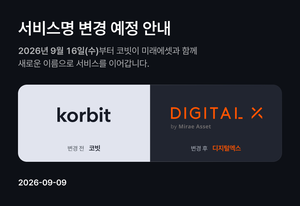
Korbit rebrands as DigitalX, matching new parent company name
Park Hyun-joo: 'X represents infinite possibility' Envisions DigitalX as a global investment platform App name, icon to change starting Wednesday Digital asset exchange Korbit will change its service name to DigitalX, aligning it with the name of its operating company. According to industry officials, Korbit announced that it will switch its service name from Korbit to DigitalX starting Wednesday. The app's name and icon will also be redesigned to match the new company name. The service name change had been expected since Korbit was folded into Mirae Asset Group. Earlier, on Aug. 11, Korbit completed the legal registration to change its corporate name from "Korbit Co., Ltd." to "DigitalX Co., Ltd." At the time, the company said it would separately change the exchange's service name at a later date. Park Hyun-joo, chairman and global strategy officer of Mirae Asset, said in a letter to employees in July that the name DigitalX carries deeper meaning. "X represents an unknown future and the infinite possibilities that arise when different values intersect and merge," he said. Park also recently told DigitalX employees and executives at an introductory meeting that he hoped "DigitalX will grow into a global investment platform," adding that the company needs to expand its product lineup to include stablecoins, real-world assets and STOs, and restructure its organization accordingly. The official website address will also change along with the service name. Visitors who use the existing web address will be automatically redirected to the new one, but users logging in for the first time after Wednesday will need to sign in again. Chart settings that users previously configured on the trading screen will also be reset. App market reviews and registration information with outside institutions will be updated gradually. As a result, the old name "Korbit" may continue to appear alongside the new name in outbound communications, such as notification messages and texts, for some time after the transition. Meanwhile, existing Korbit users' assets, transaction records and account information will remain unchanged, and deposit, withdrawal and trading methods will stay the same. Korbit also urged users to be cautious of phishing and impersonation attempts that could exploit the transition period. "Phishing sites or smishing messages impersonating either the existing service name (old domain) or the new service name (new domain) could appear," the company said, adding that users should verify the official address before proceeding.
Sept. 10, 2026
-
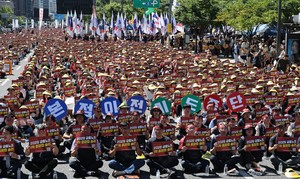
9 in 10 Industrial Bank of Korea workers oppose HQ relocation
Union surveys about 2,900 employees at Industrial Bank of Korea 86.2 percent say they do not wish to work at relocated headquarters As the government pushes ahead with plans to relocate public institutions outside the Seoul metropolitan area, a new survey shows that about 90 percent of employees at state-run Industrial Bank of Korea oppose moving the bank's headquarters to the provinces. According to the Industrial Bank of Korea chapter of the Korean Financial Industry Union, 89 percent of respondents said they opposed the government's plan to relocate the bank's headquarters. The survey polled 2,866 employees from Aug. 26 through Thursday. Among employees currently working at the headquarters, 95.5 percent opposed the relocation, as did 83.5 percent of branch employees. The most common reason cited for opposing the move, given by 59.4 percent of respondents, was having to live apart from family. Overall, 86 percent of respondents said they do not wish to work at the relocated headquarters. The union argued that relocating the headquarters would, in fact, seriously disrupt workforce operations and efforts to help employees settle in the new location. Of the respondents, 86.2 percent, or 2,471 people, said they would not want to work at the headquarters if it moved, while only 8.9 percent, or 254 people, said they would relocate together with their families if the headquarters moved to the provinces. Earlier, the labor union of the Financial Supervisory Service conducted a similar survey of 1,538 employees. Asked whether they would consider leaving the organization if its headquarters relocated, 85.6 percent said they would consider doing so. The government's policy is to strengthen the economic, cultural and international exchange functions of Seoul and the wider metropolitan area while minimizing the number of public institutions that remain there. The government plans to review the criteria used to determine which institutions stayed in the metropolitan area during the first phase of relocation. It will take into account each institution's functions and work linkages before finalizing the list of institutions to be relocated in the fourth quarter of this year. Relocations are expected to begin in phases starting in 2027.
Sept. 9, 2026
-
![Exchanges drop wallets, banks embrace L2 [Crypto360]](https://wimg.heraldcorp.com/news/cms/2026/09/09/news-p.v1.20260909.40136ad313f147e4afa730df1cecc95d_T1.jpg?type=h&h=240)
Exchanges drop wallets, banks embrace L2 [Crypto360]
DigitalX to end Korbit Web3 Wallet by year-end After Mirae Asset takeover, focus shifts to RWA, STOs L2 market still attractive, as Robinhood Chain shows Toss, DB Securities speed up L2-based wallet plans Financial firms combine blockchain tech with existing customers, products As digital asset exchange Korbit winds down its own layer 2 (L2) network and Web3 wallet business, financial firms are instead speeding up efforts to build digital asset infrastructure using L2 technology. Analysts say ecosystem competitiveness — the ability to draw users and revenue — increasingly determines each chain's performance and use cases in the L2 market. According to the digital asset industry Wednesday, DigitalX, the operator of Korbit, will end its Korbit Web3 Wallet service on Dec. 31. The service has run on Korbit's own Ethereum L2 network, Silicon. DigitalX said the decision was unrelated to its acquisition by Mirae Asset Consulting, and instead reflected a comprehensive review of the sluggish L2 market environment and the service's operating efficiency. A layer refers to a structural tier within a blockchain. Layer 1 is the base main chain — such as Ethereum — that verifies and finalizes transactions. Layer 2 is an expansion network that processes transactions separately on top of layer 1 to improve speed and cost efficiency. Korbit Web3 Wallet debuted in February last year as the first self-custodial wallet service launched by a Korean won-based cryptocurrency exchange. It was designed to let users manage their own private keys while accessing Web3 services such as decentralized applications (dApps) and non-fungible tokens (NFTs). Korbit had expanded its Web3 business on its own platform, Silicon, but decided to exit the wallet business roughly a year and a half after launch. As a result, Korbit is also winding down the Silicon network. Market observers say Korbit's withdrawal should not be read as a sign of a broader downturn across the L2 market. Some major L2 networks still generate strong revenue, and the earnings gap between chains has widened considerably. According to DeFiLlama, Robinhood Chain, an Ethereum L2, ranked second by chain revenue over the past 30 days with $28.76 million. Excluding Canton, whose figures are heavily boosted by large incentives, that makes Robinhood Chain the top earner among all chains. Over the same period, Base, an Ethereum L2 built on Optimism's OP Stack, posted $3.42 million. Other major L2s trailed further behind — Arbitrum posted about $398,000 and Starknet about $201,000. Silicon was not included in DeFiLlama's chain revenue rankings. Industry observers view Korbit's move less as a reflection of a worsening outlook for the L2 business overall and more as part of a broader reshuffling of priorities. After joining Mirae Asset Group, the exchange appears to have put its Web3 wallet and Silicon network on the list for cleanup. It realigned its focus toward real-world asset (RWA) tokenization, security token offerings (STOs) and other priority projects. "In Korbit's case, it seems Silicon never built up enough of an ecosystem — dApps that users could actually use, or assets worth investing in," an industry expert said. "To draw users to an L2, there need to be products they can use or trade within it; liquidity follows from that." Trading and revenue are indeed concentrating on L2 networks that have secured products and services capable of attracting users. Robinhood Chain built its core service around tokenized stocks, and usage has grown rapidly since it recently introduced trading products linking meme coins with tokenized stocks. According to Dune Analytics, Robinhood Chain's on-chain RWA trading volume reached $829.8 million on Friday. Of that, trading pairs combining meme coins and tokenized stocks accounted for $436 million — more than half of the total. In the financial sector, however, moves are underway to use L2 networks as the underlying technology for digital asset wallet projects. Toss signed a memorandum of understanding (MOU) with Optimism and Sunnyside Labs in July to explore the use of a won-pegged stablecoin, and the companies are now conducting a proof-of-concept (PoC) test. Toss said it chose Optimism because it allows fast, low-cost transactions backed by Ethereum's security. The OP Stack also lets it build a dedicated chain tailored to the needs of financial institutions. The securities industry has also begun exploring L2 use cases. DB Securities signed an MOU with Optimism in July to develop STO and RWA business models for Jeju. Rather than building their own blockchain from scratch, financial firms are increasingly looking to build on already-proven L2 technology to construct the infrastructure they need for financial services. Experts point to L2 networks' ability to let financial firms tap into the security and reliability of public blockchains as a key strength. At the same time, firms retain a degree of control over regulatory compliance and operations. Some also note that financial firms have greater room to apply the technology, given they can combine it with the customer base and financial products they already have. "Financial institutions find it difficult to use public blockchains as they are because of regulatory requirements, but they still want the reliability and safety of a mainnet," said Park Hye-jin, head professor of Sogang University's AI and Digital Asset Executive Program. "An L2 that offers this while allowing a degree of autonomy could be an alternative." The cost and infrastructure burden of building a proprietary chain is another factor cited. Firms would otherwise have to build everything themselves, from bridges connecting to other chains to DeFi and other underlying infrastructure. Using development tools already offered by the Ethereum ecosystem, the OP Stack, Arbitrum and others is a more rational choice. "It is not easy for financial firms to build their own independent chain from the outset," Park said. "In the early stages, they may gain experience by using existing L2 technology, and later move toward building their own infrastructure as needed." She also predicted that "the industry is likely to move toward a multichain future going forward," adding, "Ultimately, where to start and which chain to use as a reference point will become an important question."
Sept. 9, 2026
-

Korea's digital asset law risks slipping to year-end if September window is missed
Ruling party's late-September hearing looms as make-or-break moment Political burden mounts ahead of national audit Corporate investment guidelines are ready, but timeline stays murky Industry frets over mounting insurance, security certification costs The government's push to introduce its Digital Asset Basic Act is approaching its first major test at the end of this month. Unless the bill is formally submitted around the ruling party's public hearing, officials will have to wait through the National Assembly's national audit and subsequent budget review. Only after that could they find another window during the regular Assembly session. If that window closes too, industry watchers worry the domestic digital asset sector's effectively frozen state could drag on even longer. With the basic framework for market order still unsettled, a string of key policy items remain stalled. These range from allowing corporate investment in virtual assets and letting a single exchange partner with multiple banks, to enabling major operators to pursue alliances and mergers. Miss this month, and the bill slips to year-end: According to the National Assembly on Wednesday, the Financial Services Commission is pushing to submit its government-drafted Digital Asset Basic Act within the month. The bill would take the form of legislation sponsored by National Assembly Political Affairs Committee Chair Yoo Dong-soo, following coordination with the ruling party. Early this month had been widely floated as the likely timing for submission. That timeline appears to have slowed amid policy coordination among the government, ruling party and presidential office. Unlike a formal government bill, this lawmaker-sponsored route skips review by the Ministry of Government and deliberation by the Cabinet. But because the act would newly regulate the entire industry, officials still need to hold preliminary consultations. The ruling party has already announced plans to hold a public hearing at the end of this month. If the government version emerges, observers expect it to surface just before that hearing. The concern is that if the bill misses this month's window, its submission could effectively be pushed all the way to year-end. Officials view releasing the bill just ahead of October's national audit as politically risky, since it would likely only stir up regulatory controversy. The ruling party plans to hold the public hearing regardless of whether the government version is ready. But without it, the hearing could simply repeat existing discussions, raising doubts about whether it will even go ahead as planned. As a result, expectations are shifting toward the first half of next year for the bill's final passage, later than the early-next-year timeline initially projected. Multiple lawmaker-sponsored bills governing digital assets and stablecoins are already pending in the Assembly. Even after the government version is submitted, consolidating the bills for review could take additional time. "We had expected the law could be enacted early next year if the government version was submitted this month," an industry official said. "But given the regular Assembly session's schedule of the national audit followed by budget review, it now looks like we need to leave the timeline open through the first half of next year." Corporate investment stuck in caution mode, unlikely this year: Allowing corporations to invest in virtual assets also appears unlikely to happen within this year. The Financial Services Commission unveiled a roadmap for corporate participation in the virtual asset market in February 2025, promising a phased opening of the market. So far, though, only trading by nonprofit corporations and exchanges themselves has been permitted. Guidelines for allowing trading by listed companies and professional investment corporations — the segment drawing the most market attention — appear to have already been finalized in practice. They are said to cover investment limits, eligible assets, custody methods, and internal control and anti-money-laundering standards, though they have yet to be made public. "With a string of incidents at major exchanges recently, it seems the government, ruling party and presidential office have all turned more cautious about opening up the corporate market," an industry official said. Introducing a "one exchange, multiple banks" system also appears to be getting pushed back as a task for after the basic act. Currently, each exchange partners with only a single bank for its real-name verified deposit and withdrawal accounts. That is not a legal requirement, but it has effectively hardened into a kind of shadow regulation, justified on anti-money-laundering and customer-verification grounds. The industry has called for exchanges to be allowed to partner with multiple banks, including commercial banks with strong corporate finance capabilities, once the corporate market opens. If corporate clients start entering the market in earnest, mismatches between a company's primary bank and the exchange's real-name-account partner bank could make fund transfers and trading less convenient. Financial regulators, however, remain cautious about allowing multiple banks. According to a review report from the National Assembly's Political Affairs Committee, the Financial Services Commission recently submitted an opinion on the matter. It said the effects on exchange market structure and anti-money-laundering systems have not been sufficiently verified. It added that exchanges' independent anti-money-laundering capabilities should first be examined after the second-phase law is enacted and takes effect. The more the basic act's timeline slips, the further the introduction of a multi-bank system gets delayed as well. The crypto industry's "investment boomerang": With the timeline for enacting the Digital Asset Basic Act and allowing corporate investment slipping, virtual asset service providers, or VASPs, are also facing a tough situation. Custody-focused firms in particular had already taken out insurance, obtained security certifications and invested in infrastructure in anticipation of the corporate market opening. But as the timing of that opening grows murkier, there are concerns financial firms may increasingly hold off on further investment. Obtaining certifications such as the Information Security Management System and Service Organization Control, along with institutional liability insurance, requires substantial spending. So the longer corporate clients are delayed, the heavier the burden grows for VASPs that specialize in custody services. "Only once the corporate market opens can the concept of 'value-added services' even emerge, which is the precondition for our business," an industry official said. "Investors have been waiting on the assumption that the outlines of the basic act would emerge within this year, but if it is delayed further, that becomes a real problem." Adding to the burden, existing VASPs must all prepare renewal filings at once. This comes ahead of stricter enforcement of the Act on Reporting and Using Specified Financial Transaction Information, set to take effect in December. As they respond to reviews of personnel and physical requirements, capital and major shareholders, the delay in enacting the basic act adds another complication. It is raising the possibility that new VASPs' market entry will be pushed back further. Some in the market suggest that if regulators prioritize renewal reviews for existing operators first, processing of new business registrations could be delayed even more.
Sept. 9, 2026
-

Regulator, financial industry launch standing body to root out online 'dark patterns'
Misleading, obstructive tactics make up 87.5%; banks lead with 198 cases Regulator, 8 industry associations launch standing consultative body An "agree" button rendered large and in an eye-catching color, while "do not agree" is tucked away where it is hard to see. A pop-up that reappears to demand consent again even after a customer has already declined to share optional information. A screen for signing up for a separate service, such as a simple payment option, inserted into an almost-completed credit card application so that it looks like a mandatory step. These are all textbook examples of so-called "dark patterns" — subtle design tricks that steer consumers' choices during the online sign-up process for financial products. A self-check the Financial Supervisory Service conducted across the financial industry turned up more than 700 such cases. In response, the regulator is now working with the financial industry on an ongoing basis to correct online sales practices that mislead consumers. The Financial Supervisory Service held a kickoff meeting on Wednesday for a "standing consultative body for dark pattern prevention," bringing together consumer protection executives from eight financial associations and federations. The participating groups were the Korea Federation of Banks, the Korea Financial Investment Association, the Korea Life Insurance Association, the General Insurance Association of Korea, the Credit Finance Association, the Korea Federation of Savings Banks, the National Credit Union Federation of Korea and the Korea Fintech Industry Association. The meeting shared the results of financial firms' self-checks conducted under the "Guidelines on Dark Patterns in Online Financial Product Sales," which took effect in April, and discussed major cases and directions for improvement. The review found a total of 775 dark pattern cases at 268 financial firms. Banks accounted for the most, with 198 cases, followed by securities firms with 159 and card companies with 118. Savings banks logged 91 cases, life insurers 81, general insurers 63 and capital firms 49. By type, "misleading" designs — screens or wording crafted to steer consumers toward a particular choice — were the most common, with 455 cases. "Obstructive" designs, which make canceling or withdrawing difficult or hide important information from view, accounted for 223 cases. Together, the two types made up 87.5% of all cases found. "Pressuring" designs that apply psychological pressure numbered 87, while "deceptive inducement" designs that prompt unexpected costs numbered 10. For the cases uncovered in the self-check, the Financial Supervisory Service directed firms to redesign screens so they do not steer consumers toward a particular choice. It also directed firms to eliminate procedures that ask consumers to make the same choice again after they have already indicated their preference. Advertisements for add-on products or services that appear during the sign-up process must now be removed or pushed until after sign-up is complete. The process also revealed confusion within the industry over how to apply the guidelines. Financial firms and industry groups raised questions over whether selection buttons must all be the same color, or whether using different colors is acceptable as long as no single button stands out. Through the standing consultative body, the Financial Supervisory Service plans to prepare case-based questions and answers to narrow such gaps in interpretation. It will also discuss self-regulatory measures, including internal control best-practice standards, to help financial firms prevent dark patterns on their own and fix them as soon as they are found. The regulator said it will keep tracking whether the 775 cases identified in the self-check are corrected. "Dark patterns that exploit financial consumers' psychology to induce irrational decisions are not a legitimate marketing tool for financial firms," said Kim Wook-bae, deputy governor for consumer protection at the Financial Supervisory Service. "The entire financial industry needs to shift its mindset and move quickly to correct and root out these practices." "Building and operating an internal control system through which financial firms prevent and correct these practices on their own is key to eliminating dark patterns," Kim added, asking that the standing body be used actively as a channel for the industry to voice its opinions and discuss related measures. Meanwhile, the Financial Supervisory Service has recently been pushing to strengthen consumer protection in the sale of high-risk financial products as well. It plans to bring in outside experts and manufacturers at the review stage for complex financial investment products and overseas alternative investment funds, and to shorten the disclosure cycle for high-risk products to at least once a month.
Sept. 9, 2026
-
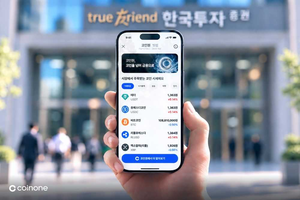
Coinone brings virtual asset prices to Korea Investment & Securities app
Real-time rankings, price changes on offer Second tie-up follows July's stock info link Coinone said Wednesday it has launched a "virtual asset prices" service that delivers a range of virtual asset information through the Korea Investment & Securities app. The service is accessible through the "virtual asset prices" tab within the Korea Investment & Securities app. Tapping the tab leads to a separate page provided by Coinone, where users can check real-time prices and price changes for virtual assets traded on the exchange. The service screen also offers real-time rankings by key categories, including trading value, market capitalization, top gainers, top losers and popular coins. Clicking on an individual asset brings up price-change charts by period, detailed price information, and materials such as white papers, official websites, key information summaries and user guides. To mark the service's launch, Coinone is running a "find your investment type" event for new subscribers from 10 a.m. that day through Sept. 30. Users who complete a short survey-based investment-type test on the "virtual asset prices" page receive an event code. Entering the code when signing up as a new Coinone user earns 30,000 won ($22) worth of virtual assets, according to the company. In July, Coinone added a tab on the main screen of its app linking to Korea Investment & Securities' web trading system. Through that tab, users can check investment-related information such as domestic shares with high real-time search volume. "Following the July launch of the 'stock investment shortcut' service within the Coinone app, this is the second collaborative service we are introducing with our shareholder, Korea Investment & Securities," said Coinone CEO Cha Myung-hoon. "We will continue to make it easier for users to move between the two companies' services, boosting synergy by increasing customer flow between us."
Sept. 9, 2026
-
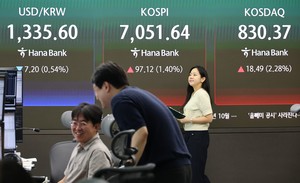
Chip export boom drives won higher, squeezing exporters as oil nears $100
Won strengthens as exporters offload dollar earnings amid strong exports Converting $1 million now yields 160 million won less than when the rate was 1,500 won Chipmakers cushion the blow with price, volume gains; automakers, petrochemical firms sound alarm Strong semiconductor exports are driving down the won-dollar exchange rate, deepening the dilemma facing South Korean exporters. The more dollars exporters bring in and sell on the market, the stronger the won becomes — a paradox that then erodes their own won-converted sales and operating profit. Adding to the strain, Middle East tensions have pushed international oil prices to near $100 a barrel. This has left companies facing a double blow: shrinking profitability from the stronger won and rising raw material costs. In Seoul's foreign exchange market Wednesday, the won-dollar exchange rate stood at 1,336.1 won as of 3:30 p.m., down 9.5 won from the previous session. Despite Middle East instability and the spike in oil prices, what pulled down the exchange rate was the wave of dollar-selling, or "nego" settlements, by exporters including chipmakers. Analysts say the dollars exporters sold outweighed dollar demand from importers settling mid-month payments and from investors buying dollars for overseas stock purchases. Robust semiconductor exports are, ironically, adding downward pressure on the exchange rate. As Samsung Electronics, SK hynix and other chipmakers convert their export dollar earnings into won, the supply of dollars in the market keeps growing. Nego settlements that used to be concentrated at month's end are now flowing into the market more frequently. The problem is that this expanding dollar supply boomerangs back on exporters themselves. When the won-dollar rate falls, the same export amount converts into less money in won. For example, converting $1 million in export proceeds would yield 1.5 billion won at an exchange rate of 1,500 won per dollar. At the current rate of 1,336.1 won, the same amount would yield only 1.34 billion won. The shift in the exchange rate alone wipes out 163.9 million won. The faster the exchange rate falls, the greater the shock. If the exchange rate is lower when a company actually collects its export payment than it expected when signing the contract, the company can suffer a foreign exchange loss. Amid fierce global competition, raising dollar-denominated sales prices is not easy, so many companies end up absorbing the full impact of the won's appreciation. Small and medium-sized exporters, which typically lack the capacity to hedge currency risk, bear a relatively heavier burden. Large companies can reduce exchange rate risk using forward contracts or currency options, but smaller firms struggle to respond actively due to cost and a shortage of specialized staff. Companies that source raw materials domestically and rely heavily on exports are especially exposed to the negative effects of a stronger won. The impact is likely to vary by industry. In the semiconductor sector, where global demand continues to outstrip supply, companies can partly offset the decline in won-converted earnings from the weaker exchange rate. They can do so through higher sales volumes and prices. By contrast, industries facing intense global supply competition — such as automobiles, petrochemicals, steel and machinery — have less room to raise product prices, so their profitability could suffer more. However, a stronger won is not necessarily bad news for every exporter. Companies that rely heavily on imported raw materials can partly absorb the shock of the falling exchange rate through lower dollar-denominated costs. Ultimately, profits and losses will likely diverge by company, depending on export exposure, raw material sourcing structure, settlement currency and whether a firm hedges its currency risk. The surge in international oil prices is also limiting the positive effects of the falling exchange rate. As of 4:20 p.m. Wednesday, Korean Standard Time, Brent crude futures for November delivery were trading at $100.02 a barrel on London's ICE Futures exchange, up 2.1 percent, or $2.10, from the previous session. This is the first time Brent crude futures have topped $100 a barrel since July 24. The renewed fighting between the United States and Iran has raised concerns over disruptions to oil shipments through the Strait of Hormuz. Tensions involving Houthi rebels along the Red Sea shipping route have also escalated. A stronger won can partly offset the rise in crude oil import prices, but if the oil price rally persists, companies will find it hard to avoid heavier raw material and logistics costs. There are concerns that in energy-intensive industries such as petrochemicals, aviation and shipping, the burden from rising oil prices could outweigh the cost savings from the stronger won. The dollar itself also weakened. The dollar index, which tracks the greenback's value against six major currencies, stood at 98.669 as of 3:30 p.m., down 0.185 from Tuesday. The yen-dollar rate fell 0.46 percent to 153.206 yen, while the won's cross rate against the yen dropped 3.07 won to 872.26 won per 100 yen. Foreign investors net sold 224.5 billion won worth of shares on the Kospi that day, but this failed to reverse the exchange rate's downward trend. Market watchers believe the won-dollar rate could fall further if strong semiconductor exports and continued dollar-selling by exporters persist. However, the spread of the Middle East conflict and the spike in oil prices could boost demand for the dollar as a safe-haven asset. This could limit further declines in the exchange rate.
Sept. 9, 2026
MOST READ
- 1KAIST develops high-performance bio-based adhesive using E. coli instead of petroleum
- 2Daimler Truck unveils next-generation transport solutions at IAA 2026
- 3Samsung Biologics union's show of force backfires at the bargaining table
- 4Trump pushes back on AI slowdown calls, vows to 'keep it that way'
- 5APR says hair-loss treatment research published in international journal
- 6Beyond 125 years of alliance, South Korea and Belgium forge ties in biotech and advanced industry
-
WORLD
US warns of punishment for anyone enabling Iran's Strait of Hormuz toll scheme
-
INDUSTRY
Toyota union puts productivity first; Hyundai Motor union demands bigger share of profits
-
FINANCE
National Growth Fund to invest $531M in FuriosaAI, which rebuffed Meta's $800M takeover bid
-
INDUSTRY

Korea Shipowners' Association holds amateur baduk tournament for Maritime Day