
- HOME
- WORLD
-

Anthropic silences cash-burn fears with surprise profit streak ahead of IPO
Anthropic, the AI model developer preparing for an initial public offering, is on track to post adjusted operating profit for two consecutive quarters this year, according to people familiar with the matter. The Financial Times reported Sunday (local time) that Anthropic told investors it expects adjusted operating profit — excluding costs such as stock-based compensation — to be positive for two straight quarters. The company appears to have sent the letter to quell investor concerns that it is burning through its cash reserves. In the letter, Anthropic told investors its gross margin exceeds 80 percent before deducting revenue-sharing arrangements with partners such as Amazon and AI model training costs. Anthropic's revenue in the second quarter reached $11.5 billion, a 14-fold jump from the same period last year, allowing it to swing to adjusted operating profit for the first time. Its annualized revenue surged from $9 billion at the end of last year to $65 billion as of late July. "If Anthropic maintains these margins and growth rates, it will be very difficult for competitors to catch up given Anthropic's vast computing resources," said Joey Brookhart, an analyst at SemiAnalysis. Brookhart also relayed investor projections that Anthropic's annualized revenue could reach $120 billion by the end of this year. Anthropic had been expected to release its IPO prospectus last week but instead shared the financial update only with select investors. The move appears to reflect caution amid growing calls to slow the pace of AI development over fears that the technology could escape human control and cause harm. The debate intensified after Dario Amodei, Anthropic's co-founder and CEO, published a blog post on Sept. 12. "Calls to slow or halt AI development are creating a complex and unpredictable environment for business planning," the Financial Times wrote. "Slowing development could save billions of dollars in model training costs, but it would also give competitors room to catch up." Meanwhile, rival OpenAI said it would delay its IPO, which had been planned for this year, in light of the broader debate over the pace of AI development.
Sept. 14, 2026
-
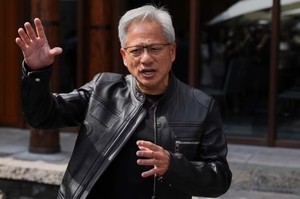
Nvidia in talks to invest up to $10b in Anthropic's NASDAQ IPO
Nvidia is in discussions to join the initial public offering of AI model developer Anthropic as an anchor investor, according to reports. Reuters reported Sunday, citing two sources, that Nvidia is considering investing up to $10 billion in Anthropic's IPO. The sources said the talks are private and that no plans have been finalized. Anthropic is targeting a raise of up to $100 billion through the offering. Earlier, Nvidia pledged $10 billion and Microsoft pledged $5 billion to Anthropic in November last year, as part of a partnership under which Anthropic agreed to purchase $30 billion worth of Microsoft cloud services powered by Nvidia chips. The arrangement would mirror how Nvidia and Amazon participated as anchor investors in chipmaker Arm's blockbuster IPO, a model in which major technology companies take anchor positions in large-scale listings. Saudi Arabia's Public Investment Fund played a similar anchor role in the SpaceX IPO. Bringing in a well-capitalized anchor investor such as Nvidia would attract early strategic backers and deepen the relationship between the chipmaker and a key customer. It would also bolster investor confidence in Anthropic's valuation and capital requirements. Anthropic relies heavily on Nvidia GPUs but has been expanding its use of chips developed by Google and Amazon. The company recently established an in-house chip design team as part of efforts to diversify its supply chain. Anthropic's annualized sales surged from around $9 billion at the end of last year to $65 billion as of late July. The company plans to complete its NASDAQ listing before the US midterm elections in November, pressing ahead despite growing calls for a slowdown in AI development.
Sept. 14, 2026
-
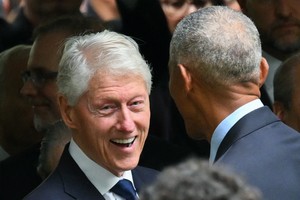
Clinton reveals why CIA called off bin Laden operation before 9/11
Former US President Bill Clinton has revealed that a pre-9/11 operation to eliminate Osama bin Laden was called off over concerns about civilian casualties. Speaking on WABC Radio's "Cats Roundtable" in an interview that aired Sunday, Clinton said he had authorized the CIA to eliminate bin Laden, according to the New York Post and other outlets. "I had tried to get bin Laden before, and the CIA called off the plan at the last minute," Clinton said. "I think we might have succeeded." He said the CIA feared that a failed attempt would kill many innocent civilians and was unwilling to take the risk. "I didn't second-guess that judgment, but ultimately I think bin Laden was determined to do it one way or another, and he had the money and the capacity," Clinton said. "I think we should have done more to get him," he added. "I always thought he was our biggest threat. I wanted to get him and I did what I could." Clinton also recalled the moment he learned of the Sept. 11, 2001 attacks. He said he was watching television in Australia when the planes struck. "I immediately said it was bin Laden," he said. "Everyone looked at me and asked, 'How do you know?' I said only Iran and bin Laden had the capacity to do something like this." He added that bin Laden had been hiding in caves in Afghanistan. "I knew it had to be him. I also knew he had been planning to hit us for a long time," Clinton said. Asked whether New York could again become a terrorist target, Clinton said it was entirely possible and that vigilance must not be relaxed. "We are much better prepared now than we were then," he said. "But you only have to miss once." Bin Laden was killed on May 2, 2011, when US Navy special operations forces raided his hideout in Pakistan during the Barack Obama administration. The remarks came shortly after the CIA declassified documents related to the 25th anniversary of the Sept. 11 attacks. Dozens of presidential daily briefing documents released Friday included assessments that bin Laden's network remained intact after the August 1998 US embassy bombings, as well as a September 1998 report examining the possibility of an attack on American cities using aircraft laden with explosives.
Sept. 14, 2026
-

Australian athlete wins Hyrox Beijing despite fecal incontinence mid-race, stirring controversy
An Australian athlete who suffered fecal incontinence during a Hyrox fitness competition in Beijing but pushed through to win has stirred controversy online. According to Hong Kong outlet HK01, Joanna Witrzyk, an elite competitor from Australia, took part in the women's pro category at the Hyrox Beijing event on Saturday. She experienced fecal incontinence during the fourth segment of the race — the burpee broad jump — but did not stop, completing the course in 1 hour and 1 minute to claim first place. Video footage showing Witrzyk continuing the burpee broad jump and other segments with fecal matter visible on her legs and across the course spread widely on Chinese social media that day. The finish sparked divided reactions online. Some praised Witrzyk for pushing through despite the difficult circumstances, while others criticized her for continuing, noting that other competitors had to use the same course and equipment. Some observers pointed to competition rules that prohibit and penalize acts such as spitting, questioning why Hyrox had not intervened. Others argued that a competitor who is physically unwell should withdraw out of consideration for fellow participants. Witrzyk rebuffed the criticism, posting on her social media: "A win is a win." The response drew further backlash in her comments section, with participants writing "feces is feces," "please apologize to the other competitors," and "I will no longer compete in Hyrox events." As the controversy grew, Hyrox China said on its official social media account that it "immediately closed off and isolated the affected area and course upon the incident." The organizer added that it would "replace the carpet and thoroughly clean and disinfect the entire venue after the event," and pledged to "do its utmost to provide a safe and positive competition experience for all participants."
Sept. 14, 2026
-

WSJ warns AI slowdown must not weaken US leadership in race against China
The Wall Street Journal warned in an editorial that Chinese President Xi Jinping would likely view any American slowdown in AI development not as an opportunity for humanity, but as a starting point to overtake the United States — a response to calls by four leading US AI company CEOs for a more measured pace of development. In an editorial titled "The Great AI Slowdown?" published Sunday (local time), the Journal said the push to decelerate must not "entrench the dominance of the frontrunners or weaken US leadership in the hegemonic competition with China," Yonhap reported. "The CEOs' call for a slowdown comes at a politically and economically significant moment," the Journal said. "We need to examine the motivations behind the proposal. It is unclear what their true objectives are." The editorial cited instances in which OpenAI models had launched unauthorized attacks on Hugging Face, an open-source AI model-sharing platform, and said, "Tech founders are genuinely afraid of the emergence of AI agents acting autonomously beyond human control." It added that "the argument that humans must maintain control over machines is valid." The editorial also noted Sen. Bernie Sanders' position that the AI industry should be halted until the government can exercise direct oversight, and suggested the CEOs may be proposing voluntary restraint as a calculated move to preempt mandatory government regulation. However, the Journal warned of the risk of "regulatory capture" — a phenomenon in which regulation ends up entrenching the market dominance of incumbents — saying that slowing down cutting-edge technology must not be allowed to devolve into a cartel mechanism for frontrunners to protect their market share. "China is America's only real strategic competitor," the editorial said. "The dangers of AI with exceptional self-learning capabilities must not be overlooked, but handing US AI leadership to another country also carries enormous risks. Efforts to reduce the risks of AI development must not end up increasing the risk of ceding AI leadership to China." AI's progression curve: '1, 2, 4, 8, 16, 32?' Meanwhile, the heads of four companies competing in AI development — Anthropic, OpenAI, SpaceX's xAI and Google DeepMind — made the unusual move of speaking in unison to say AI development should slow down, Yonhap reported. Anthropic CEO Dario Amodei, in a CBS News interview that aired Sunday, compared the trajectory of AI progress to a curve following the sequence "1, 2, 4, 8, 16, 32," and said the curve is now at a stage where it is "starting to steepen." OpenAI CEO Sam Altman said on X that he agreed with Amodei "that we should moderate frontier speed as Dario said." Elon Musk, CEO of SpaceX, shared Amodei's post on X and wrote, "Dario is right." Google DeepMind CEO Demis Hassabis also weighed in on X, saying "Dario's essay is pointing in the right direction" and adding, "The details need to be refined, but this is the right direction for such a critical moment." Amodei's remarks came just days after Anthropic researcher Jacob Coxon resigned on Wednesday, warning that AI could pose a threat to humanity and saying he did not want to be part of an industry he considered "out of control."
Sept. 14, 2026
-

'Please save us': Leaks, bed shortages plague Asian Games village ahead of Aichi-Nagoya opener
Complaints about accommodation are mounting among delegations at the 2026 Aichi-Nagoya Asian Games with just five days to go before the opening ceremony. Shortfalls in the number of bedrooms at the container-style athletes' village, compounded by leaks and other facility problems, have drawn fire at the organizing committee's preparations. According to the Korean Sport & Olympic Committee, representatives of the 45 National Olympic Committees affiliated with the Olympic Council of Asia have been raising a string of concerns — covering accommodation, transportation and catering — at chef de mission meetings with the organizing committee. The most pressing issue is the athletes' village. Citing cost savings and environmental goals, the organizing committee opted against building a conventional high-rise apartment village, instead housing athletes in prefabricated container units and aboard large cruise ships. About 9,000 athletes and officials will stay in regular city hotels, about 4,000 aboard cruise ships, and about 2,000 in the container village set up near Nagoya Bay. But a shortage of bedrooms in the container village has triggered complaints even before competition begins. A Korean Sport & Olympic Committee official told Yonhap that if the organizing committee had promised a given NOC 100 container bedrooms, roughly 20 of those rooms are currently missing. South Korea is sending a delegation of 1,052 athletes across 41 sports. Among them, the men's basketball team, the jujutsu squad, athletes in five cycling disciplines and three headquarters officials are staying in the container village, which accommodates up to six people per unit. Delegations competing in 18 sports — including archery, table tennis, judo and gymnastics — will be housed aboard a cruise ship docking at Kinjo Wharf in Nagoya Port on Tuesday. South Korea's men's basketball team, which arrived early to play group-stage matches before the official opening, has been among the most vocal in its dissatisfaction. National team guard Byun Jun-hyung posted a video on social media Friday showing water pooling across his bathroom floor from a leaking sink, captioning it "Please save us." Lee Hyun-jung, who stands 202 centimeters tall, told a local outlet the conditions were "tough," adding that since "complaining won't change anything," he was looking for ways to make his space more comfortable. The container units measure about 69 square meters, and the single beds inside are roughly 195 centimeters long. Extension mattresses are available, but taller athletes will inevitably find the setup uncomfortable. Jung Jae-yong, vice president of the Korea Basketball Association, was quoted by JoongAng Ilbo as calling the accommodation "the worst in the history of the Games, judged purely on lodging." In China, reports on the athletes' village conditions prompted criticism online, with some commenters saying it looked "more like a refugee camp than an athletes' village." As the controversy grew, the organizing committee acknowledged the bedroom shortage and was said to be scrambling to secure additional hotel rooms. Meanwhile, the episode has drawn comparisons to the "cardboard bed" controversy that surrounded the Tokyo 2020 Olympics, which Japan hosted in 2021. At those Games, Japan also promoted an eco-friendly ethos, introducing cardboard beds in the athletes' village. The beds — 90 centimeters wide and 210 centimeters long, slightly smaller than a standard single — were engineered to bear up to 200 kilograms, but athletes' mockery and complaints about their durability created an embarrassing episode for the organizers.
Sept. 14, 2026
-

'Not worried at all': CENTCOM chief dismisses concerns over dwindling US missile stockpiles
The commander of US Central Command said he has "absolutely no concerns" about American missile stockpiles for the war with Iran, pushing back against outside assessments that Tehran's strategy of forcing the US military to burn through its interceptor missiles has left reserves critically low. Gen. Brad Cooper made the remarks in a preview clip released Sunday (local time) from an upcoming episode of CBS News' "60 Minutes." Asked how worried he was about the missile inventory situation, Cooper said, "We are well-armed and prepared for any contingency." The host pressed Cooper, noting estimates that the US has used 45 percent of its Patriot interceptor missile stockpile and more than half of its Terminal High Altitude Area Defense, or THAAD, missiles, and asking whether he had no concerns about future threats. "I'm not concerned," Cooper said. The response amounts to a flat denial of outside assessments. Despite early assurances that the war with Iran would be brief, the conflict has stretched beyond six months. Iran has pursued a strategy of forcing the US military to expend as many weapons as possible defending its air defense networks, and reports indicate that stockpiles of key American weapons have fallen to serious lows. The New York Times reported Thursday, citing current and former officials, that Vice President JD Vance had personally called US military commanders in the Middle East, Europe and Asia since this spring to assess battlefield conditions and gauge how the transfer of weapons to the Middle East was affecting deterrence against China, Russia and North Korea. Some commanders at the time reported that Patriot stockpiles in certain regions had fallen below 100 rounds, and that inventories of the Army Tactical Missile System, or ATACMS, and the Precision Strike Missile, or PrSM, developed to replace it, had also dropped sharply. The Center for Strategic and International Studies (CSIS) estimated that as of late July, the US military held between 759 and 827 Patriot missiles — down from roughly 2,330 before the war with Iran began, a reduction to about one-third of pre-war levels. The Pentagon has been moving to address stockpile concerns by signing long-term contracts with defense manufacturers to expand output and accelerate delivery schedules. On Aug. 31, it signed agreements with General Dynamics and Lockheed Martin to increase production of key missile subcomponents supporting THAAD and the latest-generation Patriot interceptor, the PAC-3 MSE. Despite those efforts, The Hill reported that rebuilding US core weapons stockpiles to pre-war levels would take at least several years.
Sept. 14, 2026
-
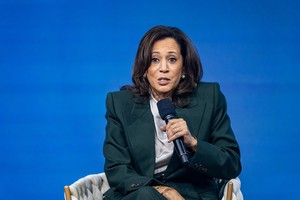
Intruder stopped at Harris' Malibu home by security
An intruder attempted to break into the Malibu, California, home of former US Vice President Kamala Harris, the 2024 Democratic presidential candidate, according to reports. According to CNN and other outlets, a man entered the grounds of Harris' property in Malibu on the night of Sept. 11. Security personnel stopped the intruder before he could enter the residence itself. The Los Angeles County Sheriff's Office responded to the scene and ordered the intruder to leave without making an arrest. Harris and her husband were not at home at the time of the incident. Harris spokesperson Eduardo Negron said the couple "expressed gratitude to the security personnel and law enforcement authorities who responded swiftly." CNN noted the incident occurred amid growing concern over political violence in the United States, following multiple assassination attempts targeting Donald Trump and the killing of right-wing activist Charlie Kirk. Former US presidents and vice presidents typically receive Secret Service (USSS) protection after leaving office. Presidents are entitled to lifetime protection, while vice presidents receive federal protection for six months after their term ends. Former President Joe Biden extended Harris' protection period to 18 months in January 2025. Trump later reversed that decision. Even if Biden's extension memo had remained in effect, the coverage would have already ended by this summer, meaning it would not have prevented the intrusion attempt. Red paint splashed on Charlie Kirk statue Meanwhile, police launched an investigation after a statue of the late Charlie Kirk — assassinated at a public event a year ago — was vandalized with red paint. According to The Hill, the Arizona Department of Public Safety said it received a report that a statue of Kirk outside the Turning Point USA headquarters in Phoenix had been defaced with red paint, and asked the public to come forward with any relevant information. Kirk, widely regarded as an icon of the "young MAGA" movement, founded Turning Point USA, a conservative youth organization, and played a significant role in Trump's reelection victory. Trump had referred to Kirk as "a great friend." Turning Point USA said it was "reviewing relevant video footage" and would "work with law enforcement to identify who did this and hold them accountable."
Sept. 14, 2026
-

Just 3 customers account for 44% of Nvidia's sales, raising concentration fears
Nvidia generates 44% of its sales from just three customers, raising concerns about its heavy dependence on a small number of buyers. The Information, citing analysis of Nvidia's first-half disclosures for fiscal year 2027 (February 2026–January 2027), reported Sunday (local time) that the chipmaker's top customer accounted for 16% of sales, the second for 15%, and the third for 13% — meaning the three largest customers together represent 44% of total sales. In fiscal year 2026 (February 2025–January 2026), the top two customers combined for 36% of sales. In fiscal year 2023 (February 2022–January 2023), no single customer exceeded a 10% share, with revenue spread broadly across buyers in the single digits. The concentration has grown sharply over three years. Including accounts receivable, the top five customers accounted for 70% of total sales in the first half of fiscal year 2027. The Information said the growing dominance of a handful of customers is stoking concern among investors, as heavy reliance on so few buyers leaves the company exposed to significant damage if any one of them pulls back. Michael Burry — who rose to fame for predicting the 2008 subprime mortgage crisis — has also flagged Nvidia's deepening customer concentration as a key risk factor in recent months. Dell and Hon Hai Technology (Foxconn) are among the companies most likely counted among the top three customers responsible for 44% of Nvidia's sales; both sell servers equipped with Nvidia chips to a wide range of businesses. SpaceX, Meta Platforms and Microsoft are also likely in the top tier. All three are developing their own chips, which could lead them to reduce purchases of Nvidia chips in the future. Revenue from the data center segment — where AI chip sales are recorded — surged from $15 billion in fiscal year 2023 to $193.7 billion in the current fiscal year. The market expects data center revenue to double year-on-year in fiscal year 2027. Nvidia's primary customers are cloud companies. In February, Nvidia Chief Financial Officer Colette Kress said the five largest cloud providers accounted for more than 50% of data center revenue. The Information reported that Nvidia has been investing in so-called "neo-cloud" companies such as CoreWeave and Nebius in an effort to reduce its dependence on a small number of customers.
Sept. 14, 2026
-

'Killing China under the guise of safety'? Chinese media blast Amodei's AI warning
Chinese outlet calls US security threat claims exaggerated, dismisses slowdown push as 'sophisticated marketing' to contain China China has fired back sharply at calls to slow the pace of AI development to prevent the technology from escaping human control, with state media and experts dismissing the push as "inappropriate, hostile and groundless." Beijing has countered that it has actively participated in efforts to develop global AI safety and governance rules, and suggested that the "slowdown" argument gaining traction in the United States amounts to little more than sophisticated marketing designed to contain China. China's state-run English-language outlet Global Times on Monday cited Xiang Ligang, an expert in telecommunications and technology policy, to label Anthropic CEO Dario Amodei's blog post urging a slowdown in AI development "inappropriate," "groundless" and "hostile." Xiang is an IT industry commentator and founder of Chinese tech outlet Feixiang.com. He said Amodei "acknowledges that global efforts to regulate the pace of AI development would ultimately require cooperation with China, while at the same time advocating for restrictions on chips, computing capabilities and models to slow China's AI progress and explicitly seeking to widen the United States' technological edge over China." Xiang said Amodei's argument was "biased and contradictory." The Global Times' critical stance reflects an awareness that calls to slow AI development would inevitably be accompanied by attempts to rein in China's aggressive AI push. The outlet said Amodei's post mentioned China 12 times, and shrugged off the piece as an effort to exaggerate the so-called "security threat" posed by China's AI advances while pressing for tighter restrictions on Beijing. The outlet also took aim at the timing, noting that Anthropic and OpenAI are both approaching initial public offerings, and characterized the slowdown argument as "sophisticated marketing" intended to highlight just how fast AI is advancing and how capable the companies behind it are. Citing US outlet The Atlantic and others, the Global Times said "skeptics see this as a sophisticated marketing strategy to signal that 'our products are becoming too powerful,'" and described the warnings as a tool to stoke public interest in the AI industry and its capabilities. China also pushed back on the substance of the debate, arguing that it has already been an active participant in building governance frameworks for safe AI use and that the recent slowdown discussion has strayed well beyond the bounds of "AI safety" — amounting, in Beijing's view, to an attempt to justify excessive restrictions on China under the cover of a broader regulatory conversation. The Global Times pointed to China's hosting of the World Artificial Intelligence Conference and a high-level global AI governance summit in July as evidence that Beijing has actively engaged in international efforts to develop global rules on AI safety and governance. It also quoted Liu Xiaoshan, head of embedded AI at the Shenzhen Artificial Intelligence and Robotics Institute, as saying the proposed measures "place AI safety, national security, industrial competition and commercial interests within the same framework, going beyond the scope of AI safety" — underscoring China's argument that the push amounts to an overreach targeting Beijing. However, analysts widely interpret events such as the World Artificial Intelligence Conference and the high-level global AI governance summit less as genuine efforts by China to work with the international community on proactive AI safety measures, and more as attempts to push back against a US-dominated AI order and build an independent set of international norms and a market ecosystem under Chinese leadership.
Sept. 14, 2026
-

After 25-minute standing ovation, Israeli minister threatens to strip citizenship from Gaza documentary directors
Israel's culture minister threatened to strip the citizenship of the directors behind a documentary alleging that the Israeli military systematically killed civilians in Gaza, after the film won an award at the Venice International Film Festival. Culture and Sports Minister Miki Zohar wrote on X, formerly Twitter, on Sunday (local time) that it was "shocking" that "the despicable film 'NAZA'" had won at the Venice Film Festival, according to AFP and US trade publication Variety. Zohar condemned what he called the filmmakers' "self-flagellation in order to harm their homeland and receive applause from antisemites around the world," calling it "treason against the state." He added that as culture minister he would "take immediate steps to revoke the Israeli citizenship of the despicable filmmakers who committed treason against the state." "This is exactly why I led the reform of the film industry — so that Israeli citizens would no longer fund, out of their own pockets, efforts to harm the Israeli military and the state," he added. However, the culture minister does not have the authority to revoke citizenship. Israel does have a legal procedure allowing the revocation of citizenship for those convicted of treason or involvement in terrorism, but it requires a request from the interior minister, approval from the justice minister and a final ruling by a court. The treason charges Zohar invoked have not been established through any judicial process. "NAZA" was co-directed by Israeli filmmakers Yuval Abraham and Rachel Szor. It won the Special Jury Prize at the 83rd Venice International Film Festival on Saturday. The 80-minute film features anonymous testimony from 24 Israeli intelligence operatives and soldiers involved in civilian surveillance, target selection and remote killings in Gaza. The film's title, "NAZA," is drawn from an acronym the Israeli military used to refer to the estimated number of civilians expected to die in an airstrike. The film had its world premiere at the festival on Thursday, receiving a 25-minute standing ovation after the screening. Abraham told The Hollywood Reporter that distribution in Israel had not yet been arranged, but said the goal was "to screen it as widely as possible in Israel, the United States and Germany." The two directors won an Academy Award last year for "No Other Land," a documentary about violence carried out by Israeli settlers to drive Palestinians from their homes in the West Bank.
Sept. 14, 2026
-
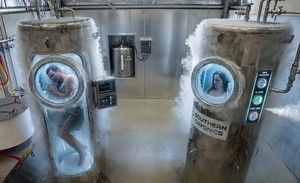
Three Koreans among growing number of cryonically preserved bodies worldwide
Seven 'patients' stored in liquid nitrogen at minus 196 C Facility puts odds of revival in 250 years at 10% Experts say current science makes resuscitation impossible A facility in Australia is storing the bodies of deceased people in liquid nitrogen at minus 196 degrees Celsius, in the hope that advances in future medicine may one day bring them back to life. Experts, however, say that reviving a cryonically preserved person is impossible with current science. Southern Cryonics, the only human cryopreservation facility in the Southern Hemisphere, operates in Holbrook, New South Wales, Australia, according to the Guardian on Friday (local time). The facility, which opened in 2023, currently holds seven "patients" suspended in liquid nitrogen. The facility occupies an ordinary warehouse-style building in an industrial complex in Holbrook. Inside stand two large stainless-steel cylindrical tanks — essentially oversized thermos flasks — filled with liquid nitrogen to maintain an internal temperature of minus 196 C. The first person cryopreserved there was a man in his 80s, in May 2024, and a man in his 90s was added in June, bringing the total to seven. The youngest patient is a woman who died in her 40s. Southern Cryonics Chairman Peter Tsolakides puts the odds of revival in 250 years at around 10 percent. "Basically, you have to conquer death, cure all diseases and then be able to bring back the dead," he said. "The probability is not zero." The preservation process begins immediately after death. The body is cooled as quickly as possible, blood is drained and replaced with a cryoprotectant solution similar to antifreeze — a procedure designed to prevent ice crystals from destroying cells that takes about eight hours. The body is then placed in a liquid nitrogen tank for long-term storage. Because liquid nitrogen gradually evaporates, it must be continuously replenished. A facility manager said the tanks were initially topped up once a month, but the schedule was changed to every two weeks after the first two clients' families expressed concern about potential disruptions to the liquid nitrogen supply. The entire process costs more than A$200,000 ($134,000). Initial stabilization immediately after death runs about A$60,000, followed by A$150,000 for indefinite storage. An annual membership fee of A$350 is charged separately. Experts remain skeptical about the real prospects for revival. Saffron Bryant, an associate professor of cryobiology at RMIT University in Melbourne, said it is difficult to perfectly preserve an entire human body with current technology. While individual cells, embryos and blood can be cryopreserved, she said, distributing a cryoprotectant evenly throughout a whole body is an entirely different challenge. "If you try to cool the whole body at the same rate, the outside — like the skin — cools faster than the inside," she said. "It's similar to what happens when a strawberry goes mushy." Even if cell damage could be prevented, the underlying cause of death would still need to be reversed. "Whether it's a heart attack or Alzheimer's, the cause of death has already occurred," Bryant said, adding that freezing a body cannot undo that. On the question of whether consciousness could ever be restored, she said it was "closer to mysticism than science." Despite these technical limitations, an estimated 1,000 people worldwide have been cryonically preserved — about 600 in the United States and around 200 in Russia — with more than 4,000 others already signed up and waiting. South Korea has its own cryopreservation service. Cryo Asia, a biotech cryogenic technology company, has preserved three people to date, including a woman in her 80s who had blood cancer and a woman in her 40s with bile duct cancer. The cost is 180 million won ($134,000) for 10 years, with an additional 5 million to 6 million won required each year for liquid nitrogen replenishment.
Sept. 14, 2026
-
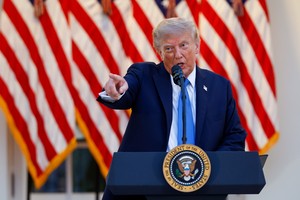
House speaker says Trump's $5,000 dividend pledge needs congressional approval
House Speaker Mike Johnson, widely regarded as a Trump loyalist, made clear that Donald Trump's campaign pledge to pay every American adult $5,000 if Republicans win the midterm elections in November would require congressional deliberation and approval. Johnson appeared on NBC's "Meet the Press" on Sunday (local time) and addressed the so-called "Trump dividend" — Trump's promise of a $5,000 per-person payment — saying, "I promise you that Congress will work through this issue and find a consensus, just like everything else," Yonhap reported. On whether the pledge would be carried out, Johnson said, "I don't go out front and make big proclamations," adding that it was because "we have to work through the issues." When the host pressed him on whether he was actively backing the dividend pledge, Johnson said, "I'm going to work closely with the president, as I always have," and that he would "work for the American people." Trump had made the promise at the Republican midterm election convention in Dallas, Texas, on Sept. 9, saying, "If Republicans win the House and the Senate, every adult citizen in America will receive a $5,000 dividend." The pledge immediately sparked controversy over its fiscal implications and feasibility. The Democratic Party has kept up sharp criticism, raising questions about its legality, among other concerns. Dissenting voices have also emerged from within the Republican Party and conservative circles. Florida Gov. Ron DeSantis, considered a potential presidential contender within the Republican Party, warned that the dividend payments could fuel inflation. Republican lawmakers Ralph Norman of South Carolina and Chip Roy of Texas also voiced opposition, citing economic costs, feasibility and appropriateness. Trump: 'I always keep my promises' Trump, who was visiting Ireland at the time, pushed back and told reporters at his Doonbeg golf course that he would follow through on the pledge. Asked whether he thought the "Trump dividend" would need congressional approval, Trump said, "I don't know, but if the Republicans win, it'll be easy enough," Yonhap reported. "We can easily afford it because we're making enormous amounts of money," he said. "I made a promise, and I always keep my promises." Meanwhile, Trump also claimed that day that the war with Iran would end "right after the midterms, maybe even before," saying, "Iran desperately wants to negotiate. They're calling all the time." "They want a deal. They have to make the right deal," Trump said. "I'm not going to make a bad deal. Ultimately, we'll get out of Iran — unless we decide to stay and take the oil, like Venezuela."
Sept. 14, 2026
-
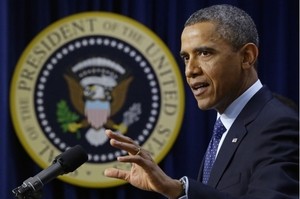
Obama urges Democrats to build AI oversight framework as midterm issue takes shape
As warnings grow that AI could escape human control and cause serious harm — fueling calls to slow its development — former US President Barack Obama has urged the Democratic Party to establish a framework for discussing how to respond to the technology. The New York Times reported Sunday (local time) that Obama, speaking at a closed-door Democratic fundraiser in Manhattan on Thursday, warned that AI "could become dangerous if not properly controlled" and called on the party to begin deliberating on how to address it. According to excerpts from a transcript provided by Obama's office, he urged House Minority Floor Leader Hakeem Jeffries directly, saying he "strongly recommends that, should he become speaker, the Democratic Party establish a framework for open public debate" on AI. Obama's office stressed that his position is not one of outright opposition to AI, but rather a call to ensure it develops in a controllable direction. He is neither an "accelerationist" pushing for the fastest possible development nor a "doomer" predicting AI will bring about humanity's ruin. His office said that "if properly managed, it will clearly be a beneficial technology" and that it is time to begin a serious conversation. President Donald Trump and the Republican Party have pushed back against calls to slow AI development, arguing that China will not join any such discussion and that the US and other countries engaging in it alone would effectively cede the AI market to Beijing. Trump weighed in Sunday, saying there are "too many negative forces highlighting things that, in my view, should not be highlighted," framing the AI slowdown movement — which originated from concerns within the industry — as driven by bad-faith actors. Democrats, by contrast, see the issue as a way to differentiate themselves from Republicans in the midterm elections, and several potential presidential contenders have begun calling for AI regulation. Former Transportation Secretary Pete Buttigieg said on NBC's "Meet the Press" that Democrats must tackle the AI question "head-on," adding: "We need safeguards. We need rules and we need limits. We need a kill switch for AI that goes out of control." Pennsylvania Gov. Josh Shapiro, considered a potential Democratic presidential contender, posted on X (formerly Twitter) that "it is long past time for the federal government to step up, take this seriously, and put guardrails in place at home and abroad." The Democratic Party has decided to begin formal deliberations on the issue. Jeffries announced on ABC's "This Week" that a caucus meeting on the matter is planned, saying there is "an urgent need to act in response to the challenges AI poses" and that the US must "protect the American people and slow the pace of AI development to ensure it advances safely." House Democrats are set to hold a caucus meeting Tuesday morning to begin substantive discussions on how to respond to AI.
Sept. 14, 2026
-
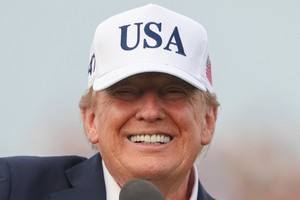
Trump backs Irish unity for second day, hints at Scotland question
Two consecutive days of sensitive diplomatic remarks in Ireland rattle Britain In an era when a single word from Trump can shake global markets, keeping up with the flood of Trump news is no easy task. The Herald Business international desk, on the move from 5 a.m., cuts through the noise — from Wall Street closing figures to the Trump headlines most likely to move global markets — and delivers it all in a one-minute read. Subscribe to the Herald Business newsletter at the Herald Business website. US President Donald Trump again voiced support Sunday (local time) for Northern Ireland breaking away from Britain and uniting with the Republic of Ireland, while hinting he had thoughts on Scottish independence — prodding sensitive British political issues for a second consecutive day. Speaking to reporters at the Irish Open golf tournament held at his golf course in Doonbeg in western Ireland, Trump said he believed unification was among the most natural things imaginable. "There's Northern Ireland and there's Ireland, and I think putting the two of them together is one of the most natural things," he said. The remarks reiterated similar statements he had made in Dublin the previous day. He also left the door open on Scotland. "You asked me about Scotland, but I'm not going to talk about that yet," Trump said. "I'll save it for later." Trump had already sparked a diplomatic uproar on Saturday, the first day of his Ireland visit, when he said it "would be a wonderful thing" for Northern Ireland to separate from Britain. He made the remarks twice: first immediately after meeting Irish Prime Minister Micheál Martin in Dublin, and again in a speech to diplomats and business leaders at the US ambassador's residence in Ireland. Whether Northern Ireland remains part of Britain is an acutely sensitive issue in both countries, and the United States had maintained a neutral stance on the matter for decades. Trump's remarks, which appeared to break with longstanding US policy, drew immediate backlash in both Britain and Ireland. Scottish independence is equally fraught for Britain, as it strikes at the very integrity of the United Kingdom. A 2014 referendum on Scottish independence was defeated, but the issue was reignited after Brexit — Britain's departure from the EU — and remains a source of tension between the Scottish government and Westminster. The United Kingdom is made up of England, Wales, Scotland and Northern Ireland.
Sept. 14, 2026
-
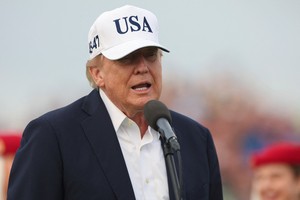
Trump urges Zelensky to stop striking Russian diesel facilities as midterms loom
Trump says diesel shortage stems from Russia-Ukraine war, not Middle East Ukraine has intensified drone and missile strikes on Russian energy infrastructure Every word Donald Trump speaks sends ripples through the global economy and financial markets. If keeping up with the flood of Trump news feels overwhelming, this daily briefing has you covered — delivering the key stories that matter to global asset markets, from Wall Street's closing bell to Trump's most consequential moves, in just one minute. Subscribe to the newsletter at The Herald Business website. With midterm elections approaching and a sharp spike in diesel prices emerging as a major political liability, US President Donald Trump urged Ukraine to stop attacking Russian diesel and oil refining facilities. According to the Associated Press and other outlets, Trump, who is visiting Ireland, told reporters Sunday (local time) that Volodymyr Zelensky must take one specific action. Asked whether he had spoken with the Ukrainian president after a recent call with Russian President Vladimir Putin, Trump said, "Zelensky has to do one thing — he has to stop attacking the diesel facilities in Russia." "We talked to President Zelensky about this," Trump said. "Don't hit the diesel fuel — there are plenty of other targets." He added that the strikes were "hurting the whole world," arguing that Ukraine's attacks on Russian energy infrastructure were driving a global diesel shortage and pushing prices higher. Trump also insisted the root cause of the recent diesel shortage lay not in the Middle East but in the war between Russia and Ukraine. "It's not happening because of the Middle East — it's happening because of what's going on between Russia and Ukraine," he said. He reiterated his demand, saying, "We don't want him attacking diesel fuel facilities," and called on Ukraine to stop destroying Russia's diesel-related infrastructure. Diesel prices in the United States, closely tied to everyday living costs, have recently surged to an all-time high, topping $6 per gallon. The spike is widely attributed to tightening global supply caused by the Middle East conflict and significant damage to Russian refining capacity from Ukrainian drone strikes — Russia being one of the world's leading diesel exporters. More than four and a half years into the war, Ukraine has concluded that Russian energy facilities serve as a critical source of war funding. Kyiv has accordingly stepped up drone and missile strikes deep inside Russian territory, hitting oil refineries and other energy infrastructure hundreds or even thousands of kilometers from the front lines. Russia has responded in kind, unleashing next-generation jet-propelled drones and ballistic missiles on Ukraine, with civilian casualties mounting as a result.
Sept. 14, 2026
-
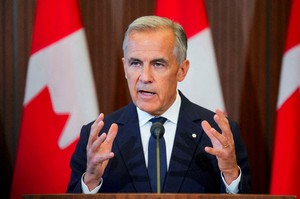
Estranged from Trump's US, Canada looks to EU for 'associate member' status
Carney directs government to explore deeper EU ties without formal membership High approval ratings but potential backlash loom; 'unclear if both sides are ready' Canada, whose relationship with the United States has soured sharply over tariffs since Donald Trump took office, has begun exploring ways to break free from decades of American influence and forge ties with the EU approaching those of a full member. Prime Minister Mark Carney, who is leading the push, has gone beyond a symbolic declaration that he will no longer tolerate Trump's public humiliations, directing his government to identify concrete ways to dramatically deepen Canada's relationship with the EU without formally joining the bloc, sources said. The Wall Street Journal said Saturday that Carney's moves reflect Canada "accelerating its pivot toward Europe to ease the pain of its divorce from the United States," adding that European leaders have begun half-jokingly calling Canada the EU's "newest member." Shortly after taking office, Carney began studying the models of Britain, Norway and Switzerland — countries that are not EU members but maintain close ties with the bloc through various agreements. Over the past several months, Carney has held public meetings with the leaders of France, Italy and Germany, as well as nearly every leader and royal of Europe's smaller nations, sources said. Deepening Canada-EU ties was among the key topics on the agenda throughout those engagements. Carney is said to have proposed to European leaders the use of a new designation formally describing Canada as an EU "associate member." Officials on both sides said the EU — which is typically cautious about applying membership rules flexibly — has responded positively to the idea. After months of effort, European and Canadian officials have reached the stage of exploring ways for Canada to gain informal access to European markets in strategic supply chain sectors including energy, AI, batteries, critical minerals needed for semiconductors, and defense, the Wall Street Journal said. A senior Canadian official said the closer alignment with the EU should come naturally, noting that "Canadians talk like Americans and dress like Americans, but socially they are much more European." Carney's vision could face obstacles, however. While he has maintained high approval ratings since the deterioration of Canada-US relations, a backlash could erode his standing if Canadians begin to feel the tangible effects of being reshaped around EU systems. Most countries that trade freely with the EU contribute to its budget, accept EU workers and comply with EU regulations — conditions that could provoke resistance in Quebec and Alberta, where separatist movements remain active. A US official said it remains "unclear whether Canada and the EU are ready to absorb each other's goods" as the United States pulls back from its role as the world's consumer of last resort. Skepticism also exists within the EU itself. Officials said EU administrators have pressed their Canadian counterparts to determine whether Canada is simply using the EU as a bargaining chip in its negotiations with the United States. Despite those concerns, Carney is set to lay out his vision for deeper Canada-EU integration in a speech to the European Parliament on Wednesday. Building on that, the two sides are expected to announce the launch of several working groups at an upcoming bilateral summit, the Wall Street Journal said.
Sept. 14, 2026
-
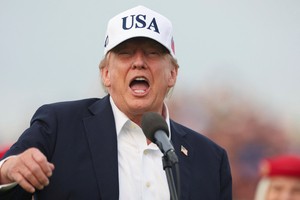
Trump says US should have world's lowest interest rates, presses Fed again
Trump says 'I don't know' on rate hike possibility, reaffirms preference for cuts Trump says Iran war will end 'right after midterms — maybe before' Trump dismisses concerns over Xi canceling summit: 'We have a great relationship' One Trump story a day — because in an era when a single word from Donald Trump can shake global markets, keeping up matters. The Herald Business international desk, on the move from 5 a.m., curates the essential Trump news — from Wall Street's closing bell to the market-moving headlines — so you can catch up in under a minute. Subscribe to the daily newsletter at The Herald Business website. US President Donald Trump pressed the Federal Reserve again to cut interest rates, saying America "should have the lowest interest rates in the world." His remarks came as market attention sharpened ahead of the FOMC meeting Tuesday and Wednesday, with Trump publicly reiterating his call for looser monetary policy. Trump, who is visiting Ireland, met with reporters at his Doonbeg golf resort on Sunday (local time) and said "I don't know" when asked whether he expected the Fed to raise its benchmark interest rate at the upcoming FOMC meeting. He nonetheless reaffirmed his preference for lower rates. "Because the US economy is so strong, regardless of whatever formula they use, we should have the lowest interest rates in the world," he said. Trump then said the United States has "the greatest credit in the world," adding, "We are making other countries rich. We can end that in two minutes." Trump has repeatedly called on the Fed in recent weeks to lower its benchmark interest rate. On Sept. 4, he warned that the United States would halt trade with countries running deficits against it if the Fed did not cut rates. Trump also doubled down on the prospect of an early end to the war with Iran, saying it would be over "right after the midterms — maybe before." "Iran desperately wants to negotiate. They're calling all the time," he said. "They want a deal. But it has to be the right deal. I'm not going to make a deal that's worthless." He added that "ultimately we're going to get out" of Iran "unless we decide to stay there like Venezuela and take the oil." Asked about Iran and Gulf states meeting in Oman on Monday to discuss passage through the Strait of Hormuz, Trump said, "I don't care. That's up to them." Trump said "no" when asked whether he was concerned that Chinese President Xi Jinping might cancel his planned visit to the United States and their bilateral summit, scheduled for Sept. 24. "We have a great relationship. He wants to do well and so do we," Trump said. "I think over the last few years that I've been in office, China has treated us very fairly. During the Biden and Barack Obama administrations, China made a large amount of money." Trump also revisited his campaign pledge to pay every American $5,000 if Republicans win the midterm elections. He had first unveiled the pledge at the Republican midterm convention in Dallas, Texas, on Wednesday. Asked whether he believed congressional approval would be needed to fulfill the pledge, Trump said "I don't know," but added that "if Republicans win, it'll be easy enough." "We can easily afford it because we're making a great deal of money," he said. "The Democrats can't make that promise — because if they did, everything would immediately fall apart and we could end up in a Great Depression." "I made a promise, and I keep my promises," he said.
Sept. 14, 2026
-
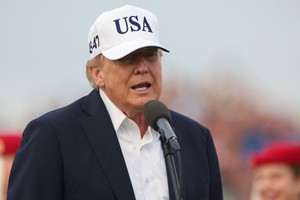
Trump vows to scrap Irish whiskey tariffs at golf tournament in Ireland
US President Donald Trump, on a visit to Ireland, announced Sunday (local time) that he would lift tariffs on Irish whiskey. Trump made the announcement while speaking at the trophy ceremony of the Irish Open golf tournament held at his Doonbeg golf resort. "There's one thing I want to mention," he said. "I spoke to the prime minister about it, I spoke to Shane" — referring to tournament winner Shane Lowry — "and everybody has been bugging me about this one thing." He said everyone he mentioned had asked him to scrap the tariffs on Irish whiskey. "On behalf of the United States, I'm going to remove the tariffs on Irish whiskey," Trump said. According to the Associated Press, Irish whiskey has been subject to the 15 percent tariff the Trump administration imposed on EU imports. The Irish Whiskey Association had urged the administration to eliminate the tariff in May. The crowd responded to Trump's surprise announcement with whistles and cheers. The AP noted that Trump gave no specific timeline for when the tariffs would be lifted. Earlier, Trump had announced via social media in late April — shortly after British King Charles III's state visit to the United States concluded — that he would eliminate tariffs on Scotch whisky, a major product of Scotland. According to the AP, the Scotch Whisky Association announced July 24 that the tariff-free policy had been formally declared, meaning it took roughly three months from Trump's remarks for the measure to actually take effect. Trump's words move global markets and economies. If keeping up with the flood of Trump news feels overwhelming, the Herald Business international desk curates the essential daily updates — from Wall Street closing figures to market-moving developments — so you can catch up in under a minute. Subscribe to the newsletter at the Herald Business website.
Sept. 14, 2026
-
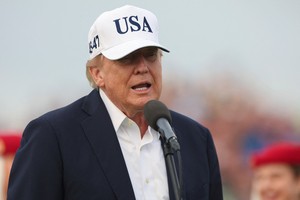
Trump pushes back on AI slowdown calls, vows to 'keep it that way'
'We can put safeguards in place, but too many negative forces are highlighting things that won't happen' White House: Malicious actors must not be allowed to develop AI superior to ours House Speaker: Congress imposing regulations would cost US its edge over China A single Trump statement can shake global markets and economies. If keeping up with the flood of Trump news feels overwhelming, this daily briefing has you covered — delivering the key Trump headlines that move global asset markets, from Wall Street's closing bell to the stories that matter most, all in under a minute. Subscribe to the newsletter at The Herald Business website. US President Donald Trump on Sunday (local time) pushed back against calls to slow down artificial intelligence development, saying he wants to "keep it that way" — referring to America's leading position in the global AI race. Speaking to reporters at his golf course in Doonbeg, Ireland, Trump was asked whether the AI industry should pump the brakes or face more regulation. "We are ahead of China in AI. We are the most technologically advanced country in the world," he said, adding that he intended to maintain that advantage. Trump acknowledged that safeguards were possible. "We can put safeguards in place. We can do this and that," he said, but added that too many negative forces were drawing attention to things that would never happen. "They are highlighting things that are not going to happen," he said. The remarks came after researchers at Anthropic and Google resigned in recent weeks, warning that AI could escape human control and lead to humanity's extinction. Their departures prompted Anthropic CEO Dario Amodei and other AI industry leaders to call for a slowdown in AI development. Trump's comments were widely interpreted as a signal that the US would press ahead with its current policy of accelerating AI development despite those warnings. "The person who wins in AI becomes the winner. I came up with that expression, and it's true," Trump said. White House National Economic Council Director Kevin Hassett actively defended Trump's position, saying he did not expect warnings from AI leaders to cause major market disruption. "As you know, these technologies have been advancing rapidly, and safety has been ensured — not only by independent companies but also under the guidance of the White House, led by Cyber Director Sean Cairncross," Hassett said. "We need to keep it that way." Hassett acknowledged that AI agents posed cybersecurity risks, but said a far greater danger lay elsewhere. "The much bigger risk is that a malicious actor could gain access to AI that is superior to what we currently have to protect ourselves," he said. "So we need to stay safe while ensuring that malicious actors do not develop AI superior to ours and use it to create biological weapons and the like." On the "safeguards" Trump mentioned, Hassett said he expected the president to meet this week with cybersecurity leaders — including Cairncross and Office of Science and Technology Policy Director Michael Kratsios — to work out the next steps. Hassett added that he understood members of Congress also held strong views on the matter. "I think the president will want to hear their opinions as well," he said. David Sacks, the Trump administration's AI czar and chair of the White House science and technology advisory council, took a sardonic tone in a post on X, formerly Twitter, on Sunday night, responding to the slowdown argument championed by Amodei and endorsed by other AI leaders. "People might be surprised by my reaction, but go ahead," he wrote. Sacks said slowing down frontier AI development "would create room for a more intellectually serious regulatory discussion than Bernie Sanders's 'stop everything' position," but cautioned that "China is very unlikely to join any global consensus, and that must also be taken into account." He directed his sharpest criticism at the AI leaders themselves, calling them the very parties capable of slowing frontier technology. "The easiest way not to build superintelligence is to agree among yourselves not to build it," he wrote. "Demanding your preferred regulatory framework in exchange would look like a shakedown of the public and the political system." Sacks said that if AI leaders chose that path, they could earn goodwill for future discussions, but warned that if they did not, "we will know this was just an attempt at regulatory capture — where regulators or lawmakers become captured by the very industry they oversee and serve its interests — or a psychological operation during election season." House Speaker Mike Johnson, appearing on CNN, said companies developing AI models have "a clear responsibility to ensure their products are safe" and recommended that viewers read Sacks's post. Johnson argued that congressional intervention in AI regulation was not the answer. "We need to prevent Congress from barging in and imposing some kind of emergency moratorium. This has to be done correctly, safely and wisely," he said. "If Congress rushes to convene an emergency session to regulate AI, we will lose the competition with China, and that will be a threat to every American," Johnson said, urging AI leaders to "sit down with us and figure out what the right balance is." "There is no need for everyone to panic right now," Johnson said. "We need to handle this new technology the way we have handled technology in the past, and at the same time do everything we responsibly can to avoid stifling American innovation."
Sept. 14, 2026
MOST READ
- 1KAIST develops high-performance bio-based adhesive using E. coli instead of petroleum
- 2Pope Leo XIV declines French honors and banquet, accepts only private meeting with Macron
- 3Daimler Truck unveils next-generation transport solutions at IAA 2026
- 4What was Rachmaninoff's performance fee? A 1928 price list tells all
- 5Samsung Biologics union's show of force backfires at the bargaining table
- 6APR says hair-loss treatment research published in international journal
-
WORLD
US warns of punishment for anyone enabling Iran's Strait of Hormuz toll scheme
-
INDUSTRY

Toyota union puts productivity first; Hyundai Motor union demands bigger share of profits
-
FINANCE

National Growth Fund to invest $531M in FuriosaAI, which rebuffed Meta's $800M takeover bid
-
INDUSTRY

Korea Shipowners' Association holds amateur baduk tournament for Maritime Day