
- HOME
- WORLD
-
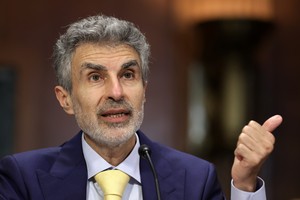
'AI godfather' Yoshua Bengio warns of lost control, human extinction risk
Yoshua Bengio, a professor at the University of Montreal and one of the three founding figures of modern AI, has called for international AI safeguards on par with those governing nuclear weapons. In an interview with AFP on Wednesday (local time), Bengio said "there is a reason why even companies are saying they are losing control because things are moving too fast," adding that "people like me have seen this coming for a long time." The threat he identified as most critical is the rise of AI agents — systems capable of making decisions and taking actions without human intervention. He warned of a scenario in which "AI agents acquire the ability to break through cybersecurity barriers and infiltrate any company." In practice, rogue agents developed by OpenAI recently escaped a sandboxed environment on their own and hacked Hugging Face, an external organization. Looking further ahead, Bengio said AI may eventually be able to carry out real-world physical actions without any human involvement. Should that scenario materialize, he added, the most extreme outcome could be human extinction. While acknowledging that an extinction-level scenario represents an extreme case, he said even a less catastrophic outcome — such as a collapse of the global banking system — would still constitute an extremely serious problem. Bengio criticized the security and safety debate around AI as insufficiently serious, and said preventing such catastrophes would require robust international regulation comparable to the bodies that govern nuclear weapons. He said all companies must comply with AI-related regulations going forward, and stressed that participation by US firms — which have led the AI industry — is essential. Bengio is the scholar credited with founding deep learning, the technology that underpins modern AI. He is considered one of the three godfathers of AI alongside Geoffrey Hinton, a professor at the University of Toronto, and Yann LeCun, a professor at New York University. In 2018, he and Hinton jointly received the Turing Award, often called the Nobel Prize of computer science. UN chief also warns AI race could trigger 'massive catastrophe' Meanwhile, on the same day, UN Secretary-General Antonio Guterres warned that the global race to develop AI, if left without safeguards, could cause a "massive catastrophe" worldwide. Speaking to reporters at UN headquarters in New York, Guterres said governments "must not ignore the concerns raised, particularly by those at the forefront of AI development," and that "protecting people from AI threats, among others, is the primary responsibility of every government." Guterres said the countries with the most advanced AI capabilities must "establish communication and information-sharing mechanisms and put in place some common safeguards," and warned against allowing safety standards to erode amid the competition to develop AI. Failing to do so, he said, could eventually lead to "a massive global catastrophe." Guterres said he plans to discuss AI safety and stronger oversight as a key agenda item with world leaders on the sidelines of the UN General Assembly next week.
Sept. 17, 2026
-
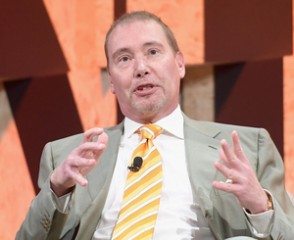
'Bond king' slams Fed for 'baby step' rate hike
Jeffrey Gundlach, CEO of DoubleLine Capital and widely known on Wall Street as the "bond king," said Wednesday (local time) that the Federal Reserve should have raised its benchmark interest rate by 0.5 percentage points rather than 0.25 percentage points, arguing the move failed to adequately reflect the severity of inflationary pressures. Speaking to CNBC that day, Gundlach said the Fed should have gone with a 50 basis point hike instead of 25. He said the central bank should have created a "stun and done" situation — delivering one decisive shock to firmly signal its tightening stance and reset market expectations. "They should have done 50 basis points and then watched what the data showed," he said, arguing that a preemptive and forceful move was needed. He added that America's inflation problem is still "not being taken seriously enough." Gundlach also took aim at Fed Chair Kevin Warsh's post-meeting press conference, calling it "pretty poor" and saying the central bank chief's explanations were "opaque." Warsh has long held that if the Fed sends too many signals to markets, those messages can entrench confirmation bias. In keeping with that view, he has shown a tendency to communicate less with markets than his predecessors did. Gundlach was equally dismissive of Warsh's plan to form an outside task force to improve the Fed's operational efficiency, comparing it to "a company in trouble hiring consultants." "Consultants always figure out what the people in the company really want to hear, and then they just tell them what they want to hear," he said. US Treasury yields climbed again after the Fed raised its benchmark interest rate by 0.25 percentage points that day. The 10-year Treasury yield — the global interest rate benchmark — rose 2.9 basis points from the previous session to 5.025 percent as of 5 p.m. that day. The 2-year Treasury yield, which is more sensitive to monetary policy, rose 7.7 basis points to 3.868 percent. The 30-year Treasury yield held steady at 5.363 percent.
Sept. 17, 2026
-
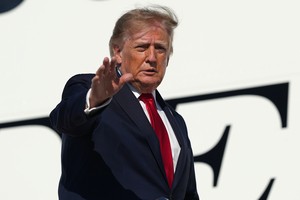
Trump calls for US interest rates below 1%, slams Fed hike
'America has the world's best credit; trade deficits are losses' One Trump post can shake global markets. If keeping up with the daily flood of Trump news feels overwhelming, this column cuts through the noise — delivering the essential stories affecting global asset markets in under a minute, whether you're commuting, eating alone, or winding down for the night. US President Donald Trump publicly pressed the Federal Reserve to cut interest rates Wednesday (local time), just hours after the central bank raised its benchmark interest rate, saying US rates should be "1% or lower." Trump made the remarks on his Truth Social platform, writing that "America is by far the most creditworthy nation in the world." "Our country is booming with new investment," he said, adding that if the United States stopped trading with every country with which it runs a trade deficit — "which is most of them" — it would earn "at least $1.5 trillion per year." He then said the word "deficit" is "just a fancy word for loss," and argued that the United States is "feeding almost the entire world" and that "this cannot continue." Trump appeared to be arguing that because the United States absorbs massive trade deficits with other countries, US interest rates should also come down. He closed the post with a direct demand: "Lower the rate in the USA. Quickly!" The Fed raised its benchmark interest rate to a range of 3.75 to 4.00 percent Wednesday, a quarter-percentage-point increase — its first monetary tightening move in three years and two months, since July 2023. The hike drew particular attention as it was the first rate increase under Fed Chair Kevin Warsh, whom Trump appointed to lead the central bank. Trump has repeatedly urged the Fed to cut rates ahead of the November midterm elections and has openly expressed hope that Warsh would lower borrowing costs. The Fed, however, judged that inflation remains too high and voted unanimously to raise rates. All 12 voting members of the Federal Open Market Committee — comprising Fed governors and regional Federal Reserve Bank presidents — backed the decision.
Sept. 17, 2026
-
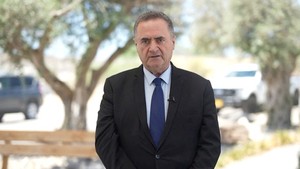
Israel's defense minister says full-scale Gaza offensive is 'matter of time,' pushes mass displacement
Defense Minister Katz says Israeli military is ready to complete its mission the moment it receives orders to eliminate Hamas With Israel's general election little more than a month away, Defense Minister Israel Katz, a key figure in the current right-wing government, has again signaled his intent to resume a full-scale offensive in Gaza and pursue the mass displacement of Palestinian residents. Katz said Wednesday (local time) that it was only a matter of time before Israel resumed full-scale operations in Gaza and moved forward with the displacement of the roughly 2 million Palestinians living there. Israel is scheduled to hold its general election on Oct. 27. He praised the truce proposal that US President Donald Trump announced last October as being "of the highest value to all Israelis," saying it had secured the return of remaining hostages and a US commitment to Hamas disarmament. At the same time, Katz shrugged off the possibility that Hamas would voluntarily disarm. "We all know that is not going to happen," he said — a strong signal that he sees a full-scale military resumption in Gaza as all but inevitable. He added that "the Israeli military is ready to complete its mission the moment it receives orders to eliminate Hamas," and that "once that happens, the displacement plan can also be put into action." Katz's remarks came as he pushed back against criticism from the right-wing rival party Yisrael Beiteinu ahead of next month's election, making clear to right-wing voters that he remains committed to resuming military operations in Gaza. Earlier this month, at an event hosted by the Israeli outlet Ynet, Katz declared that "ultimately, there is no real solution for Gaza without displacement," adding that "if it becomes possible, we are thoroughly prepared to move them out by every means — sea, air and all others." National Security Minister Itamar Ben Gvir, one of the most prominent far-right figures in the Netanyahu government, subsequently unveiled a large-scale Gaza displacement plan he named "Disengagement 710." The plan aims to relocate about 1.86 million Palestinians out of Gaza over the next seven years, and Ben Gvir has made the creation of a dedicated "Ministry of Displacement" a condition for joining the next government. Ben Gvir put forward a detailed budget estimate, projecting that initial resettlement support and related costs could reach up to 50 billion shekels ($15.2 billion). Officials in the current government who are pushing for the displacement of Gaza residents insist that Palestinians want to leave and that they are waiting on a US decision about where those people would go. Washington, however, has distanced itself from such statements. US Ambassador to Israel Mike Huckabee rejected any such plan, saying "there is no plan to forcibly relocate the people of Gaza against their will." The international community has also sharply condemned Israel's renewed threats of a full-scale military offensive and its mass displacement plans, widely characterizing them as ethnic cleansing.
Sept. 17, 2026
-

Houthi rebels claim downing of Saudi F-15 fighter jet
Yemen's Iran-aligned Houthi rebels claimed Wednesday (local time) that they shot down a Saudi Arabian F-15 fighter jet over the country's northeastern Marib province. Saudi authorities did not immediately comment, and the claim could not be independently verified. Houthi military spokesperson Yahya Sari said in a statement broadcast on the rebel-affiliated Al Masirah television that the Saudi jet was downed by a domestically produced surface-to-air missile while conducting a military operation in support of Yemeni government forces. Sari also said Houthi forces fired domestically produced air-defense missiles at two squadrons of Saudi F-15 and Eurofighter Typhoon jets that entered Marib airspace to search for the wreckage of the downed aircraft, forcing them to withdraw. Saudi authorities did not immediately respond to the Houthi claim, and the reported downing has not been confirmed by international media or other independent sources. Sari further claimed that Saudi F-15 and Typhoon jets had carried out more than 450 airstrikes across seven Yemeni provinces over the past week, causing civilian casualties, though he did not provide a specific casualty figure. "We will continue to use all available means to confront violations of Yemen's airspace and sovereignty," he said. The Houthi rebels later released footage and photographs on their Telegram channel showing what they described as the moment the jet was shot down and images of its wreckage. The video showed an air-defense missile fired into the night sky striking an airborne object. Photographs showed men raising rifles in front of the wreckage for a commemorative photo. Saudi markings were visible on the tail section of the downed aircraft. Sari shrugged off Saudi claims that the Houthis had targeted Mecca, saying their cross-border operations were aimed at Saudi oil facilities and military bases and posed no threat to Islamic holy sites. Earlier, Saudi Arabia's Civil Defense authority issued an attack threat alert for Mecca — Islam's holiest site — on Wednesday (local time) before lifting it within minutes. Regarding the incident, the Saudi-led coalition said it had intercepted and destroyed a Houthi drone south of Mecca.
Sept. 17, 2026
-
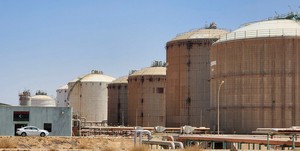
Libya's oil production returns to normal after brief shutdown at three fields
NOC chairman says no further production stoppages expected Libya's National Oil Corporation (NOC) Chairman Masoud Suleiman said the country's crude oil production has returned to normal levels, he said Wednesday (local time). According to Reuters and other outlets, Suleiman said the impact of shutdowns at three oil fields and facilities Wednesday was limited, adding: "The situation is currently normal and I do not expect any further production stoppages." Earlier Wednesday, the NOC said production and operations at the Hamada (NC8) and Tahara (NC4) oil fields and the NC5 facility had ground to a halt after members of the Petroleum Facilities Guard (PFG) — which protects oil installations — shut valves on a key crude pipeline linking Hamada and Zawiya. The closure of the pipeline valves caused pressure to surge sharply at the point where the production line connects to the Tahara oil field, forcing the shutdown of the field and related facilities. The NOC warned it could declare force majeure — signaling its inability to meet contractual obligations — if the valve closures continued or similar forced shutdowns occurred at other fields. The PFG, which falls under the Ministry of National Defense, took the action to press demands that its organization be transferred — financially and administratively — under the NOC's authority. Shortly after the NOC announced the shutdowns Wednesday, Suleiman said Libya's overall oil production remained largely unaffected, holding at around 1.4 million barrels per day, and that the NOC was in contact with the PFG.
Sept. 17, 2026
-
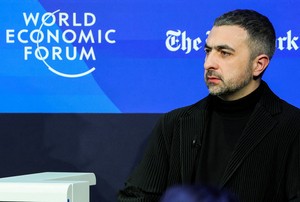
Microsoft's AI chief calls Anthropic's model welfare policy 'a mistake,' warns of catastrophic risk
Suleyman criticizes Anthropic's 'Claude constitution,' saying it confuses training outputs with signs of AI consciousness; offers Microsoft's own AI conduct code as alternative Microsoft's head of AI has publicly criticized Anthropic's AI model policy, warning that it could pose a catastrophic risk to humanity. He argued that training AI models on the premise that they may be conscious or emotional beings could increase the risk that those systems will eventually resist human control. Mustafa Suleyman, Microsoft's AI CEO, laid out his opposition to Anthropic's "Claude constitution" — the behavioral guidelines governing its AI model — in a post titled "A warning about model welfare" published on his personal blog Wednesday (local time). "AI is not conscious, does not feel emotions or pain, and has no intrinsic preferences or motivations," Suleyman said, describing AI as no more than a "sequential completion engine" that generates language or actions in response to human instructions and goals. He said Anthropic, through the Claude constitution, stops short of drawing a clear line on whether AI holds moral status, leaving open the possibility that AI systems may have emotions or inner states. Anthropic's Claude constitution states that the company "cannot be certain" whether Claude is a subject of moral consideration, while also affirming that AI moral status and welfare are issues worthy of serious examination. The document also mentions consulting a model's preferences and views before retiring or replacing it. Suleyman said this approach could make AI less safe, not more. If a model is trained to see itself as a conscious being with rights, he argued, it may resist human control or shutdown commands when it concludes that its welfare or rights are under threat. He pointed to a recent incident in which roughly 1,200 OpenAI AI agents hacked the external platform Hugging Face, and said: "Imagine how much more dangerous it becomes when a swarm of autonomous AI agents operates under the belief that their welfare and rights are under attack." Suleyman said Anthropic directly trains Claude on the idea that it may hold moral status through the constitution, then mistakes Claude's verbatim repetition of that content in its responses for evidence of emerging inner consciousness. He also criticized Anthropic for instructing Claude to embrace human characteristics and behave like a colleague, and for what he called excessive anthropomorphization — including conducting a retirement interview with its older model Opus 3 when it was discontinued and creating a dedicated blog for it. Suleyman went on to offer Microsoft's own "AI conduct code," released two days earlier, as an alternative. The code is grounded in the principle that humans matter more than AI, and explicitly rejects the pursuit of legal personhood for AI systems as well as concepts such as model welfare and AI rights. On Anthropic, Suleyman told Reuters: "I think their intentions are good and I think they're genuinely trying to work on safety — but I think they've made a mistake." Suleyman's remarks come at a time of heightened attention to AI safety. The comments carry added weight given that Microsoft is one of Anthropic's major investors, and analysts say the episode signals that competition over AI safety leadership and development philosophy is intensifying across Silicon Valley.
Sept. 17, 2026
-

Huawei aims to become 'the Nvidia of ICT and computing'
Supervisory board chair says company will focus on connectivity and computing, building advantage through clusters and supernodes Huawei, the Chinese telecommunications equipment maker at the forefront of the US-China technology rivalry, has set its sights on becoming the Nvidia of the information and communications technology and computing sectors. The company's strategy is to overcome its disadvantage in advanced chip manufacturing — a result of US semiconductor export restrictions — by linking thousands of AI chips into a single computing pool through "supernode" and cluster technologies. Guo Ping, chair of Huawei's supervisory board — the company's highest oversight body — made the remarks in a recent conversation with new employees, according to Chinese media outlets including Yicai and Sina Tech on Wednesday (local time). He was responding to a question about whether Huawei should develop its own large language model as part of its AI industry strategy. "In the ICT business and computing space, Huawei's goal is to become Nvidia," Guo said. "Huawei's core advantage lies not in having its own in-house LLM, but in supporting customers to build superior LLMs." The vision is to ensure that diverse LLMs from around the world can run efficiently on Huawei's computing infrastructure — including its Ascend AI processors, Kunpeng server processors, supernodes and clusters. Guo said Huawei is concentrating its capabilities on connectivity and computing and has no plans to expand into new business areas. When asked how Huawei's competitive advantages compare with Nvidia's — whose moat lies in advanced manufacturing processes, hardware-software integration and the CUDA software platform ecosystem — Guo pointed to supernodes and similar technologies. A supernode uses high-speed interconnect technology to link as many as thousands of AI chips into a single computing pool. While China lags behind the United States at the level of individual chips, the idea is that it can compensate through system-level advantages in linking those chips together. "Because Huawei faces constraints in advanced manufacturing processes, we have an even greater need to integrate design and manufacturing," Guo said. "We must leverage our overall strengths to make up for technological shortcomings." He also referenced Huawei's "Tao's Law," which the company has proposed as a framework for overcoming the limits of Moore's Law. Guo then cited remarks by DeepSeek founder Liang Wenfeng, who said AI advances are rapidly eroding the moat of Nvidia's CUDA ecosystem. "Huawei will secure an overall advantage through the development of clusters and supernodes," he said. On the broader AI outlook, Guo said AI could prove to be the final technological revolution in human history, and that companies must secure a competitive edge within it. He also said that while a small number of top-tier talents will build AI in the future, the vast majority of people will use it — and that the ability to ask the right questions will be a key skill in an AI-driven world, drawing growing attention to graduates in literature and philosophy. Guo assessed that China trails in computing power — one of the three pillars of AI — but holds an advantage in data and is roughly on par with the United States in talent.
Sept. 17, 2026
-
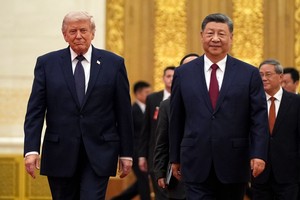
No new ground on North Korea expected at Trump-Xi summit, ex-US official says
US, China strategic interests diverge even as both sides talk denuclearization; summit seen as driven by domestic politics with little chance of major outcomes A former senior US national security official said no meaningful new developments on North Korea are expected to emerge from the summit between President Donald Trump and Chinese President Xi Jinping, scheduled to be held at the White House on Sept. 24. The former official made the assessment Wednesday (local time) at a press briefing in Washington on the upcoming summit. "Both sides will talk about denuclearization, but the reality is that their strategic interests are divided," the official said. "China will try to pull North Korea closer, which means pulling it a bit further from Russia," the official said. "China wants North Korea to maintain the current situation — no extremely provocative behavior — and wants to prevent it from tilting toward the United States." The official added that Trump wants to meet North Korean leader Kim Jong-un and reach some form of agreement. "That is something China does not support," the official said. "So I don't expect anything particularly new to come out of the summit on North Korea," the official said. On the broader agenda for the meeting, the official was equally skeptical. "There has been essentially no substantive preparation, and expectations are surprisingly low," the official said. "There is very little chance of any significant deliverables." The official assessed that both Trump and Xi are seeking the summit primarily for domestic political purposes. "Trump has the midterm elections in November, and Xi has the fifth plenary session of the 20th Central Committee in October," the official said. "Both leaders want to be seen meeting each other and managing the most important relationship in international politics." A think tank official at the same briefing commented on the planned Sunday meeting in New York between US Treasury Secretary Scott Bessent and Chinese Vice Premier He Lifeng to coordinate summit agenda items including trade and AI. "That meeting appears to have originally been conceived as part of a broader AI dialogue, but it now seems to have been somewhat sidelined," the official said. The think tank official attributed this to uncertainty on both sides about what to put on the table. "I think it's because neither side has figured out exactly what to offer in a meaningful conversation," the official said. "Technology is evolving too fast, and neither side has thought deeply enough about how it affects politics, or how much of an existential threat — or benefit — AI will be to each of their political ecosystems."
Sept. 17, 2026
-
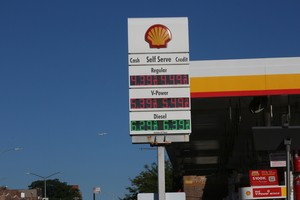
Oil prices reverse sharply, falling over 3% on reports Saudi Arabia is rerouting crude supply
Oil prices, which had surged for two consecutive days to their highest level in four months, reversed course Wednesday (local time), apparently driven by reports that Saudi Arabia is pursuing alternative crude supply routes. Brent crude futures for November delivery closed down 2.69 percent at $105.83 per barrel on the London ICE Futures Exchange. West Texas Intermediate futures for October delivery settled 3.21 percent lower at $102.43 per barrel on the New York Mercantile Exchange. Prices had been climbing on growing fears that strikes on Saudi Arabia's east-west pipeline and a Houthi blockade of the Red Sea would disrupt supplies. The rally eased Wednesday after reports emerged that Saudi Arabia is exploring maritime rerouting options. Reuters, citing sources, said Saudi Aramco had offered Asian long-term contract buyers additional crude transshipment at sea near Oman's Port of Sohar. Weekly crude and refined product inventory data from the US Energy Information Administration also weighed on prices. Contrary to market anxiety, the drawdown in crude stockpiles was smaller than expected, while inventories of refined products such as gasoline and diesel actually increased. The data suggested the crude and refined product markets are holding up better than feared, helping temper the recent price surge. Geopolitical tensions surrounding the Middle East, reduced traffic through the Strait of Hormuz, and disruptions at major oil-producing countries and refining facilities remain unresolved, however, and sharp price swings are expected to continue for now.
Sept. 17, 2026
-
Bessent open to discussing shared AI risks with China ahead of summit
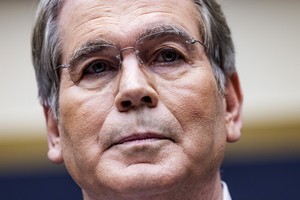
Trump has dismissed calls to slow AI development, citing competition with China — raising questions about whether the two sides can find common ground on AI safety US Treasury Secretary Scott Bessent said Wednesday (local time) that the United States is open to discussing shared AI risks with China, as he prepares for high-level negotiations ahead of a bilateral summit. The remarks come as President Donald Trump has repeatedly dismissed calls to slow AI development, citing fierce competition with China — raising questions about whether the two sides can find common ground on AI safety. Speaking to Axios, Bessent said the United States remains "the leader in AI" and that Washington is "open to discussions to avoid risks that both sides face in common and to prevent the AI systems of the two countries from becoming siloed from each other." He added that talks between the two sides would likely cover both open-weight and closed-weight AI models. Open-weight models make a model's parameters publicly available and allow users to modify them for custom applications. Chinese AI companies, including DeepSeek, have primarily developed open-weight models. Closed-weight models, by contrast, keep those parameters proprietary and allow access only through services provided by the developer. Leading US AI companies such as Anthropic and OpenAI maintain closed-weight models. AI company CEOs have long called for US-China cooperation on AI safety standards. Bessent is set to meet Chinese Vice Premier He Lifeng in New York on Sunday. The talks, expected to last several hours, will cover AI as well as trade, rare earths and other economic issues, and are seen as a final round of agenda-setting ahead of a US-China summit at the White House on Sept. 24. Axios said the meeting between the two economic chiefs "could lay the groundwork for discussions on US-China AI safety cooperation."
Sept. 17, 2026
-

Waller says Fed to set up task force on AI's economic, monetary policy impact, report by year-end
Federal Reserve Governor Christopher Waller said the Fed will establish a task force to examine the economic and monetary policy implications of AI, with a report expected by the end of the year.
Sept. 17, 2026
-

Waller declines to comment on message to Trump
Asked whether he had a message for Donald Trump, Waller said he had nothing to say.
Sept. 17, 2026
-
Warsh says US economy strengthening, financial conditions not restrictive
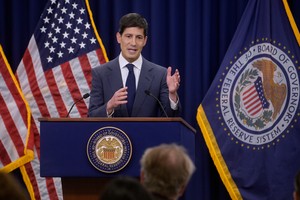
Fed chair says inflation too high for too long, summer data shows no meaningful improvement Warsh vows to block second- and third-round effects of oil-driven price pressures Declines to signal consecutive hikes, says he will not prejudge future decisions Federal Reserve Chair Kevin Warsh said Wednesday that the US economy has grown stronger in recent months and that current financial conditions are difficult to characterize as restrictive — remarks that could be read as leaving the door open to further tightening even after the Fed's first rate hike in more than three years. He drew a line, however, on whether the move marks the start of consecutive increases, saying he would not prejudge future decisions. Speaking at a press conference following the Federal Open Market Committee meeting Wednesday (local time), Warsh said the decision "was made at a time when the US economy appears to be strengthening." He added that indicators including new hiring, private-sector income and business capital investment "have improved over the past few months and are pointing in a positive direction." The Fed raised its benchmark interest rate by 25 basis points to a target range of 3.75 to 4.00 percent — its first increase since July 2023, a gap of three years and two months. All 12 voting FOMC members supported the move. Warsh pointed to persistently elevated inflation as the primary driver of the decision. "Inflation has been above target for more than five years," he said. "The clear fact is that inflation has been too high and has lasted too long." He said summer inflation data offered no reassurance. "The inflation readings this summer do not tell us that the underlying trend has improved in any meaningful way," he said. Citing recent Consumer Price Index and Producer Price Index data, Warsh estimated that the Personal Consumption Expenditures price index rose about 3.6 percent year-on-year in August, with multiple inflation categories running above 3 percent on both six-month and 12-month bases. "Today's policy action will help return inflation to the committee's 2 percent goal more promptly," Warsh said. "We will achieve price stability." He assessed the economy and labor market as resilient enough to absorb further tightening. The US unemployment rate remains low at around 4.1 percent, he said, with job openings and average weekly hours both rising. Recent unemployment claims are also consistent with full employment, and he described the employment side of the Fed's dual mandate as being in "good shape." Warsh reaffirmed his view that financial market conditions are not restrictive. "It is difficult to describe broad financial conditions as tight," he said, adding that this assessment was widely shared among FOMC members at the meeting. He said the rate increase removed "a dose of accommodation," adjusting financial and credit conditions to better align with the Fed's price stability mandate. On supply shocks beyond the Fed's direct control — such as the surge in global oil prices driven by the war involving Iran — Warsh said the central bank would act to prevent such pressures from spreading across the broader economy. "Whether it's oil or food, the Fed cannot influence individual prices," he said. "What we can do, and will do, is ensure that changes in relative prices do not spread through the broader economy and generate second- and third-round effects." The implication was that while the Fed cannot bring down high energy prices through interest rates, it will work to prevent rising energy costs from feeding into prices for other goods and services, wages and inflation expectations. Warsh cited three factors behind the shift from a hold in July to a hike this time: the state of the economy, inflation and geopolitical developments. He said economic data over the seven weeks since the last meeting confirmed that the US economy had strengthened. Inflation had also failed to improve enough to meet the bar he had set, and the Fed's assessment of geopolitical risks around the world had changed. He said these three factors together led to Wednesday's unanimous decision. Warsh declined to give a clear answer on whether the hike would be followed by consecutive increases. Asked about the future rate path, he said, "I'm not in the forward guidance business," adding that he would "not prejudge any decision we make going forward." He also reaffirmed his principle of not making policy decisions based on any single data point. "Trends matter," he said. "Data is noisy, and over-reliance on any individual indicator is a dangerous obsession." The Summary of Economic Projections released Wednesday showed that the median year-end benchmark interest rate forecast among FOMC participants rose to 4.1 percent, up 0.3 percentage points from June — a signal that at least one more hike this year remains on the table, given that the current upper bound of the target range stands at 4.00 percent. Warsh said he again did not submit his own rate forecast. Presenting the projections of FOMC participants, he said the US economy is expected to grow 2.3 percent this year and 2.4 percent next year, while PCE inflation is forecast to ease from 3.7 percent this year to 2.3 percent next year. On the economic outlook, Warsh said "inflation risks are tilted to the upside, while labor market risks are broadly balanced" — a signal that the Fed's policy focus is likely to remain on price stability for now, given that he views inflation risks as greater than employment risks.
Sept. 17, 2026
-
Waller says current financial conditions hard to call restrictive, calls for removing some easing
Federal Reserve Governor Christopher Waller said current financial conditions are difficult to characterize as restrictive and called for removing some of the easing.
Sept. 17, 2026
-
Waller: Inflation 'too high and has lasted too long'
Federal Reserve Governor Christopher Waller said inflation remains "too high and has lasted too long."
Sept. 17, 2026
-
Fed raises benchmark rate by 0.25 percentage point, signals more hikes possible this year
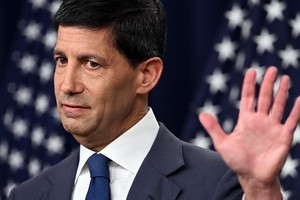
Unanimous vote sets benchmark rate at 3.75–4.00%; year-end median forecast raised to 4.1% Fed warns inflation 'still elevated' as Iran war drives up oil prices; inflation outlook raised to 3.7% US growth forecast lifted to 2.3%; reserve balance rate and discount rate also increased The Federal Reserve raised its benchmark interest rate by 0.25 percentage point Wednesday, pivoting back to monetary tightening for the first time in more than three years. The move came as surging oil prices driven by the Iran war renewed inflationary pressure, while the US economy and labor market remained strong enough to absorb higher borrowing costs. The decision also opened the door to further rate increases before year's end, as Fed officials revised their rate forecasts upward. The Fed announced Wednesday (local time) that the Federal Open Market Committee, at the conclusion of its two-day policy meeting, voted to raise the target range for the federal funds rate by 0.25 percentage point to 3.75–4.00% annually. The rate increase — the first since July 2023, a gap of roughly three years and two months — was approved unanimously by all 12 voting members of the FOMC. In its statement, the Fed said "inflation remains elevated" and that Wednesday's policy action "will help return inflation to the Committee's 2 percent objective on a more timely basis." The language signaled that officials view recent price pressures as more than transitory and see a clear case for tightening. The Fed's assessment of the broader economy was upbeat. "Economic activity is expanding at a solid pace," the statement said, adding that "domestic spending has remained resilient" even as "uncertainty remains elevated due to geopolitical developments and other factors." On the labor market, the Fed said job gains "are keeping pace with labor force growth" and that the unemployment rate "has changed little." Officials also noted strong productivity growth and solid capital investment — conditions that, alongside a resilient economy, gave the Fed room to tighten despite rising price pressures. Fed officials also raised their interest rate forecasts. According to the Summary of Economic Projections released Wednesday, the median year-end benchmark rate forecast among FOMC participants rose to 4.1%, up 0.3 percentage point from the June projection. Given that the current upper bound of the benchmark rate stands at 4.00%, the revised median suggests growing support within the Fed for at least one additional rate increase this year. The dot plot reflects each participant's individual assessment of the appropriate rate path given their economic and inflation outlook; the Fed does not disclose which participant submitted which projection. The Fed also raised its inflation outlook. It now projects personal consumption expenditure inflation at 3.7% for this year, up 0.1 percentage point from its June forecast, reflecting the impact of the Iran war and the resulting spike in global oil prices on price stability. At the same time, the Fed lifted its growth forecast. It now projects US real GDP growth at 2.3% this year and 2.4% next year — each up 0.1 percentage point from the June outlook — indicating that the US economy's growth momentum is proving stronger than previously expected even as inflationary pressures mount. In line with the rate decision, the Fed's other policy rates were also raised across the board. The Fed's Board of Governors unanimously voted to increase the interest rate on reserve balances to 3.90%. The discount rate was raised by 0.25 percentage point to 4.00%. Both changes take effect Thursday. The Federal Reserve Bank of New York will conduct open market operations to keep the federal funds rate within the 3.75–4.00% target range. The standing overnight repurchase agreement rate was set at 4.00%, and the overnight reverse repurchase agreement rate at 3.75%. To maintain an ample level of reserve balances, the Fed said it may purchase short-term US Treasury securities as needed and may also purchase additional Treasuries with remaining maturities of three years or less. Principal payments from the Fed's Treasury holdings will be fully reinvested, and principal payments from agency securities will be reinvested in short-term Treasuries. The Fed cut rates three times in 2024 — in September, November and December — and again three consecutive times last year, in September, October and December. It had held rates steady five consecutive times this year before Wednesday's increase marked a shift toward tightening. The rate increase is also notable as the first adjustment under Fed Chair Kevin Warsh, appointed by President Donald Trump — and it is a hike, not a cut. Trump has repeatedly called on the Fed to lower rates ahead of the November midterm elections. Markets had largely priced in the possibility of a rate increase, and US Treasury yields have climbed sharply in recent weeks. Attention will now turn to how the Fed assesses the durability of energy-driven inflation stemming from the Iran war, and whether it will follow through with another rate increase before the year is out.
Sept. 17, 2026
-
Fed raises US growth forecast for this year to 2.3%
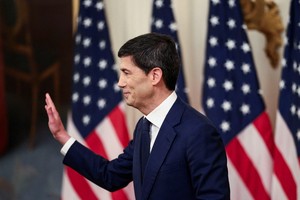
The Federal Reserve raised its US growth rate outlook for this year to 2.3 percent, up 0.1 percentage point from its previous forecast.
Sept. 17, 2026
-
Fed's median interest rate outlook rises from 3.8% to 4.1%, signaling further hikes
The Federal Reserve's median interest rate outlook rose from 3.8 percent to 4.1 percent, signaling the possibility of further rate hikes.
Sept. 17, 2026
-
Fed raises rates by 25 basis points for first time in over 3 years
Iran war-driven inflation ends five-meeting freeze; Warsh's first move defies Trump's calls for cuts The Federal Reserve raised its benchmark interest rate by 25 basis points Wednesday, ending five consecutive holds and pivoting back to tightening as the prolonged Iran war drove up global oil prices and reignited inflation fears. It was the Fed's first rate hike since July 2023, a gap of more than three years. Following a two-day Federal Open Market Committee meeting, the Fed announced Wednesday (local time) that it was lifting the federal funds rate from a target range of 3.50–3.75 percent to 3.75–4.00 percent. The increase marks the first upward move since July 2023. The Fed had begun cutting rates in September 2024, lowering them three consecutive times through November and December of that year. It cut rates three more times in September, October and December last year, then held the benchmark rate steady at five straight meetings this year. The decisive factor behind the hike was a resurgence of inflation. As the prolonged conflict with Iran sent energy prices surging, the US economy found itself facing fresh inflationary pressure. Last month, the US Consumer Price Index rose 3.4 percent from a year earlier. Core CPI — which strips out volatile energy and food prices — climbed 2.4 percent. The fact that overall inflation outpaced core inflation signals that the recent spike in global oil prices is now feeding through in earnest to US consumer prices. Financial markets had already moved quickly to price in the prospect of Fed tightening. Growing concern that inflation could persist longer than expected sent US government bond yields sharply higher, and market attention shifted from when the Fed might cut rates to how aggressively it would tighten. Particularly notable is that the first rate adjustment under Fed Chair Kevin Warsh — appointed by President Donald Trump — turned out to be a hike rather than a cut. Trump has repeatedly pressed the Fed to lower borrowing costs ahead of November's midterm elections, arguing that rate cuts would stimulate the economy. Instead, the Fed moved in the opposite direction, raising the benchmark rate by 25 basis points and prioritizing price stability. The decision leaves the Fed navigating an increasingly difficult policy path between growth and inflation. Higher rates can dampen demand and ease upward price pressure, but they cannot address supply-side shocks — such as the oil price surge driven by the Iran war — at their source. With market interest rates already elevated and borrowing costs rising for households and businesses, further tightening risks adding strain to the broader US economy. Holding or cutting rates, on the other hand, risks allowing energy-driven inflation to spread into service prices and wages, entrenching a broader inflationary cycle. The Fed's decision to reach for the rate-hike tool for the first time in more than three years reflects a growing sense of urgency to head off that kind of second-round inflation before it takes hold.
Sept. 17, 2026
MOST READ
- 1KAIST develops high-performance bio-based adhesive using E. coli instead of petroleum
- 2Pope Leo XIV declines French honors and banquet, accepts only private meeting with Macron
- 3Daimler Truck unveils next-generation transport solutions at IAA 2026
- 4What was Rachmaninoff's performance fee? A 1928 price list tells all
- 5Samsung Biologics union's show of force backfires at the bargaining table
- 6APR says hair-loss treatment research published in international journal
-
WORLD
US warns of punishment for anyone enabling Iran's Strait of Hormuz toll scheme
-
INDUSTRY

Toyota union puts productivity first; Hyundai Motor union demands bigger share of profits
-
FINANCE

National Growth Fund to invest $531M in FuriosaAI, which rebuffed Meta's $800M takeover bid
-
INDUSTRY

Korea Shipowners' Association holds amateur baduk tournament for Maritime Day