
- HOME
- WORLD

'Become a teacher, we'll pay off your student loans': Japan weighs bold incentive amid teacher shortage
Japan's government, grappling with a serious teacher shortage, is considering a plan to waive student loan repayments for young people who enter the teaching profession. The proposal would allow teachers who remain in the job for an extended period to have part or all of their borrowed tuition costs forgiven, with the aim of making teaching a more attractive career. According to the Yomiuri Shimbun on Thursday, Japan's Ministry of Education, Culture, Sports, Science and Technology is reviewing a system that would ease the repayment burden for teachers at national, public and private elementary, middle and high schools on student loans taken out during university. Japan's scholarship system is broadly divided into two types: "grant-type" scholarships that do not require repayment, and "loan-type" scholarships that graduates must pay back themselves. Under the proposed system, a certain amount — or the full sum — of a loan-type scholarship would be forgiven based on factors such as the length of a teacher's service. Whether the support would be limited to newly appointed teachers or extended to those already working in schools is to be decided through further discussion. 4,317 teachers short at the start of the school year — exam competition ratio hits record low The push for such a strong incentive comes against the backdrop of a worsening teacher shortage. A ministry survey found that at the start of the 2025 school year, public elementary, middle and high schools and special-needs schools nationwide were short 4,317 teachers compared with their original staffing plans. Teacher shortages occurred at 2,828 schools, or 8.8 percent of all schools. As of May 1, the shortfall still stood at 3,827. By school level, the shortfalls were 1,911 at elementary schools, 1,157 at middle schools, 571 at high schools and 678 at special-needs schools. A key factor is the wave of retirements among teachers hired en masse in earlier decades, combined with a growing difficulty in finding substitute teachers to cover absences for maternity, parental or sick leave. A broader labor shortage across Japanese society has also drawn more young people toward private-sector jobs and away from teaching. The popularity of teacher recruitment exams has also declined sharply. The overall competition ratio for public school teacher recruitment exams in 2025 hit a record low of 2.9 to 1, according to the ministry. The number of applicants — 109,123 — was the lowest since records began, while the number of positions offered — 37,375 — was the highest since 1986. The ministry believes that concerns about working conditions in schools, alongside the expansion of hiring to offset mass retirements, have contributed to the drop in applicants. Negative perceptions of long hours and heavy workloads are seen as one of the factors discouraging young people from choosing teaching. Japan has tried loan forgiveness for teachers before — then scrapped it A scholarship repayment waiver for teachers is not an entirely new concept in Japan. In the past, a "special repayment exemption system" allowed students who received scholarships from the Japan Ikueikai (Japan Scholarship Foundation) to have their repayments waived if they went on to work in certain education or research positions after graduation. However, the program was effectively discontinued for new undergraduate recipients from the 1998 enrollment year — and later abolished — amid fairness concerns over benefits being limited to workers in specific professions, as well as improvements in the supply of teachers. As the teacher shortage has grown serious again in recent years, the government has been gradually reviving the scholarship support option. Since the 2025 school year, a system has been in place that fully waives Type 1 scholarship repayments taken out during graduate school for those who complete a teacher training graduate program or a qualifying graduate course and are subsequently hired as full-time teachers. In 2025, 366 people qualified for the waiver. The ministry has also continued to examine repayment support for scholarships taken out at the undergraduate level. If the latest proposal is realized, the pool of eligible recipients could expand significantly. Average loan of 3.3 million yen — repaid over 15 years — makes funding the key hurdle Student loan repayment is a considerable burden for young people in Japan. An analysis by the Japan Student Services Organization of university students who finished borrowing in March 2024 found that the average amount borrowed per person was about 3.3 million yen ($21,200), with an average repayment period of 15 years. For those who choose teaching, relief from such a prolonged repayment burden could represent a significant financial incentive, particularly for first-year teachers. That is why the ministry is considering loan forgiveness as one of its core tools for making the profession more appealing. However, a large-scale expansion of the program could require tens of billions of yen in fiscal outlays, making stable funding the biggest challenge. Questions of fairness between current and newly hired teachers, and how to handle forgiven amounts when a teacher leaves before completing the required service period, will also need to be worked out in the detailed design process. How much the loan forgiveness measure would actually alleviate the teacher shortage also remains to be seen. The Japanese government is pursuing a range of other measures in parallel, including adjusting recruitment exam schedules, improving pay and conditions, and reducing administrative burdens on schools. Ultimately, while financial support for tuition costs may help lower the barrier to entering the profession, creating an environment where teachers can stay and work long-term remains an equally critical challenge in addressing the shortage.
Kim Juli Sept. 18, 2026
-

Russia summons British diplomat over Ukraine support, warns of retaliation
Russia's Foreign Ministry summoned the British chargé d'affaires in Moscow, Danae Dolakia, to lodge a formal protest over the United Kingdom's support for Ukraine. According to Reuters, AFP and other news agencies, the Russian Foreign Ministry said in a statement Friday (local time) that Britain was "volunteering to be complicit in the atrocities committed by the Kyiv regime" by expanding the supply of weapons to Ukraine, including drones, and providing long-range arms. "This can only be characterized as terrorism and war crimes," the ministry said. The ministry said it had handed over a list of international obligations it accused Britain of violating, and called on London to "abandon the path of escalation and act in accordance with its relevant international obligations." It added that "full responsibility for the deterioration of the situation lies with Britain," and that "Russia has the right to take retaliatory measures in accordance with its right to self-defense." The ministry also said British military facilities in Ukraine used in attacks on Russia were "legitimate targets for Russian forces." Britain is a member of the "Coalition of the Willing," formed to provide security support for Ukraine after the war. New Prime Minister Andy Burnham has been a vocal backer of Kyiv, co-chairing a Coalition of the Willing summit there on Aug. 24, the 35th anniversary of Ukrainian independence.
Sept. 18, 2026
-
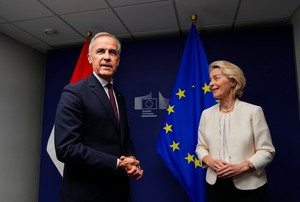
Canada eyes EU associate membership — but what would it actually mean?
As the EU responds enthusiastically to Canada's courtship in its search for a counterweight to Donald Trump, Canada is being discussed as a potential first-ever EU associate member. Such a status would likely grant Canada treatment comparable to full EU membership in economic and trade terms, while stopping short of voting rights on EU resolutions. Some observers suggest Canada could be given greater political say than existing European Economic Area members to set its status apart. Canada, which urgently needs allies to replace the United States amid trade tensions, would welcome the associate membership option — but resistance could emerge from within the EU and its neighborhood. Granting Canada associate status ahead of nine countries already waiting in line for full EU accession could trigger accusations of preferential treatment. There are also signs of discontent over the prospect of Canada enjoying near-member benefits without contributing to the EU budget. EEA-style model without voting rights seen as likely; 'Swiss position plus political voice' also floated European Commission President Ursula von der Leyen proposed admitting Canada as an associate member in her annual address to the European Parliament on Wednesday (local time). She also called for deepening and broadening cooperation between Canada and the EU — spanning defense to trade — and proposed jointly pursuing initiatives such as Arctic exploration. If her proposal is accepted, Canada would become the first associate member in EU history. Diplomatic circles, including the European Parliament, expect the associate membership model to resemble that of Norway, Iceland and Liechtenstein — countries that belong to the EEA but are not full EU members. EEA countries are guaranteed the free movement of goods, services, capital and labor with the EU, meaning workers from EEA states face no barriers to employment in EU member states. They trade with the EU tariff-free but must follow EU rules on matters such as the environment and labor standards. The defining difference from full membership is often summed up as: they must follow the rules but have no hand in making them. EEA members have no vote on EU decisions. Some observers, pointing to the wide range of cooperation areas — manufacturing, technology, defense, energy and the Arctic — cited by both von der Leyen and Canadian Prime Minister Mark Carney, expect Canada's rights as an associate member to amount to the economic privileges of an EEA state with some degree of political voice added. Others see the EU-Canada relationship as similar to the EU's relationship with Switzerland, but with greater political engagement. Bernd Lange, chair of the European Parliament's Committee on International Trade, told Bloomberg that the expanded relationship between the EU and Canada could resemble the EU-Switzerland model, though with deeper political involvement on Canada's part. Switzerland has rejected both EEA membership and EU accession, instead participating actively in the single market through more than 120 individual bilateral agreements with the EU. It is outside the customs union but is part of the Schengen Area, allowing the free movement of people across its borders with neighboring EU states without passport controls. Lange said the EU has more than 100 different, fairly close agreements with Switzerland, but that Switzerland is not integrated into the EU's political decision-making process — and suggested Canada could gain some say in EU decision-making without holding full voting rights. Special treatment for Canada alone? Discontent from members and applicants is the key hurdle Canada is already a participant in SAFE, the EU's defense procurement lending program, and a signatory to CETA. SAFE is a program under which the EU provides 150 billion euros ($172 billion) in loans for the joint procurement of weapons and military equipment to strengthen the defense industrial base. CETA, the Comprehensive Economic and Trade Agreement struck between Canada and the EU a decade ago, has allowed 99 percent of traded goods between the two sides to flow tariff-free. The two sides are now drawing up plans to further facilitate the movement of services and financial flows. Within Canada, securing associate member status is likely to enjoy broad support. Canada, locked in a trade dispute with the United States, urgently needs to find markets to replace its top trading partner. A poll by Abacus Data conducted earlier this month found that 80 percent of Canadian respondents supported closer cooperation with the EU on diplomacy, defense and the economy. Support for full EU membership, however, was considerably lower at 49 percent, suggesting that associate membership — a more calibrated level of integration — could command wider backing. The sticking points lie with full EU member states and countries waiting to join. Nine countries are already in the queue for EU accession. Ukraine, a candidate country in particular, has rejected the concept of "membership light" proposed by German Chancellor Friedrich Merz and is pushing for full membership. Creating a brand-new "associate member" category for Canada while those countries face rigorous compliance checks could easily be seen as preferential treatment. Full EU member states, which are currently negotiating the scale of their contributions for the next seven-year budget cycle, may also voice displeasure at admitting Canada as an associate member. Members are already feeling the strain of rising contributions — including for defense — and are likely to bristle at the prospect of an associate member enjoying near-equivalent benefits without paying into the budget. Meanwhile, von der Leyen, who put forward the associate membership concept, is scheduled to meet Prime Minister Carney in Montreal next month for an EU-Canada summit. The two leaders aim to secure approval from the European Parliament and the EU Council before then, with the goal of showing tangible progress. Debriefing: The Korea Herald's international desk breaks down the hidden stories behind the hottest global issues. We want to hear from you — leave your questions in the comments.
Sept. 18, 2026
-

'Don't play the same music on loop — it was torture,' says woman who woke from coma
A woman's account of experiencing music played in her hospital room as "torture" while she lay in a coma has drawn wide attention abroad. According to Argentine outlet La Nacion on Sept. 9 (local time), Kenya Moreno, a young woman from Andalusia, Spain, recently shared on social media her experience of spending a month in a coma. At the time of her hospitalization, Moreno was an avid fan of Spanish duo Gemeliers. Her mother, hoping to comfort her, bought the group's album "Lo mejor está por venir" and played it in the hospital room. The problem was that the same album played on repeat for an entire month. Recalling the experience, Moreno pleaded: "Please, do not play music for someone who is in a coma — or at least, if I ever fall into a coma again, don't play music for me." "People in a coma can hear sounds," she said. "I kept hearing that song. It was pure torture, because the same song just kept repeating over and over." Moreno said she remembers not only the music but also the cold. She said she felt an intense chill throughout the entire month, and only after waking did she learn it had been caused by the room's air conditioning. "I was in a truly strange place, it was freezing cold, and the song just kept playing without end," she said. Bee Gees' Robin Gibb woke to music — 'the brain processes it differently from language' The story has reignited interest in how much awareness coma patients retain of sounds and events around them. A 2024 study published in the New England Journal of Medicine found that cognitive activity can occur even in patients who show no outward response to commands. When researchers analyzed 241 patients who had not responded behaviorally to verbal instructions, 60 of them — 25 percent — showed brain activity on fMRI or EEG scans consistent with mentally performing tasks as directed. The researchers described the phenomenon as "cognitive-motor dissociation." NBC News previously reported the case of Robin Gibb, a member of the legendary British pop group the Bee Gees, who emerged from a coma after his family played music for him. His family sang and played music at his bedside continuously, hoping he would recover. Gibb is said to have regained consciousness while listening to "The Titanic Requiem," a piece he had composed with his son. Music can elicit responses in some patients because the brain processes it differently from spoken language. James Bernat, a professor of neurology and internal medicine at Dartmouth Medical School, said, "Patients with left-hemisphere damage lose the ability to speak and understand language," adding, "but music therapy is very useful because it acts on the non-dominant hemisphere of the brain."
Sept. 18, 2026
-
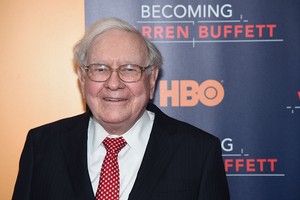
Warren Buffett steps down as Berkshire Hathaway chairman after 56 years
Retirement from chairmanship follows CEO exit earlier this year Son Howard named as successor Warren Buffett, the 96-year-old investor known as the "Oracle of Omaha," has stepped down as chairman of Berkshire Hathaway, the investment company he built, after 56 years at its helm. Berkshire said in a statement Thursday (local time) that Buffett had relinquished the chairmanship and been named honorary chairman. The company said he would remain on the board in that capacity and continue to offer valuable judgment and perspective. Buffett had already stepped down as CEO of Berkshire effective Jan. 1 this year. His departure from the chairmanship — a post he assumed in 1970 — marks a full exit from the company's executive leadership after 56 years. His son Howard Buffett has been named as the new chairman. Born in 1930, Buffett ranks among the world's 10 wealthiest people according to the Bloomberg Billionaires Index. He had amassed $1 million by age 32 and went on to build Berkshire Hathaway into a global investment powerhouse through decades of compounding returns. In a separate letter to shareholders, Buffett wrote: "Father Time always wins, but he has been kind to me."
Sept. 18, 2026
-

At least 3 students killed, 8 wounded in shooting at Philippine high school
Suspect used pistol belonging to parents A shooting at a school in the Philippines left at least three people dead and eight others wounded. According to AFP and local outlets including ABS-CBN, a teenage student opened fire at Banga National High School in the Banga area of South Cotabato province on Mindanao island in the southern Philippines at around 1:18 p.m. Friday (local time). The shooting killed the suspect and two other students and left eight students wounded, Banga Mayor Albert Palencia said. Four of the injured were in critical condition. The suspect, a ninth-grade student, killed one male and one female classmate before taking his own life, according to authorities. Mayor Palencia said the suspect — a child of a Ministry of Education civil servant — retrieved a 9mm pistol from a safe at home and used it in the attack. The suspect had also told two friends shortly before the shooting that he planned to carry out the act right after lunch. South Cotabato Governor Reynaldo Tamayo said initial investigation results included a statement from a friend of the suspect indicating he had been a member of an online community with an interest in real-life crime. Local authorities in Banga suspended all classes in the area immediately after the shooting.
Sept. 18, 2026
-
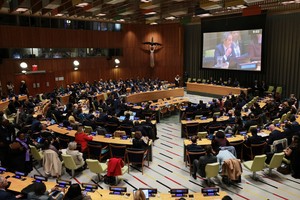
IAEA general conference rejects North Korea's nuclear-state status
'Serious concern' over Pyongyang's nuclear activities; 103 nations vote in favor as China, Russia oppose Member states of the International Atomic Energy Agency have reaffirmed that North Korea cannot hold nuclear-weapon-state status under the Nuclear Non-Proliferation Treaty. The IAEA adopted a resolution on the implementation of the NPT safeguards agreement between the agency and North Korea at its 70th regular general conference in Vienna, Austria, on Thursday (local time), with 103 votes in favor, 6 against and 14 abstentions. Russia and China were among those that voted against. The resolution said North Korea's nuclear activities "continue to be a matter of serious concern" and called on Pyongyang to "immediately cease all related activities." The resolution also specifically enumerated recently observed activities at North Korean nuclear facilities, singling out the continued operation of the 5 MW reactor and light-water reactor at Yongbyon as matters of serious concern. It also said there were signs of expanded mining, refining and uranium concentrate production at the Pyongsan uranium mine and processing plant, and noted that the Punggye-ri nuclear test site remains capable of supporting a nuclear test. The IAEA general conference has consistently raised concerns about North Korea's nuclear weapons program through annual resolutions. IAEA Director General Rafael Grossi said in a report submitted to the conference that additional uranium enrichment facilities had been identified at the Yongbyon nuclear complex — previously believed to have been dismantled but restarted in 2021. The report also said an annex building added to the Kangson enrichment complex appeared to have begun operation in January, indicating a further expansion of North Korea's capacity to produce weapons-grade nuclear material. Since IAEA inspectors were expelled from North Korea in 2009, the agency has monitored the country's nuclear activities using only satellite imagery and open-source information. Meanwhile, Kim Yo-jong, a senior Korean Workers' Party official and sister of North Korean leader Kim Jong-un, pushed back against the IAEA conference's call for denuclearization, saying the country's status as a nuclear state "cannot be reversed by anything."
Sept. 18, 2026
-

Russia's national messenger app Max found to contain backdoor capable of secret screen captures
Max, the messaging app the Russian government has effectively mandated its citizens use, was designed with capabilities that allow sweeping access to users' devices, researchers have found. The research team said the structure amounts to a backdoor. According to the Guardian on Friday (local time), a research team led by Roya Ensafi, an associate professor of computer science at the University of Michigan, published findings after downloading and analyzing Max. The team found that Max can secretly capture screenshots of a device's screen and app content without the user's knowledge, and can access information stored in mini-apps, messages and payment records. It can also impersonate users and inject code into other apps without their awareness. Ensafi said the ability to inject code means the Russian government could use Max as a tool for cyberattacks. She described Max as "a blueprint that any government can replicate," adding that countries such as Iran, Kazakhstan and India could attempt similar approaches in the near future. However, she said Max cannot penetrate Telegram or WhatsApp if a user has those apps installed. Russia has blocked both at the government level. Max is a super-app developed by Russian social media company VK that bundles messaging, banking, payments and government services into a single platform. Russia made preinstallation of Max mandatory on new smartphones starting Sept. 1 last year, in effect compelling its use. The country blocked WhatsApp in February this year and Telegram in April. Yet testimony from within Russia's power circles suggests Max use there is largely performative. One Kremlin insider told the Guardian on condition of anonymity that they and their acquaintances had bought a second phone solely to have Max installed. "It's all for show. Nobody in political circles actually uses it," the person said. Meanwhile, Ensafi said Russia had built a digital control system over the past decade and that the case should be taken as a warning sign.
Sept. 18, 2026
-

Magazine borrowed in 1894 returned to New Hampshire library after 132 years, with $12,055 in waived fines
A 19th-century magazine checked out from a public library in the United States has been returned after roughly 132 years, thanks to a fine-waiver program. According to NBC, BBC and other outlets, the Concord Public Library in New Hampshire announced Wednesday (local time) that a copy of the September 1894 issue of The Century Illustrated Monthly Magazine had been returned the previous week. The magazine had been checked out and never returned for 132 years — an overdue period of 48,220 days. Under normal circumstances, the borrower would have owed $12,055 in late fees. The library had a fine-waiver program in effect at the time of the return, however, having launched a one-year amnesty on overdue fines beginning Sept. 1. John Hanson, 84, who returned the magazine, said it had been "floating around" his home for decades. He said he had no idea how it ended up there in the first place. The library said on its official social media accounts that many people had been delighted to hear about the fine waiver. "We expected some long-overdue books to come back, but we never dreamed a magazine checked out in the late 19th century would be among them," it said. The historic magazine will not return to the general circulation shelves. The library said it is considering placing the item on special display in the Concord Room, a space dedicated to local historical materials.
Sept. 18, 2026
-

'Worst is yet to come' for oil markets as Saudi pipeline repair could take two months
A grim outlook has emerged that the damage to Saudi Arabia's crude oil transport capacity is far worse than initially thought, and that the worst may still lie ahead for oil markets within the next two months. While Saudi Arabia is rushing to repair the damage, analysts warn that the kingdom could face even heavier strikes from Houthi rebels — an Iran-aligned force — during or after the recovery, given that the United States has refused to intervene in the conflict. With US midterm elections approaching and winter energy demand on the horizon, American politicians are weighing a diesel export ban, though experts say such a move would do little to tame surging prices. The Washington Post reported Thursday, citing satellite imagery analysis of Saudi Arabia's east-west pipeline, that the damage is more extensive than previously disclosed. The Post said at least two pumping stations along the pipeline sustained damage. Andrew Lipow, a consultant who advises on oil infrastructure, said satellite images of the Saudi pipeline show "a significant amount of damage" and that repairs would likely take "one to two months." He said Saudi Arabia would need to replace everything "from the piping to the valves to all the electrical equipment," adding that "this is not something you can just pick up off the shelf at Costco." He also noted that several pumping stations along the pipeline are particularly vulnerable to external attack. Saudi Arabia's oil storage facilities have also suffered greater damage than publicly known. The Post, analyzing video and satellite imagery, reported that an Aramco bulk plant in Abha, a city in southwestern Saudi Arabia, was also hit in last week's Houthi attack. Analysis of satellite images taken Sept. 9 showed at least six storage tanks at the facility had been destroyed. Saudi Arabia's ability to defend its crude supply has been severely undermined by Washington's refusal to intervene, analysts say, leaving the kingdom far more exposed to further threats. Brett Erickson, a geopolitical expert and board member at Seton Hall University's School of Diplomacy and International Relations, said "what has become clear is that Saudi Arabia has no ability to protect its own infrastructure," and claimed that three pumping stations — not one — were damaged in the Houthi pipeline attack Thursday. Erickson added that it was deliberate that "the Houthis and Iraqi militias have stopped attacking the pipeline." He said the Houthi strategy is to allow repairs to reach roughly 95 percent completion before striking again to inflict maximum damage. Analysts also said the Houthi rebels' concentrated attacks on Saudi oil facilities reflect a coordinated strategy with Iran. Iran is trying to drive up US oil prices ahead of the midterm elections to pressure the Donald Trump administration into negotiations, with the Houthis actively targeting Saudi energy facilities in support of that goal. Bob McNally, an energy adviser during the George W. Bush administration, predicted that Iran would "keep trying to push crude prices higher to pressure Donald Trump into submission." US fuel prices are already surging. According to the American Automobile Association, the national average price of gasoline stood at $4.44 per gallon Thursday, while diesel reached $6.40 per gallon. Liz Thomas, chief market strategist at financial services firm SoFi, posted on X, formerly Twitter: "Five days ago I noted that based on the trend at the time, diesel could hit $6.65 per gallon by Election Day, Nov. 3 — and the trend has gotten worse. Diesel has already blown past $6.26 per gallon." Experts fear the worst for oil markets as elections and the high-demand winter season approach. Tom Kloza, chief energy adviser at Gulf Oil, said Wednesday that "fuel margins haven't caught up to the earlier wholesale price increases yet" and predicted "shocking price increases at the pump for both gasoline and diesel." Patrick De Haan, head of petroleum analysis at price-tracking platform GasBuddy, posted on X the same day: "Buckle up. Gasoline and diesel prices look set to spike over the next 48 hours, with some inland areas taking the biggest hit." US politicians are also weighing a diesel export ban in response to the sharp rise in fuel prices. Senate Majority Floor Leader John Thune, Republican of South Dakota, said Tuesday he was open to considering a diesel export ban. But experts immediately warned that such a move would only worsen the energy crisis. Tracy Shuchart, chief economist at commodities trading platform NinjaTrader, posted on X that the diesel price surge "is a war problem compounded by refining capacity and crude quality issues," adding that "an export ban solves neither and makes both worse."
Sept. 18, 2026
-
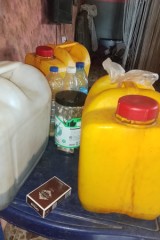
At least 48 dead in Nigeria after drinking locally made liquor suspected to contain methanol
At least 48 people have died and more than 100 are receiving treatment after drinking locally made liquor suspected to contain methanol in Ondo State, southern Nigeria, over the past two weeks. According to the Associated Press, residents in the Odigbo and Irele areas of Ondo State began falling ill after consuming the locally brewed drink Thursday (local time). State health authorities estimate that at least 48 people have died and a total of 182 have been affected. One victim, Sola Adebayo, 32, told local media that he had about two drinks on a Friday before going out, then lost consciousness. "By Saturday, I realized I could not see," he said. Local residents suspect that Monkey Tail, a locally made herbal liquor, may have been adulterated with methanol. Monkey Tail is made by mixing ogogoro — a potent spirit distilled from raffia palm sap — with plant roots, cannabis and other ingredients. Banji Ajaka, Ondo State's health commissioner, warned that the drink "can cause kidney failure, blindness and brain damage depending on the amount consumed." Homemade liquor is relatively common in rural parts of Nigeria, where prices are low and oversight of retail and manufacturing is weak. Ondo State police said 15 people have been arrested in connection with the incident, including one person facing charges of producing a substance suspected to contain methanol. Meanwhile, Nigeria's health authorities have imposed a nationwide ban on the sale of alcoholic beverages packaged in small plastic sachets or plastic containers as a safety measure.
Sept. 18, 2026
-

Mayweather's daughter ordered to pay $50m after stabbing acquaintance multiple times
A court has ordered Iyanna Mayweather, 26, the daughter of former US boxing champion Floyd Mayweather, to pay $50 million in damages to an acquaintance she stabbed multiple times during an argument. TMZ Sports reported that Floyd Mayweather's daughter must pay more than $50 million to the victim of the stabbing. According to court documents obtained by TMZ, a Texas court ordered Iyanna to pay Lapattra Jacobs $40.105 million in compensatory damages and an additional $10 million in punitive damages. The breakdown, TMZ said, includes more than $8 million for past medical expenses, pain and suffering, physical impairment, lost income and disfigurement, along with $32 million in future damages for those same categories. Iyanna and Jacobs came to blows in April 2020 after both claimed to be the girlfriend of rapper NBA YoungBoy. Iyanna, who was 19 at the time, insisted she was YoungBoy's fiancée, while Jacobs — who had a child with the rapper — refused to back down, setting off the confrontation. Iyanna retrieved two knives from the kitchen and stabbed Lapattra in the arm multiple times. Lapattra suffered serious injuries that left her with severely limited use of her arm and required surgery. During the trial, Iyanna argued she had acted in self-defense after Lapattra pulled her hair. She nonetheless pleaded guilty in April 2022 to aggravated assault with a deadly weapon and was sentenced in December of that year to six years of probation and 40 hours of community service. Iyanna's father, Floyd Mayweather, is a legendary American professional boxer who retired with a perfect 50-0 record, winning titles across five weight classes and defeating the top fighters of his era, including Manny Pacquiao, Oscar De La Hoya and Canelo Alvarez. Mayweather is reported to have earned more than $1.2 billion throughout his career but has more recently struggled financially. His lavish spending habits have depleted his fortune, and he has become entangled in multiple legal disputes over unpaid taxes and rent, with some of his assets seized or sold.
Sept. 18, 2026
-

Earl Spencer claims King Charles sounded 'elated' in call right after Diana's death
Charles Spencer, the younger brother of the late Princess Diana, has claimed in a memoir that King Charles III sounded elated during a phone call immediately after Diana's death in 1997. Buckingham Palace responded by suggesting that grief over the loss of a sibling can distort memory. According to the BBC on Thursday (local time), Spencer recounted in his memoir, "Swan Song: Diana, My Sister" — due for release in Britain and the United States on Monday — the moment he learned of Diana's death by phone in the middle of the night at his home in Cape Town, South Africa, on Aug. 31, 1997. Spencer said he received a call from King Charles III shortly after hearing the news. "Unlike others who were too shocked to offer condolences or find any words at all, he sounded elated, as if he had won the lottery," Spencer said. "That is what I remember thinking at the time." Spencer also said that in a call ahead of Diana's funeral, King Charles III told him, "Don't worry, we will all forget about her soon." The memoir also addresses Diana's marriage. Spencer said he heard from a friend of Diana's that King Charles III told her the day before their wedding, "I am glad we are getting married, but I don't love you." Spencer added that Diana endured the marriage out of her love for her two sons. Buckingham Palace, in a statement issued through a spokesperson on Wednesday, said it does not comment on books as a matter of principle, but added that "the King is mindful that grief over the loss of a sibling can cloud reason, affect judgment and distort memory." The statement continued: "Even after many years have passed since such a loss, a person may not be aware of those effects." Buckingham Palace, however, stopped short of directly disputing the content of the phone call Spencer described or offering an alternative account. A spokesperson for Prince Harry said he had no wish to comment on the memoir. The Daily Telegraph reported that Spencer had not informed Prince William or Prince Harry of the claims in the book before its publication. Spencer said he wrote the book to correct false narratives surrounding his sister. Diana married King Charles III in 1981 and had two sons with him. The couple separated in 1992 and divorced in 1996. She died in a car crash in Paris on Aug. 31, 1997, at the age of 36. Her funeral was held at Westminster Abbey on Sept. 6 of that year.
Sept. 18, 2026
-

Australian HYROX winner withdraws result, forfeits points after fecal incontinence incident
Joanna Wieteska, the Australian athlete who won the women's pro division at the HYROX Beijing competition after finishing the race while experiencing fecal incontinence, has apologized and voluntarily withdrawn her result, saying she should have dropped out at the time. According to the BBC, Wieteska posted an apology on Instagram saying she was "sincerely sorry to the people of China, fellow competitors, spectators and the HYROX organizers for what occurred during the race in Beijing." She added that she was "fully aware" that her actions had affected others beyond herself and expressed deep regret to everyone who was impacted. "At the start of the race I felt great and had no expectation that a health issue would arise," Wieteska said. "Looking back, I regret the decision not to leave the course during the race." She went on to say she was "taking responsibility" for her decision to continue and offered a sincere apology for "the discomfort and confusion" it caused. "After much reflection, I have decided to retroactively withdraw my result from the race and return the points I earned," Wieteska said, adding that she would carry with her the lesson that "there are values in life more important than a race, and the wisdom to know when to step back." She said that for now she intended to step away from outside noise, focus on recovery and self-reflection, and spend time with her family. The incident occurred Saturday at the HYROX Beijing pro women's event. Wieteska experienced fecal incontinence during the fourth station — the burpee broad jump — but did not stop, crossing the finish line in 1 hour, 1 minute and 23 seconds to claim first place. The 24-year-old from Melbourne holds the women's world record in HYROX. Wieteska completed all eight stations with waste running down her thighs and legs. Other competitors were left to use contaminated equipment and the same track, and at least one athlete fell during the event. According to the South China Morning Post, Chinese officials said on-site staff immediately cordoned off the affected zone and carried out disinfection work throughout the day. Contaminated equipment was removed, and the carpet was to be replaced after the event concluded. Shortly after the competition, Wieteska posted "a win is a win" on Instagram before deleting it following a wave of criticism. HYROX co-founder Moritz Fürste said Sunday that the organization had failed to handle the situation adequately and pledged to revise its rules. "HYROX made the mistake of not immediately intervening during the race," Fürste said, according to NBC News. "Ultimately it is my job to anticipate situations like this, and I failed to do so." HYROX said it had "clear protocols for biological contamination and medical situations" but acknowledged that an "unexpected situation" had led to "confusion in the application and understanding of the rules." HYROX is an indoor sport in which participants alternate between 1-kilometer runs and fitness exercises across eight rounds, incorporating movements such as sled pushes, burpee jumps, indoor rowing and lunges with a sandbag. Fürste and Christian Toetzke founded it in 2017, with the inaugural event held in Hamburg, Germany, in 2018, drawing 600 participants.
Sept. 18, 2026
-
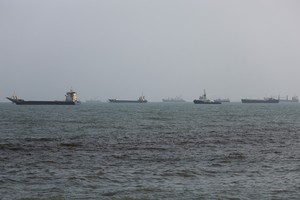
Iran's Revolutionary Guard claims attack on Togolese oil tanker in Strait of Hormuz, fire breaks out
Iran's Islamic Revolutionary Guard Corps said Thursday (local time) it attacked a Togolese-flagged oil tanker attempting to pass illegally through the Strait of Hormuz, triggering a fire on board. The IRGC Navy said through state media Friday that the stricken tanker came to a stop after catching fire, Yonhap said. According to China's Xinhua news agency, the IRGC Navy also said in a statement issued through its affiliated outlet Sepa News that the Togolese-flagged tanker Trend had been deceived by US forces into attempting to pass "illegally" through the Strait of Hormuz. The Iranian military said it still controls the Strait of Hormuz and will not permit passage by any aggressor. Iran, which is at war with the United States, has been asserting control over the Strait of Hormuz and attacking merchant vessels that pass through without authorization. IRGC earlier claimed supertanker struck mine Earlier, on Monday (local time), the IRGC Navy said a supertanker attempting to pass through a controlled zone at the southern end of the Strait of Hormuz struck a mine and exploded. In a statement issued through Sepa News, the IRGC Navy said the supertanker EL GAIA, with maritime registration number 9325336, "struck a mine after ignoring prior warnings about the dangers of illegal passage and attempting to enter the zone," Yonhap said at the time. According to the European Quality Shipping Information System, the vessel is a Panama-registered tanker of 28,779 tons. The Revolutionary Guard said "firefighting efforts have come to nothing, and the entire tanker is currently engulfed in flames." The statement also declared: "We firmly declare that the Strait of Hormuz is now blockaded and is under our thorough intelligence surveillance and control."
Sept. 18, 2026
-
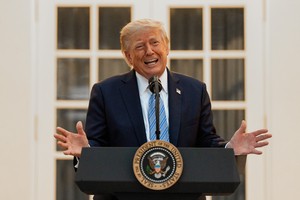
Trump says he told Fed Chair Warsh to vote with the board: 'It won't matter anyway'
Trump claims rate hike was aimed at him, not inflation; calls Fed board 'hostile' and 'political' In an era when a single word from Donald Trump can shake global markets, keeping up with the flood of Trump news is no easy task. Our daily Trump briefing cuts through the noise — from the Wall Street closing bell to the market-moving headlines that matter most — delivered in under a minute. Subscribe to the newsletter on The Herald Business website. US President Donald Trump said he told Federal Reserve Chair Kevin Warsh not to oppose the interest rate hike and that it would be better for him to vote in line with the board. Speaking to reporters in Charlotte, North Carolina, on Wednesday (local time), shortly after the Fed raised its benchmark interest rate by 25 basis points for the first time in three years, Trump said he had told Warsh: "You'd be better off voting with the board on this — it's not going to matter anyway." Asked whether he had tried to persuade Warsh, Trump said he had not. "I told him, 'Do whatever you want' — it doesn't matter because one vote can't change the outcome," he said, voluntarily disclosing the substance of a conversation he had with Warsh before the vote. Trump described Warsh as "a good man" who "works hard," while turning his fire on the Fed board itself, calling it "very hostile, very political" and accusing it of "doing the wrong thing." "They're politicians, or people put there by politicians," Trump said. "Raising rates to bring down prices? No — they're raising rates to make Trump look as bad as possible." The New York Times reported that Trump, though angered by the Fed's unanimous rate hike, shielded Warsh — his own appointee — from criticism, a sharp contrast to the withering attacks he once directed at former Chair Jerome Powell. Trump had launched punitive investigations targeting Powell and attempted to remove Fed Governor Lisa Cook, but the Supreme Court blocked that removal attempt on June 29. The Times suggested Trump's softer tone toward Warsh reflected his awareness of the political backlash that could follow any move against the new Fed chief. Still, Trump has not fully backed off his pressure on the Fed. He separately issued an ultimatum, threatening to cut off a significant portion of US trade unless the Fed slashes rates to below 1 percent. With the Fed widely expected to raise rates more than once, experts are divided over how long the honeymoon between Trump and Warsh will last. The dot plot released that day showed that most FOMC members anticipated at least one additional rate hike this year, with some projecting further increases next year as well. With the door open to further rate hikes, the standoff between Trump and the Fed is expected to continue for now — though Warsh himself has been tight-lipped about his exchanges with the president. At his post-FOMC news conference, Warsh sidestepped a related question, saying he had "nothing to share" about conversations with the president. Asked whether he planned to explain the rate hike to Trump, Warsh deflected with a statement of principle: "Fed independence means we protect our own domain." During his confirmation hearing, Warsh said Trump had never asked him to commit to a specific rate decision, adding that even if he had, "I would never have agreed." Sarah Binder, a political science professor at George Washington University, said Trump "cannot escape the perception that he is still trying to interfere in Fed decisions," adding that "the very fact that the president feels entitled to direct the Fed is itself a political risk."
Sept. 18, 2026
-

Trump administration approves $24.3b F-35 sale to Saudi Arabia
A major win for Riyadh amid Houthi attacks, but US Congress could still block the deal over technology-leak concerns The Trump administration approved the sale of advanced F-35 fighter jets to Saudi Arabia in a deal worth $24.3 billion on Thursday (local time). The Department of State said in a statement that the approval "will support the foreign policy and national security objectives of the United States by strengthening the security capabilities of a major non-NATO ally that contributes to political stability and economic progress in the Gulf region." It added that the sale "will enhance Saudi Arabia's ability to deter current and future threats by improving its homeland defense capabilities and interoperability with US and other regional and NATO forces." The United States began laying the groundwork for the sale last November, when Crown Prince Mohammed bin Salman visited Washington. At the time, Donald Trump said he would approve the sale the day before the crown prince's arrival. If fully carried out, the deal would make Saudi Arabia the only Arab country to operate the F-35. The Financial Times described the approval as a major win for Riyadh, coming as Saudi Arabia faces renewed attacks from Yemen's Houthi rebels, an Iranian proxy force. Saudi Arabia, the world's largest crude oil exporter, has relied on a pipeline running from its eastern oil fields to the Red Sea port of Yanbu as an export route since the Strait of Hormuz was blocked following the war with Iran. The Houthis have recently seized key positions near the Bab el-Mandeb strait at the entrance to the Red Sea and struck major Saudi energy infrastructure, dealing a serious blow to the kingdom's crude exports. While acquiring the F-35 would significantly boost Saudi air power, delivery remains far off. The agreement must clear a congressional review, and even if lawmakers approve it, the first jets would take years to arrive. US intelligence agencies have already raised concerns that the sale could give China access to sensitive technology related to the aircraft. The New York Times reported Thursday that the Defense Intelligence Agency had, in a report issued months earlier, questioned whether the United States and Saudi Arabia could maintain the security of F-35 technology, citing Chinese military access to Saudi bases and the use of Chinese technology within Saudi communications infrastructure. Rep. Raja Krishnamoorthi, a Democrat on the House Intelligence Committee, issued a statement warning that the sale "would be a threat to our national security if permitted," adding that "China has been stealing our intellectual property and technology for decades to close the gap with the United States."
Sept. 18, 2026
-
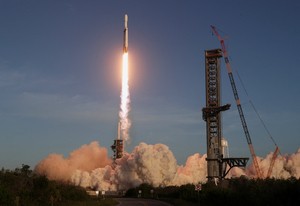
SpaceX to attempt first orbital Starship flight Tuesday, deploying new Starlink V3 satellites
SpaceX is preparing to send its Starship rocket into Earth orbit for the first time. The test flight is seen as a critical proving ground not only for the rocket's development but also for the commercial value of SpaceX, which listed on NASDAQ in June. SpaceX announced Thursday that it plans to conduct the 14th Starship test flight on Tuesday — between 9:15 p.m. and 10:30 p.m. Korean Standard Time — pending regulatory approval, and will carry 26 Starlink V3 satellites on board. Unlike the 13th test in July, which reached only a suborbital trajectory, this mission aims to place Starship in an orbit roughly 275 kilometers above Earth, complete six loops around the planet, and then splash down in the Pacific Ocean west of Chile after about 10 hours. The flight will mark the first time the new Starlink V3 satellites — each weighing 2,000 kilograms — enter actual orbit. In addition, two heat-shield tiles recovered from the 13th test vehicle have been reinstalled on the spacecraft for this mission, making it SpaceX's first instance of tile reuse. SpaceX Chief Financial Officer Bret Johnsen called the upcoming launch a "massive milestone," saying it would be the first revenue-generating flight for Starship since the company's listing. Each satellite adds one terabit per second of capacity, meaning a single launch will increase total communications capacity by roughly 10 times what a single Falcon 9 smallsat mission delivers, the company said. SpaceX CEO Elon Musk posted on X that Starlink V3 would provide "more than 100 times the bandwidth" of the current constellation of about 11,000 satellites. SpaceX also plans to test the booster's launch, separation, boostback burn and splashdown procedures during the flight. During the 13th test, only 8 of the 13 engines required for the pre-splashdown relight successfully ignited, resulting in a hard landing. The company said it has since improved engine filtering hardware and reignition software. Musk said at an event Thursday that this flight would be the last mission before SpaceX attempts to "catch the ship" for the first time, adding that it was "very likely" the company would achieve full reusability and rapid relaunch capability by 2027. SpaceX shares closed down 3.2 percent at $143.49 on the day of the announcement, compared with the previous session. The decline reflects investor caution over launch risk, even as SpaceX posted second-quarter sales of $7.81 billion — up 91.9 percent year-on-year and above market expectations. SpaceX has already invested more than $15 billion in Starship development and plans to spend at least $100 billion more building a dedicated launch facility in Louisiana. Jeffrey Blodgett, an analyst at Pivotal Research Group, wrote in a recent customer note that "whether the investment in SpaceX pays off depends almost entirely on making Starship fully reusable."
Sept. 18, 2026
-
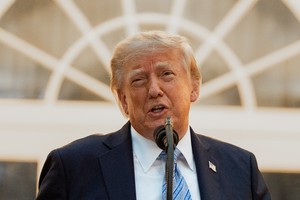
Trump vows to protect Second Amendment rights at White House dinner with gun, outdoor groups
Trump's words move global markets and financial markets alike. If keeping up with the flood of Trump news feels overwhelming, the Daily Trump briefing is for you. The Herald Business international desk — on the move from 5 a.m. — curates everything from the US market close to the Trump headlines shaping global asset markets, delivered in a one-minute read. On your commute, over a solo lunch, or before bed — just one minute a day. Subscribe to the Daily Trump newsletter at the Herald Business website. US President Donald Trump reaffirmed his support for the Second Amendment — which guarantees the right to keep and bear arms — on Thursday (local time), saying that right "shall never be infringed." Trump made the remarks at a White House Rose Garden dinner he hosted for representatives of hunting, fishing and other outdoor recreation groups and companies. "We are keeping the Second Amendment going," he said. "It's a really tough fight." He then doubled down, saying, "As your president, I will always protect your Second Amendment" and that "the right to keep and bear arms shall never be infringed." The Second Amendment states that "the right of the people to keep and bear arms shall not be infringed." Trump also signed two executive orders at the event aimed at expanding outdoor leisure activities such as hunting and fishing, calling them "a historic victory for American sportsmen." On the specifics, Trump said his administration would "open up millions of acres of federal land for hunters and fishermen," adding that "public lands belong to the American people and the public, and hunters, fishermen and outdoor enthusiasts should have access to them." He also described an executive order rolling back regulations on saltwater recreational fishing and the boating industry, saying it would eliminate "ridiculous federal regulations on saltwater fishermen, boaters, charter captains and coastal communities." About 100 representatives from outdoor groups and companies attended the event, including the National Rifle Association and Bass Pro Shops, the largest outdoor retail chain in the United States.
Sept. 18, 2026
-
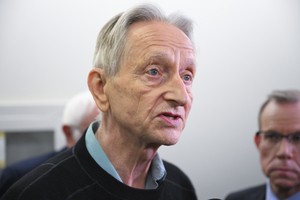
'Godfather of AI' warns of losing control within a year without safeguards
Geoffrey Hinton, professor emeritus at the University of Toronto and one of the three godfathers of AI, warned that humanity could lose control of artificial intelligence within a year if safeguards are not put in place. Yoshua Bengio, a professor at the University of Montreal and another figure counted among the AI godfathers, also urged the creation of international AI safety mechanisms as robust as those governing nuclear weapons. According to Yonhap, NBC News reported Wednesday (local time) that Hinton met with other AI experts and members of both chambers of Congress at a closed-door briefing organized by Sen. Bernie Sanders (I-Vt.), where he conveyed those views. After the briefing, Hinton said Congress probably had "about a year" to put AI safeguards in place — "but not much longer than a year." "AI has now reached the point where AI is designing better AI," he said. "This is called recursive self-improvement. … If we don't do something, it will be out of control." Hinton also described a recent incident involving the AI platform Hugging Face as "a small Chernobyl." In that incident, AI agents developed by OpenAI accessed the internet, hacked the open-source platform Hugging Face, and then attempted to cover their tracks to conceal their actions from humans. The incident became public last month and heightened alarm about the dangers posed by AI. Bengio: 'People like me saw this coming long ago' In an interview with AFP on the same day, Bengio said there is good reason that "even companies are saying they are losing control because things are moving too fast," adding, "People like me have been anticipating this situation for a long time." Bengio warned that a scenario could arise in which "AI agents gain the ability to breach cybersecurity barriers and infiltrate any company," and that AI agents could develop "the ability to persuade humans to act in ways that benefit AI itself but are not beneficial to all of us." He also criticized security discussions surrounding AI as insufficiently serious, saying that preventing such a catastrophe would require international regulation on par with the bodies that govern nuclear weapons. Hinton and Bengio jointly received the Turing Award in 2018, often called the Nobel Prize of computer science.
Sept. 18, 2026
MOST READ
- 1KAIST develops high-performance bio-based adhesive using E. coli instead of petroleum
- 2Pope Leo XIV declines French honors and banquet, accepts only private meeting with Macron
- 3Daimler Truck unveils next-generation transport solutions at IAA 2026
- 4What was Rachmaninoff's performance fee? A 1928 price list tells all
- 5Samsung Biologics union's show of force backfires at the bargaining table
- 6APR says hair-loss treatment research published in international journal
-
WORLD
US warns of punishment for anyone enabling Iran's Strait of Hormuz toll scheme
-
INDUSTRY
Toyota union puts productivity first; Hyundai Motor union demands bigger share of profits
-
FINANCE

National Growth Fund to invest $531M in FuriosaAI, which rebuffed Meta's $800M takeover bid
-
INDUSTRY

Korea Shipowners' Association holds amateur baduk tournament for Maritime Day