
Bae, Kim & Lee, Personal Information Protection Law Association hold joint seminar
'Exploring a cooperative enforcement model under the Personal Information Protection Act'
As large-scale personal data breaches continue to occur, critics say that punitive fines alone are not enough to genuinely help victims recover from the damage. This has fueled calls for South Korea to adopt a consent decree system that would allow for faster relief and more predictable law enforcement.
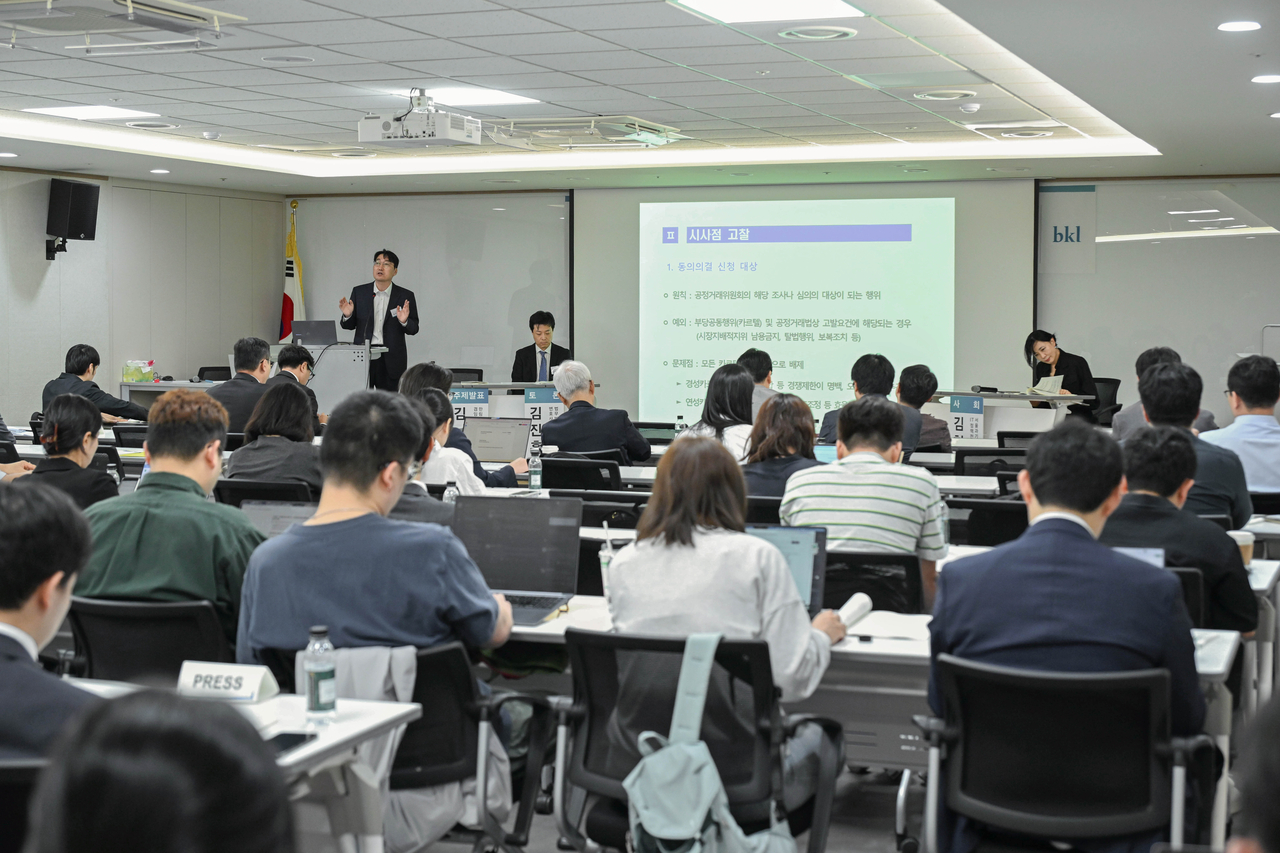
Law firm Bae, Kim & Lee said Friday that it held a seminar with the Personal Information Protection Law Association, or PIPLA, to flesh out this discussion. The two organizations co-hosted the seminar on Thursday. It was titled "Exploring a Cooperative Enforcement Model Under the Personal Information Protection Act: Introducing a Consent Decree System for Effective Damage Relief and Reduced Regulatory Uncertainty."
About 100 people from companies, government agencies and academia attended the seminar, held at the main conference room of the National Information Society Agency's Seoul office in Jung-gu. Their turnout underscored the high level of interest in introducing a consent decree system under the Personal Information Protection Act.
At the opening ceremony, PIPLA Chairman Kim Do-seung delivered opening remarks. Cho Kyung-sik, an advisor at Bae, Kim & Lee and a former vice minister of the Ministry of Science and ICT, gave the welcoming address.
Shin Young-soo, an advisor at PIPLA, also serves as dean of the Kyungpook National University School of Law and a commissioner at the Korea Fair Trade Commission. In the keynote speech, he spoke on "Beyond Sanctions to Recovery: The Possibilities and Challenges of a Paradigm Shift in Enforcing the Personal Information Protection Act." Drawing on his own experience operating the consent decree system in the fair trade sector, Shin said the current Personal Information Protection Act should be restructured into a cycle. He described this cycle as "detecting risk, halting the violation, restoring damage and improving the system."
In the first presentation, Kim Geon-sik, an adjunct professor at Hallym International Graduate University, spoke on "Reviewing the Consent Decree System in the Fair Trade Sector and Its Implications." Kim said the system, introduced in 2011, has helped resolve cases quickly and restore consumer damages, but it also revealed structural limitations, including low utilization and poor implementation management. In response, Kim Jin-hoon, an attorney at Bae, Kim & Lee, led a discussion drawing on his practical experience in the fair trade field. He identified areas that would need to be addressed when introducing the system under the Personal Information Protection Act.
In the second presentation, Kang Tae-uk, an attorney at Bae, Kim & Lee, spoke on "Key Issues and Challenges in Introducing a Consent Decree System Under the Personal Information Protection Act." Kang compared and analyzed the US Federal Trade Commission's consent orders and similar systems in the EU, Australia, Canada and Singapore. He also reviewed the current state of the consent decree system in South Korea's legal framework, along with the key contents of proposed amendments to the Personal Information Protection Act.
Kang particularly emphasized that the consent decree system functions as a "cooperative enforcement framework" that strengthens the effectiveness of personal information protection. He cited expected benefits such as easing regulatory uncertainty in emerging technology and industry sectors and ensuring genuine compliance through enforcement fines. Hwang Eui-kwan, a research fellow at the Korea Consumer Agency, then continued the discussion on considerations for introducing the system.
The subsequent panel discussion was moderated by PIPLA Chairman Kim Do-seung. Panelists included Lee Seung-min, a professor at Sungkyunkwan University School of Law, and Kim Jin-hwan, a commissioner at the Personal Information Protection Commission. Also on the panel were Kwon Se-hwa, a director at the Korea Internet Corporations Association, and Kang Dae-hyun, head of the Investigation Planning Division at the Personal Information Protection Commission. Im Chae-tae, head of the Personal Information Policy Bureau at the Korea Internet & Security Agency, also joined the discussion. They held an in-depth discussion on issues including the scope of application and exclusions for the consent decree system, implementation management and its relationship with criminal penalties. They also discussed victim participation procedures and the system's application to public institutions.
"To strengthen the effectiveness of enforcing the Personal Information Protection Act, we need an enforcement framework that covers not just sanctions but also damage recovery and prevention of recurrence," said Park Ji-yeon, head of the TMT Group at Bae, Kim & Lee. "We will continue to actively participate in related legislative and policy discussions, and proactively support companies in responding to regulatory changes."
Bae, Kim & Lee's TMT Group advises domestic and international companies on compliance and regulatory response across the information and communications technology sector, including AI, personal information, platform regulation and data governance.
Founded in 1980 as South Korea's first law firm, Bae, Kim & Lee comprises about 900 professionals, including roughly 600 attorneys, along with foreign lawyers and certified public accountants. The firm operates specialized teams across areas such as corporate law, mergers and acquisitions, securities and finance, and fair trade, providing one-stop services. It launched its public interest committee in 2001 and has received honors including the first Korean Bar Association Pro Bono Award in the organization category and the 2014 National Human Rights Commission of Korea Human Rights Award.
arete@heraldcorp.com




