
Chip giants drop over 3% as US markets slump
Concern grows over supply-demand gap after buybacks end
Oil tops $100, US bond yield hits 4.95%
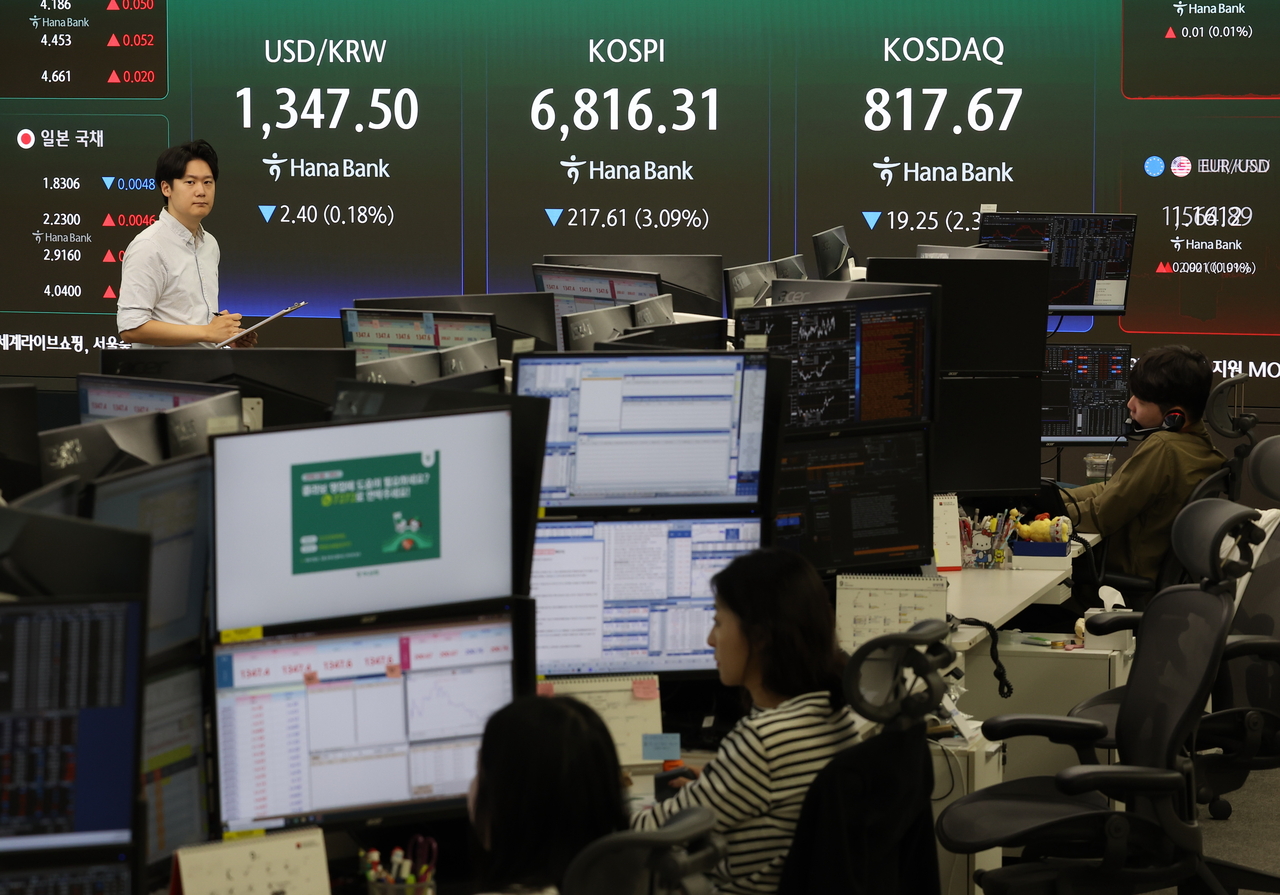
All three major New York indexes fell Thursday amid concerns over high oil prices and interest rates, and the Kospi followed suit Friday, dropping more than 2% in early trading and slipping below the 7,000 mark.
Samsung Electronics and SK hynix, the two largest companies by market capitalization, both fell more than 3% in early trading. With individual, foreign and institutional investors all net sellers over the past month, the two companies' share buybacks had been the main force propping up the Kospi, but analysts say even that support may be reaching its limit.
The Kospi stood at 6,867.77 as of 10 a.m. that day, down 2.36% from the previous close, according to the Korea Exchange. The index opened even lower, down 3.29% at 6,802.50, before trimming some of its losses.
The Kospi opened lower after all three major US stock indexes fell overnight. The Dow Jones Industrial Average dropped 0.60%, while the S&P 500 and the NASDAQ Composite fell 0.58% and 0.65%, respectively.
West Texas Intermediate crude futures jumped 6% to top $100 a barrel, following a similar rise in Brent crude, while the yield on the 10-year US Treasury note climbed past 4.95% — both weighing heavily on stock markets.
Selling was concentrated in rate-sensitive technology shares. Nvidia and Micron Technology fell 2.26% and 4.90%, respectively, while Intel dropped nearly 6%. SK hynix's American depositary receipts fell 5.20%.
Reflecting this pressure, shares of Samsung Electronics and SK hynix, the two leading chipmakers, were down 3.35% and 3.40%, respectively, as of 10 a.m. that day. Other large-cap stocks also declined, including Samsung Electronics preferred shares (down 5.07%), SK Square (down 4.67%), Samsung Electro-Mechanics (down 0.29%), LG Energy Solution (down 2.19%) and Hyundai Motor (down 2.31%).
Buybacks by Samsung Electronics and SK hynix had helped cushion the Kospi's decline to some degree.
Both companies announced buyback plans last month as part of efforts to expand shareholder returns and employee compensation, buoyed by rising cash reserves amid the memory chip boom.
Such purchases are classified as net buying by "other corporations" in supply-demand statistics. That category posted net buying of 295.9 billion won ($221 million) that day. Individual investors were net buyers of 1.28 trillion won, while foreign and institutional investors were net sellers of 825 billion won and 754.4 billion won, respectively.
Over the past month, "other corporations" were the only net buyers in the Kospi market. Individual investors net-sold 12.96 trillion won, foreign investors net-sold 10.36 trillion won and institutional investors net-sold 583.1 billion won, while "other corporations" net-bought 23.91 trillion won, effectively sustaining the market.
The concern centers on around October, when the two companies' buyback programs are expected to end. Without a new buyer stepping in, the Kospi could face a vacuum in demand once the buybacks stop.
The Kosdaq also declined. As of 10 a.m., the index stood at 822.37, down 1.74% from the previous close. It opened at 816.91, down 2.39%, before paring some losses. Large-cap Kosdaq stocks also fell, including Alteogen (down 3.07%), Ecopro (down 3.34%) and Ecopro BM (down 5.39%).
"Amid growing macro uncertainty — including the US 10-year yield breaking above 4.9%, WTI crude re-entering the $100 range, weakness in US stocks, and caution ahead of the August US CPI reading — the Kospi is expected to open lower today, following a more than 3% drop in Kospi night futures," said Han Ji-young, a researcher at Kiwoom Securities.
However, Han added, "It is worth noting that Oracle, which reported earnings after the US market closed, rose more than 6% in after-hours trading. Oracle's strong results are likely to help narrow the Kospi's losses during today's session in South Korea."
jiyun@heraldcorp.com



