Inheritance is something most people face at least once in their lives, and long-marriage divorces are growing more common. Both carry major consequences for personal assets and household finances. Through landmark legal battles involving LG Group, SK Group and Smilegate, this column examines how family restructuring affects wealth — and why it can become a corporate governance issue for ordinary investors.
The Wall Street Journal recently reported that Americans aged 55 and older hold assets worth $110 trillion — signaling that the largest wealth transfer in history is set to unfold over the coming decades. South Korea appears to be on a similar trajectory. According to Supreme Court data, the number of inheritance-division cases rose roughly 4.7-fold, from 771 in 2014 to 3,612 in 2025.
South Korea recorded 88,000 divorces in 2025, down 3.3 percent from the previous year. Yet divorces in which both spouses were 60 or older numbered 13,743, accounting for 15.6 percent of the total. Particularly notable: divorces after 30 or more years of marriage made up 17.7 percent of all cases — the single largest group. As couples who have spent longer accumulating assets account for a growing share of divorces, the scale of property division is likely to grow as well.
When a family is restructured, the effects ripple through to assets. At the corporate level, those effects can reach ordinary investors. What happens inside another family can become an event that moves your own portfolio.
Several high-profile lawsuits involving business families have recently drawn public attention: the divorce and property-division case between SK Group Chairman Chey Tae-won and Noh So-young, director of Art Center Nabi, widely dubbed the divorce of the century; an inheritance dispute and adoption-dissolution suit within the family of LG Group Chairman Koo Kwang-mo; and the divorce and property-division case between Smilegate founder Kwon Hyuk-bin and Lee Hwa-jin.
Wills are where inheritance begins — and inheritance-division agreements must be airtight
LG Group has practiced eldest-son succession since its founding, with family decisions channeling controlling stakes to the designated heir. Under current law, however, being named an heir does not automatically entitle a person to all — or even a larger share — of an estate. A will can concentrate shares in the heir's hands, but it cannot fully extinguish the rights of other heirs: spouses and children hold a statutory right to claim their reserved portion, known as the "yuilbun."
Corporate succession therefore requires more than a will. It demands coordination with other heirs, lifetime restructuring of shareholdings, and advance preparation of the financial resources needed to fund the transfer. This is why so many companies invest heavily in building a succession framework well before it is needed — and why the LG Group case offers instructive lessons.
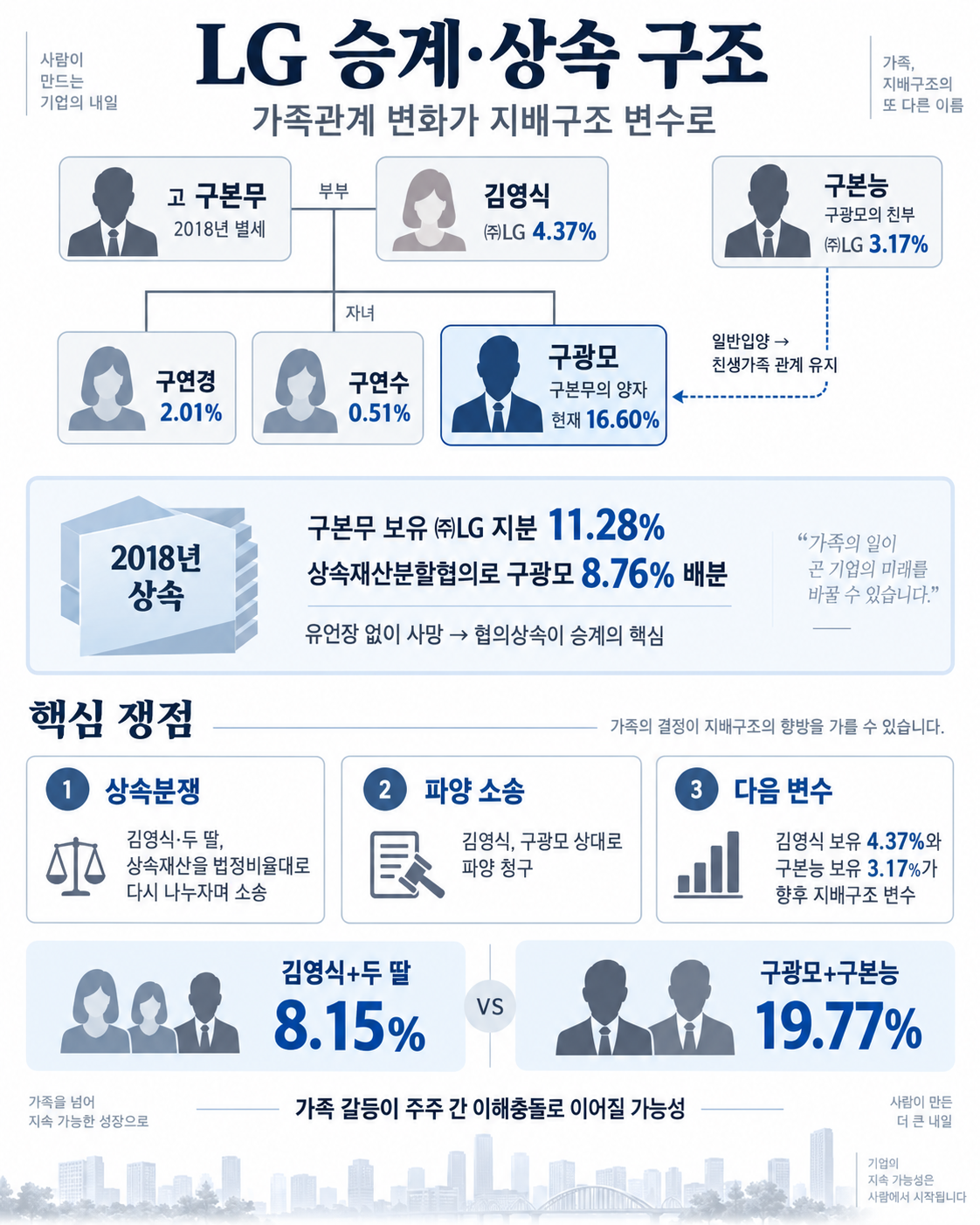
The succession picture at LG Group came into focus in 2004, when Koo Kwang-mo was adopted by then-Chairman Koo Bon-moo. Yet no shares changed hands at that point. Koo Bon-moo died in 2018 without leaving a legally valid will. The surviving immediate family members then reached an inheritance-division agreement, allocating 8.76 percent of the 11.28 percent stake in LG Corp. that Koo Bon-moo had held to Koo Kwang-mo.
An inheritance-division agreement is a powerful instrument: when all co-heirs consent, assets can be distributed in proportions that differ from the statutory default — including concentrating a company's shares in a single heir. The catch is that such an agreement cannot be legally locked in before the inheritance opens. This is precisely why it matters to set out a basic framework in a will and to align family members thoroughly while still alive.
In 2023, however, Koo Bon-moo's wife, Kim Young-sik, and their two daughters filed a suit to recover their inheritance, arguing that the division agreement had been flawed and seeking to redistribute the estate according to statutory ratios. A court of first instance ruled in Koo Kwang-mo's favor in February, finding that the agreement had been validly executed and that no fraud had occurred. The three women appealed. The final outcome remains to be seen, but the rift within the family already appears severe.
Suits to strip inheritance rights or dissolve adoption can block reserved-portion claims
In 2024, Kim filed a suit to dissolve her adoptive relationship with Koo Kwang-mo. Even if the dissolution were granted, it would not affect the already-established father-son relationship between Koo Bon-moo and Koo Kwang-mo. The real issue is Kim's 4.37 percent stake in LG Corp.
As long as the legal mother-son relationship remains intact, Koo Kwang-mo stands as an heir to Kim's estate. Even if Kim were to leave a will bequeathing her shares solely to her two biological daughters, Koo Kwang-mo could still invoke his reserved-portion right and claim the monetary value of his statutory share. A will can set the direction of an inheritance, but it cannot erase an heir's rights entirely.
Under current law, the primary mechanism for stripping inheritance rights is the inheritance-right forfeiture system. For adoptees, dissolution of adoption is another avenue. The two are distinct legal instruments, but the grounds required — such as a serious breach of the duty of support or grossly unjust treatment — overlap considerably. Inheritance-right forfeiture can also be pursued through a notarized will in which the deceased expresses the intent to disinherit, with the executor petitioning the court after death; but in either case, a court ruling is required.
Even when a relationship has broken down in practice, ending it in law is a separate matter. From Koo Kwang-mo's perspective, avoiding dissolution of the adoption is essential to preserving his status as an heir to Kim's estate.
Could the inheritance dispute shake LG Corp.'s ownership structure?
Although Koo Kwang-mo was adopted by Koo Bon-moo, his legal relationship with his biological father, Koo Bon-neung — chairman of Heesung Group — remains intact. General adoption in Korea does not sever ties with the birth family. Koo Kwang-mo therefore retains inheritance rights over Koo Bon-neung's estate as well.
Koo Bon-neung has a remarried spouse and a daughter from that marriage. While other assets — including Heesung Group shares — could pass to the spouse or daughter, LG Group's tradition of eldest-son succession suggests that the 3.17 percent stake in LG Corp. directly tied to group control is likely to go to Koo Kwang-mo, who is already the group's chairman.
Kim and her two daughters together hold 8.15 percent of LG Corp. — well short of the 19.77 percent held by Koo Kwang-mo and Koo Bon-neung. Barring losses in both lawsuits, a decisive blow to Koo Kwang-mo's control appears unlikely. That said, if Kim and her daughters were to dissolve their current status as a jointly acting group of specially related persons and exercise their voting rights independently, the controlling shareholder's combined stake could fall to around 35 percent.
Long marriages, long contributions: higher property-division ratios for homemaking and child-rearing
The property-division case involving Smilegate founder Kwon Hyuk-bin is easier to understand when compared with the SK Group case.
Looking at recent court rulings, when a spouse's contributions through homemaking and child-rearing over a long marriage are broadly recognized, there is a considerable likelihood that a division ratio exceeding one-third will be awarded.
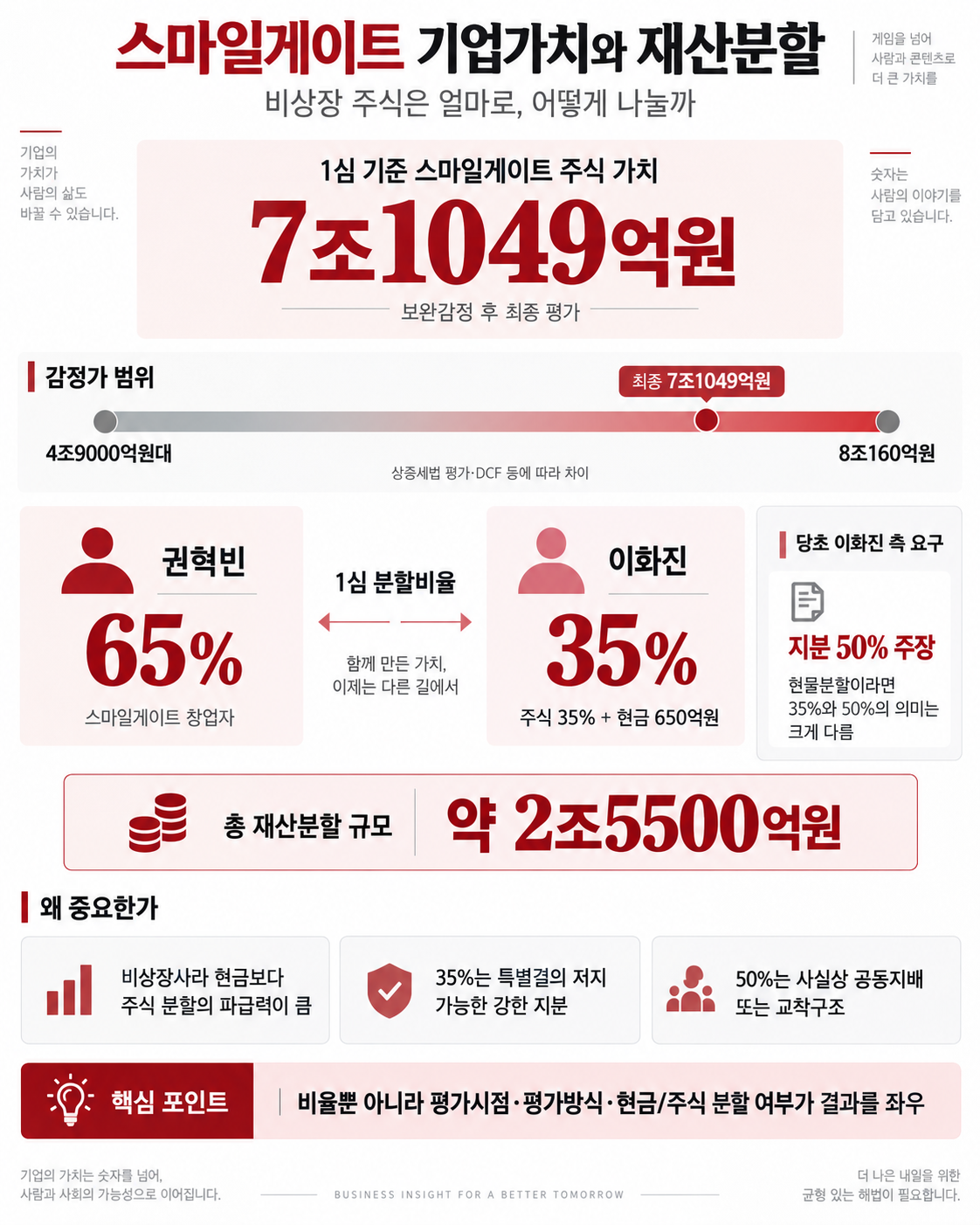
In the Chey Tae-won and Noh So-young case, the division ratio was set at roughly 67 percent to 33 percent — a figure reached even though Noh's direct contribution to business management was not recognized. The first-instance ruling in the Kwon Hyuk-bin and Lee Hwa-jin case came in at 65 percent to 35 percent. Lee's role in the company's early days and her contributions through homemaking and child-rearing were acknowledged, yet the 35 percent figure stands out.
A divorce trial is also currently under way in New Jersey involving John Overdeck, co-founder of hedge fund Two Sigma, and his wife Laura. Overdeck proposed a settlement of $723 million, but Laura's side has argued that his stake in Two Sigma is worth approximately $6.2 billion and is seeking 35 percent of that — about $2.17 billion. The couple married in 2002 and have three children; Laura is a full-time homemaker.
No less important than the division ratio is the question of when a share's value is assessed. In contested divorce proceedings, the standard reference point is in principle the state and value of assets at the close of oral arguments before the fact-finding court.
In the retrial of the Chey Tae-won and Noh So-young case, SK Group's share price rose sharply afterward, but the value of SK shares was calculated based on the closing date of oral arguments in the appellate court in April 2024. For unlisted companies with no market price, enterprise value is assessed using financial statements, valuation methods under the Inheritance and Gift Tax Act, and discounted cash flow analysis, among other approaches. The company's earnings and financial position in the relevant year are therefore critical.
When a divorce suit is filed — and when it concludes — can make a substantial difference to the outcome.
Cash settlement beats receiving physical assets for the receiving spouse
Yet there is an issue even more consequential than the ratio or the valuation date: the form of the property division itself.
In the Chey Tae-won and Noh So-young case, a cash settlement was chosen. Noh's side requested cash, and the court — taking into account that the SK shares were the basis of management control — ordered a cash settlement. In the Kwon Hyuk-bin and Lee Hwa-jin first-instance ruling, by contrast, the court ordered the actual Smilegate shares to be divided. The fact that Smilegate is an unlisted company is also a significant distinction.
For the receiving spouse, a cash settlement is generally the cleaner outcome. A properly executed divorce property division is in principle exempt from gift tax and capital gains tax. Receiving cash means there is no need to liquidate the asset afterward.
For the spouse who must pay, however, the costs can be substantial. For Chey Tae-won to pay Noh 944 billion won ($705 million), he would need to raise cash by selling shares or through dividends. Any taxes arising in that process fall on Chey. To generate 944 billion won after tax through dividends alone — applying the top marginal rate on general financial income as a rough estimate — would require pre-tax dividend income of close to 1.9 trillion won. Selling shares would attract tax only on the capital gain rather than the full proceeds, and at a lower rate, but the tax burden would still be considerable.
In short, a cash settlement is the cleanest outcome for the recipient but can be the most expensive for the payer.
Receiving shares in kind, on the other hand, avoids a large immediate tax bill — but it also means inheriting the latent tax embedded in those shares. When an asset received through property division is later disposed of, the capital gain is in principle calculated using the original acquisition price paid by the transferring spouse.
If Lee were to receive Smilegate shares and later sell them, the tax calculation would start from the price at which Kwon originally acquired those shares. If those shares were acquired at a low price at the time of founding, the enormous accumulated unrealized gain would come along with them. Unlisted shares also cannot easily be sold on the open market.
Shares may be worth taking if they carry management control
The calculus changes, however, if receiving shares means gaining management control as well.
What Lee sought at the first-instance level was a 50 percent stake in Smilegate, arguing that she should be recognized as a co-founder. When the court chose an in-kind share division rather than a cash settlement, the economic significance of that 50 percent figure grew considerably.
Even a 35 percent stake is powerful enough to block special resolutions — such as amendments to the articles of incorporation or mergers. At 50 percent, however, neither party could independently control the company, creating effective joint control or deadlock. The negotiating leverage when selling to a third party would also be far greater than with a 35 percent minority stake, and there would be room to discuss a control premium.
Ultimately, restructuring a family means restructuring its assets — all the more so when that family owns a business. Ownership structure, management control, and the asset value of ordinary shareholders all become variables in play. In inheritance, the key questions are who receives which assets and how. In divorce, they are how jointly built wealth is valued, when that valuation is set, and what form the division takes. Through this process, a family relationship may end — but a shareholder relationship may be just beginning.
kyhong@heraldcorp.com