
AI screens real CCTV footage for theft, falls, fires and other anomalies
Existing cameras kept in place to cut monitoring staff and boost efficiency
Vietnam version already live; Korean edition targets year-end commercial launch
S-TEC System, a South Korean integrated security and facility management company, is using its established Vietnam operations as a testbed for AI-powered video surveillance technology.
The company feeds CCTV footage and incident data gathered at security sites into its AI development pipeline. S-TEC System, which has long deployed human guards and facility managers, plans to layer an AI-based video monitoring system on top of existing CCTV infrastructure to improve operational efficiency — letting the AI flag anomalies such as theft, falls and fires before a human operator ever sees them.
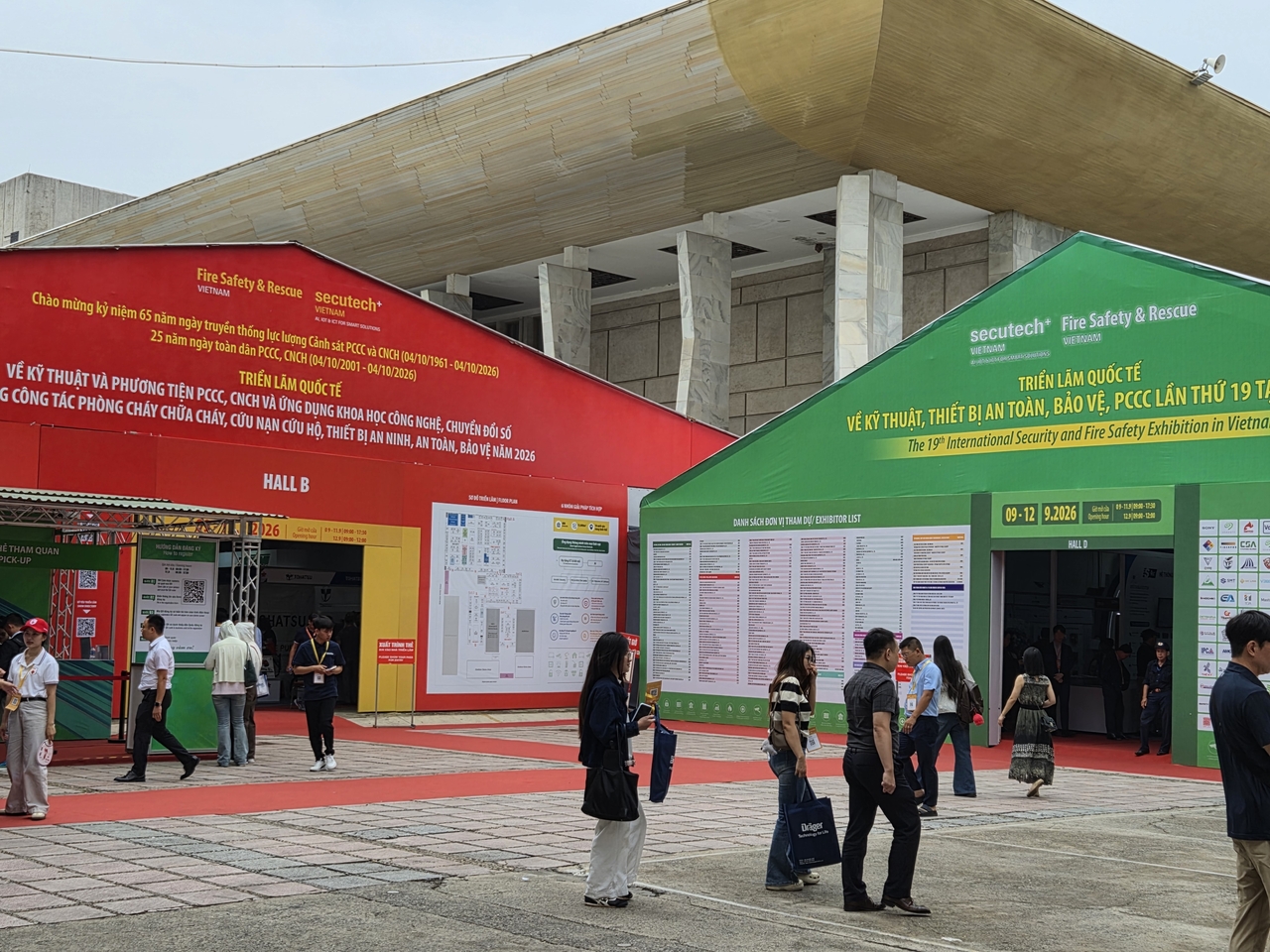
At the company's booth at Secutech+ Vietnam 2026, held in Hanoi on Thursday, the centerpiece was the S-TEC NAVI AI integrated control center, or NOC. The hub aggregates CCTV feeds from multiple locations, runs AI analysis on the footage in real time and surfaces anomalies for operators. Access control, intrusion detection, fire detection and parking management can all be handled from a single system.
![The S-TEC NAVI AI integrated control center at the S-TEC System booth at Secutech+ Vietnam 2026 on Thursday. The system analyzes existing CCTV footage with AI to detect anomalies and send alerts to monitoring staff. [Hanoi, Vietnam = Kim Yu-jin]](https://wimg.heraldcorp.com/news/cms/2026/09/15/news-p.v1.20260915.c1b71f3700d04c1d92715a729cf93053_P1.jpg)
A live demonstration at the booth showed the AI doing more than detecting movement. In one clip, a woman at a supermarket picked an item off a shelf and slipped it into her bag; the system tracked the action beyond the initial grab and classified the full sequence as theft.
In another clip showing a worker smoking on camera, the AI identified the individual's face, cross-referenced the time against their scheduled shift and flagged the behavior as a workplace violation. The same smoking behavior by passersby in a separate clip drew no alert. The system integrates action, subject and context rather than reacting to motion alone.
The AI also distinguishes situations that look similar at a glance, such as falls. Rather than triggering an alert simply because a person's position drops lower in the frame, the system analyzes the sequence of footage before and after the moment — so a person lying on a sofa scrolling through a phone is not misread as a collapse. It reads continuous video, not isolated frames.
![The S-TEC NAVI AI integrated control center at the S-TEC System booth at Secutech+ Vietnam 2026 on Thursday. [Hanoi, Vietnam = Kim Yu-jin]](https://wimg.heraldcorp.com/news/cms/2026/09/15/news-p.v1.20260915.9b1b0011e848488a86655ecd01a544f4_P1.jpg)
At the current stage of development, the AI can detect more than 20 types of anomalies, including theft, falls and fires. When it identifies an incident, it sends alerts to a control room and to managers' mobile phones, after which monitoring staff handle the response. The immediate goal is not to replace human operators but to let one person handle work that previously required two or three.
Compatibility with existing cameras was a deliberate design choice to ease real-world deployment. Instead of installing new AI-dedicated cameras, the system connects software to existing CCTV hardware and control-room computers to add video-analysis capability. Facilities that already have cameras and a control room in place can adopt AI monitoring without replacing any hardware.
![Fire safety equipment on display at the S-TEC VINA exhibition area — S-TEC System's Vietnam subsidiary — at Secutech+ Vietnam 2026 on Thursday. [Hanoi, Vietnam = Kim Yu-jin]](https://wimg.heraldcorp.com/news/cms/2026/09/15/news-p.v1.20260915.cece11d92f0046a0be1db8d8e21cc44e_P1.jpg)
S-TEC System's decision to use Vietnam as its AI testbed rests on a solid existing local business. Through its fire safety subsidiary S-TEC VINA, the company operates a production facility in Vietnam and supplies fire protection equipment to Samsung Electronics' research and development center, Lotte Mall and LG Group's production factory there. It later expanded into the security personnel business through a separate subsidiary, S-TEC SYSTEM VINA.
Real footage and incident data collected at Vietnamese worksites serve as essential training data for AI development. Executive Vice President Lee Chung-yeon said Vietnam presents fewer legal restrictions on the use of surveillance footage for system development than South Korea does, giving the company an advantage in building out its AI capabilities there.
Because the regulatory environment for AI development using real CCTV footage differs in South Korea, the company is developing a separate Korea-specific system. Domestically, a pilot program is underway at several sites with a target of commercial launch by year-end.
Lee said S-TEC System's edge lies in nearly 20,000 incidents accumulated over decades, which allow the AI to analyze pre-crime behavioral patterns and anticipate incidents before they occur. He added that the company plans to roll out its business in line with a phased roadmap for developing an integrated AI monitoring system.
![An overview of the S-TEC VINA production facility in Ha Nam Province, Vietnam, on Sept. 8. [Ha Nam, Vietnam = Kim Yu-jin]](https://wimg.heraldcorp.com/news/cms/2026/09/15/news-p.v1.20260915.550f8cfe3016468bb3467ff85be465ae_P1.jpg)
S-TEC System is also pursuing an initial public offering. The company filed a preliminary listing application with Korea Exchange for a Kospi listing in August. Proceeds are expected to go toward operating costs, facility investment and research and development.
kacew@heraldcorp.com




