Misleading, obstructive tactics make up 87.5%; banks lead with 198 cases
Regulator, 8 industry associations launch standing consultative body

An "agree" button rendered large and in an eye-catching color, while "do not agree" is tucked away where it is hard to see. A pop-up that reappears to demand consent again even after a customer has already declined to share optional information. A screen for signing up for a separate service, such as a simple payment option, inserted into an almost-completed credit card application so that it looks like a mandatory step. These are all textbook examples of so-called "dark patterns" — subtle design tricks that steer consumers' choices during the online sign-up process for financial products.
A self-check the Financial Supervisory Service conducted across the financial industry turned up more than 700 such cases. In response, the regulator is now working with the financial industry on an ongoing basis to correct online sales practices that mislead consumers.
The Financial Supervisory Service held a kickoff meeting on Wednesday for a "standing consultative body for dark pattern prevention," bringing together consumer protection executives from eight financial associations and federations. The participating groups were the Korea Federation of Banks, the Korea Financial Investment Association, the Korea Life Insurance Association, the General Insurance Association of Korea, the Credit Finance Association, the Korea Federation of Savings Banks, the National Credit Union Federation of Korea and the Korea Fintech Industry Association.
The meeting shared the results of financial firms' self-checks conducted under the "Guidelines on Dark Patterns in Online Financial Product Sales," which took effect in April, and discussed major cases and directions for improvement.
The review found a total of 775 dark pattern cases at 268 financial firms. Banks accounted for the most, with 198 cases, followed by securities firms with 159 and card companies with 118. Savings banks logged 91 cases, life insurers 81, general insurers 63 and capital firms 49.
By type, "misleading" designs — screens or wording crafted to steer consumers toward a particular choice — were the most common, with 455 cases. "Obstructive" designs, which make canceling or withdrawing difficult or hide important information from view, accounted for 223 cases. Together, the two types made up 87.5% of all cases found. "Pressuring" designs that apply psychological pressure numbered 87, while "deceptive inducement" designs that prompt unexpected costs numbered 10.
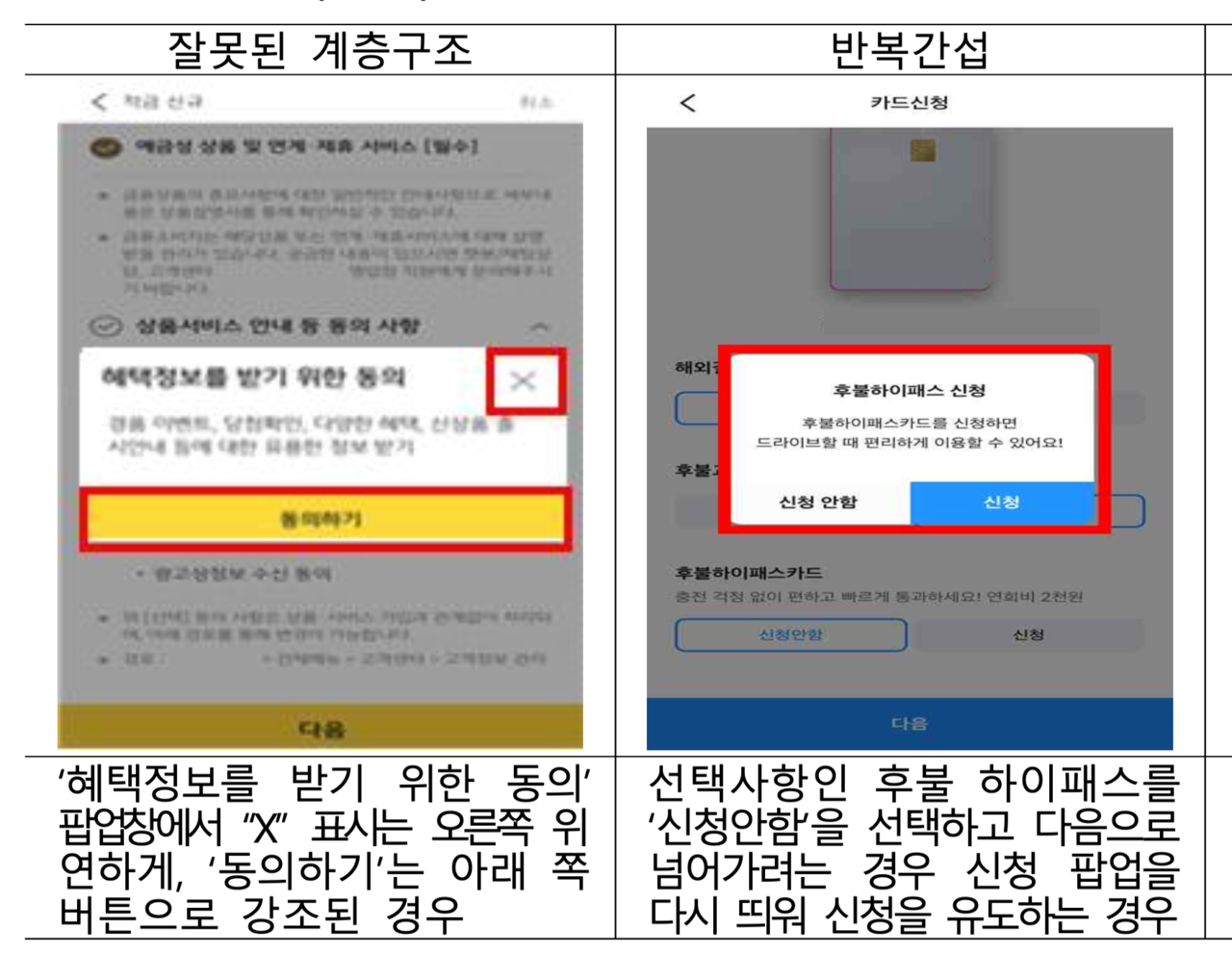
For the cases uncovered in the self-check, the Financial Supervisory Service directed firms to redesign screens so they do not steer consumers toward a particular choice. It also directed firms to eliminate procedures that ask consumers to make the same choice again after they have already indicated their preference. Advertisements for add-on products or services that appear during the sign-up process must now be removed or pushed until after sign-up is complete.
The process also revealed confusion within the industry over how to apply the guidelines. Financial firms and industry groups raised questions over whether selection buttons must all be the same color, or whether using different colors is acceptable as long as no single button stands out.
Through the standing consultative body, the Financial Supervisory Service plans to prepare case-based questions and answers to narrow such gaps in interpretation. It will also discuss self-regulatory measures, including internal control best-practice standards, to help financial firms prevent dark patterns on their own and fix them as soon as they are found. The regulator said it will keep tracking whether the 775 cases identified in the self-check are corrected.
"Dark patterns that exploit financial consumers' psychology to induce irrational decisions are not a legitimate marketing tool for financial firms," said Kim Wook-bae, deputy governor for consumer protection at the Financial Supervisory Service. "The entire financial industry needs to shift its mindset and move quickly to correct and root out these practices."
"Building and operating an internal control system through which financial firms prevent and correct these practices on their own is key to eliminating dark patterns," Kim added, asking that the standing body be used actively as a channel for the industry to voice its opinions and discuss related measures.
Meanwhile, the Financial Supervisory Service has recently been pushing to strengthen consumer protection in the sale of high-risk financial products as well. It plans to bring in outside experts and manufacturers at the review stage for complex financial investment products and overseas alternative investment funds, and to shorten the disclosure cycle for high-risk products to at least once a month.
rim@heraldcorp.com