
DigitalX to end Korbit Web3 Wallet by year-end
After Mirae Asset takeover, focus shifts to RWA, STOs
L2 market still attractive, as Robinhood Chain shows
Toss, DB Securities speed up L2-based wallet plans
Financial firms combine blockchain tech with existing customers, products
![[123rf]](https://wimg.heraldcorp.com/news/cms/2026/09/09/news-p.v1.20260909.40136ad313f147e4afa730df1cecc95d_P1.jpg)
As digital asset exchange Korbit winds down its own layer 2 (L2) network and Web3 wallet business, financial firms are instead speeding up efforts to build digital asset infrastructure using L2 technology. Analysts say ecosystem competitiveness — the ability to draw users and revenue — increasingly determines each chain's performance and use cases in the L2 market.
According to the digital asset industry Wednesday, DigitalX, the operator of Korbit, will end its Korbit Web3 Wallet service on Dec. 31. The service has run on Korbit's own Ethereum L2 network, Silicon. DigitalX said the decision was unrelated to its acquisition by Mirae Asset Consulting, and instead reflected a comprehensive review of the sluggish L2 market environment and the service's operating efficiency.
A layer refers to a structural tier within a blockchain. Layer 1 is the base main chain — such as Ethereum — that verifies and finalizes transactions. Layer 2 is an expansion network that processes transactions separately on top of layer 1 to improve speed and cost efficiency.
Korbit Web3 Wallet debuted in February last year as the first self-custodial wallet service launched by a Korean won-based cryptocurrency exchange. It was designed to let users manage their own private keys while accessing Web3 services such as decentralized applications (dApps) and non-fungible tokens (NFTs).
Korbit had expanded its Web3 business on its own platform, Silicon, but decided to exit the wallet business roughly a year and a half after launch. As a result, Korbit is also winding down the Silicon network.
Market observers say Korbit's withdrawal should not be read as a sign of a broader downturn across the L2 market. Some major L2 networks still generate strong revenue, and the earnings gap between chains has widened considerably.
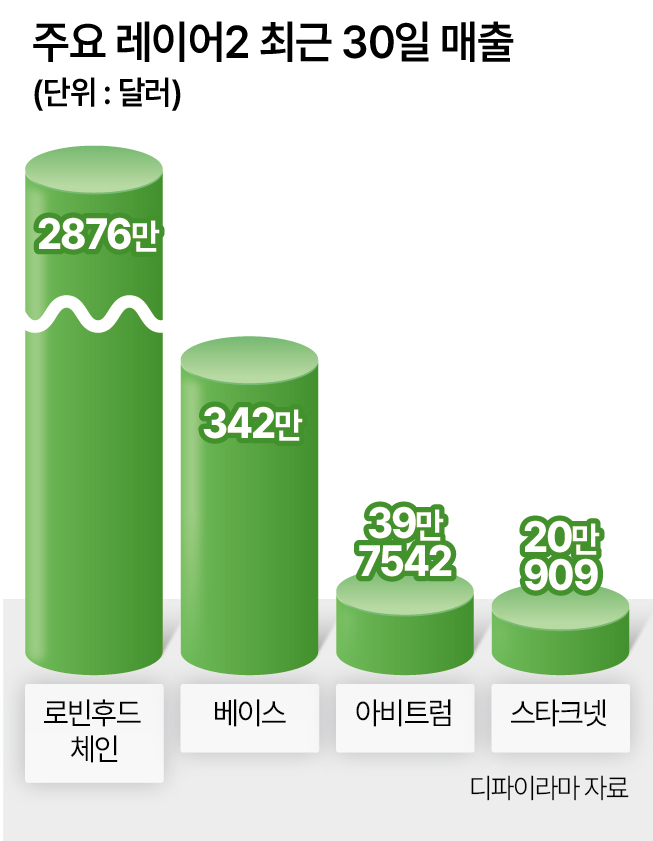
According to DeFiLlama, Robinhood Chain, an Ethereum L2, ranked second by chain revenue over the past 30 days with $28.76 million. Excluding Canton, whose figures are heavily boosted by large incentives, that makes Robinhood Chain the top earner among all chains. Over the same period, Base, an Ethereum L2 built on Optimism's OP Stack, posted $3.42 million.
Other major L2s trailed further behind — Arbitrum posted about $398,000 and Starknet about $201,000. Silicon was not included in DeFiLlama's chain revenue rankings.
Industry observers view Korbit's move less as a reflection of a worsening outlook for the L2 business overall and more as part of a broader reshuffling of priorities. After joining Mirae Asset Group, the exchange appears to have put its Web3 wallet and Silicon network on the list for cleanup. It realigned its focus toward real-world asset (RWA) tokenization, security token offerings (STOs) and other priority projects.
"In Korbit's case, it seems Silicon never built up enough of an ecosystem — dApps that users could actually use, or assets worth investing in," an industry expert said. "To draw users to an L2, there need to be products they can use or trade within it; liquidity follows from that."
Trading and revenue are indeed concentrating on L2 networks that have secured products and services capable of attracting users. Robinhood Chain built its core service around tokenized stocks, and usage has grown rapidly since it recently introduced trading products linking meme coins with tokenized stocks.
According to Dune Analytics, Robinhood Chain's on-chain RWA trading volume reached $829.8 million on Friday. Of that, trading pairs combining meme coins and tokenized stocks accounted for $436 million — more than half of the total.
In the financial sector, however, moves are underway to use L2 networks as the underlying technology for digital asset wallet projects. Toss signed a memorandum of understanding (MOU) with Optimism and Sunnyside Labs in July to explore the use of a won-pegged stablecoin, and the companies are now conducting a proof-of-concept (PoC) test.
Toss said it chose Optimism because it allows fast, low-cost transactions backed by Ethereum's security. The OP Stack also lets it build a dedicated chain tailored to the needs of financial institutions.
The securities industry has also begun exploring L2 use cases. DB Securities signed an MOU with Optimism in July to develop STO and RWA business models for Jeju. Rather than building their own blockchain from scratch, financial firms are increasingly looking to build on already-proven L2 technology to construct the infrastructure they need for financial services.
Experts point to L2 networks' ability to let financial firms tap into the security and reliability of public blockchains as a key strength. At the same time, firms retain a degree of control over regulatory compliance and operations. Some also note that financial firms have greater room to apply the technology, given they can combine it with the customer base and financial products they already have.
"Financial institutions find it difficult to use public blockchains as they are because of regulatory requirements, but they still want the reliability and safety of a mainnet," said Park Hye-jin, head professor of Sogang University's AI and Digital Asset Executive Program. "An L2 that offers this while allowing a degree of autonomy could be an alternative."
The cost and infrastructure burden of building a proprietary chain is another factor cited. Firms would otherwise have to build everything themselves, from bridges connecting to other chains to DeFi and other underlying infrastructure. Using development tools already offered by the Ethereum ecosystem, the OP Stack, Arbitrum and others is a more rational choice.
"It is not easy for financial firms to build their own independent chain from the outset," Park said. "In the early stages, they may gain experience by using existing L2 technology, and later move toward building their own infrastructure as needed." She also predicted that "the industry is likely to move toward a multichain future going forward," adding, "Ultimately, where to start and which chain to use as a reference point will become an important question."

kyoung@heraldcorp.com




