![한국 등 국가 주도 자본주의에 사활을 걸고 있는 나라들의 재정정책이 반도체·인공지능(AI) 분야 투자를 통한 경제 자체의 체질을 재편하려는 쪽으로 무게가 옮겨가고 있다. 이에 따라 통화정책이 배분적 성격을 띠게 될지 주목된다. [연합·게티이미지·헤럴드 DB]](https://wimg.heraldcorp.com/news/cms/2026/08/18/news-p.v1.20260818.8e1c13bb299448b6b253a1bf5ede8b6a_P1.jpg)

지난 30년 대부분의 기간 동안 거시경제학자들은 단순한 역할 분담을 전제로 했다. 중앙은행은 물가를 관리하고, 정부는 국가 재정을 관리한다는 것이다. 그러나 이제 이러한 분리가 도전받고 있다.
세계 주요 국가를 살펴보자. 미국은 재정건전성 회복을 계속 의제로 올려놓을 만큼 큰 폭의 재정적자를 기록하고 있지만, 현재 워싱턴의 논쟁은 반도체법(CHIPS Act)이나 인플레이션 감축법(Inflation Reduction Act)에서 물러날 것인지가 아니라 여기에 무엇을 더할 것인지에 맞춰져 있다. 일본은 370조엔 규모의 장기 전략 투자 프로그램을 승인했다. 그리고 7월 13일 한국의 이재명 대통령은 내년도 예산안을 발표했다. 이는 사상 처음으로 800조원을 넘어서는 예산으로, 10%가 넘는 증가다. 반도체 호황에 따른 이례적인 세수 증가를 바탕으로 하고 있으며, 그 일부는 장기 전략 투자를 위한 새로운 미래대응펀드의 재원이 된다. 동시에 정부는 반도체, 피지컬 AI, 데이터센터 분야의 기업 대형 프로젝트가 추진될 수 있도록 길을 열고 있다.
그런데 정부가 한 방향으로 움직이는 동안 중앙은행은 점점 더 반대 방향으로 움직여야 한다는 압력을 받고 있다. 미국 연방준비제도(Fed)는 7월 금리를 동결했지만, 12명의 투표권자 가운데 3명은 5년간 물가상승률이 목표치를 웃돈 상황에서 금리 인상을 주장하며 반대했다. 일본은행은 다른 모습을 보인다. 측정된 물가상승률은 정부의 자체적인 보조금과 가격 통제에 의해 부분적으로 억제되고 있는 반면, 여전히 완화적인 수준인 금리는 엔화 약세와 수입 에너지 가격 상승을 초래하고 있다. 이는 정부가 보조금으로 억제하려는 바로 그 물가 압력을 다시 키우는 요인이 되고 있다.
한국은 가장 멀리 나아갔다. 예산안 발표 사흘 뒤 한국은행은 기준금리를 2.50%에서 2.75%로 인상했다. 3년 반 만의 첫 인상이었다. 신현송 한은 총재는 두 달 연속 3%를 웃돈 물가상승률이 2% 목표 수준으로 돌아올 때까지 추가 인상이 이어질 것임을 시사했다. 얼핏 보면 이는 익숙한 정책 공조의 문제처럼 보인다. 정부는 확장적인 정책을 펴는 반면 중앙은행은 반대 방향으로 움직이는 상황이다. 하지만 나는 이를 다르게 해석하고 싶다.
배경
오늘날의 재정정책과 통화정책 사이의 긴장이 과거와 다를 수 있는 이유를 이해하려면, 내가 ‘과거의 체제’라고 부르는 것을 떠올려볼 필요가 있다. 이는 이런 긴장이 거의 존재하지 않았던 장기간의 시기였다.
중국이 세계무역기구(WTO)에 가입한 이후 약 20년 동안 세계화는 디스인플레이션이라는 순풍을 만들어냈다. 값싼 수입품은 물가를 낮게 유지했고, 공급망은 더 길고 효율적으로 변했다. 인플레이션 목표제는 성공적이었다. 다만 그 성공의 일부는 통화정책 자체보다는 우호적인 글로벌 환경에 힘입은 것이었다. 재정정책은 대체로 배경에 머물렀고, 경기 침체가 발생했을 때 개입하는 정도였다.
글로벌 금융위기는 이 모델의 균열을 드러냈고, 팬데믹은 이 모델을 무너뜨렸다. 무엇보다 재정정책이 무엇을 할 수 있는지를 보여줬기 때문이다. 각국 정부는 10년 전만 해도 상상하기 어려웠던 규모로 재정을 투입했고, 자신들이 실제로 그렇게 할 수 있다는 사실을 깨달았다. 그 이후 수년간 축적돼 온 힘들이 본격적으로 작동하기 시작했고, 서로를 강화하고 있다. 인공지능의 부상, 지정학적 분열, 전략적 생산기지의 자국 회귀, 경제안보에 대한 우려가 그것이다. 성격은 서로 다르지만 이들 요인은 모두 같은 방향을 가리킨다.
이들이 요구하는 투자는 어느 하나만으로 완결될 수 없다. 반도체 클러스터에는 전력, 교통, 데이터 인프라, 회복력 있는 공급망이 필요하다. 이는 민간시장이 이 정도 규모와 장기간에 걸쳐 제공하기 어려운 종류의 조정이다. 따라서 정부는 단순히 수요를 안정시키는 수단이 아니라 생산능력을 형성하는 수단으로서 재정정책을 다시 발견하고 있다. 동시에 이러한 힘들은 인플레이션 환경도 바꿔놓았다. 세계화는 비용을 낮췄지만, 새로운 세계는 효율성과 함께 회복력을 중시한다. 생산을 국내에 더 가깝게 가져오고, 공급업체를 다변화하고, 전략적 생산능력에 투자하는 일은 적어도 일정 기간 비용을 높이는 경향이 있다. 재정정책에 더 큰 역할을 부여하는 동일한 구조적 힘들이 인플레이션을 통제하기도 더 어렵게 만들고 있는 것이다. 따라서 이 ‘충돌’은 구조적인 것이다.
과거의 문법
기존의 합의는 각 기관에 역할을 부여했다. 독립적인 중앙은행은 물가를 낮게 유지하고 경기 변동을 완화하며, 재정정책은 국가부채를 지속 가능한 경로로 유지하고 경기침체가 심각해졌을 때만 개입한다는 것이다. 이런 체제에서는 두 정책 당국 간의 충돌이 구조적으로 거의 배제된다. 이것이 주류 통화정책 접근법인 뉴케인지언 체계(the New Keynesian framework)가 재정정책을 대부분 다루지 않았던 이유다.
두 정책의 상호작용이 중요하다는 점은 서전트(Sargent)와 월리스(Wallace)가 1981년 발표한 고전적 논문 ‘불편한 통화주의적 산술(Some Unpleasant Monetarist Arithmetic)’에서 강조됐다. 정부가 재정을 조정하지 않으려 한다면 오늘의 긴축적 통화정책이 내일의 더 높은 인플레이션을 의미할 수 있다는 것이다. 재정이론은 이 주장을 한 단계 더 발전시켰다. 궁극적으로 인플레이션은 정부 부채가 어떻게 뒷받침되는지에 달려 있다는 것이다. 팬데믹 이후 이러한 논의는 다시 힘을 얻었다.
그러나 이 이론들이 공통적으로 갖고 있는 점에 주목할 필요가 있다. 모두 ‘재원 조달’에 관한 이론이다. 적자와 부채, 그리고 궁극적으로 누가 비용을 부담하는지에 관한 것이다. 이것이 통화정책과 재정정책의 상호작용을 분석하는 공통된 뿌리다.
오늘날의 경험도 부분적으로는 이 틀에 들어맞는다. 워싱턴의 지속적인 재정적자는 재정 지속가능성 문제를 계속해서 의제로 남겨놓고 있다. 일본의 국가부채는 엔화와 관련된 모든 논쟁이 격렬해지는 이유 중 하나다. 하지만 한국은 다르다. 새로운 예산은 대부분 반도체 호황에 따른 이례적인 세수 증가에 기반하고 있으며, 지출 구조조정이 이를 보완한다. 그럼에도 누구도 한국의 재정정책을 소극적이라고 말할 수는 없다. 재정정책은 이미 한국의 경제전략에서 가장 적극적인 수단이 됐기 때문이다. 재원 조달이 제약요인이 아니며, 현재의 정책 상호작용은 과거의 문법으로 설명할 수 없다.
전환적 재정정책
내가 주장하는 것은 재정정책의 규모가 변하고 있다는 것이 아니다. 그 목적이 변하고 있다는 것이다. 오늘날의 예산은 단순히 수요를 안정시키는 것이 아니라 경제 자체의 구조를 재편하는 데 초점을 맞추고 있다. 앞서 설명한 기술적·지정학적 도전에 대응하기 위해서다. 정부들은 이러한 경쟁이 앞으로 한 세대 동안 경제적 주도권을 결정할 것이라고 믿고 있다. 나는 이를 전환적 재정정책(transformational fiscal policy)이라고 부른다.
전환적 재정정책은 주로 수요를 안정시키기 위해 예산을 사용하는 것이 아니라 경제의 생산구조를 재편하기 위해 예산을 활용한다. 그렇다면 이는 전통적인 재정정책 사고방식과 어떻게 다른가. 안정화 재정정책은 경제의 구조가 주어진 것으로 보고 경기변동을 완화하기 위해 지출을 조정한다. 질문은 ‘얼마나 할 것인가’이며, 시간적 지평은 향후 몇 년이다. 성공 여부는 경기 하강을 얼마나 흡수했는지, 부채를 얼마나 안정적으로 유지했는지에 달려 있다. 전환적 재정정책은 이 세 가지 차원을 모두 뒤집는다. 질문은 무엇을, 어디에 할 것인가다. 경제가 어떤 산업을 갖게 될 것인지, 어느 정도 규모로 갖게 될 것인지, 이를 뒷받침할 인프라는 무엇인지가 핵심이다. 시간적 지평도 분기 단위로 측정되는 산출량 격차가 아니라 수십 년에 걸친 기술 전환이다. 성공의 기준 역시 그 나라가 앞으로 중요해질 제품과 서비스를 생산하게 될 것인지에 달려 있다.
안정화 정책은 존재하는 경제를 관리한다. 전환적 정책은 어떤 경제가 존재하게 될지를 결정한다. 그렇다면 산업정책과는 어떻게 다른가. 산업정책은 하나의 정책 수단이다. 전환적 재정정책은 전략이다. 전자는 보조금이나 관세를 활용한다. 후자는 거시경제적 결과에 영향을 미칠 만큼 충분히 큰 규모의 구조적 변화를 중심으로 예산을 조직한다. 예산이 이러한 역할을 맡게 되면 통화정책은 더 이상 총수요만 상대하는 것이 아니다. 산업전략을 상대하게 된다.
한국은 이 주장을 잘 보여준다. ‘무엇을, 어디에’라는 질문에 대한 답은 이미 나와 있다. 반도체, 피지컬 AI, 데이터센터다. 이들은 6월 말 발표된 한국 남서부의 거대한 클러스터를 중심으로 추진된다. 삼성전자와 SK하이닉스가 참여하고 있으며, 전력·용수·교통·주거시설이 이재명 대통령의 표현대로 기업의 일정에 맞춰 순차적으로 구축된다.
시간적 지평과 목표도 대통령 자신의 표현에서 명확하게 드러난다. 이는 “글로벌 AI 패권이 결정되는 골든타임”이다. 중앙은행의 관점에서 이런 유형의 재정정책은 더 이상 배경에 머물러 있지 않다. 단기적으로 보면 이 예산은 물론 확장적이다. 기업은 시장 규모가 충분해 투자비용을 회수할 수 있다고 예상할 때에만 새로운 기술에 막대한 고정비용을 투입한다. 정부는 인프라와 수요를 약속함으로써 이러한 시장을 신뢰할 수 있는 것으로 만든다.
바로 여기서 긴장이 발생한다. 채권시장 관점에서 질문은 부채를 팔 수 있는가다. 하지만 한국에는 재원 조달 문제가 없다. 진짜 질문은 경제가 재정 투입을 흡수할 능력을 갖추고 있는가이며, 그 답은 인플레이션으로 나타난다. 이것이 아래 표의 세 번째 행에서 내가 강조하는 제약이다.
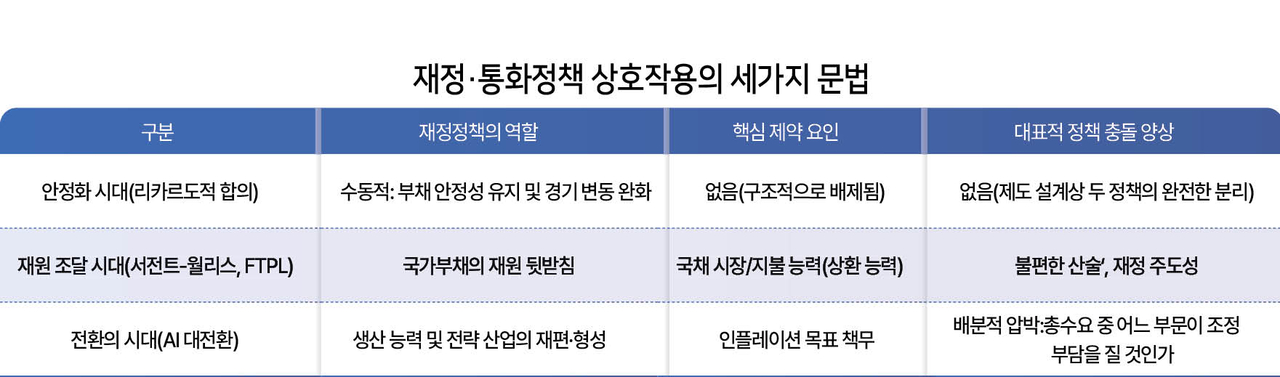
통화정책은 배분정책이 된다
7월 한국은행 금융통화위원회는 만장일치로 기준금리를 인상했고 추가 인상이 이어질 것임을 시사했다. 그 근거는 세 가지였다. 예상보다 훨씬 높은 성장률, 당분간 목표치를 웃돌 것으로 예상되는 인플레이션, 주택가격과 가계부채에 초점을 맞춘 금융안정이다.
금리 인상의 논리는 총수요를 억제하는 것이다. 그러나 이러한 억제는 공공투자, 민간소비, 주택, 수출 등 여러 요소의 합으로 구성된 총수요에 적용된다. 그리고 한국은행 자체 평가처럼 경제가 현재 생산능력에 가까운 수준으로 움직이고 있다면, 진짜 질문은 어떤 부분이 조정될 것인가이다.
나는 전환적 재정정책의 추진력이 상대적으로 경직돼 있다고 본다. 클러스터 건설은 이미 확정됐고, 일정은 기업 중심이며, 이 전략은 정부의 핵심 프로젝트다. 따라서 한국은행이 금리를 올리면 압박은 움직일 수 있는 부문으로 쏠린다. 그리고 금리가 실제로 타격을 주는 곳, 즉 레버리지가 높은 가계, 이미 이자비용을 감당하지 못하고 있는 소규모 기업, 자영업자에게 집중된다. 반면 차입이 거의 없는 현금부유형 전략산업에는 상대적으로 영향을 덜 미친다. 총수요를 겨냥한 정책수단이 결국 총수요를 구성하는 요소들 사이에서 어느 쪽이 부담을 질지를 선택하는 결과가 되는 것이다. 이것이 내가 통화정책이 ‘배분적’이 됐다고 말하는 의미다. 그리고 한국의 양극화된 경제에서 K-자형 구조는 이 충돌의 부수적인 결과가 아니라, 충돌이 경제에 전달되는 경로 자체가 된다.
한국의 정책 조합과 그 잠재적 의미에 대한 몇 가지 생각
한국은행의 평가는 수입 비용, 즉 유가와 원화 약세에 따른 영향을 국내 물가 압력과 신중하게 구분하고 있다. 근원물가 상승률은 2.5%로 전체 물가상승률 3.2%보다 상당히 낮다.
한국은행이 가장 우려하는 것은 반도체 호황이 임금과 소비, 수요로 전달되는 과정이다. 그런데 이것이 무엇을 의미하는지 주목할 필요가 있다. 한국은행이 억제하려는 압력은 반도체 호황이 이윤과 임금, 그리고 현재 예산의 재원이 되고 있는 세수를 통해 경제 전반으로 확산되면서 나타나는 경제 전환의 경로다. 역설적으로 말하면 한국의 인플레이션 가운데 일부는 재정전략이 성공하고 있기 때문에 발생할 수도 있다. 또 다른 중요한 측면은 시간이다. 반도체 클러스터와 발전소, 물류시설은 시차를 두고 경제가 생산할 수 있는 규모를 확대한다. 수요가 먼저 도착하고 생산능력은 나중에 도착한다.
금융통화위원회는 이러한 순서를 지금 경계해야 할 이유로 보고 있다. 하지만 반대의 해석에도 같은 정도의 무게를 둘 필요가 있다. 순수하게 수요 측면에서 평가한 예산은 실제 공급능력이 확충되고 나면 예상했던 것보다 덜 인플레이션을 유발할 수도 있다.
앞을 내다보는 중앙은행이라면 추가되는 수요와 함께 건설되고 있는 생산능력도 고려해야 한다. 이러한 상황에서는 이것이 금리 인상 사이클의 강도를 조정하는 데 중요한 요소가 된다.
마지막으로 미래대응펀드는 예산의 영향을 평가하는 데 중요한 의미를 갖는다. 공개된 계획에 따르면 펀드 규모는 약 100조원이다. 이 펀드는 반도체 호황에서 발생한 세수 증가분의 일부를 흡수하고, 새로운 성장동력과 청년 지원, 지역 개발에 단계적으로 자원을 배분한다. 아직 집행되지 않은 자금은 석유 수입을 운용하는 국부펀드와 마찬가지로 금융자산에 투자한다. 거시경제적 관점에서 핵심은 간단하다. 펀드에 배정된 1원의 자금은 올해 수요를 늘리지 않는다. 실제로 집행된 1원만 수요를 늘린다. 따라서 예산이 인플레이션에 미치는 영향을 결정하는 것은 순수한 재정 충격이다. 즉 펀드가 자신의 몫을 흡수하고 다른 지출이 재구성된 이후 실제로 경제에 흘러들어가는 자금이 얼마인지를 봐야 한다. 이 기준으로 보면 두 정책 당국의 충돌은 헤드라인이 보여주는 것만큼 크지 않을 수도 있다. 물론 자금 집행이 실제로 단계적으로 이뤄지고 펀드의 운용체계가 정치적 경기순환의 유혹을 견뎌낸다는 전제가 필요하다.
결론
포스트 코로나 환경은 기술, 지정학, 경제안보라는 새로운 도전을 제시하고 있다. 이는 재정정책을 전략적 역할로 밀어 넣고 있다. 경제가 변화에 적응할 수 있도록 경제 자체를 재편하는 역할이다.
이 정도 규모로 경제를 재편하면 통화정책과 긴장이 발생한다. 그러나 이러한 긴장은 정책 공조의 실패가 아니라 새로운 환경이 갖는 구조적 특징이다.
통화정책에 주는 시사점은 분석의 차원에 있다. 전환적 힘들이 어떤 경로를 통해 수요와 공급에 영향을 미치는지, 그 영향이 나타나는 시간적 지평은 얼마나 되는지를 평가하고 그에 맞춰 정책을 조정해야 한다.
한국은 이러한 새로운 환경을 보여주는 초기 사례이자, 특히 명확한 사례다. 독립적인 인플레이션 목표제의 중앙은행은 재정정책이 수요를 안정시키던 세계를 위해 설계됐다. 재정정책이 생산능력을 재편하기 시작하면 통화정책은 필연적으로 배분적 성격을 갖게 된다.
![Fiscal policies in countries like South Korea, which are staking their future on state-led capitalism, are increasingly shifting toward restructuring the fundamental fabric of their economies through investments in semiconductors and artificial intelligence (AI). Consequently, attention is turning to whether monetary policy will assume a more distributive character. [Yonhap/Getty Images]](https://wimg.heraldcorp.com/news/cms/2026/08/18/news-p.v1.20260818.79cc8bace7974a85a3f5c9b7422825b0_P1.jpg)

Transformational Fiscal Policy
Why Korea forces us to rethink the relationship between fiscal and monetary policy
For most of the past three decades, macroeconomists assumed a simple division of labour. Central banks managed inflation; governments managed the public finances. That separation is now being challenged.
Let‘s look across the world’s major economies. The United States runs deficits large enough to keep consolidation on every agenda, yet the live debate in Washington is not whether to retreat from the CHIPS Act and the Inflation Reduction Act, but what to add to them. Japan approved a ¥370 trillion long-term strategic investment programme. And on July 13th, South Korea‘s President Lee Jae Myung announced plans for next year’s budget, the country‘s first above 800 trillion won, an expansion of more than ten percent, built on an extraordinary semiconductor tax windfall, part of which will seed a new Future Response Fund for long-term strategic investment, while the state clears the way for corporate mega-projects in chips, physical AI and data centres.
Yet governments are moving in one direction while central banks feel mounting pressure to move in the other.
The Federal Reserve held rates in July, but three of its twelve voters dissented in favour of a hike after five years of above-target inflation. The Bank of Japan presents a different picture: measured inflation is partly held down by the government‘s own subsidies and price controls, while interest rates, rising, but still accommodative, keep the yen weak and imported energy expensive, feeding the very pressures the subsidies are meant to contain. Korea has gone furthest. Three days after the budget was announced, the Bank of Korea raised its policy rate from 2.50 to 2.75 percent, its first increase in three and a half years, with Governor Shin Hyun-song signalling that further hikes will follow until inflation, above three percent for two months running, returns to the two percent target.
At first glance this looks like a familiar coordination problem: governments in expansionary mode while central banks lean in the opposite direction. I would interpret it differently.
Background
To understand why today‘s fiscal-monetary tension might be different, it helps to recall what I refer to as the old arrangement, a long period notable for the absence of such tensions.
For roughly two decades after China‘s entry into the World Trade Organization, globalization created a disinflationary tailwind: cheap imports held inflation down while supply chains became longer and more efficient. Inflation targeting was successful, though part of that success reflected a favourable global environment rather than monetary policy alone. Fiscal policy remained largely in the background, stepping in during recessions.
The global financial crisis exposed cracks in that model. The pandemic broke it, not least by demonstrating what fiscal policy could do: governments deployed budgets at a scale unthinkable a decade earlier, and discovered they could.
Since then, forces that had been building for years have begun operating at full strength, and reinforcing one another: the rise of artificial intelligence, geopolitical fragmentation, the reshoring of strategic production, and growing concern over economic security. While different in nature, these forces point in the same direction.
None of the investments they demand stands alone: chip clusters require power, transport, data infrastructure and resilient supply chains, precisely the sort of coordination that private markets struggle to provide at this scale and over these horizons. Governments have therefore rediscovered fiscal policy as an instrument for shaping productive capacity, not just stabilizing demand.
At the same time, these same forces have changed the inflation environment. Globalization reduced costs; the new world values resilience alongside efficiency, and producing closer to home, diversifying suppliers and investing in strategic capacity all tend to raise costs, at least for a time. The same structural forces that give fiscal policy a larger mission also make inflation harder to control. The “conflict” is then structural.
The old grammar
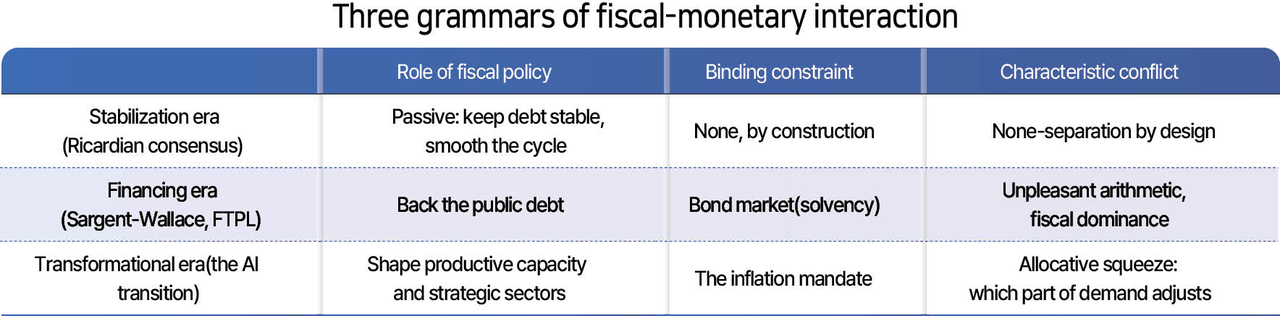
The consensus assigned each authority a task: independent central banks would keep inflation low and smooth the cycle; fiscal policy would keep public debt on a sustainable path and step in only when recessions turned severe. In that arrangement, conflict between the two authorities is ruled out almost by construction, which is why the mainstream approach to monetary policy, the New Keynesian framework, largely bypasses fiscal policy.
The importance of the interaction was highlighted by Sargent and Wallace‘s classic 1981 paper, “Some Unpleasant Monetarist Arithmetic”: if governments refuse to adjust their budgets, tighter money today can mean higher inflation tomorrow. The fiscal theory of the price level pushed the argument further: ultimately, inflation depends on how public debt is backed. After the pandemic, these ideas regained traction.
But notice what they have in common. They are all theories about financing: about deficits, debt and who ultimately pays. That is the common root behind the analysis of monetary and fiscal policy interaction.
Today‘s experiences partly fit it. Washington’s persistent deficits keep sustainability permanently on the agenda, and Japan‘s public debt is one reason every debate over the yen is so charged. Korea, though, is different. The new budget rests largely on an extraordinary tax windfall from the semiconductor boom, supplemented by expenditure restructuring. Yet nobody could describe Korean fiscal policy as passive, since it has become the most active instrument in the country’s economic strategy. Financing is not a binding constraint and the current interaction cannot be framed within the old grammar.
A transformational fiscal policy
I argue that what is changing is not the size of fiscal policy. It is its purpose. Today budgets are oriented at reshaping the structure of the economy itself, to address the technological and geopolitical challenges described above, in a contest that governments believe will settle economic leadership for a generation. I call it transformational fiscal policy.
Transformational fiscal policy uses the budget not primarily to stabilize demand but to reshape the economy’s productive structure.
How is that different from the traditional way of thinking about fiscal policy? Stabilization fiscal policy takes the structure of the economy as given and adjusts spending to smooth the cycle: its question is how much, its horizon is the next few years, and its success depends on whether the downturn was absorbed and the debt kept stable. Transformational fiscal policy inverts all three dimensions. Its question is what and where: which sectors the economy will have, at what scale, with what infrastructure supporting them. Its horizon is a technological transition measured in decades, not an output gap measured in quarters. And its success metric depends on whether the country will produce the things that will matter. Stabilization policy manages the economy that exists. Transformational policy decides which economy will exist.
How is that different from industrial policy? Industrial policy is a toolkit. Transformational fiscal policy is a strategy. The former uses subsidies or tariffs. The latter organizes the budget around structural change on a scale large enough to affect macroeconomic outcomes.Once budgets take on that role, monetary policy is no longer dealing only with aggregate demand. It is dealing with industrial strategy.
Korea illustrates the argument: the what-and-where question has an answer: chips, physical AI, data centres, anchored by a vast cluster in the country‘s southwest, announced in late June with Samsung Electronics and SK Hynix, with power, water, transport and housing sequenced, in President Lee’s words, to corporate timelines. The horizon and the objective are explicit in the president‘s own framing: this is “the golden time when global AI supremacy is decided”. From the perspective of the central bank, this type of fiscal policy does not operate in the background.
In the short run this budget is of course expansionary. Firms sink huge fixed costs into new technologies only when they expect markets large enough to repay them, and governments make those markets credible by committing infrastructure and demand. This is where the tension emerges. From the perspective of the bond market, the question is whether the debt can be sold, but Korea has no financing problem. The real question is whether the economy has the capacity to absorb the fiscal push, and the answer shows up as inflation. That is the constraint I highlight in the third row of the table below.
Monetary policy becomes allocative
In July, the Board voted unanimously to raise the base rate, signalled that more increases are coming, and rested its case on three legs: growth running well above forecast, inflation set to stay above target for some time, and financial stability, with a focus on housing prices and household debt.
The logic of a rate rise is to restrain aggregate demand. But that restraint applies to a total made of parts --- public investment, private consumption, housing, exports --- and when the economy runs near capacity, as the Bank‘s own assessment says Korea’s now does, the real question is which part adjusts.
I interpret the transformational fiscal push as relatively rigid: the cluster is committed, the timelines are corporate, the strategy is the government‘s central project. So when the Bank of Korea raises rates, the squeeze falls on the components that can move, and it falls where interest rates bite namely on leveraged households, on small firms already unable to cover their interest payments, on the self-employed and not on a cash-rich strategic sector that barely borrows. An instrument aimed at aggregate demand ends up choosing among its components. That is the sense in which monetary policy has become allocative and, in Korea’s divided economy, the K-shape is not a side effect of the conflict but the channel through which it is transmitted.
Some reflections on the Korean policy mix and its possible implications
The Bank of Korea‘s assessment is careful to separate imported costs (oil, the weak won) from domestic pressures, and core inflation, at 2.5 percent, sits well below the 3.2 headline. What worries the Bank most is the transmission of the chip boom to wages, consumption and demand. But notice what that means: the pressure the Bank is leaning against is the transformation channel at work as the boom propagates through the rest of the economy via profits, pay and the tax revenues now funding the budget. The paradox is that a share of Korean inflation might come from the fiscal strategy succeeding.
Another important dimension is timing. Chip clusters, power plants and logistics expand what the economy can produce, with a lag; the demand arrives first, the productive capacity later. The Board treats that sequencing as a reason for vigilance now. But the opposite reading deserves equal weight: a budget assessed purely as demand looks more inflationary than it will prove once the supply materializes. A central bank looking ahead should weigh the capacity being built alongside the demand being added, which, in this configuration, is relevant in calibrating the interest rate cycle.
Finally, the Future Response Fund matters for assessing the budget‘s impact. Reported plans put it at around 100 trillion won: it would capture part of the semiconductor windfall, allocate resources in stages to new growth engines, youth support and regional development, and direct what is not yet deployed into financial assets, much as sovereign wealth funds do with oil revenues. The macroeconomic point is simple: a won allocated to the fund does not add to demand this year; only a won deployed does. What matters for the budget’s inflationary content is therefore the net impulse, that is, what actually flows into the economy once the fund absorbs its share and other spending is restructured. On that measure, the two authorities may be less in conflict than the headlines suggest, provided deployment is genuinely staged and the fund‘s governance survives the temptations of the political cycle.
Conclusions
The post-Covid environment presents new challenges (technological, geopolitical, and of economic security) that are forcing fiscal policy into a strategic role: shaping the economy so that it can adapt. Reshaping an economy on this scale creates tension with monetary policy. But that tension is a structural feature of the new environment, not a coordination failure. For monetary policy, the implication is analytical: assessing how the transformative forces transmit to demand and to supply, over what horizon, and balancing its actions accordingly. Korea is an early, and unusually clear, example of this new environment. Independent inflation-targeting central banks were designed for a world in which fiscal policy stabilized demand. Once fiscal policy begins reshaping productive capacity, monetary policy inevitably acquires an allocative dimension.


![온기[溫記]](https://wimg.heraldcorp.com/svc/series/202601/2b3df642-aa35-42bd-a9e6-cb4ad932be11.png)